




Abstract
This article proposes a power-focused perspective for International Relations to specifically undertake an examination of grotesque and ridiculous representations of leader figures. This is illustrated by examples of Vladimir Putin in public media and online. By bringing together the theoretical insights of Achille Mbembe and Michel Foucault on the grotesque, the paper elaborates how displaying Putin in public in grotesque ways contributes to political power through creating indifference towards excessive behaviour and the truthfulness of representations among the audience. The theoretical concept of the grotesque enables an innovative and context-sensitive understanding of power mechanisms underlying the public representations of Putin’s governance. The article highlights how ridiculous performances can be a source of political power. Mbembe observed how elements of the grotesque are fundamental to any dominance structure. Grotesque leaders operate outside of the establishment and thereby can subvert the existing power hierarchy. Consequently, Putin seems to be immune to ridicule and even benefits from being ridiculed in public. By being represented and perceived as laughable, the grotesque protects dictators through a pre-emptive critique from fierce and sustainable opposition as the satisfaction of joking about the most powerful is highly fascinating and thereby disincentivises resistance. Simultaneously, audiences encounter indifferences in distinguishing between reality and the imaginative creations of meme creators. By analysing prominent examples of grotesque media representations, such as depictions of Putin seated on an oversized table or riding shirtless on horses, the study explores the connection between grotesque representations, humour, and indifference towards rude behaviour.
The primary focus of this paper is to reveal how grotesque representations of powerful people lead to humour and potentially induce political indifference towards excessive behaviour and truthfulness of representations (Ceci, 2023; Malmvig, 2023). It does so by examining different occurrences of grotesque depictions found in some of the most prominent memes featuring the Russian president Vladimir Putin for illustrative reasons. By bringing together theoretical insights into the grotesque by Achille Mbembe (1992) and Michel Foucault (2003), where especially Mbembe sees the grotesque as immanent to all forms of domination (Mbembe, 1992, p. 3), this paper will provide a deeper understanding of the grotesque in the context of online humour and why it contributes paradoxically to the stabilisation and legitimation of leadership through stimulating indifference among media consumers.
Humour is gaining ground in international politics, mainly by the means of attention (Brassett et al., 2021, p. 3) and legitimation (Chernobrov, 2021; Crilley & Chatterje-Doody, 2021) through public communication, often by referring to well-known narratives in popular culture. Memes are here seen as playful communication in world politics which get politicised through interaction, intertextuality, and circulation (Cooper-Cunningham, 2022). While most research focuses on the intentional use of humour (Beck, 2022, 2024), this paper elaborates the grotesque as a specific genre of political performance that can illuminate authoritarian styles of leadership generally and Putin’s leadership specifically, in a way that a more general focus on humour cannot. Therefore, the role of the grotesque and its relation to humour are emphasised, contributing to the special issue’s exploration of how humour serves as a legitimising factor in politics, specifically addressing its effects on legitimating political power within societies. As an initial understanding, the grotesque can be seen as ‘a strong exaggeration or distortion, peculiarly exaggerated’ and thereby ‘appearing ridiculous’ (Duden, 2023).
The Russian President Putin is usually not perceived as someone who is humorous. Rather, he is often seen as a stern and stoic figure embodying a strong, macho appearance. However, Putin’s style of domination and his manly and sportsmen-like self-representation have been called ‘grotesque leadership’ (Göpfert, 2022, p. 22), which was the inspiration for this article and could be applied to many other politicians.
Among the latest examples for the grotesque that sparked international attention is Putin sitting at an ostentatious seven-metre-long table when he welcomed guests in February 2022 (Holmes, 2022). The official reason for the long table was his fear of a COVID infection. However, the somewhat grotesque table where Putin and his visitors were sitting at the opposite ends and nearly had to shout to communicate across the long table was publicly perceived with bewilderment (Holmes, 2022). It also became the basis for many news articles and memes on the internet (Pepios, 2022) when meme makers ridiculed Putin and published numerous creative text–image combinations containing the table (Pepios, 2022). This meanwhile iconic case of the giant long table, its grotesque qualities, and its connection to political power presents itself as an active gift and deserves to be more at the forefront of our awareness (Göpfert, 2022, p. 22). Of particular interest are the potential consequences magnified and instigated by social media users and traditional media platforms disseminating and repurposing these images as grotesque memes and images. This includes the act of ridiculing Putin, which may lead to the normalisation and indifference towards his behaviour and reality, ultimately elevating him to celebrity status. One benefit of engaging with memes and press coverage is that they inherently reflect the prevailing perception of Putin’s self-representation in single cases.
In this field of ridicule, amusement, and humour, insights from humour research are needed to make sense of grotesque performances because grotesque power ‘can be fully understood only in relation to laughter and, consequently, in relation to the context which makes a leader to be seen as funny or ridiculous’ (Ceci, 2023, p. 173). Therefore, this paper will firstly situate the research article within humour in the field of Political Science, before it addresses the grotesque and its relation to power. In a further step, different cases of grotesque memes of Putin will be advanced as an illustration of the argument around indifference towards absurd behaviour and truthfulness of representations through grotesqueness and humour. Finally, consequences like normalisation, indifference, and a personality cult, which are caused by grotesque memes and reports, are discussed. A key benefit of understanding the indifference triggered by grotesque representations might be to understand why so many did not take Putin’s provocations and threats seriously (Stanovaya, 2022) but simply chuckled about what they saw as machoism and infamy (Foxall, 2013, p. 153; Parfitt, 2011). Overall, this shows how traditional media and social media contribute to trivialising Putin through grotesque depictions and the subsequent humour.
Legitimisation Through Humour
In recent years, Mbembe’s and Foucault’s concepts of the grotesque resonate strongly as the grotesque manifests as a conspicuous element in leadership, encompassing figures such as Donald Trump, Silvio Berlusconi, Jair Bolsonaro, and Vladimir Putin (Arens & Ford, 2020; Taylor, 2018, p. 12). Therefore, readers should be encouraged to think of the grotesque in relation to forms of power (Arens & Ford, 2020, p. 5) which, in the case of Mbembe, originates from the African context and can be transferred to other contexts.
Following Wolfgang Kayser (1963), humour is one specific context of the grotesque. While much research has looked at the use of humour in Russian public diplomacy (Crilley & Chatterje-Doody, 2021), there is little comprehensive research on the official performance of state power that is perceived as ridiculous and, therefore, understood as humour by audiences which have been studied for this article.
For situating humour within Political Science, one has to know that humour is multidimensional as it possesses the capacity to either legitimise or delegitimise political structures, to challenge power dynamics, and to stimulate the reconceptualisation of diverse facets within politics and society (Brassett, 2016, p. 175).
While many strategies and fields of applying humour in politics are well-documented, the connection of humorous communication and state institutions for the means of legitimacy have recently become a topic of research (Adler-Nissen & Tsinovoi, 2019; Brassett et al., 2021) and is highly relevant for current forms of international political communication (Beck & Spencer, 2021; Chernobrov, 2021). There are successful examples of state actors and institutions using humour in their public communication for the means of legitimate and authentic self-representation, like Ukrainian memes (Rakityanskaya, 2023), the armed forces (Beck & Spencer, 2021), the Russian embassy in the United Kingdom (Kopper, 2021), or state-sponsored TV. Russia strategically deploys state humour in public diplomacy to shape narratives on global happenings and thereby challenges opposing viewpoints. In recent years, humour has been used in public communication to create support for Russia in state-controlled media like RT (Chernobrov, 2021; Crilley & Chatterje-Doody, 2021; Manor, 2021) or via official diplomacy as in the case of the Russian embassy in the United Kingdom (Kopper, 2021). This tactic appears notably during times of external scrutiny or when dealing with contentious foreign policy matters, aiming to shape public opinion both domestically and internationally (Chernobrov, 2021, p. 6). Lately, the term ‘strategic humour’ has been used to typify the Russian state and state-sponsored humour (Chernobrov, 2021) as a way ‘to promote instrumental interpretations of contested international events to domestic and foreign audiences’ (Chernobrov, 2021, p. 278). Similar strategies can be seen in Israel where public diplomacy made use of humour to deflect critique from outside against their narratives of national identity (Adler-Nissen & Tsinovoi, 2019).
These and other forms of professional humour by state actors are highly popular and successful (Beck, 2022). Also grotesque humour which gets spread via social media to a much wider audiences has to be situated in the tradition of research on humour in political power and domination, even if it seems to be contradictory for politicians to become the object of ridicule. The aim of this article is, when so many state leaders are standing out through their absurd behaviour, to show the value of the concept, which has been abandoned during the last years.
The memes which are studied in this article are part of political humour and serve as an emerging supplement to conventional political news. Research in democratic settings indicates that comedy, political satire, and similar forms of humour increasingly offer a non-traditional information outlet, which is especially appealing to younger audiences (Baym & Jones, 2012), like the phenomenon of the long table that went viral. Humorous memes instead of serious news are part of the development because humour and entertainment more and more substitute traditional news (Baym & Jones, 2012).
The Grotesque
There is not too much research available on the grotesque, but the diverse interpretations of the term ‘grotesque’ have sparked several debates, fostering various understandings (Bakhtin, 1984; Kayser, 1963; Taylor, 2018; Torres-Robles, 1992) and making it difficult to grasp the concept. Subsequently, this section outlines different perspectives on the concept and provides a comprehensible understanding.
The role of the grotesque and humour as a tool for resistance is elaborated by the Russian theorist Bakhtin (1984). His theory of the grotesque is about carnivalesque resistance to official power as carnival holds authorities and rules in low regard (Bakhtin, 1984). According to Bakhtin, the grotesque can be employed as a powerful tool for critique by exaggerating and distorting certain aspects of a subject, whether it be an individual, a societal trend, or a political system. Others agree that the grotesque incorporates mockery as a significant element; farce, parody, caricature, and ridicule are employed as methods to disrupt the established order (Crosby, 2020, p. 110).
Egypt as a prominent example for the grotesque as resistance is proposed by Kraidy who looks on humour as ‘creative insurgency’ (Kraidy, 2017) and highlights the widespread use of political humour in Egypt. There, President Mubarak was mockingly referred to as the ‘Laughing Cow’ by the public, contributing to the erosion of his leadership during times of political upheaval. According to Kraidy (2017, p. 18), this gradual mode of humour challenges established norms of sovereign power by incrementally undermining authority. This approach, evident in revolutionary humour, employs symbolic inversion to diminish the powerful and elevate the powerless. Overall, the grotesque serves as a potent means of critique by challenging norms, exposing absurdities, and prompting viewers to reconsider their perceptions of people and the world around them.
Beside many elaborated interpretations, dictionaries like the German Duden provide an easy and convincing definition by seeing the grotesque as ‘a strong exaggeration or distortion, peculiarly exaggerated, appearing ridiculous’ (Duden, 2023). Many have, furthermore, something like an everyday-term-understanding of the grotesque. This ‘intuitive sense of the grotesque’ is often connected to ‘the slang term “gross”’ – which is not the specific meaning of grotesque, ‘but conveys something of the feeling we associate with the grotesque’ (Taylor, 2018, p. 12). This shows how the grotesque ‘is related to the incongruent or the disproportionate. Its complex definition includes such notions as the fantastic, strange, ridiculous, laughable, and extravagant as well as the gross and crude elements of human life’ (Torres-Robles, 1992, p. 399). This shows a connection to humour but also to other facets of human experience, encompassing elements of absurdity, satire, and even the surreal.
The grotesque can furthermore be defined as an aesthetic category which is a term one can give to the ‘immediate felt experience of something’ (Taylor, 2018, p. 12). The leadership style of someone can be encountered as grotesque comparable to how ‘we might experience a sunset as beautiful or traffic as ugly’ (Taylor, 2018, p. 12). It is a feeling that can be experienced during exact moments where the nuances of leadership are executed and can be observed (Taylor, 2018, p. 12).
One of the first things that stand out then is that what was grotesque for one era is not grotesque for another era; it is always contextual and contextualised – ‘each age redefines the grotesque in terms of what threatens its sense of essential humanity’ (Harpham, 1976, p. 463). Time and context matter as the grotesque is constantly changing (Ceci, 2023; Harpham, 1976, p. 463). Furthermore, there are different perceptions of the grotesque possible, as the everyday context shows. Humour represents only one specific context while various reactions to the grotesque are conceivable and terror and fear constitute other possible contexts (Kayser, 1963). ‘In the genuine grotesque the spectator becomes directly involved at some point where a specific meaning is attached to events. In the humorous context, on the other hand, a certain distance is maintained throughout and, with it, a feeling of security and indifference’ (Kayser, 1963, p. 118). This feeling of indifference towards the observed grotesque elements in the humorous context of the grotesque is what this article is about. The argumentation here is that Putin is perceived as grotesque by consumers and creators of memes who have been studied for illustrative reasons for this article. They reinforce this impression in their memes and stimulate indifference towards his excessive behaviour among the audience. Meme makers uncover the grotesque elements and then circulate them through further exaggeration to new and wider audiences by ridiculing and exaggerating Putin’s self-staging in public.
Grotesque Power
Elaborating these functions of the grotesque in more detail can help to understand how Putin’s position in power is stabilised through media portrayals. The notion of how grotesqueness and the resulting ridicule can wield political influence remains intriguing and puzzling. This, in the case of Putin, is amplified through memes which highlight the grotesqueness of his staged behaviour and bring it to wider audiences.
Achill Mbembe offers nuanced analyses of power dynamics, governance structures, and forms of resistance within postcolonial African contexts. He thereby ‘questions the subversive potential that Bakhtin assigns to the grotesque’ (Arens & Ford, 2020, p. 2). This is seen as a novel discourse aimed at comprehending the imagination of exercising power in modern-day Africa and has been applied for many different geographical contexts (Arens & Ford, 2020, p. 2).
As Mbembe proclaims in the Provisional Notes on the Postcolony, the grotesque cannot be separated from (political) power. For him, ‘elements of the obscene and the grotesque […] are intrinsic to all systems of domination’ (Mbembe, 1992, p. 3). Mbembe (1992) elaborates further on the grotesque and is convinced that ‘the grotesque and the obscene [are] being used as means of erecting, ratifying or deconstructing particular regimes of violence and domination’ (p. 5) and ‘for dramatising its own magnificence’ (p. 4).
In the realm of politics, Mbembe (1992) explores the orchestrated events where state power showcases its magnificence. He delves into the timing, location, materials, and presentation methods of these ceremonial displays meant to manifest authority, turning them into spectacles for the audience (p. 4).
Foucault adds to this concept his historical perspective where the grotesque has a crucial part in the functionality of power (Foucault, 2003, p. 12). Already the Roman emperor Nero was, for Foucault, a prototypical example of the incompetency of the origin of power. The emperor’s persona epitomised not just governance but domination. This characteristic disqualified the possessor of ‘maiestas’, the ultimate power, rendering them simultaneously in their character, physicality, attire, gestures, body, sexuality, and lifestyle, as a contemptible, ludicrous figure (Foucault, 2003, p. 12).
Foucault’s exploration of strong leadership through the lens of the grotesque in his Abnormal Lectures (Foucault, 2003) draws parallels to Alfred Jarry’s play Ubu Roi, which portrays the ascent of a violent and deceptive king (Bossier & Jarry, 2014). Ubu Roi serves as a grotesque depiction of power, where the discrepancy between the ruler’s actual authority and societal expectations evokes a mix of laughter, repulsion, and disgust (Ceci, 2023, p. 172).
The grotesque portrayal challenges traditional notions of legitimacy in leadership, suggesting that, even without legitimacy, power can still flourish. For Foucault, ‘power does not reside in the sovereign or the expert, but in the specific rationalities and regimes of power/knowledge in which each functions’ (Sawicki, 2005). For him, grotesque people ‘can have effects of power that their intrinsic qualities should disqualify them from having’ (Foucault, 2003, p. 11). This possible application of Foucault’s concept to modern forms of populism is a benefit for Political Science.
Especially, for Mbembe humour is a central reaction to forms of domination and not ‘simply an aspect of a rather crude, primitive culture’ (Mbembe, 1992, p. 8). The grotesque is an instrument to secure power as people act not sustainably against the powerful when they are fascinated about ridiculing the leader (Mbembe, 1992). Basically, in representations of power, a tipping point can be reached when the representation is so exaggerated that it tips over into the sphere of the ridiculous. Humour manifests in grotesque forms of leadership, intertwined with the portrayal as a ‘caricature or exaggeration of normal leadership’ (Taylor, 2018). Also, Foucault sees the grotesque as ‘a specific manifestation of power in which a political leader or king acquires more power through scorn and mockery’ (Ceci, 2023, p. 161). Hence, grotesque depictions amplify and strengthen the influence wielded by the ruler ‘enhancing his or her visibility and softening the anger and resentment of the people towards their leader’ (Ceci, 2023, p. 173). In other words, the grotesque fabricates laughter which ‘might be the very tool through which power that moves between despicable sovereignty and ridiculous authority is glossed over through widespread performances of ridicule’ (Das, 2017). This is the central mechanism, how grotesque power works: The satisfaction derived from mocking powerful figures often masks the ineffectiveness of our resistance against the consequential effects of their grotesque authority (Das, 2017).
Social media users in the case of Putin gave these effects of the grotesque a new direction through memes which seem to criticise and ridicule Putin’s behaviour and are at the same time an insight into how Putin is perceived publicly by audiences attuned to memes. However, it seems currently as if these memes contribute more to a normalisation of his excessive behaviour, as well as satisfaction and indifference among the audience as many seem not to care about the truthfulness of photos and the original context. Instead of first-hand encounters of the execution of state power as Taylor (2018, pp. 12–13), describes it, the phenomenon here is about non-involved observers and depictions in media which highlight the aesthetic aspect. Given the emphasis on memes and media representations, the perception of grotesque depictions tends to be distant and detached, particularly from a mainly Western viewpoint. The nature of political performances and representations implies that there are different ways of experiencing grotesqueness, one being ‘a feeling of security and indifference’ (Kayser, 1963, p. 118) as in Kayser’s humour context of the grotesque context which is applied throughout the article when the grotesque is mentioned.
Cases of Grotesque Humour
In the following part, illustrative cases of grotesque memes and media representations based on Putin’s self-representation will be displayed and analysed. The sampling process was driven by the aim to illustrate a range of reactions available to the original text and images portraying Putin. Therefore, instances widely covered by international media showcasing some of the most iconic moments with substantial global attention were selected without focusing on statistics behind the images. Basically, creators and consumers made the grotesque images so popular that they were taken up by traditional media like tabloids. Furthermore, highlighting the most popular cases also includes their reception in the traditional media which takes them up. A specific study of various audiences is not doable in this article, and was not intended, as prominent memes like the ones studied here have a huge degree of dispersion and reach broad and diffuse audiences (Mitman & Denham, 2024). All the cases are thereby part of international political communication. Beyond public spectacles such as the giant table, one encounters additional grotesque depictions, such as Putin’s famous topless horse-riding and outlandish stunts during leisure or sports activities, a style reminiscent of the traditional villainous portrayals seen in James Bond films.
Similar to other studies on memes, it is also here impossible to show the full circulation of the memes and images (Cooper-Cunningham, 2022, p. 306). Instead, the study was conducted qualitatively to illustrate specific reactions within primarily European contexts.
Putin Rides
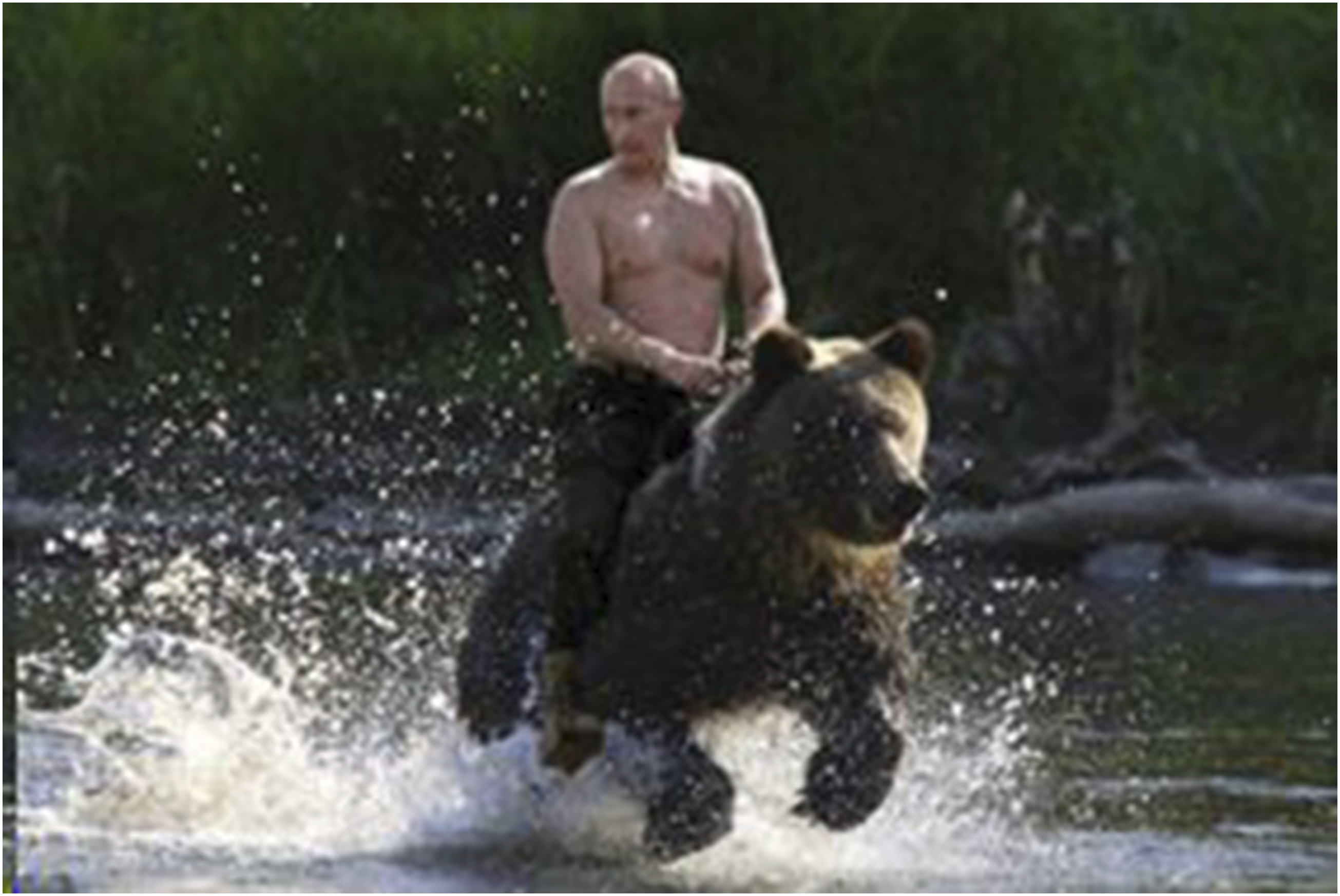
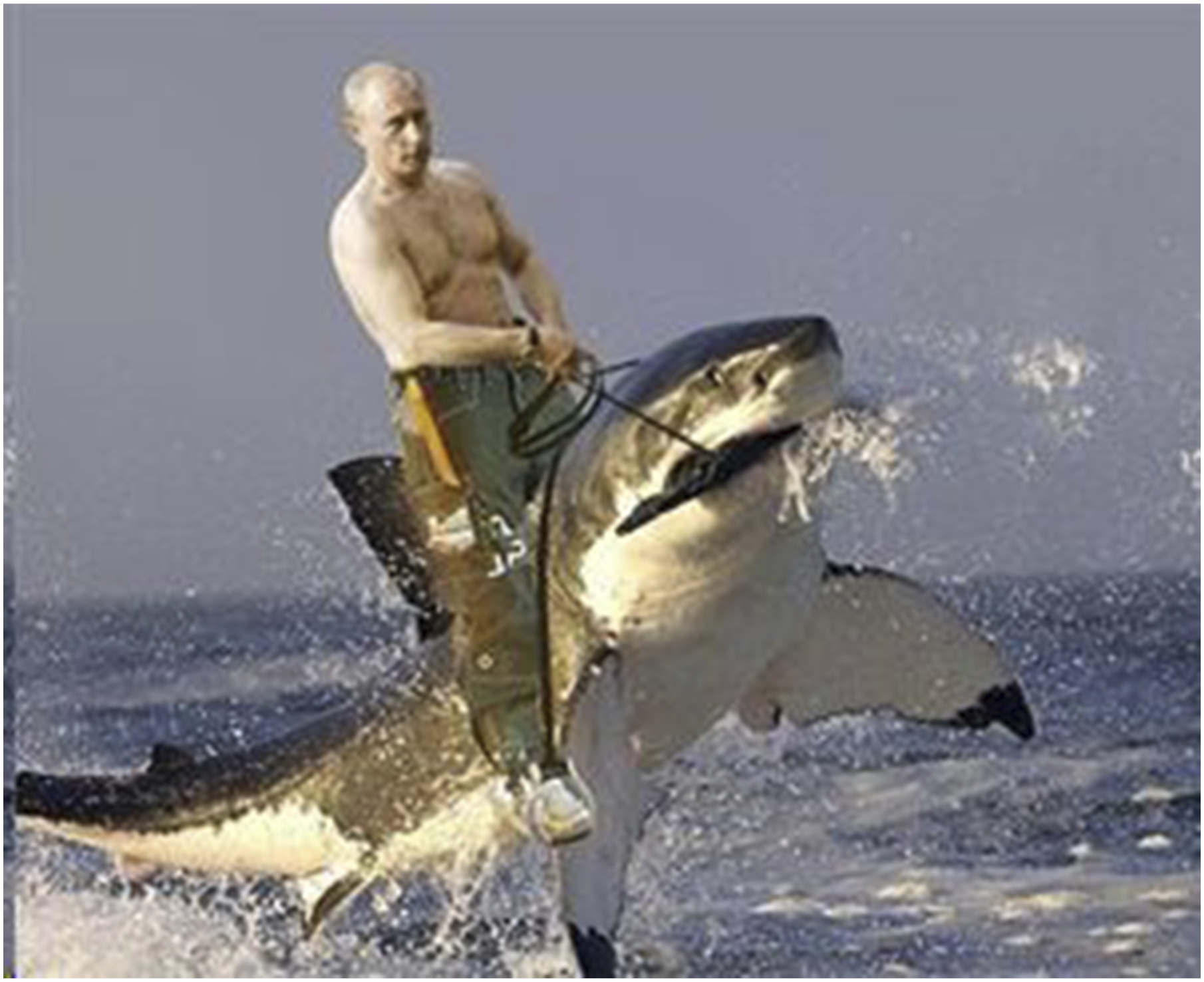
The first case is probably the most iconic scene regarding grotesqueness. It originates from Putin’s vacation in Southern Siberia in August 2009 where he presented himself riding on a horse, topless (Druzhinin, 2009). Meanwhile, there are numerous creative images of Putin riding topless on different things like crackers (Figure 1) and sausages as well as animals like a bear (Figure 2) or a shark (Figure 3) (Vidinova, 2016). Showcasing the grotesque reception, there is even an exhibition about ‘Putin rides’ memes (Vidinova, 2016) mocking the well-known photo by showing the immense creative potential and the fun the meme makers have. The memes exaggerate Putin´s macho behaviour and thereby are presenting him as ridiculous. Putin rides a cracker. Putin rides a bear. Putin rides a shark.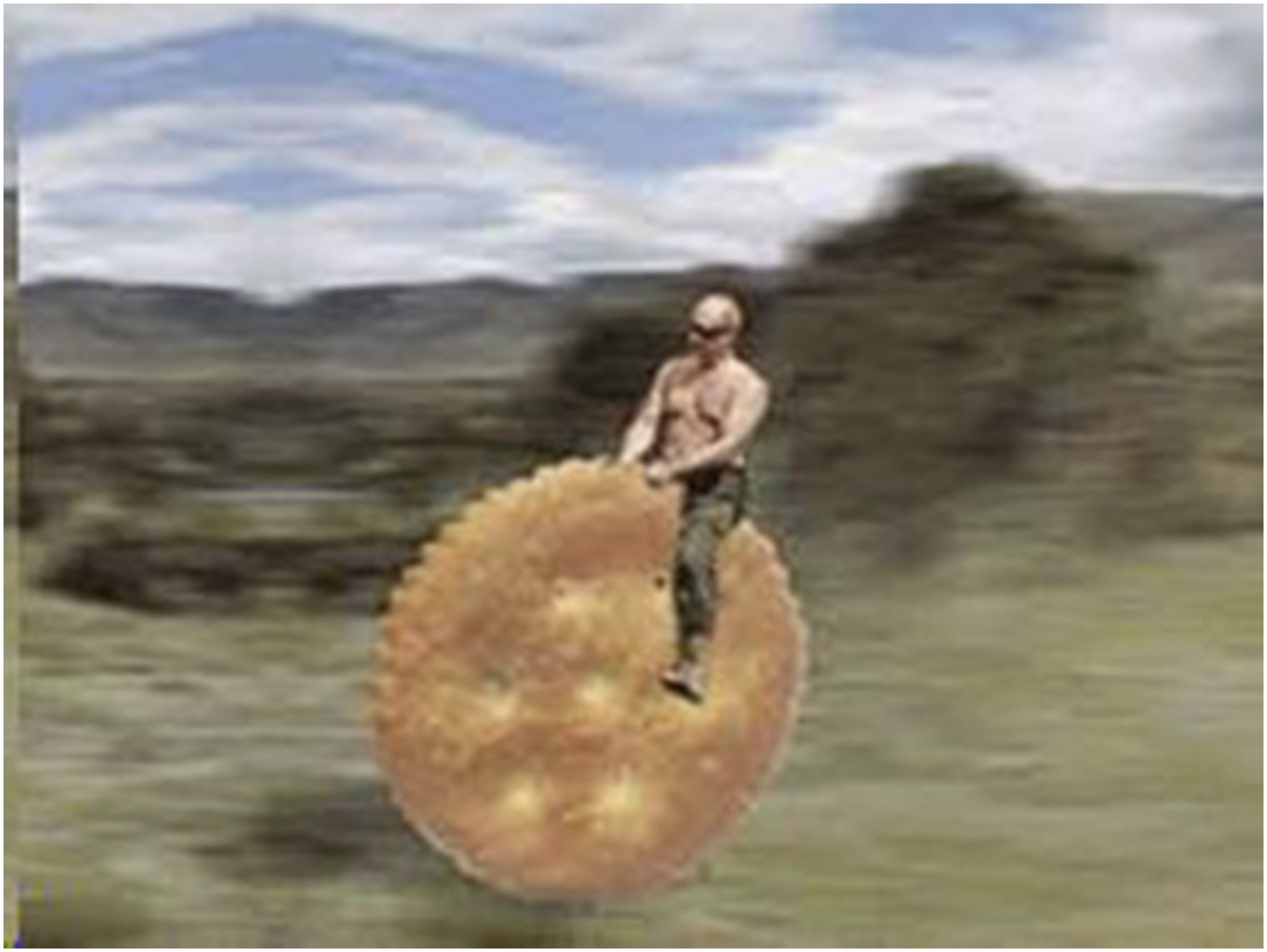
As suggested by Mbembe (1992) and others (Ceci, 2023), the role of the body and the fetish of state power are among the most important characteristics of the grotesque. This is notably exemplified in the case of Putin, where his portrayal as a strongman embodies these characteristics as described by Mbembe: ‘Debauchery and buffoonery readily go hand in hand’ with ‘The body of the despot, his frowns and smiles, his decrees and commands the public notices and communiques repeated over and over again’ (Mbembe, 1992, p. 7) being the main signifiers of force. The perception of Putin riding topless on a horse seems unusual, grotesque, and even humorous to many because it goes against the typical image of a political leader. Seeing a state leader like Putin engaging in such an unconventional activity in such an unconventional way creates a stark contrast to other state leaders (Foxall, 2013, p. 135). Additionally, the media portrayal in these images plays a role in shaping the public perception. It is an attempt to portray power or control in an unorthodox way, which can lead to varied interpretations and reactions, including finding it strange or even humorous.
Regarding the reception, it can be said that several, mainly tabloid, newspapers have presented Putin as ridiculous and stated this in their headlines (Parfitt, 2011; Rollins, 2015). The grotesque and ridiculous qualities of the horse-riding scene were, for example, taken up for a photo caption contest by the Huffpost (2013), which seemed to be fascinated by the image material, in 2013: ‘Is it new? No. But is it amazing, nearly four years later? You’d better believe it’ (Huffpost, 2013). And further: ‘The gem will never lose its luster’ (Huffpost, 2013). Other similar examples for the reception of the visual material are image galleries with funny mostly macho moments (Charlton, 2016) or the already mentioned exhibition with Putin rides memes (Vidinova, 2016).
Putin, the James Bond Villain
The second case is of similar prominence as there is really a broad interest in Putin’s KGB-shaped, macho-style representations and visual performances in the media, as many newspapers have illustrated over the past years (Borland, 2022; Druzhinin, 2009; Feeney, 2014). In recent times, there has been a significant number of examples for media and memes seeing Putin as ‘the archetypal Bond villain’ (Galeotti, 2019). In these examples, the pop culture ideas about being a KGB-agent or Russian villain (Foxall, 2013, p. 139) are at the centre when Putin is shown in image galleries on newspaper websites while vacationing ‘like a Bond villain’ (Williams, 2013). Or there are simply photos put in the context wherein Putin would apply as an actor for Bond films (Figure 4) (The Washington Times, 2015). The fact that, due to his behaviour, Putin is seen as Bond villainSmeister1+ shows how his self-representation as macho is received publicly. Putin applying as actor for a James Bond film.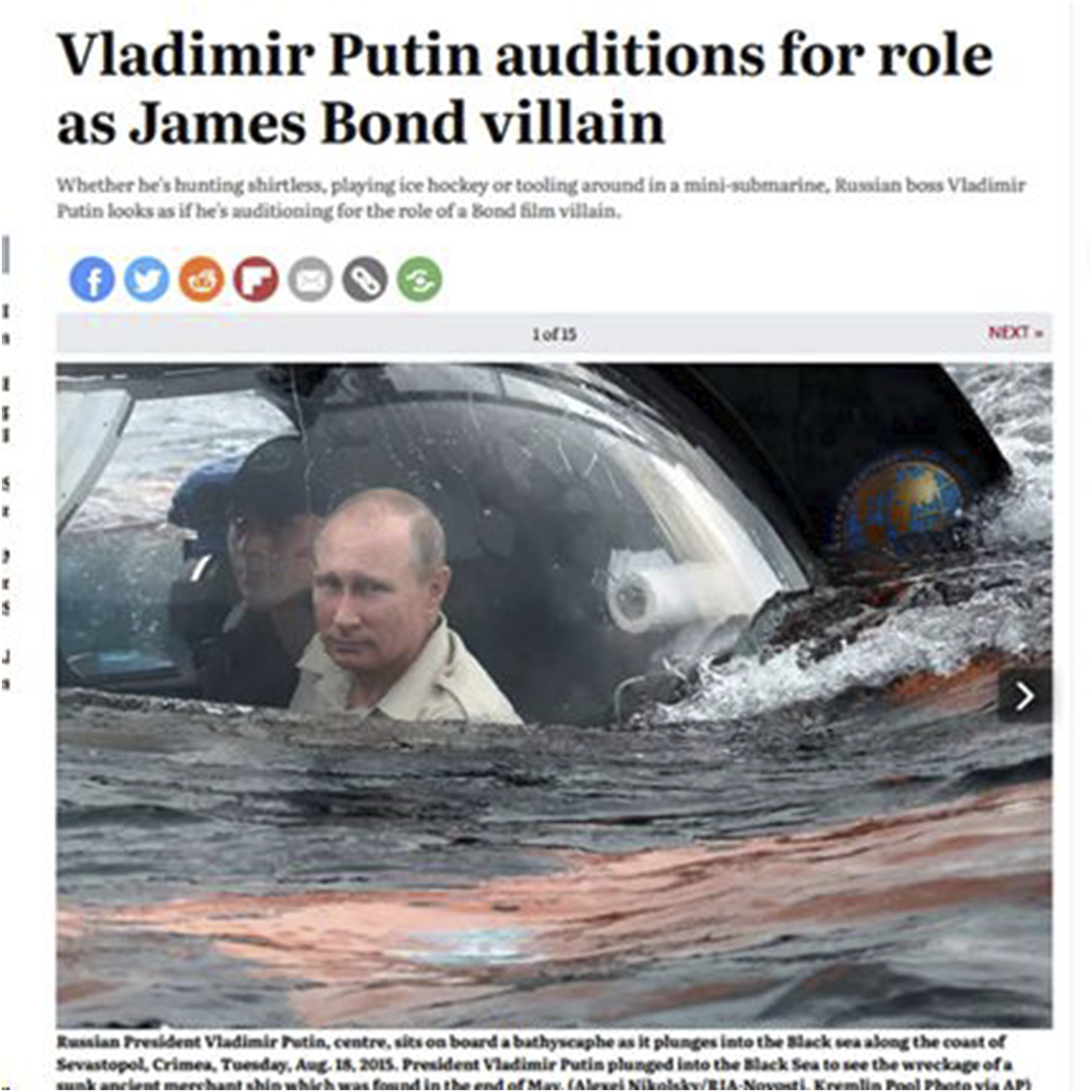
According to newspaper articles, many of Putin’s giant furniture objects as well as the architecture of his meeting rooms and of his private villa could be taken from the villains’ headquarters in the famous James Bond films (Dhillon & Stewart, 2024; Feeney, 2014; Pepios, 2022). His leadership style seems like the self-staging as a classical James Bond villain (Borland, 2022). And he is often compared to Ernst Stavro Blofeld, the prototypical James Bond villain during the Cold War (Tahir, 2019), which shows his public reception, leading to grotesqueness and a celebrity cult as shown in the next section. Other sources suggest creative and specifically matched film titles where Putin is starring as a Bond villain like ‘Coldfinger’ when he is skiing or ‘Dr Throw’ when he does judo (Figure 5) (Parry, 2015). Putin providing material for the James Bond film title “Dr. Throw”.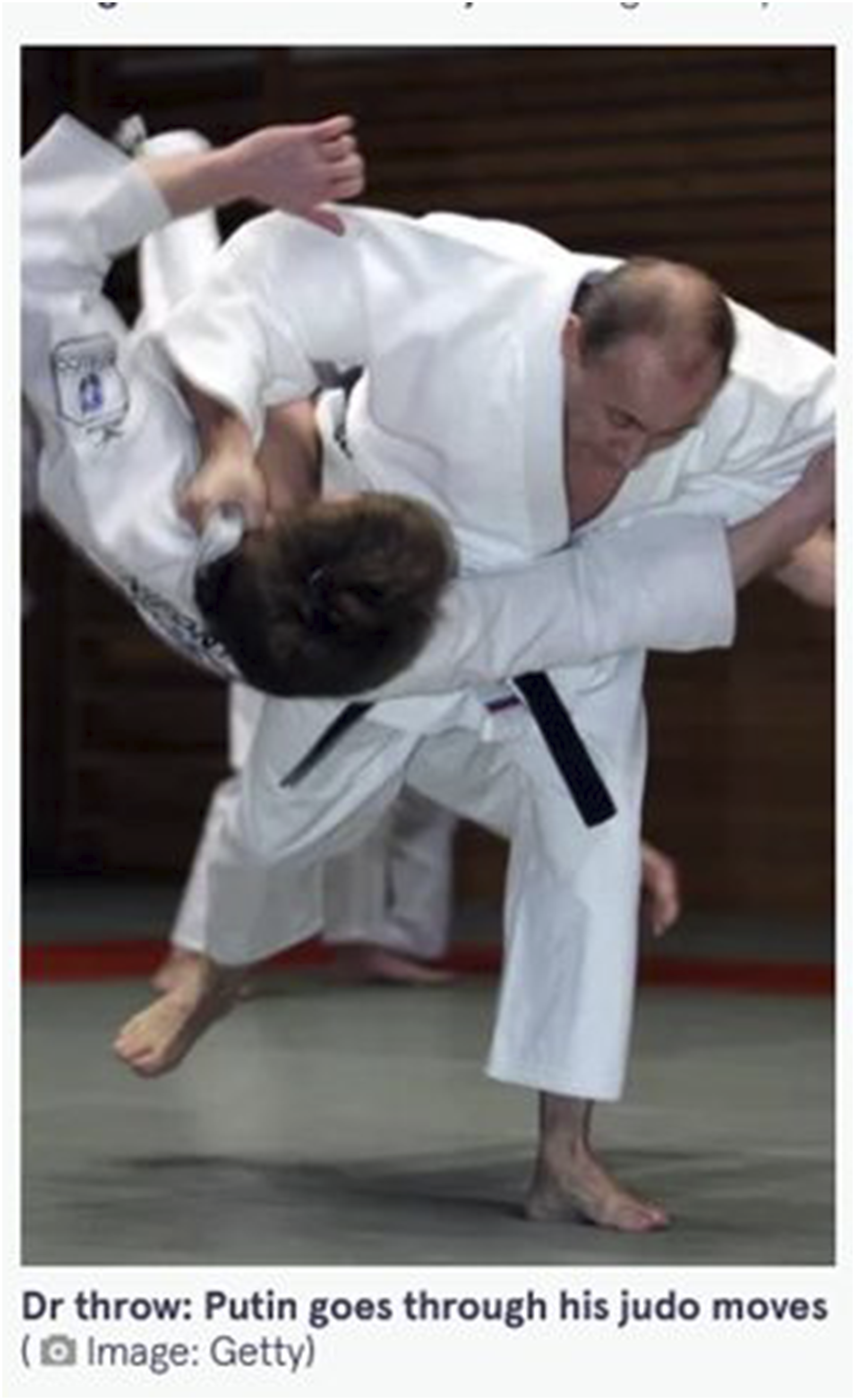
Once could say that Putin’s way of self-staging provides plenty of inspiration and hands the material for memes on a plate to those who discover the grotesque qualities of his style. By reinforcing Soviet cliches of a strong leader, Putin creates some sort of nostalgia ‘and a longing for the good old days when the world felt like it was supposed to feel – even if the world the followers are longing for is a figment of their collective imaginations’ (Taylor, 2018, p. 13). The characterisation of a real-world political figure in such an exaggerated, fictionalised manner blurs the line between reality and fiction, creating a distorted and caricatured image. This grotesque portrayal has serious implications regarding political power. It amplifies certain characteristics while making the complexity and nuance inherent in political figures like Putin invisible for the audience.
Putin’s Giant Table
As mentioned at the beginning of this article, Putin welcomed several politicians in 2022 at his long table and the images of the meetings provoked many memes and jokes as the depicted situation of inviting someone and sitting so far apart seemed just too grotesque.
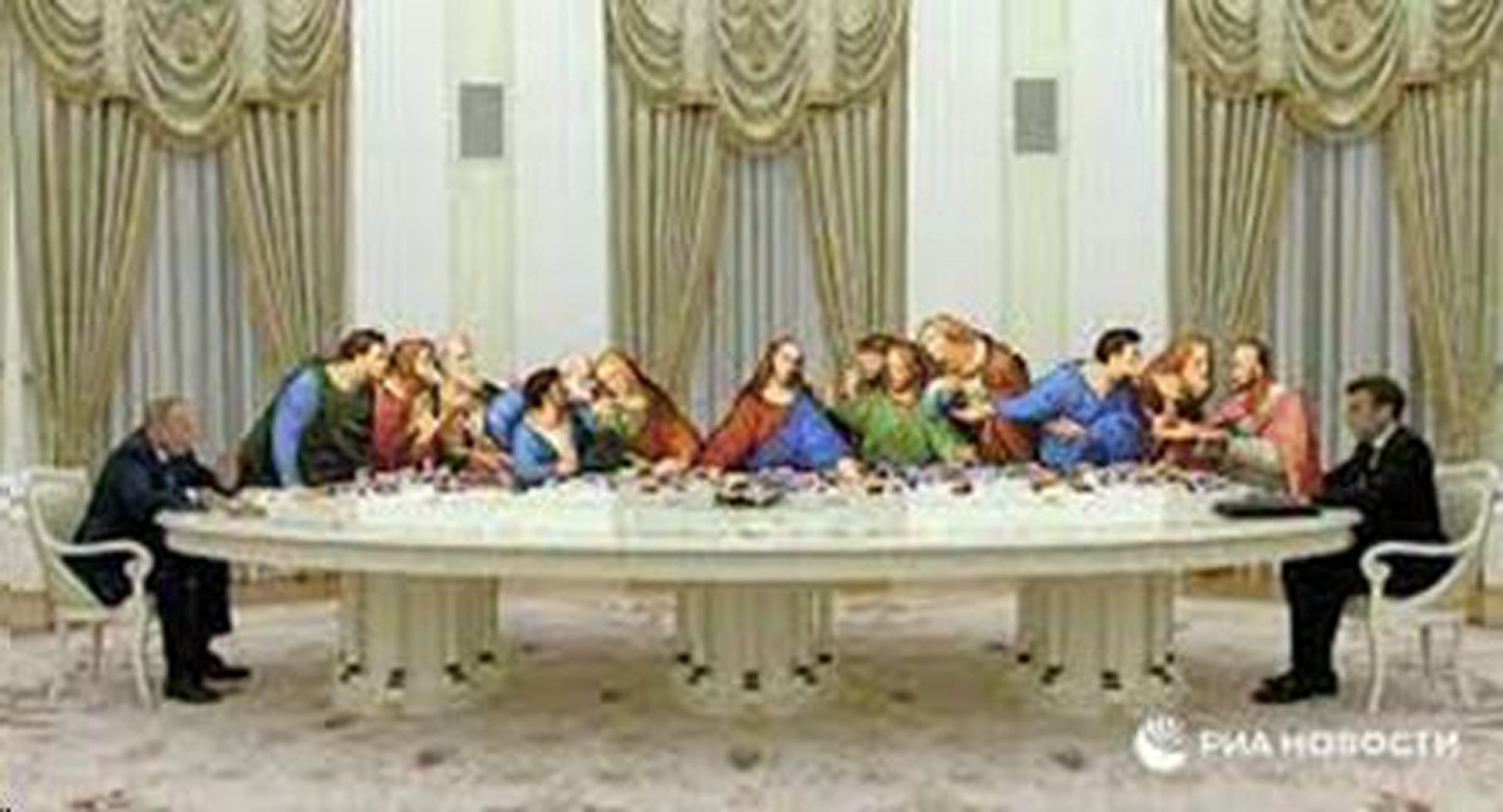
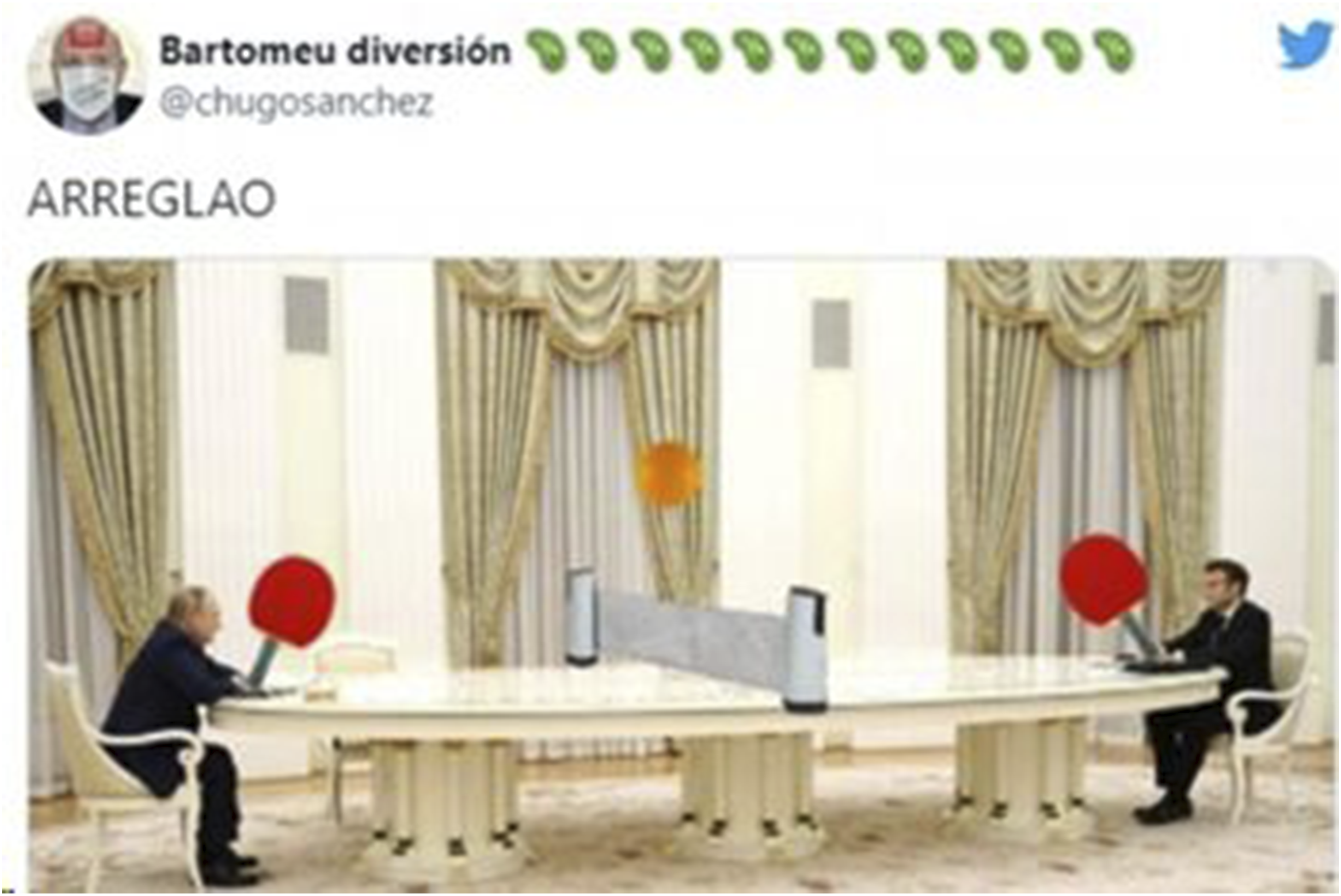
Instances of the specific context of grotesqueness manifest in the humour of meme creators, such as a fictitious advertisement mimicking IKEA’s style, proposing an exceptionally lengthy table named ‘Putin’ as part of the IKEA product collection (Figure 6) (Know Your Meme, 2022). These are further examples for Putin’s reception with other memes showing the famous Last Supper scene happening at the long table between Putin and Macron (Figure 7), or how the table is suitable for playing table-tennis (Figure 8) (The Moscow Times, 2022). Making this excessive behaviour totally normal, as noted by Ceci (2023), indicates the reception of such memes and their ability to reinterpret and normalise political imagery in contemporary culture. The enormity of the table, far beyond practical necessity, serves as a visual exaggeration that emphasises power and authority. Such ostentatious displays, when associated with a political figure like Putin, can be seen as an attempt to convey an exaggerated sense of dominance, potentially bordering on the grotesque and absurd. These exaggerated representations of power can appear grotesque, as it magnifies the leader’s authority to an extreme and impractical level. Although being directly present as a guest might have induced fear, the perception through media channels leaned more towards a humorous context (Kayser, 1963) as the headlines and recontextualisations in memes signal. The depiction reaches a tipping point and leads to a surreal or distorted perception of Putin’s stature, which can tip into the ridiculous. IKEA table Putin. Last Supper with Putin. Putin and Macron playing table tennis at the giant table.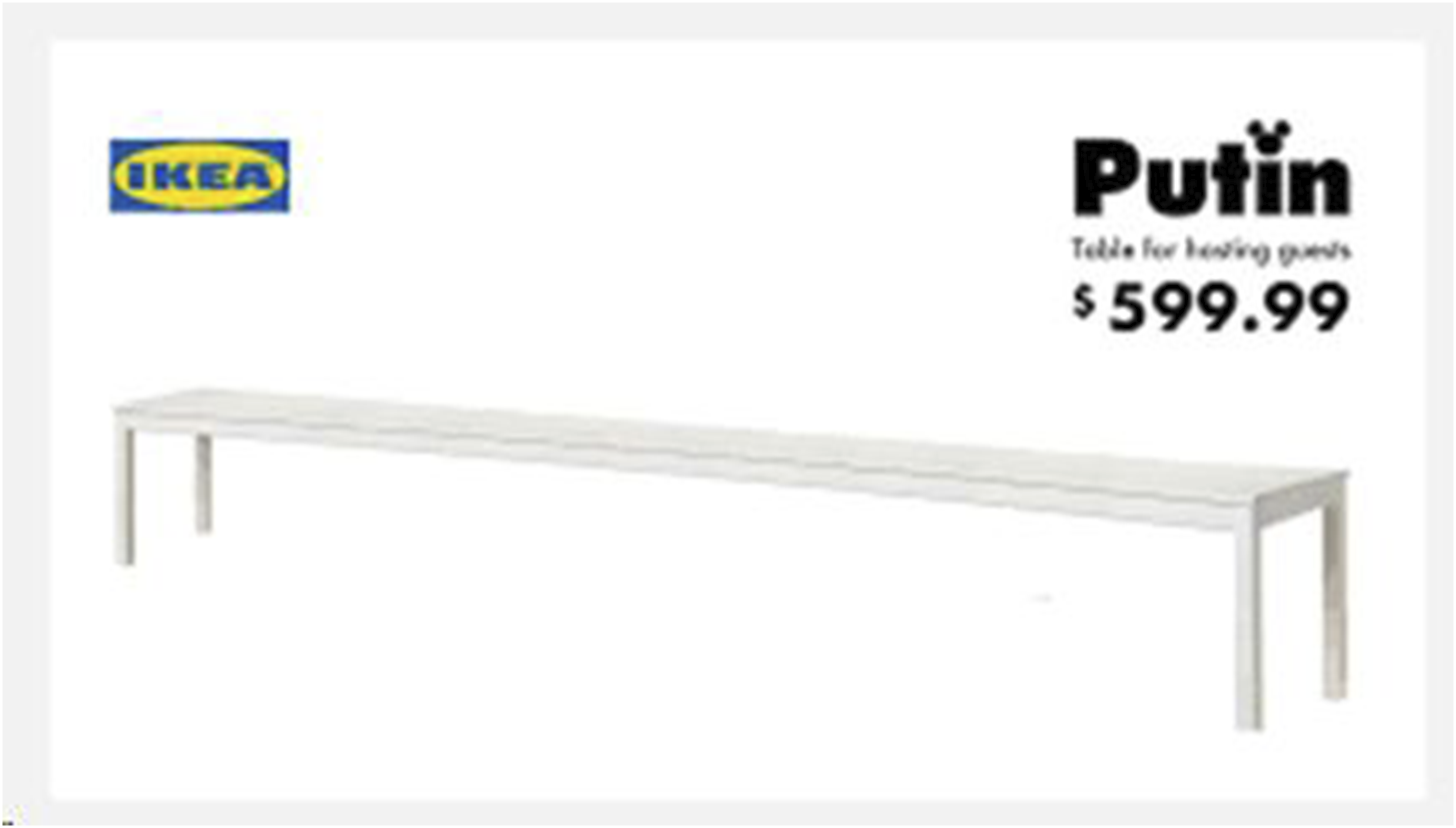
Potential Consequences
A plausible argumentation is that all the illustrated grotesque cases and the resulting humour lead, among young and Western audiences, to a normalisation of vulgar behaviour, indifference of media consumers towards the truthfulness of representations, and finally a personality cult around the leader. Consequences are understood as implications and ramifications of the media representation and memes.
Social media outside Russia demonstrates a different perception, as the illustrative memes and public reporting by the press suggest (Druzhinin, 2009; Pepios, 2022). There is definitely a huge difference regarding the perception of Putin inside and outside Russia because among Russians Putin is a celebrity (Cooper et al., 2017, p. 314) and his grotesque performances are not seen as funny inside Russia. Context can influence the perception of leaders and celebrities as either grotesque or not (Cooper et al., 2017, p. 314). There are different interpretations regarding grotesqueness possible as humour is subjective and the experience of something aesthetic like the grotesque is individual itself as well. While Putin can be seen as a strong political leader within Russia, the experience in other cultural contexts could also be fear as the second context cited by Kayser (1963). This is illustrated by his KGB past which is connected to ‘cruelty and brutality in Russian historical memory’ (Sheygal-Placzek, 2009, p. 240).
In contrast to other images of half-naked politicians which are captured by the press or common people, Putin’s pictures are officially released by the state (Foxall, 2013, p. 135).
Normalisation
One main consequence of the grotesque is the normalisation of Putin’s vulgar behaviour as the grotesque is a ‘transfer point between sovereign power and techniques of normalization’ (Das, 2017). This technique is assumed to be one of the main ways in which the grotesque has some influence on international audiences and their behaviour. The grotesque allows individuals to passively absorb indignation via diverse satirical media, effectively displacing their anger and refraining from more proactive forms of dissent (Brock, 2018). This highlights the inherent ambiguity within memes. Despite aiming to ridicule Putin, they fail to embody a morally desirable quality. This is a typical aspect of memes and one which can provide many different possible readings (Cooper-Cunningham, 2022).
Due to the influence of memes and media portrayals, the grotesque leader often functions beyond the established norms, enabling a challenging of existing expectations towards state leaders. Operating outside conventional boundaries, they avoid compliance to political correctness, gaining influence by disregarding established rules and behavioural norms (Taylor, 2018, p. 13). Portraying absurd behaviour in grotesque ways normalises it and disincentivises active resistance (Brock, 2018).
Furthermore, a constant exposure to the grotesque can lead to desensitisation. The ‘grotesque can normalize actions, tastes and behaviours that would not be considered normal in another setting’ (Ceci, 2023, p. 173). What initially seems shocking or abnormal can gradually become familiar. Over time, this familiarity may lead to the normalisation of absurd behavioural elements that were previously deemed outside societal norms, such as the publication of photos showing state leaders riding topless on horses (Charlton, 2016) or a state leader perceived as a Cold War villain (Feeney, 2014); the provocative behaviour gets normalised and accepted. By repeatedly showcasing exaggerated or provocative content, there is the probability that some individuals might perceive these extremes as acceptable or as part of the norm, contributing to a desensitised view of what should be considered extreme or unacceptable behaviour, leading to the acceptance of offensive acts and new moral standards (Holm, 2017). Grotesque acts become ‘so recurrent and surreal that laughing at them simply accelerated our process of interiorization of these behaviours, making them if not normal at least acceptable on a daily basis’ (Ceci, 2023, p. 173). This normalisation of and through grotesqueness becomes especially visible in the picture where Putin rides a bear (Evon, 2022). Many take this picture for granted without questioning its truthfulness, which means that people believe that Putin would be capable of it (Evon, 2022), showing one effect of the humorous grotesque memes.
Indifference Towards Excessive Behaviour and Towards Truthfulness of Representations
The question concerns what the jokes and memes about Putin can do politically. The yearlong representation as macho has a certain impact on how people perceive Putin: As grotesque guy (Göpfert, 2022, p. 22). Social media users are contributing to the perception of Putin as grotesque through creating, liking, and sharing the images and memes and thereby enable indifference towards his toxic behaviour amongst the audience, which makes Putin’s position stronger (Das, 2017). If grotesque representations become a common thing, they may lose their intended impact. As mentioned, initially shocking or disturbing representations may become normalised over time, causing people to become indifferent (Kayser, 1963) or desensitised to their impact. The described desensitisation can result in a lack of emotional response or engagement with the underlying issues being portrayed. One step further than normalisation is indifference.
In humour studies, several effects of humorous critique have been discussed. Among the most likely effects through the repeated use of humour is the acceptance of outrageous acts which get more likely and thereby lead to new moral standards (Das, 2017). Grotesque humour is the capacity assigned ‘to revaluate our standards regarding tastes and ethical issues and to normalize behaviours that would usually be considered inadmissible’ (Ceci, 2023, p. 173).
Generally, things are much easier acceptable and sanitised through humour (Momen, 2019). This consequence can also be seen as indifference towards rude behaviour, which means the ‘lack of interest, concern, or sympathy’ (Collins Dictionary, 2023). The repetition of similar representations and seeing the same images and memes as well as jokes again and again contributes to indifference as things are no longer seen as special (Holm, 2017). When everything is portrayed in an exaggerated or extreme manner, people might become indifferent towards scandals due to an inability to discern what is truly important or upsetting.
The growing use and prominence of grotesque depictions and reports in international media goes hand in hand with an ‘ambiguous blurring of fiction and reality’ (Malmvig, 2023, p. 1). This development can, on a theoretical level, be situated within the interconnection of popular culture and politics. For many consumers, it is hard to know if things are real or they do not care if things are real as it is more about fun and entertainment (Stoehrel, 2013). The line between the original and the copy, reality and fiction, the serious and humorous, is becoming unclear or vanishes, leading us into a realm of uncertain purpose and artificial authority (Malmvig, 2023, p. 11). A general tendency regarding indifference towards truthfulness of representations can be observed online across the political spectrum (Ceci, 2023, p. 168) and has been described by others in similar words: ‘The public is continuously assailed by a flood of images so all-encompassing that, according to Baudrillard, it becomes difficult for social actors to distinguish between “concrete” reality and the hyperreality of the image’ (Brock, 2018, p. 289). The flood of grotesque visual material might create a feeling of resignation, leading to a disengagement from the issues being depicted (Ceci, 2023). Especially, memes often reproduce ‘politics as an ironic spectacle, thereby risking inducing similar forms of momentary amusement, indifference, or even despair with global publics as Trumpian politics have’ (Malmvig, 2023, p. 7).
Furthermore, the reinforcement of stereotypes in grotesque representations can lead to a simplified view of individuals, causing a perception based solely on these exaggerated characteristics rather than their true complexity as a person, leading to different standards because, indirectly, grotesque humour has the potential to alter our ethical perspectives of actions that ‘we would usually perceive as abnormal’ (Ceci, 2023, p. 175).
When someone’s actions are consistently portrayed in an exaggerated or grotesque manner, it can encourage others to perceive them as inherently different or separate, fostering indifference, reducing the motivation to express criticism, and thereby providing almost immunity. It has been argued elsewhere that grotesque leaders like the former US President Donald Trump show a sort of an immunity against ridicule (Kilby et al., 2020). Especially, Trump ‘has embodied many of ridicule’s central characteristics including exaggeration, irony, and stupidity. Thereby, it has become increasingly difficult for satirists to skewer him. Whether accidental or on purpose, nothing, it seems, is more ridiculous than the man himself’ (Kilby et al., 2020). Many of today’s populist and authoritarian leaders seem to have such a relationship to ridicule. Even Putin seems to be immune as a scenario at the G7-summit in Germany in 2022 showed when Boris Johnson mocked Putin’s topless horse riding and Putin replied that the other state leaders would look disgusting ‘topless’ (The Guardian, 2022).
It is essential to recognise that the impact of grotesque representations on indifference can vary widely based on individual perceptions, cultural contexts, and the specific nature and purpose of the representations themselves. However, when grotesque representations are permanently present for individuals, it can lead to a sense of overwhelm.
Personality Cult Through Popular Culture
Exaggerated or grotesque depictions can strip away the human qualities of a person, reducing them to a mere caricature and thereby initiating a personality cult. When individuals are portrayed in a distorted and caricatured manner, it might degrade them in the eyes of others, making it likely for people to detach emotionally and feel indifferent towards their actual perceptions.
Many observers describe such a personality cult around Putin (Charlton, 2016; Foxall, 2013, p. 136) which emerged in the years around 2010 and made him omnipresent. In recent years, Putin has become a part of popular culture, as the personality cult and the related fan-articles demonstrate (Campbell & Denezhkina, 2017, p. 321; Foxall, 2013, p. 140). People who are long enough in the public eye can become part of popular culture and, from then on, they are mainly dependent on public attention, but not on positive attention (Campbell & Denezhkina, 2017, p. 318). Therefore, Putin is not a conventional politician as he is partly a celebrity, which goes against critical debates. Personality cults and aesthetic propaganda are specifically a phenomenon in authoritarian regimes (Street, 2012, p. 353) ‘where political competition is dampened’ (Campbell & Denezhkina, 2017, p. 318).
Memes are part of popular culture and can be used to bring legitimacy to certain ways of stories and political actions (Nexon & Neumann, 2010). And it provides the intertextual basis which is needed to communicate successfully to a broader audience, as the James Bond examples (Parry, 2015) or the reference to the Last Supper (Pepios, 2022) show. Putin cultivates a strategic public image as a former KGB-agent and gets publicly connected to James Bond films and the Cold War. The cult of personality surrounding Putin often employs exaggerated visuals, stories, or symbols to cultivate an almost mythical image, elevating him to ‘a larger-than-life figure’ (Campbell & Denezhkina, 2017, p. 321).
Conclusion
As this article has illustrated, grotesque representations have inherent power mechanisms, often supported by problematic representations by the media. The illustrated reception shows furthermore, how specific forms of media coverage contribute to Putin’s power through ‘our’ indifference towards rude behaviour and the disincentivising impact on resistance through the fascination about ridiculing the powerful. These media representations and their aim of being funny and their immense circulation have problematic and unintended effects which can help Putin regarding power. They transform mockery into a tool that fosters normalisation among audiences, often contributing at the same time to the development of personality cults around political leaders. The likely effects of such memes are indifference towards behaviour and the truthfulness of representations among the audience instead of motivation for resistance and participation. These effects likely are not what the meme creators and online community intend; their primary aim is simply to enjoy themselves by creating playful memes.
The analysed material has focused on a specific form and perception of the grotesque, particularly within the humour context, following Kayser (1963). Generally, the distant perception, ridicule, and an exaggerated depiction lead to political consequences and influence the power of powerful individuals. As Mbembe (1992) outlined, the grotesque has to be seen as intrinsic to power and can have immunity against ridicule as a side effect. The grotesque operates in a different sphere and contributes to a normalisation of extreme and uncommon behaviour. This has made it much easier for critics to live with politicians who behave like Putin as recent years have shown.
In particular, memes bring content to wide audiences but with less interest in the serious political issues and much more about entertainment. These analysed phenomena show what the discourse in the media through memes does. The indifference towards the distinction between fiction and reality is illustrated by many online discussions about the truthfulness of pictures and if the photo portraying Putin riding on a bear is a fake (Evon, 2022).
In anticipating future trends and potential issues, it is essential to recognise that humorous responses to the grotesque may inadvertently strengthen and perpetuate existing power structures. This fostering of indifference among audiences is a phenomenon that needs to be extended to other realms of visual politics and studied with audience-centred methodologies.
Anthropological research and its methodology furthermore show that humour has the power to reveal things that would perhaps remain at the sidelines. Among well-known examples is Charlie Chaplin who, in The Great Dictator, also pointed to the grotesque as a key feature of German fascism and the figure of Adolf Hitler (Göpfert, 2022).
Footnotes
Acknowledgments
The author expresses gratitude to Anja Karlsson Franck and Antonio Roselli for their essential support and feedback, which made this article possible. Additionally, the author thanks the two anonymous reviewers and Alexander Spencer for their valuable feedback and encouragement.
Declaration of Conflicting Interests
The author(s) declared no potential conflicts of interest with respect to the research, authorship, and/or publication of this article.
Funding
The author(s) received no financial support for the research, authorship, and/or publication of this article.
