




Abstract
From 9/11 to the Boston Marathon, from Charlottesville to the Capitol Riots, from Sandy Hook to Parkland, from Eric Garner to George Floyd, from Hurricane Katrina to widespread wildfires. In the span of just two and a half decades, the United States has been plagued by numerous tragic events. During the same period, the number of late-night shows, a simple though controversial measurement of popular demand for comedic material dealing with or distracting from these crises, proliferated from four shows in 2000 to 17 in 2020. Looking at these shows over the course of two decades (2001–2021), the paper examines if and how late-night hosts addressed tragic events, a topic thus far largely relegated to grey literature. The empirical study draws on theories of comedy and tragedy to inform its content analysis of late-night monologues. The article finds that late-night hosts did address a wide range of tragic events, from mass shootings to environmental catastrophes. However, the ways in which they did so differed, exhibiting shifts over time and comedic genre. Overall, late-night comedians’ replies to tragic events became more instantaneous, serious, and civically minded. The article argues that this subversion of genre expectations through the absence of humor and increasing incorporation of political accountability and advocacy frames in comedians’ responses to tragedies became particularly pronounced in the late 2010s. The paper suggests potential explanations for these results and concludes that these findings provide valuable insights and implications for the American public and policy discourse.
Introduction
“We are now used to the calm voice of a late-night host after a mass shooting, but in those first couple weeks [following the events of 9/11] … Many comedians didn’t talk about it or simply made a passing reference,” writes Fox (2021), reflecting on the shift in comedic responses to tragedy over the span of only two decades. Focusing specifically on comedic responses by American late-night television show hosts in the 20 years following 9/11 (2001–2021), this paper examines whether and how these hosts have commented on tragic events and crises. In doing so, the article tackles the famous comedic formula that dictates: Comedy = Tragedy + Time. Tragedy, here, refers to “sorrowful or terrible events,” while the principal objective of comedy is “to amuse” and entertain (Conversi & Sewall, 2023; Hoy, 2023). 1 The formula hence implies that for there to be comedy, a certain measure of time needs to have passed following a tragic event.
To demonstrate the consistency of the above-mentioned formula (or lack thereof), the article focuses on the monologue segments of nine late-night shows (Bee, Colbert, Conan, Corden, Fallon, Kimmel, Meyers, Noah/Stewart, and Ruffin), examining (1) the extent to which monologues featured jokes, and (2) the ways in which late-night hosts framed the events in question. 2 For this purpose, the paper begins by introducing readers to the context of American late-night television, its history, structure, functions, and “seriousness.” Next, the article describes the methods used to analyze the late-night show monologues, followed by the presentation of research results and discussion thereof. The paper finds that late-night discussions of tragic events become increasingly (1) instantaneous, (2) serious, and (3) civically minded over time. Herein, the author identifies four dominant frames used by late-night hosts in their responses to the events in question, highlighting how the show’s discussion of tragic events shifts from (1) addressing the emotional reaction to the events in question and (2) critiquing related media coverage to also include accountability and advocacy frames that (3) connect tragedies to underlying systemic issues (e.g., school shooting to gun control) and (4) call for political action. Finally, the article suggests potential explanations for these shifts in the ways late-night hosts respond to tragic events, and provides a brief conclusion, pointing to potential avenues for further research.
Contextualizing Late-Night Comedy
Late-night television has long been a staple in the American political public sphere, and the early 21st century witnessed a rapid increase in the number of late-night programs, with only four such shows in 2000 and 17 shows in 2020. This section introduces readers to the history, structure, and functions of American late-night shows. Next, the section outlines the subject literature on American late-night TV’s “serious comedy.” Here, the article also highlights the paper’s fit in the special issue From resistance to legitimation: The changing role of humor in politics, underlining late-night shows’ simultaneous legitimacy as established parts of the American entertainment and political firmament and resistance to the latter through its serious criticism of politicians’ failures and oversights.
American Late-Night Shows: History, Structure, and Functions
The history of American late-night shows can be traced back to the early days of television. Adapting late-night for television from its radio predecessors, such as Bob Hope’s Popsodent Show, the format was pioneered by entertainers like Ed Sullivan (Ealer, 2021). These early shows largely focused on apolitical entertainment value, featuring musicians, dancers, actors, and comedians. The late-night format as it is known today, from the set design to the segment structure, however, only began with NBC’s 1954 Tonight Starring Steve Allen (Ealer, 2021). While the number of late-night shows has notably increased since then, the format’s overall structure has largely prevailed.
This structure is divided into multiple segments, which are separated by commercials on television or posted as separate clips online. Following the shows’ opening credits, the hosts present a monologue discussing personal anecdotes and the news of the day. The monologue predominantly features hard news. This is followed by a soft news segment, often featuring stories involving animals, phallic-shaped items, or celebrities. Next, the shows feature guest interviews and/or topical segments. Finally, the shows host a musical or stand-up performance followed by the hosts’ closing remarks thanking their guests and teasing the next episode while the credits roll.
Scholars of late-night have noted that the topics discussed, and the selection of guests invited on the shows commonly correspond to current events and entertainment trends. Particularly the monologue segment tends to follow the dominant news cycle (Baym & Jones, 2013; Day, 2011). As Late Night host Colbert explains, “we don’t set the agenda; we reflect what happened in your day, and we curate it back at you with our own emotions” (Hoskinson, 2021, p. 4:44–4:50).
It is this process of reflection or “meaning-making” of the events and news of the day through a satirical lens that marks the function American late-night shows fulfil (Jones, 2010, p. 109). Herein, the shows employ satire, a comedic discursive practice, to offer an interpretation or “reading” (Butler, 1994) of reality. In doing so, the shows establish what Bakhtin and Venzke would term the shows’ “semantic authority,” referring to the shows’ ability to make “interpretive claims” that both question the hegemonic discourse while remaining within societally acceptable limits (Bakhtin, 1973; Day, 2011; Morson, 1989). Late-night shows’ legitimacy is further derived from its recognizable format and structure, and location on American television as part of the dominant mass media. This quasi-subversive yet firmly established position in the mainstream allows late-night shows to stimulate the public’s awareness and perception of certain issues by “unmask [ing] and deconstruct [ing information], point [ing] us toward the flaws and posturings of official policy” through the lens of satire (Day, 2011, p. 12). In doing so, Holbert (2013) argues that late-night provides an important service to democratic societies, akin to that of the traditional news media.
Nevertheless, satirical theorists have frequently criticized late-night shows’ inability to provoke genuine political action. They argue that while late-night shows effectively deconstruct dominant narratives and have been proven to raise awareness of political issues (Amarasingam, 2011; Baym, 2010), and encourage viewers to participate in public events (Day, 2011, pp. 145–185; Kilby, 2014), this rarely translates into political or policy action (Day, 2011, p. 12). Yet, politicians’ avid attention to and policing of late-night shows suggests that these programs are serious political forces to be reckoned with (see Benen, 2021; Brownell, 2016, pp. 927–928), and their recorded impact on policy reform and activism (see Chattoo, 2017; Kilby, 2019), contradict such criticism. The following section explores what happens when these impactful shows address issues in a sincere manner.
When Late-Night Gets Serious
Scholars have long highlighted the importance of media spectacles in American politics, from presidential appearances on late-night shows (Brownell, 2016), to studies suggesting that young Americans view news recaps in late-night monologues as an alternative news source (Baym, 2010; Duerst et al., 2001). However, fewer studies have examined what happens in or with late-night shows when the comedians stop joking around and get serious.
In his 2008 book chapter by the same name, Geoffrey Baym defines “serious comedy” as speaking truth to power in a humorous manner (emphasis in original, Baym, 2008, p. 21). Herein, Baym highlights the oxymoron that is serious comedy, with the dictionary definition of the term serious literally referring to an individual who is “not joking,” whereas “comedy entails laughter and levity” (2008, pp. 21–22, emphasis in original).
Though Baym does not directly link serious comedy to tragedies and crises, the very first example he provides is that of Colbert addressing then-President Bush at the 2006 White House Correspondents Association Dinner in “a biting monologue on the president, accusing him … of responding to national tragedy with spectacle instead of substance, with publicity in place of policy” (Baym, 2008, p. 21, emphasis added). Ironically, this paper highlights the extent to which comedians may increasingly live up to Colbert’s expectations, reacting to tragic events without jokes or comedic spectacle, while highlighting underlying systemic issues and calling for political action (see results and discussion sections).
Similarly, Garber notes: “Political humor has always been serious business because it can be used to mask the sting of political criticism … Yet the message still conveys its assessment to audience members” (2008, p. 333). In doing so, the reflection of late-night hosts regarding tragic events or crises performs “an essential function in governance. It alerts inattentive publics to the foibles, inanities and failures of their political leaders in a way that delights audiences and motivates some members to action” (Garber, 2008, p. 333). To investigate comedians’ engagement with this function, the following section details the methods employed to investigate if, when, and how late-night hosts respond to tragic events.
Research Design
To investigate how American late-night shows have reported and commented on tragic events in the 21st century, the paper examines late-night shows’ monologue segments. These segments are the most consistent in style across various late-night shows, ensuring their comparability. Furthermore, of all the formulaic late-night segments, the monologue is traditionally associated with the most (hard) news and current events-related content.
It should be noted that the majority of studies focusing on such content of late-night shows provide limited or outdated results. By outdated, this article is referring to the fact that few shows reviewed in most relevant studies remain on the air to date, having either ceased to exist or transformed due to network and/or host changes (Baym, 2008; Duerst et al., 2001; Niven et al., 2003). By limited, the article is referring to previous studies’ tendency to focus on a single show or a comparison of merely two late-night shows. Herein, researchers have particularly focused on a limited number of shows whose slacktivist efforts often made headlines, such as The Colbert Report or The Daily Show (Amarasingam, 2011).
In choosing which shows’ monologues should be analyzed, the study selected American televised shows that (a) address the news of the day in a monologue segment that can be clearly differentiated from the shows’ other segments, and (b) were on the air during and at the end of the data collection period (2021). These criteria sought to ensure the sample’s relevance and topicality. Consequently, nine shows were selected: Conan, Full Frontal with Samantha Bee, Jimmy Kimmel Live!, Late Night with Seth Meyers, The Amber Ruffin Show, The Daily Show, The Late Late Show with James Corden, The Late Show with Stephen Colbert, and The Tonight Show Starring Jimmy Fallon. 3
All shows air four or five nights a week, apart from Bee and Ruffin, which aired one episode a week during the data collection period. The non-probability, purposive sampling strategy was intentionally designed to include Bee and Ruffin to ensure the inclusion of the only late-night shows hosted by women, and the only show hosted by a woman of color (Ruffin). 4 This precaution was taken since the hosts’ perspectives shape the content featured in their monologues. As such, both Bee and Ruffin improve the representativeness of the sample, complementing the perspectives of the more established late-night shows hosted by white, middle-aged, heterosexual, married, fathers (except for Trevor Noah).
The study sourced monologue segments via YouTube clips to ensure the source material’s availability and relevance. A comparison of television ratings and YouTube viewer numbers showed that the monologue segments’ YouTube viewership often outpaced television audiences. By reviewing YouTube clips, the study is consequently analyzing the monologue versions viewed by the largest audience, ensuring the sample’s representativeness. 5 It should also be noted that late-night shows are increasingly aware of the above-described shifting consumption patterns, conceptualizing and editing shows to suit online formats. 6
Since the monologue clips vary in duration and numbers (with some shows uploading monologues in their entirety and others breaking them up into multiple shorter clips), the author identified relevant clips via keyword searches or upload dates matching and following the dates of the events in question. The author only focuses on the parts of the respective clip that address the tragic event in question (usually the beginning of the monologue). The paper only examined the first time the respective monologue addressed the tragic event in question, although the hosts at times continued discussing these tragic events in the weeks and sometimes even months that followed.
For the purpose of this paper, the author examines only short-term tragedies that occur over the course of only a few minutes, hours, or days, not including their consequences, and excluding long-term crises, such as the COVID-19 pandemic. Examples of such events include natural disasters, acts of terrorism, including school shootings, as well as police and far right violence. The author selected two events from each of these types of tragic events, with the events in each category belonging to two different decades (2000s, 2010s, or 2020s). Consequently, the paper examined late-night responses to (1) hurricanes Maria and Katrina, (2) the terrorist attacks of 9/11 and the 2017 Las Vegas Shooting 7 , (3) mass shootings at schools and universities in the form of the 2007 Virginia Tech and 2018 Parkland Shooting, (4) far-right violence at the Unite the Right Rally in Charlottesville and the Capitol Riot, and (5) the police-inflicted deaths of Erik Garner and George Floyd.
The author first catalogued the monologues addressing these tragedies, noting their duration and how soon after the tragic events in question they aired, before analyzing their content. In total, the author identified and analyzed 60 monologues, amounting to over 6 hours of video footage. To analyze this footage, the study adopted a qualitative content analysis approach popular in television and film studies (Krippendorff, 2008, pp. 89–90; Vande Berg & Wenner, 1991, p. 322) to identify the ways in which late-night hosts framed the events in question. This analysis is structured in five stages, beginning with the review of the source material and the detection of frames. The latter are subsequently described, analyzed, interpreted, and evaluated. This qualitative analysis was complemented by a quantitative content analysis to assess the extent to which monologues featured jokes based on mixed-method studies of humor and entertainment (Lichter, Baumhartner, & Morris, 2015). Since there are many questions and much debate about whether and how to qualify and quantify a joke (cf. Irony in Day, 2011; Lichter, Baumhartner, & Morris, 2015), the author chose a binary coding scheme merely evaluating whether a clip segment included jokes (1+) or not (0). Remarks were coded as jokes when they included a set-up and a punchline, wherein the same set-up could serve multiple punchlines.
The following presentation of results and discussion of late-night hosts’ responses to tragic events over the course of two decades (2001–2021) is structured based on the three most significant analytical results, finding that responses grew (1) more instantaneous, (2) more serious, and (3) more civically minded.
Results
More Instantaneous
In the early 2000s, more than a week would pass before comedians would cautiously comment on tragic events. In recent years, however, late-night hosts have taken to addressing moments of tragedy, predominantly involving casualties, mere hours after the events have taken place and, in some cases, as they are still occurring. The graph illustrates this clearly declining linear trendline according to the average number of days between the tragic event in question and late-night hosts’ monologue responses to the latter.
Perhaps the most striking comparison observed in Graph 1 lies between the tragedy of 9/11 (2001) and the Capitol Riot (2021). Monologues responding to the latter followed more than a week after the terrorist attack, while, 20 years later, most late-night hosts responded to the Capitol Riot on the day of the event, as officials were still in the process of cleaning up the capital building. This difference in response times is also reflected in the tone and self-perception of hosts, with Conan stating in his 2001 monologue, “no one’s looking to me to put this in perspective” (O’Neil, 2001, p. 01:29–1:33). By comparison, in 2021, several late-night hosts responded to the Capitol Riot in live monologues, with a distraught Stephen Colbert stating, “today, the US Capital was overrun for the first time since 1814, and a woman died.” (Hoskinson, 2021, p. 1:03–1:11, emphasis added). Number of days between tragic event and late-night response.
8
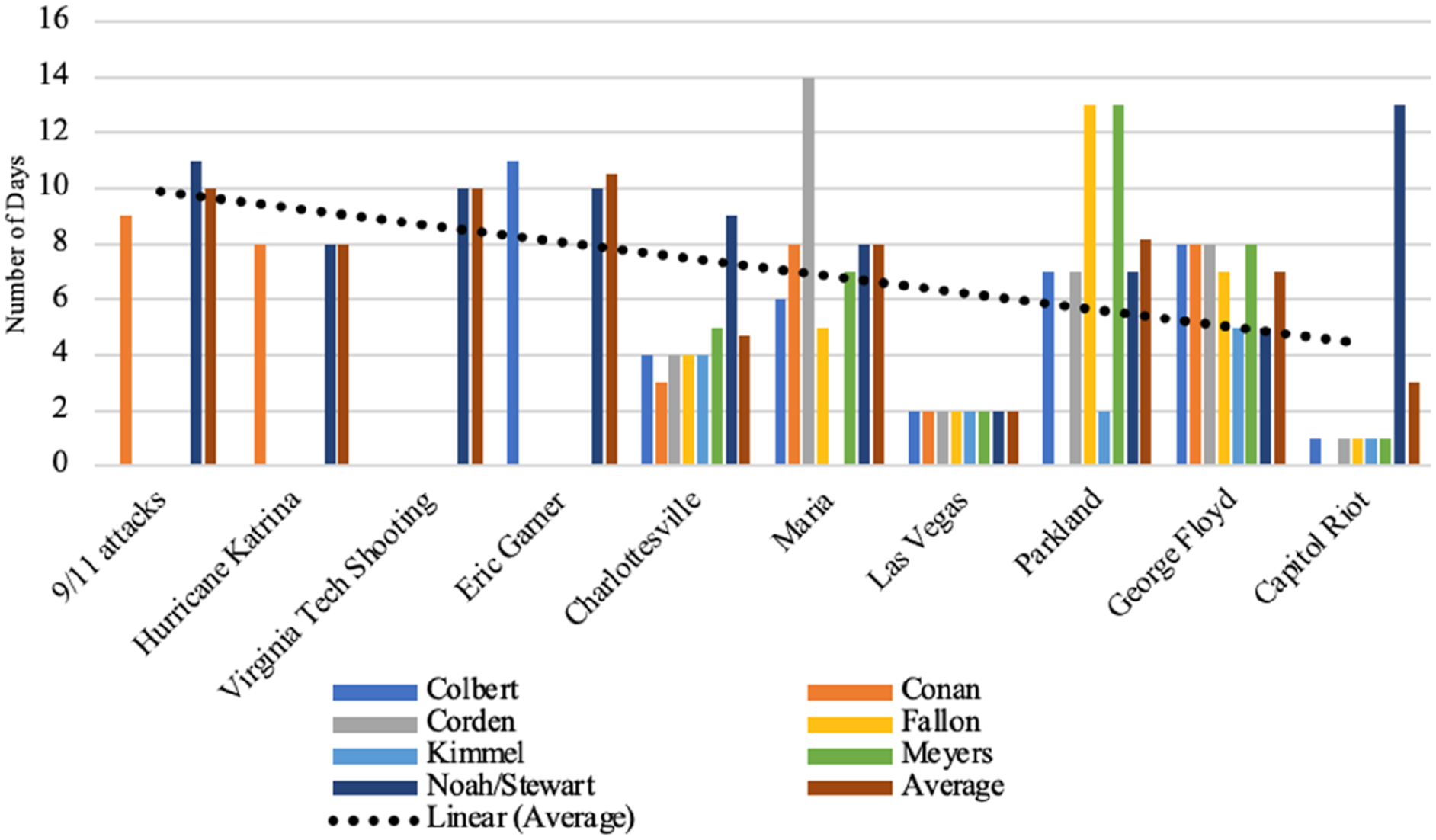
Yet, despite this growing immediacy, hosts also critically commented on how this shortened timeline between tragedy and commentary affected their ability to deliver the expected monologue. For instance, commenting on the trial following Eric Garner’s death, Jon Stewart states, “If comedy is tragedy plus time, I need more *bleep* time. But I would really settle for less *bleep* tragedy” (O’Neil, 2014, p. 1:28–1:35), adding “I don’t know what to say, it just happened, so I have not had a chance to really digest it.” (2:50–2:56).
More Serious
As the immediacy with which late-night hosts addressed tragic events has grown, so has the seriousness with which they go about this task, as illustrated in Graph 2. Several shows even feature entirely jokeless monologues, such as those following the Capitol Riot. For instance, as officials were still documenting the damage and cleaning up the capitol building, Meyers commented on the events in an entirely jokeless, sincere monologue. The host exhibits awareness of the way in which he and his team of writers chose to address the tragedy by stating, “first, I think it’s important, as the first draft of history is being written, and as we’re all processing what we witnessed today, to be as plain-spoken and clear-eyed as possible” (Vietmeier, 2021a, p. 0:46–0:58). Similarly, in his response to the 2017 Las Vegas Shooting, Colbert states “jokes aren’t appropriate to address the shock and grief and anger we all feel” (Hoskinson, 2017a, p. 0:12–0:17). Number of late-night responses to tragic events that included jokes.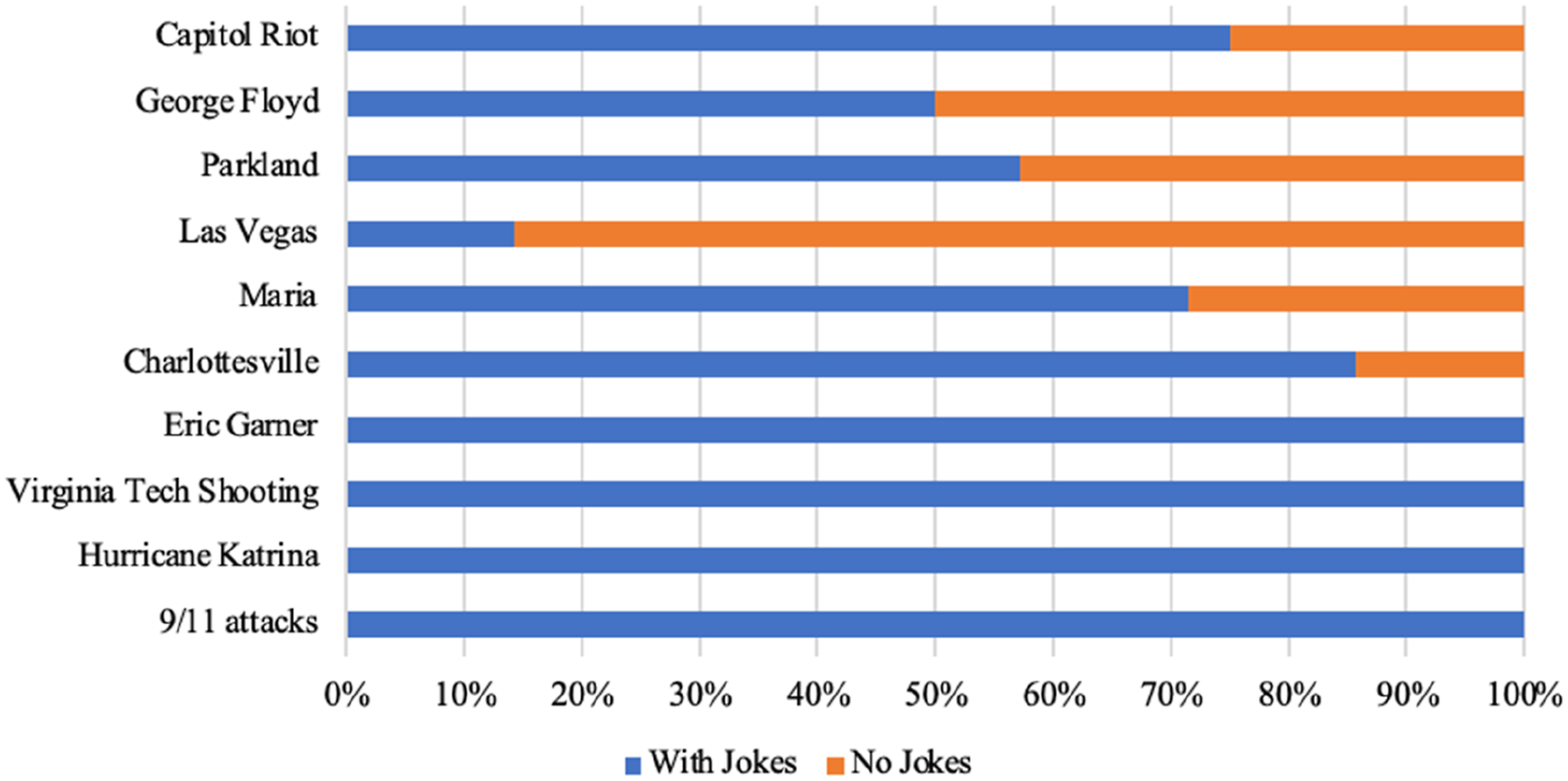
The graph illustrates that the phenomenon of the joke-less monologue following tragedies is a fairly recent one, only beginning to appear around 2017. It should be noted that the number of jokeless responses to tragedy in the years following may be even higher than the graph implies. This is due to its binary differentiation (1+ jokes = with jokes, 0 jokes = no jokes) resulting in several monologues being counted as “with jokes” despite featuring extensive serious opening remarks. For instance, in his Capitol Riot monologue, Corden delivers almost 5 minutes (4:46 min) of serious remarks on the state of American democracy from his perspective as a British citizen, before making the first humorous observation.
It is also vital to mention a shift in the type of humor employed in the monologues, coinciding with the appearance of jokeless monologues in 2017. The humor used in these later instances is more cutting and sinister, particularly regarding the Republican President and lawmakers perceived as guilty of inciting, for example, an attempted coup, frequently drawing on accountability frames. Prior late-night responses to tragedies feature comparatively lighter humor aimed at lifting peoples’ spirits and fostering hope, like Stewart invoking video footage of kittens “to change the mood” after discussing the lack of accountability for police officers following the death of Eric Garner (O’Neil, 2014, p. 2:59–3:08). By contrast, post-2017 monologues concerning tragedies are often devoid of such levity, following the tonal shift toward seriousness and accountability. For instance, in Colbert’s discussion of Republican politicians’ complicity in the Capitol Riot, the host notes of Senator Josh Holly, “raising your stupid fist to the mob outside the capital … obviously, he has to keep his fist closed because if he opened it, you’d see all the blood on his hands.” (Hoskinson, 2021, p. 01:58–2:16).
More Civically Minded
Late-night shows’ use of advocacy and accountability frames with respect to politicians thought to blame for causing or not responding appropriately to tragic events can be traced back to the very beginning of the 21st century, though the incorporation of these frames significantly increased over time. Initially, hosts addressing tragedies primarily incorporated two meaning-making functions into their statements, (1) addressing the emotional reaction to the tragedy—for example, with Colbert reflecting, “I’ve rarely been as upset as I am tonight, and I’m sure you are too” (Hoskinson, 2021, p. 0:38–0:46)—and (2) criticizing media coverage of the event in question. However, beginning approximately in 2017, monologues featured additional functions reflective of the shows’ increasingly prominent accountability and advocacy frames, (3) connecting the tragic events to systemic issues, and (4) calling for political action. 9
Examples of these functions can be identified in all nine shows examined. For instance, in his reaction to a mass shooting, Meyers reiterates (1) the emotional frustration provoked by “yet another” mass shooting and proceeds to (2) criticize news coverage of the shooting focusing on the terminology used to describe perpetrators: “stop using ‘shooter’. It makes these people sound like hobbyists which is exactly the bullshit rationale that keeps these bullets flying. ‘Killer’ or ‘murderer’ works just fine” (Vietmeier, 2021b, p. 0:53–1:03). He then transforms the media frame into (3) a political action theme calling attention to legislative inaction on gun control and (4) calls for political action, suggesting supporting a gun safety advocacy initiative, such as Every Town, and providing viewers with a link to their website (everytown.org). Similarly, Kimmel’s 2018 monologue about the Parkland School Shooting follows the same blueprint, also pointing viewers to Every Town.
Discussion
Having established the three most important shifts in late-night responses to tragedy, the following section will discuss each of the three trends and offer potential explanations.
More Instantaneous
This article began by discussing the famous “Comedy = Tragedy + Time” formula. Yet, contrary to the formula, the results presented in the previous section highlight that comedians respond to tragic events with increasing immediacy, sometimes even providing live monologues on the day of the respective tragedy. This growing expectation of quasi-immediate late-night commentary may be associated with the prominence of the 24-h news cycle, as late-night shows too are expected to follow and comment on the latter (see Baym & Jones, 2013; Cushion & Lewis, 2010). As such, the greater immediacy with which comedians are increasingly expected to provide commentary on tragic events might be conceived as a positive addition to the national debate. However, on occasion, late-night hosts remark on the conflict between the perceived need to reflect on the tragedy in question immediately and their ability to do so without the necessary time to feel the effects of the respective tragedy, empathize with those affected the most, and make sense of the event’s causes and implications.
Yet, instances in which hosts did take the time to reflect before commenting on tragedies, such as 9/11, while applauded for their content, were later criticized for their delayed timing. As Garber (2008, p. 333) notes, following the “2001 terrorist strike against the United States […] Most criticism of the government, humorous and otherwise was suspended. Although the suspension was short-lived in the light of 20/20 hindsight, it was harmful and greatly regretted.” Here, Garber argues that humorous critique, such as that uttered in late-night monologues, is essential in driving political and public discourse, challenging authorities, for instance, on their crisis management performance. The quote thus also underscores the close connection of late-night and other official commentary and criticism provided by journalists, pundits, and others.
More Serious
Continuing with the reversal of the “Comedy = Tragedy + Time” formula, the results demonstrate a reversal of the formula (Tragedy – Time = No Comedy), as Graph 2 shows that there is little humor involved when late-night comedians are called on to comment on tragedies in their immediate aftermath. It should be noted that late-night shows have always included serious aspects and messages too (Baym, 2008). Yet, despite this undercurrent of seriousness, the shift towards monologues that are largely or even entirely devoid of jokes nonetheless marks a notable change, particularly in comparison to earlier monologues on similarly serious tragedies.
This development of increasingly swift and serious statements by late-night hosts appears reminiscent of prominent newscasters, and political or spiritual leaders addressing the nation in the aftermath of a tragedy. Scholars have noted similarities in the informative and comforting functions assumed by both late-night hosts and trusted newscasters or political leaders (Baym, 2010). Conan O’Brien effectively described this transformation in his monologue, “We have a ritual now in America whenever something terrible happens: our nation goes into shock, and hundreds of people like myself come on television and try to make sense of it … it used to be a task reserved for newscasters and pundits, but over the years it has inexplicably expanded to include … comedians.” (Bollotino, 2020, 0:03–0:25).
Reflecting on a late-night comedian’s intentionally humorless public statements, Kilby (2019) argues that “it is the absence of humor … that made his [Stewart] message all the more powerful”; without “the comedic safety blanket,” the late-night host’s message is unobscured, viscerally emotional, and clear. To this effect, communication and media studies scholars Skurka et al. (2019, p. 414) muse, “Perhaps audiences are more likely to take arguments seriously when the hosts adopt a serious tone and avoid humor. In other words, viewers likely expect [late-night] hosts … to joke about the topics they cover, so when these hosts do not incorporate humor, viewers may be inclined to focus intently on the content because the host’s serious tone (positively) deviates from their expectations.”
However, the researchers caution that hosts need to limit their humorless content so that they do not lose their joke-loving audience, concluding their study of late-night climate discourse with the following assessment, “our data suggest that averting humor could be a powerful technique if used periodically” (Skurka et al., 2019, p. 414). Consequently, while jokes provide a certain comfort to the comedians and audiences confronted with a tragic event, collectively relieving some of the associated tension through humor (Meyer, 2000, p. 312), one may argue that late-night hosts also assist audiences with their emotional reaction to this type of trauma by limiting or withholding humorous commentary. For instance, as comedian Hannah Gadsby suggests, “stories… unlike jokes, need three parts. A beginning, a middle, and an end. Jokes… only need two parts. A beginning and a middle. … Punchlines need trauma because punchlines… need tension, and tension feeds trauma. … Laughter is not our medicine. Stories hold our cure. Laughter is just the honey that sweetens the bitter medicine.” (Parry & Olb, 2018, 39:55–40:58, 1:06:52–1:07:03).
The examples listed above consequently evoke late-night shows’ function of sense-making or framing, the public need for which is perceived as particularly acute in moments of national crisis. The inclusion of late-night shows in this response group previously consistent of political and spiritual leaders or newscasters also reinforces the relevance and legitimacy of late-night’s position in the dominant political discourse.
To explain this shift towards seriousness, late-night hosts and observers offer stylistic and medium-related insights. For instance, Seth Meyers coined the term “clapter,” which “describes the kind of jokes that, instead of making audiences laugh, elicit applause by pandering to their preëxisting beliefs.” (Kang, 2024). 10 Predominantly associated with shows, like The Daily Show with Jon Stewart, which center around the opinion or “take” of the respective host on the events in question, this shift in comedic writing may be indicative of increasingly serious late-night monologues. Similarly, scholars, pundits and hosts have commented on the changing nature of media and news landscapes, including (young) media consumers getting their news from late-night shows rather than traditional news sources (see Baym, 2010; Boukes et al., 2022; Duerst et al., 2001). The sub-genre’s adoption of a more serious tone may thus also be reflective of late-night shows’ shift towards not only commenting but also presenting the news. Late-night creators, writers, and hosts, however, appear split on this issue, with some arguing that viewers would not understand their content without at least some prior knowledge of the news, while others embrace the idea of audiences getting their news from a comedy show (Baym & Jones, 2013; Gehrke, 2024).
More Civically Minded
The above findings thus reinforce existing studies’ assertion that late-night is increasingly providing services that were previously exclusively covered by the traditional media (see Baym & Jones, 2013; Day, 2011). In the past, observers often framed this type of engagement with issues by late-night shows as slacktivism. Slacktivism refers to activism linked to a “feel-good factor” for those engaging in it, predominantly associated with online activism, and as such, often criticized for its failure to produce “real-life outcome [s]” (Christensen, 2011). However, the shows’ use of advocacy frames following tragic events and crises lacks the levity commonly associated with slacktivism, provoking a closer comparison to advocacy journalism. This new advocacy role increasingly incorporated in late-night shows, such as John Oliver’s Last Week Tonight, even has genre implications, with Stewart labelling the subgenre of programs that combine comedy, political information, and advocacy as “comedy hybrid shows” (Chattoo, 2017; Pennolino, 2021, p. 29:10–29:13; Wild, 2019). Nowadays also included in the programs themselves, this advocacy function was previously primarily associated with comedians’ advocacy outside their shows, such as late-night hosts Robin Thede, Jon Stewart, Stephen Colbert, and Hasan Minhaj testifying before Congress (Kilby, 2019; NBC News, 2019; PBS NewsHour, 2010; Peacock, 2020). 11
In addition to the above-described changes in framing patterns, the examined late-night shows also undergo tonal changes as described in the previous section, from lighter humor addressing viewers to comfort them amid the emotional experience of the respective tragic event to harsher, more cutting humor directly addressing the politicians who contributed to, failed to prevent, or inadequately responded to the tragedy in question. Much like the shift in framing patterns, the beginning of this tonal shift can be traced to approximately 2017. For instance, in 2014, Stewart openly displayed disappointed bafflement regarding the Grand Jury decision concerning the police officers involved in Eric Garner’s death. His humorous remarks, however, remained relatively tame, including jokes about kittens and the food quality of a restaurant chain. Stewart describes the purpose of this monologue himself as “a creative outlet, a catharsis, a way of processing emotion that might otherwise be undigested” (O’Neil, 2014, p. 0:29–0:37), thereby (1) addressing the emotional reaction to a tragedy. By comparison, in 2017, Kimmel responded to the Las Vegas Shooting by exhibiting accountability and advocacy frames (3) connecting the tragic events to systemic issues, and 4) calling for political action, outlining Republican lawmakers’ blame for ineffective gun control while employing comparatively more explicit, harsher tone: “Why [are] our so-called leaders continuing to allow this to happen? … Why do we continue to let them to allow this to happen? … The Senate Majority Leader Mitch McConnell, the Speaker of the House Paul Ryan, and a number of other lawmakers, who won't do anything about this because the NRA has their balls in a money clip, also sent their thoughts and prayers today … These are the faces of the senators who, days after the Orlando shooting, voted against a bill that would have closed those loopholes [that allow people to buy guns without background checks]. … So, with all due respect, your thoughts and your prayers are insufficient. … There is more that we can do, and we need to do it.” (Fisher, 2017, 3:35–8:43).
These examples are only three years apart, a period during which presidential campaigns and an election took place, and Donald Trump became President of the United States. Some may go so far as to argue that the hosts perceived the latter to be a tragedy in and of itself. 12 And though it may be difficult to establish a definitive causal connection between these changes in framing patterns and tone and the Trump presidency, the hypothesis appears probable considering Trump’s centrality to American late-night.
Trump’s public persona is deeply intertwined with (late-night) comedy, with some comparing his demeanor to that of a comedian, and others arguing that President Obama and Seth Meyers’s jokes at the 2011 White House Correspondents’ Dinner motivated his presidential run (Scott Smith, 2020, p. 00:25–01:32). Trump, who long existed at the periphery of late-night, became a fixture of the genre during his presidency. As Corden noted in his monologue, “Now let’s talk about Trump, because this is a late-night show, and it’s apparently required by law” (Mancinelli, 2016, p. 01:53–02:01).
Since the later period examined in this paper, which featured more serious monologues, added accountability frames, and harsher comedy, coincided with the Trump presidency, it comes as little surprise that Trump and his political allies are among the parties most frequently labelled responsible for failures to prevent the tragic events in question as well as related systemic issues. It should, however, be noted that shows often discuss Trump and his actions with reference to or as a representation of broader socio-political shifts in the structure of American democracy. As President Obama noted, here, Trump can be seen as “a symptom” of systemic issues (Associated Press, 2018, p. 01:22–01:24). Yet, some late-night hosts disagree with this characterization. For instance, Colbert argues, “Let’s stop pretending that Trump is a symptom of something, he’s the disease,” referencing the deterioration of political discourse fostered by Trump (Hoskinson, 2017b, p. 03:30–03:35). While firmly placing blame on the former President, Colbert includes his own show in the latter trend, “I tend to reflect back the national tone, and that tone comes from the top [referring to the President] … I’ve done harsher jokes [during the Trump presidency] than I’ve ever done in my entire life.” (Hoskinson, 2020, p. 12:50–12:54, 13:09–13:12).
Though it may be challenging, if not impossible, to pinpoint the causal mechanisms driving the shifts in the ways late-night shows address tragic events explored in this paper, future research should further investigate the potential drivers outlined in this section. The following conclusion will provide further potential avenues for future research.
Conclusions
This paper focused on providing new insights into the ways in which late-night hosts responded to tragic events in the 21st century (2001–2021). In doing so, the study found that the speed and seriousness of hosts’ responses, as well as the degree of civicmindedness, changed significantly over this time period.
The shows maintain their critique of news anchors violating journalistic (and moral) ethics, but in the later years, this point of criticism becomes secondary to holding the political individuals and entities accountable, who are thought to be responsible or at fault for the respective tragic event. In these later accountability frames, however, hosts do not merely talk about individual tragic events, such as a school shooting, but rather focus on the overarching systemic issues at play, like gun violence.
The shows’ responses to tragedies also featured fewer jokes, reflecting the renowned “Comedy = Tragedy + Time” formula, and perhaps even more so its inversion (Tragedy – Time = No Comedy). While late-night’s treatment of tragedies has grown increasingly serious over the examined timeframe, hosts continue to incorporate humor in their monologues, thus upholding the comedic genre of late-night comedy. In doing so, the hosts perform the balancing act of being “(un)funny against all odds” amid a “changing landscape of humour in politics,” which Beck & Spencer, (forthcoming) outline in their contribution to this special issue. The shows thus reinforce their legitimacy as part of the dominant political discourse and mainstream entertainment, a position which, in turn, allows for momentary subversions of comedic expectations, such as sincere calls for policy reform in the wake of tragedy.
In discussing tragic events, late-night hosts, too, openly ponder their role in addressing these tragedies, touching on many of the trends identified in this paper. For instance, Conan notes: “I've been doing this job for more than 24 years, and when I began in 1993, occasions like this were extremely rare. For me, or any TV comedy host back then, to come out and need to address a mass shooting spree was practically unheard of. But over the last decade, things have changed. Now, today, when I came into work, my head writer was standing in my office with a sheet of paper [with Conan’s past remarks on mass shootings] … And that, that struck me. How could there be a file of mass shooting remarks for a late-night host? When did that become normal?” (Bollotino, 2017, 0:43–1:55).
Like Conan, other hosts have also suggested that the increasing amount of gun violence forces a discussion of this serious issue even in commonly unserious spaces, such as late-night shows. While the number of mass shootings in the United States did increase during the examined period (see Statista, 2023), further research is required to investigate this correlation.
In addition, by virtue of focusing on short-term tragic events happening over the course of only minutes, hours, or days, the paper was unable to examine long-term crises, such as the COVID-19 pandemic or the climate emergency (though the latter is perhaps somewhat represented through the examined extreme weather events). Future studies should thus strive to investigate late-night responses to such long-term crises (see also Gehrke, 2024).
Moreover, this article was written at a time of transformation for the landscape of late-night comedy, following months-long strikes of the Writers Guild of America and the Screen Actors Guild—American Federation of Television and Radio Artists, and omnipresent speculations regarding “Late-Night’s Decline” amid the oversaturated television and streaming market (Swisher, 2023). Further research may examine the extent to which these shifts in the industry may impact the ways in which late-night shows react to tragic events.
Finally, the study’s inclusion of the only female-led late-night shows (Bee and Ruffin) significantly enriched the qualitative analysis of late-night responses to tragic events, though the study largely excluded them from its quantitative analysis for comparability reasons. While the author would like to encourage further study of these shows, Full Frontal with Samantha Bee has since been cancelled, and The Amber Ruffin Show has yet to be renewed.
Footnotes
Acknowledgments
The author would like to thank Geniesa Tay, Roman Zinigrad, the two anonymous reviewers, and Alexander Spencer and Daniel Beck, the special issue editors, for their valuable feedback and encouragement.
Declaration of Conflicting Interests
The author(s) declared no potential conflicts of interest with respect to the research, authorship, and/or publication of this article.
Funding
The author(s) received no financial support for the research, authorship, and/or publication of this article.
Prior Distribution
This manuscript contains material from the author’s undergraduate and graduate theses, neither of which were published or posted in institutional online archives.

Data Availability Statement
The data that support the findings of this study are available from the corresponding author, C.G., upon reasonable request.