




Abstract
This study seeks to explore how the advances in digital technologies have created a problem for democracy. Information technology has continued to leap forward, and it has been envisaged to provide a free flow of information, freedom of choices and hence enhanced democratisation. However, rulers have devised ways to turn the tide of technological advancement in their favour to entrench their rule and their grip on power. From internet shutdowns and online surveillance to social media intimidation rulers have used digital platforms to undermine basic freedoms and fundamental human rights. Zimbabwe is among the countries that have used digital technologies to stifle people’s ability to organize, voice their concerns and participate in governance. Using the qualitative research design, the study argues that digital technologies have presented an opportunity for authoritarian regimes to censor citizens, manipulate their subjects and disseminate propaganda to the detriment of democracy.
Introduction
In the last two decades, the world has witnessed an exponential increase in the use of mobile phones and internet technologies. Projections peg that by 2030, there will be 29.3 billion devices online which is an increase from 18.4 billion devices in 2018 worldwide (Mytton, 2021). In Zimbabwe, between 2009 and 2019 there has been an increase from 2.3 per cent to 90.6 per cent of the total population in mobile penetration (POTRAZ 2019a). The widespread use of digital technology has come with the expanded participation of citizens in the civic space but has equally expanded the state’s repressive capacity. Citizens have used digital technologies to mobilise, engage and share socio-political messages.
On the flip side, governments have gone on the offensive and have deployed digital tools to monitor, track and control their citizens (Feldstein, 2021; Schlumberger et al., 2023). The double-edged impact of digital technologies can only be fully understood in the context of the use of technology by authoritarian states (Karekwaivanane & Msonza, 2021). This has been described in the literature as digital authoritarianism. This entails internet surveillance, internet shutdowns, misinformation and disinformation among others (Ayalew, 2019; Freyburg & Garbe, 2018; Mare, 2019). These have been common during elections, protests, terror attacks and public disturbances (Ayalew, 2019; CIPESA, 2019). Such events have been used as justifications for internet blackouts and the suspension of citizens’ digital rights. This happens despite the euphoria that greeted the advent of the internet and its characterisation as a decentralised, democratic and fluid tool for liberty and freedom (Curan 2012). Owing to its assumed empowering potential, the internet and other digital media technologies have been described by Diamond (2010) as liberation technology. Scholars such as Howard et al. (2011) and Yilmaz (2023) further posited that the internet had the potential to undermine authoritarianism. From this perspective, the digital technology revolution has been credited as having the potential to undermine authoritarian tendencies by offering new communication channels that are ‘fundamentally resistant to state regulation, reducing a state’s capacity for repression by hindering its ability to control the flow of information and political communication’ (Garrett, 2006, p. 220). Yet scholars such as Freyburg and Garbe (2018) remind us that the internet relies on the physical structure that often relies on the state’s regulatory authority and control over the telecommunications companies. Mare (2020) argues that the state’s control opportunities are manifest in its ability to control telecommunication infrastructure including the licensing of operators, a controlling stake in the international gateway system and the installation of surveillance infrastructure on telecommunication boosters.
This article seeks to demonstrate how digital technologies in the hands of authoritarian regimes have become tools for the control and suppression of citizens in the process, negating the tenets of democracy. This is particularly important because social media has played an important role in mobilising mass demonstrations in the Arab world in 2011 and the ‘Twitter Revolution’ in Iran in 2009. These developments made governments especially those led by authoritarian rulers, pick important lessons on how to exploit the very same technologies to control and survey their citizens. Zimbabwe is particularly suited as a case study for a study on digital authoritarianism because of a coterie of measures the country has put in place to limit and repress citizens’ digital rights. The country fits in the description of digital authoritarianism as given by Feldstein (2021). According to Feldstein (2021), digital authoritarianism is the use of information and communications technology tools to survey, coerce, suppress or manipulate individuals or groups with the view of deterring them from activities or beliefs that challenge the state. Since 2000, the Zimbabwe state has been implementing laws that seek to control its citizens. Government efforts have sought to deter citizens’ activities on digital platforms. Zimbabwe’s digital transformation fits the general pattern of digital authoritarianism. As this article will show, the increased activity of citizens on digital platforms has seen increased surveillance and state repression using information and communication technology tools.
Review of Literature
The arrival of digital technologies has allowed authoritarian governments to develop tools to monitor and track their opponents, consolidate their positions and keep dissent and opposition at bay. Technological advances have provided authoritarian regimes with a wider set of tools to quell opposition and dissent (Codreanu, 2022; Conduit, 2023). So, literature has shown that authoritarian governments have used the flip side of technology to undermine human rights and protect their power (Tiberiu & Lupu, 2021). Despite the euphoria that greeted the coming of technology as an aid to enable activists to organise and bypass authoritarian controls, technology has contributed to the consolidation of authoritarian rule worldwide as surveillance increased. Initially, ICT (Information and Communications Technology) and social media platforms (WhatsApp, Twitter, Facebook and others) were used by citizens and civil society groups to organise and promote anti-government protests. In this, the Arab Spring of 2011, the Twitter revolution in Iran in 2007 and the Moldovan protests of 2009 come to mind. These developments spurred measures by authoritarian governments across the world to control the internet and social media to work in their favour (Feldstein, 2019; Pytlak, 2020).
The control by governments of the internet has resulted in what has been called digital authoritarianism. According to Freedom House (2021), countries such as China, Russia, Iran, Cuba, Ethiopia, Belarus, Kazakhstan, Myanmar and many others in Eastern Europe and the Middle East are rated as ‘not free’ regarding their access to the internet. Countries in the UK, the United States, Japan, South Korea, Taiwan and Australia constitute the bloc of states that promote digital freedoms internationally. At some point, digital freedoms were limited in these countries. There were threats to regulate social media companies in the UK in 2017 following the London Bridge and Borough Market terrorist attack. China, Iran, Russia and Saudi Arabia lead the way in states that promote digital authoritarianism and strict internet governance (Deibert, 2015; Knake, 2020). Internet freedom has been declining over the years which means more and more controls have been put on internet access. In 2021, global internet freedom declined for the 11th consecutive year and digital authoritarianism has been on the rise (Freedom House, 2021; Shahbaz, 2018).
Digital authoritarianism is defined as the use of digital technology by governments to ‘surveil, repress, and manipulate domestic and foreign populations' (Polyakova & Meserole, 2019, p. 1). Digital authoritarianism represents the use of technology by authoritarian governments to control and shape the behaviour of its citizens, using surveillance, censorship, manipulation and repression to retain and expand control and power (Khalil, 2020, p. 6). It is also defined as the use of the internet and digital technologies by governments (especially authoritarian ones) to micromanage social and political life of citizens and undermine civil liberties, curtailing the rights to privacy, freedom of speech or freedom of movement (Yayboke & Brannen, 2020). Countries such as China, Russia, Iran and Saudi Arabia are consolidating digital authoritarianism and are exporting their models and tools to like-minded regimes across the world. Zimbabwe is among the countries that have been recipients of the digital suppression models and tools, especially from China. It is important to note that the use of tools and practices of digital authoritarianism is not only peculiar to authoritarian regimes but also to countries that are viewed as democratic (Yayboke & Brannen, 2020). The main threats that citizens in largely illiberal countries are arbitrary surveillance, restriction of freedom of expression and the prevalence of disinformation (Glasius & Michaelsen, 2018). It is important to mention that digital tools and the internet can be used to disrupt the trajectory of both democracies and dictatorships (Shahbaz, 2018).
Artificial intelligence (AI) has revolutionised the art of surveillance by authoritarian regimes on its citizens. Several states have used artificial intelligence technology for surveillance to monitor and track their citizens and curtail human rights. By 2019, 40% of the world’s countries were using AI technologies for surveillance purposes (Codreanu, 2022; Mirzoyan, 2023). More than 50% of liberal democracies use AI surveillance systems from facial recognition cameras to safe city platforms. This of course does not imply that they are abusing the systems. It is interesting to note that almost half of the countries that are classified as competitive authoritarian states use AI surveillance technology and often abuse the systems (Feldstein, 2019).
The total and partial closure of the internet is another tool that authoritarian regimes have used to control their citizens. This entails the closure or suspension of specific websites especially social media platforms by governments to suppress or control citizens. Such measures have been common around the world in many countries including Russia, Iran, Myanmar, Venezuela, Zimbabwe and recently (in 2023) in Senegal. In 2021, Cuba had an internet shutdown during anti-government protests that lasted several days, and this shutdown involved blocking access to communication and social media platforms such as Facebook or WhatsApp (Codreanu, 2022). According to Newman (2021) and Ron Deibert (2015) identify three generations of information and internet controls and digital authoritarianism. The first generation entails measures that are taken to restrict citizens’ access to information from other countries. A perfect example in this case is the Great Firewall of China (this entails the filtering of information and URLs to control all internet traffic accessed from other countries). This form of control has become widespread and used in most countries, even in some liberal countries to filter websites that are perceived as offering illegal content (e.g. digital piracy). The second generation involves the consolidation of information controls through laws and regulations and close monitoring of private tech companies and network operators. The third-generation controls involve targeted espionage, surveillance and disruptions in cyberspace.
Methods
Zimbabwe’s tendencies towards digital authoritarianism became evident at the turn of the 21st century. Around this time Zimbabwe started to experience massive social protests as the country started to experience a worsening economic crisis, shortages of fuel and cash, and a deteriorating human rights record (Mpofu & Mare, 2020). Besides the traditional online intimidation, Zimbabwe experienced its first internet shutdown in July 2016 and January 2019. The two shutdowns resulted in internet blackouts at a time when the country was faced with social unrest. To enforce this internet shutdown, the government of Zimbabwe relied on pieces of legislation such as the Interception of Communications Act of 2007. In its toolkit of digital suppression, the Zimbabwe government also has online surveillance and intimidation. Those whose online activity is perceived to be critical to the government are either intimidated or arrested. This study seeks to investigate the implications of digital authoritarianism on the future of democracy. To answer this question, the article relies extensively on secondary data that was collected from published scholarly articles from databases such as Research Gate, Google Scholar and Web of Science among others. Content on X handles of some senior government officials especially Nick Mangwana (@nickmangwan) and George Charamba (@Tinoedzazvimwe1) was analysed. Nick Mangwana is the Permanent Secretary in the Ministry of Information, Publicity and Broadcasting Services and George Charamba is the Deputy Chief Secretary for Presidential Communications. It is interesting to note that through these two X handles, the government’s intimidatory information was churned out. The two Twitter accounts have been extensive in their campaign to disseminate government propaganda, misinformation and disinformation. Moreover, other X handles that the study consulted were that of Fadzayi Mahere (@advocatemahere) and Hopewell Chin’ono (@daddyhope). Data gathered from these sources were subjected to thematic content analysis. The section that follows discusses the ways through which the government of Zimbabwe has enforced its digital authoritarianism.
Digital Authoritarianism in Zimbabwe
Internet Shutdowns in Zimbabwe
In its history, Zimbabwe experienced two government-authorised internet shutdowns. These shutdowns were a combination of government verbal directives and written orders (Mare, 2020). The two internet shutdowns can be described as legal and extra-legal. In 2019, the country experienced what can be described as a legal internet shutdown that comply with international human rights law, such as legality, legitimacy, necessity and proportionality (Ayalew, 2019). On the other hand, extra-legal measures in internet shutdown refer to a situation in which the government issues orders to have internet blackouts which are outside the remit of the law. A typical example of this was the government of Zimbabwe’s directive to telecommunications operators to block internet access in 2016 without following the dictates of the law.
Partial internet Shutdown in July 2016
Zimbabwe experienced the first partial internet shutdown on Wednesday, July 6, 2016. This shutdown made the WhatsApp social messaging platform to be inaccessible for an approximated four fours. This followed nationwide protests which were organised using social media platforms via WhatsApp, Twitter and Facebook. The protests which used the #ZimbabweShutDown, #Tajamuka and #ThisFlag hashtags came against the background of a collapsing economy hallmarked by poor service delivery, high unemployment, widespread corruption, runaway inflation and a worsening human rights record (Mpofu & Mare, 2020). During the protests, WhatsApp was disabled on all the Internet Service Providers in the country; Liquid Telecom, ZOL, Telecel, Econet and Net*One. While there was silence from other Internet Service Providers about the reason for the blackout, Econet alerted its customers alluding that the WhatsApp service was temporarily down. The statement read: ‘Econet would like to confirm that WhatsApp is currently down. We will notify you once it is working again’ (Mare, 2020).
It is important to note that all the Internet Service Providers (ISPs) did not explain the reasons behind the malfunctioning of the WhatsApp social messaging platform. Other than the statement issued by Econet no other ISP alerted their stakeholders about the temporary closure of WhatsApp. Mare (2020) argues that in the political economy of the telecommunications sector in Zimbabwe, in which the government owns and controls four of the five international gateways (through the government’s ownership of Tel*One, Net*One, Telecel and Africom), it is easier for government to effect a partial internet shutdown without the cooperation of private players such as Econet, ZOL, Liquid Telecom and Telco. The government also often resorts to extra-legal measures such as threats and intimidation to private Telecoms to comply with its orders. With the government holding immense influence in the issuance of operating licences for Telecoms, it provides the government with enough ammunition to coerce Telecoms to shut down their services. Most ISPs in Zimbabwe rely on the international gateway systems that are operated by the SoEs such as Tel*One, Net*One, Africom and Powertel. Thus, it is not only the number of ISPs that are in the hands of the government, but the government has the key that enables domestic service providers to connect with regional and international traffic through its gateways (Mare, 2020). To effect internet shutdowns, governments should be able to control the physical infrastructure (Weber, 2011). This is the situation in Zimbabwe where the government controls the physical infrastructure of the internet provision.
In the obtaining circumstances, the Zimbabwe government has often used the intimidation tactic to make Telecoms toe the line. In 2016, the regulatory authority (Postal and Telecommunications Regulatory Authority of Zimbabwe (POTRAZ)-which is chaired by a government appointee-issued a strongly veiled threat to ordinary citizens and Telecoms. The statement as published in the media read as follows: The Postal and Telecommunications Regulatory Authority of Zimbabwe (POTRAZ) together with all the telecommunications service providers in Zimbabwe have noted with concern, the gross irresponsible use of social media and telecommunications made through our infrastructure and communication platforms over the past few days. We would like all Zimbabweans to know that we are completely against this behaviour and therefore advise that anyone generating, passing on or sharing such abusive and subversive materials which are tantamount to criminal behaviour will be disconnected and the law will take its course. (“Warning Over Social,” 2016 as cited by Mare, 2020).
This veiled threat to disconnect subscribers who abused internet services, especially social media, made interesting insinuations that the government could survey users. This was possible because all subscribers to any Internet Service Provider were registered, which registration was required by the statutory instrument 142 of 2013. The statutory instrument requires all mobile phone users to be registered using their details including name, physical address, gender and nationality. This statutory instrument is often used by the government to justify communications surveillance and the sharing of subscriber communications between ISPs and the government (Mare, 2019).
Total Internet Shutdown-2019
In January 2019, Zimbabwe experienced its first countrywide internet shutdown in the wake of massive protests and a 150% fuel price hike. A total shutdown occurs when all internet services are inaccessible because they have been deliberately blocked (Mare, 2020). The shutdown took a maximum of six days during which period the security agents went on a door-to-door reign of terror campaign which left over a dozen people dead and many injured (Ndlovu, 2020). Through his X handle, @edmnangagwa the President of Zimbabwe Emmerson Mnangagwa justified the closure of internet access. He wrote ‘Social networks are being used to plan and incite disorder and to spread misinformation leading to violence (Karekwaivanane & Msonza, 2021). The technical details of how the shutdown was enforced are still a subject of debate, but what is clear is that in terms of the Interception of Communications Act of 2007, the Minister of State Security, Owen Ncube ordered the turning off of internet access. The Act allows the government to intercept or monitor data and voice traffic to curb crime and protect national security. Though the government cited national security as the reason behind the internet shutdown, the real reason was to camouflage the violent crackdown of the protestors by the security forces. What was happening during internet blackouts emerged when the internet was finally restored after 6 days.
Exploiting the controversial clauses of the Interception of Communications Act of 2007, the Minister of State Security, through the Central Intelligence Organisation, which falls under his purview, ordered the Telecoms to shut down all internet connections until further notice. The shutdown left the country cut out from the outside world for at least 7 days (January 14–21, 2019). One of the ISP founders Strive Masiyiwa suggested that the company had to comply with a government order to avoid imprisonment of the company management as stipulated by the ICA of 2007. He posted on his Facebook page: This morning, I was informed that the authorities in Zimbabwe have directed that all Internet services be shut down. As it was a written directive issued in terms of the law, non-compliance would result in immediate imprisonment of management on the ground. … I'm sure you will agree that it is extremely unfair to blame Econet executives and engineers in Zimbabwe for something over which they have no control, and which threatens them with imprisonment should they resist. … As an organization, we are obliged to act when directed to do so in terms of the law. . . Failure to comply would result in 3 years imprisonment for members of local management in terms of section 6:2 (b). (p. 2)
This Facebook post by the Econet founder, Strive Masiyiwa is very telling on the attitude of the government towards telecom operators. This shows that the failure of Telecoms to comply with the government directive to switch off the internet would have resulted in loss of operating licenses or/and imprisonment.
Internet services were temporarily restored during the shutdown reportedly to facilitate the processing of civil servants’ salaries and debt servicing. Upon completion of these transactions, another government directive was issued to have the internet switched off. Econet notified its subscribers of the issuance of the second government order to turn off the internet. The company texted: We were served with another directive for a total shutdown of the Internet until further notice. Our lawyers advised that we are required to comply with the directive pending the court’s decision on its legality. The earlier directive(s) are already the subject of pending high court applications. We sincerely apologize for all inconvenience caused by the acts of the government.
Mare (2020) argues that what compelled the Telecoms to comply with the directive is the intercalary position inhabited by private Telecoms in an authoritarian regime where failure to comply with such orders often is followed by punitive measures including withdrawal of licences or/and even imprisonment. Switching off the internet meant that citizens could not access social media such as Facebook, X, WhatsApp and others. The relatively easy through which the government was able to order Telecoms to block access to the Internet and social media messaging platforms underscores the political and economic factors in an authoritarian environment. Despite widespread condemnation of the second internet shutdown, the government of Zimbabwe did not bow to this pressure. The internet was only restored after the government lost a court challenge in the High Court on January 21, 2019. The court challenge was instituted by the Media Institute of Southern Africa Zimbabwe Chapter and the Zimbabwe Human Rights Forum and argued that the ministerial directive to shut down the internet was illegal. In the judgement, Judge Owen Tagu ruled that the minister of State Security had no legal mandate to order the switching off of the internet using the Interception of Communications Act of 2007. The judgement also revealed that the right to block internet access lies with the president. He, therefore, instructed all telecoms ‘to unconditionally resume the provision of full and unrestricted services to all subscribers forthwith’.
Cyber Laws: the Cyber and Data Protection Act
Zimbabwe has had several laws governing digital access and rights since the turn of the 21st century. The legal basis for repressing digital rights in Zimbabwe rests on laws such as the 2003 Access to Information and Protection of Privacy Act (AIPPA), the Interception of Communications Act (ICA) of 2007, the Cyber and Data Protection Act (CDPA) of 2021, among other laws. These laws were introduced at a time when Zimbabweans were increasingly using digital platforms to participate in civic issues. Among other restrictions, the legislation empowers the government to set up the Interception of Communications Monitoring Centre which has enabled the government to place its critics under intrusive surveillance in the name of national security (Karekwaivanane & Msonza, 2021). Section 9 of the Interception and Communications Act of 2007 requires Telecoms to provide the state with ‘real-time and full-time’ monitoring facilities for the interception of communications and failure to comply is punishable by a fine or a jail term of up to three years (Karekwaivanane & Msonza, 2021).
In 2019, Zimbabwe had the first formal data governance bill which came in the form of the Cyber Security and Data Protection Bill. The Bill, which is now an act, recommends the establishment of a Computer and Cybercrime Committee that implements the law and policy related to cybercrimes and security and a Data Protection Authority that governs data handling in the country. The Act focuses on data protection while addressing cybersecurity through amendments to existing laws like Chapter VIII of the Criminal Law (Codification and Reform Act) that deals with computer-related crimes, the Criminal Procedure and Evidence Act as well as the Interception of Communications Act. The Act’s primary concern is data privacy and ensuring data protection for any data obtained by data handlers both inside and outside the country. Data controllers are obliged by the Act to process data fairly and lawfully by ensuring that data is collected only for specified, explicit and legitimate purposes.
Among other things, the Cyber and Data Protection Act of 2021 mandates the following: • Data handlers to actively seek consent in writing from the data subject to collect any sensitive personal data and outline when consent is not necessary. • Data controllers to take appropriate technical and organisational measures to protect data from unauthorised destruction, negligent loss, unauthorised alteration or access and any other unauthorised processing of the data. • Personal data cannot be transferred outside Zimbabwe unless an adequate level of protection is ensured in the destination country (Research ICT Africa, 2023).
Technology Timeline in Zimbabwe.
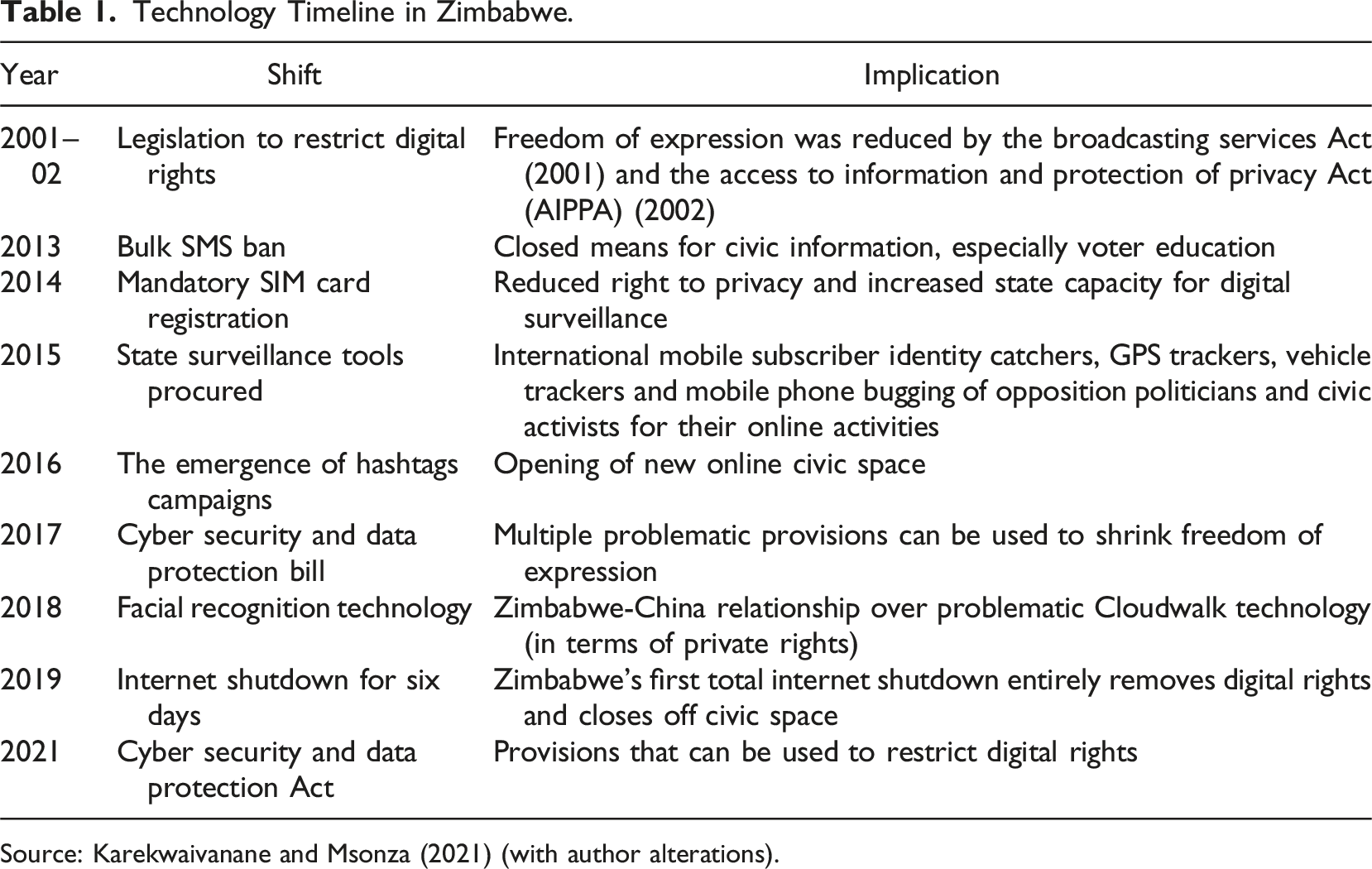
Source: Karekwaivanane and Msonza (2021) (with author alterations).
Online Surveillance
Another form of digital authoritarianism that has been implemented with lethal force by the government of Zimbabwe, is online surveillance. This has been excessive during the electoral period. The elections of 2013 marked the beginning of the use of digital platforms in the electoral process. One of these online campaign tools which was used especially by the opposition was massive text messaging. Bulk messaging was a powerful means for activists and non-governmental organisations to reach wide audiences with civic education and political messaging. To try and stop the opposition from gaining electoral ground, the government banned the use of bulk text messaging (Batambuze, 2013). This was done under the text of protecting the privacy of subscribers and unsolicited bulk SMS (POTRAZ, 2013). The ban curtailed access to information, especially to the public, the majority of whom then could not afford smartphones and mobile data. In 2013 again, the telecommunications regulatory authority (POTRAZ) introduced mandatory SIM card registration which it claimed was in line with international best practices intended to guarantee national security and to control crime (POTRAZ, 2013). Notwithstanding the security concerns, the mandatory SIM card registration expanded the state’s surveillance capabilities while reducing citizens’ privacy and freedoms (Karekwaivanane & Msonza, 2021). The registration of SIM cards instilled fear in citizens who regarded such registration as an alibi for surveillance by the state. As a response to the July 2016 stayaway coordinated under the auspices of the #ThisFlag campaign, POTRAZ issued a veiled threat to citizens through a public notice (Gambanga, 2016). POTRAZ threatened customers who were sharing abusive and subversive materials with disconnection and subsequent arrest.
The government installed large-scale facial recognition imported from China as part of a strategic public-private partnership backed by the Chinese Belt and Road Initiative (Quartz Africa, 2018). This partnership demonstrates the way the Chinese information control model is diffused via the digital Silk Road (Weber, 2019). The government intended to use the facial recognition system for law enforcement purposes. This was not the only surveillance equipment which has been used by the government of Zimbabwe. According to data collected by the Carnegie Endowment for International Peace, artificial intelligence surveillance technology from two other Chinese firms Huawei and Hikvision is currently being used in Zimbabwe (Feldstein, 2019). The adoption of facial recognition technology represents an inclination towards surveillance measures like those used in Chinese cities (Weber, 2019).
There has been an increased arrest of people because of their online activities. This shows a progressive increase in state surveillance capabilities. From July 2014 to 2020, the Zimbabwe Lawyers for Human Rights represented a minimum of 200 people who were arrested for posts on social media sites which were considered critical to the government (CIPESA, 2019). These people include journalists such as the former editor of the state-owned weekly newspaper Edmund Kudzayi and prominent freelance journalist Hopewell Chin’ono (Karekwaivanane & Msonza, 2021). Hopewell Chin’ono’s arrest drew international attention after he was arrested in 2021 for tweeting what the state regarded as falsehood. On 08 January 2021, Chin’ono tweeted using X handle @daddyhope: They say they are charging me with communicating falsehoods for tweeting that a child had been beaten up and died by a police officer! They are taking me to the Law-and-Order section at Harare Central Police Station.
The 2021 arrest of Chin’ono came after another arrest on 20 July 2020 and pre-trial imprisonment for close to six weeks in a high-security prison (Chikurubi Maximum Prison). This arrest followed another tweet that Chin’ono had posted on his X page exposing alleged government corruption involving COVID-19 supplies. He was arrested and charged with inciting public violence ahead of planned demonstrations against corruption and deteriorating living standards scheduled for the end of July 2020. It is not only Chin’ono who was arrested for his online activity, Fadzai Mahere, then spokesperson of an opposition party, Citizens Coalition for Change, was also arrested for tweeting what the state described as falsehoods. She was charged and later convicted of publishing or communicating a statement which is wholly or materially false with the intention or realising that there is a real risk or possibility of undermining public confidence in a law enforcement agency of Zimbabwe. Fadzai Mahere, on 5 January 2021, posted on her X handle @advocatemahere: A police officer beat a woman who was carrying a baby on her back. His baton stick hit the baby on its head and the baby died. The unconstitutional culture of violence on the use of disproportionate use of force by @ PoliceZimbabwe must fall. The officer must be brought to book. Violence is in the blood of @PoliceZimbabwe. The killing of this baby by a policeman was criminal. There is no justification whatsoever for it. The arbitrary beating of citizens is what leads to the beating of a baby on the head with a baton stick. Rogue policing must fall.” “They kill a baby and can’t even apologise. They try and deny the incident caught on video? What a shameless lack of empathy. What a violent ruthless lot. Police brutality must fall.” “There are means other than violence to enforce Covid Regulations. The disproportionate use of force is criminal. Respect the dignity and rights of citizens whom you are meant to serve not kill. Your unrestrained conduct is leading to unnecessary loss of life! (Centre for Human Rights, 2023).
The police responded by issuing a statement disputing the post from Mahere and proceeded to arrest her. She was later convicted in this case in early 2023. The government using its senior employees has spied on what citizens say online. Besides arresting those whose posts are critical to the government, threats of arrests and sometimes unspecified action have been churned out against citizens. In early 2023, Aljazeera (Qatar-based television network) aired a four-part documentary series entitled ‘Gold Mafia’ focussing on Zimbabwe. The documentary generated massive interest and online news outlets reported extensively about the documentary. In a threatening tweet, George Charamba, deputy chief secretary to the president, using his ghost account (@Tinoedzazvimwe1) that he has confirmed to be his, threatened journalists and other online users with arrest and other unspecified action. He tweeted: Friendly advice to all reckless journalists: Al Jazeera is not a court of law whose claims impart privileges to defamatory utterances. It is merely some weaponised channel. If you are reckless enough to repeat what its phoney documentary defamatorily says, hoping to plead: ‘I heard/saw it on Al Jazeera,’ you will be sorry for yourself. Do not for once think there is grit to act against defamatory and politically motivated journalism. Faceless twitter names egging you on will not be a factor when brickbats come. Be warned.
To show that the threats reached their intended targets, Hopewell Chin’ono, a freelance journalist, responded to Charamba’s threats by tweeting that he would stop reporting about the story of the gold mafia. He tweeted (@daddyhope) on 29 March 2023: Ladies and gentlemen, after these continued threats from President Mnangagwa’s spokesman against journalists reporting on the Al Jazeera investigation findings, I won’t be reporting on this story for my safety. George Charamba has made clear the consequences if we continue.
Another journalist, Mduduzi Mathuthu (@Mathuthu), who is the editor of an online publication, ZimLive, responding to the threats from the deputy chief secretary to the president tweeted on 28 March 2023: We learn tonight regime coming after @zimlive, @NewsHawksLive and @daddyhope for reporting what Al Jazeera’s investigation has turned up the president’s people offering to launder cash for undercover Al Jazeera journalists. They are not going after Macmillan, Rushwaya or Angel (Macmillan, Rushwaya and Angel were identified in the documentary as the architects of the illicit gold flows).
George Charamba responded to this tweet by Mathuthu using his other Twitter account (@GeorgeCharamba2): We will come for you if you elect to defame people on flimsy grounds of the privileges of false journalism. Trust us on that. As I warned you, you want to be heroes of Al Jazeera, as did your counterpart in Egypt a few years back, we help you ascend that pedestal of false…
The Future of Democracy in the Digital Era
The idea and practice of democracy are highly contested concepts with competing accounts of great nuance. For this discussion, it is important to reduce this concept to a few important features of democracy which digital authoritarianism impacts. This article presents two areas of impact at different analytical levels: freedom of expression, and the right to access information. This article does not follow one specific theory of democracy, instead, it approaches democracy as a multifaceted phenomenon (Asenbaum, 2022). This offers a broader view of the areas where digital authoritarianism may conceivably affect democratic governance.
Freedom of Expression on the Internet under Siege
The constitution of Zimbabwe guarantees the right to freedom of expression, and to share information and opinions freely according to one’s conscience. These rights are also guaranteed by Articles 18 and 19 of the International Covenant on Civil and Political Rights (ICCPR) as well as Articles 8 and 9 (2) of the African Charter on Human and Peoples’ Rights to which Zimbabwe is a signatory. While these rights are not absolute, such a limitation should respect the principles of legitimacy, necessity and proportionality. Prosecuting individuals for expressing their opinions on social media, cannot be said to meet the principles of necessity. Political activists and journalists were arrested for online posts, some of which were characterized as false news. International human rights mechanisms state that such restrictions are incompatible with international standards for restrictions on freedom of expression. The United Nations Special Rapporteur on Freedom of Association and Assembly states that laws that criminalise false news and are deployed to target political opponents and human rights defenders must be avoided. The UN Special Rapporteur on Freedom of Expression has also referred to prison sentences for false news as reprehensible and out of proportion to the harm suffered by the victim.
Freedom of expression is widely regarded as one of the essential foundations of a democratic society and one of the basic conditions for its progress and for everyone’s self-fulfilment given its centrality to human development and its essential role in securing other rights. It is the essence of democracy to allow diverse political discussions for it to thrive. The internet platform is characterised by harassment and intimidation of users, especially by state agents and supporters of the ruling party. This harassment includes the use of ‘obscene gestures, dirty looks, threats and giving the silent treatment’ (Bowling & Beehr, 2006, p. 998). Online harassment denotes antisocial behaviours that include ‘threats of violence, privacy invasions, reputation-harming lies, calls from strangers to physically harm victims and technological attacks’ (Citron, 2014, p. 3). This has become so prevalent in Zimbabwe. Though the harassment and surveillance of citizens and political activists has been happening offline, the internet has exacerbated this harassment. The use of anonymous and parody accounts on social media even by government officials has intensified the harassment of citizens online.
In non-democratic contexts such as Zimbabwe, citizens are subjected to state surveillance and eventually to arrests and detentions (Ndlovu & Sibanda, 2021; Tshuma, Msimanga, & Sibanda, 2022). The country is ranked 137th out of 180 countries on the freedom index. Citizens are stalked online by suspected state security agents whenever they post things that are critical to the government. How Zimbabweans perceive surveillance has implications for the practice of democracy. Thus, online harassment in the form of surveillance is disrupting the democratic culture in Zimbabwe. Threats of violence online have negative consequences on how political discussions are done and how news is gathered by journalists (Munoriyarwa & Chiumbu, 2019, p. 27). Online surveillance is weaponised to intimidate citizens and make them withdraw from political processes.
Online threats to journalists have exposed them to arbitrary arrests and beatings that are made through anonymous phone calls and online platforms. Such forms of threats and intimidation are undermining the prospects of democratic development in Zimbabwe. The harassment of journalists is prevalent in digital spaces as government officials have given threats to journalists. Digital technologies have been lauded for promoting interactive and participatory democracy, but the downside has been an increase in the harassment of citizens by in most cases government officials. The online harassment of citizens is disrupting participatory democracy as the government issues threats.
The political environment in Zimbabwe is polarised and hate being peddled on digital platforms has exacerbated the polarisation. On one hand, the state is perpetuating its narrative to counter what they call an onslaught from the opposition. Moreover, there is a gendered dimension of online abuse as female politicians especially those from the opposition ranks are being labelled with derogatory names such as prostitutes. The labelling of female politicians as ‘prostitutes’ and other negative comments on social media demonstrate the toxicity of the digital platform. This gendered online harassment of female politicians reflects the discrimination and prejudice in various spaces in Zimbabwe (Ndlovu & Khupe, 2023). Political social media discourses are characterised by the sexism, harassment and objectification of Zimbabwean female politicians (Ncube & Yemurai, 2020). Studies have confirmed the prevalence of gendered violence in online spaces (Holton et al., 2021; Lewis et al., 2020). Online harassment disproportionately affects women (Lewis et al., 2020) as women often must deal with harassment in life (Holton et al., 2021).
One core feature of authoritarianism is the restriction of ‘access to alternative sources of information’. Digital technologies provided authoritarian rulers the opportunity to censor content more effectively and less expensively than manual censorship. Digital censorship takes various forms but includes commanding online service providers to remove content that the regime thinks is critical to it and directly blocking websites as happened in Turkey (Schlumberger et al., 2023). Moreover, bots can be programmed to detect and block web pages using keywords. For example, the Chinese Great Firewall uses algorithms to filter and block critical automatically (Arthur, 2012). The most dramatic digital censorship is the total shutdown of the internet to prevent international audiences from getting information about the regime’s crackdowns on citizens or the opposition. In January 2019, Zimbabwe ordered a total shutdown of the internet following riots against the hiking of fuel prices. During this time of the internet blackouts, the security forces arbitrarily detained, beat and in some cases, tortured protesters and opposition activists. This crackdown on the demonstrators was hardly covered by the international media as it was conducted under a blanket of ordered internet shutdown.
Conclusion
A rapid expansion of digital technologies used around the world presents a new opportunity for authoritarian rulers and democracies alike. It was envisaged that digital technology weakens the state’s control of information and may threaten regime viability. Zimbabwe has witnessed a rising number of online users who initially believed could potentially destabilise a well-entrenched authoritarian regime in the country. However, the Zimbabwe government has used digital technologies to turn on the screws on authoritarian rule. Cyber-attacks on opposition groups is a commonplace and harsh penalties await those who violate the Cyber-Security Act. The opposition has leveraged the affordances of digital technologies to offer alternative sources of information, recruit supporters, coordinate activities and in some cases organise for large-scale offline mobilisation. Despite the increased use of digital technologies in Zimbabwe, the opposition parties must contend with restricted media environments and repressive cyberspace. Much of the opposition’s common goal has been to fight for more liberalised and open political systems that would allow for greater movement toward democratic politics. However, this has posed a danger to regime survival, more state repression of the online arena to enable the incumbent to hold on to power and not succumb to the onslaught of cyber activism by the opposition. In the medium to long run, Zimbabwe is likely to witness an expansion of state control over the online space.
Footnotes
Declaration of Conflicting Interests
The author(s) declared no potential conflicts of interest with respect to the research, authorship, and/or publication of this article.
Funding
The author(s) received no financial support for the research, authorship, and/or publication of this article.
