




Abstract
This study examines the evolving securitization of Unidentified Anomalous Phenomena (UAPs) in the United States (U.S.), utilizing the Copenhagen School’s theory to illustrate a significant shift in the Pentagon’s discourse, moving from outright dismissal to a nuanced acknowledgment of UAPs. By engaging with and expanding upon the UFO taboo discussions, this research sheds light on the contemporary debates on the role of materiality in securitization processes. The paper argues that the complexity of UAP securitization necessitates a multidisciplinary approach that integrates security, scientific inquiry, and global cooperation which will consequently provide a multidimensional understanding of UAPs within national and international security frameworks.
Introduction
The enigma of Unidentified Anomalous Phenomena (UAP) has captivated public interest, evolving from a domain dominated by conspiracy theories—often stifled by the UFO taboo as discussed by Wendt and Duvall (2008)—to a serious national security concern acknowledged by the Pentagon. This paper builds upon the theoretical insights of Wendt and Duvall (2008) and responds directly to Murphy’s (2024) analysis of the dynamics of this taboo, which posits that “even when people are talking about it, they aren’t really talking about it.” By examining the Pentagon’s recent strategic ambiguity in acknowledging UAPs, we illustrate a pivotal shift from outright dismissal to nuanced engagement, thus challenging the prevailing taboo, and opening new avenues in international relations discourse. This shift, underscored by the official release of UAP reports by the Office of the Director of National Intelligence (ODNI, 2022, 2023), signifies a profound transformation in how these phenomena are understood and approached within the U.S. security framework.
Employing the Copenhagen School’s securitization theory, this paper scrutinizes the Pentagon’s strategy of partial securitization—acknowledging UAPs as potential, but not definitive existential threats, leading to a strategic hesitation before mandating specific countermeasures. This nuanced stance allows for flexibility in policy adaptation, reflecting the complex dynamics of audience acceptance and engagement. This stance opens avenues for diverse interpretations and policy adaptations, reflecting a calculated ambiguity aimed at navigating the intricate interplay between security, public perception, and scientific inquiry.
The choice of securitization theory, with its constructivist roots, enables a deep dive into the narratives and discourses that shape perceptions of security threats. This approach, advocated by Buzan et al. (1998), illuminates the process by which the U.S. government, Pentagon, and the United States Space Force (USSF) have constructed the narrative around UAPs, situating them within the broader national security conversation. The significance of this theoretical lens is further amplified when examining the insights from the ODNI’s annual reports on UAPs (ODNI, 2022, 2023), which highlight the shift towards recognizing UAPs as non-traditional security (NTS) issues that transcend the conventional military and state-centric security models, as outlined by Caballero-Anthony (2016). NTS issues often involve non-state, non-military threats, and they are complex to solve because they involve a multiplicity of actors that transcend national borders.
This paper innovatively applies the Copenhagen School’s securitization theory to UAPs within the U.S. national security context, revealing a shift towards recognizing UAPs through a lens of strategic ambiguity and unprecedented official acknowledgment by the Pentagon. By transcending traditional security studies, it underlines the importance of “speech act” in framing UAPs as security issues, without provoking public alarm, thereby encouraging scientific inquiry and international cooperation. This dual focus not only enriches securitization discourse but also underscores the necessity for an interdisciplinary approach to grasp the complexities of emerging security threats like UAPs.
By highlighting the utility of securitization theory over purely discourse analytical approaches, this study underscores the evolving target audience of securitization efforts—from a narrowly defined national security apparatus to a broader, more inclusive audience encompassing the public and international partners. This shift is critical for understanding the Pentagon’s partial securitization of UAPs, as it reflects a deliberate attempt to balance the maintenance of national security with the promotion of global scientific collaboration and transparency.
This study challenges the existing notions of UAPs within international relations and security and marks a significant departure from the perspectives of Wendt and Duvall (2008) and Murphy (2024) regarding the UFO taboo. By analyzing the securitization of UAPs, it unveils a pivotal shift in discourse, suggesting a gradual dissolution of the longstanding taboo and its replacement with a framework of strategic ambiguity and partial securitization. This development, evidenced by the Pentagon’s nuanced engagement with UAPs, signals an evolving understanding that transcends traditional dismissals of UAPs as mere subjects of conspiracy theories. Consequently, our exploration offers a critical reflection on the dynamics of securitization in contemporary security discourse, illustrating the adaptability and breadth of securitization theory when applied to unconventional security challenges. This repositioning not only aligns with but also critically engages with established scholarship, providing a fresh lens through which to comprehend the complex interplay between security, scientific inquiry, and societal perception in the face of ambiguous phenomena.
The Copenhagen School’s Securitization Theory
The securitization framework advanced by the Copenhagen School, mainly through the contributions of Buzan et al. (1998), marks a significant shift in the field of security studies by conceptualizing the notion of security as a construct of societal discourses, perceptions, and language. This theory posits that the essence of security issues is shaped through “security speech acts,” wherein political elites frame problems as existential threats, thus warranting extraordinary countermeasures. These acts, which underscore the linguistic potency in crafting security narratives, initiate a process that involves the securitizing move, the articulation of the threat, and the audience’s reception and validation of the threat narrative, with each stage playing a critical role in the formation and recognition of security issues (Buzan et al., 1998; Floyd, 2011; Huysmans, 2011; McDonald, 2008; Vuori, 2008).
Championing a constructivist perspective (Wendt, 1999), this framework emphasizes the subjective nature of security, arguing that labeling an issue as a security concern propels it into a state of urgency, demanding a response that often goes beyond conventional politics. This trajectory of securitization unfolds in three pivotal phases—identification of the threat, narrative construction, and audience acceptance or rebuttal—through which issues are transformed into security matters. The interaction among securitizing actors, functional actors such as NGOs, the media, and the audience is central to this process. Their interplay can either crystallize or dissolve the securitized status of an issue, thereby illustrating the dynamic, ever-evolving nature of what is considered a security threat.
The framework’s holistic approach transcends traditional, narrow interpretations of security by expanding the scope of referent objects and acknowledging diverse actors’ broad spectrum of influences. In this multifaceted realm, security issues are continuously constructed and reconstructed, considering factors like cultural nuances, historical precedents, and the perceived authority of the securitizing entity. The Copenhagen School, primarily through the work of Buzan et al. (1998), places significant emphasis on the “speech act” in the securitization process. However, the Paris School, mainly through scholars like Didier Bigo (2002), argues that the securitization processes are equally, if not more, important than mere speech acts. This perspective suggests that security mechanics, including practices, institutional dynamics, and procedures, play a critical role in how security concerns are manifested and addressed. The model posits that without the audience’s endorsement, the matter remains a political debate rather than escalating to a security crisis, advocating a nuanced comprehension of how security is established and challenged within the global context. This understanding of securitization, enriched by the contributions of scholars from both the Copenhagen and Paris Schools, critiques existing paradigms and deepens the discourse surrounding the politics of global security (Bigo, 2002; Buzan et al., 1998; Buzan & Wæver, 2009; Hansen & Nissenbaum, 2009; Rasmussen, 2001; Stritzel, 2007; Williams, 2003).
The Copenhagen School’s securitization theory, while groundbreaking, has been critiqued for its Eurocentric and state-centric approach, limiting its applicability in diverse geopolitical contexts (Baele & Jalea, 2022; Greenwood & Wæver, 2013). Its perceived undemocratic nature has led to calls for a broader sociopolitical and sociological lens in securitization studies (Arı, 2023; Markiewicz, 2023; Sahu, 2019). Additionally, the emphasis on speech acts has been deemed insufficient by some scholars, who argue for a more comprehensive understanding that includes the audience’s role in legitimizing securitization processes (Côté, 2016; Emerson, 2019; Léonard & Kaunert, 2010). These critiques underscore the need for an expanded conceptualization of securitization that addresses its complexities, including the dynamics between actors, the audience, and the broader sociopolitical impacts (Lucarelli, 2018; Greenwood & Wæver, 2013; Williams, 2003). Despite critiques regarding its Western-centric focus, the framework stands out for its comprehensive approach to understanding the securitization process, acknowledging the multifaceted and ongoing dialogue among all involved actors. The framework goes beyond traditional state and military concerns, incorporating a more comprehensive array of referent objects and recognizing the impact of various functional actors and the audience’s role in constructing security narratives (Stritzel, 2014).
In our examination of UAP securitization, it is imperative to elucidate the dynamics of securitizing moves, especially considering the pertinent debate between the Paris and Copenhagen schools. This discussion not only frames our theoretical grounding but also contextualizes our empirical analysis. The Copenhagen School posits securitization as predominantly a speech act, where security is constructed through discourse (Buzan et al., 1998). Conversely, the Paris School advocates for a broader understanding of securitization, emphasizing the importance of practices and the sociopolitical context (Bigo, 2002). A critical component of this debate is the role of the audience in securitizing moves. Following Stritzel (2007), we refine our argument to highlight that the audience is not a passive recipient but a key actor in the securitization process. Considering the nuanced strategies employed in the securitization of UAP, it is imperative to more deeply understand how these efforts resonate with various audiences, encompassing both public and institutional stakeholders. Recent trends in public perception of UAPs show a significant shift from traditional skepticism to a more engaged and inquisitive approach. As will be demonstrated in the paper, this transformation is supported by an increase in media coverage and academic discourse, which collectively point to a change from the public’s role as passive receivers of information to active participants in the security dialogue concerning UAPs. These developments are crucial for the effectiveness of securitization efforts as they reflect a broader, more inclusive approach to both national and international security concerns. The nuanced engagement and active participation of the public underscore the importance of audience acceptance in the strategy of partial securitization. By maintaining strategic ambiguity, this approach allows for a flexible, adaptive security response that can accommodate evolving public and political landscapes without causing undue alarm or resistance. Such dynamics are pivotal to our discussion on the role of audience acceptance in the securitization process, suggesting that a full endorsement of securitization moves requires a nuanced understanding of potential threats and a willingness from the audience to support extraordinary measures.
Recent advancements in securitization theory also underscore the pivotal role of materiality in the construction of security issues. Proponents of new materialist approaches have emphasized the significant influence of nonhuman actors in shaping security landscapes (Salter, 2019; Salter & Mutlu, 2023). This perspective is particularly salient in the context of UAP discourse, where the material presence of UAPs, despite their uncertain nature, plays a critical role in their designation as security threats. The engagement with these newer theoretical insights allows for a more profound understanding of how UAPs, as ambiguous material entities, contribute to the dynamics of security production. This approach not only broadens the analytical lens beyond traditional speech act theory but also aligns with the case study’s demonstration of how uncertain materiality, represented by UAPs, can still engender a securitization process. Incorporating these considerations into our framework enriches the conceptual contribution towards current debates in securitization theory, highlighting the interplay between materiality and discourse in the securitization of UAPs.
After discussing the foundational principles of the securitization theory, it is imperative to address the mechanisms through which securitizing moves are identified and the roles of various actors in this process. Securitization is not merely an academic concept but a dynamic and interactive process involving multiple stakeholders. The identification of securitizing moves hinges on the articulation of a perceived existential threat and the call for extraordinary measures to address it. This involves a complex interplay between “securitizing actors”—typically state officials or institutions—and the “audience,” whose acceptance is pivotal for a successful securitization move. The audience actively legitimizes the securitization process, with its acceptance depending on the credibility of the actor, the persuasiveness of the threat, and the context, highlighting the critical role of shared beliefs and perceptions in understanding the threat and the need for proposed measures (Côté, 2016; Emerson, 2019; Léonard & Kaunert, 2010).
Furthermore, the dynamics of securitizing moves and audience acceptance are influenced by the broader socio-political environment, including existing narratives, historical precedents, and the media landscape. These elements collectively shape the potential for securitizing moves to resonate with the audience and achieve the desired level of urgency and action. Thus, examining the securitization of UAPs requires not only an analysis of the speech acts and actors involved but also a nuanced understanding of the audience’s role and the context within which these interactions occur.
Considering this, our analysis extends to consider how the shift in discourse surrounding UAPs reflects broader changes in societal attitudes towards security and the unknown. By integrating the audience’s perspective into our theoretical framework, we aim to provide a more comprehensive account of the securitization process, particularly as it applies to the unique and evolving case of UAPs. This approach allows us to explore the conditions under which the UAP discourse has been elevated to a security concern and the implications of this securitization for both national and international security paradigms. As we segue into the next section on the Pentagon’s UAP discourse, this framework, enriched by constructivist insights, provides a lens to examine the background, historical context, and main functional actors, elucidating the complex interplay between security politics and societal narratives in a real-world case study, thereby deepening our understanding of the dynamics at play in contemporary international relations.
Background, Historical Context, and Main Functional Actors
Initial Exposure and Pentagon’s Response to UAPs
The Pentagon’s increased attention to UAPs can be attributed to the exposure of a covert program in December 2017 (Blumenthal, 2017). This pivotal event led to a surge in interest from the Pentagon, marking a significant departure from the historical societal stigma and mockery associated with UAPs (Dean, 1998). The revelation of the clandestine UAP program prompted the Pentagon to intensify its intelligence and research activities aimed at swiftly identifying UAPs (Dodd, 1999). Additionally, evidence of UAP absorption lines and physical modeling of outflows further supports the Pentagon’s heightened interest in the phenomena (Parker et al., 2017). The historical ridicule and societal stigma surrounding unidentified flying objects (UFOs) are evident in the recommendation for a widespread debunking campaign to diminish public interest (Agrama, 2020). Furthermore, academic literature has long held a fascination with UFOs, as evidenced by the substantial accumulation of literature on the topic (see White, 1973). The societal ridicule and stigma associated with UFOs are also reflected in the course on “Flying Saucers,” designed to capitalize on student interest in UFO reports discrediting the scientific establishment (Page, 1967).
This shift in the Pentagon’s stance may also be seen as a response to the growing challenge to the UFO taboo in academic and political discourse. Wendt and Duvall (2008) argue that the anthropocentric nature of modern sovereignty has created a taboo around taking UFOs seriously, a notion that has been ignored despite the lack of conclusive evidence against extraterrestrial origins of UAPs. Murphy (2024) further explored this taboo, analyzing the citational practices in international relations theory to illustrate how the UFO taboo influences the field’s prestige economy. Their studies suggest that the Pentagon’s changing approach to UAPs is not just a response to new evidence but also an evolving understanding of the UFO phenomenon within the broader context of international relations and sovereignty.
Kean et al. (2017) authored a front-page exposé in The New York Times that unveiled the Pentagon’s covert program, clandestinely operational for a decade. This exposé included the release of videos recorded by the U.S. Navy featuring instances of UAPs. This disclosure marked a critical juncture, leading to high-ranking officials’ acknowledgment and vocal curiosity regarding UAP occurrences. For instance, Senator Marco Rubio acknowledged the presence of enigmatic flying objects within restricted airspace, affirming that “we don’t know what it is, and it isn’t ours” (Browne, 2020; Petrescu et al., 2017). Likewise, former Central Intelligence Agency (CIA) Director John Brennan conceded the existence of unexplained phenomena, suggesting their potential connection to alternative life forms (Ciaccia, 2020).
Subsequently, Deputy Secretary of Defense David Norquist publicly announced the formal establishment of the UAP Task Force in 2020 (U.S. Department of Defense, 2020). This task force was entrusted with compiling and analyzing UAP-related data sourced from various government agencies within a stipulated 180-day timeframe, culminating in the anticipated release of a report in June 2021. Notably, John Ratcliffe, the former Director of National Intelligence, underscored the gravity of UAP sightings, affirming their validation by Navy and Air Force pilots and substantiation through satellite imagery (McCarthy, 2021). These observations defied conventional technological limitations, fueling intrigue and concern (Kean et al., 2017).
Historical Perspectives and Shifting Stances
The historical antecedents of the Pentagon’s altered disposition towards UFOs can be traced to the release of the 1969 Condon Report, an outcome of the “Scientific Study of Unidentified Flying Objects” (Page, 1969). The primary objective of this report, authored by Edward Condon, was to debunk UFO phenomena and discourage further scientific inquiry. The report’s conclusions and recommendations categorically dismissed the necessity for in-depth UFO investigations and discouraged active participation by the scientific community. This marked the conclusion of the “golden age” of official UFO investigations and scientific exploration (Condon & Gillmor, 1969). However, the legacy of J. Allen Hynek, an esteemed astronomer and dedicated UFO researcher, persevered. Hynek vocally criticized the debunking approach towards UFOs, advocating instead for an impartial and systematic research framework. He took the initiative to establish an independent organization dedicated to the ongoing examination of UFO phenomena, underscoring the imperative for an unbiased evaluation (Hynek, 1972).
Contemporary developments within the UFO field hint at the potential clandestine study of UFO crash debris by aerospace companies. Harry Reid, a former senator, posited the occurrence of UFO crashes and clandestine material analysis spanning several decades, potentially facilitated by private military contractors. However, it is essential to acknowledge the dearth of substantiated evidence about these claims (Reid, 2021). While not all segments of society anticipate comprehensive revelations from the government, the escalating recognition of UFO phenomena by high-ranking officials, the inception of the UAP Task Force, and the continuation of scientific investigations collectively signify an augmented gravity and interest in the subject matter (Kean et al., 2017). In recent years, COVID-19 restrictions, emerging trends in artificial intelligence (AI), the dramatic rise of social media outlets, and generational change are factors that have contributed to the acknowledgment of the UFO phenomena in both civil society and the state.
RAND Corporation’s Analysis, Contemporary Developments, and Public Engagement
The RAND Corporation’s comprehensive analysis reveals a nuanced view of societal engagement in the securitization of UAPs within the U.S. Tracking a notable rise in sightings from 1998 to 2020—with a pronounced influx between 2012 and 2014, a slight decline up to 2018, and a resurgence after that—the report sketches a landscape of escalating public interest and interaction with UAPs. This pattern is set against the canvas of technological evolution that has democratized airpower, enabling broader public access to the skies, and intensifying the volume of UAP reports (RAND Corporation, 2023). The narrative turns dramatically with the U.S. Air Force’s interception of a Chinese surveillance balloon in 2023. This pivotal moment not only punctuated the strategic imperative of airspace control but also spotlighted the critical role of civilian vigilance in pinpointing potential aerial threats (RAND Corporation, 2023).
In parallel, the U.S. government’s intensified scrutiny of UAPs—manifested through the Department of Defense’s (DoD’s) Advanced Aviation Threat Identification Program and the establishment of the Airborne Object Identification and Management Synchronization Group (AOIMSG)—mirrors a growing institutional recognition of the significance of these enigmatic occurrences. The inception of the All-Domain Anomaly Resolution Office (AARO), along with Congressional hearings, punctuated a decisive move towards a more structured and formalized analysis of UAP encounters (RAND Corporation, 2023).
Moreover, the three-step reporting process—encompassing observation, submission, and evaluation—adopted by the National UFO Reporting Center (NUFORC) has been pivotal in constructing a coherent narrative around UAP incidents, offering a transparent and systematic protocol for the public documentation of such events (Unidentified Flying Object (UFO) Reports, n.d). This collective data, when analyzed, provides intriguing correlations between UAP sightings and established aerospace activities, such as those around military bases and airports, offering valuable insights into their possible origins and behaviors (RAND Corporation, 2023). The statistical clusters of UAP sightings, some exceeding a hundred reports, highlighted in the RAND study, pinpoint geographical hotspots of heightened reporting frequency. These clusters, especially salient in 2013 and 2019, suggest sporadic occurrences and periods of intensified public participation and concurrent sightings, painting a picture of community involvement in monitoring and reporting UAP activities (RAND Corporation, 2023).
The RAND Corporation’s findings, highlighting the American public’s transition from mere spectators to engaged stakeholders in the conversation on UAP, serve as a prelude to a broader, more complex discourse. This emerging role reflects a societal shift that places UAPs at the vanguard of national security concerns, marking a collective endeavor to demystify and perhaps reshape the understanding of these enigmatic occurrences through active public reporting, institutional involvement, and the communal navigation of airspace. Building upon this shift, the narrative surrounding UAPs has evolved into a multifaceted subject for exploration, encompassing governmental, societal, and scholarly perspectives. The Office of the Director of National Intelligence’s 2021 report is emblematic of this evolution, which openly recognized the phenomena previously termed UFOs. By discounting explanations rooted in natural occurrences or technical faults and admitting to the inexplicability of numerous incidents, this acknowledgment has altered the official stance and amplified academic interest and public discourse, setting the stage for ongoing inquiry (Yingling et al., 2023). This convergence of heightened public awareness with a governmental pivot towards transparency illustrates a significant turning point in the UAP narrative, fostering a vibrant landscape for continued investigation and dialogue.
The claim that the Pentagon has played a pivotal role in the evolution of UAP incidents by assigning most of them to a “catchall other bin” and stimulating a broader conversation on the topic, pushing it into the realms of credible scientific and political discourse, is supported by relevant evidence. The Pentagon’s involvement in categorizing UAP incidents has sparked broader debates within scientific and political circles, discussing the influence of UAP on energy intensity and its impact on various aspects, including environmental and political factors (Lewis-Kraus, 2021). This demonstrates the significant role of the Pentagon’s actions in shaping broader discourse.
Other Official Statements
Beyond the two central Pentagon reports (ODNI, 2022, 2023), several official statements and reports highlight the perceived security threat posed by UAPs. For instance, in July 2023, the U.S. House Oversight Committee conducted a public hearing on the national security implications of UAPs (Committee on Oversight and Accountability, 2023). This indicates significant concern and attention from various governmental bodies regarding the potential security risks associated with UAPs. Additionally, a statement by Pentagon Press Secretary John Kirby on the UAP Assessment reiterates this security focus. Kirby mentions that the Director of National Intelligence delivered a preliminary assessment of UAPs to Congress, emphasizing the collaborative effort involving many departments and agencies in understanding this threat. He notes, “Incursions into our training ranges and designated airspace pose safety of flight and operations security concerns and may pose national security challenges” (U.S. Department of Defense, 2021). This statement underscores the perceived security risks UAPs present, particularly concerning safety and national security.
Further, the Pentagon’s assessment highlights the challenges in assessing UAP occurrences near DoD training ranges and installations. Deputy Secretary of Defense Kathleen Hicks directed the development of a plan and the creation of a new group to formalize the mission previously performed by the UAP Task Force. This plan aimed to synchronize the collection, reporting, and analysis of UAP. Its recommendations, which included securing military test and training ranges, signified a strategic approach to addressing these phenomena as a security concern. The new group, AOIMSG, established in November 2021, is overseen by the Under Secretary of Defense for Intelligence, the director of the Joint Staff, and officials from the ODNI (Reuters, 2021). In addition to the two Pentagon reports, these official perspectives and actions in the U.S. reflect a growing recognition of UAPs as an NTS issue. In the case of UAPs, this recognition aligns with the broader shift in security studies towards understanding and addressing security threats that transcend traditional state and military paradigms.
Legislative Actions, Global Reactions, and International Cooperation
The passage of the National Defense Authorization Act (NDAA) of 2022, which provides a framework to address UAPs systematically, marks a notable point of convergence in U.S. politics, receiving considerable bipartisan support—a rarity in the contemporary legislative climate (Yingling et al., 2023). However, the act’s bipartisan backing merits a closer examination through the lens of legislative behavior. Studies on institutional voting patterns suggest that the seeming bipartisanship often aligns more closely with the majoritarian dynamics of Westminster than the polarized corridors of Washington, D.C. This insight raises questions about the depth of the consensus on UAPs, indicating that unanimous votes may not always mirror a genuine bipartisan stance (Epstein, 2023; Walker, 2023).
Moreover, Seeberg’s (2022) research argues that government-initiated legislation can often pre-empt and suppress the opposition’s ability to set the legislative agenda. In the case of the UAP-focused legislation, what appears to be cross-party support might be a calculated governmental tactic to steer the legislative focus. Similarly, Picon’s (2023) findings suggest that bipartisan agreement may also be swayed by the pragmatic need to channel funds into opposition-held districts, casting further doubt on the authenticity of the bipartisan enthusiasm for UAP legislation.
This multifaceted situation implies that the acclaimed bipartisan support for the NDAA concerning UAPs could be less a reflection of unanimous concern and more a product of legislative dynamics, strategic maneuvering, and fiscal imperatives. Nevertheless, despite these domestic intricacies, the international response to UAPs has been gaining momentum, with countries worldwide initiating their own protocols and research efforts. Such international activities amplify the significance of UAPs, hinting at their evolving role in global security and diplomatic discourse (Yingling et al., 2023). The juxtaposition of domestic legislative intricacies with international engagement illustrates a complex array of political, strategic, and security considerations surrounding the enigmatic subject of UAPs. 1
Interdisciplinary Approaches
In the academic realm, the narrative surrounding UAPs has transitioned from one of skepticism to a more open and deliberate engagement, as evidenced by initiatives such as Harvard University’s Galileo Project, which commenced in July 2021. Under the stewardship of Avi Loeb, this endeavor exemplifies the academic community’s commitment to demystifying UAPs through rigorous scientific inquiry, aiming to dispel the stigma that has historically relegated such studies to the margins (Yingling et al., 2023). Faculty and researchers from various disciplines progressively contribute to this dialogue, bringing diverse perspectives to UAP research and critically assessing the veracity of associated claims (Andresen, 2022; Yingling et al., 2023). This collective academic curiosity, coupled with the Pentagon’s openness in declassifying UAP information, the burgeoning global attention to these incidents, and the shift towards more serious scientific and political discourse, encapsulates a significant paradigm shift. It underscores a dynamic fusion of security, science, and public engagement, fostering a comprehensive framework for addressing and understanding the complexities of phenomena that were once dismissed or ignored.
The discourse on UAPs has evolved into a rich tapestry of insights informed by the diverse contributions of researchers and organizations. Franc Milburn’s work, alongside the RAND Corporation (2023) study, illuminates the intricate roles of various actors in the securitization processes of UAPs. Milburn (2020) casts light on critical developments such as the Senate-backed Unidentified Aerial Phenomena Task Force (UAPTF) at the Office of Naval Intelligence, which signifies a structured governmental response to UAPs and examines the complexities faced by the U.S. Air Force (USAF) and the DoD in grappling with these occurrences. Meanwhile, the RAND Corporation (2023) emphasizes the growing utility of public reporting mechanisms like the NUFORC in threat assessment amid more widespread airpower technologies. Adding to this multifaceted narrative, theorists such as Jack Sarfatti contribute scientific theories on UAP technologies and intentions. At the same time, government entities, including the Senate Committee, the National Reconnaissance Office, and the Federal Bureau of Investigation (FBI), indicate an elevated institutional focus on UAPs (Milburn, 2020). Milburn (2020) also delves into the historical and cultural imprints of UAPs, suggesting their longstanding presence in human consciousness. Together, analyses by Milburn and the RAND Corporation sketch a complex, layered understanding of UAPs that intersects scientific exploration, military strategy, historical significance, and national security.
While we acknowledge the involvement of diverse agencies and academic institutions in examining UAPs, this does not explicitly delineate the motivations behind these investigations within the traditional versus non-traditional security framework. To clarify, while entities such as the Pentagon and academic researchers have engaged in UAP studies, the primary motivation for these investigations extends beyond traditional security concerns. For instance, the 2023 report’s emphasis on determining whether UAP can be “attributed to foreign activity” underscores a traditional security concern (ODNI, 2023). However, the broad spectrum of investigation, including scientific inquiry into UAPs’ technological aspects and origins, indicates a nuanced approach that transcends conventional military and national security paradigms. This multifaceted investigation reflects a recognition of UAP as a complex phenomenon that requires an interdisciplinary approach, merging traditional security concerns with broader scientific and societal interests.
The Pentagon’s nuanced approach to communicating about UAPs, particularly in the 2022 and 2023 ODNI reports, reflects an evolving strategy that seeks to balance transparency with national security considerations. This communication is not merely informational but actively shapes the securitization process. How the Pentagon and the USSF articulate UAP incidents—whether as threats to sovereignty, potential risks to aviation, or sources of societal anxiety—can significantly influence their classification as security concerns. The stakes of this rhetorical framing extend beyond mere policy adjustments; they can lead to substantial shifts in resource allocation, public perception, and international relations, addressing both state and societal security concerns (Bale, 2007). This strategic communication underscores the Pentagon’s role not just as a security actor but as a narrative constructor, navigating the complex interplay between known and unknown aspects of UAPs to shape the security discourse.
In summary, the Pentagon’s recent focus on UAPs marks a transformative phase in the U.S. government’s stance towards what was once a subject of societal skepticism and derision. This paradigm shift, underscored by increased transparency and strategic initiatives to investigate these phenomena, is paralleled by a notable rise in public engagement and scholarly research, suggesting a significant recalibration of the UAP narrative within the security, academic, and public domains. This collective reorientation from the margins to the mainstream in UAP discourse reflects an evolving recognition of their potential implications for national security and scientific inquiry. Transitioning to the application of the Copenhagen School’s securitization theory, in the next section, we dissect the Pentagon’s 2022 and 2023 UAP reports (ODNI, 2022, 2023) to understand how this theoretical framework can elucidate changes in the discourse. This analysis aims to trace the trajectory of UAPs within security conversations, examining how the narrative has expanded and adapted considering new disclosures and to what extent this reflects broader trends in the securitization of ostensibly non-traditional threats.
How Language Evolved in Pentagon Reports on Unidentified Anomalous Phenomena: A Comparison of 2022 and 2023
Referent Objects
Comparative Overview of Pentagon UAP Reports: 2022 Versus 2023.
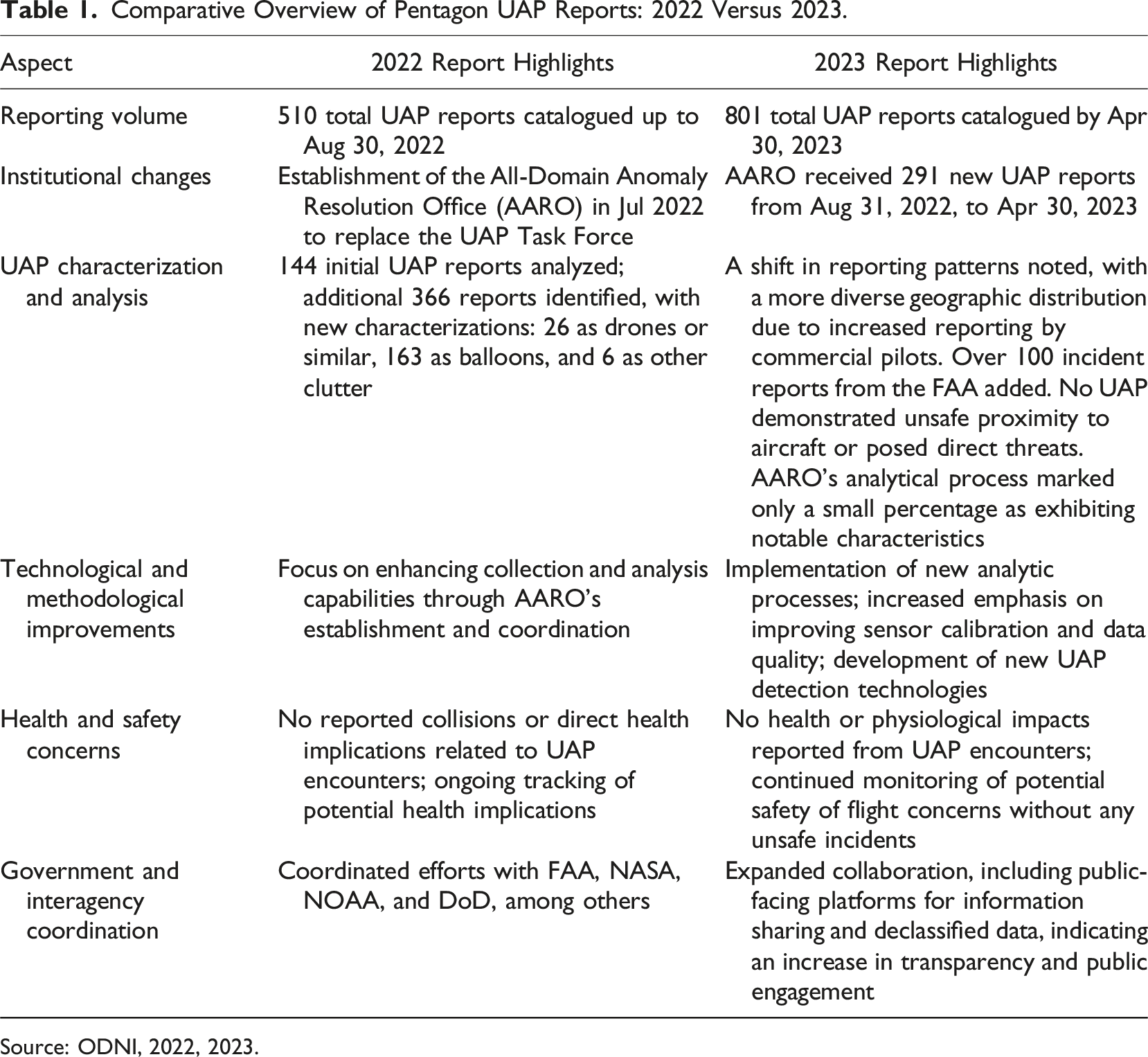
Source: ODNI, 2022, 2023.
In contrast, the 2023 report signals a departure towards a more inquisitive and less reflexive stance. It suggests a burgeoning interest in the mechanics and capabilities of UAPs to decipher their technological underpinnings. The discussion considers the scientific implications of UAPs’ advanced propulsion systems and aerodynamic performances, which defy current understanding (ODNI, 2023). This shift in focus from solely security concerns to a broader investigative scope intimates the Pentagon’s recognition of UAPs as potential vessels of innovation, prompting a more profound and systematic inquiry into their origin, technology, and intent. Notably, this exploration is separate from the ongoing commitment to national security and airspace integrity but complements it. The report’s balanced perspective acknowledges the dual potential of UAPs as both security risks and sources of breakthroughs in aerospace technology and physics (ODNI, 2023). This nuanced approach suggests a strategic calibration responsive to the dual exigencies posed by UAPs: the immediate need to safeguard against potential threats and the strategic advantage of advancing scientific knowledge.
This subtle yet substantive shift in the narrative between the two reports unveils an adaptive strategy that positions the U.S. at the vanguard of understanding UAPs as a defense issue and harnessing them as a catalyst for scientific advancement. The Pentagon’s evolving discourse on UAPs reflects a maturation in policy thinking, moving from a historically constrained view towards a more expansive engagement that straddles defense strategy and scientific curiosity. The 2023 report encapsulates this progression, indicating a readiness to delve into the unknown with a sense of openness previously overshadowed by the urgency of threat mitigation.
As we move forward, our analysis pivots to scrutinize the dynamics of securitizing actors detailed in the Pentagon’s reports, delving into how their roles and engagements have been reshaped considering the shifting narrative on UAPs. This involves examining the interplay between military imperatives, scientific research communities, and policy frameworks that collectively influence the ongoing discourse and response to UAP phenomena from 2022 to 2023.
Functional Actors
The progression of functional actor involvement in the Pentagon’s UAP discourse, as detailed in the 2022 and 2023 reports, showcases a significant development in strategy and collaboration. The 2022 report underscores the establishment of foundational partnerships within the All-Domain Anomaly Resolution Office (AARO), pivotal in coordinating efforts across various sectors, including aviation and national defense. Collaboration with federal entities like the Federal Aviation Administration (FAA) and scientific bodies such as the National Aeronautics and Space Administration (NASA) highlighted an interdisciplinary approach to unify UAP tracking, analysis, and resolution protocols. This early collaboration stage also involved health and air safety agencies, underlining a solid emphasis on mitigating potential hazards to aviation posed by UAP incidents (ODNI, 2022).
In contrast, the 2023 report illuminates an expanded engagement, suggesting that the scope of UAP investigations has broadened beyond immediate response and containment to include a deeper focus on scientific inquiry and technological exploration. AARO’s role has evolved to advocate for advancements in sensor technology and data processing capabilities, enabling more precise detection and identification of UAPs. Integrating space and maritime actors into the investigative framework, including the USSF and U.S. Space Command, signifies a shift towards a comprehensive, multi-domain understanding of UAP phenomena (ODNI, 2023).
Three key developments mark this evolution in functional actor engagement. First, the AARO has progressed from a primary coordinating and collaborative hub to an active participant in spearheading technological innovation and scientific research within the UAP investigative framework. Second, the spectrum of collaboration has widened, now enveloping the space and maritime domains, indicating an acknowledgment of UAPs as phenomena that transcend traditional aerospace boundaries. This expansion is evident in the active involvement of agencies like the Space Force and U.S. Space Command, which brings new perspectives and capabilities. Third, there is a discernible pivot towards leveraging advanced technology and scientific expertise, recognizing that the enigmatic nature of UAPs requires cutting-edge tools and research methodologies for comprehensive analysis and understanding.
These developments point to a Pentagon that is reacting to the immediate challenges posed by UAPs and proactively seeking to unravel the mysteries they present through a robust, technologically savvy, and scientifically grounded approach. Including a broader range of expertise—from technical to scientific communities—reflects a strategic adjustment to the multifaceted challenges of UAP analysis, aiming for a nuanced, informed, and methodically rigorous exploration of these phenomena.
In the next section, we delve into the Pentagon’s reports, scrutinizing the evolving dynamics of securitizing actors and their roles in the broader context of UAP securitization. This enables us to discern how the interplay between policy directives, scientific innovation, and security imperatives shapes the current and future trajectory of UAP research and response strategies.
Security Audience and Acceptance
The Pentagon’s UAP reports from 2022 and 2023 reveal a dynamic shift in the constitution and engagement of the security audience. In 2022, the report was initially tailored for a narrow, specialized audience, primarily military and governmental personnel with stakes in national security and aviation integrity. It communicated a measured narrative to inform and align stakeholders on UAP-related developments without provoking public hysteria or speculative discourse. The language employed was guarded to establish a foundational understanding of UAPs while managing the balance between transparency and security (ODNI, 2022).
By 2023, the audience engagement strategy had transformed, embracing a broader audience that included the original military and governmental entities, the public, and the scientific community. This expansion is evidenced by initiatives such as creating a public-facing website and declassifying UAP information, reflecting a deliberate strategy shift towards greater openness and public inclusion (ODNI, 2023). The report’s language evolved to match this broader audience, adopting a more detailed and proactive tone that reveals an increased commitment to engaging with the issue at multiple levels.
This shift towards transparency suggests a strategic adaptation to the growing public demand for openness and a more significant societal push for understanding mysterious phenomena. The 2023 report’s approach likely enhanced the acceptance and credibility of its content, indicating a successful reception of its “security speech acts” by a more diverse audience (ODNI, 2023). The broadened communication reflects an acknowledgment of the public’s capacity to responsibly engage with complex security issues.
The discernible evolution from a restricted to a more inclusive audience engagement between the 2022 and 2023 reports signals the Pentagon’s recognition of the multifaceted interest in UAPs. It shows an institution evolving in its communication strategy, responding to a security environment where public interest and scientific inquiry intersect more prominently with national defense narratives. As the analysis progresses, it further dissects how this broader audience engagement influences the formulation and reception of security policies and actions related to UAPs within the contemporary socio-political landscape.
After analyzing the evolving engagement with the security audience as detailed in the 2022 and 2023 Pentagon’s UAP reports, it is imperative to further dissect the nuanced dynamics between securitizing actors and the audience. This entails a deeper exploration of what constitutes full versus partial securitizing moves. Full securitizing moves achieve widespread acceptance of existential threats and the necessary extraordinary measures among the audience, leading to a cohesive and mobilized response. Conversely, partial securitizing moves, as explored in this paper, involve recognizing potential existential threats without definitive classification. This recognition does not necessarily lead to immediate extraordinary measures due to the audience’s strategic hesitation or lack of full endorsement (Lupovici, 2016, 2019; Roe, 2008; Salter, 2008; Salter & Piché, 2011; Wilkinson, 2015).
This distinction is vital for understanding the complexities of securitizing UAPs, where diverse audience perceptions can lead to varying degrees of acceptance and support for proposed measures. Moreover, the concept of failed securitizing moves, or instances when securitization efforts do not achieve the intended audience mobilization, further complicates the discourse surrounding UAPs. These theoretical considerations prompt a reassessment of how securitization theory applies to the unique and evolving case of UAPs, necessitating a nuanced approach that acknowledges the spectrum of audience responses and their implications for national and international security paradigms.
Recent developments in public opinion underscore a significant transformation in how audiences perceive UAPs, moving from a predominantly skeptical viewpoint to a more engaged and inquisitive approach. This shift is evidenced by the increased media coverage and academic discourse that emphasize the public’s transition from passive receivers of information to active participants in the security dialogue concerning UAPs. For instance, amidst a resurgence of interest in extraterrestrial possibilities, a 2023 congressional hearing and substantial media attention have refocused public and academic interest in UFOs, transforming it from fringe conspiracy theories to a topic of credible scientific inquiry (De Visé, 2023). This nuanced acceptance of the security implications posed by UAPs reflects a complex societal response, illustrating a form of partial securitization where the public is hesitant to fully endorse the notion of UAPs as a conventional security threat (Saad, 2021). Moreover, despite the increased acknowledgment of UAPs, there is limited public support for extraordinary measures such as military preparedness or dramatic policy shifts. These changes are critical for the success of securitization efforts as they reflect a broader, more inclusive approach to national and international security concerns. The active engagement of the public, facilitated by recent governmental openness and scientific studies, underscores the importance of audience acceptance in the strategy of partial securitization, where maintaining strategic ambiguity allows for a flexible, adaptive security approach that accommodates evolving public and political landscapes without inducing unnecessary alarm or resistance. This scenario supports our theoretical discussion on the pivotal role of audience acceptance in the securitization process, emphasizing that full endorsement of securitization moves is contingent upon a nuanced understanding of potential threats and the audience’s willingness to support extraordinary measures.
Security Speech Acts
The Pentagon’s approach to communicating about UAPs, as delineated in the 2022 and 2023 reports by the ODNI, signifies a marked evolution in its strategy for engaging with this complex and potentially sensitive subject. The 2022 report serves as a crucial turning point in this narrative, signifying an increased awareness and reporting of UAP incidents. This escalation in reporting indicates a transformative shift in both cultural and operational attitudes within military and government sectors, progressing towards a more nuanced understanding of UAPs and diminishing the stigma previously associated with them. The establishment of the AARO, as stated in the report, “facilitate[s] more coordinated UAP efforts, resulting in greater attribution of UAP” (ODNI, 2022). This development signals a more formalized and structured approach to investigating UAPs, denoting a significant consideration of their potential impact on national security and air safety.
In the 2022 report, the language employed is assertive, providing clear statements about the number of UAP reports and the creation of AARO. This assertiveness is encapsulated in the report’s declaration that “additional information is provided in the classified version of this report” (ODNI, 2022), underscoring the document’s factual and confident tone. Additionally, the report is directive, subtly implying a need for increased vigilance and reporting within airspace monitoring systems. This directive nature is reflected in the report’s emphasis on the “observed increase in the UAP reporting rate” and the acknowledgment of UAP as potential “safety of flight hazards or as potential adversary collection platforms” (ODNI, 2022). The report also conveys a subtly expressive concern for safety and security, especially regarding UAP events occurring in restricted or sensitive airspace. The committal stance of the report is pivotal as it lays the groundwork for a more systematic and comprehensive approach to UAPs, targeting a specialized audience that includes military, government, and international stakeholders. The report commits to “apply[ing] rigorous analysis and resolve events,” highlighting a dedication to enhancing efforts to comprehend and address UAP events (ODNI, 2022). Overall, the 2022 report marks a significant stride in the Pentagon’s communication strategy about UAPs, illustrating a shift from a guarded, reactive posture to a more proactive and structured approach (ODNI, 2022). This transition reflects a growing understanding and acknowledgment of the phenomena. It indicates a readiness to engage with the complexities and implications of UAPs more transparently and coordinately.
In the 2023 report, there is a discernible continuation in the reporting of UAPs, yet with a notable shift in focus and tone from the previous year. The report maintains its recognition of ongoing UAP encounters, explicitly stating, “The report covers unidentified anomalous phenomena (UAP) reports from 31 August 2022 to 30 April 2023” (ODNI, 2023). This continuity, however, is accompanied by a highlighted bias towards military airspace in these reports. The 2023 report observes, “Most reports still reflect a bias towards restricted military airspace,” suggesting an overrepresentation of UAP sightings in military zones and underscoring the need for a broader, more globally inclusive approach to data collection (ODNI, 2023). Further, the 2023 report provides reassurance regarding the safety implications of UAPs, asserting that “AARO received no reports indicating UAP sightings have been associated with any adverse health effects.” This statement alleviates public concern regarding the immediate danger posed by UAPs. Complementing this assurance is the report’s acknowledgment of ongoing investigations and the absence of any definitive foreign activity attribution, as it states, “none of these UAP reports have been positively attributed to foreign activities” (ODNI, 2023). This aspect highlights a commitment to understanding the origins of UAPs while recognizing the challenges inherent in their detection and analysis, particularly regarding data gaps and sensor limitations.
In the context of the evolving discourse surrounding UAPs, official investigations and public communications increasingly adopt a holistic approach that transcends the conventional military-security paradigm. The 2023 ODNI report’s explicit acknowledgment that the UAP incidents have not been attributed to foreign activities underscores a departure from viewing these phenomena solely through the lens of international military rivalry. This statement is significant, reflecting a strategic recalibration towards understanding UAPs in a broader, more nuanced manner. Such an approach recognizes the potential for UAPs to encompass a range of phenomena with implications that extend beyond the immediate framework of national security threats potentially emanating from foreign military powers. Moreover, this approach, rather than indicating a securitization move, may reflect a strategic de-securitization, aiming to shift the narrative from potential adversarial threats to a broader, more inclusive exploration of UAPs.
The 2023 report’s speech act analysis reflects an assertive update on UAP incidents, emphasizing the absence of direct health impacts or threats. The report’s language is directive in advocating for enhanced data collection and analysis, as evidenced by its statement, “working with military and technical partners to improve sensor placement and calibration to better collect against UAP” (ODNI, 2023). It is also expressive in acknowledging the uncertainties and concerns regarding UAPs and committing to the ongoing investigation of UAP phenomena. This evolution from the more cautious, data-focused approach of 2022 to a more assertive and inclusive communication style in 2023 illustrates the Pentagon’s strategic adaptation to the evolving nature of UAPs. This progression signifies a growing confidence in handling UAP-related challenges and a responsiveness to public interest in transparency and information. Through the 2023 ODNI report, the Pentagon demonstrates a readiness to engage more dynamically with the complexities of UAPs, signaling an openness and a commitment to a more transparent, inclusive, and informed discourse on the subject.
The terminological evolution in the discourse surrounding unidentified phenomena is notable in the official reports. The 2022 report utilized the term “Unidentified Aerial Phenomena” (ODNI, 2022), while the subsequent 2023 report adopted the term “Unidentified Anomalous Phenomena” (ODNI, 2023). This shift in nomenclature is not merely semantic but indicative of a broader conceptual framework applied to these phenomena. “Unidentified Anomalous Phenomena” encompass a broader spectrum of unexplained occurrences not exclusively confined to aerial instances. This broader classification is crucial as it allows for including various categories of UAPs that could manifest in different domains. Appendix B of the 2023 report is particularly illustrative of this expansive approach, as it includes a glossary of terms delineating different types of UAPs (ODNI, 2023). This glossary references categories such as spaceborne UAP, airborne UAP, seaborne UAP, and transmedium UAP. Each category represents a different domain of occurrence, suggesting that these phenomena could manifest in air, space, sea, or even across multiple mediums (ODNI, 2023). The inclusion of such varied categories underscores the acknowledgment by the ODNI of the multifaceted nature of these phenomena and the need for a comprehensive framework to categorize and study them.
This terminological evolution is significant as it reflects the intelligence community’s adaptive and responsive approach to categorizing and analyzing UAPs. It acknowledges the complexities and uncertainties inherent in these phenomena, moving beyond the traditional confines of aerial-only occurrences. By broadening the scope of terminology, the reports demonstrate a readiness to engage with the UAP issue in all its potential manifestations, thereby enabling a more thorough and nuanced understanding of these unexplained phenomena. This approach indicates an evolving discourse within the intelligence and defense communities, striving to accommodate the diverse and often puzzling nature of UAPs within a more flexible and comprehensive analytical framework. The shift in terminology from “UFO” to “UAP” itself is indicative of this broader perspective, aimed at fostering a more inclusive and open inquiry that is not predicated on the assumption of adversarial origins. This nuanced understanding acknowledges the complexity of UAP phenomena, advocating for a multidisciplinary investigation that leverages advancements in science and technology alongside security considerations.
In summary, the Pentagon’s evolving communication from 2022 to 2023, as detailed in the ODNI reports, signifies a strategic recalibration in response to the persistent nature of UAPs and the growing public demand for clarity and engagement. This evolution is not only marked by a shift from a data-centric approach in 2022 to a more dynamic, transparent, and inclusive engagement in 2023 but also by a notable change in nomenclature. The terminological shift reflects an expanded understanding and categorization of these phenomena, encompassing a broader range of unexplained occurrences. The Pentagon’s recognition of the comprehensive impact of UAPs is evident in this change, demonstrating a commitment to proactive and transparent information sharing. This approach, reflecting a nuanced understanding of a subject historically shrouded in speculation and stigma, balances the need to inform and reassure the public and stakeholders. The Pentagon effectively manages public perception by acknowledging the unknown and adapting its terminology and communication strategy. It sets expectations regarding UAPs in a manner that is both responsible and forward-looking.
Conclusions and Future Research Directions
In conclusion, our research marks a pivotal advancement in the academic discourse on UAPs, rigorously challenging and expanding upon the foundational ideas of Wendt and Duvall (2008) regarding the UFO taboo and directly addressing the challenge posed by Murphy (2024) on the dynamics of this taboo in international relations theory. By illustrating how recent shifts in public and governmental discourse on UAPs not only acknowledge but also actively engage these phenomena through a lens of strategic ambiguity, our work demonstrates a substantive move beyond the traditional UFO taboo. Through the application of the Copenhagen School’s securitization theory, we have delineated how this emergent discourse navigates the complex interplay between national security imperatives and the necessities of scientific inquiry and international collaboration. The Pentagon’s recalibrated strategy, as evidenced in official UAP reports, exemplifies a balanced approach to security management, knowledge advancement, and public engagement. This strategic ambiguity serves multiple critical functions: maintaining vigilance, promoting scientific exploration, and enhancing diplomatic engagement, thereby offering a novel perspective on UAPs within both national and international security realms.
Our findings significantly enrich the discourse on security studies, demonstrating the utility of securitization theory in addressing complex and evolving security challenges, and underscore the imperative for an interdisciplinary approach to fully comprehend and tackle the multifaceted challenges posed by UAPs. We invite further scholarly exploration into how these dynamics reshape the interplay between secrecy, security, and societal understanding in a rapidly evolving global context.
Future research should adopt an interdisciplinary framework that integrates international law, political psychology, science, and technology studies to probe deeper into the multifaceted implications of UAPs. This approach will broaden our understanding of UAPs’ impacts on national sovereignty, public perception, and the nexus between technological uncertainty and security. Furthermore, examining the construction of narratives around UAPs and their influence on public discourse and policymaking will provide critical insights into the securitization process, revealing how governments balance security, transparency, and public engagement. As the Pentagon’s stance on UAPs signals a transformative phase in addressing these phenomena, this shift towards a more open, analytical, and collaborative approach not only demystifies UAPs but also integrates them into a broader discourse that bridges security concerns with scientific inquiry. Future research on these domains will further unravel the complexities surrounding UAPs, contributing to a richer, more informed dialogue that spans the realms of security, science, and public policy.
Footnotes
Declaration of Conflicting Interests
The author(s) declared no potential conflicts of interest with respect to the research, authorship, and/or publication of this article.
Funding
The author(s) received no financial support for the research, authorship, and/or publication of this article.
