




Abstract
One of the capacities of civil society in peace processes is the promotion of peace-oriented attitudes among citizens through peace education. This article investigates how civil society peace education may be enhanced through collaboration with counterparts in another conflict arena. The article begins by discussing the potential and pitfalls of the comparison of peace/conflict contexts. The empirical findings are based on interviews and focus groups with peace educators in Northern Ireland and South Korea who have engaged in dialogue and partnerships with each other, and they indicate perceived benefits and impact of both the comparative learning to the personnel and the partnership to the organisations. The discussion sets out an ideal model of the peace educative impacts of comparative learning and encounter. Overall, the findings show how local-to-local engagements between peace processes can support the civil society contribution to peacebuilding.
Comparing conflicts for the purposes of academic research and for drawing political ‘lessons’ can be controversial, given the scope for misunderstanding the unique complexity of conflict contexts (see Charbonneau and Sandor, 2019). Yet recent research points to the potential value of the direct sharing of learning between peace actors at various levels from different peace/conflict arenas (Mitchell, 2021a; 2021b; Kim, 2022). This study probes whether – despite the challenges of mutual understanding between conflicts – dialogues, collaborations and exchanges between civil society peacebuilders from different conflict contexts can further their work, and thus enhance and empower the civil society contribution to peacebuilding.
Interviews and focus groups were conducted among twenty peace educators who had travelled between Ireland and Korea to meet with counterparts and/or had online contact with counterparts. The findings focus on their perceptions of the benefits and impact of comparative learning and relationships: these were, first, changing learners’ perspectives on their own conflicts; second, building the capacity of partnering peace education organisations; third, creating a transformative sense of solidarity. Participants also gained insights specific to the comparison. In addition, several practical challenges to such collaboration were identified. The discussion sets out an ideal model of the peace educative impacts of comparative learning and encounter. The conclusion calls for further research on such partnerships which, given online connectivity, are likely to increase. Overall, the findings demonstrate how local-to-local engagements between peace processes can support the civil society contribution to peacebuilding.
Peace Education and Comparing Conflicts
Peace education is an umbrella term referring to settings in which facilitators create experiences, provide content and lead discussion with the purpose of enhancing learners’ skills and desire to promote harmonious relations between individuals and groups (Cromwell, 2022; Harris, 2004; Niens, 2009). It may be carried out in schools but is also conducted by community-level non-governmental organisations (NGOs) and is therefore a mode of civil society peacebuilding. Peace education may be ‘indirect’ (promoting reflection, tolerance, human rights and conflict resolution) and ‘direct’ (engaging with attitudes to a specific conflict) (Bar-Tal et al., 2010). Although it is ‘edupsychologically rather than politically oriented’ (Salomon & Ed Cairns, 2010, p. 5), writers on peace education recognise the limitations of solely social psychological interventions in conflict contexts which require structural and political reform (Ross, 2010). Moreover, advocates of ‘critical peace education’ stress that peace education should not reproduce the status quo but ‘empower learners as transformative change agents’ (Bajaj and Brantmeier, 2011, p. 221). In terms of theories of learning, peace education is in the constructivist tradition, which, rather than the traditional teaching methods of behaviourism, uses dialogical, experiential and participatory formats. Constructivism holds that teachers and learners co-create their knowledge based on their prior understandings and beliefs (see Aubrey and Riley, 2019; Bar-Tal et al., 2010). Peace education’s specific theories of change are discussed later in the article in relation to the findings.
The potential for other cases of conflict to be used as a pedagogical resource, and as vehicle of organisational capacity building, is not explored in the peace education literature. However, insights, and cautions, on such approaches may be drawn from elsewhere in the peace and conflict field. Many writers have investigated the potential and pitfalls of comparing conflicts in both scholarly analysis and the political discourse surrounding conflicts.
Comparative research has been at the heart of peace studies given the field’s aim to accumulate generalisable knowledge about conflict resolution (Ramsbotham et al., 2016). However, the conduct and goals of such studies have varied widely. Comparative studies of peace processes differ in the extent, and strengths, of their generalisations, and this reflects the diversity of uses of case studies and comparative cases studies in social science generally, as well as differing epistemological perspectives (Lai and Roccu, 2019; Gerring, 2004). Analytical comparison relies on the categorising function of language, and the category of ‘peace process’ is loose, covering a diverse range of politico-military processes (Özerdem and Mac Ginty, 2019). The effectiveness of conflict resolution interventions, strategies and mechanisms in any given peace/conflict context depends on the (unique) underlying dynamics of that context. This makes drawing policy lessons for elsewhere difficult.
Meanwhile, the political argumentation surrounding protracted conflicts is filled with analogies and comparisons. Partisans align themselves with counterparts elsewhere: ‘As the parallels invariably portray the group making them in a positive light and depict rivals negatively, they can help rally one’s domestic constituency and attract sympathy from outsiders’ (McGarry, 2001, p. 3). International actors also use analogical rhetoric to ‘justify intervention and translate complexity into familiar solutions and programmes’ (Charbonneau and Sandor, 2019, p. 438). Such rhetorical comparisons are inevitable, given humans’ innate tendency to use ‘analogical reasoning’ to make sense of the world (Gentner, 2002). They are obviously open to propagandistic use. Thus, writers on political/rhetorical comparison emphasise the need to interrogate the extent to which a political comparison reflects reality, as well as whether it serves a just outcome, because comparisons shape power relations and delineate the boundaries of what actors deem possible or desirable in a conflict situation (Kühn, 2019; Turner, 2019).
Comparing conflicts, then, in both scholarly research and political discourse, has considerable potential to entail false equivalences and lead to spurious inferences. Nevertheless, a more recent and as-yet underdeveloped strand of research examines how conflict resolution practitioners and organisations use comparison cases as an educational resource aimed at building conflict resolution capacities. In a practice described by Mitchell (2021a) as ‘comparative consultation’, conflict/peace actors are taken, usually by a conflict resolution NGO, to the setting of another peace process and participate in workshops with interlocutors who occupy similar roles and who share their experiences in conflict and peacemaking. Mitchell found that the specifically comparative nature of the practice could have distinct benefits. First, the education dimension afforded direct access to real-world expertise and human experience; second, the capacity building dimension equipped participants with knowledge and skills to operate within a peace process; third, the experiential travel dimension deepened understanding and created a space for creative thinking and relationship building.
Dilek (2021) identified similar benefits in her study of a series of comparative consultation activities carried out by an NGO in relation to the Turkish-Kurdish conflict. Participants learned about ‘resilience and the continuity of negotiations in periods of crisis, valued personal contact and actor lessons and [...] insights on inclusivity and practical matters’ (p. 15). However, regarding controversial matters such as disarmament, demobilisation and reintegration and transitional justice, participants were also found to draw ‘lessons’ from comparison cases which fitted their prior beliefs. Such confirmation bias in looking to other cases resonates with the political-rhetorical deployment of comparison described above. In a similar vein, Kim (2022) examines the potential mutual benefits of the direct interaction of civil society organisations in conflict-affected societies. Using the framework of ‘reciprocal empowerment’ (Darlington and Mulvaney, 2003), he argues that relationship building between civil society activists in ‘comparable’ divided societies can build solidarity, enhance capacity and sustain their contribution to political processes. Such horizontal and transnational connections can empower civil society in contexts in which they are often marginal to top-down peace efforts. These relationships avoid the ‘power relations between outside experts and inside beneficiaries’ (p. 248) but are self-interested and mutually supportive.
Overall, this educative and experiential mode of conflict comparison contains wider characteristics of comparison evident in scholarly and political comparison: the opportunity to glean knowledge from outside the intense and often insular environment of a conflict, and to see that conflict afresh, yet also the challenges of grasping another conflict and remaining sensitive to difference and complexity. A starting point for the present study was recognising the possibility that the aspects of comparative learning and inter-conflict relationships found to be beneficial in the kind of facilitated inter-peace process work just described would also be beneficial in civil society peace education. Despite the analytical challenges and political controversy that can be attached to peace/conflict comparison, can peace education productively deploy comparison cases and relationships within its pedagogy?
Methodology
The study took an interpretive qualitative approach in which semi-structured interviews and two focus groups were carried out among twenty peace educators who had travelled between Ireland and Korea to meet with counterparts, and/or had, online contact with counterparts. The two focus groups involved facilitators of a partnership called G4P (Generation for Peace). This partnership comprises R CITY (https://twitter.com/Rcitybelfast) and Okedongmu Children (https://twitter.com/okedongmu). R CITY is a youth project which works with both unionist (pro-British) and nationalist (pro-Irish) young people in North Belfast, one of the most deprived and conflict-affected areas in Northern Ireland. Okedongmu Children is a South Korean NGO which has engaged with North Korean young people for nutritional, medical and educational support and conducts peace education in South Korea. G4P, which began in 2020, consists of regular interaction via online sessions and V-logs in which young people share about their daily lives, cultures and conflicts. A number of staff members from each organisation have so far visited the other group in person. A focus group was carried out online in English with four R CITY staff, and another carried out online in Korean with four Okedongmu Children staff.
In addition, one-to-one semi-structured interviews were carried out with seven peace educators working in Korea and five working in Northern Ireland, all of whom had travelled to the other context and met with counterparts. They are not individually named below but they are associated with the Corrymeela Peace Centre, R CITY, Korean Sharing Movement and Okedongmu Children. The totality of the work carried out by the individuals and organisations included in the research is diverse and spans activity with adults and young people, in school, faith and sport contexts and single-identity and cross-community contact work. However, it can all be regarded as peace education as defined above. The overall sample is roughly evenly split between males and females. Interview questions were focussed on the nature of the interactions; what was thought to be learned, how and why and challenges to the implementation and sustainability of international dialogues and partnerships. The focus groups and interviews were transcribed verbatim and the Korean language material translated by the authors. A thematic analysis was carried out (Braun and Clarke, 2022), guided by the research question and conducted collaboratively by the authors, in which cross cutting themes were identified and an analytic narrative created around illustrative extracts from the transcripts.
As is the norm in qualitative research, we do not claim objectivity but acknowledge the role of our own identities, biases and relationship to the research subjects in the creation of our data and interpretations. This is especially important in this case: All of the links between the interviewees were facilitated by the authors, R CITY and Okedongmu Children were originally connected by the authors and the authors have attended many sessions in the partnership. We are involved in the phenomenon we are studying. Admittedly, this may have made interviewees more likely to report positively on their experiences, yet our relationship to them and to this work hopefully enhances, first, their candidness, and second, our ability to critically interpret the topic under study. This research is not a formal evaluation of the work, nor a psychological study. Rather, it sets out to understand a novel peacebuilding practice through the views and experiences of participants regarding, in particular, the value of the comparative dimension of international peace/conflict learning and partnerships. As an exploratory study, it provides a basis for further research using different methods regarding this kind of work’s conduct and impact. Furthermore, our identities and positionality help us to manage the ‘problem of asymmetric understanding’ (Azarian, 2011, p. 122) which confronts comparative research – gaining sufficient knowledge of more than one context. A limitation of the research is that it does not engage with participants, only facilitators/educators. We can only report the facilitators’ impressions of the probable impacts on participants. However, as will become clear, both facilitators and learners are learning together, meaning that they are likely to be impacted in similar ways.
Regarding the cases, suffice it to note that the pairing is uncommon in scholarship in politics, and there are obvious differences. Korea’s conflict is international and ideological in nature to an extent that the Northern Ireland conflict, primarily a self-determination dispute, is not. That said, both places share histories of colonialism and division, and legacies of enmity and trauma. Northern Ireland reached a comprehensive peace agreement in 1998 which is largely still in place, although it remains a society divided mainly between people of a unionist and nationalist background. A similar settlement remains elusive in Korea amid military confrontation and a complex configuration of interested regional and international stakeholders. Interest has been growing in South Korea in recent years in possible lessons and implications of the Northern Ireland peace process – where borders and relationships have been transformed but the opposing entities remain intact – for Korea (on the comparison see Kim and Mitchell, 2022). The exchange between peace educators is indicative of this.
Findings
The findings are reported under five themes. Four relate to the perceived benefits and impact of comparative learning and relationships. These were, first, changing learners’ perspectives on their conflicts; second, building the capacity of partnering peace education organisations; third, creating a transformative sense of solidarity and fourth, gaining insights specific to the cases. A fifth theme examines challenges in this work.
Changing Learners’ Perspectives on Conflict
Exploring the history, issues and lived experience within another conflict context as part of peace education was thought to have the capacity to transform learners’ perspectives in three ways. First, it undermined a sense that intractable political/social conflict was unique to one society. As a Northern Ireland respondent noted, travel to ‘normal’ places could reinforce a sense of the unique dysfunction of one’s own society yet learning about another divided place showed that one’s socio-political problems were far from unusual.
I think when you’re telling the young people that you’re doing something like this, it always surprises them because they don’t really understand Korea, and when you actually tell them there’s a divide there the way we have, it’s good for them to know that we’re not the only ones stuck in a wee bubble living in Northern Ireland ... If you go on holiday to Spain, you just feel like when you come back here that we’re the only people stuck living like this.
1
Northern Ireland participants recognised parallels such as how, in both Ireland and Korea, opposing groups would speak of each other in similarly derogatory ways, and differing communities had different names for certain locations based on culture and interpretations of history. A Korean interviewee observed: ‘we share similar questions such as “how can we transcend opposing identities?”’
2
A Northern Ireland interviewee stated: ‘We have this lived experience of partition and fracture with deep histories and hard hearts. So we have that common story. We can therefore not be trapped in that story but also encourage each other to move forward’.
3
The understanding that a conflict is not unique was thought to lead to a greater sense of possibility that the conflict could be transformed. A Northern Ireland interviewee said: It's about getting people out of the mindset about the impossibilities so many people place on this work. But if we only encourage people to see their situation as unique ... they're not going to get the space and the freedom to imagine something different.
4
Second, learning about the comparative case could be an effective stimulant of reflection on learners’ own conflict issues and relationships. For instance, this Korea interviewee recalled a discussion session in which Northern Ireland peace educators asked questions about the Korean situation, based on their experience of growing up in Northern Ireland: The questions were also relevant to the Korean context. It’s just that you wouldn’t normally ask these questions in the Korean context, sometimes, because they might be considered dangerous. These questions were very helpful for us to review our context with fresh eyes. Seemingly ignorant questions from innocent looking foreigners can provoke our own questions which need to be asked for us to make progress.
5
This Korea interviewee felt that the comparison brought to light problems that needed addressed in their context: ‘In Korea, everything seems to be binary, especially politics, and gender. Looking at other societies who are trying to address these seemingly binary issues as part of peace education is helpful’.
6
The Northern Ireland participants in the G4P partnership included people from across the main identity divide. The facilitators observed how learning about Korea both gave the young people a shared experience removed from their everyday experience, and also led naturally to young people talking about their own differing identities and cultures: We always would have asked each other lots of questions after someone shared and that's when the questions about the divide and politics would have come in, and the ones from Korea, they wouldn't have been shy about asking questions and the same of us as well – it just came naturally after the presentations.
7
Overall, the comparative discussions enabled reflections and debate which the interviewees did not believe would have occurred otherwise.
Third, learning about another divided context and forming relationships with people there was thought to develop a sense of global citizenship, that is, an awareness of global issues accompanied by a motivation to address them where possible. As one Northern Ireland interviewee said: ‘You’re becoming aware that there’s much more to life than just my community and these are some global issues and here’s how I can impact them’.
8
Acquiring knowledge of another conflict context could be part of the personal development of the young person towards a sense of agency and empowerment regarding social injustice and conflict. Another Northern Ireland interviewee stressed the need to build a community of educators that believe that their task is to work as if there are no borders, and to encourage young people to grow up thinking the same, even though another reality today is that there are borders there. ...So I think the purpose of exchanges would be to liberate and transform educators.
9
The sense of global solidarity and citizenship could be modelled for young people through international partnerships.
Capacity Building
‘Through the process of sharing and empathising with each other’, said a Korea interviewee, ‘individual educators and peace education organisations both have significant opportunities to enhance their capacity’.
10
There were four aspects to such capacity building, which emerged most clearly in the findings from the G4P partnership. First, organisations could learn from each other’s work practices and experiences of addressing comparable challenges. As a Northern Ireland participant noted, in the early stages of the G4P partnership, when staff teams were getting to know each other: each organization made a list of scenarios that challenge them within their practice and we had loads of discussion around, have you ever faced a challenge like this and how did you tackle it and vice versa, and I think that there was something that determined what international partnership is all about, learning from each other, shared practice, shared learning, engaging with each other and trying to take out the pros with each others’ work and be complementary to each other.
11
Second, the relationship also allowed the organisations to do more, widening the opportunities that they could offer to young people: ‘with South Korea, we were thinking what else can we do for young people, what other opportunities can we offer them in terms of youth work practice and in terms of international partnerships’. 12 A Korea facilitator of G4P noted that the partnership and the input of R CITY simply gave the organisation more to do with their young people – fresh content and appealing activities to use in their programme that were ‘based on real life experience’. 13 Third, the partnership contributed to staff development. A Korea interviewee believed it encouraged ‘the personal growth of peace educators, and the growth of organisations through collaborative activities. Seeing and learning from each other’s activities enriches us’. 14 Some of the Northern Ireland facilitators of G4P admitted that despite working in the peacebuilding sector, they knew little about other conflicts in the world, and therefore learning about Korea increased their confidence and sense of being equipped for their professional role. The impact on staff is explored further in the next section.
Fourth, the G4P partnership was seen as enhancing the organisations’ work through its attractiveness to participants. Northern Ireland interviewees involved in G4P noted how interested and engaged their young people were in the project due to its novelty and distinctiveness. In the cases of Ireland and Korea, the novelty value may have been all the greater, given the nature of the pairing. The countries are on opposite sides of the world, and their conflicts are, on a surface level, quite dissimilar. Thus, it appeared that, rather than being disadvantageous, the dissimilarity and ‘otherness’ of the two places was an asset in attracting interest. A Northern Ireland interviewee, not involved in G4P, suggested that the lack of any real prior history, and therefore preconceptions, between the two places was an advantage: ‘We don’t threaten each other. We don’t start with a cultural bias’. 15 This Korea interviewee also believed that a transnational relationship could boost engagement with young people: ‘More and more countries and regions are having difficulties in youth participation. Exchanges between one another can be a great driving force in encouraging youth participation in peace education’. 16 Furthermore, the immediacy and relatability of gaining insight from ordinary people navigating real situations was also viewed as attractive and engaging. As this Korea interviewee observed: ‘Learning from real cases and on-the-ground experience is more appealing and compelling than some famous theories and academic concepts’. Overall, the opportunity to learn about an unfamiliar part of the world was regarded as an attractive prospect, and therefore well-suited to motivating participation in the organisations’ programmes.
Developing Solidarity
Beyond capacity building, a less tangible but perhaps more powerful benefit of comparative learning and the formation of relationships between peace educators was thought to be the solidarity built which could help sustain and inspire what usually was challenging, isolating and long-term work. For example, this Northern Ireland interviewee noted that a sense of solidarity came from recognising that peace educators in both places were working towards similar goals for similar reasons: You have that feeling of freshness of, you know, motivation about real passion for people to make a difference in their city. And I felt that. But I also felt, like, a mutual understanding, which is crazy because we came from these different sides of the world. It's as if I understood what was going on, even though I didn't know the history, but vice versa, like the people actually understood where I was coming from. And it wasn't about the detail of the situation. It was just about, here's people who want to make a difference. You have people who want to see a brighter future. I think we had that in common.
17
These Korea interviewees, meanwhile, emphasised the solidarity that came from recognising that they shared the same challenges faced by their counterparts in Ireland: Peace education is a long-term project, which is carried out by various people. Therefore, change is quite slow, and not easily visible. That's why peace educators need to have faith and confidence in what they do. Sometimes, we get tired and feel lonely. In this sense, collaboration with peace educators, who have the same concerns in their own contexts, helps me renew my motivation and confidence in my work … There is a saying that a sense of togetherness is a strength, right? I think that is the power of solidarity.
18
Sometimes, we’re thrilled to see some positive change, but it’s quite slow, and faces setbacks. Interactions with Northern Irish peace educators made me realise that this fluctuation does not just happen to us in Korea, but to many others in similar situations.
19
Overall, mutual recognition and empathy between peace educators had the effect of validating and affirming their work. A Korea interviewee recounted how questions and comments from Northern Ireland peace educators to whom he had made a presentation ‘were very encouraging and gave me great strength. As I listened to the answers, I became convinced once again that, even if time and space are different, encountering different cases can nurture hope in peace education’. 20 However, for one Korea facilitator of G4P, solidarity came simply from the relationship and camaraderie that were built in the programme’s informal moments: ‘Sometimes, I learnt more from these fun sessions than the serious sessions about the history of conflict’. 21
The energising effects of thinking about other contexts were described by some Korea interviewees in terms of expanding the ‘imagination’. For example: If we are immersed within our own conflict-contexts, we tend to limit our imagination. Sometimes we hesitate, sometimes we fear, and sometimes we despair and get frustrated about doing something about our conflicts. When we encounter stories from other places, this new meeting space gives us inspiration and imagination, sometimes support, sometimes courage, and sometimes hope once again.
22
The specific value of being present with people through in-person exchanges was highlighted by some interviewees who had experience of this. A Northern Ireland interviewee recalled how people had stayed away from Northern Ireland during ‘the Troubles’, compounding peacebuilders’ sense of isolation. It was important, this person said, to show that people were willing to visit even when there is tension in the country – it could ‘raise their spirits’. 23
Gaining Insights Specific to the Cases
Some interviewees noted points of learning that emerged from the specific pairing of Ireland and Korea. For instance, Northern Ireland interviewees were impressed by the high value that Koreans placed on education, and the dedication of the Korean peace educators in such an intractable conflict. However, most of the specific ‘lessons’ were drawn by the Koreans from the Northern Ireland case. This is perhaps to be expected given that Northern Ireland is the more advanced peace process in terms of achieving and implementing a comprehensive peace agreement.
Accordingly, some Korea interviewees observed that, although the conflicts were very different and limited the scope for finding specific direction as to how to resolve conflict, Northern Ireland offered a picture of a potential future on the Korean peninsula in which North and South Koreans would have to learn to live side by side. Thus, the comparison usefully revealed potential future challenges for Korea.
If North and South Koreans can meet with each other again, would the dynamics of relationships be similar to those in Northern Ireland between Protestants and Catholics? I never seriously thought about what would happen if we’re allowed to freely interact with North Koreans.
24
Another interviewee said that learning about Northern Ireland’s struggles to achieve reconciliation and manage contested cultures undermined his romantic of a future united Korea: when North and South Koreans are together [in a united Korea], I believe we need to prepare ourselves so that the different cultures and traditions can be respecting of each other instead of a provocation. Bringing people together is not the end of the story, it’s only the beginning. I think the Northern Irish case is a reminder for us.
25
Northern Ireland offered a more realistic image of a peace future, and therefore highlighted the kind of work that needed done in the present. On this point, a Korea interviewee believed that Northern Ireland civil society understood the identity divide in their society and the need to address it, whereas in South Korea, it can appear that they are simply waiting to absorb the North: they [Northern Ireland civil society] have found a space where they can engage with each other, they've shown there to be fruitful results and when they found a place to cross identity lines, they've shown there to be fruitful results. So I feel a massive lesson for the Korean society.
26
Challenges
All interviewees were asked about challenges of international relationships and partnerships between peace educators. Interestingly, the four main challenges identified were related to practicalities, rather than mutual understanding of each other’s contexts and perspectives. First, interviewees from both Korea and Northern Ireland pointed out the language barrier which at times either made communication difficult for many participants or had to be managed by interpretation which was labour-intensive and slowed interaction. Having said this, language difference produced learning opportunities, mutual respect and some creative approaches. For instance, a Northern Ireland G4P leader paid tribute to the effort and commitment of the Koreans whose English improved to the point where after several sessions, interpretation was no longer needed, despite the fact that ‘when you’re from Belfast, you speak a different kind of English three times faster than everyone else’. 27 Young people shared videos and photos which were easier to comprehend than live discussion. Northern Ireland young people learned some Korean phrases and became more aware of how English speakers tend to lack language skills. A Korean interviewee who noted that their English was limited was inspired to learn about Northern Ireland through television and film available in Korean language.
A second challenge was distance. This could be overcome to some extent by online meetings and conferences, and in fact G4P as well as many of the conferences in which interviewees shared with each other would not have happened without online communication. G4P interviewees commented that online engagement made them more eager for in-person engagement. The decline of pandemic restrictions re-opened the possibility of in-person visits, yet as one Korean interviewee noted, even then, not everyone can travel. A third challenge was funding, especially for travel; a Northern Ireland interviewee commented that there appeared to be greater funding available in Korea than Ireland for this kind of work. 28
A fourth challenge was the sustainability and consistency of partnership. A Northern Ireland facilitator of G4P observed the danger that, given distance, time difference, young people’s busy schedules and language issues, a partnership like G4P could ‘fall on its face very quickly without consistency’. 29 The commitment of the staff teams and the rewarding nature of the sessions meant that consistency was maintained. A Northern Ireland peace educator emphasised that funding, sustainability and a commitment to share knowledge, were interdependent: ‘I think the important thing is that any of us who get that chance to go to Korea or vice versa, it needs to be (almost nobody needs to state) that they are committed. They are committed to having their knowledge shared with their organisation, and that their organisation is supporting them in this journey’. 30 Overall, despite the frustrations of these barriers, navigating them appeared to make the interaction and partnership even more rewarding.
Discussion
Interviewees reported how comparative learning through international collaboration could change people’s perspectives on their own conflicts, build the skills and capacity of peace education organisations and foster the resilience of peace educators through a sense of transnational solidarity. Specific points of learning could also be drawn from and for individual comparative cases. Nevertheless, real but not insurmountable obstacles stood in the way of forming consistent relationships.
Analysis of the peace educative impacts of comparative learning and encounter.
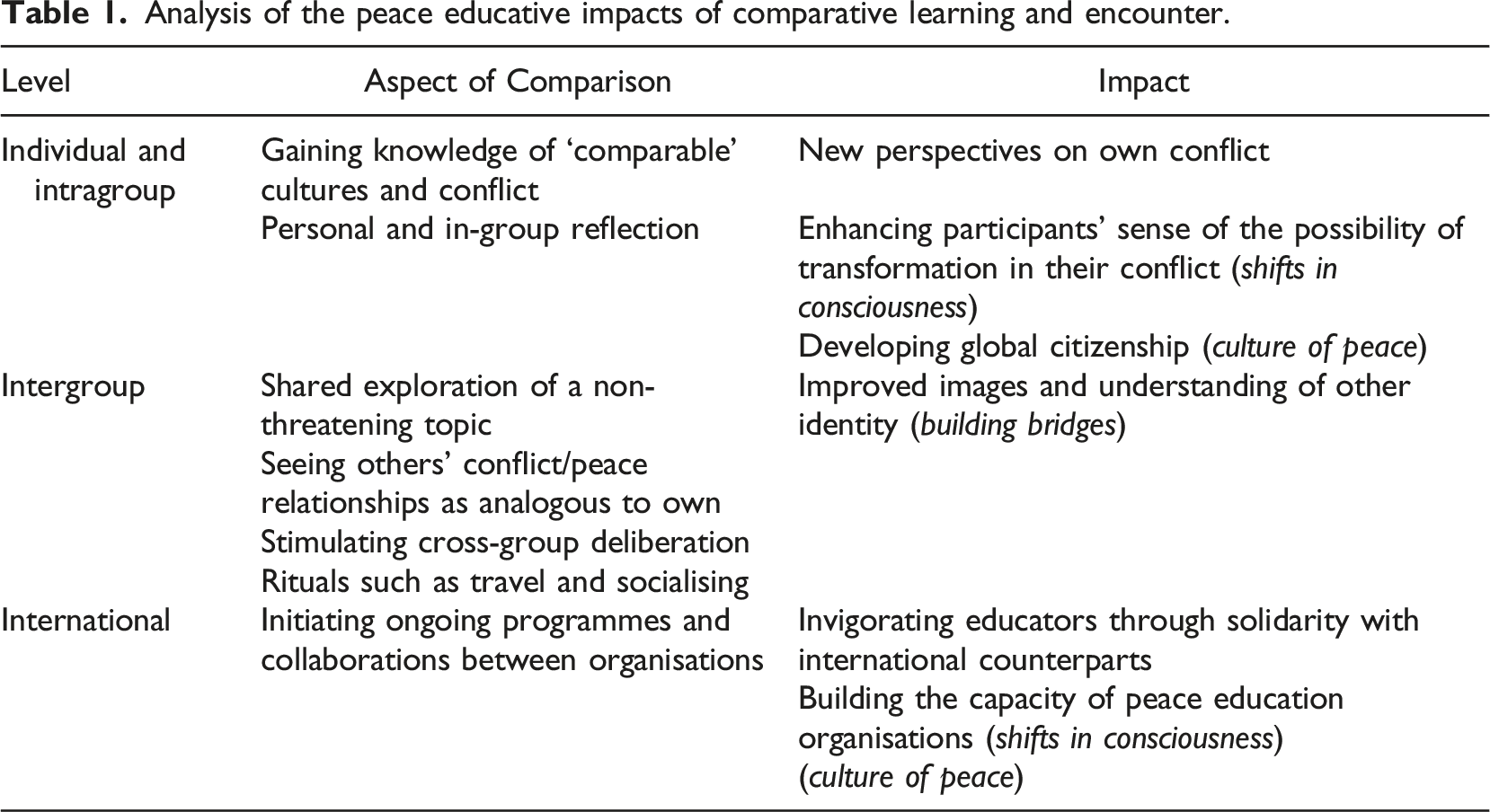
These impacts may be placed in terms of three theories of change underlying peace education in all its diversity: ‘building bridges theory’, ‘culture of peace theory’ and ‘shifts in consciousness theory’ (see Cromwell, 2022). As shown in Table 1, using comparative cases can support each mode of change.
Building bridges theory assumes that, as captured in the ‘contact hypothesis’ (Paluck et al., 2019; Allport, 1954), facilitating cooperative encounters between groups will lead them to develop more positive images of each other. While a peace education project can forge connections between people of different identities and backgrounds through vehicles such as sport, the arts, cultural identity discussions and so on, the exploration of a comparative case and encounters with people from another conflict setting may have a distinctive impact. They provide a ‘mirror’ through which participants can reflect on their own identities, experiences and conflict issues and begin to interrogate aspects of their societies which they had taken for granted. Indeed, exploration of the comparison case may be a less threatening, and more appealing and effective route to self-reflection than the direct confrontation of conflict issues. While the G4P partnership studied here did not involve young people visiting the other context, this is the hoped-for next step. Obviously, such an exchange would be a powerful opportunity for relationship-building through shared experience among a diverse group.
In culture of peace theory, peace education promotes thinking and behaviour supportive of non-violence and respect for life. Notably, it is expressed in the work of Elise Boulding (2000) and the United Nations’ ‘Declaration on a Culture of Peace’ (1999) which defines it as: ‘a set of values, attitudes, traditions and modes of behaviour and ways of life based on respect for life, ending of violence and promotion and practice of non-violence through education, dialogue and cooperation’. While non-violence is not explicitly a part of the comparative learning studied here, culture of peace theory is still relevant in that the cross-cultural contact inherent in comparative learning and relationships can promote attitudes of global citizenship and responsibility, as well as intercultural understanding. The organisational partnership also strengthened a mutual sense of a global civil society working against cultures of conflict and towards similar transformative goals in different locales. Moreover, a ‘culture of peace’ is also an ‘imaginative construction’ (De Rivera, 2010: 187) which can motivate people towards its realisation. The research emphasised the imaginative stimulation that came though comparative learning and how this deepened commitment to peace education.
Lastly, shifts in consciousness theory holds that peace education encourages learners to both become aware of the social structures they inhabit – what Paulo Freire (1970) called ‘conscientisation’ – and become empowered and optimistic that they can transform these structures towards peace, equality and justice. The research indicated the ‘shifts in consciousness’ that were possible: a greater sense of agency in addressing socio-political challenges, and a (re)commitment to the possibilities of peace education. Again, empowerment through a renewed imagining of the possibilities for peace is relevant, and recalls Lederach’s (2005) elaboration of imagination as an essential faculty of peacebuilding.
A comment may be made about the comparative commensurability of the cases themselves. Above, the key pitfall of comparison was noted, namely, transferring ‘lessons’ between cases which are too different. It might be expected that this problem could hamper the peace education work studied, with peace educators and participants from different contexts misunderstanding or unable to relate to each other, especially in cases like Ireland and Korea which are so starkly different in their natures and structures. The research showed these differences were not a barrier because the emphasis of the engagements was on open-ended sharing/learning and relationship-building. The organisations and educators involved were also like-minded in terms of working to promote similar values (such as conscientisation, peaceful conflict resolution and intercultural understanding). The differences between the two contexts also had pedagogical value. The engagements helped to highlight the particularity of the learners’ society and thus clarify ways to address identified problems. Northern Ireland also offered an aspirational analogy to Korean peace educators and participants, of a kind discussed in relation to rhetorical comparison above.
However, all this does not mean that peace education collaborations between any conflict-affected societies will be meaningful and productive. For instance, societies experiencing starkly different levels of development, or levels of direct or structural violence, may not be conducive to the kind of activity studied here. Further research, and perhaps experimentation in practice, would help to determine how and where international civil society peace partnerships might be best implemented.
In any case, the activity studied here does demonstrate how collaborations between civil society peacebuilders need not, and should not, impose models developed in one context on another context, nor seek to force an artificial sense of sameness. Their goal is to equip civil society peacebuilders to continue and extend their agency in their own context. In this way, this activity not only represents an innovative means of advancing the aims of peace education, but also is exemplary in terms of developments in contemporary peacebuilding theory and policy which foreground contextually embedded actors and processes. The once-dominant liberal peacebuilding paradigm – which held that state-level, and internationally assisted, liberal political and economic reforms would establish peace and order – has been critiqued via a phalanx of alternative visions emphasising, inter alia, local participation, the strategic cooperation of peace actors at all levels, gender justice and continuous experimentation and adaption (Richmond, 2019; De Coning, 2018; Duncanson, 2016; Lederach & Appleby, 2010).
The ‘reciprocal empowerment’ of peace educators in different contexts emerges from the sharing of knowledge and experience between people who are living in conflict. Rather than being based on external-internal relationships of dependency, it is based on the mutual self-interest of conflict-affected communities. It occurs through direct and horizontal relationships, digital and in-person, unmediated by states or international agencies. It eschews international templates or internationally driven policies. Such translocal peacebuilding entails a circular influence in which knowledge and capacities are fed back into each context. What results is peace agency which is locally relevant, legitimate and inclusive, while being fostered with and sustained by the moral support and input of actors elsewhere. In this way, the work studied here demonstrates, in practice, the United Nations’ 2016 reconceptualisation of peacebuilding as ‘sustaining peace’ (United Nations, 2016) which places responsibility on states and their citizens to shape, own and sustain their own unique peacebuilding processes.
Conclusion
This study has shown how, in addition to their analytical and rhetorical uses, conflict comparisons can be used to support conflict resolution. This is achieved, not by seeking, or mechanically applying, prescriptive ‘lessons’, but bringing cases, and actors based within those cases, into open-ended dialogue and relationship. Learning about other cases of protracted conflict and peacemaking through engaging with counterparts living in other conflict-affected societies can expand learners’ knowledge, understanding, skills and strategic repertoire in a manner which may contribute to the transformation of a conflict situation. This study of the interaction of peace educators in Ireland and Korea, including an ongoing peace education programme involving young people from both places, identified several advantages and some challenges. Overall, it showed how international comparative connections could enhance the work of the civil society peace organisations in a manner consistent with contemporary peacebuilding theory and policy which prioritises maximising local agencies for peace.
In terms of further research, three points may be made. First, as already noted, the natural next step is more focussed engagement with participants in comparative peace education projects. Having said that, based on this study, it may be inferred that the impacts on participants will be similar to the impacts on educators/facilitators reported here. In G4P, the influence was multidirectional, with facilitators from Ireland listening to the stories of both Korean facilitators and participants, and vice versa, and the impact on facilitators thought to influence both their work with their own participants and their commitment to the overall partnership. Second, more research is warranted on specific conflict/peace dyads. As set out above, the Ireland-Korea comparison yielded insights specific to that pairing. What is the potential of, and challenges to, comparative peace education collaborations among actors within different pairings? Third, and more broadly, this kind of work is likely to increase, making it an important topic for further and ongoing study. The research showed how pivotal online communication was to the connections formed between Ireland and Korea. Indeed, online connectivity dramatically expands the possibilities to translocal peacebuilding. While the internet has, for some decades now, facilitated cooperation between like-minded civil society organisations around the world, the pandemic catalysed a further revolution, making online video communication a normal part of everyday life. Accordingly, the possibilities for comparative learning and relationship between, not only peace educators, but all manner of peace process stakeholders, are almost limitless, making this a fertile area for further developments in research and practice.
Footnotes
Declaration of Conflicting Interests
The author(s) declared no potential conflicts of interest with respect to the research, authorship, and/or publication of this article.
Funding
The research for this article was carried out during the project, ‘Reconciliation: Perspectives from Korea, Ireland, and Beyond’, 2022-2023, in which David Mitchell was Principal Investigator. The project was funded by the Korea Foundation as part of its Policy Oriented Research Programme.
