




Abstract
The neo-Gramscian scholarship locates the agency of common sense in the reproduction of the hegemonic world order but under-theorises the underpinnings for dissimilar subaltern responses to common sense. This article draws on insights from Gramsci and anti-colonial thinkers to unpack three analytical categories for investigating subaltern consent and dissent in hegemonic orders. These analytical categories offer a tripartite framework which maintains the central theoretical argument that the key underlying rationale why some subaltern social groups consent to the hegemonic order while others dissent from the same order could be found in the subaltern past experience, (non)commitment to alternative ideologies and level of socio-political consciousness. Essentially, the article contributes to the theoretical discussion of the re/unmaking of hegemony and demonstrates how neo-Gramscian analysts could further reconnect with Gramsci and engage the postcolonial literature to enhance our understanding of the continuity and disruption of hegemonic orders in the world periphery.
Introduction
The subject of hegemony and hegemonic orders has become an important theme of theoretical discourse in International Relations (IR) (Gilpin, 1981; Keohane, 1984; Dutkiewicz et al., 2021). Mainly from the early 1980s, the neo-Gramscian scholarship made its way into this conversation and made a far-reaching contribution to what constitutes hegemony and how hegemonic ordering operates in world politics (Cox, 1981; Cox, 1983a; Gill, 1986; Morton, 2003). Being grounded in Antonio Gramsci’s thoughts, this scholarship brought a needed innovation to the conceptualisation of hegemony by presenting a more nuanced analysis that uncovers the weak spots of the conventional neo-realist and neo-liberal readings. Unlike its neo-realist and neo-liberal rivals, which situate hegemony solely within the confines of interstate relations and thereby conceptualise it as ‘dominance of one country over others’, it locates hegemony within the global society and delineates it as an ideological leadership in the realm of global superstructures (Cox, 1983b, pp. 170–171; Cox, 1981, p. 139; Cox, 1992a, p. 264). In the same way, it moves beyond the orthodox domain of relative possession of coercive material powers by a state to situate the reality of a hegemonic order in the extent to which the social order created by the dominant social group generates a widespread (unquestioned) acceptance (Cox, 1989). More specifically, this literature advances an important theoretical standpoint by averring that what reproduces the hegemonic world order – that is, the prevailing way things usually happen – is the social forces of its common sense (Cox, 1981, pp. 151–152). The argument is that the hegemonic world order is embedded in specific historical and social structures, which often gain the consent of nonhegemonic actors to support the same order. Making this point unequivocal, Robert Cox contends that a hegemonic order is sustained by its capacity to acquire the acquiescence of nonhegemonic actors through the instrumentality of historical intersubjective structure, which often ‘imposes [structural] pressures and constraints’ (Cox, 1992b, p. 179; Cox, 1981, p. 135). Ted Hopf (2013, p. 321) equally argues that a ‘[h]egemonic power is maximized [in recreating itself] to the extent that… [its] ideas become taken for granted by the dominant population’. Reinforcing a similar assertion, Adam Morton (2003, p. 156) contends that a hegemonic order is maintained by appearing ‘as an expression of broadly based consent manifest in the acceptance of [its] ideas’. However, while the significance of this analysis cannot be over-emphasised in the broader theoretical conversations about the reproductive mechanism of hegemony, it does not help us grasp why variations exist in the subaltern responses to common sense of hegemonic orders in world politics.
The need to pay more attention to this aspect of the discourse is twofold. First, consent to the prevailing socio-political order, as constructed by the dominant social group, is never universal. A typical illustration could be found in the recent dissimilar non-Western reactions to the hegemonic Western liberal order – I use the liberal world order here in the context of its (normative) post–Cold War hegemony and not in the context of its post-hegemony as discussed in Acharya’s (2017) work. While it is tenable to argue that common sense plays a key role in gaining consent for remaking the hegemonic world order, the same theoretical argument does not provide a lens for accounting for the local dynamics that shape whether or not a subaltern group would embrace the hegemonic way of doing. In other words, the consent to hegemony, and compliance to its prescribed normative standards on the part of nonhegemonic actors, does not automatically happen at the level of structural causation. Some analysts, for instance, have shown how a few non-Western actors dissented from the hegemonic Western liberal order (Cooley, 2019; Goh, 2019). Lehti and Pennanen (2020, p. 29) assert, in this regard, that ‘[c]onsent for an order is never universal’. Even Cox argues that ‘individuals and groups may move with the pressures [of hegemony] or resist and oppose them’ (Cox, 1981, p. 135). It is, therefore, necessary to open up a conversation that would elucidate the contextual realities that work together to facilitate or stifle the subaltern agency in the hegemonic (re-)ordering project. Such a theoretical discussion would offer a pathway for studying and conceptualising consent and resistance to hegemony from the standpoint of subaltern actors who are often side-lined in analysing the continuity, resilience and decline of global hegemonic orders (Lehti & Pennanen, 2020, p. 28). Second, while relative material capability is crucial in constructing the hegemonic world order, empirical evidence shows that it does not offer a framework for pinning down why acquiescence and resistance to that order fragmented along certain lines and not the others in the subaltern worlds. It, therefore, means that further analytical interventions are needed to navigate why variations occur in the outcomes of the subaltern encounter with the prevailing ideological order.
This article responds to this gap to contribute to the broad conversation on the re/unmaking of hegemonic orders in world politics. It is basically a theoretical piece and does not necessarily aim at presenting a critique of the neo-Gramscian analysis. Following Gruffydd Jones (2008), the article draws on insights from Gramsci and the postcolonial literature to unpack three analytical categories for investigating and comprehending consent and dissent from the standpoint of the nonhegemonic actors. It undertakes this task in two major steps. First, it unearths the limit associated with the epistemological claim in the neo-Gramscian literature about common sense as the central mechanism for winning the consent of the subaltern towards the reproduction of the ideological hegemony of the dominant social group. Of course, by common sense in this article, I mean the ‘way of perceiving and understanding the world that has become “common” in a given epoch’ (Gramsci, 1971, p. 322/3). Second, and more importantly, it builds on thoughts from Gramsci and anti-colonial thinkers to develop a tripartite framework for exploring the micro-politics of dissimilar responses of subaltern groups to the hegemonic order. A subaltern social group is a politically and socially marginalised group in the construction of the hegemonic order, and examples of this group in the case of the hegemonic liberal world order include the Chinese, African and Indian political elites. The framework I advance in this article contends that three analytical categories are central when investigating and deconstructing the outcome of a subaltern encounter with the technologies of common sense. In this case, the central theoretical argument is that the key underlying rationale why some subaltern social groups consent to the hegemonic order while others dissent from the same order could be found in the subaltern’s past experience, (non)commitment to alternative ideologies and level of socio-political consciousness. Fundamentally, the article contributes to the theoretical analysis of the re/unmaking of hegemony in global politics. It demonstrates how analysts could further reconnect with Gramsci and engage the postcolonial literature to enhance our understanding of the continuity and disruption of hegemonic orders in the world periphery. It equally offers heuristic analytical categories for analysts to open up the ‘black box’ and delve into why the recruiting efficacy of common sense (may) succeed(s) in certain subaltern contexts but not the others.
Revisiting the Neo-Gramscian Theorising of Hegemony and Hegemonic Orders
The neo-Gramscian IR theoretical scholarship provides an intriguing theorisation of hegemony that takes the debate from the domain of ‘the international’ to the realm of ‘the global’ (Morton, 2003, p. 157). Informed by its novelty and thought-provoking perspectives, the neo-Gramscian account of hegemony could no more be neglected in the matrix of ways to think about hegemony and hegemonic orders in the contemporary global society. In a Gramscian sense, hegemony (within a world order) occurs when the ideological, political and intellectual values held by a particular social group turn out to be the prevailing ordering principles, widely accepted not only by the same social group but also by other (nonhegemonic) social groups (Morton, 2007, p. 113). In this case, a hegemonic (world) order entails the ‘intellectual and moral leadership’ of a particular social group where the group’s constitutive political and ideological standards become diffused as a ‘taken-for-granted’ natural way of thinking and doing (Cox, 1993, p. 264; Femia, 1981; Mantzari & Georgiou, 2019, p. 73). The operative realities of the hegemonic world order do basically manifest within the confines of the global superstructure, which allows the perpetuation of unifying thinking and, therefore, a domineering normative order with the consent of varying nonhegemonic actors (Mouffe, 1979, 197; Femia, 1981, p. 29). Accordingly, the operation of hegemony is not mainly within the realm of political society, which is directly controlled by ‘the State’ but rather within the confines of the civil society, a different superstructure that involves the larger public. Even though the two superstructures have operational and organisational interconnections, the expression and evidence of hegemony are mainly within the latter’s domain (Morton, 2000, p. 257; Gramsci, 1971, p. 12).
In any case, what constitutes hegemony is not merely the possession of disproportionate material powers by a social group but by the extent to which its constructed ordering project received popular acceptance across the global political and civil society (Cox, 1989, p. 42; Cox, 1981, p. 139; Hopf, 2013, p. 321). In other words, the practical demonstration of the hegemonic world order is not just ‘the dominance of one country [or a social group] over others’, through the exercise of coercive material powers (Cox, 1983a, p. 170). Rather, and more importantly, it demands adding popular consent that foregrounds the state or group’s ‘intellectual and moral leadership’ (Gramsci, 1971, p. 57). To this end, even if a social group can (or does) exercise material power via the state apparatuses based on its economic and political capability, such a practice alone does not amount to hegemony. For hegemony to take place within a world order, such a dominant social group must demonstrate leadership in a way that shows the general acceptability of its ideological vision(s) (Taylor, 2000, p. 51; Mouffe, 1979, p. 181). Hegemony is, thus, only attained by a social group at a point when the group’s conception of the world ‘transformed into an intersubjectively constituted reality’ (Cox, 1994, p. 336) by appearing to embody ‘an expression of broadly based consent’ and a universal aspiration of all (Morton, 2007, p. 113). Therefore, Robert Cox postulates that hegemony depicts a kind of dominance, but which is concealed by appearing to be ‘the natural order of things’ (Cox, 1994, p. 336).
As a development connected to historical materialism, every hegemonic order is a product of history. Robert Cox argues in this regard that hegemonic orders are ‘themselves products of history’ and ‘human responses to material environment’ (Cox, 1989, p. 38). For him, they are fundamentally a ‘fit between material power, ideology and institutions’ in a historical moment (Cox, 1981, p. 141). The hegemonic world order is normally constructed through the collaboration between a historic bloc and its organic intellectuals. Once a hegemonic world order is created, it (in turn) acts as a social force to legitimate a particular set of values, standards and practices. It works as a kind of ‘invisible’ structural force for creating intersubjectivity of meanings around the norms historically presented by the dominant social group to empower these norms to prevail as the natural standards for defining acceptable practices. It creates moral and institutional structures that command conformist behaviour and practices across diverse civilisations through the enforcing instrumentality of supposed consensus (Femia, 1981, p. 38; Cox, 1983b, p. 164). Therefore, to Robert Cox, ‘Hegemony [in reality] frames thought and… circumscribes action’ (Cox, 1992a, p. 179). Yet, a hegemonic world order demands a continuous (re)construction (Adamson, 1980, p. 174). This is because the dominance of a particular mode of thinking is not the same as the absence of alternative social visions and civilisations. Rather, it is merely a reflection of the current capacity of the prevailing order to hamper the widespread acceptance of alternative ordering ideas.
This ‘Gramscian way of thinking’ about hegemony offers a more nuanced epistemological prism for ‘analysing the [hegemonic] restructuring of social relations’ in the world society (Bieler & Morton, 2001, p. 13). Certainly, this is not to suggest that its dissection of hegemony in the global setting is above criticisms. As a matter of fact, a few scholars have drawn attention to some of its weak points (see, for instance, Germain & Kenny, 1998). Notwithstanding its possible shortcomings, in my view, its analysis provides a compelling vantage point for visualising ideological leadership and intellectual dominance in world politics and in the disciplinary field of IR. It presents a useful critical framework for understanding ‘the development of hegemony historically’ (Bieler & Morton, 2014, p. 215) and for uncovering, characterising and deconstructing the dynamics of ideological power formation at the level of the global superstructure which conveniently ‘frames thought[s] and… circumscribe action[s]’ across different civilisations (Cox, 1992a, p. 179). As a critical heuristic tool, the neo-Gramscian discourse of hegemony empowers analysts to ‘take a more nuanced understanding of dominance and power in [world] politics’ (Taylor, 2000, p. 51) and allows them to stand ‘apart from the prevailing order of the world and asks how that order came about’ (Cox, 1981, p. 129). Moreover, it provides a framework for making sense of the existence of hegemony as not only a function of what transpired among states but also the popular acceptance of a particular social vision as historically devised by the historic bloc in the course of passive revolution (Lehti & Pennanen, 2020, p. 29).
Social Forces of Common Sense in the Remaking of Hegemonic World Orders
A central conundrum that many IR theorists attempt to grapple with within the context of world hegemony is how the most influential social group sustains the resilience of its hegemonic ideological order outside the application of coercion. Of course, the necessity for this type of curiosity cannot be over-emphasised since the uncovering of this process offers an analytical prism for exposing the hidden structural incentives that perpetuate the dominant way of thinking (as historically devised by the dominant social group) beyond the invocation of coercive measures. Neo-Gramscian analysts have been at the forefront of this sociological inquiry. An effort to account for the hegemonic (re)production in the global society was carried out by Robert Cox. As a critical thinker, Robert Cox sees the hegemonic world order as basically a congruence between material capabilities, ideas and institutions, but which is nonetheless an outcome of a historical (re)production process (Cox, 1981, p. 139). To be specific, the term ‘production’ is used here in a broad sense as it involves how the dominant knowledge ‘of the social relations, morals, and institutions’ is crafted (Cox, 1989, p. 39). For Robert Cox, a mechanism through which the hegemonic mode of thinking, doing and practice is expressed and preserved is the international organisation (Cox, 1983a, p. 172). In his analysis, international organisations in their varying forms announce, preserve and reproduce the hegemonic world order by embodying the rule of the order, legitimising its ideological and normative visions, co-opting elites of nonhegemonic social groups and absorbing counterhegemonic ideas. According to Robert Cox, this turned out to be the case because the leading global international organisations fundamentally reflect the ‘orientations favourable to the dominant social and economic forces’ of the historic bloc (Cox, 1983b).
However, while this analysis is not without its value, it has been censured for neglecting the sociological mechanism of common sense as the central operative framework that reproduces the prevailing world order (Hopf, 2013, pp. 320–321). This could not have been otherwise, as Robert Cox had equally previously captured the same causal reality via his elucidation of historical structures and social forces in world ordering (Cox, 1981, p. 135). In other words, there is a consensus within this discussion that the dominant social group often maintains its hegemony and, therefore, its established hegemonic order by remodelling its ideological vision into common sense. As a conceptual frame, common sense represents the prevailing beliefs shared by the generality of actors in a given historical period (Gramsci, 1971, p. 323). It constitutes the ‘way of perceiving and understanding the world that has become “common” in any given epoch’ (Gramsci, 1971, pp. 322, 323). It embodies the popular way of thinking at a given time and, thus, a taken-for-granted truth (Hopf, 2013, p. 321). It symbolises the folklore of philosophy and takes manifold forms (Gramsci, 1971, p. 419). It is the ‘philosophy of non-philosophers’ and ‘spontaneous philosophy of the multitude’ (Gramsci, 1971, pp. 419, 421). On the whole, common sense is a ‘syncretic historical residue’ (Rupert, 2003, p. 185) and ‘a conception of the world mechanically imposed by the external environment, i.e.[,] by one of the many social groups’ (Gramsci, 1971, p. 323).
Drawing on these insights, the existing analysis is unequivocal on how the transmutation of the ideology of the dominant social group into common sense often acts as functional social forces for (re)creating the widespread consent that sustains the group’s hegemony. Analysts argue from this standpoint that the structural forces of common sense do function to affirm and uphold the hegemonic order and, thereby, ensure conformity on the part of nonhegemonic social groups. Gramsci, for instance, contends that ‘[t]he “spontaneous” consent given by the great masses of the population to the general direction imposed on social life by the dominant fundamental group’ usually perpetuates hegemony that ‘presupposes a certain collaboration’ (Gramsci, 1971, pp. 12, 271). Robert Cox also asserts that the maintenance of a hegemonic world order lies in its capacity to acquire the acquiescence of nonhegemonic actors through its historical and social structures of intersubjectivity that often ‘imposes [structural] pressures and constraints’ (Cox, 1981, p. 135). Arguing from the same vantage point, Ted Hopf avers that ‘for any hegemonic project to succeed it must make compromises with common sense’ (Hopf, 2013, p. 323). In this regard, it is agreed that common sense works as a medium for shaping the direction of everyday practices (Hall & O'shea, 2013, pp. 9, 10). In other words, it serves as the social structure for sustaining a hegemonic order by preventing non-dominant social actors from operating within the milieu of alternative ideologies (Taylor, 2010, p. 166). In their contribution to this theorisation, Enrico Augelli and Craig Murphy maintain that the ‘clutter of common sense makes critical reflection difficult’ (Augelli & Murphy, 1988, p. 20), and Green and Ives argue that common sense hinders ‘the ability of subaltern groups to assert political autonomy’ (Green & Ives, 2009, p. 9).
This article shares this theoretical standpoint that consent to the social prescriptions of common sense is at the centre of what explains the resilience of any hegemonic order. The focus on historical-social structures when theorising the continuity of hegemony in world politics is not mistaken insofar as they embody the major conduits for remoulding widespread conformist interests that make the prevailing order ‘appear[ing] to most actors as the natural order’ (Cox, 1992b/1996, p. 151). In this case, the pathway to elaborate the sustenance of the hegemonic world order ‘cannot but start in the first place from common sense’ (Gramsci, 1971, p. 425). Having an idea about how common sense works structurally to prescribe actions is elemental for unravelling the social reproduction process of hegemony at a given time. However, what is under-theorised in this conversation, which underscored the need for this intervention, is the issue of puzzling dissimilar subaltern reactions to the recruiting forces of common sense. It is important to throw light on this aspect of the discourse since the outcomes of nonhegemonic encounters with hegemony are not always the same. Edward Said (1994, p. 186) was very clear on this phenomenon when he noted that ‘No vision… has total hegemony over its domain… [as] there are always resistances’. Marko Lehti and Pennanen (2020, p. 29) also buttress a similar point when they opine that ‘[c]onsent for an order is never universal’.
An integral component of the issue raised in different efforts to critique the neo-Gramscian analysis of hegemony and hegemonic ordering centred on its inability to provide a framework for casting light on the realities beyond the structural processes and mechanisms. James Scott is one of the leading scholars who pointed attention to this subject. For Scott (1990), the theory of hegemony and its reproduction, as provided by neo-Gramscians, does not offer a lens for disentangling whether the hegemonic ordering will perpetually prevail and how changes to its normative order could emanate from the subordinates in the periphery. More specifically, he avers that the analysis lacks a pathway to explain whether ‘hegemony has often prevailed’ and ‘how changes could ever originate from below’ (Scott, 1990, p. 78). Fundamentally, this assessment unearths how the macro analysis of the workings of hegemony as provided by the neo-Gramscians fails to offer insights into the un/remaking of hegemony from the subject position of the subaltern. Owen Worth raises a similar concern in his critique of the no-Gramscian account of hegemony. Worth (2009, p. 20) shares the view that its theoretical exploration is largely top-down and turns a blind eye to some crucial complexities. He submits, accordingly, that it is pertinent for neo-Gramscian theorists ‘to imagine a more generic account of hegemony that fully allows for contrasting and contradictory practices’ within a given hegemonic world order (Worth, 2009, p. 31). A similar conclusion could be found in Persaud’s (2016, p. 549) contention that the neo-Gramscian theoretical reading must go ‘beyond ideas and culture restricted to processes of legitimation’. What is explicitly agreed in this critique is the necessity for the disciplinary theorisation of hegemony to provide a framework of hegemonic (dis)ordering that is sufficient to connect the macro and micro realities.
Towards a Conceptualisation of Consent and Dissent in World Hegemony
Unless analysts are equipped with suitable heuristic tools, they will encounter difficulty in their attempt to disaggregate how subaltern responses to common sense ‘fractured along certain lines and [but not] in certain directions’ (Gramsci, 1971, p. 327). This is part of why a critical thinker advises that ‘critical theory must continually adjust its concepts to the changing object it seeks to understand and explain’ (Cox, 1981, p. 129). Having assurance in the significance of such an undertaking, David Vital (1969, p. 151) asserts that ‘the most fruitful and original work is therefore precisely that which suggests new frameworks [and] new manners of ordering observations’. In this section, I advance a conceptual framework for comprehending why dissimilarities materialise in how non-dominant actors react to the co-opting forces of the hegemony. More specifically, I unpack three analytical categories that are elemental when investigating the outcome of a subaltern interaction with common sense. These analytical tools are (i) past experience, (ii) alternative ideologies and (iii) socio-political consciousness. The combination – and not just one – of these variables offers a coherent vantage point to think more broadly about why hegemonic world orders find easy acceptance in certain subaltern societies and not the others. A schematic representation of these interactions is shown in Figure 1. It needs to be emphasised that the derivation of these conceptual tools is not a function of mere conjecture or speculation. Rather, it is a product of my close engagement with Gramsci and postcolonial minds. In addition to Gramsci, thinkers like Frantz Fanon and Edward Said have illuminating perspectives on what facilitates and hinders the continuity of hegemony from the standpoint of the Subaltern. Unfortunately, these ideas have not been taken seriously in the broad theoretical discussion of the un/remaking of hegemonic world orders. I fundamentally reconnect with these ideas in this section to demonstrate how the current analysis of hegemonic ordering could benefit from Gramsci and postcolonial theorising. In what follows, I explore each aspect of this conceptualisation. Hegemonic orders, consent and dissent.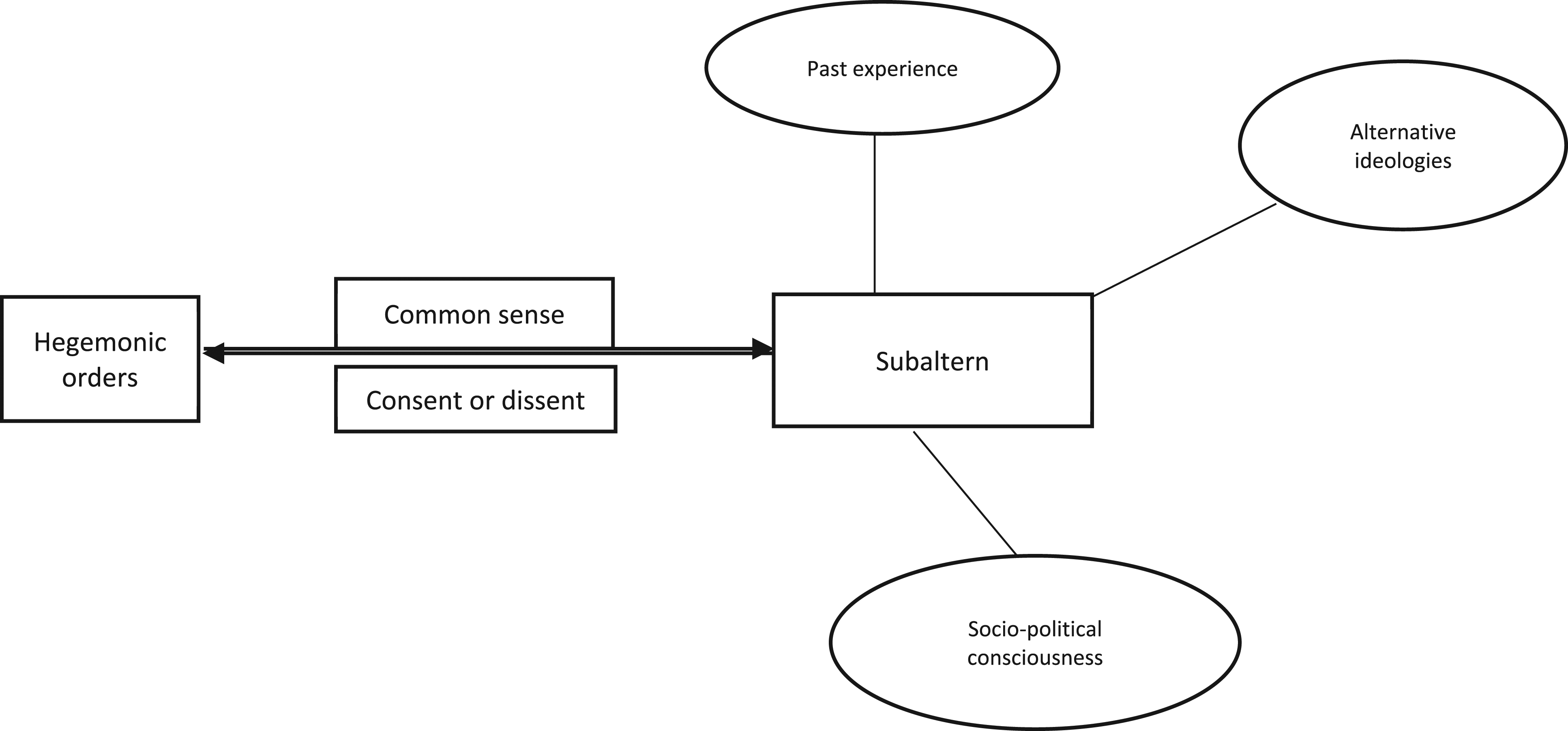
Past Experience
The reality of today is a product of yesterday and, therefore, could be rarely disentangled from the experience of the past. Even though they have different analytical standpoints, both Fanon and Gramsci shared this viewpoint. Fanon (1963, p. 69), for instance, notes that ‘We must also notice… the role played by the history’. Gramsci (1971, p. 324) also argues that any attempt to study a person’s conception of the world should not forget that every individual is ‘a product of the historical process to date’. In this case, when analysing the disposition of a subaltern group to common sense of the prevailing order, one of the subjects that demand delving into is the issue of the group’s past experience. An illuminating question that is worth broaching is to what extent have these actors been subjected to the technologies of dispossession in the recent past, especially in the areas of their ways of being and doing? This is particularly because different subaltern social groups are with different historical experiences. Whereas some were privileged to escape a direct and prolonged devastating domination of external forces, others were historically dehumanised and subjugated by the imperial power of civilising missions. In the latter case, to different degrees, it was an encounter that allowed the watering down of the affected actors’ ways of life, being and doing. No matter how ineffective it looks, the nonhegemonic actors with such a history of socio-political dispossession are more susceptible to consenting to common sense than their counterparts who escaped such a traumatic ordeal.
The past reality of coordinated dispossession is especially applicable to the previously colonised communities in the global South. Many anti-colonial thinkers have been vocal in narrating the dehumanising horror and the enduring impact of colonialism. This set of analysts provides an illuminating lens for understanding how Western colonisers disrupted diverse non-Western civilisations and socio-political projects to varying degrees in recent history. One of the leading figures in this intellectual undertaking is Frantz Fanon. Fanon was very emphatic and head-on in underscoring the disempowering technologies of colonialism in the realms of the past, present and future. He notes expressly in this regard that ‘colonialism is not simply content to impose its rule upon the present and the future of a dominated country. Colonialism is not satisfied merely with holding a people in its grip and emptying the native’s brain of all form and content. By a kind of perverted logic, it turns to the past of the oppressed people, and distorts, disfigures, and destroys it’ (Fanon, 1963, p. 210). Edward Said’s account does not contradict Fanon’s position on this subject matter. For Said (1994, p. 9), colonialism was not just an instrument of accumulation and acquisition but that of ideological and epistemological formations and assimilation. Leading political figures in the ex-colonial world have not been silent in unearthing the divesting mission and legacy of past colonialism. In 1994, for instance, at the Sixth Pan-African Congress, President Ahmed Sekou Toure asserted that ‘The pre-colonial period witnessed the grandeur of flourishing civilizations… But this free development was brutally interrupted by the aggression of European imperialist powers’ (Campbell, 1975, p. 72). Looking at it from this perspective, it is not surprising today to see the English language serving as the lingua franca in the Indian, Nigerian and South African societies while the same is not the case in the Chinese and Ethiopian societies.
Essentially, it would be a mistake to neglect the past erasing and re-ordering project of colonialism when analysing which subaltern consents to hegemony and which one dissent. In other words, no account of the modern global politics of power, domination and receptivity/resistance would be complete without considering the past constructions of European colonialism. Colonialism was a conscious transformative project that went deep into institutional structures of its object to expunge, alter and re-configure its social and political worlds. The category of the subaltern who underwent the ordeal of colonial subjugation and its civilising mission for close to (or more than) a century lost a significant aspect of their cultures, civilisations and ways of life (Spivak, 1988). Thus, as Fanon (1963, p. 246) observed, the political independence of the colonised was both a ‘disappearance of colonialism’ and a ‘disappearance of the colonized man’. It is the recognition of this constitutive divesting phenomenon that prompted Gayatri Spivak (1988) to conclude that the colonised subaltern cannot speak outside the language of hegemony.
Beyond a mere theoretical exploration, a wide range of investigations has illustrated how the dispossessing functionality of past projects shaped the contemporary affairs of many non-dominant social groups. Ndirangu Mwaura, for instance, employs this analytical tool to zoom in on empirical developments in Africa. As a conclusion to his findings, Mwaura (2005, p. 5) argues that although many African societies reclaimed their political independence a few decades ago, their postcolonial practices are far from reclaiming independence. This contention does not in any way negate the submission by Sabelo Ndlovu-Gatsheni. For Ndlovu-Gatsheni (2013, pp. 3, 38), the past colonial encounters for different African communities allowed a situation of ‘postcolonial neocolonized world’ with ‘the inscription of hegemonic Western forms of knowledge… [that pushes] African forms of knowledge into the barbarian margins’. The same footprint of the subjugation had been observed elsewhere. Aimé Césaire (1972 [1955], p. 6), for instance, brings attention to how colonisation stifled Indian civilisations. Also, in The Intimate Enemy, Ashis Nandy (1983, p. 31) further demonstrates how colonialism deeply impacted Indian society. It is on this basis that Mustapha Pasha (2013, p. 147) argues that ‘[n]o aspect of the postcolonial world has remained untouched by the dialectic of colonial domination/subordination’. As a caveat, this is not to suggest that the efficacy of colonialism as a dispossessing project was total or absolute. On the contrary, this is far from the case. Homi Bhabha (1994), for example, was very unambiguous in showing the eventual hybridity and metonym of presence across different sites of the postcolonial world. What cannot be disputed, however, is how the theoretical discourse of hybridity gave credence to the alteration of the previous social practices and ways of being (Abrahamsen, 2003, p. 204). What this legacy does, in essence, is that it distorts the terrain through which the affected subalterns could engage the prevailing order as created by the dominant social group. Thus, Abrahamsen (2003, p. 195) concludes that ‘The colonial experience is… crucial to an understanding of contemporary politics’.
The fundamental point here is that history matters in the overall deconstruction of who participates in or rejects the hegemonic way of doing. The past experience of a subaltern social group, whether it reflects dispossession or not, is one of the cardinal tripartite underpinnings that shape the extent to which the group would commit to the prevailing ordering project of the historic bloc. Worrying about how the past subjugations and conquest might be neglected in the modern analysis of the subaltern disposition to social order, Gyan Prakash (1995, pp. 3–4) laments how ‘the colonial aftermath does not appear as a narrative framed by the hierarchical knowledges and subjects instituted by Western domination’. The assimilating and civilising mission of colonialism cannot be neglected in the discourse of the contemporary formation of consent and dissent regarding the dominant Western liberal order. The importance of evoking the past experience as a component of analytical categories for comprehending the dissimilar responses to common sense is informed by the fact that it is history that ‘shows how thought has been elaborated over the centuries and what a collective effort has gone into the creation of our present method of thought’ (Gramsci, 1971, p. 327).
Alternative Ideologies
The second conceptual gateway through which analysts could untangle the rationale for consent or dissent in the subaltern encounter with common sense revolves around the issue of commitment or non-commitment to alternative ideologies. Insights from Gramsci are particularly useful to elaborate on this analytical category. Before I proceed, however, it is necessary to first disentangle worldviews from ideologies. According to Gramsci (1971, p. 324), a worldview is basically ‘one’s conception of the world’. Luk Van Langenhove (2004, p. 96) notes in this regard that it can be described as ‘a certain “lens” used to look at the world’. Knowingly or unknowingly, every individual has a specific conception of the world. Gramsci (1971, p. 323) notes in this context ‘that everyone is a philosopher… since even in the slightest manifestation of any intellectual activity whatever, in “language”, there is contained a specific conception of the world’. Whether explicit or implicit, this ownership of a specific worldview by every individual equally applies to every categorised social group. Thomas Tieku (2012, pp. 36–50), for instance, shows a distinction between the individualist and collectivist worldviews. For him, while actors in the global West hold an individualist worldview, which prioritises individuality in social relations, actors on the African continent hold a collectivist worldview, which puts a premium on collectivist social relations (Tieku, 2012). Nonetheless, what needs to be pointed out here is that a worldview is not necessarily the same as an ideology. Whereas an ideology could be derived from a specific worldview, it constitutes the highest expression of ideas which connect theoretical formulations to practices. Hence, in trying to elucidate the connection between a mere conception of the world (i.e. worldview) and ideology, Gramsci notes that: One might say “ideology” here, but on [the] condition that the word is used in its highest sense of a conception of the world that is implicitly manifest in art, in law, in economic activity and in all manifestations of individual and collective life (Gramsci, 1971, p. 328).
In this case, an ideology demands a clear (re-)articulation with potency to be manifested in the ways of life. An ideology is, therefore, the ‘science of ideas’ or as ‘system of ideas’ (Gramsci, 1971, p. 376). It is in this context that Gramsci moves away from the earlier analysis of Marx and Engels to contend that ideologies are not only ‘real’ – as against illusion – in the configurations of societies (Taylor, 2000), but that they constitute ‘material forces’ for shaping the actual pattern of behaviour and actions in socio-political and economic realms of the society (Gramsci, 1971, p. 165). This is because, for him, ideologies ‘have a validity which is “psychological”; they “organise” human masses, and create the terrain on which men move’ (Gramsci, 1971, p. 377).
In every context of a hegemonic ideology, there is always room for alternative ideologies under the conceptual rubric of ‘good sense’. By its very nature, an alternative ideology usually constitutes an expression of ‘a criticism of the “common sense”’ (Gramsci, 1971, p. 330). It does not necessarily need to maintain a stark opposition to all the ideas ingrained in the prevailing order but an expression of the necessity to rework the dominant ways of thinking and doing (Hunt, 1990, p. 313). To this end, having an alternative ideology ‘is not a question of introducing from scratch a scientific form of thought… but of renovating and making “critical” an already existing activity’ (Gramsci, 1971, p. 331). Such an alternative way of envisioning social and institutional practices may be unpopular and likely to have limited advocates, but this does not mean it is inferior to the hegemonic order in solving human and societal problems. The key theoretical point here is that when a subaltern group embraces an alternative ideology of order, it has a way of shaping the group’s socio-political practices. The subaltern actors with alternative ideologies are likely to engage in epistemic disobedience regarding the prescriptions of the hegemonic order and its common sense. This analytical standpoint could be substantiated with empirical evidence. An instance of how a commitment to alternative ideological visions worked to facilitate subaltern dissent from conforming to the order created by the dominant social group could be seen in the Tanzanian society under the leadership of President Julius Nyerere. In 1962, Julius Nyerere championed a philosophical undertaking that culminated in the articulation of the ideology of Ujamaa, otherwise known as African socialism (Nyerere, 1968). As a distinct system of ideas, Ujamaa embodies a criticism and reworking of the two major ideologies during this time (i.e. Western capitalism and Soviet Socialism). As Nyerere (1968, p. 12) pointed out, ‘It is opposed to capitalism, which seeks to build a happy society on the basis of the exploitation of man by man; and it is equally opposed to doctrinaire socialism which seeks to build its happy society on a philosophy of inevitable conflict between man and man’. As Tanzanians embraced the socio-political and economic ideas embedded in Ujamaa, especially between 1967 and 1985, they embarked on a governance system that prioritised the ethics of African socialism at the expense of the dictates of the dominant capitalist democracy (Cliffe & Saul, 1972; Lal, 2015). A few commentators have not hesitated to draw attention to this social fact. This development, for instance, prompted Arrighi and Saul (1972, p. 3) to aver that ‘Tanzanian is, perhaps, the [only] country in contemporary Africa where socialist aspirations figure most prominently… and most powerfully affect the kind of policies which are being pursued’. This reality could also be spotted in the Chinese society. The Chinese political elites, especially from 1949, have not concealed their resolved commitment to specific socio-political ideologies that directly conflict with the dominant liberal ideology. As Xuetong (2018, p. 7) pointed out, Marxism has been ‘the official ideology of the Chinese Communist Party’. It is, therefore, not surprising that, unlike many subaltern groups, Chinese political actors unequivocally dissented from the liberal political order during its heydays in the aftermath of the Cold War. Today, it is no more a doubt that many Western politicians are raising concerns about the threat to the liberal order in the context of the rise of China (Reus-Smit, 2017, p. 881).
On the contrary, this is unlikely to be the case when a subaltern society does not have or embrace an alternative ideology that is coherent enough to guide its socio-political practices. Kwame Nkrumah (1965, p. 254) once noted that the pre-condition for resisting the hegemonic (neo-colonial) structures ‘is to develop ideological clarity among the anti-imperialist, anti-colonialist, [and] pro-liberation masses’. The subaltern group that does not subscribe to a specific alternative ordering paradigm will not be able to resist the reception of hegemony by the time its common sense exerts its social pressures. In other words, the subaltern with no different ideological standpoint, particularly when placed side-by-side with conventional reasoning, will find it uneasy to dissent from the prevailing way of doing, as invented by the historic bloc. The high propensity for consent in this circumstance, as Gramsci (1971, p. 419) reminds us, is premised on the fact that ‘the philosophy of common sense… is the “philosophy of non-philosophers”’. Looking at it from this lens, it is not surprising that during its heydays in the wake of the Cold War, the Western liberal order gained consent across many non-Western societies in the global South.
Socio-Political Consciousness
The third component of this conceptual framework concerns the socio-political consciousness of the subaltern. The theoretical ideas from postcolonial minds are very helpful in elaborating the centrality of consciousness in the variables shaping the upshot of the subaltern reaction to the co-opting social forces of hegemonic orders. In The Wretched of the Earth, Fanon enunciates the salience of socio-political consciousness as an instrument for epistemic, ideological and cultural liberation in the present global modernity. To this end, he expressly advised the subaltern peoples who envision total liberation from the domineering neo-imperial structures to not only strive for nationalism but should equally venture into the politics of socio-political consciousness – an undertaking which involves having accurate knowledge of the global matrix of power. More specifically, while admonishing the subaltern, Fanon (1963, p. 203) notes that ‘If you really wish your country to avoid regression, or at best halts and uncertainties, a rapid step must be taken from national consciousness to political and social consciousness’. He stated further that ‘if nationalism… is not enriched and deepened by a very rapid transformation into a consciousness of social and political needs, in other words into [new] humanism, its leads up a blind alley’ (Fanon, 1963, p. 204). For Fanon (1963, p. 204), ‘The living expression of the nation is the moving consciousness of the whole of the people; it is the coherent, enlightened action of men and women’. To further demonstrate his location of dissent, liberation and emancipation in the realm of subaltern consciousness, Fanon maintains that: you'll never overthrow the terrible enemy machine, and you won't change human beings if you forget to raise the standard of consciousness of the rank-and-file. Neither stubborn courage nor fine slogans are enough (Fanon, 1963, p. 136).
Other figures in the pantheon of postcolonial intellectuals have also buttressed the primacy of socio-political consciousness in the overall pathway for actualising genuine emancipation while engaging with hegemonic orders. Within the context of this theoretical postulation, Edward Said (2000, p. 377) once argued that the project of liberation was not successful in many ex-colonial societies as the previous ‘nationalist efforts [only] amounted to little short of a reconstructed communal political and cultural program of independence’. He took up the same issue in his interview with Jennifer Wicke and Michael Sprinker (1992, p. 236) to maintain that the reason for such a reality was because ‘the transformation, of national consciousness into political and social consciousness hasn’t yet taken place’. While echoing Fanon, Said (1963, p. 378) emphasises that national consciousness needs to be converted into social consciousness to enforce holistic liberation in the subaltern society. He, accordingly, made this connection explicit elsewhere when he states: Fanon foresaw this turn of events: His notion was that unless national consciousness at its moment of success was somehow changed into a social consciousness, the future would hold not liberation but an extension of imperialism… I believe, he expresses the immense cultural shift from the terrain of nationalist independence to the theoretical domain of liberation. This shift takes place mainly where imperialism lingers on” (Said, 1994, pp. 267–8).
In addition to Fanon and Said, Ranajit Guha also delves into the salience and utility of political consciousness as an emancipatory apparatus in the struggle against hegemonic social structures. In his 1983 Elementary Aspects of Peasant Insurgency in Colonial India, Guha demonstrated how the peasant resistance to different forms of colonial domination in rural India before 1900 was a clear expression of the birth of socio-political consciousness. In Guha’s (1983, pp. 9, 11) final account, the rebellion was not launched ‘in a fit of absent-mindedness’, but rather in the context of peasant’s transformative consciousness and ‘awareness of his own world and his will to change it’. The inference from these analyses reinforces the difference that the presence of a high level of socio-political consciousness could make in the subaltern encounter with hegemony.
The liberation from the global matrix of power for the subaltern is a process and at the heart of this process is the discovery of self in the realms of the social and political (Said, 1994, p. 274). By socio-political consciousness in this analysis, I mean a self-awareness of one’s historical and contemporary environment and the needed actions to shape the reality of this environment in one’s favour (Rulska-Kuthy, 2014). Thus, for Gruffydd Jones (2008, p. 269), it embodies ‘how people understand their situation and what kinds of action they take to change their situation’. It is, therefore, not the same as nationalist aspiration. Socio-political consciousness relates to what Ashcroft (2001, p. 20) describes as un/spoken ‘forms of social and cultural resistance’ and what Jefferess (2008, p. 20) characterises as ‘resistance as transformation’. The invocation of this kind of consciousness in a subaltern society may demand a deliberate effort on the part of the leading elite. Going back to Fanon and Said, the presence or absence of socio-political consciousness within a subaltern society matters as to whether the encounter of the people in the society with common sense will result in consent or dissent. In his preface to The Wretched of the Earth, Jean-Paul Sartre argues that ‘we only become what we are by the radical and deep-seated refusal of that which others have made of us’ (Fanon, 1963, p. 17). The nonhegemonic society, where there is a demonstration of activated socio-political consciousness regarding the global matrix of domineering powers, is most likely to follow the path of dissent when common sense of the prevailing order beckons. For instance, notwithstanding the ascendancy and hegemony of the Western liberal world order, especially in the wake of the Cold War, Chinese society does not consent to its political-ideological prescriptions. This development is not unconnected to the reality of a high level of socio-political consciousness, especially among the elite, in Chinese society. Kupchan (2014, p. 238) was clear on this when he noted that ‘the Chinese saw themselves as representing not just a higher civilization, but the civilization – the global standard bearer’. In a way, it speaks to why some scholars are beginning to argue that there is an ongoing move by the Chinese actors to ‘re-invent a Sino-centric world order and revive China’s hegemonic ambition to dominate and order the world once more’ (Zhang & Buzan, 2012, p. 6).
A commitment to nationalism on the part of the subaltern is not sufficient to subdue the compelling instinct to follow the prescribed normative order of the hegemony. This underpins the point by Fanon (1963, p. 148) that ‘the battle against colonialism [and, of course, ideological/cultural domination] does not run straight away along the lines of nationalism’. Given the complex reality of structural constraints in every hegemonic order, as Gruffydd Jones (2008, p. 269) argued, the tool of ‘political consciousness… [is] central to the possibility of progressive, radical change in the interests of [the] subaltern’. However, one needs to recognise that the effort to invoke socio-political consciousness is not the same across subaltern societies. Many subaltern societies in contemporary world politics are stuck with the enterprises of nationalism and nationalist aspirations while abandoning the liberating instrument of socio-political consciousness. By implication, they technically side-lined the project of decoloniality. In these instances, any encounter with the social forces of common sense is most likely to trigger consent to the social order invented by the historic bloc. This analytical lens could be utilised to cast light on some recent developments regarding encounters with common sense. For example, the issue of paucity of a high level of socio-political consciousness could be located in the transitions of many sub-Saharan African societies to multi-party electoral democracy in the wake of the Cold War. While these transitions received popular local support and were orchestrated in the context of yearning for good governance, they fundamentally conveyed African consent to the Western liberal order that became hegemonic in the immediate post-Cold War. This scenario prompted Abrahamsen (1997) to ask whether the phenomenon was a ‘victory of popular forces’ or a ‘passive revolution’. She subsequently concluded that these transitions – which were mounted in the name of commitments to good governance agenda – worked essentially ‘to produce processes and forms of political subjugation that help maintain Western hegemony’ (Abrahamsen, 2003, p. 203). Looking at it from a holistic perspective, this contention cannot be more correct. Nonetheless, it was primarily a reflection of inactive socio-political consciousness on what needs to be done to stifle the ideological hegemony and domination of the West. There were no clear, coherent self-awareness conversations during this period in these societies on how such (re-)embracement of multi-party electoral democracy would further reproduce the global ideological imperialism and domination of the West.
Conclusion
This article has drawn on insights from Gramsci and postcolonial thinkers to highlight a tripartite conceptual framework through which (neo-Gramscian) analysts could delve into the subject of divergence in how different subaltern social groups respond to the prevailing social, cultural and ideological order. The article has advanced the central argument that the key underlying rationale why some subaltern social groups consent to the hegemonic order while others dissent from the same order could be found in the subaltern’s past experience, (non)commitment to alternative ideologies and level of socio-political consciousness. The combination – and not just one – of these variables offer a potent perspective to think more broadly about why the prevailing normative practices find easy acceptance in certain subaltern contexts and not the others. By prioritising the connection between the past and the present in this causal analysis from the subject position of the subaltern, the analytical framework presented in this article provides a nuanced thinking lens for IR theoretical scholars, especially the neo-Gramscians, to connect the historical and contemporary developments that often shape the positionality of nonhegemonic global actors within the continuum of acquiescence and repudiation of the hegemonic orders. In this way, it is worth noting that the article contributes to the theoretical discourse of the re/unmaking of hegemony in at least two ways. First, it shows how a neo-Gramscian-postcolonial (re)engagement could broaden the horizons of our understanding of the continuity and disruption of hegemonic orders in world politics. Bringing postcolonial perspectives into this debate helps us to look at consent and dissent from the subaltern’s subject position. Second, the article offers heuristic analytical categories for opening up the ‘black box’ of structural analysis of hegemonic ordering. In this regard, it unearths the centrality of past experience, alternative ideologies and political consciousness in the toolkits for delving into why the recruiting efficacy of common sense (may) succeed(s) in certain subaltern societies but not the others.
In the 2016 special issue of Globalizations, Persaud (2016, p. 550) specifically argued that the ‘Neo-Gramscian theory needs to be broadened perhaps by paying attention to the relevant thinking in postcolonialism [i.e., postcolonial literature]’. Even today, this assertion cannot be over-emphasised, and this is what I have attempted to demonstrate in this article. The theoretical insights from different anti-colonial thinkers have something significant to offer in any critical theorisation that would unravel multiple dimensions and dynamics of power, domination, passivity, and resistance in contemporary global politics. The postcolonial literature not only exposes the fallacy of single imperial knowledge production but also offers a nuanced perspective into how different subaltern actors engage the domineering structures and institutions erected by the imperialist in the course of history. Similarly, as Abrahamsen (2003, p. 210) pointed out, postcolonial scholarship ‘provides crucial insights concerning the maintenance and reproduction of current relations and structures’ and could ‘help generate possibilities for transforming social and political conditions’ in world politics. All of these point to the fact that the critical (neo-Gramscian) analysis that engages more deeply with the postcolonial literature stands a better chance to shed light on important macro- and micro-politics of hegemonic resilience and discontinuity in the current world order.
Footnotes
Acknowledgements
I wish to thank Nicolas Lemay-Hébert, George Lawson, Cian O’Driscoll, Cecilia Jacob, Maria Tanyag and the three anonymous reviewers for their constructive comments on the earlier versions of this manuscript. This research was supported by an Australian Government Research Training Program (RTP) Scholarship.
Declaration of Conflicting Interests
The author(s) declared no potential conflicts of interest with respect to the research, authorship, and/or publication of this article.
Funding
The author(s) received no financial support for the research, authorship, and/or publication of this article.
