




Abstract
The present study introduces four novel compound binders CB1, CB2, CB3 and CB4, incorporated in cold-bonded briquettes (CBBs), by varying 3–6 wt.% and briquetted at briquetting pressures ranging from 200 to 400 MPa. Experimental analyses show that a minimum of 4 wt.% compound binder is required to fulfil blast furnace application requirements. CBBs with 4 wt.% CB1 and CB2 compound binders, briquetted at 200 MPa, achieved compressive loads of 3411 N and 2728 N. Reduction disintegration index (RDI) analysis revealed that CBBs prepared with 4 wt.% CB1 require 250 MPa briquetting pressure and those with 4 wt.% CB2 requires only 200 MPa. Reduction swelling index (RSI) analysis indicated that 4 wt.% of CB1 and CB2 performed well at 200 MPa briquetting pressure, resulting in 16.7% and 18.8% swelling, respectively. Economic assessments showed a reduction of 12% per ton as compared to conventional sinter and 17% per ton for pellet production, attributed to lower energy requirements.
This is a visual representation of the abstract.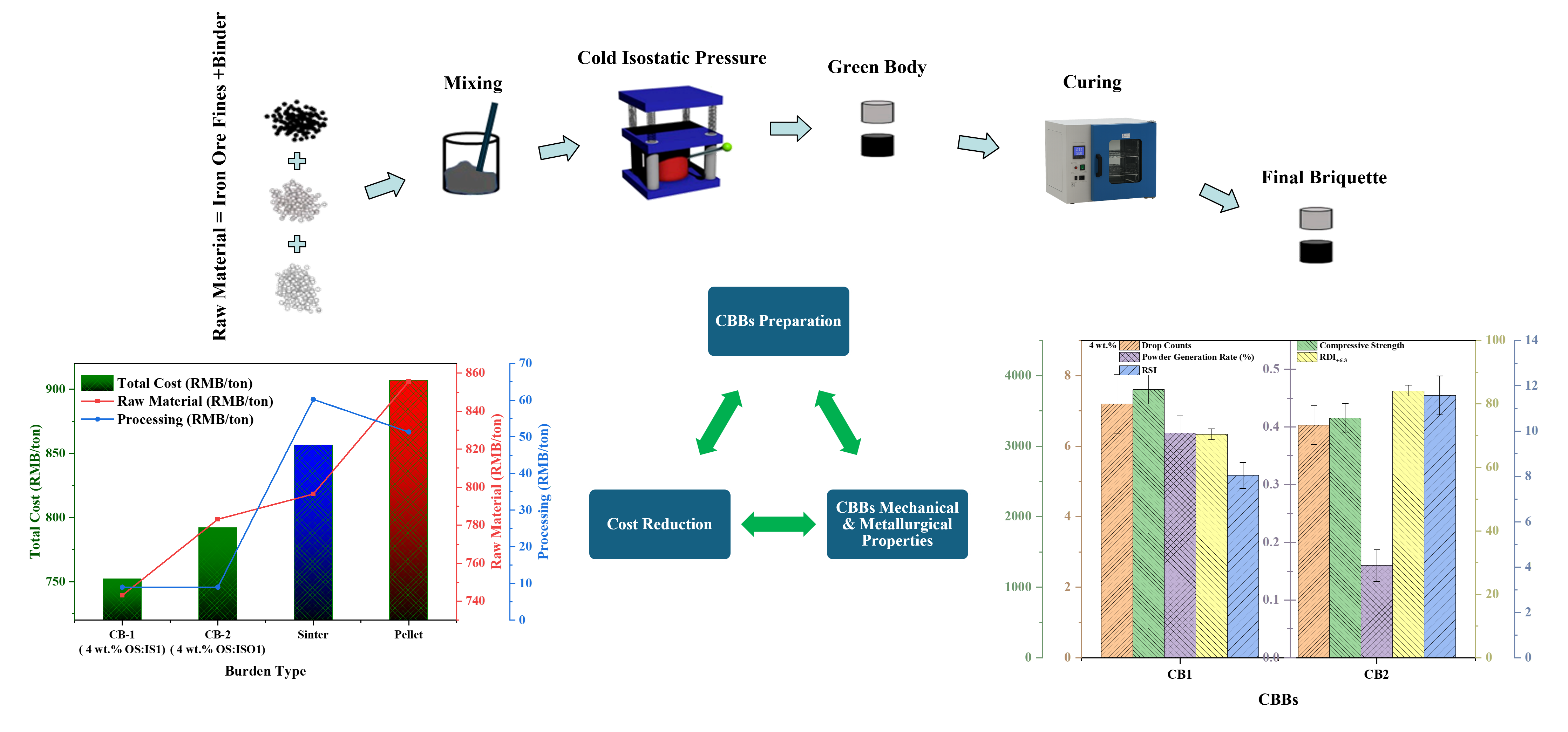
Keywords
Get full access to this article
View all access options for this article.
References
Supplementary Material
Please find the following supplemental material available below.
For Open Access articles published under a Creative Commons License, all supplemental material carries the same license as the article it is associated with.
For non-Open Access articles published, all supplemental material carries a non-exclusive license, and permission requests for re-use of supplemental material or any part of supplemental material shall be sent directly to the copyright owner as specified in the copyright notice associated with the article.
