



Abstract
Soft-tissue pathologies frequently complicate orthodontic care by interfering with appliance fit, treatment mechanics, or patient compliance. While several textbooks address these lesions individually, no clinically oriented classification exists to guide orthodontic management. “OrthoPath” is a practical, color-coded framework that categorizes soft-tissue pathologies into seven distinct groups based on etiology, clinical behavior, and relevance to orthodontic treatment. This communication introduces and illustrates the utility of this system for timely recognition and appropriate intervention in routine orthodontic practice.
Introduction
Orthodontic treatment necessitates long-term appliance wear and frequent intraoral manipulation, which predispose patients to a spectrum of soft-tissue lesions. These may include reactive hyperplasias, trauma-induced proliferations, infections, immune-mediated conditions, and occasionally, neoplastic changes. While many lesions are benign and self-limiting, others can significantly impact treatment outcomes, delay mechanics, or necessitate urgent referral.1, 2
Despite the prevalence of such lesions, orthodontists lack a unified, treatment-oriented classification that integrates pathogenesis, clinical relevance, and management directives. Existing classifications in oral pathology focus on histopathologic and etiologic dimensions but offer limited guidance on how these lesions impact orthodontic treatment directly.4, 5, 8, 9
OrthoPath fills this gap by providing a clinically focused, color-coded classification system that helps orthodontists triage soft-tissue pathologies based on urgency, required modifications, or the need to suspend or discontinue treatment.
Classification Framework of OrthoPath
Core Structure
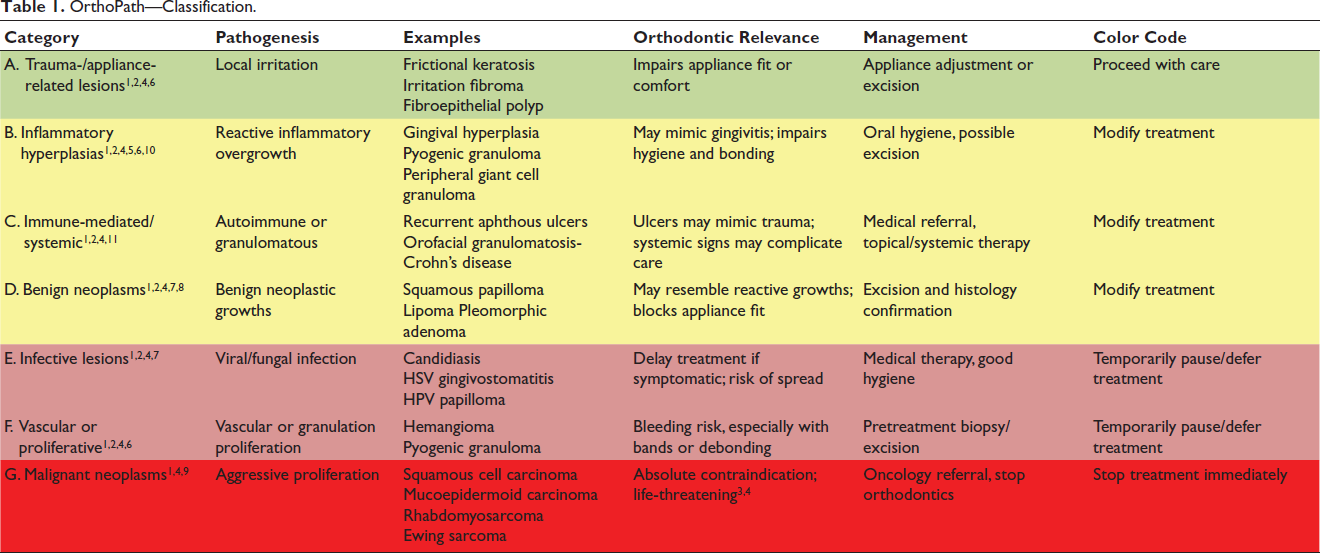
The classification system comprises seven primary categories (A–G), each based on pathogenic mechanisms and their orthodontic implications. Each category is assigned a color code indicating the required level of clinical action (Tables 1 and 2).
OrthoPath—Classification.
Color Code Guidelines.

Clinical Implications
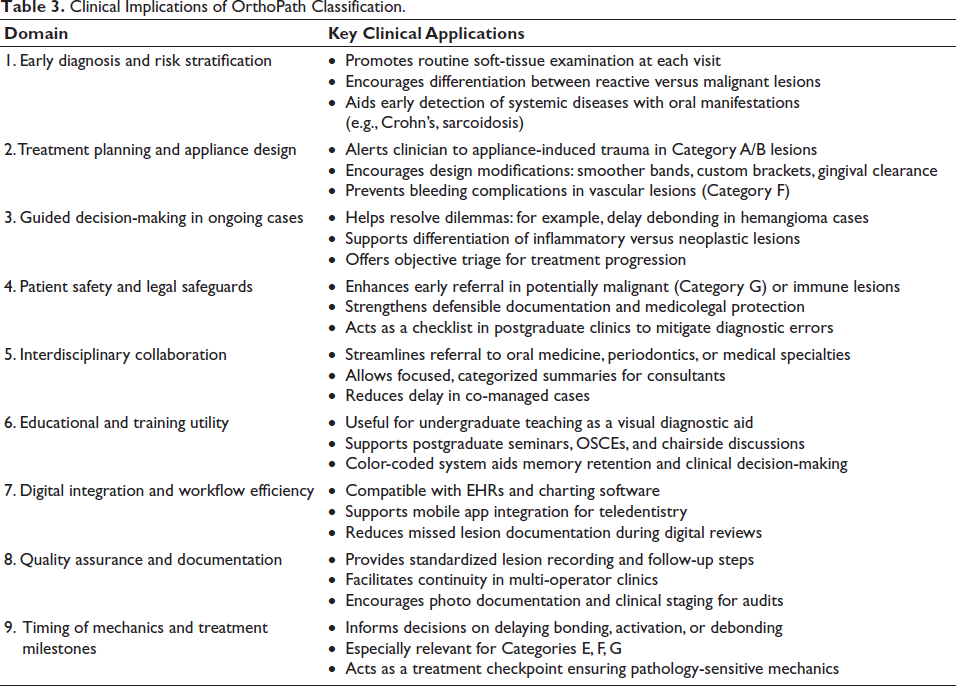
The clinical utility of OrthoPath lies in its real-time, chairside applicability. Unlike conventional pathology-focused taxonomies, this classification prioritizes orthodontic treatment relevance, offering actionable steps for the practicing clinician. Its color-coded approach immediately signals whether treatment may proceed, be modified, deferred, or stopped, thereby ensuring that lesions are neither under- nor over-treated. Below are key clinical implications organized under relevant practice domains (Table 3).
Clinical Implications of OrthoPath Classification.
Conclusion
OrthoPath offers a practical and clinically relevant framework for managing soft-tissue lesions in orthodontic patients. By aligning pathologic understanding with orthodontic decision-making, it promotes safer, more efficient care. Its adoption may enhance diagnostic precision, improve patient outcomes, and serve as an educational aid in both undergraduate and postgraduate settings. Broader clinical application and validation are encouraged to realize its full potential across diverse orthodontic environments.
Footnotes
Authors Contribution
Sujit Zadake : Conceived the research idea, designed the study, conducted data analysis, and drafted the manuscript.
Pravinkumar Maroore: Collected and analyzed data, contributed to manuscript writing and provided critical revisions.
Yatishkumar Joshi: Reviewed literature, contributed to manuscript drafting, and provided supervision throughout the project.
Declaration of Conflicting Interests
The authors declared no potential conflicts of interest with respect to the research, authorship, and/or publication of this article.
Ethical Approval
Ethical permission was not applicable for this article, as this is a short communication drafted from various research articles and not from patients directly.
Funding
The authors received no financial support for the research, authorship, and/or publication of this article.
Informed Consent
Consent was not needed/not applicable, as this is a short communication compiled from various research articles and guidelines and not from patients directly.
