



Abstract
Bracket holding tweezer is used for bonding brackets in orthodontics and mouth mirror for indirect vision for checking the horizontal positioning of the brackets. In this article, bracket positioner has been modified with mouth mirror on the opposite side of the positioner to aid in precise positioning of the brackets both vertically and horizontally and to provide a proper view while bonding.
Introduction
Bonding in orthodontics is a very important step to achieve our treatment goals. Placing the brackets precisely is a very important aspect, which can be enhanced by different instruments, such as bracket positioner, especially useful for straight wire technique. The sizes of the mirrors range from 18 to 30 mm. The mouth mirror was invented by Joseph Murphy in 1811. Mouth mirrors were introduced in the 1800s, but it was not until 1950 that front surface mirrors 103 into widespread were advocated and later came into widespread use. Now, clear images without the double image of the glass-covered mirrors formerly in use were possible. Patent model for Thomas Cogswell, “Dental Mirror,” U.S. Patent 163,578 (May 25, 1875). Thomas Cogswell (1835–1912) was a dentist then living in Boston, Massachusetts, USA. A mouth mirror will aid in horizontal positioning particularly for indirect vision in crowded or rotated tooth. In this article for clinical tip, we have modified bracket positioner with mouth mirror on the opposite side to aid in precise bonding of brackets.
Materials
Instruments used in this method are as follows:
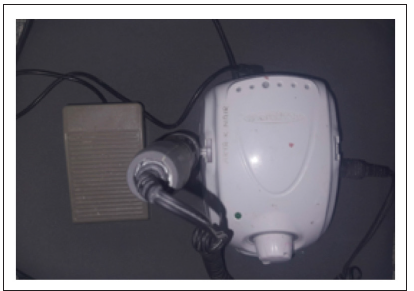
Marathon hand piece (Figure 1)
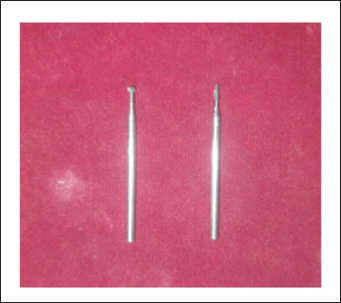
Tungsten carbide burs—round, straight fissure (Figure 2)
Bracket holding tweezer
Mouth mirror
Brackets
Cheek retractor
Marathon Handpiece Used for Drilling.
Tungsten Carbide Burs Round and Straight Fissure.
Procedure
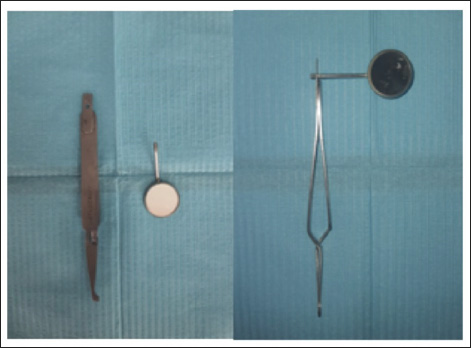
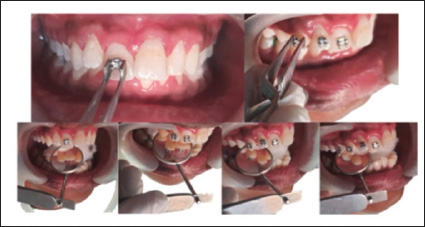
Bracket holding tweezer, which is used for bonding of brackets, is taken and hole is drilled in the posterior blade of the tweezer, which is used for horizontal placement of the brackets (Figure 3). Hole is made with metallic straight fissure bur with a marathon handpiece (Figure 3). Mouth mirror is screwed into the hole of bracket holding tweezer as shown (Figure 3). This makes it easier for bonding and checking the bracket placement without any hinderance with the same instrument named BRAC-M both in the anterior and posterior (Figure 4).
Bracket Holding Tweezer with a Hole in the Posterior Aspect for Attachment of Mouth Mirror.
Bonding Brackets and Checking with the Same Instrument in the Anterior BRAC-M.
Discussion
Many different varieties of bracket holding tweezers are available in the market. Moreover, correct bracket positioning during bonding results in less brackets repositioning and minimizes additional archwire bending during the subsequent phases of orthodontic treatment, thus increasing the predictability of results.2–4 Unwanted tooth movements such as extrusion, unplanned tip, torque, and rotation are minimized. This modification of bracket holding tweezer with mouth mirror on the opposite side can be used simultaneously for bracket placement and indirect vision for accurate placement of brackets especially in the posteriors, which often helps the orthodontist for accuracy. The advantage of this modification is that it is inexpensive and sterilization protocol can be followed with the detachment of mouth mirror. Although the handling of the bracket positioner with mouth mirror might be bulky, but it reduces the chair time in adjusting the brackets both vertically and horizontally instead of using two separate instruments during bonding of brackets.
Conclusion
This method of bracket placing tweezer named BRAC-M can be used for bonding brackets as well helps in indirect vision to check bracket placement simultaneously. It also gives advantage to orient the brackets especially in the posteriors with less time consumption, which avoids the use of normal mouth mirror to check each time after placing the brackets.
Footnotes
Declaration of Conflicting Interests
The authors declared no potential conflicts of interest with respect to the research, authorship, and/or publication of this article.
Funding
The authors received no financial support for the research, authorship, and/or publication of this article.
Informed Consent
This article received the consent and approval for its publication.
