




Abstract
Introduction
Publication trends are pointers to areas of scientific interest and enquiry. The aim of this study is to peruse the American Journal of Orthodontics and Dentofacial Orthopaedics (AJODO) over a 10 years’ period between 2013 and 2022 for original articles. The objective of the study is to analyze topic wise distribution, geographical location of contributors, and specific contribution from India.
Materials and Methods
Original articles alone were taken into consideration. A total of 1,270 articles were classified according to the topic classification grid used by the journal.
Results
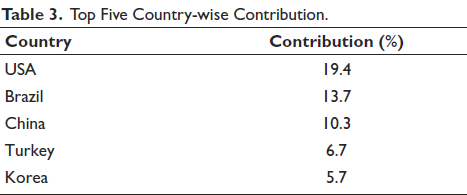
Of the 22 broad topics, topic head No.160 – Treatment & Biomechanics had the maximum publication at 352 articles (27.7%) and topic head No.20 – Biostatistics was the least. Special mention is warranted to the topic head No.120 - Psychology/Sociology with 129 articles (10.15%). USA had the most publication (19.4%) and India ranked 10th with a rate of 1.8%.
Conclusion
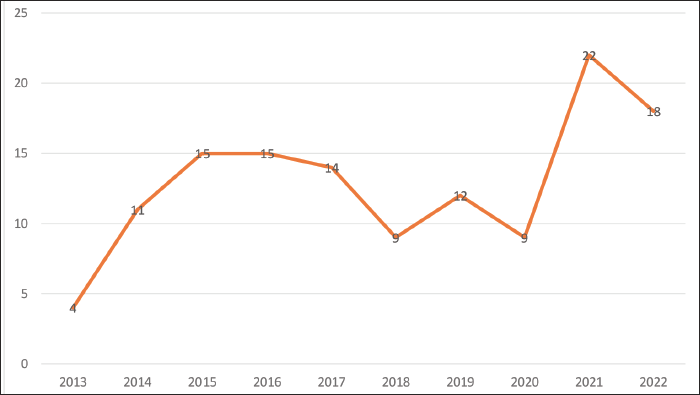
Even though Treatment & Biomechanics as a topic head had 352 articles, it included 16 subheads. However, Public health and Psychology/Sociology were narrower areas with a greater number of articles. It can be inferred that there is a definite shift in interest toward public health and public perception.
Introduction
Scientific journalism is the gathering, processing and dissemination of reliable, verifiable and accurate information. 1 The advent of evidence-based clinical decision-making post 1990s 2 has sharpened the focus on medical/dental research and publication. High-quality bias-free studies are the basis for evidence-based decision making. Over the years, there has been enquiry about how reflective is available literature on the practice trends and which areas attract research more. Research metrics 3 does that by quantifying and monitoring published research. Very few metric studies are available on Orthodontic literature.4–6 Topic, origin, type of study, authorship demographics, and affiliation are some of the intrinsic characteristics of a publication. 7 Analysis of topics is an article-level metric that provides information on areas of academic discourse at a given point of time. It can also reflect editorial policy of journals in accepting articles for publishing. This study analyzes original articles in American Journal of Orthodontics & Dentofacial Orthopedics, published during a 10 years’ period between 2013 and 2022. The enquiry is on the topics, contributing countries with a separate analysis on contribution from India.
Materials and Methods
The study design is retrospective observational. The American Journal of Orthodontics and Dentofacial Orthopedics (AJO DO) is the journal of interest. It is a peer reviewed journal with current impact factor of 2.711. Only original articles were included in the study.
The following were excluded:
Case reports
Randomized controlled trials
Systematic reviews
Short communications
Guest columns
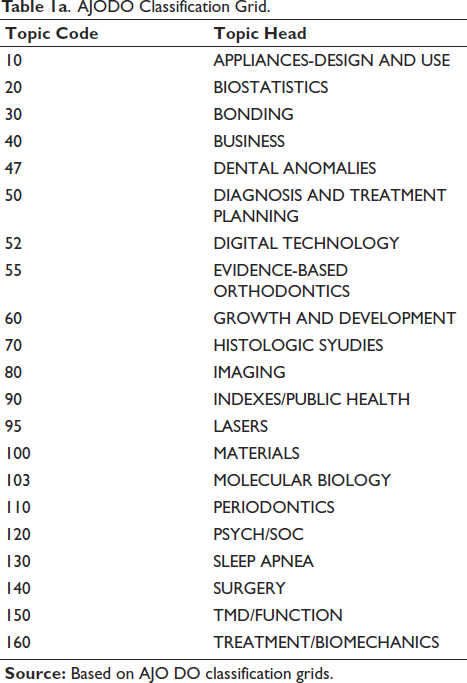
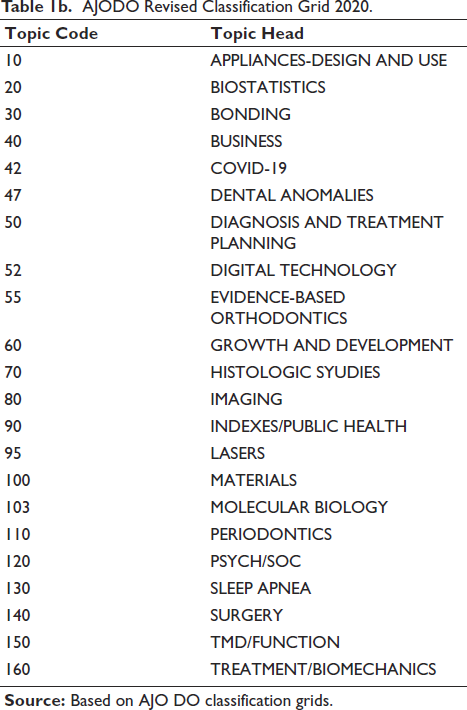
A total of 1,270 articles were narrowed down after applying the inclusion and exclusion criteria. Articles were hand searched as against Medline search. 8 The classification grid used in AJO DO (Table 1a and 1b) was used to classify topic heads. Method used by Vaid et al. 6 was used in the sorting of articles into topic categories on the basis of the subject of the research question. Five examiners assigned individual articles to the topic categories. In case of discordance, a vote was raised among the reviewers for a majority decision. Codes were given to individual topics and tally tables were constructed for the 10 years (2013–2022). Articles were also segregated on the basis of contributing countries. In case of multicenter studies involving more than one country, contribution was assigned to all countries involved. Contribution from India was analyzed separately for frequency of publication at state and institutional levels.
AJODO Classification Grid.
AJODO Revised Classification Grid 2020.
Cohen’s Kappa co-efficient was used to measure inter-examiner reliability. Observational statistics in percentage was used to assess the frequency of occurrence (number of times an article on a topic is published, number of times an article from a country is published).
Results
Inter-examiner reliability was high with a Cohen Kappa score of 0.92.
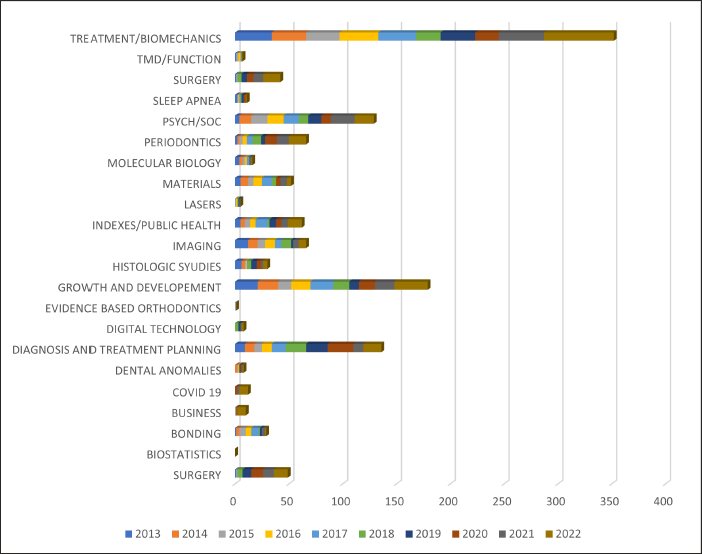
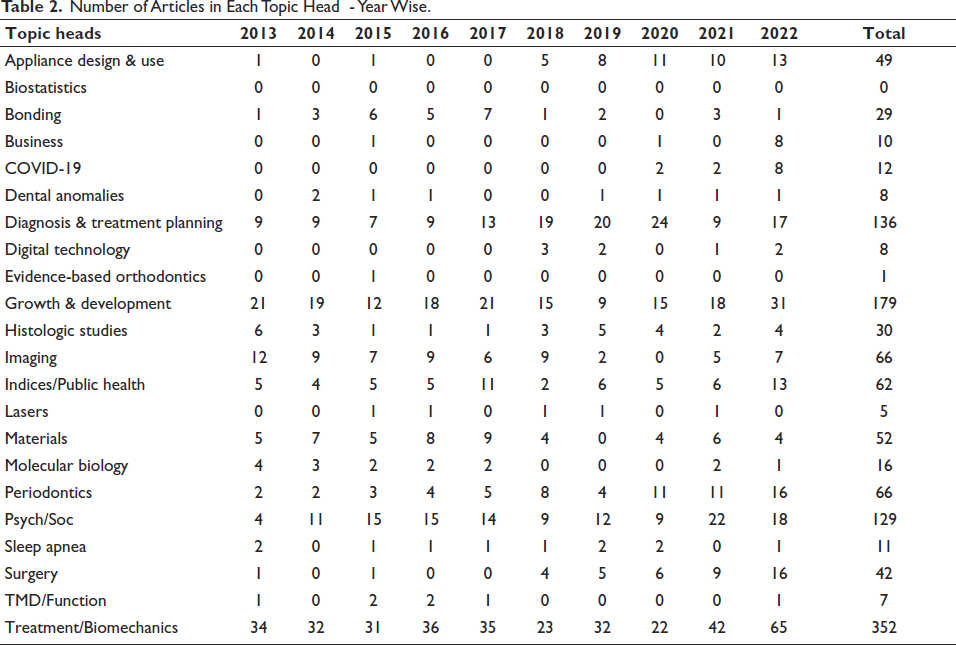
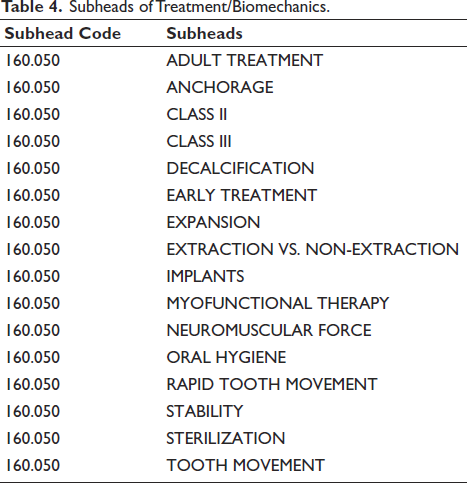
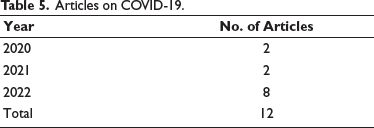
Out of the 1,270 articles satisfying the inclusion and exclusion criteria, 22 topic heads and 47 contributing countries were identified. The classification grid originally had 21 topic heads with COVID-19 added in 2020. The overall trend showed Treatment/Biomechanics (C-160), Growth & Development (C-60), Diagnosis & Treatment Planning (C-50), Psycho/Socio (C-120), Imaging (C-80), and Periodontics (C-110) as the top five topic heads with maximum publications (Figure 1, Table 2). The least published topic heads over the 10 years’ period were Biostatistics (C-20), Evidence-based Orthodontics (C-55), Lasers (C-95), TMD/Function (C-150), and Dental anomalies (C-47).
Overall Topic Heads Published Through the 10 Years’ Period.
Number of Articles in Each Topic Head - Year Wise.
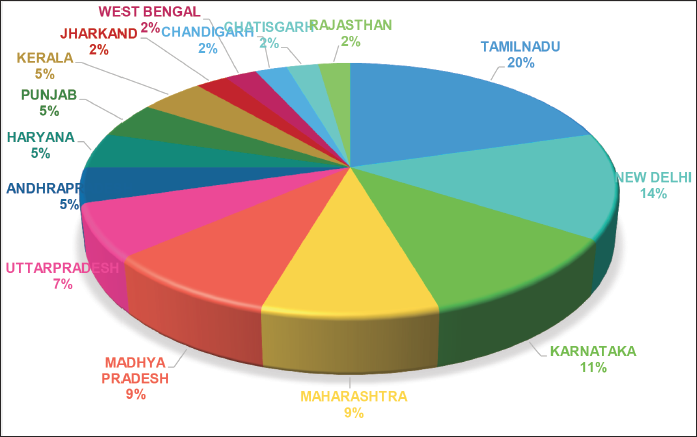
Forty-seven countries contributed to publication of original articles in AJODO during the ten-years period. USA, Brazil, China, Turkey, and Korea are the top five contributors (Table 3). India ranks tenth with a contribution of 1.8%. State wise in India, Tamil Nadu has the highest number of publications followed by New Delhi and Karnataka. SRIHER (Sri Ramachandra Institute of Higher Education and Research) as an Institution has contributed the maximum.
Top Five Country-wise Contribution.
Discussion
Research metrics is a statistical analysis of published articles, journals, and their citations. Impact factor is a journal-level metric that is widely used to evaluate the relative importance of a journal within its field. However, from the point of view of authors, there is a need for analysis of journals for their topic content. An article getting published in a journal is influenced by its editorial policy even though a formal statement regarding that is not made in the instructions to authors. 9 Journal prestige, previous publication topics, and reader composition have been shown as determinants used by authors in their choice of journal to submit their work. 10 Sparse article-level metrics is available in Orthodontics. Two prior studies4, 5 have done similar article-level metrics, but the enquiry was on article types published in three journals. A study by Vaid et al. 6 had compared articles based on topics among three journals. None of the studies mentioned above have considered contributing countries.
This study analyzed the topic heads published in AJO DO, a high impact factor (2.65 updated in 2023) orthodontic journal. Contributing countries were also studied with an emphasis on Indian contribution. Original articles alone were included in the study. Randomized controlled trials were excluded owing to their reporting limitations in orthodontics.11, 12 Systematic reviews, case reports, and guest columns were excluded, as they do not reflect trends. AJO DO uses a topic grid at the time of submission. We used this grid to assign articles to topic heads for accuracy.
Treatment and Biomechanics is an extensive topic head including 16 subheads (Table 4). Psychology and Sociology is a topic head that has shown a distinctive upward trend over the study period (Figure 2). While Treatment/Biomechanics has always been an area attracting publications, the increasing acceptance of articles on Psychology/Sociology and Public health is a definite trend toward patient-centric enquiries. COVID-19 is a new area of research post the pandemic (Table 5). United States understandably is the top contributor with 19.4%. Brazil and Turkey with 13.7% and 6.7%, respectively, have substantially increased rate of acceptance over the years.
Subheads of Treatment/Biomechanics.
Articles on COVID-19.
Trend in Publication of Topic Head Psycho/Soc.
India with 1.8% ranks tenth. Tamil Nadu has contributed the highest statewide followed by New Delhi and Karnataka (Figure 3). At the institutional level, Sri Ramachandra Institute of Higher Education and Research has contributed the maximum.
India State-wise Contribution.
A 10 years’ period is an appreciable time to observe trends. There is a definite sway in perception toward public outreach with respect to occlusal health.
Conclusion
Article-level metrics analyzing topic head distribution is rare in orthodontics. There are no studies that have enquired into contribution by countries. This study analyzed topics in which original articles were published in American Journal of Orthodontics & Dentofacial Orthopedics in a 10-year period between 2013 and 2022.
The salient findings are as follows:
Treatment/Biomechanics(C-160), Growth&Development(C-60), Diagnosis & Treatment Planning (C-50), Psycho/Socio(C-120), Imaging(C-80), and Periodontics(C-110) are the top five topic heads with maximum publications. Biostatistics(C-20), Evidence based Orthodontics(C-55), Lasers(C-95),TMD/Function(C-150), and Dental anomalies (C-47) are the topic heads that were least published. Psychology and Sociology is a topic head that has shown a distinctive upward trend during the study period. USA, Brazil, China, Turkey, and Korea are the top five contributors. India ranks tenth with a contribution of 1.8%. In India, Tamil Nadu has contributed the highest statewide followed by New Delhi and Karnataka. Sri Ramachandra Institute of Higher Education and Research as an institution has contributed the maximum in the 10 years’ period.
Footnotes
Declaration of Conflicting Interests
The authors declared no potential conflicts of interest with respect to the research, authorship, and/or publication of this article.
Ethical Approval
Ethical approval is not required for this study as it is a research metric study involving analysis of published articles which are in the public domain.
Funding
The authors received no financial support for the research, authorship, and/or publication of this article.
Informed Consent
Not applicable.
