




Abstract
Distal end cutter is an indispensable utility plier in the clinical armamentarium. The major challenges faced during utilization is its loss of cutting efficiency, fracture of the tip, and wearing of cutting edge of the plier. This article provides a simpler way of modifying it into an archwire securing and placement plier.
Introduction
Commercially a wide variety of orthodontic pliers are available. Once a plier loses its specific efficiency during the course of usage, orthodontist tend to discard it irrespective of its other clinical applications. Distal end cutter is one among the most utilized and widely replaced by an orthodontist in his/her practice. The instrument design is one of the main reasons for it to be sought out by orthodontist as it favors good accessibility, while a major reason for it to be replaced is its loss of cutting efficiency. 1 Hence the aim of this article is to provide a simple way to modify the distal end cutter and use it.
Materials
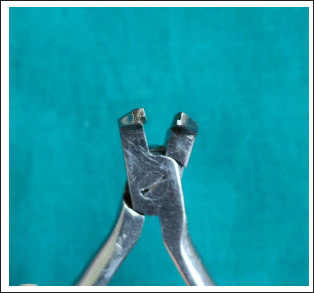
The materials used in the study were
Distal End Cutter.
Carborundum Disc on a Handpiece.
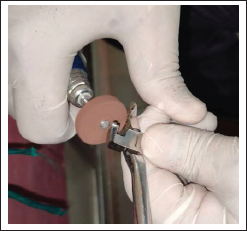
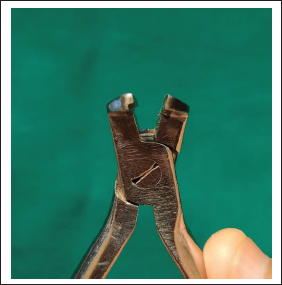
The inner part of the cutting edge of the distal end cutter is grounded using a carborundum disc mounted on a handpiece until the surface merges, then finished and polished with intact outer edges (Figure 3).
Distal End Cutter with Intact Outer Edges.
Results
The final result was the modification of a distal end cutter in a way by which it can be used for placement and removal of arch wires.
Discussion
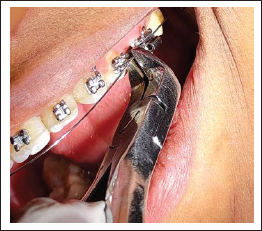
The design modification specified in the manuscript encompasses the standards and requirements of an archwire placement plier. Distal end cutters used to engage and remove the archwire into the posterior teeth and presence of contra-angled beak being a favorable feature gives better accessibility to the posterior teeth with increased versatility (Figure 4). This modification is at par with any of the standard utility pliers and was subjected to clinical use following successive attempts on exercising its efficiency on a typhodont model. The ergonomic design and precise closing tips of the plier with tungsten carbide tip resists opening as observed in bird beak plier and performs at par as any other designated plier. Polished surface ensures that no nick is created while handling the wire and does not require replacement with new blades as it is not so cost effective. Hence, instead of discarding a nonperforming distal end cutter, a simple modification can make the plier an indispensable part of the clinical armamentarium.
Modified Distal End Cutter in Use.
The major advantages are
Cost effectiveness of the modification Easy to execute and accomplished in a clinical set up Optimal intraoral access with better visibility for clinician High angle design with long handle is effective for posterior teeth Re-utilization of an instrument Solid, excellent grip, and durable
The major factor one must consider is that this modification cannot be done in distal end cutter, where the ends of the beak are deteriorated, damaged, distorted, or there are cracks on the blades.
Footnotes
Declaration of Conflicting Interests
The authors declared no potential conflicts of interest with respect to the research, authorship, and/or publication of this article.
Ethical Approval
Not applicable.
Funding
The authors received no financial support for the research, authorship, and/or publication of this article.
Informed Consent
The participant has consented to the submission of the article to the journal.
