




Abstract
Facial growth indicator line was originally developed by Dr John RC Mew. Dr Mew discloses a facial growth indicator in his textbook, Bioblock Therapy published in Great Britain by Dr Mew. The indicator line—this is defined as the distance from the tip of the nose to the incisal edge of the lowest upper central incisor. Andy’s facial growth indicator is a modification of facial growth indicator, which was originally developed by Dr Mew.
Introduction
Facial growth indicator line was originally developed by Mew. 1 Dr John Mew discloses a facial growth indicator in his textbook (pp. 118–120). 1
The indicator line is the distance from the tip of the nose to the incisal edge of the lowest upper central incisor. While measuring the indicator line, the ruler must not be pressed against the nose but placed at a tangent to it, and the line from the tragus is extended to where both lines meet. 1
Andy’s facial growth indicator is a modification of facial growth indicator. A patient’s measurement can be compared to a normal standard expected for a child at his or her particular age. If the child being examined has an abnormal measurement, then further diagnostic tests can be performed on the child. 1
Materials and Methods
Sample Size
As this is a clinical innovation, we have conducted a pilot study. The sample size for the pilot study was 42, out of which 21 were children and 21 were adults. Research is still ongoing (82 patients).
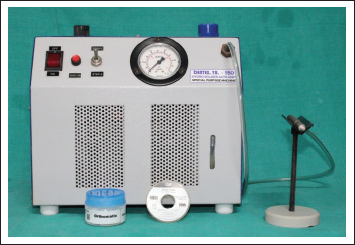
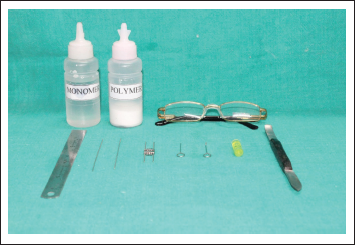
Armamentarium: (Figures 1 and 2)
Spectacle
Monomer
Polymer
19-gauge wire
Used hyrax screw
Tube level
Metal scale
Wax knife
Hydro solder
Flux
Silver solder
Hydro Solder, Flux, Silver Solder.
Spectacle, Monomer, Polymer, 19-gauge wire, Used Hyrax Screw, Tube level, Metal Scale, Wax Knife.
Appliance Fabrication
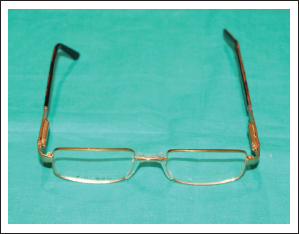
A metal frame of a spectacle was taken (Figure 3).
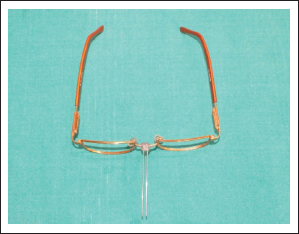
Two small pieces of 19-gauge wires of size 2.5 cm were fixed at the center of the spectacle with a clear acrylic (Figure 4).
Free ends of stainless-steel wires were soldered at the body of hyrax screw. Out of the 4 arms of hyrax screw, 2 arms were removed and the remaining 2 arms were bent in such a fashion that it will hold the metal scale which can slide up and down (Figure 5).
An incisal stopper was soldered at the lower end of the scale.
The tube level was fixed at the horizontal arms of the spectacle, which will help the clinician to maintain the Frankfort Horizontal (FH) plane parallel to the floor (Figure 6).
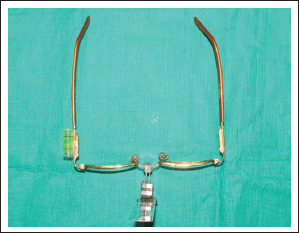
A metal scale was inserted in 2 bent arms of hyrax screw (Figure 7).
Metal Frame of Spectacle.
Two Pieces of 19-Gauge Wires were Fixed at the Centre of the Spectacle.
Hyrax Screw is Soldered.
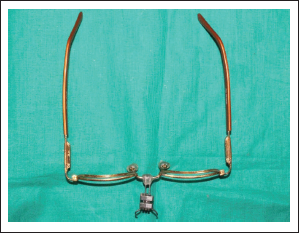
Tube Level was Fixed at the Horizontal Arms of the Spectacle.
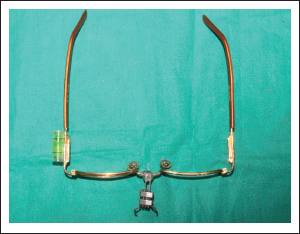
A Metal Scale Inserted in Bent Arms of Hyrax Screw.
Method
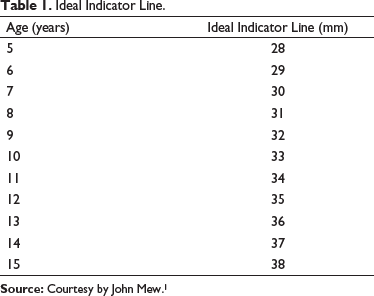
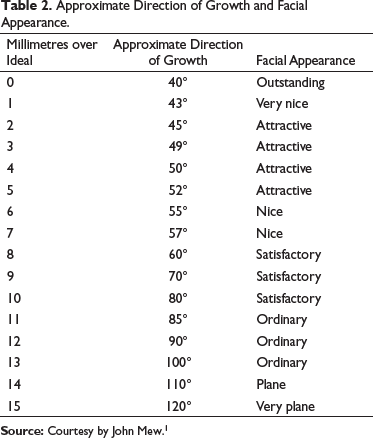
The patient is asked to wear spectacles and the water bubble attached to the horizontal arm of spectacle is set at the middle so that the FH plane will be parallel to the floor to achieve natural head position. The incisal stopper is fixed at the incisal edge and the distance is measured from the incisal edge to the tip of the nose. This obtained value is compared with the value mentioned in the table given by Dr John Mew.
Method of Application
Ideal Indicator Line.
Approximate Direction of Growth and Facial Appearance.
Uses
Gives a rough guide of the direction of growth of very young children.
Provides useful guidance in the absence of serial x-rays.
Used to assess the maxillary position in epidemiological studies where x-rays may not be possible.
It provides guidance during treatment, especially when deciding how far to advance the incisors or the maxilla and when to accept a compromise.
It provides an approximate guide of the relationship of the mid-face and the frontal bone, representing the ‘fullness’ of the facial profile.
Results
Results for pilot study were as follows:
Mean facial growth indicator value for children is 36.29 mm (P = .001), and for adults, it is 39.67 mm (P ≤ .01). Growth indicator value for children is 32–44 mm with mean of 36.29 and approximate direction of growth is 40°–55° with mean value of 43.60. Growth indicator value for adults is 34–46 mm with mean of 39.67 and approximate growth direction
Statistical Analysis for Pilot Study
Data were collected by using a structured proforma. Thus, data were entered in MS Excel sheet and analyzed by using SPSS 24.0 version IBM USA.
Quantitative data were expressed in terms of mean and standard deviation
Comparison of mean and SD between 2 groups was done by using unpaired t test to assess whether the mean difference between groups is significant or not.
A P-value of < .05 was considered as statistically significant, whereas a P-value < .001 was considered as highly significant.
As mentioned earlier, we have submitted the manuscript as a clinical innovation and research is under progress in our department. Hence, results, statistics, and discussion for complete study are not mentioned.
Limitations
Inference for actual growth indicator value less than ideal growth indicator value is not mentioned by Dr John Mew.
Conclusion
Andy’s facial growth indicator is a modification of the facial growth indicator which was originally developed by Dr John Mew. It is patient-friendly and comfortable to patients. It can be used in screening camps where serial x-rays are not possible. It is used to assess the maxillary position in epidemiological studies where x-rays may not be possible.
Footnotes
Declaration of Conflicting Interests
The authors declared no potential conflicts of interest with respect to the research, authorship, and/or publication of this article.
Funding
The authors received no financial support for the research, authorship, and/or publication of this article.
Statement of Informed Consent
Informed consent was not sought for the present study because no identifiable images were used.
