




Abstract
Introduction:
In little more than a decade, social media has gone from being an entertainment source to a fully integrated part of nearly every aspect of daily life. This study aimed to provide an insight into how orthodontics-related social media posts are looked upon by the Indian population.
Material and Methods:
Orthodontics-related social media posts were analyzed for the number of likes, shares, and comments. Comments were also scrutinized for determining whether they were appreciation comments or enquiries related to orthodontic treatment and procedure. Posts were collected from 3 platforms: Twitter, Facebook, and Instagram. A mixed-methods approach was applied. First, all posts were structured according to a quantitative content analysis. Subsequently, qualitative analysis was performed to detect potential differences between the quality of response to posts on Twitter, Facebook, and Instagram. Using one-way ANOVA test, differences in the data were tabulated. A Chi- Square test was used to analyze the qualitative differences in the comments, which were scrutinized to check if they were appreciation comments or enquiries/doubts related to the posts.
Results:
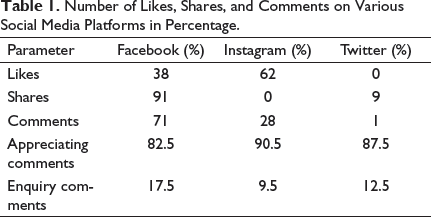
There was a significant difference between the numbers of likes, shares, and comments. Appreciation comments were more in number than enquiries. Instagram had the maximum number of likes, followed by Facebook and Twitter (P < .00001). Facebook had more shares in comparison to Twitter. Upon an analysis done on the number of comments, Facebook was found to have the highest number of comments, followed by Instagram and Twitter. All the results were significant, with P < .00001.
Conclusion:
It can be concluded that social media awareness related to orthodontics posts among Indians is gaining pace, and a lot can be achieved using these social media platforms to spread awareness related to orthodontic treatment.
Introduction
Information and communication technology has changed rapidly over the past 20 years, with a key development being the emergence of social media. 1 Social media has gone from being an entertainment source to a fully integrated part of nearly every aspect of daily life for many. 2
India has embraced social media with open arms. It is estimated that by December 2020 there will be around 639 million active Internet users in India. 3 What started with just a simple email correspondence has expanded into a digital universe, with social networking giants like Facebook, Instagram, Twitter, etc.
Social media is characterized by a proliferation of web applications that facilitate collaborations between users. These interactions can occur through reviews, comments, user-generated content, and content sharing. 4
In modern healthcare, social media has become increasingly important for professionals.5-7 Social networks offer a means of leveraging what is special about one’s orthodontic practice; good patient relationships, team culture, and sharing of insightful content.5, 8 Social networks are not only an easier and cheaper way to advertise one’s practice, but they also help draw new patients and transform current patients into brand supporters. Creating and posting insightful content on one’s social media accounts is the key.
Across different social media platforms, Facebook has hundreds of millions of followers. While Twitter was widely popular a few years ago, newer social media, such as Instagram, are rising in popularity. The number of studies on how these social media platforms influence the perception of people in India on orthodontics is negligible. Thus, the current study was taken up with an aim to provide an insight into how orthodontics-related social media posts are looked upon by the Indian population, taking into account the number of likes, shares, and comments on such posts on Facebook, Instagram, and Twitter.
Material and Methods
A descriptive cross-sectional study was conducted over a period of 30 days. Orthodontics-related social media posts were collected from Facebook, Instagram, and Twitter using the content analysis method. All the social media platforms were searched within the framework of set selection criteria.
The following were the inclusion criteria:
Indian social media posts; and Social media posts that had pre- and post-orthodontic treatment pictures.
The following were the exclusion criteria:
Posts from orthodontists who are not from India; Posts in languages other than English; Advertisements from orthodontists; and Posts that had been reposted by the same or another user.
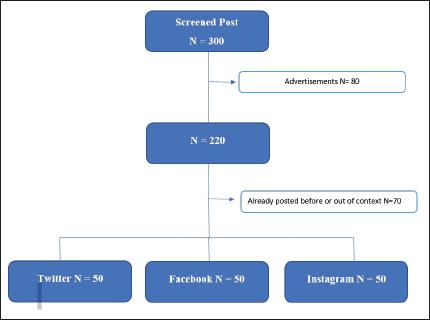
The search was executed using the terms and phrases like “Indian Orthodontist Page,” “Indian Orthodontics Page,” “Indian Orthodontics Study group,” “Indian Orthodontic Society Page,” “Indian Orthodontists,” and “Indian Orthodontic Clinic.” The same search strategy was utilized for search execution across all the social media platforms. A total of 300 posts were scanned initially; out of these, 80 were advertisements and 70 were out of context, and so these posts were excluded from the study. Finally, a total of 150 posts were collected, 50 each from the 3 platforms (Figure 1).
Sample Selection.
A mixed-methods research approach was used to scrutinize the posts, that is, the posts were analyzed both quantitatively and qualitatively. First, the posts were analyzed quantitatively for the number of likes, shares, and comments. Then, the comments were analyzed qualitatively for the content. Depending on the content, the comments was categorized into appreciation comments or enquiries/doubts. “Thank You” comments by the poster on appreciation comments were excluded. Similarly, replies by the poster to enquiries or doubt comments were also excluded.
The data thus collected were fed into a Microsoft Excel spreadsheet (version Microsoft Office Professional Plus 2019). The difference between the different social media platforms in terms of number of likes, shares, and comments was analyzed using a one-way ANOVA test. A Chi- Square test was used to analyze the qualitative differences in the comments. The P-value was set at <.5 for significance. SPSS software version 22 was used to perform all the statistical analysis.
Results
Number of Likes, Shares, and Comments on Various Social Media Platforms in Percentage.
One-Way ANOVA Test for the Number of Likes on Instagram, Facebook, and Twitter.

One-Way ANOVA Test for the Number of Shares on Instagram, Facebook, and Twitter.

One-Way ANOVA Test for the Number of Comments on Instagram, Facebook, and Twitter.

Comparison of Appreciation and Enquiry Comments on Instagram, Facebook, and Twitter.

Discussion
As Kevin Werbach said, “Social media has become really fundamental to the way that billions of people get information about the world and connect with each other, which raises the stakes enormously.” 2 Social media has massively expanded its wings over every field of life. The medical and dental professions have not been left far behind.
The existing literature on orthodontics in social media is really limited, with only a handful of studies with diverse intentions. Although the role of social media in healthcare is viewed with some controversy, the popularity of social media is increasing day by day owing to the ease of obtaining information with a single click and the current tech-savvy generation’s preference for such media over anything else.9-11
Clinical orthodontic photography is an important and essential skill that an orthodontist should master. It not only is part of case history or record-keeping but also has come in quite handy when one wants to educate patients, during peer presentations, in marketing, and in obtaining additional certification. 12 It is an integral part of social media campaigning by orthodontists, and most often, the posts in the form of photographs receive more attention than verbal posts. Accordingly, the scope of the current study was to examine the effect of orthodontic-related social media posts on the Indian population, and the goal was to assess the number of likes, shares, and comments on orthodontics-related social media posts on Facebook, Instagram, and Twitter.
An earlier study that was done to explore the use of social media platforms by orthodontic patients provides insights into the experiences, attitudes, and emotions of patients and their peers regarding orthodontics. Most often, pictures and emoticons were used by the patients to express emotions related to orthodontic treatment on social media platforms.13, 15
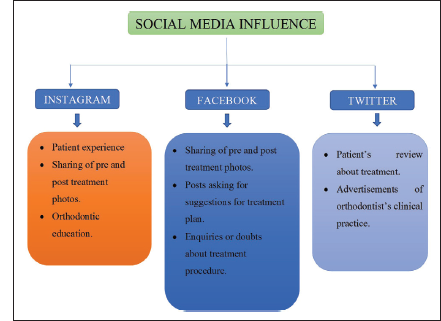
The results of the current study indicate that in India, Instagram had more likes on orthodontics-related posts than any other social media platform. However, Facebook had more comments, of which appreciation comments were more than enquiries or doubts. Around 555 comments were posted on Facebook, followed by Instagram with 219 comments and Twitter with only 7 comments. This is a great insight, as this shows the positive orientation of people toward the field of orthodontics. Similar results were noted in the earlier systemic review, where positive feelings were expressed more commonly than negative feelings, with positive feelings ranging from enthusiasm, self-esteem, and pleasure to excitement about the aesthetic result and excitement after braces removal. 14 Henzell et al 15 reported that in New Zealand, 80.8% of orthodontics patients used social media platforms, with Facebook being the most preferred platform. They also reported that only 13.3% of the patients had posted comments about orthodontics on social media platforms. This finding is similar to the result of our study. One more interesting fact was that only 6.7% had thought of obtaining information related to orthodontics through social media platforms, with 81% of the people preferring to obtain the information directly from the orthodontist. 15 Similar results were also reported by Graf et al, 13 who found that there existed a significant difference between the posts on Twitter and Instagram, with Instagram showing more positive posts related to orthodontics than Twitter. They emphasized the need to understand the basic functionality of these two platforms. 13 In the present study, when the content analysis was performed across the various social media platforms for the search terms like “Indian orthodontic clinics,” “Indian orthodontists,” etc, the information obtained on each platform was quite different (Figure 2). Instagram, for example, had more patient experiences-related posts, followed by shares of pre- and post-orthodontic treatment pictures. However, Twitter had more patient reviews on treatment and orthodontics-related advertisement. Facebook showed the maximum sharing of pretreatment and posttreatment photos, followed by posts asking for suggestions for treatment plan and enquiries or doubts about treatment procedure.
Social Media Influence.
An earlier study on social media published in a reputed journal of orthodontics enlists the five most influential social media tools: Twitter, YouTube, practice blogs, Facebook, and Google Places. 4 However, a recent systemic review on social media and orthodontic treatment revealed that orthodontic patients preferred social media platforms in the following order: Twitter, YouTube, Facebook, Google+, Pinterest, and Instagram. 14 The findings seem to be in agreement with the results of our study, with Facebook and Instagram being the popular media platforms; however, the present study did not include the other platforms such as YouTube, Google+, and Pinterest.
Twitter is not popular among the Indian population, and so there were not many comments or likes on orthodontics-related social media posts. The reason might be the slow gain in the usage of Twitter microblogging by Indians because of the lack of Internet facilities in remote areas in the country or the lack of advertisement from the company itself. According to a website, there were over 10 million users in the year 2013, and by the end of 2019, it is estimated, there will be over 34 million Twitter users. 16 In the month of January 2021, India (17.5 million) was ranked third in Twitter usage, with the United States (69.3 million) in the lead. 17 Taking this into account, it should not be surprising to see a surge in orthodontics-related posts on Twitter in the upcoming years.
The sharing of orthodontics-related posts remained very low across all three social media platforms, with Twitter showing 0.36 shares on average. Facebook showed 3.76 shares on average, the highest among the three social media platforms. Considering the fact that Facebook was introduced to the Indian population earlier in comparison to Instagram and Twitter, this trend seems to be expected. In fact, the number of Facebook users in India is estimated to be nearly 320 million by 2021. 18 Nevertheless, considering the number of users, the sharing of posts on orthodontics was very low.
The current study clearly demarcates the three popular social media platforms in terms of orthodontics-related posts, with Facebook being at the top of users’ list in comparison to Twitter and Instagram. The popularity of all these platforms is attributed to their user-friendly features. Their adaptability toward android mobile phones has added another dimension to their popularity. A techno byte article in the most popular orthodontic journal mentions; google places, Facebook, practice blogs, YouTube and Twitter as the topmost social media giants where orthodontic utility related posts were spotted frequently. 19 Although all these platforms remain popular in Western countries, in India, practice blogs and Twitter have not yet entered the race.
Other than social media platforms, the tools like YouTube can also provide access to information related to malocclusion, orthodontic treatment modalities, and outcomes of orthodontic treatment. Social media platforms can additionally be used to give patients instructions, which can augment the verbal instructions usually provided by the orthodontist. Studies taken up with a similar intention have reported that there has been a significant gain in orthodontics-related knowledge among patients who had been given instructions via YouTube links along with the verbal instructions.20, 21
It is beyond doubt that social media platforms do influence the field of orthodontics and that each platform has its own role to play in educating, motivating, and sharing the experiences of patients. YouTube, for example, gives valuable information in the form of videos related to various modalities of orthodontic treatment. Facebook provides the advantage of posting pre- and post-orthodontic treatment photographs. Sharing and commenting on the same by peers/friends is also an added advantage. Unlike Facebook, Twitter is mainly comment-centric, where one can mainly spot patient’s positive or negative responses or bullying comments. Laypersons’ orthodontics-related knowledge nowadays is mainly acquired through the digital platforms like WikiLinks, popular websites, and blogs. 22
Social media seems to have all the benefits that one desires for patients, but one should not forget the ill effects of social media, which might range from reduced care toward one’s well-being, addiction to their usage, loss of privacy, and the danger of becoming an easy target of the promotional activities of companies. 23 Keeping these things in mind, one should use social media platforms judiciously. In the current study, search engine platforms and YouTube-related information were not assessed for orthodontics-related blogs and posts. Thus, the study carries the scope to explore the impact of orthodontics-related blogs and posts on orthodontics patients or potential patients. The literature available on the influence of social media platforms on the perception of orthodontic treatment per se was scant, and in India, this study was the first of its kind, and so it was difficult to compare the results of the current study with other similar ones.
Conclusion
Social media constitute one of the best platforms to spread and educate the general population about malocclusion and orthodontic treatment. Effective usage of them can increase the awareness of people about the different orthodontic treatment modalities, and they also can act as a myth-buster and fact-checker for the interested public. Facebook and Instagram are the most used platforms in India, and Twitter seems to be gradually gaining popularity.
Footnotes
Declaration of Conflicting Interests
The authors declared no potential conflicts of interest with respect to the research, authorship, and/or publication of this article.
Funding
The authors received no financial support for the research, authorship, and/or publication of this article.
Statement of Informed Consent and Ethical Approval
Necessary ethical clearances and informed consent was received and obtained respectively before initiating the study from all participants.
