




Abstract
Objective:
With the global crisis of the COVID-19 pandemic, orthodontic postgraduate students’ education and clinical training might be affected. The objective of this study was to explore their perception on didactics and clinical training.
Materials and Methods:
A pretested and validated 26-item online survey that addressed COVID-19’s impact on didactic components and clinical management was sent to postgraduate students in the Indian subcontinent. The survey was available for 3 days, and the responses were collected and analyzed.
Results:
Overall, 165 out of 244 (67.62%) orthodontic postgraduate students completed the survey. Of them, 88.48% noted that orthodontic education and patient management are at stake because of the ensuing crisis. The majority (66.28%) acknowledged that Internet-based education will become the significant part of postgraduate coursework. With regard to patient care, 80% felt that 2-way communication channels and a guarded approach with strict infection control protocols may be the way forward during the crisis. Many preferred attending patients with space closure stage at the follow-up (51.23%) and to postpone new case start-ups until normalcy returns. About 55% of the respondents felt that clear aligners could transform into a popular orthodontic practice regimen if the crisis continues.
Conclusions:
Orthodontic postgraduate students were concerned that the crisis would go on and affect their education. They perceived transition of face-to-face didactic learning and summative assessments to online settings as a viable approach during the COVID-19 crisis. They felt that orthodontic clinical training would benefit from teleorthodontic approaches and prioritization of care and its alignment with crowd control.
Keywords
Introduction
The COVID-19 outbreak could be the first major crisis of humanity after World War II, and it is unprecedented for the current generation. The SARS-CoV-2 virus outbreak has brought about a large-scale public health crisis with a massive economic slowdown and burden of uncertainty.1-3 The situation has unleashed many alternative methods in the functioning of many systems, including medicine and education, to cope and adapt for future survival. 4 The pandemic has shadowed both medical and dental specialties with a huge impact on patient care and projected far-reaching implications for education.5-7
The education sector has largely been affected, with a disruption in the delivery of curricula and assessment.8, 9 In dentistry, the quantum of disruption is immensely high with respect to postgraduate specialty dental training, as the postgraduate curriculum is heavily dependent on patient care and management. In the orthodontic postgraduate program, the nature of education and training has a different complexity compared to other specialties. The treatment is hailed by continuous follow-ups and regulated care addressing different stages in the treatment. According to the World Federation of Orthodontists (WFO), the orthodontic postgraduate curriculum mandates a minimum of 24 hours of supervised patient management, 6 hours of didactics, and 10 to 12 hours for research and administration per week, 10 and most Indian programs run for a minimum of 3 years. For attaining competency in various domains, each student needs to complete a stipulated number of orthodontic cases of various complexities during the duration of the program. The COVID-19 outbreak has affected this routine and momentum. Apart from training requirements, it has also affected patient follow-ups and emergency care, which are integral aspects of orthodontic patient management, unlike in any other specialty. From the didactic curriculum point of view, Internet-based education and virtual platforms have seen a surge in their application in recent times.9-11 However, their value addition to the knowledge and skills of postgraduate students who are in the midst of the crisis is unknown. It could be interesting to know how postgraduate students perceive the impact of the sudden transition in the mode of delivery of didactic components through online platforms, and how the COVID-19 crisis is affecting the postgraduate orthodontic clinical training and case management. The objective of this survey was to explore orthodontic postgraduate students’ perception on didactics and clinical training during the COVID-19 crisis.
Methods
This study was a cross-sectional online survey and was approved by the Institutional Review Board (IRB), with oversight by the Sri Vishnu Educational Society’s Vishnu Dental College (IEC-VDC) on May 02, 2020 (Project #IECVDC/2020/F/ODFO/Q/13). A questionnaire was developed, pretested, and used in a cross-sectional survey with a sample of orthodontic postgraduates in India. The questions were designed to provide data on the perception of postgraduate orthodontic students on the didactic and clinical-training components. At the outset, a face validity assessment was conducted with 5 orthodontic educators and 14 postgraduate students in orthodontics in 3 focus group discussion rounds, for their opinions with regard to clarity and writing style. The pretested draft questionnaire was subjected to content validation by a panel of 10 experts selected based on their expertise in the field. The list included 5 orthodontists from academia, 4 clinicians, and 1 public health dentist. The pre-testers of the questionnaire were chosen in such a way that there was homogeneity in age, gender, clinical and academic experience, and distribution in India. Each panelist was asked to rate the usefulness of the questions on a 4-point scale (1—extremely useful, 2—useful, 3—may be useful, 4—can be excluded). The scores were dichotomized, and 1 and 2 were considered as “yes” and to be included and 3 and 4 were assessed as “no” and to be excluded. For each item, the total number of yes/no answers was noted, and a content validity index (CVI) was calculated (total score/number of experts). A score of 0.8 or above was considered to be adequate for inclusion in the questionnaire. Thus, the final questionnaire had 26 items after excluding 7 items of poor content validity (Appendix A).
An online survey was implemented using the “SurveyMonkey” platform. The questionnaire was divided into 4 parts to segregate the responses that could be implicated during the crisis. The list of questions is organized in Appendix A. The questionnaire was mailed to 250 Indian orthodontic postgraduate students selected at random from the orthodontic convention email register between May and June 2020. Six email addresses bounced, leaving the total number of emails at 244. After obtaining the completed questionnaires, a post-survey analysis and reflections from the survey participants were generated through email contacts and the survey platform. All responses were collected in an Excel table and subjected to analysis. Special care was taken to ensure the anonymity and confidentiality of the information. Online consent was obtained from the participants. The data collected were subjected to statistical analysis using IBM SPSS 21.0 (IBM Corp, Armonk, NY). Descriptive analysis was done. Chi-square test was done for a set of questions that are relevant to be compared for any differences. The P-value was set at .05 for all the comparisons.
Results
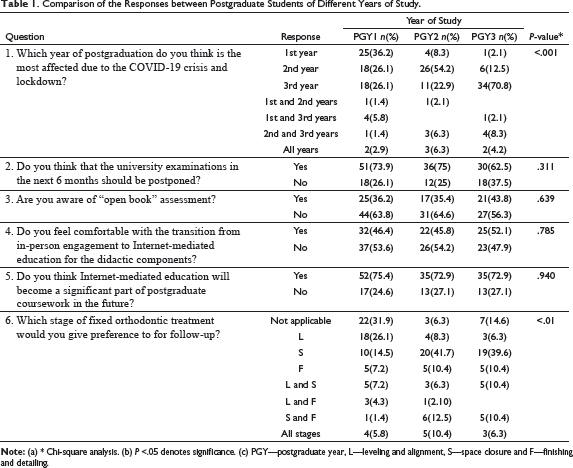
Comparison of the Responses between Postgraduate Students of Different Years of Study.
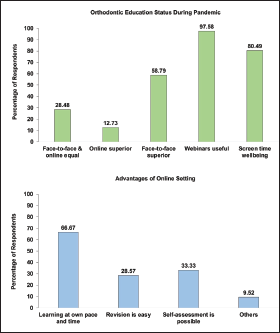
COVID-19 Crisis and Online Learning
With the emergence of internet-based education, the respondents perception are depicted in Figure 1. About 21% of the respondents perceived that online case-based discussion could compensate for 50% of the knowledge gained through direct clinical exposure. About half of the respondents noted that they feel uncomfortable in the transition from face-to-face learning to Internet-based education modes. However, the majority (66.28%) acknowledged that Internet-mediated education will become the significant part of postgraduate coursework in the future. When asked “if online platforms could replace face-to-face engagement at conferences and scientific meetings,” 52% answered affirmatively.
Orthodontic Education Status During the COVID-19 Crisis.
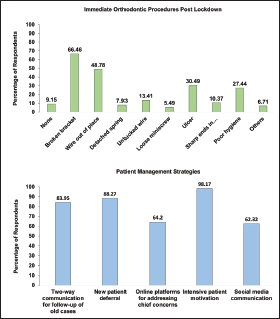
COVID-19’s Impact on Orthodontic Clinical Training and Patient Management
Postgraduate students encountered various immediate orthodontic procedures after the resumption of clinical management, and “broken brackets” topped the list (Figure 2). The “others” include dislodged Rick-A-Nator appliances, loose-fitting and broken functional appliances, loose bands, and detached Hyrax. The strategies to deal with orthodontic patients during the crisis are depicted in Figure 2. Ninety-eight percent of the respondents felt that motivation of orthodontic patients is a fundamental requisite to resolve anticipated prolonged treatment time and uncertainty due to the COVID-19 crisis. For follow-up appointments of old cases, the majority of the respondents (80%) noted that each and every patient should be communicated with through 2-way communication channels, like live videoconferencing or texting, before fixing up appointments.
Strategies for Patient Management During the COVID-19 Crisis.
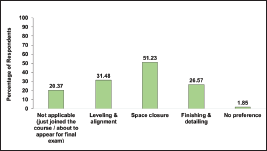
The preferences for the care in the follow-up appointments with respect to the stage of the fixed orthodontic treatment are depicted in Figure 3. The majority felt that they will give preference to the space closure stage. Of the 1st-year postgraduate (PGY1) students, 43.4% mentioned the leveling and alignment stage as their preference in the follow-up appointments. The differences among the postgraduate students were statistically significant (Table 1). Considering long treatment with periodic follow-ups, postgraduate students (67%) perceived managing orthodontic patients in the workplace as a high risk of exposure to COVID-19. Ninety-three percent of the respondents noted that personal protective equipment (PPE) will become the primary measure, even for screening potential orthodontic patients, until normalcy returns. About 88% of the respondents were aligned with the opinion that new orthodontic case start-ups should be postponed until normalcy returns.
Preference to Care for Orthodontic Stages of Treatment at Follow-up Appointments During the COVID-19 Crisis.
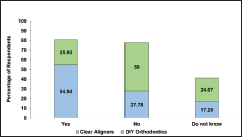
With regard to potential practice shifts during the COVID-19 crisis, about 55% of the respondents felt that clear aligners could transform into a popular orthodontic practice regimen, and 27.78% noted that DIY (do-it-yourself) orthodontics may emerge (Figure 4).
Perception for Popularity With Clear Aligners and Do-It-Yourself Orthodontics.
COVID-19 Crisis and Postgraduate Research
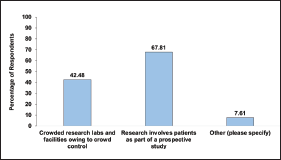
About 67% of the respondents have commenced either in-vitro or in-vivo research. Out of these, 73% (n = 81) of the students are worried about the progress of their research due to COVID-19. Further, 69% noted that they would require more time to manage their research. The reasons cited for an anticipated increase in the duration of the research are depicted in Figure 5.
Anticipated Delay in Research Activity During the COVID-19 Crisis.
COVID-19 Crisis and Assessment
Twenty-nine percent would go for no postponement of exams and stated via open comments how exams could be planned and conducted during these trying times. Some of the notable suggestions include online written test, viva voce through video conferencing, online presentation of dissertation, bonding exercise assessment on a typodont through livestreaming, online wire bending assessments, online case discussion (finished cases that belong to the examinee), and roleplay through online platforms, like Microsoft Teams or Zoom, for clinical reasoning and judgment. Twenty-one respondents (43.75%) who do not want the examination to be postponed were aware of open-book assessment. Overall, 38% of the respondents were aware of the open-book assessment pattern.
Post-survey Comments From Respondents
All respondents (self-isolated from education) were encouraged to provide their reflections on completing the questionnaire and how the COVID-19 crisis could have influenced their temperament toward day-to-day activities and the emerging uncertainty. Twenty-eight respondents came forward to record their concerns. PGY1 students responded with no grave concerns, but the questionnaire helped them adopt new ways of learning and adjust to the situation. The 3rd-year postgraduate (PGY3) students felt that they could cope with the situation through adjustments. However, 2nd-year postgraduate (PGY2) students noted a few mixed concerns, and some were disturbing: “ psychologically depressed,” “It has let us all into a confused state of following-up of our cases,” “being at home allows me having a healthy food but had to carry out the household chores and balance both academic and personal life … really stressed … presently practicing yoga….”
Discussion
The stimulus for conducting the online survey was the notion that this pandemic crisis has affected the education sector, which is in the grip of a major crisis. 8 The survey attempted to explore the context from orthodontic postgraduate students’ perspective, as this pandemic influences their education. Though the survey elements were contextualized from Indian postgraduate students’ perspectives, it is prudent to apply the results in the global context and relate to many associated factors, including pandemic restrictions, education culture and mindset, varied program educational objectives, availability of the Internet, and the course of the pandemic itself. We adopted the rapid online survey format, as it is intended to assess perceptions in the midst of any rapidly evolving infectious disease outbreak. 12 However, we took extreme care in drafting the questionnaire and choosing the response options. The questions were designed with the context to simplicity and not to tax the responders with any leading questions. With regard to the placement of the order of questions, we managed to jumble the questions where necessary to avoid participants responding in a similar manner.
The postgraduate learning environment is anchored with the generation of ideas, chairside huddles, open discussions, debates, etc. 10 The translation of these attributes to the online platform is least understood and unknown. However, in the present situation, students may need to adapt to Internet-based education channels, which seem to be the holy grail of education at the moment. Further, the COVID-19 pandemic could be an avenue to introspect these approaches for learning advantage.13, 14 A few reviews on the subject reported that computer-aided learning (CAL) programs favored positive responses and attitudes from the students.15, 16 Hughes et al in an online survey on learning preferences noted exceptional qualities in orthodontic residents demonstrating high visual acuity and the capability to sense and adopt sequential learning strategies. The residents have the potential to suit CAL modules in their learning as a potential supplementary to the classroom approach.17, 18 The assessment of a new modular teaching program at Bristol reported that web-based resources had positive impacts on learning. However, the trainees favored the opportunity for face-to-face interaction with their tutors and peers. 19
The current survey deliberated that the transition posed an uncomfortable mindset in almost half of the respondents. However, the majority felt that they could acknowledge the transition and its inevitability. Hence, the authors believe that the system could accommodate appropriate and varied learning modes within the postgraduate orthodontic education and generate curiosity and acceptance among the students. Aly et al in an exploration of the instructional multimedia programs in postgraduate orthodontic training found that hierarchical sequencing improved the learning outcome of clinical knowledge. 20 Thus, it is a task in hand to design a curriculum that could integrate technology-enhanced learning based on varied learning strategies and generate a student support mechanism to give confidence to the learners. Provision of integrated self-study and assessment tools, robust e-learning platforms at the institutional e-library, and hierarchical sequencing models could render support in their online learning.
The COVID-19 outbreak has disrupted healthcare services across the globe, and orthodontic care with continuous follow-ups is no exception. Unlike didactic components, the clinical workplace curriculum that encompasses direct patient care poses a heavy challenge during the COVID-19 crisis. No online session can duplicate the close experience with patients. Outreach and hospital postings have also been cancelled. 9 The respondents in the current survey noted that orthodontic patient management is at stake and unpredictable. Every stage of orthodontic treatment requires a meticulous management strategy and focused care every time the patient visits the clinic for follow-up. Clinical didactic online sessions that showcase virtual cases and case-based discussions could be the needed support during this pandemic crisis. Respondents noted that this delivery method would benefit them in keeping the learning going. Thus, educators have greater responsibility to create such experiences for students, who are usually assigned clinical workplace-based activities. Moving the clinical didactic sessions online earlier in the course, along with changes in the academic calendar, will allow early entry into the clinical environment at least for PGY1 students and can compensate for the lost time span to a certain extent. 21
Patient, doctor, and their team safety are the embodiments during the outbreak and any negligence could be catastrophic. 22 The respondents acknowledged the high risk of exposure and pertinent need for PPE. The Occupational Safety and Health Administration places dentists in the category of very high exposure risk. 23 The Centers for Disease Control and Prevention (CDC) has proposed infection prevention and control guidance for dental settings (dated August 28, 2020) with both COVID-19 and non-COVID-19 patients during the COVID-19 response. 24 Orthodontic postgraduate students and faculty need to be prepared to address patients’ demands and doubtful propositions. With the COVID-19 surge and evolving situation, it is imperative for care providers to learn from each other and with their patients. Teledentistry is a strategy that was originally promoted to support dental care in remote areas through effective communication. 25 Nevertheless, there has been a resurgence in its application. It is considered an effective way to triage patients and engage in a 2-way communication for problem-focused evaluations in order to limit office visits to patients needing care. 26 Postgraduate students have been quite fixed in one clinical environment but are generally finding the move to teledentistry/teleorthodontics positive.
Almost half the respondents acknowledged that the ongoing situation could unleash a boom in the commercial teleorthodontics industry with the COVID-19 crisis. The formula includes a distance mode communication coupled with clear-aligners advertisement, but indirectly facilitating DIY treatment. As the guardians of the profession, orthodontists need to uphold the ethical principles and cautiously protect the public from the menace. 27 The current survey did not address how to proactively plan for the future, but it noted the perceptions from students’ point of view. It is definitely a wake-up call to everyone.
The respondents in the current survey are clueless and worrisome, as most of the research activities and development was curtailed. The implications are large and unfortunate, especially where the research involves human interaction and participation. 28 Allowances and policies that operate in terms of research activity and progression, supervision, funding, and completion of research are deemed necessary by educational organizations.
The survey reported that postgraduate students are aware of the methods to conduct examinations through online settings, including “open book” exams. Though many respondents were of the opinion that their final exams should be postponed, it may be interpreted as a continuum of their fear and anxiety associated with their learning and fulfillment of clinical requirements for graduation. Some of the PGY3 students who will be sitting for the final-year examinations are in the grip of the crisis to finish the treatment of fixed orthodontic patients as a requirement. As the vicious spread of SARS-CoV-2 continues and as one is unsure when normalcy will return, it is reasonable to continue with the exams rather than postponing them. Institutions have the opportunity for innovation in assessment approaches, which could allow for graduation based on the competencies achieved. Stress and anxiety are at the forefront, and it is the need of the hour to make appropriate amendments to learning and assessment. However, student preparedness for the new assessment type is a cause for concern.
Conclusions
Postgraduate orthodontic students perceived that the transition to the online setting for the delivery of didactic coursework is a viable framework considering the unpredictability of the pandemic crisis. Further, they acknowledged that no amount of learning through virtual sessions would compensate for direct orthodontic patient care. Strategies for patient management, including teledentistry approaches and adequate PPE, could be the way forward, along with prioritizing care based on the stage of orthodontic treatment. Postgraduate students felt that the progress of clinical research involving patients would be affected, and they anticipated a delay in completion. They were keen to undertake the final examination through online platforms that could duplicate the traditional assessment patterns.
Appendix A
Complete list of questions from the survey.
Age
Gender
Year of study
Dental college
In which ‘State’ your school is located?
Please answer the following questions with your personal opinion on the situation
Which year of postgraduation do you think is the most affected due to COVID-19 crisis and lockdown? (First year/Second year/Final year) Do you think COVID-19 crisis puts the orthodontic education and patient management at stake? (Yes/No) How online learning is comparable to face-to-face learning with regards to didactic components in orthodontic education (seminars/lectures/journal club)? (Equal/Online superior/Face-to-face superior) If your answer is “online superior,” in what areas do you think that online is superior? (can choose more than one option) (Learning at own pace and time/Revision is easy/Self-assessment is possible/Others: please specify…….) Do you think the webinars conducted by various national and international speakers on orthodontic topics useful? (Yes/No) If “no,” why do you consider webinars conducted by various national and international speakers on orthodontic topics is not useful? (can choose more than one option, if appropriate) (Information overload/Makes harder for me to learn as I get distracted to do my other activities like checking my emails, or do other work/It cannot communicate technical aspects of the topic with hands-on experience/Others, please specify:—————–) How much online case-based discussion can compensate to direct clinical exposure? (0% to 10%; 10% to 20%; 20% to 30%; 30% to 40%; 40% to 50%; 50% to 60%; greater than 60%) Do you feel comfortable with transition from face-to-face engagement to online learning of the didactic components? (Yes/No) Do you think online learning will become the significant part of postgraduate coursework in the future? (Yes/No) Do you think online platforms can replace face-to-face engagement at the conferences and scientific meetings? (Yes/No)
Have you commenced patient management? (Yes/No). If “yes,” what is/are the common immediate orthodontic procedures you encountered during the crisis? (None/Broken bracket/Wire out of place/Detached spring/Untucked wire/Loose miniscrew/Ulcer/Sharp ends in retainer/Poor hygiene/Others, if any, please specify:—–) As a post graduate student managing orthodontic patients with continuous follow-ups, what in your opinion is the risk of exposure to COVID-19? (Mild/Moderate/High) Do you think PPE will become the prime measure, even for screening the potential orthodontic patient until normalcy returns? (Yes/No) Do you think virtual platforms can play a significant role in addressing the chief complaints/concerns of new orthodontic patients? (Yes/No) Do you think startup of new orthodontic patients should be deferred until normalcy returns? (Yes/No) Do you think that each and every patient should be communicated through 2-way communication channels like live videoconferencing or texting, before fixing follow-up appointments? (Yes/No) Which stage of fixed orthodontic treatment would you give preference for follow-up? (Not applicable-just joined the course/About to appear for final exam/Leveling and alignment/Space closure/Finishing and detailing/Others, please specify:—————) Do you think clear aligners can be an easy and popular treatment modality? (Yes/No/Do not know) Do you expect the spread of “Do It Yourself” orthodontics? (Yes/No/Do not know)
Have you commenced your research component in the coursework? (Yes/No) If “yes,” does the COVID-19 crisis affect the progress of your research? (Yes/No) Do you think that you would require more time to complete the research project? (Yes/No/Not applicable) If “yes,” what could be the reason(s) for anticipated increased duration of research activity? (The research labs and facilities could be crowded owing to earlier lockdown/Research involves patients as part of a prospective study/Others, if any, please specify:————–)
Do you think that the university examinations in the near 6 months should be postponed? (Yes/No) What are your thoughts and plan of action from your perspective to manage the conductance of the examination, both the clinical and the didactic components? Are you aware of “open book” assessment? (Yes/No)
Footnotes
Declaration of Conflicting Interests
Funding
The authors received no financial support for the research, authorship, and/or publication of this article.
Statement of Informed Consent and Ethical Approval
Necessary ethical clearances and informed consent was received and obtained respectively before initiating the study from all participants.
