




Abstract
Aim and Objective:
To assess the level of awareness among local adult population (orthodontically untreated) regarding orthodontic treatment and procedures.
Materials and Methods:
A cross-sectional study was planned by accessing 100 subjects comprising of 2 groups (50 male and 50 female). After due ethical clearance, a self-structured questionnaire consisting of 17 questions was given to a group of randomly selected 100 individuals with an age range of 20 to 30 years.
Results:
The overall awareness of orthodontics as a speciality among both the groups was only 52% to 56%. Statistically insignificant difference was found in the knowledge and awareness of orthodontic treatment among both male and female subjects, that is, Group I and II. Also, those who knew about the orthodontic treatment did not opt for it because of high cost and longer duration involved.
Conclusion:
More than half of the population is unaware of the scope of orthodontic treatment, and thus, they do not seek any assistance. Hence, more efforts are needed to create awareness about orthodontics and the associated benefits.
Keywords
Introduction
There is no denial of the fact that oral health is now considered an important and integral part of general health and together they govern an individual’s overall well-being. 1 Therefore, it is momentous to increase awareness regarding oral health. Oral health knowledge is considered to be an essential prerequisite for health-related behavior. 2 It not only comprises of restorations and periodontal diseases, but also the aesthetics play a vital role, and the branch basically concerned with aesthetics is none other than orthodontics which was declared as a speciality by Edward H Angle in 1900 and became the first dental speciality. However, even after 120 years, in 2019, there is not enough awareness regarding this as a speciality.
Orthodontic treatment not only improves the quality of life through the correction of aesthetic component, but it also enhances the individual’s self-regard which, in turn, improves quality of life. Moreover, it can also bring physical, psychological, and social changes as well. Both perceived needs and demand vary with social and cultural conditions, but the most important motivation for orthodontic treatment is usually an improvement in appearance 3 by not only improving the appearance of teeth but overall face. There is a scarcity of data about the awareness of orthodontic treatment. Thus, this study was conducted to evaluate the awareness regarding orthodontics among the college-going and working adults of Lucknow, Uttar Pradesh, India.
Materials and Methods
A cross-sectional and observational survey was planned and conducted in the Dental Institute of North India for a duration of 2 months among the diverse population consisting of all ethnic groups.
All data were prospectively entered into an Excel sheet. One master sheet was prepared consisting of data collected. From the master data, separate data sets were made for the purpose of analyzing different aspects of the study. All data were then exported to SPSS software for statistical analysis.
Results
Discrete (categorical) data were summarized in number (n) and percentage (%). Categorical groups were compared by chi-square (χ2) test. A two-tailed P & .05 was considered statistically significant. Analysis was performed on SPSS (Windows version 17.0) software.
Distribution and Comparison of Different Question Responses Between Two Groups.
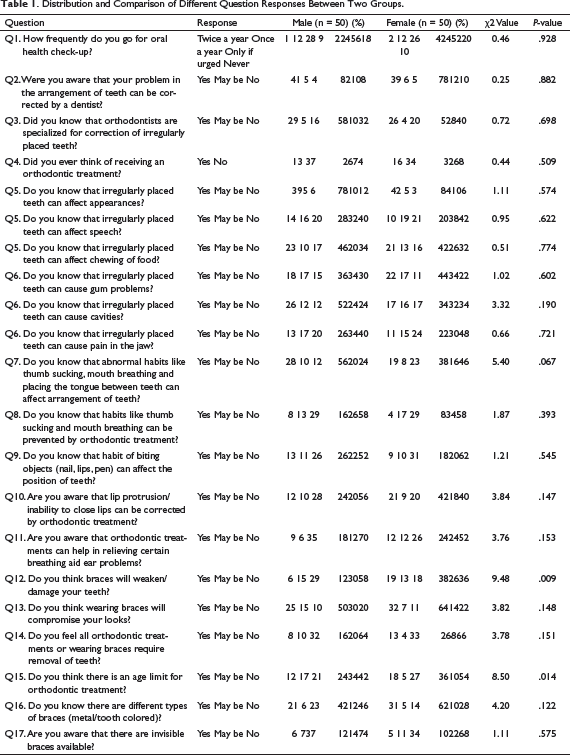
Seventy-three percent of the subjects were completely unaware of the scope of orthodontic procedures involved in correction of abnormal habits like mouth breathing and thumb sucking (Table 1, Q8).
The fact that orthodontic treatment can help in relieving certain breathing and ear problems was known by a mere 30% (Table 1, Q11).
An average taken out of both the genders believing in the myth that there is an age limit for orthodontic treatment was as high as 41% (Table 1, Q15). Sixty-eight percent of the subjects feared their looks would be compromised following an orthodontic treatment (Table 1, Q13), understandably suggestive of poor knowledge regarding the availability of different types of braces. The awareness about the availability of invisible braces was only confined to 20% (Table 1, Q17).
The response of different questions (Q1 to Q17) to assess the level of awareness among local male (n = 50) and female (n = 50) adult population regarding orthodontic treatment and procedures is summarized in Table 1. For each question, comparing the response frequency (%) between two groups (male and female), χ2 test showed a similar (P > .05) response between two groups except Q12 and Q15.
In Q12 (ie, do you think braces will weaken/damage your teeth?), the response (yes/may be/no) frequency differed significantly between the two groups and the response frequency “yes” was significantly different and 26% higher in females as compared to males (12% vs 38%, χ2 = 9.48, P = .009).
Similarly, in Q15 (ie, do you think there is an age limit for orthodontic treatment?), the response (yes/may be/no) frequency differed significantly between the two groups and the response frequency “yes” was significantly different and 12% higher in females as compared to males (24% vs 36%, χ2 = 8.50, P = .014).
Discussion
Orthodontic problems are generally not associated with high debilitation. The incidence of orthodontic problems in rendering an individual handicap is minimal. Therefore, they are mostly ignored and do not serve as the primary health concern.
There has been a noticeable rise in the awareness of orthodontics, pressing on to the speciality in adults as well as children all around the globe, but in India, the epidemic of chronic diseases affecting the bulk of the rural population has been neglected, and it can be said more for the oral diseases. 4 This is because of lack of education and awareness and low socioeconomic status for much of the population. Therefore, there is a dire need to assess and develop knowledge regarding this speciality.
The results obtained from the survey outlined that there is indeed little awareness of the study participants (49.5%) concerning orthodontics as a dental speciality (Table 1, Q3). It was observed from the filled-in questionnaire that half of the subjects under evaluation did not know the existence of orthodontics in the field of dentistry.
Based on the outcome of the survey, it is observed that high cost and longer duration of treatment dissuaded individuals from seeking an orthodontist’s assistance (Table 1, Q4). A proportion as large as three-fourth of the study population was completely unaware about the scope of orthodontic procedures involved in correction of abnormal habits like mouth breathing and thumb sucking (Table 1, Q8).
Majority of the subjects were in concordance with the fact that appearance would be affected by malocclusion (68%, Table 1, Q13). This agrees with another study conducted on patient cooperation and assessment by Salzman JD, which states that this maybe because it has been observed that the demand for orthodontic treatment is motivated primarily by aesthetic values and the high social premium placed on well-aligned teeth and attractiveness in general. 5
There was a belief among the study population that there is an age limit for orthodontic treatment. This indicates paucity of the information received regarding orthodontics. It is worrying that the knowledge pertaining to the advancements in orthodontics such as the availability of invisible braces is minimal and, thus, demands immediate focus to increase the level of awareness regarding orthodontics and its need.
Chi-square test was also conducted to find the correlativity between males and females regarding the cognizance of orthodontic treatment. There was insignificant difference in cognition between male and female, but the belief that braces will weaken the teeth and an age limit to orthodontic treatment was higher in females. Visibly proposing that females tend to believe in the myths attached to orthodontic treatment was more as compared to males. Various studies identified female orthodontic patients as more cooperative than males.6-9
Therefore, an increase in awareness regarding this field will be helpful in eradicating the misbeliefs and increase sentience.
Conclusion
More than half of the subjects under survey only sought dental assistance when urged; this negligence regarding dental check-ups is one of the most important factors for the lack of awareness in them.
71% of the people studied never thought of receiving an orthodontic treatment. Amongst those who considered, most did not opt for the orthodontic treatment as they believed braces would compromise their looks.
Had it been they were aware about the “NOW OF ORTHODONTICS- INVISALIGN” they would have not hesitated to seek treatment.
Scope of the Study
This study will help to evaluate and enhance the knowledge of the youth regarding orthodontics. People will become increasingly aware of orthodontic problems. 10
Footnotes
Declaration of Conflicting Interests
The authors declared no potential conflicts of interest with respect to the research, authorship, and/or publication of this article.
Funding
The authors received no financial support for the research, authorship, and/or publication of this article.
Statement of Informed Consent and Ethical Approval
Necessary ethical clearances and informed consent was received and obtained respectively before initiating the study from all participants.
