Abstract

The past few decades have seen a rapid acceleration in research with concomitant increase in the number of journals and scientific publications. This exponential growth has also been accompanied by significant evolution in the publication process, with technological upgrade in the process, publication trends, and editorial and peer review process necessitating researchers and authors to stay abreast not merely on their area of expertise but also on the publication process, learning new skills, and honing old ones.
The need to remain abreast of current trends also applies to research and publication ethics, and this has been a challenge with the pressure placed on academics to publish. There has been a recognition of various kinds of academic misconduct, and journals, publishing houses, institutions, and regulatory bodies have had to create guidelines and enforce regulations to ensure ethical publication practices.
Authorship conflict, plagiarism, salami slicing, text recycling, etc, are just some of the issues that constitute academic misconduct. While some are intentional and condemnable, some others are inadvertent and quite often because of a lack of knowledge on current trends and regulations.
The Committee on Publication Ethics (COPE), the Directory of Open Access Journals (DOAJ), the Open Access Scholarly Publishers Association (OASPA), and the World Association of Medical Editors (WAME) are scholarly organizations that have collaborated in an effort to identify principles of transparency and best practices for scholarly publications.
The Committee on Publication Ethics offers direction on how to deal with specific situations. 1 These guidelines are often revised and updated, and it is important for professional organizations, the journals run by them, and the authors who contribute to be aware of the current guidelines. In India, the united grants commission (UGC) also has emphasized the importance of transparency and academic integrity, and this starts with the selection of the right journal that has to be included in the UGC-consortium for academic and research ethics (CARE) reference list of quality journals and the denouncement of the “pay and publish” trash culture.
Thus, this survey was conceptualized by the Journal of the Indian orthodontic Society (JIOS) to evaluate and create an awareness on current guidelines for best publication practices for this can only be created authors, peer reviewers if, editorial board members, and organization being on the same page in an effort to create a healthy research and publication ecosystem.
A total of 307 IOS members participated in this survey, of which 26% were clinicians, 44% were academicians, and 30% were postgraduate student members. Seventy-eight percent of the participants had already published before, whereas 22% mostly belonging to the student group had not.
Of the nonstudent participants in the survey, 23% had less than 5 years of experience, 22% had 5 to 10 years of experience, and 55% had more than 10 years of working experience.
When asked which was the gravest form of scientific dishonesty, the majority of participants in all groups opined that plagiarism, misleading authorship, and falsification of data were all equally grave misdemeanors. While indeed they are all grave offences, it may be argued that, falsification of data and plagiarism are more serious offences warranting strict disciplinary action over authorship conflicts.
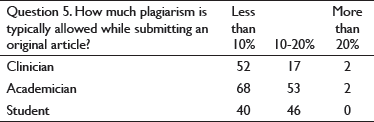
Of the various forms of plagiarism, that is, complete plagiarism, mosaic plagiarism, accidental plagiarism, and self-plagiarism, the majority of participants in all three groups opined that complete plagiarism is the worst. The majority of participants in the non student groups opined that less than 10% of plagiarism is acceptable whereas a smaller percentage felt that 10-20% is acceptable. A very small percentage is all three groups opined that more than 20% of plagiarism is acceptable. Generally, similarities of 15% or lower are deemed to be predominantly acceptable by journals, however the UGC allows only 10% of plagiarism without consequence.
While many are aware that only a specific amount of overlap is acceptable, not many are aware that the amount of similarity allowed from one article is usually 2% to 3%. Majority of participants in each group felt that less than 5% is permissible from a single source. A smaller percentage in each group felt that 10% is acceptable.
Plagiarism can be avoided by giving due credit to the original authors. Citing sources, paraphrasing (writing in one’s own words), and using plagiarism check software are some of the other ways. While majority of the participants acknowledged that all the above methods are useful in avoiding plagiarism, most participants felt that free online plagiarism software did not work as well as paid ones. Most believed that cross-language plagiarism can be checked by online software. Hence, it is highly recommended that authors have their original work screened to detect and correct any unintentional plagiarism or reproduction as well.
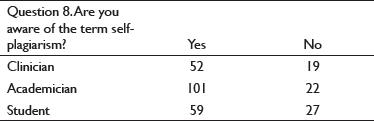
Majority of participants were aware of the term “self-plagiarism.” Of the 3 groups, academicians were best aware of this term and what it constitutes. Most of the participants appeared to think that only duplicate plagiarism constitutes self-plagiarism. A smaller percentage also felt that augmented publication, salami slicing, and text recycling are forms of self-plagiarism authors often take a previously published work, add some data to it to make it meatier and republish it and this becomes an augmented publication. Salami slicing is dividing a work into numerous publications to get into the numbers game. Text recycling is often unintentional. Authors tend to use similar words and phrases or could take similar sentences from a previous work which would constitute text recycling. 1 More participants in all three groups opined that this was not acceptable, but there was a resounding clarity in the academicians’ group.
The feeling of ownership with regard to a previous publication is what probably leads authors to commit self-plagiarism. It is often forgotten that once a publication is submitted to a journal, it becomes the property of the journal. It is gratifying that majority of the participants were aware that permission needs to be sought from the publisher to use the content published previously. A smaller percentage were divided into not knowing and not thinking it necessary. Most participants in all three groups were aware that image manipulation is not acceptable.
Editors often have to deal with authorship misconduct. This becomes particularly irksome because it crops up only after the article is published. According to the International Council of Medical Journal Editors (ICMJE) guidelines, the following criteria need to be fulfilled to qualify for authorship.
Substantial contributions to the conception or design of the work; acquisition, analysis, or interpretation of data for the work; drafting the work and revising it critically for important intellectual content; and final approval of the version to be published and agreement to be accountable for all aspects of the work.
2
Other contributions such as fund acquisition, administrative support, overall supervision, language editing, and proof reading do not qualify for authorship but such contributions can be acknowledged.
Majority of the participants seemed to be aware of this, but this needs execution at the level of department, institution, and university. Self-righteousness also becomes a major part of allocating credit to the right people. The order of authorship is also important. The primary investigator deserves to get first authorship, whereas the most senior person can be the last author. Majority of the participants were aware of this, but there was a lack of clarity on guest authorship and ghost authorship. Giving authorship to those who have not fulfilled the ICMJE guidelines is gift authorship, and leaving out the rightful authors of the work constitutes ghost authorship. 3
There was also a divided opinion on who is the rightful owner of the research/thesis conducted in an institution. Most believed it belonged to the university/institution and the investigators. However, the rightful owner is the institution, since it provides the facilities to carry out the research. 2
Most journals now mandate a publishing statement on conflict of interest. Most participants were aware of this. Most participants also opined that involvement of business interests affected the outcome of science. Dual submission or the simultaneous submission of the same manuscript to two journals is considered unethical, since it could lead to copyright infringement, could lead to dual/redundant publication, and could waste the time and resources of the journal. Most participants were aware of this and were aware of the issues of data fabrication and agreed that reviewers /journals have a right to ask to see the raw data if required.
Public domain work is accessible to all, and this would be mentioned in the work, but this has the same plagiarism implications as any other published work. Majority of the participants were aware of this.
Most respectable journals would respond to a report of plagiarism, but if they do not, a legal notice can be sent. Majority of the participants felt that either this or reporting to the authorities was an option. Only a very small percentage felt that nothing could be done. Resolution of raised ethical issues is also the hallmark of a good journal and organization.
Most contributors felt that the pressure on publishing is what leads to academic misconduct. The stress of the publish and perish on academics is what probably leads to misconduct, although most participants opined that lack of awareness and a general disregard for the law is the cause. Most believed that strict guidelines will help in controlling academic misconduct, and there was a divided opinion on who should impose these guidelines whether institutions, regulatory bodies, or professional associations. In reality, the journal needs to take appropriate action according to the COPE guidelines and should inform the institution from which the offenders hail. In recent times, IOS has amended its constitution to include academic misconduct in the list of misdemeanors, which could lead to a member becoming a member of not good standing.
While systems may be in place to create consequences for misdemeanors, JIOS and IOS also seek to educate and increase awareness. The best discipline would be self-discipline.
Real integrity is doing the right thing, knowing that nobody’s going to know whether you did it or not. ―