




Abstract
The crimpable hook is a widely accepted tool onto which active elements can be fixed to aid in orthodontic tooth movement.
This clinical pearl aims at showing the different ways in which crimpable hooks can be used to better orthodontic treatment mechanics, which are
Crimpable hooks used for buccolingual force mechanics and Crimpable hooks used in conjunction with orthodontic miniscrews.
The above-mentioned simple methods aim to facilitate and make easy the attachment of force elements for various kinds of tooth movements.
It can help the operator to save time, prevent unwanted side effects of forces, as well as reduce the need for ligature wires for the attachment of force systems onto implant heads or lingual sheaths.
Introduction
Space closure is one of the most challenging and common procedures in orthodontics. Depending on the anchorage requirement and treatment plan, the space present can either be closed by
Maximum retraction of the anterior segment (maximum anchorage), Equal retraction and protraction of the anterior and posterior segments, respectively (moderate anchorage), and Maximum protraction of the posterior segments (minimum anchorage).1
A thorough knowledge of biomechanics is essential to bring about space closure without unwanted tooth movements such as dumping of teeth into the extraction space or rotations of the teeth adjacent to the edentulous spaces.
For example, in case of a first premolar extraction, to prevent the distal-in rotation of the canine and mesial-in rotation of the molar during space closure, bucco-palatal or buccolingual forces can be used, rather than just a buccal force system.
The advent of temporary anchorage devices or orthodontic miniscrews has drastically expanded the arena of the orthodontic treatment envelope. These miniscrews provide absolute anchorage for various kinds of tooth movement where force delivery systems such as elastics or coil springs can directly be attached to the head of the miniscrew.
However, the attachment of these force elements to the miniscrew head is sometimes challenging.
The crimpable hook is a widely accepted tool onto which active elements can be fixed to aid in orthodontic tooth movement.
A crimpable hook is defined as “An improved orthodontic device defining an anchor for an elastic, ligature or spring along an archwire or a stop on a wire member.”2
In literature, to our knowledge, there is no method describing the use of crimpable hooks on the lingual or palatal side through lingual sheaths, or the combined use of crimpable hooks with miniscrews.
This clinical pearl aims at showing the different ways in which crimpable hooks can be used to better orthodontic treatment mechanics, which are
Crimpable hooks used for buccolingual force mechanics and Crimpable hooks used in conjunction with orthodontic miniscrews.
The above-mentioned simple methods aim to facilitate and make easy the attachment of force elements for various kinds of tooth movements.
Versatile Uses of Crimpable Hooks
Crimpable hooks used for buccolingual force mechanics and
Crimpable hooks used in conjunction with orthodontic miniscrews.
Crimpable Hooks Used for Buccolingual Force Mechanics
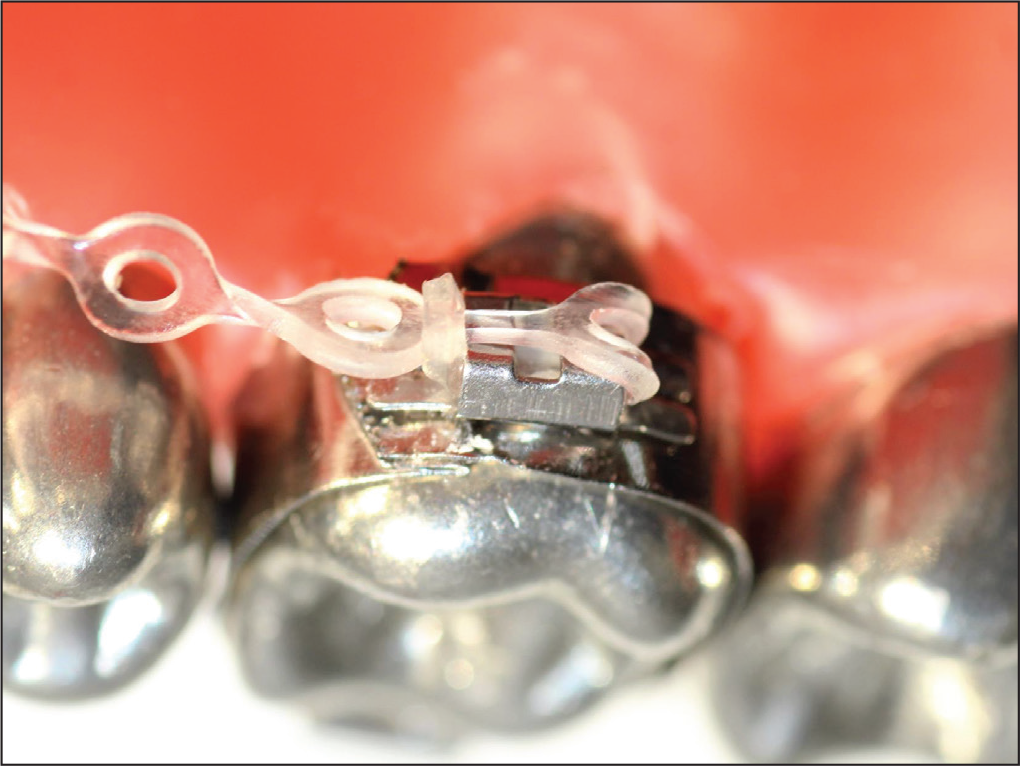
In the cases of molar protraction or where there is a need for attaching elastics onto the lingual or palatal surface of the tooth for the application of buccolingual or palatal forces, threading a stainless steel ligature wire along with an elastic through the lingual sheath (Figure 1), without a hook, is challenging. Furthermore, these elastics need to be changed routinely, thus adding to the struggle.
Threading of elastic through the lingual sheath with the stainless steel ligature
In order to provide an attachment onto which elastics can be easily hooked, the following can be done:
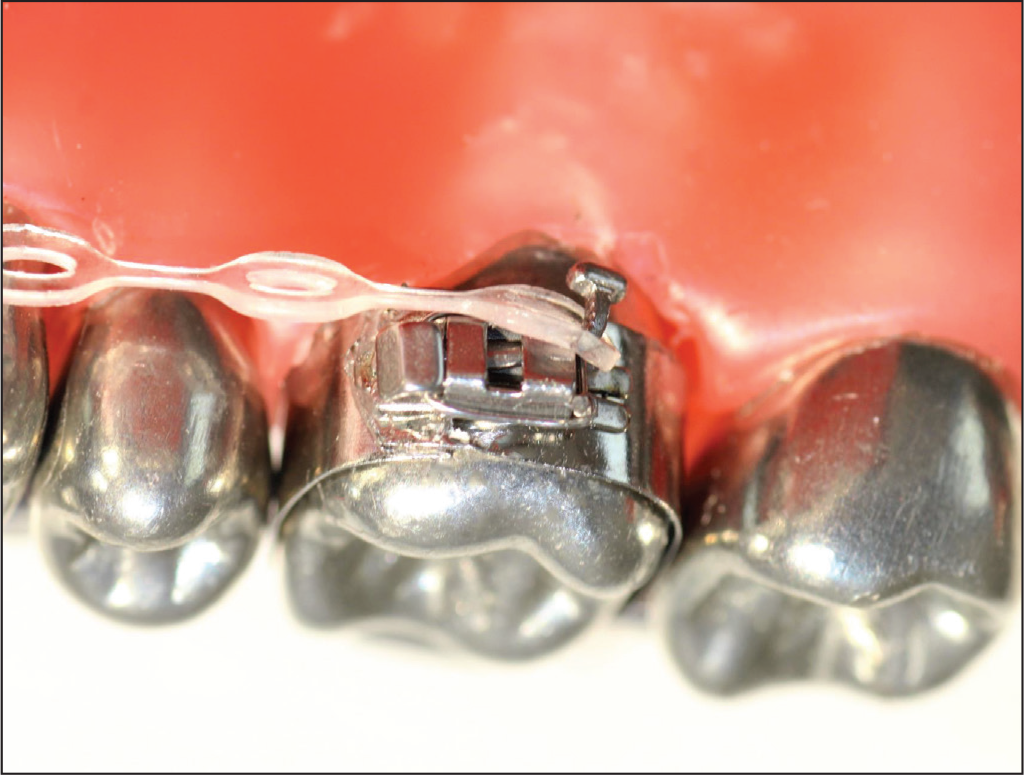
The hook is now stable and firm in place and can be used as a fixed auxiliary for the attachment of elastics (Figure 3).
A crimpable hook secured in the sheath lingual
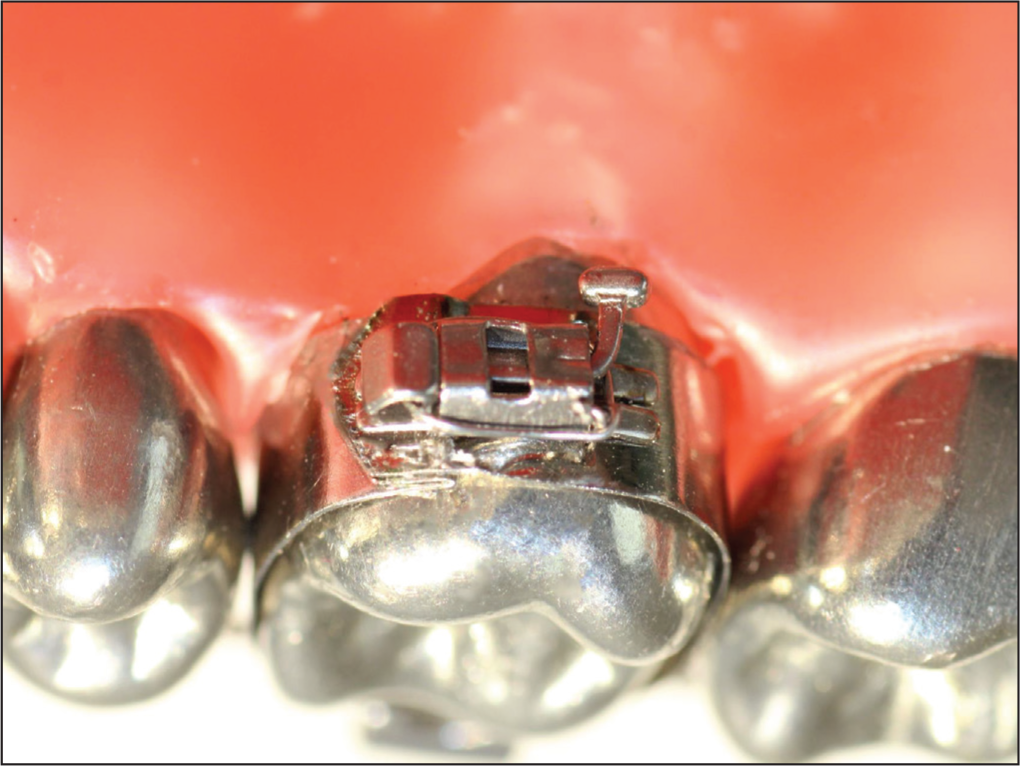
Use of crimpable hook for the easy attachment of force elements of the lingual sheath
Advantages
Easy to use, readily available, small and inconspicuous;
Omits the need for changing of ligature wire plus elastics at every appointment; and
Since the attachment comes out from the distal end of the sheath, it increases the elastomeric units that can be incorporated.
Crimpable Hooks Used in Conjunction with Orthodontic Miniscrews
When Nickle Titanium(NiTi) coil springs are used for retraction or intrusion mechanics with miniscrews, the spring cannot be hooked directly onto the head of the miniscrew.
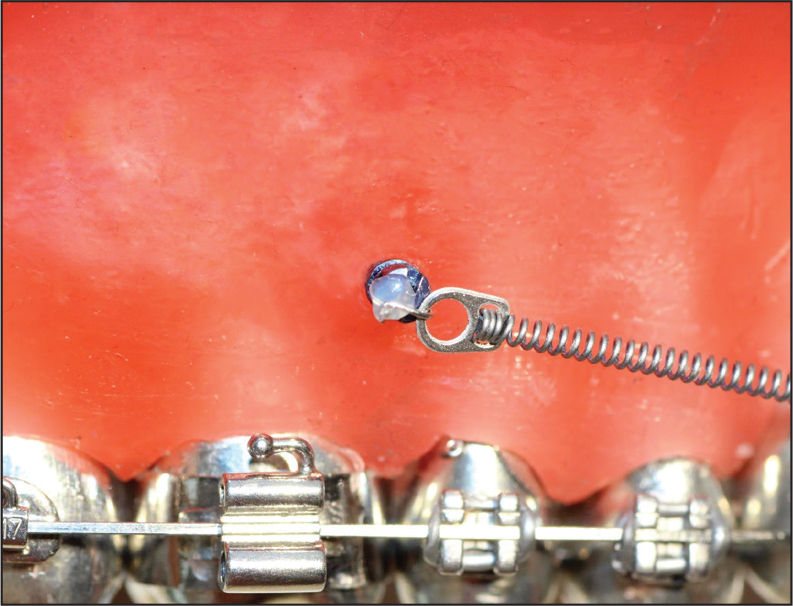
This is due to differences in dimensions of the spring attachment hook and miniscrew head. Most often, ligature wire is needed to be passed through the miniscrew head to secure the spring. (Figure 4)
Use of ligature wire to secure the coil spring onto the miniscrew head.
In bracket head type of miniscrews or those heads with a slot, the following can be done for the ease of coil spring attachment:
A crimpable secured into the miniscrew slot with composite.
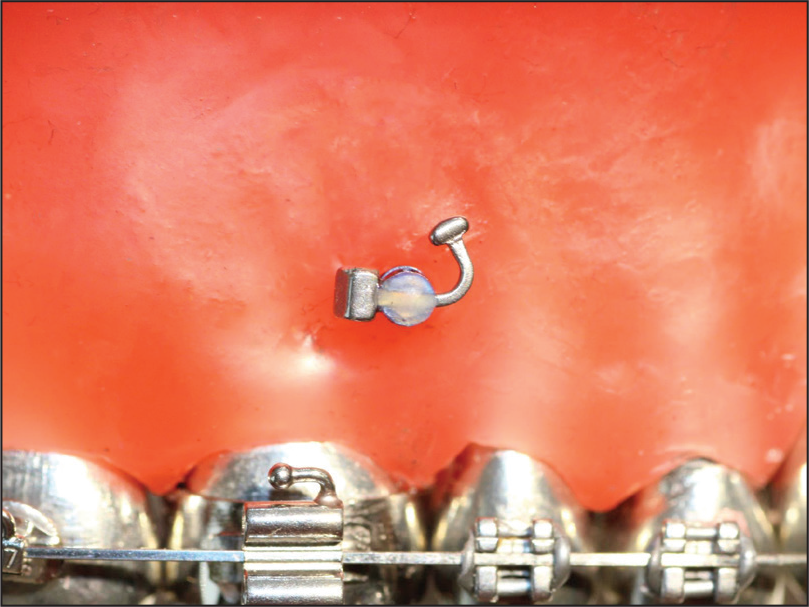
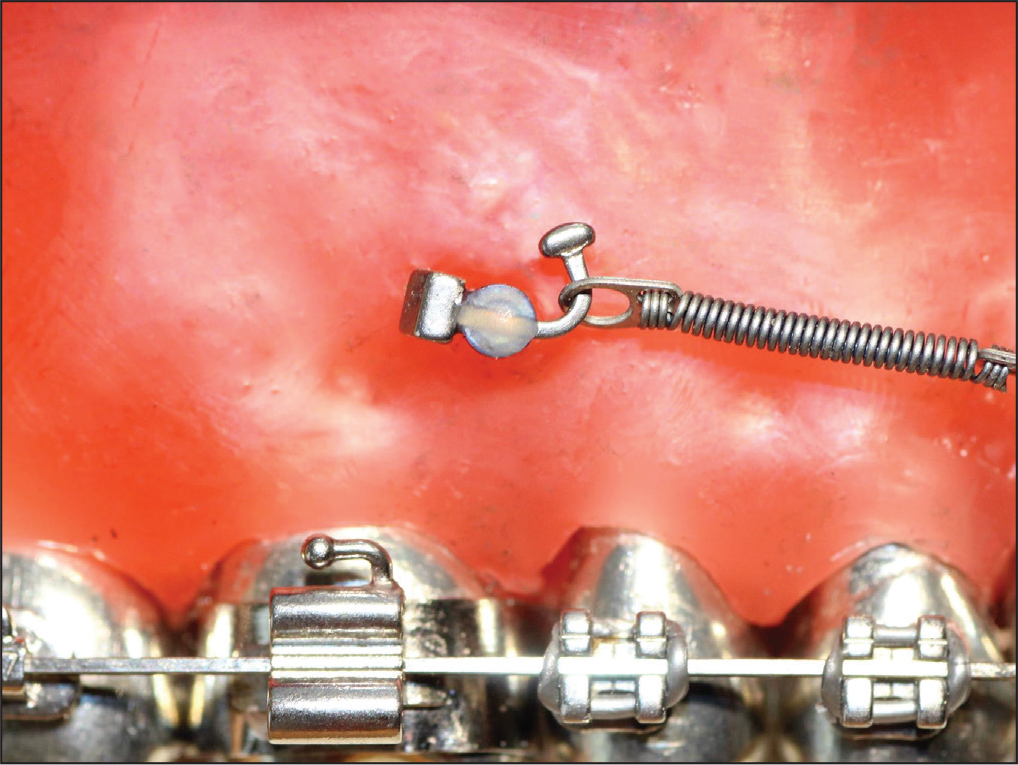
Thus, the crimpable hook is now secured onto the miniscrew and can be used for the attachment of elastics or coil springs to bring about various tooth movements (Figure 6).
Use of a crimpable hook with miniscrews for the easy attachment of force elements.
Advantages
Easy to use and readily available;
Makes the attachment of NiTi coil springs to the miniscrew easy and quick; and
The composite bead also prevents soft tissue injury and can be easily removed or detached when needed.
Conclusion
The described versatile uses of crimpable hooks in this article are simple ergonomic procedures that can increase the efficiency of treatment.
It can help the operator to save time, prevent unwanted side effects of forces, as well as reduce the need of ligature wires for the attachment of force systems onto miniscrew heads or lingual sheaths.
