




Abstract
Emerging and prevalent infectious pose a significant threat to all stakeholders in the orthodontic office, namely, treating orthodontists, clinical assistants, and the patients. Due diligence must be applied to prevent further transmission of disease and infections. The elastomeric modules are one of the most frequent components of the fixed appliance. This clinical aid puts forth a novel clinical tip to prevent cross-contamination of and from elastomeric modules.
Introduction
The dental/orthodontic office is a high-risk working zone both for the professionals and patients accessing care. 1 Previously known transmissible infections of bacterial and viral origin as well as emerging diseases pose a formidable challenge in preventing cross-infection in the orthodontic office.2,3 Cross-infection may occur in the orthodontic office through several routes, including direct contact with blood, saliva or other bodily secretions, or indirectly through contaminated instruments and elastomeric material, routinely employed for orthodontic treatment.
Rationale for Development of the Device
It is commonly observed that manufacturers often provide with more than enough elastomeric modules (elastomeric ligatures) on the strip, than required for a single patient in one sitting. The remaining unused elastomeric modules present on the strip either get contaminated or are thrown away. To combat this issue, we have designed a new metal auxiliary to avoid cross-contamination of the elastomeric modules. This auxiliary is a more robust device than measures which have been previously suggested. 4
Device Design
The salient features of this auxiliary are that (a) it prevents direct contact of the elastomeric strip containing the elastomeric modules with the gloved hand of the orthodontist which would have been contaminated during the procedure; (b) the elastomeric strip is safely enclosed within the auxiliary, and each and every elastomeric module can be accounted for and used later.
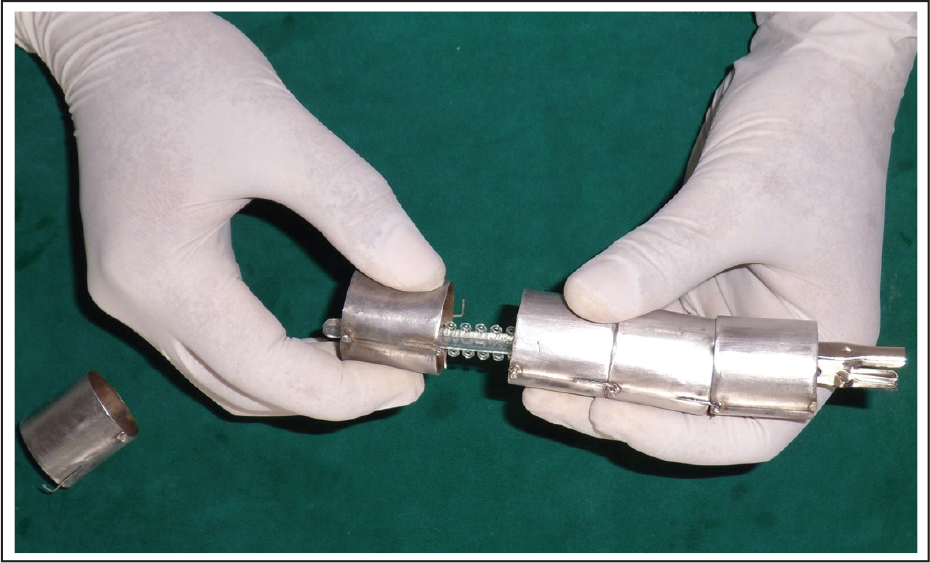
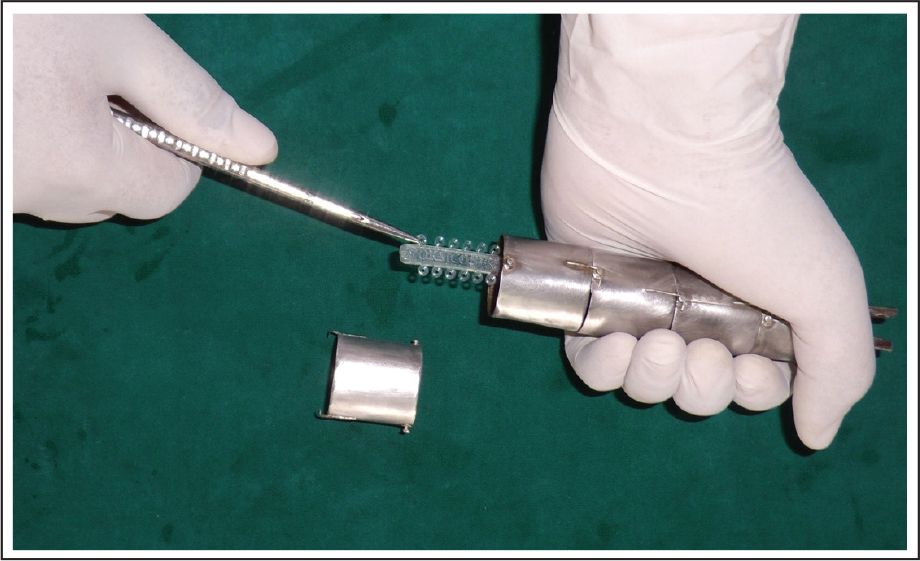
The metal auxiliary is made of a 5-inch stainless-steel hollow tube of diameter 0.5 inch (Figure 1). This tube is sectioned into five pieces of 1-inch length. A reverse action crocodile clip is mounted over a stainless-steel bar that is soldered over the first section. The jaws of the crocodile clip hold the elastomeric strip securely in place in the center of the lumen of the tube, and a Mathieu needle holder can be used to detach the elastomeric module from the strip (Figure 2). As the elastomeric modules are used up from the last section of the strip and if more are needed, then the next section can be easily detached by rotating it counter-clockwise thereby releasing it from the lock assembly which unites the sections (Figure 3). After the elastomeric modules are exhausted the elastomeric strip can be conveniently detached. The metal auxiliary can then be reprocessed by heat sterilization for reuse. The sections can be reattached to one another by twisting them clockwise for the lock assembly to swing into place.
The Metal Auxiliary
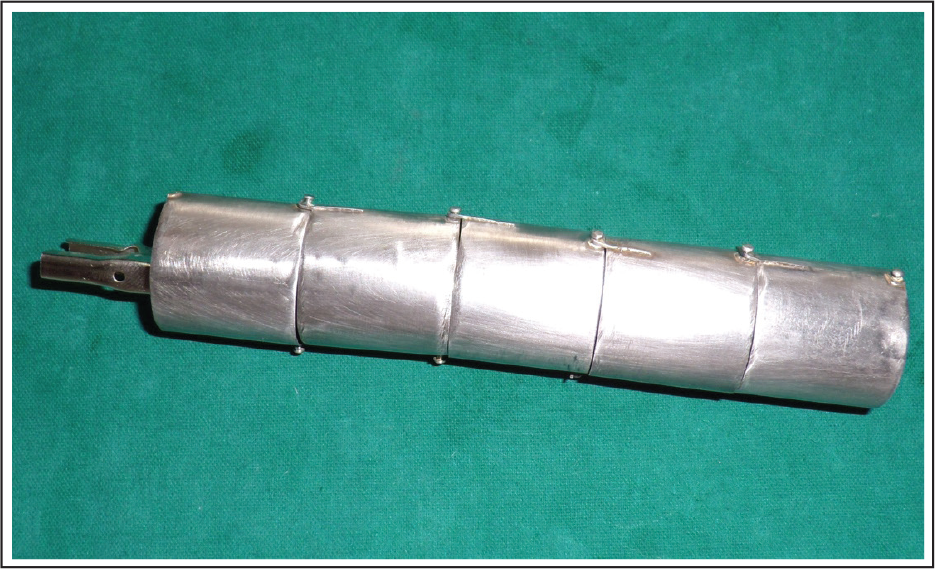
The Metal AuxiliaryDetaching an Elastomeric Module Without Contact With the Elastomeric Stick
Detaching a Segment After the Elastomeric Modules Present in that Section Are Exhausted
Conclusion
This auxiliary design puts forth a rigid, secure, and heat-sterilizable device to prevent contamination of elastomeric modules thereby negating the chance of cross-infection in an orthodontic office. It can be easily fabricated without expensive inventory. This will help orthodontists render not only beautiful smiles but also healthy ones too.
Footnotes
Declaration of Conflicting Interests
The authors declared no potential conflicts of interest with respect to the research, authorship, and/or publication of this article.
Funding
The authors received no financial support for the research, authorship, and/or publication of this article.