




Abstract

Introduction
Macro, mini, and micro esthetics forms an integral part of orthodontic diagnosis and treatment planning. Every orthodontist strives to achieve the best smile esthetics at the end of treatment, which in turn translates into a satisfied patient. 1 Hence, analysis of the smile pre and post treatment needs considerable standardization.
Though smile analysis design is not a new concept and is mainly based on the principles of golden proportions as proposed since the time of ancient Egyptian paintings, 2 The field of orthodontics is mainly concerned with the defined parameters of smile design which form a part of micro- and mini-esthetics, that is, incisor display, smile arc, golden proportion, tooth height–width ratio, and gingival marginal contour. 3
Various methods such as visual evaluation, photographic evaluation, or computer-aided analysis are used for smile analysis.4,5 With increased digitization in orthodontics, computer-based software tools have been proposed for the same. However, most of them are proprietary, technically sensitive, and expensive.
Here, we present a simple tool called “ESA,” which is an easy-to-use computer-based smile analysis for evaluating the smile proportions by using the PowerPoint software (Figures 1 and 2). It also can be used on computer, photograph, dental study models, or chairside with bare minimum armamentarium.
Smile Analysis Template
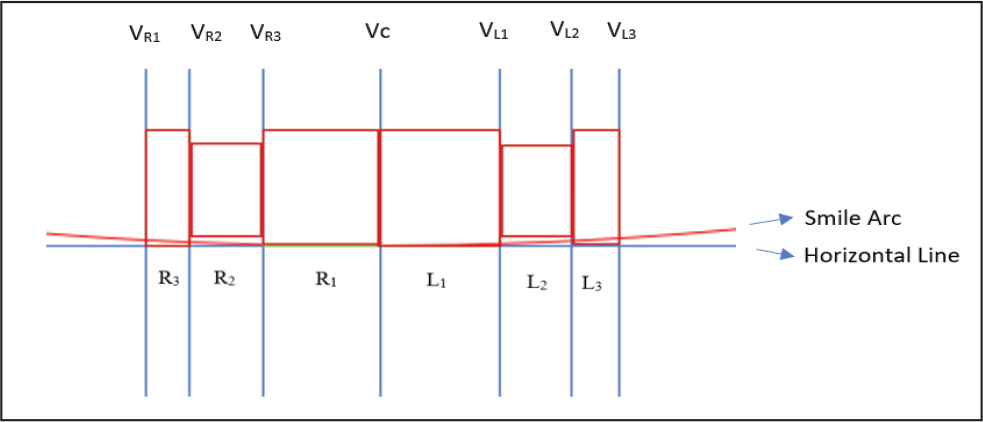
Smile Analysis Template Superimposed on a Patient Smile
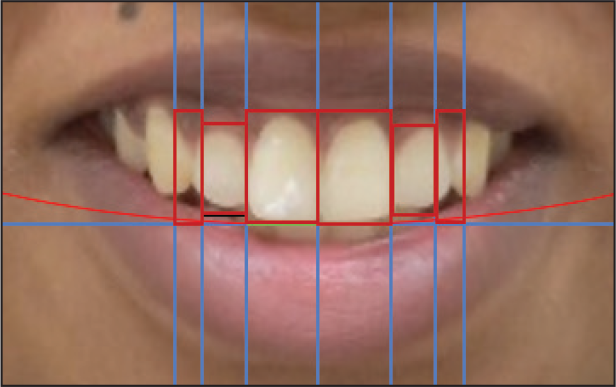
Procedure and Description of Easy Smile Analysis
Easy smile analysis template can be made as per standard population norms or can be easily modified for individual patient. For making the first template, we can start by assuming the central incisor clinical crown height to be 10 mm and width 8 mm.
Easy smile analysis has 7 vertical lines each of 30 cm (VC,VR1,VR2,VR3,VL1,VL2,VL3), 1 horizontal line of 50 cm, 1 elliptical arc (dimension same as horizontal line), 3 pairs of rectangles each having dimensions 10 × 8 cm (R1,L1), 6.2 × 6 cm (R2,L2), 3.844 × 8 cm (R3,L3) going laterally from midline on both sides, width keeps on decreasing by 62% of the preceding one following golden proportion drawn on a PowerPoint. These lines can be arranged in the below sequence:
Align the horizontal line at the center of the slide, such that one vertical line is at the center of the horizontal line, place the rectangles in decreasing order of size on both sides with each of the vertical lines at their point of overlap. Lastly, the arc is placed such that its midline coincides with the middle line. These lines are grouped into one and its aspect ratio is locked, so that its ratio and proportion remain unaltered irrespective of its stretch from any corner (Figure 1).
This premade template can be then used by copying and pasting it on any standardized photograph imported from a PowerPoint slide by superimposing it over the maxillary dental midline and central incisor to instantly check for golden proportions, gingival contour height, smile arc, anterior cant, etc.
This template can be modified digitally according to patient central incisor size which dictates dimensions of rectangles R1, L1 primarily and secondarily rest of the rectangles will change in width as per golden proportion of 62% and printed on a translucent/OHP sheet for making an individualized template and used on cast or patients mouth for instant chairside evaluation.
Modifications can be done to add other parameters such as interlabial gap, buccal corridors, intercommissural width, etc.
Advantages
It is simple, reliable, and easy to conduct.
It does not need any special software and can be made chairside and free of cost.
1:1 template can be printed on the acetate/transparent paper as per the patient’s tooth size and clinical/photographic evaluation can also be done.
Disadvantages
Needs familiarization with PowerPoint software.
Needs manual adjustments to avoid any errors, which can be rectified by re-verifying the proportions.
Conclusion
Easy smile analysis is an easy-to-use computer-based smile analysis which can be performed on computer, photograph, dental study models, or chairside in patients mouth using bare minimum equipment which are routinely available in the clinic without involving overhead cost, and it may also prove useful in case presentations.
