




Abstract
Abstract
Facial and dental midlines are an essential diagnostic feature in orthodontic treatment planning. Interpreting the deviation helps us to establish a proper treatment plan. This article describes an easy way to record and interpret a new nomenclature coding system for facial and dental midlines.
Introduction
Facial attractiveness is an essential objective of orthodontic treatment, and frontal symmetry is considered one of the evaluation standards of facial appearance. 1 All esthetic deviations revolve around the midline and act as an essential plugin in orthodontic treatment planning. Interpreting the scale of deviation in this regard helps us to get precise treatment plans and contributes to the success of the treatment outcome. However, to date, there is no coding system where we can visualize the scale of deviation in facial and dental midlines. Hence, we contribute an easy way to record and interpret a new nomenclature coding system for facial and dental midlines.
Procedure for Coding
Following are the steps involved in coding:
Determination of facial and dental midlines Historically, several landmarks located on the face have been used to determine the facial and dental midlines, such as bisector of pupils, the nasion, bridge, and the tip of the nose, philtrum of the upper lip, and the midpoint of the chin. The midpoint of the central incisors in the upper, as well as lower, arches defines the dental midline which is in the same plane to the facial midline. With the limitation such as inaccuracies in transposing bisector of pupils, the use of vertical perpendicular from glabella might be used as an alternative with the face in the natural head position. Based on convention and dogma, most of the clinicians choose one specific anatomic landmark and an imaginary line passing through it. Thus, the clinician is left with no established guidelines to determine facial midline.1, 2 Components of the code and their nomenclature There are 6 basic coded nomenclatures for describing facial and dental midlines. “B” for the nasal bridge, “T” for the tip of the nose, “P” for the philtrum of the upper lip, “U” for upper dental midline, “L” for lower dental midline, and “C” for chin center. These 6 components, namely B, T, P, U, L, and C, are denoted in upper case letters. The deviation from the midline is recorded in millimeters (mm) as subscript next to their respective components of codes, with the “+” for right-side shift, “–” for the left side, “0” for no shift, and “x” when the midline cannot be determined, such as the case with missing central incisors, grossly decayed mesial surface of central incisors, overlapping of central incisors, midline diastema, trauma, carcinoma, etc. Hence, a normal coding system for facial and dental midlines is written as B0 T0 P0 U0 L0 C0.
Example 1
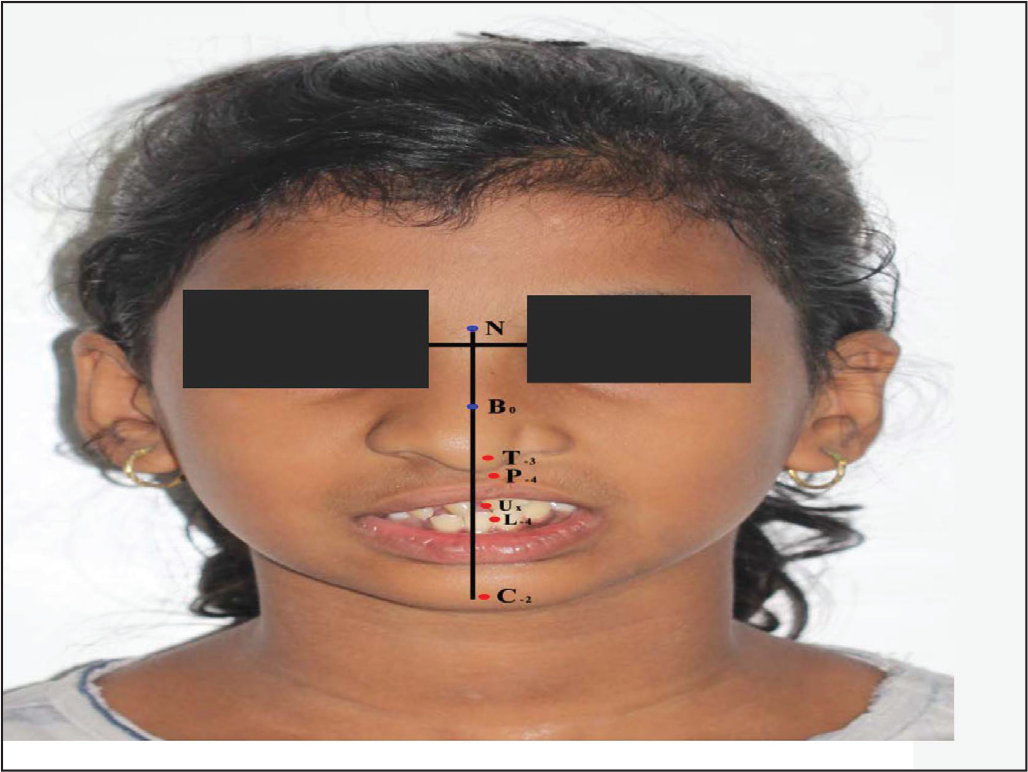
Description of the Code
The nasal bridge is in line with the facial soft-tissue midline. Tip of the nose, philtrum, lower dental midline, and center of the chin are deviated to the left side by 3 mm, 4 mm, 4 mm, and 2 mm, respectively, to that of the facial soft-tissue midline. Upper dental midline cannot be determined.
Discussion
Unlike a facial profile, frontal symmetry is a perspective that the patient sees regularly, and it is judged by others during face-to-face encounters. 3 Deviation of midline structures to the right or left, however, is not considered to be normal. In patients presenting for orthodontic treatment, the maxillary and/or mandibular dental midlines often are not coincident with each other or with the facial soft-tissue midline. 1
In orthodontics, the extent of deviation from the facial soft-tissue midline is commonly recorded in a very elaborated form, which makes it very tiring to visualize the hitch. This problem is effortlessly resolved with the nomenclature coding system “B0 T0 P0 U0 L0 C0” for facial and dental midlines. The deviation is noted in millimeters at the subscript to their codes with “+,” “–,” “0,” and “x” as of right, left, no shifts, and cannot be determined, respectively.
Conclusion
This present nomenclature coding system for facial and dental midlines elucidates an easy and precise method to record the scale of deviation, assists in calculated orthodontic treatment planning in the transverse dimension, and contributes to a successful treatment outcome.
Footnotes
Declaration of Conflicting Interests
The authors declared no potential conflicts of interest with respect to the research, authorship, and/or publication of this article.
Funding
The authors received no financial support for the research, authorship, and/or publication of this article.
