




Abstract
Abstract
Introduction: Elastomeric chains are relevant in orthodontic mechanics due to the form memory property; however, elastomers present high force reduction in some circumstances. The objective was to evaluate the effect of hot beverages on tensile strength degradation of orthodontic elastomeric chains.
Material and Methods: Four groups were tested according to different immersion liquids: artificial saliva (group 1), hot water (group 2), green tea (group 3), and coffee (group 4). The elastomeric chains of groups 2, 3, and 4 were immersed in the respective liquids, with temperature of 70 ± 1°C twice daily for 30 seconds for a period of 7, 14, or 21 days. All samples were kept in artificial saliva and stored in an incubator at controlled temperature of 37 ± 1°C. The elastomeric chains were then examined in the testing machine (AME-2kN; Filizola, São Paulo, Brazil) to measure the tensile strength degradation.
Results: It was observed through intragroup comparisons that the control showed a progressive reduction of tensile strength in a statistically significant manner throughout the study period. In turn, the hot water, green tea, and coffee samples showed a statistically significant reduction from 7 to 14 days. From 14 to 21 days, the tension remained stable. When the test groups were compared with the control, it was observed that all groups presented tension reduction in a statistically significant manner at all periods, except for the coffee group at 21 days (P < .001).
Conclusions: Experimental immersion in hot water, green tea, and coffee at 70 ± 1°C contributed in a statistically significant manner to the strength degradation of orthodontic elastomeric chains in the period of 7 and 14 days.
Introduction
Since the beginning of the last century, efforts have been devoted to fundamental research on tooth movement, and the design and mechanisms of orthodontics appliances and accessories have received great interest. 1 The orthodontic movement results from the application of a varied force system composed of springs, wires, and/or elastics. The system should be able to transfer strength and thus promote movement without discomfort to the patient or damages to the surrounding tissues. 2 The ideal orthodontic force required to achieve tooth movement is controversial, but it is often assumed that slight and continuous forces are considered optimal. 3 In this context, studies aiming at enhancing appliances and accessories performance are continuously expected.
Elastics are amorphous polymers formed of polyurethane material, presenting rubber and plastic characteristics.4, 5 Elasticity is defined as the ability of the elastic to return to its original dimensions when subjected to deformation forces. The type of molecular attraction and the geometric pattern of the polymers determine this property, 4 and yet, factors linked to the intraoral environment such as saliva pH, enzymes, diet, physical action of teeth brushing, temperature variations, water, and pigment absorption accelerate elasticity loss and strength degradation.3, 5, 6
It is thus speculated that feeding and hygiene particularities can interfere in the elastic properties and affect the treatment outcome. Based on this assumption, studies have been carried out to evaluate force degradation in several conditions related to individual habits and oral cavity, such as the use of alcoholic beverages, 7 chlorhexidine wash in different formulations, 2 alcohol concentration in mouthwashes, 8 and different diet products. 9 However, the effect of high-temperature feeding habits has not been accessed. It is well known that hot beverages are highly appreciated in most of the countries. In this context, it is relevant to investigate if this drinking routine can somehow affect the orthodontic outcome. The aim of this study was to evaluate experimentally the effect of hot water, hot green tea, and hot coffee on the tensional strength of orthodontic elastomeric chains.
Material and Methods
For the present investigation, Memorychain (American Orthodontics, Sheboygan, USA) pearl-colored elastomeric chains were used. The segments were carefully removed from the reels without stretching, and 5 loops were selected for each sample. Segment cutting was always done in the middle portion of the sixth link, leaving half a link at each of its ends, so that no damage of the structure of the elastomeric chains occurred during cutting.
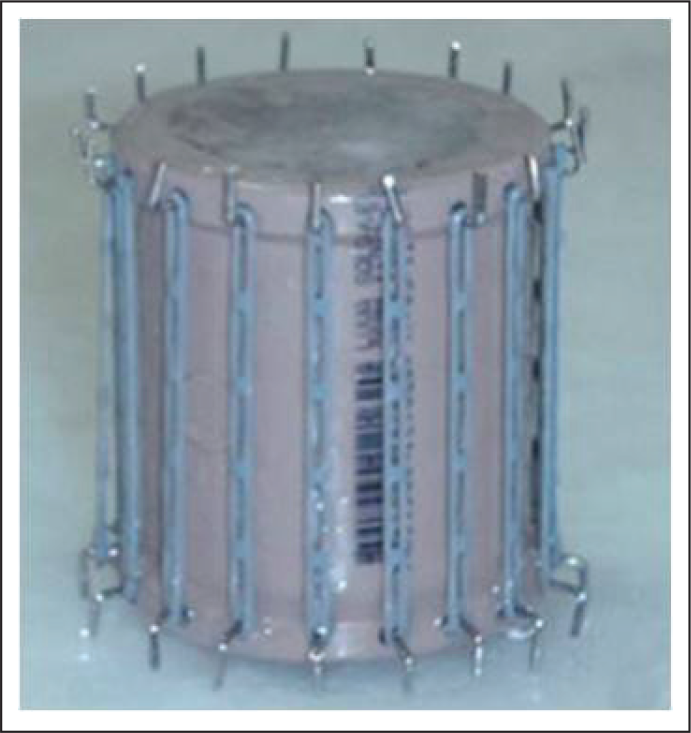
The segments were then placed using a Mathew clamp in a previously prepared tube, fitting 18 elastic segments each. The custom tubes are made with polyvinyl chloride, with small holes at a horizontal distance of 0.5 mm between them, for the purpose of inserting support rods made of stainless steel (0.7 mm), which will serve as hooks for the elastic chains setting. The inside part of the tubes is filled with self-curing acrylic resin in order to fix the rods. Therefore, 2 of the 5 connections will be introduced and distended by a vertical distance of 23.5 mm (Figure 1). This methodology was based on a previously published work by Pithon et al. 2
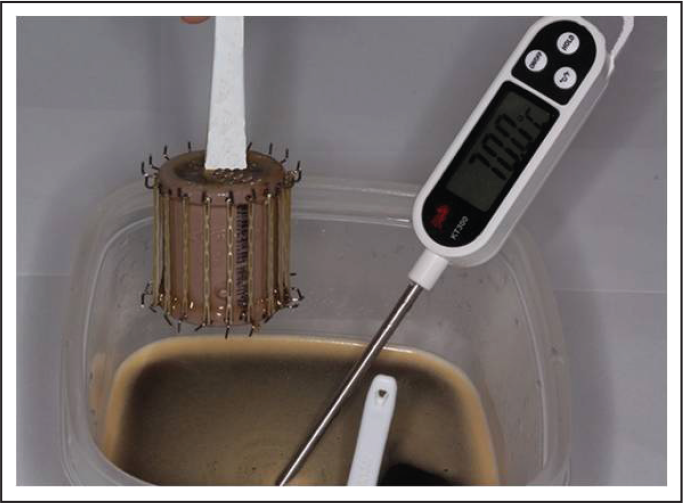
Sample was divided into 4 groups according to the testing liquids: artificial saliva at 37 ± 1°C (control group, group 1), hot water at 70 ± 1°C (group 2), hot green tea at 70 ± 1°C (group 3), and hot coffee at 70 ± 1°C (group 4). The elastomeric chains arranged on the tubes were immersed in artificial saliva at a temperature of 37°C for 1 h prior to beginning the experiments. Then, the tubes were removed from the container with artificial saliva, allowing the saliva to drain, and then immersed in the containers with the liquids to be tested (Figure 2) in which they remained immersed for 30 seconds twice daily, with an interval of 12 hours. After each experiment, samples were totally re-immersed in plastic containers with artificial saliva and kept in an incubator with a temperature of 37 ± 1°C, controlled by a thermostat and digital thermometer, simulating the temperature of the oral cavity. The saliva was changed twice a week. Each liquid had the temperature controlled with the aid of a digital thermometer (KT-300, UF Tools, China). The temperature of the hot liquids was set at 70 ± 1°C.
Specimens were finally removed from the tubes and mounted in a testing machine at intervals of 7, 14, and 21 days. In order to evaluate the strength degradation, the elastomeric chains were removed from the hooks and placed in the universal calibration machine (AME-2kN; Filizola, São Paulo, Brazil) previously calibrated to the distance of 23.5 mm from the sensors. This setting ensured greater reliability of the data obtained. After each measurement, the machine was restarted and the values were recorded on a control chart.
Artificial saliva was formulated and prepared to be used in the present study. The composition was as follows: sodium bicarbonate 2.19 mg, potassium phosphate monobasic 12.7 mg, magnesium chloride 1.25 mg, calcium chloride 4.41 mg, potassium chloride 8.2 mg, sodium fluoride 0.045 mg, sodium benzoate 15 mg, 70% sorbitol 0.24 g, carboxymethylcellulose 0.06 g, and distilled water 1000 mL.
Green tea was prepared as follows: water was heated in a pan until boiling was achieved. Heat was turned off and tea sachets were added according to the proportion of tea and water suggested by the manufacturer (Maratá, Sergipe, Brazil). The prepared tea rested until the temperature reached 70 ± 1°C. Then, the mixture was transferred to the experimental container, and the samples were immersed. Coffee was prepared similarly, except that the beverage was brewed using a disposable paper filter. The powder/water proportion was obtained according to the manufacturer’s suggestion (Maratá, Segipe, Brazil).
Statistical Procedures
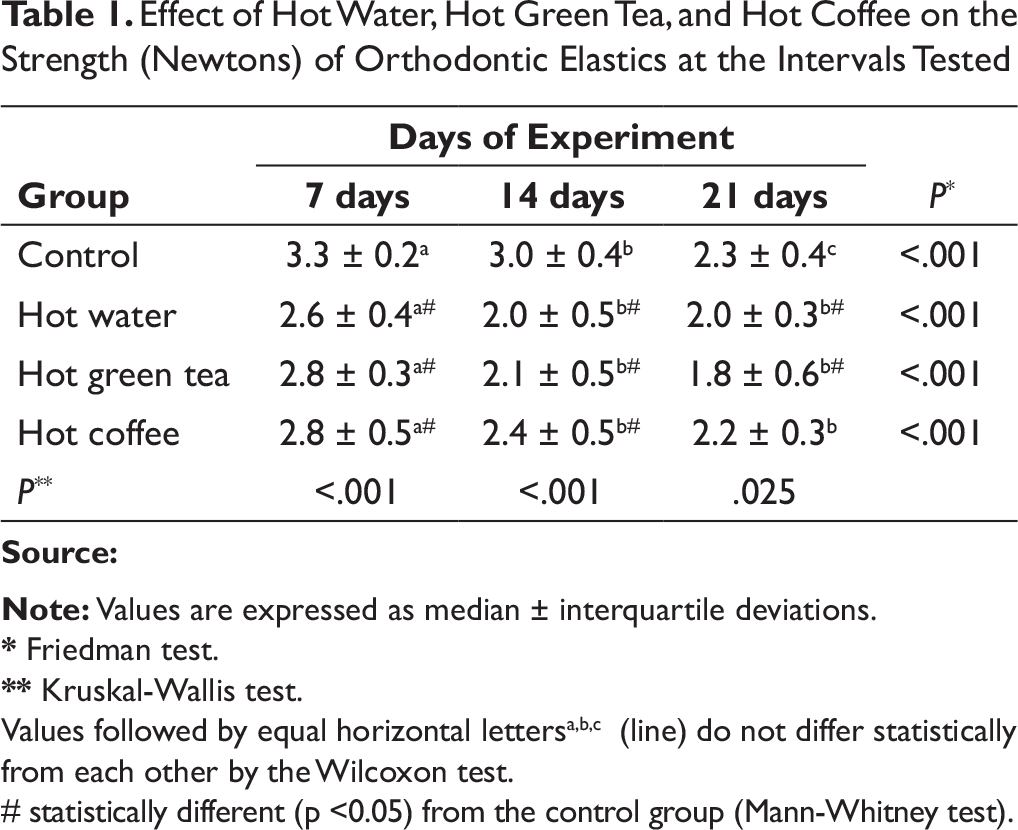
Effect of Hot Water, Hot Green Tea, and Hot Coffee on the Strength (Newtons) of Orthodontic Elastics at the Intervals Tested
* Friedman test.
** Kruskal-Wallis test.
Values followed by equal horizontal lettersa,b,c (line) do not differ statistically from each other by the Wilcoxon test.
# statistically different (p <0.05) from the control group (Mann-Whitney test).
Results
Table 1 shows the median and interquartile range of all groups evaluated. It was observed through intragroup comparisons that the control showed a progressive reduction in a statistically significant manner throughout the study period. In turn, the hot water, green tea, and coffee samples showed a statistically significant reduction from 7 to 14 days (P < .001). From 14 to 21 days, tension remained stable. When the test groups were compared with the control, it was observed that all groups presented tension reduction in a statistically significant manner at all periods, except for the coffee group at 21 days.
Discussion
In orthodontics, various types of elastics are used. The elastomeric chains are fabricated as a connected elastic chain reel, which can be cut to the specific number of necessary links. 8 The elastomeric chains are useful and convenient in many situations.4, 10, 11 The stretched chain provides elastic potential energy that can be converted into mechanical energy, thus promoting tooth movement. 5
Several advantages are attributed to elastics such as low cost, satisfactory biocompatibility, high flexibility, color diversity, relative ability to maintain forces after distortion, and good tolerance by patients. Elastomeric chains are easily applied and removed and do not require patient cooperation. Moreover, they do not compromise hygiene or oral and phonetic functions.12, 13 In some circumstances, however, elastics show rapid tensile force degradation, thus compromising the treatment outcome. 3 In this context, studies are anticipated for better understanding of elastics behavior in varied oral conditions, and the present study aimed at researching the effect of hot beverages on the tensional strength of orthodontic elastomeric chains.
The results demonstrated that over time, all groups presented reduction of elastic force. It was observed through intragroup comparisons that the control showed a statistically significant progressive reduction throughout the study period (P < .001). In turn, the hot liquid samples showed a great and statistically significant reduction from 7 to 14 days, remaining stable from 14 to 21 days. The tension loss is observed clinically and explained in several studies as an intrinsic property of elastics. 12 The present study revealed, however, that immersion in the tested liquids accelerated the reduction of the tensile force in a statistically significant manner (P < .001) at moments 7 and 14 days, compared with the control. At 21 days, there was a more abrupt drop in the tension of the elastics in the control group, approaching the values of the test groups, which continued to decrease with less intensity. Nevertheless, at 21 days, the tension of the hot water and green tea samples was still significantly lower. However, no statistical difference between control and coffee group was noticed for the final period. Pithon et al 7 researched immersion of elastomeric chains in alcoholic drinks. No statistical differences were reported when compared with the control group at the end of the experiment.
Our study group has previously published a study on the effect of cola soft drink on the tension force of orthodontic elastomeric chains. The study comprised a laboratory experiment in which cola soft drink at 5 ± 1°C contributed statistically (P < .001) to the strength degradation of the orthodontic elastomeric chains in the period of 7 and 14 days. Similar results were obtained in specimens immersed in cold water, thus indicating that the composition of the beverage did not promote an extra lowering. It was thus speculated that temperature may be the predominant factor. 14 Regarding the effect of temperature on elastic strength, Stevenson et al 15 reported that an increase in temperature of the environment appeared to significantly influence the degradation mechanism responsible for the deterioration of the mechanical properties of polyurethane elastomers. Paige et al 16 evaluated the effect of temperature cycling on elastics force loss. The authors reported that hot liquids reduced the force of latex and non-latex elastics even when cycled between hot temperatures for brief periods. Due to completely different methodology and objectives, the results of the previously published studies are not suitable for comparison with the present study. Varied experimental methods and elastic features (among other variables) make the comparisons impossible. The diversity of variables provides distinct results when assessing the degree of force degradation; moreover, it is considered very difficult to control all factors that can influence the results. 3
Employing very similar methodology, a previous study 7 evaluated the effect of immersion in whisky, brandy, vodka, beer, sugar cane spirit, and wine. Authors showed that none of the aforementioned alcoholic beverages promoted loss of strength in the elastomeric chains. Other research 2 with similar methods revealed that chlorhexidine at different concentrations did not influence the elastic strength degradation. Finally, regarding the use of mouthwash with or without bleaching agent, a previously published article reported no effect on the force degradation of elastomeric chains. 17
Considering the physiology of tooth movement and taking into account that the elastomeric chains cannot produce constant levels of force over a long period, the present study aimed at evaluating the 21-day period, that is the usually recommended interval between orthodontic appointments.6, 11 Studies published previously also used the same protocol,11, 18 although is also available in the literature studies with longer testing periods.2, 5, 6, 7, 8 Throughout the research, samples were kept in an incubator at 37 ± 1°C immersed in artificial saliva. This care is essential to keep the laboratory study as close as possible to oral conditions and also avoid results that could be influenced by other variables.
The present study standardized the test beverages at 70 ± 1°C, which is believed to be an approximate temperature of hot beverages during consumption. The objective was also to verify the effect of this temperature on the behavior of the elastics. With this purpose, hot water group was included. Assuming that water is an inert substance, the comparisons of the control group with the hot water, in the present study, showed that the temperature itself promoted statistically significant reduction of the tensile strength at all intervals. Similar results were obtained in specimens immersed in hot green tea and coffee, indicating that the composition of the beverage did not promote an extra lowering. It is thus speculated that temperature may be the predominant factor. No studies involving the temperature were found in the literature for proper comparison, and further studies are needed to elucidate this question. In addition, the present study is a laboratory research, and in the oral environment, other decisive factors may be involved, causing the present result to be interpreted with caution. Moreover, only 2 exposures of 30 seconds per day were performed; however, in the daily routine, time of liquid contact with mouth can vary greatly depending on the individual habits.
Finally, it is important for the orthodontist to understand the behavior of the materials to achieve appropriate clinical outcomes. More clinical studies are needed to investigate whether the strength degradation observed in the present study has any implication in the treatment.
Conclusions
Experimental immersion in hot water, hot green tea, and hot coffee at 70 ± 1°C contributed in a statistically significant manner to the strength degradation of orthodontic elastomeric chains in the period of 7 and 14 days.
Experiment Device for Chain Elastics Setting
Chain Elastics During Immersion
Footnotes
Declaration of Conflicting Interests
The authors declared no potential conflicts of interest with respect to the research, authorship, and/or publication of this article.
Funding
The authors received no financial support for the research, authorship, and/or publication of this article.