




Abstract
Time perception is influenced by the spatial factors of visual stimuli. When observing a moving visual stimulus, a longer moving distance is judged to be longer than a shorter moving distance, even if the moving time is the same (the kappa effect). In the present study, to examine the effect of retrospective attention on the kappa effect, two visual stimuli with different moving distances were presented simultaneously. Immediately after these stimuli disappeared, the stimulus to which attention should be directed was specified. Participants judged the time interval to be longer when the stimulus to which they directed retrospective attention moved a longer distance than when it moved a shorter one. This finding indicates that stimulus features (distance moved) affect time perception by directing attention to a specific object in the memory after the disappearance of visual stimuli.
Introduction
The perceived length of time in humans has been shown to expand or contract owing to a variety of factors, and attention is one of the most significant factors. For example, the duration of a visual stimulus presented at a location to which spatial attention is directed is perceived as longer than that of stimuli presented at other locations (Mattes & Ulrich, 1998; Yeshurun & Marom, 2008). In addition to spatial attention, selective attention has been reported to influence time perception. Hayashi et al. (2019) presented static and moving random dot patterns in the same area and instructed participants to direct their attention to either pattern. The results showed that directing attention to a moving pattern resulted in a longer perceived duration than directing attention to a static pattern. This finding indicates that even in situations in which the stimuli are physically identical and have the same presentation duration, variations in the properties of the object to which attention is directed can affect how time is perceived.
Previous experiments on time perception and attention have examined the effects of attention by indicating the object or feature to which attention should be directed before a stimulus is presented. However, Ono (2024) revealed that the perceived presentation time could be distorted when the target of attention is indicated after the stimulus has disappeared. In the field of memory research, attention directed retrospectively, after the item to be remembered has disappeared, is called “retrospective attention” (Bays & Taylor, 2018; Makovsik & Jiang, 2007). In the study by Ono (2024), two shapes of different sizes were presented simultaneously and participants were asked to direct their attention to one of the shapes immediately after its disappearance. According to previous research, people perceive large visual stimuli as having a longer presentation time than small visual stimuli (e.g., Long & Beaton, 1980; Mo & Michalski, 1972; Thomas & Cantor, 1975). If retrospective attention influences time perception, it is likely that presentation time will be perceived as longer when the figure to which attention is directed is larger. The findings revealed that when the figure to which attention was directed was larger, the presentation time was judged to be longer than when attention was directed to a smaller figure. This suggests that a stimulus feature (size) can influence time perception by directing attention to a specific feature of the stimulus in memory after the visual stimulus disappears.
This study extends Ono's (2024) work by investigating the effects of retrospective attention on time interval perception. In this study, two visual stimuli with different moving distances were presented simultaneously. The stimulus to which attention was directed was specified immediately after its disappearance. According to earlier research, when two visual stimuli are presented sequentially, a larger distance between the stimuli is judged to be a longer time interval than when the distance between the stimuli is smaller, a phenomenon known as the kappa effect (Abe, 1935; Cohen et al., 1953; Kuroda et al., 2016; Sarrazin et al., 2004). One of the main hypotheses is the constant velocity hypothesis, which explains how the kappa effect is generated (Cohen et al., 1955; Henry & McAuley, 2009; Jones & Huang, 1982; Price-Williams, 1954). This hypothesis assumes that an object is perceived as moving at a constant speed. In other words, assuming a constant speed, a longer (shorter) distance results in a longer (shorter) movement time.
In the present study, if retrospective attention affected the kappa effect, it would be expected that longer moving distances of the stimulus to which attention was directed would be judged to have a longer time interval than shorter moving distances. Note that “moving” in the present study was regarded as the apparent motion caused by two successive presentations of a visual stimulus.
Although this study's primary aim was to replicate the effect of retrospective attention inspired by Ono's (2024) study, using the kappa effect, an essential difference between these two studies was whether the time interval in each study was a filled or unfilled interval. The difference was that in Ono's (2024) study, the participants judged the length of the presentation time of the visual stimulus (filled interval). However, in the present study, the participants judged the length of the time interval as interrupted by the momentary presentation of the visual stimulus (unfilled interval). In time perception studies, filled intervals (involving continuous sensory input) are perceived as longer than unfilled intervals (gaps between discrete events) of the same objective duration (Wearden & Ogden, 2021). Rammsayer and Lima (1991) reported that 50-ms auditory intervals were better discriminated when filled than when empty, hypothesizing that this was owing to increased neural firing from more perceivable stimuli in filled intervals, which enhanced the subjective representation of duration. Despite the various differences between filled and unfilled intervals, confirming the effect of retrospective attention on time perception in this study would demonstrate the robustness and versatility of this effect.
Method
Participants
The results of the study of Ono (2024) showed a large effect size (Cohen's d = 0.857); therefore, a large effect size (d = 0.8) was used for the power analysis. The sample size required to detect a significant main effect in a t-test was calculated using G*power (d = 0.8, α = .05, 1–β = .90). The required sample size was 19, and 19 participants (15 females and four males) with ages ranging from 19 to 28 years were recruited. The Yamaguchi University Ethics Committee approved this study (Approval No. 2018-001-02) and all participants provided written informed consent.
Apparatus and Stimuli
In a quiet, low-lit environment, participants observed the stimuli on an LCD monitor (Dell AW2521HFL, refresh rate 120 Hz) at a distance of approximately 60 cm. The experimental stimuli were programed using the Psychophysics Toolbox extension (Brainard, 1997; Pelli, 1997). All the stimuli were presented on a gray background. A 0.4° diameter white cross in the center of the screen served as a fixation cross. The shapes of the reference and test stimuli were bars with a height of 0.8° and width of 0.1°, and the presentation time for all bars was 100 ms. The bars were presented 0.9° above and 0.9° below the fixation cross, and their horizontal position depended on the condition. The direction of movement of all the bars was random. The bars for the reference stimuli were white. In half of the participants’ experiments, the test stimulus was green for the top bar and red for the bottom bar (in the other half of the participants’ experiments, the top bar was red and the bottom bar was green). The last fixation cross was either red or green and had the same luminance.
Procedure
A timeline of the sample trials is shown in Figure 1. Each trial began when the participants tapped the spacebar. The reference stimuli were then shown for 1,000 ms after the fixation cross. As reference stimuli, white bars were presented above and below the fixation cross and were re-presented on the opposite horizontal side after the presentation of the fixation cross screen. The horizontal distance moved by the reference stimuli was 2.2°. The interstimulus time interval (ISI) of the reference stimuli was 400 ms (reference interval). The test stimuli were then shown for 1,000 ms after the fixation cross. As test stimuli, red and green bars were presented above and below the fixation cross and were re-presented on the opposite horizontal side after the presentation of the fixation cross screen. The horizontal movement distance of the test stimuli was 1.6° for the short condition and 2.8° for the long condition. The ISIs of the test stimuli was chosen randomly among eight intervals (test intervals: 100, 283, 333, 383, 417, 467, 517, or 700 ms). Following the test stimulus, participants were shown a red or green fixation cross until they responded to the two tasks. The participants indicated whether the test interval was longer or shorter than the reference interval by pressing the corresponding key (Task 1). After Task 1, participants pressed the corresponding key (Task 2) to indicate the direction of movement (right or left) of the bar with the same color as that of the last fixation cross.
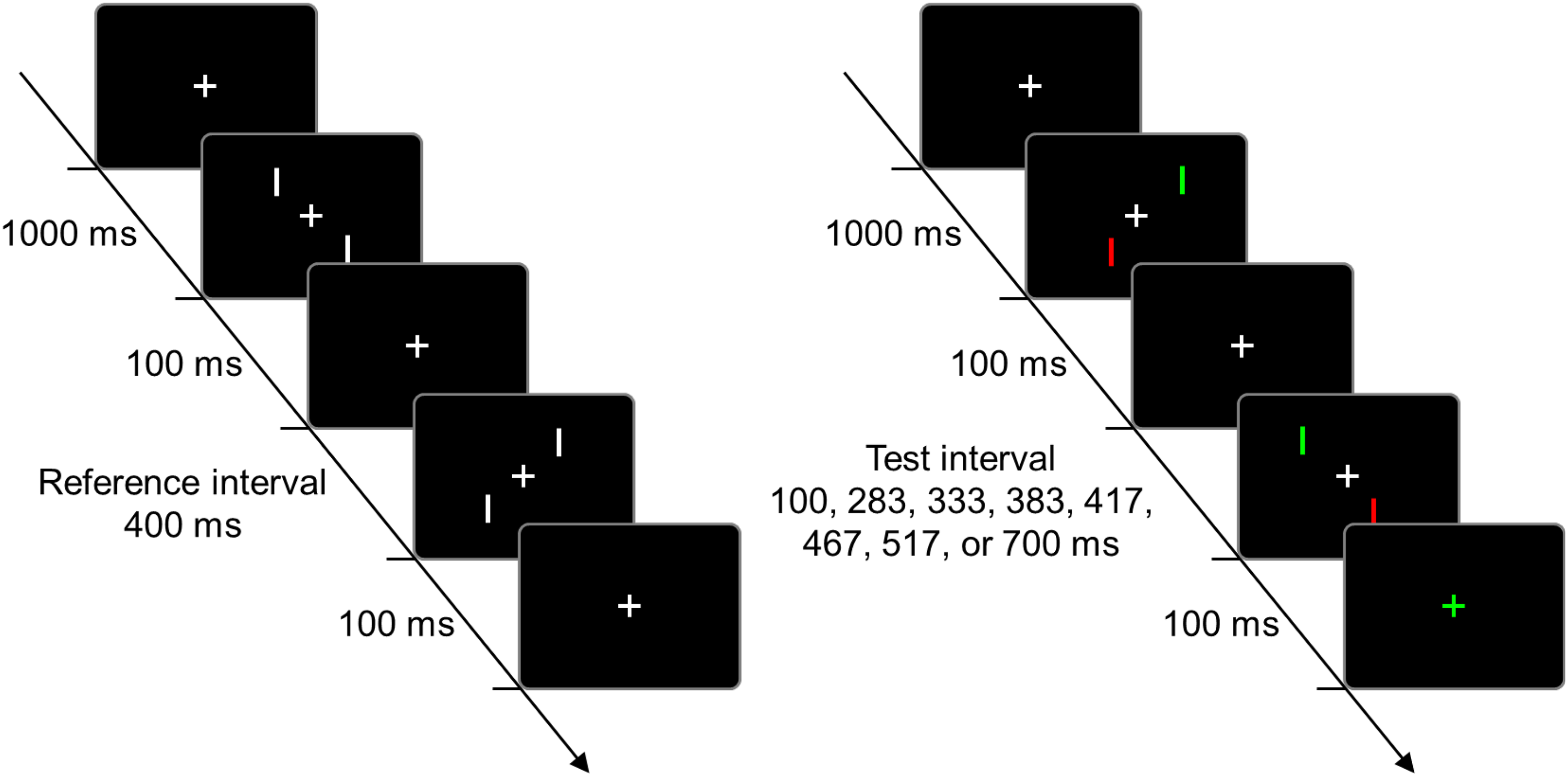
Timeline of a sample trial.
The color of the last fixation cross (red or green) indicated the response of the two bars to the test stimuli. For example, if the last fixation cross was green, the participants had to respond to the direction of movement of the green bar of the test stimuli in Task 2. The trials were divided into long and short conditions based on the test stimulus and the last fixation cross (Figure 2). For example, if the test stimuli were a green bar with a long moving distance and a red bar with a short moving distance and the color of the last fixation cross was green, the trial was classified as a long condition because of the green bar's long moving distance. Each participant performed 128 trials (Eight Test Intervals × Two Conditions×Eight Repetitions). The order of trials was determined at random among the participants, and they were free to take short breaks whenever needed. Prior to the experiment, the participants completed ten practice trials. The analyses were performed using R (version 4.2.1) and R Studio (version 7.2.576).
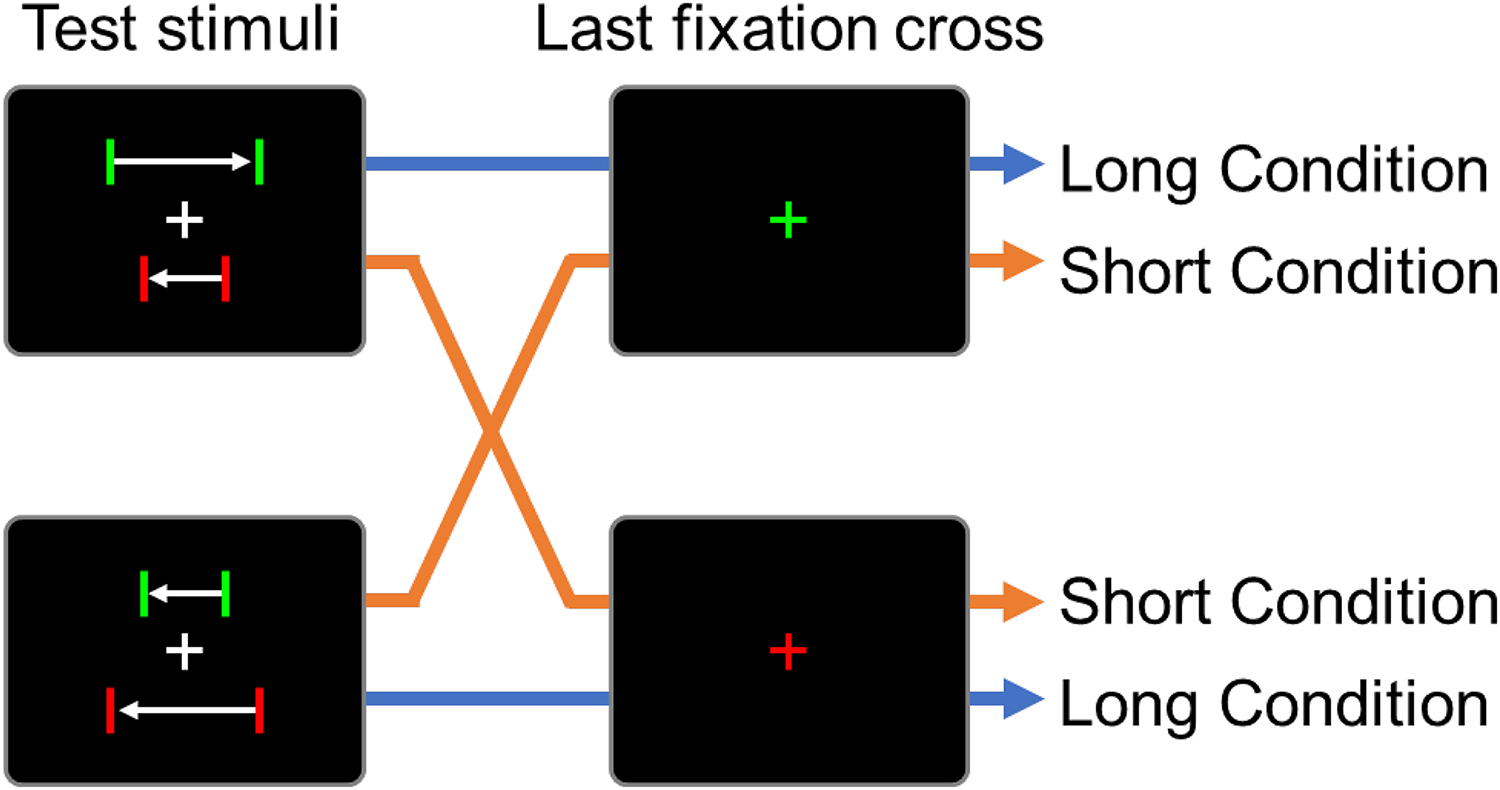
Trial classification based on a combination of the test stimuli and the last fixation cross.
Transparency and Openness
The study design and analysis plan have been registered and all data can be found on the Open Science Framework website at https://osf.io/fz6a7/.
Results
In Task 1, the participants judged whether the test interval was longer or shorter than the reference interval. In Task 2, they judged the direction of movement of the bar with the same color as the last fixation cross. The analyses included Task 1 responses for trials in which Task 2 responses were correct (97.5%). Figure 3 shows the proportion of trials in which the test interval was determined to be longer than the reference interval. The point of subjective equality (PSE) was the outcome variable. PSE was defined as the intersection of the sigmoid curve and the horizontal line, indicating p = .5. For model fitting, the probit-transformed value of the proportion of the test interval judged to be longer than the reference interval was regressed. The maximum likelihood method was used for estimation. The mean PSE for the long condition was 374.895 ms (10.455) and 410.608 ms (8.541) for the short condition (values in parentheses are standard errors). A t-test revealed that the PSE of the long condition was significantly lower than that of the short condition, t(18) = 3.444, p = .003, d = 0.863. According to the analysis, test intervals for the long condition were judged to be longer than those for the short condition. This finding suggests that stimulus features (distance moved) can influence time-interval perception by directing attention to specific features in memory after the visual stimulus has disappeared.
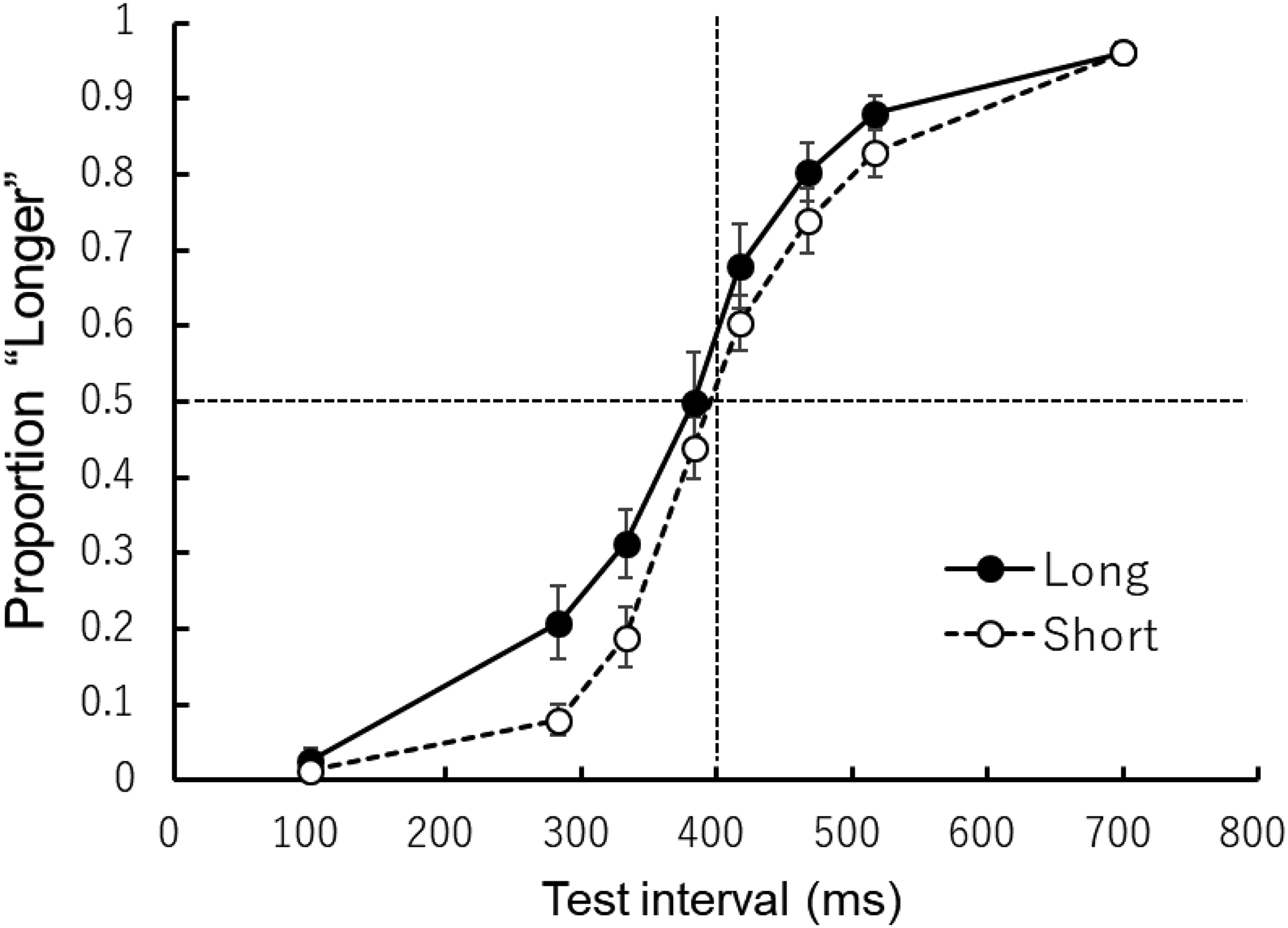
Proportion of the test interval judged to be Longer than the reference interval plotted against the test interval.
Discussion
This study investigated the effect of retrospective attention on time interval perception using the kappa effect. The results showed that the participants judged the time interval to be longer when the stimulus to which retrospective attention was directed moved a longer distance than when it was moved a shorter distance. These results indicate that the kappa effect was affected by retrospective attention. This observation is consistent with the findings of Ono (2024), who showed the effect of retrospective attention on time perception through the modulation of perceived time by the size of the visual stimulus. Ono (2024) explained these results using parallel-time processing. The parallel-time processing explanation assumes a slight time delay between the end of the event for which time is to be judged and the final judgement, during which stimulus information is input concurrently with time processing. In the current study, the input of stimulus information (distance moved), concurrent with temporal processing during the slight delay between the end of the test stimuli and the final judgement, may have resulted in the stretching and contracting of the perception of the time interval.
This study's limitation is that it is unclear whether the effect of retrospective attention on time interval perception is owing to the expansion and contraction of subjective time length or to a bias associated with judgment. In the present study, the participants necessarily had to access representations in memory because they were instructed to direct their attention to a stimulus after the disappearance of the target stimuli. Previous studies on time perception have suggested that the overlap between spatial and temporal concepts may influence the estimation of time (Ivry & Schlerf, 2008). It is possible that the overlap between the concepts of “long” for distance moved and “long” for time interval affected the judgment of time in this study as well. In future studies, it would be necessary to investigate the boundary at which this effect ceases to occur to elucidate the mechanism by which the phenomenon of distorted time perception caused by retrospective attention arises.
Supplemental Material
sj-docx-1-pec-10.1177_03010066251326817 - Supplemental material for Retrospective kappa effect: Attention can retrospectively distort the perception of time interval
Supplemental material, sj-docx-1-pec-10.1177_03010066251326817 for Retrospective kappa effect: Attention can retrospectively distort the perception of time interval by Fuminori Ono in Perception
Footnotes
Availability of Data and Materials

Author Contribution(s)
Consent to Participate
Written informed consent was obtained from all participants before the experiment.
Consent for Publication
The author affirms that human research participants provided informed consent for publication of the research.
Declaration of Conflicting Interests
The author declared no potential conflicts of interest with respect to the research, authorship, and/or publication of this article.
Funding
The author disclosed receipt of the following financial support for the research, authorship, and/or publication of this article: This work was supported by the Japan Society for the Promotion of Science (Grant Nos. 17K04432, 21K03132).
Ethics Approval
This study was approved by the Ethics Committee of Yamaguchi University (Approval No. 2018-001-02). The experiments were conducted in accordance with the Declaration of Helsinki guidelines.
Open Practices Statement
Supplemental Material
Supplemental material for this article is available online.
References
Supplementary Material
Please find the following supplemental material available below.
For Open Access articles published under a Creative Commons License, all supplemental material carries the same license as the article it is associated with.
For non-Open Access articles published, all supplemental material carries a non-exclusive license, and permission requests for re-use of supplemental material or any part of supplemental material shall be sent directly to the copyright owner as specified in the copyright notice associated with the article.
