




Abstract
Recent research on time perception has revealed that actions which are replayed in slow motion are perceived to take longer and rated to be more intentional (e.g., foul plays). Interestingly, the bias on duration estimations seems to disappear when information on the slow motion factor (i.e., the degree the video was slowed down) was provided. Here, we scrutinize the question whether also the intentionality bias disappears when explicit information about the slow motion factor is provided. To this end, two groups watched the same video clips, all displaying foul situations in a basketball match, in different video speeds. While the uninformed group saw the videos without further information, the informed group received additional information about the current slow motion factor. This study replicated the overestimation of original duration with increasing slow motion and indicated that this effect might be reduced when information about the slow motion factor is provided. However, despite generally lower intentionality ratings in the informed group, video speed information was not able to reduce the rise in intentionality ratings with increasing slow motion. Potential reasons and open questions regarding the nature and mechanisms behind these perceptual temporal biases (e.g., different time processing systems) are discussed.
Keywords
Video replays have become more and more present in professional sports within the last decades: The international basketball federation (FIBA) first introduced instant replay at the World Championship 2010 (International Basketball Federation [FIBA], 2019). Also, for instance, in handball, the video proof system has been introduced in 2015 (International Handball Federation [IHF], 2015), and in football, the video assistant referee was established by the FIFA in 2018 (Zglinski, 2020). In those examples, video replay including slow motion and even frame-by-frame replays can be used to evaluate objective situations (e.g., if the basketball left the player's hand within the actual game time at the end of the quarter; FIBA, 2020, 2021) and players’ actions (e.g., foul plays or forbidden touches; Fédération Internationale de Football Association [FIFA], 2021; The International Football Association Board [IFAB], 2017). However, there is still an ongoing debate about whether slow motion replays are a purely supportive auxiliary tool for referees to correctly re-evaluate situations given that there might occur temporal misperceptions when watching scenes in slow motion (Caruso et al., 2016; Schmidl, 2021; Spitz et al., 2017, 2018).
In fact, time perception is known to be highly subjective and variable (see e.g., Block et al., 1999, 2010; Eagleman, 2008; Lacquaniti et al., 2014; Matthews & Meck, 2016; Michon & Jackson, 1985; Tse et al., 2004). With regard to instant replays in sports, there is evidence that slowed down videos can distort the viewer's perception of how long an action originally took. Specifically, when presented in slow motion, the displayed actions are often perceived to last longer than they actually do (see, e.g., Caruso et al., 2016; Schütz et al., 2021; Sperl et al., 2021). This means that the same action is rated as lasting longer when watched in slow motion compared to original speed, despite being aware that the original duration is obviously lengthened due to altered video speed. For example: A video showing a basketball player throwing a ball with that action originally taking 4 s is slowed down four times (i.e., the video now lasts 16 s) and presented to a viewer who is asked to estimate the original time (i.e., 4 s). The viewer is likely to overestimate the original action duration and may indicate, for example, that the action (i.e., throwing the basketball) originally took 6 s, hence, 2 s more than it took in real time.
In a recent study (Sperl et al., 2021), we investigated the roots of this bias by letting participants rate the original duration of several actions that were displayed at original speed or in slow motion and found an interesting result: The bias disappeared when viewers were provided with explicit information about the slow motion factor (i.e., degree to which the original video was slowed down). This indicates that this phenomenon might not be caused by generally overestimating the duration of the original action. Instead, it turned out plausible that the bias derives from an underestimation of the current slow motion factor. That is, the overestimation of the time an action actually took seems to emerge because participants do simply not know how much a video was slowed down (see also Schmidl, 2021). As a consequence, they appear to develop an own, but wrong idea about the video speed which results in a miscalculation back to real time duration (Sperl et al., 2021).
Importantly, subjective time perception has also been shown to influence other cognitive-evaluative processes. In a pertinent study, Caruso et al. (2016) found that such a misperception of time elicited by slow motion replay seems to have a crucial impact on the perceived 1 intentionality of an action. The authors could show that when participants were asked to evaluate a real life crime scene (recorded via CCTV), the action was rated as more intentional when the viewers saw the video in slow motion compared to real time, which in turn might have critical impact on the verdict decisions (Caruso et al., 2016). Also in the context of sports, it has been observed that slow motion replays may bias referees’ decisions: Both untrained novices (Caruso et al., 2016) and elite referees (Spitz et al., 2018) experienced foul plays as more intentional or penalized them more severely when they watched these fouls in slow motion compared to original speed. For both situations, it is argued that this happens because the slow motion gives the viewer the false impression that the actor had more time to plan and reflect upon his/her action (Caruso et al., 2016). Schmidl (2021) further argues that observers often make the mistake to look at slow motion videos in the same way we look at the real world. According to the author, this is a fundamental error. Specifically, while slow motion is providing the observer with many apparent action alternatives, in the real life situation, this variety of options was often simply not at disposition for the actor in their perception of time. 2
Relating these findings to the observations from our recent study (Sperl et al., 2021), a fundamental question arises: That is, may providing video speed information not only be able to eliminate the time overestimation bias but also reduce the undesired impression of increased intentionality? In other words, if—following the rationale by Caruso et al. (2016)—the increased perception of intentionality of an action is really caused by an overestimation of the time this action took, then, in line with our recent findings (Sperl et al., 2021), providing participants with explicit video speed information when watching actions in slow motion should not only counteract the overestimation of original time but also eliminate the undesired intentionality bias.
Thus, in this study, we first hypothesize to observe the previously reported interaction between video speed (original speed vs. slow motion) and video speed information (provided vs. not provided). Hence, actions should be experienced to last longer when displayed in slow motion, but not in the group that is provided with explicit information about the slow motion factor (cf. Sperl et al., 2021). This will be assessed with both an absolute and a relative time rating.
Second, we examine whether actions are also experienced to be more intentional when replayed in slow motion (Caruso et al., 2016) and if yes, whether this bias is also eliminated (or reduced) by explicit video speed information. Additionally, it will be tested whether participants are indeed unable to estimate the respective slow motion factor, when explicitly asked for the degree a video was slowed down.
Hence, the aim of the study is to bring together findings from two previous studies (Caruso et al., 2016; Sperl et al., 2021) in order to investigate how slow motion replay may not only influence time perception per se, but also related cognitive-evaluative processes. Regardless of the findings, this question bears high practical relevance (in court, in sports and wherever slow motion replays are used to better evaluate an action).
Methods
The core methodology followed that already used in Sperl et al. (2021) including a set of necessary adjustments (most of them addressing the stimulus material and the new dependent variable in this study).
Participants
The main sample consisted of N = 40 participants (age: M = 27.88, SD = 5.95; male: N = 16). For the exploratory analyses, data collection was continued resulting in a total sample size of N = 102 (age: M = 28.04, SD = 6.56; male: N = 41, other/diverse: N = 1).
The study was approved by the Ethics committee of the Faculty of Social and Behavioral Sciences of the Friedrich Schiller University Jena (reference number: FSV 20/050). Inclusion criteria were an age between 18 and 65 years (according to ethical approval).
Sample Size: To determine an appropriate sample size, a power analysis was conducted with G*Power 3.1.9.7. Thanks to our previous study which followed a highly similar design using the same stimuli and general set-up, we were able to base our parameter settings for this analysis on existing empirical data: As outlined above, in that previous study (Sperl et al., 2021), participants were asked to estimate the duration of different sport actions presented in different video speeds by providing absolute time ratings in seconds. Following the reasoning by Caruso et al. (2016) that the overestimation of perceived intentionality derives (primarily) from the overestimation of time, the expected effect sizes for the perceived intentionality and relative time rating (main task) should be comparable to the effect size of the time overestimation. Also, for the dependent variables from the additional task, namely absolute time estimation and slow motion factor estimation, this data-based effect size turned out to be appropriate: First, the absolute time estimation is exactly the same dependent measure deriving from an identical task as in the previous study. Furthermore, assuming that the overestimation of duration is (primarily) caused by a misconception of the slow motion factor (see Introduction), the effect for slow motion factor estimation should correspond to the aforementioned one and thus experimental investigations should involve a comparable size of effect.
This effect size was calculated using the dataset from Sperl et al. (2021) based on the interaction from the 2 (group: informed vs. uninformed) × 3 (slow motion factor: original speed vs. ×2 vs. ×4) analysis of variance (ANOVA) (conducted separately for basketball only) and is ηp2 = 0.164. The power analysis followed a design with 2 groups and 3 measurements and a parameter setting of α = 0.05, a power of 0.80, ɛ = 0.831 and an expected correlation among repeated measurements of r = .622 (averaged correlation from existing data). This resulted in a required minimum total sample size of n = 10. As participants were additionally assigned to either an absolute time estimation or a slow motion factor estimation condition in the additional task block, at least 10 participants in each of the two tasks were needed. However, even though in our view the reported data-based method was the best approach here for estimating the sizes of the expected effects, we would like to emphasize that we were only able to interpret the given effect size as an upper bound since it is not clear yet whether a potential intentionality bias is fully conveyed by time overestimation (as suggested by Caruso et al., 2016) or if also other unknown variables are significantly causing this effect (for a related discussion on the interplay of different temporal judgments, see also Eagleman, 2008) 3 . Hence, it is not unlikely that the actual effect size for some of the dependent variables is smaller. Therefore, we were only able to interpret the results from this power analysis as a minimum sample size. Following this reasoning and controlling for the less reliable and less standardized environment in online experiments, we sought for a doubled sample size, which resulted in a total sample size of 40 participants. In order to ensure that the total sample size did not exceed this pre-determined number (which can indeed occur when administering a randomized group assignment and given the fact that in online studies, in contrast to lab studies, it cannot be perfectly controlled how many persons actually participate in the experiment), only the first ten participants of each condition were included in the main analyses. In case of exclusions of data, gathering data was pre-determined to be continued following the aforementioned random assignment procedure until the required sample size in each condition was reached.
Materials
Video material included four different video clips that each showed a short scene of a foul play (and detected as such by the referees) during a basketball match (NCAA tournament, 24 March 2019; Duke Blue Devils vs. UCF Knights), retrieved online from the video platform YouTube (https://www.youtube.com/watch?v=Z67_uHlzLa4). For each of the four video clips (lengths: 2.6, 3.8, 5.3, and 8.0 s), additional to the original speed clip, slow motion versions in two intensities (×2 and ×4, that is, 50% and 25% of the original video speed, respectively) were created. This resulted in a total stimulus set of 12 videos. This set was then duplicated, and one set extended by an additional stamp that displayed the video speed (original speed, ×2 or ×4) at the left bottom corner (see Figure 1 for an example).
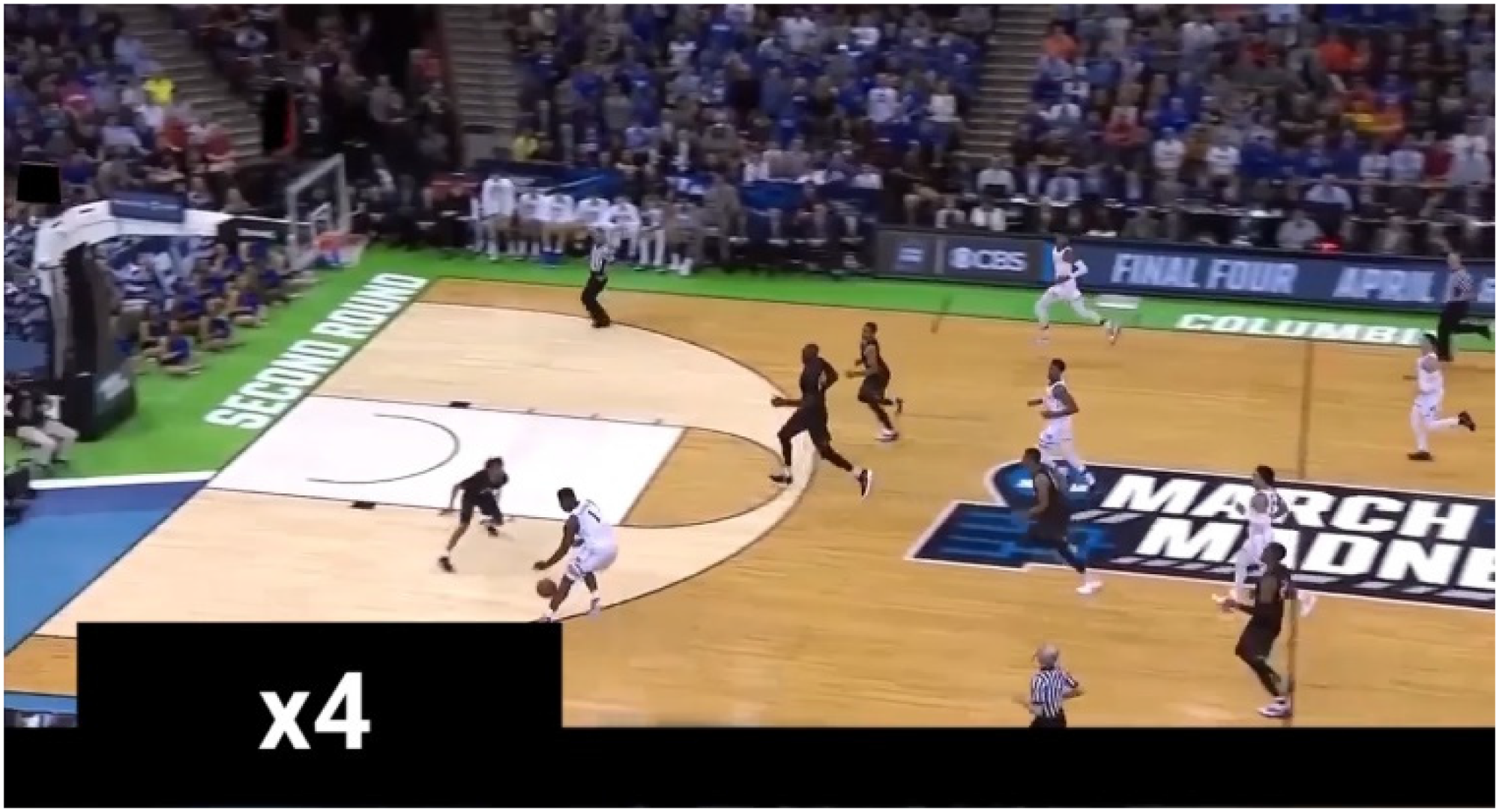
Example of video clip with video speed information in the informed group.
Design
Conditions
Participants were randomly 4 assigned to the experimental groups when starting the experiment. Specifically, there were two between-subject conditions. In the main task condition, the participants were assigned to an informed group and an uninformed group. All participants watched and rated the same 12 videos with the only difference that the informed group was provided with the additional information about video speed of the clip that they were currently watching (cf. Figure 1). To additionally investigate time or slow motion estimation, another between-subject factor, namely additional task condition, was included. Importantly, this additional task was completed subsequently to the main task (see Procedure). This resulted in a mixed 2 (group: informed vs. uninformed) × 3 (slow motion factor: original speed vs. ×2 vs. ×4) × 2 (additional task: absolute time estimation vs. slow motion factor estimation) design.
Dependent Variables
The key dependent variable was the perceived intentionality of the action, rated on a scale from 0 (not at all) to 10 (totally intentional) (see also Caruso et al., 2016, who used a similar continuous scale). A second variable of interest was the perceived time that participants felt the foul player had at disposition to plan his action, rated on a scale from 0 (no time at all) to 10 (plenty of time), in the following called relative time rating (cf. also Caruso et al., 2016). Furthermore, a second round of watching aimed to assess two side variables (see Procedure). On the one hand, in line with our previous study, we asked participants for an additional absolute time estimation, that is, the subjective time in seconds that participants felt the displayed action took in original speed. While half of the participants gave this absolute time rating in this additional task, the other half was asked to estimate the slow motion factor instead. This was included in the design in order to test how well participants are actually able to detect to which amount a video was slowed down. In fact, it had been observed that sensitivity to altered video speed is considerably low (see, e.g., de'Sperati & Baud Bovy, 2017). Which task they were fulfilling in this second round was also randomized across groups with the intention to not overstretch the frequency of watching the same scenes and the total length of the experiment.
Finally, to investigate a potential effect of visual and/or motor experience (cf. Gavazzi et al., 2013; Pizzera & Raab, 2012), we also assessed personal basketball experience as a player (responses: none/minimal, as a part of education, irregularly during free time, active player), a viewer (scale from 0—never to 5—frequently) and a referee (present or past experience: yes or no) in a short exit questionnaire.
Procedure
The study was programmed and conducted online using standard web technologies (HTML and JavaScript). Therefore, participants were instructed to run the experiment on a computer in a quiet setting without acoustic or visual presence of clocks. Furthermore, before starting the study, participants provided informed consent.
After collecting demographic data (age and gender), instructions were given in written form, explaining the concept of intentionality and including a brief explanation of offensive and defensive foul plays in basketball. The informed group received additional information about the speed stamp and how to interpret it. Like in our previous study, participants received detailed instructions including animation video examples and a control question to ensure correct understanding of the task. All 12 videos were then presented in randomized order. Each video started and ended with a frozen image (1 s) of the first and last frame and was preceded by a fixation cross (min. 2 s). In the informed group, the fixation cross was already accompanied by the information about the video speed. Importantly, following piloting experience, participants watched every video twice before giving the rating to briefly familiarize with and understand the displayed scene. After having watched each video twice, participants provided the ratings of perceived intentionality and the relative time rating (see Dependent Variables). Participants were always asked to give their ratings independently of previous ratings. In case of unclarity, participants were able to choose the option that they could not identify the foul play and skip the ratings for that trial. After having rated each video in each video speed and invitation to take a short break, participants continued with a second and final round of video replay and rating following a new instruction. In line with our previous study (Sperl et al., 2021), in this rating round, we asked half of the participants for an absolute time estimation, that is, the viewer's estimation of how long the displayed action lasted in real time (estimated in seconds). Hence, again, regardless of whether they saw the video at original speed or in slow motion, the task was always to estimate the original time. The second half was asked to estimate the slow motion factor, that is, the degree to which the video was slowed down. Please note that also the informed group now watched the videos without video speed information. However, of course the main focus was on the uninformed group to investigate how well video speed could be estimated 5 .
The experiment ended after the short exit questionnaire including questions on the individual rating/estimation strategies, basketball experience (see Dependent Variables) and offering the option to add personal comments or report technical problems. The whole experiment lasted approximately 20–25 min.
Data Preprocessing
Mean ratings were calculated across all four video clips, separately for each group and slow motion intensity for each rating.
For the absolute time rating in seconds from the additional task, analogous to our previous study, for each given duration estimation, a deviation from the original length was calculated creating a difference score that represents the estimation error, where positive values stand for an overestimation and negative values for an underestimation of the original duration. The same was true for the ratings of the slow motion factor, creating a difference score also for this dependent measure, comparing the given rating to the actual slow motion factor. 6
Datasets which were not fully completed, for example, when participants aborted the experiments before completing, and whenever a participants recognized less than 50% of the foul plays, were pre-determined to be excluded.
Outliers were removed in accordance with the methodology in Sperl et al. (2021), that is, ratings that were more extreme than three interquartile ranges above the 75% and below the 25% quartile for that video clip were removed. Following extensive piloting and experience from previous studies, an outlier analysis here was critical to identify participants (or single trials) who despite thorough instructions including animations and control questions did misunderstand the instructions of estimating the original time and instead estimated the time of the displayed video duration (which for the slow motion condition results in immensely high durations).
Finally, whenever any technical or individual problems were spotted or reported, datasets were pre-determined excluded.
Data Analysis
Main Analyses
A mixed 2 (group: informed vs. uninformed) × 3 (slow motion factor: original speed vs. ×2 vs. ×4) ANOVA for repeated measures was conducted for each dependent variable (perceived intentionality, relative time rating, absolute time estimation, and slow motion factor estimation).
The alpha level was set to α = 0.05. In case of Mauchly's sphericity assumption violations, Greenhouse-Geisser-corrected values are reported. Partial eta squared ηp2 and Cohen's d are reported as effect sizes.
Exploratory Analyses
To additionally investigate the strength of the expected overestimations (regarding perceived intentionality, relative time rating, absolute time estimation, slow motion factor estimation) with increasing slow motion factor, post-hoc Holm-corrected t-tests were conducted in case of significant main effects and interactions. Since data revealed that the intentionality effect is not of a comparable size as the assumed time overestimation effect (and consequently required a higher power), additional calculations with a larger sample size were conducted as exploratory analyses. 7
Moreover, correlations among the four dependent variables were explored in order to better understand the relation between these measures. Furthermore, the influence of visual and motor expertise (assessed via the additional ratings from the exit questionnaire) was assessed via correlations and/or inference statistical group comparisons. We additionally looked at whether foul identification per se was easier in the slow motion conditions compared to original speed.
Results
Main Analyses
In total, 112 individuals participated in the study. Data from ten participants had to be excluded due to reported technical problems (e.g., video lagging). For the main analyses, only the data of the first ten participants per condition were considered, that is, the final sample consisted of N = 40 individuals (age: M = 27.88, SD = 5.95; male: N = 16), see preregistered determination of sample size above. No participant had to be excluded for detecting less than 50% of the foul plays. In total, 16.0% of the foul plays were not detected by the participants. Moreover, there were no outliers for absolute time estimation, and 4.6% outliers removed for slow motion factor estimation.
The first 2 (group: informed vs. uninformed) × 3 (slow motion factor: original speed vs. ×2 vs. ×4) ANOVA on the intentionality ratings revealed a significant main effect of slow motion factor, F(1, 38) = 5.95, p = .004, ηp2 = 0.14, but no main effect of group, F(2, 76) = 0.61, p = .441, ηp2 = 0.02, and no interaction, F(2, 76) = 0.12, p = .890, ηp2 < 0.01. Actions were rated to be more intentional when videos were played in the ×4 slow motion condition.
Similarly, another 2 × 3 ANOVA for relative time rating was computed, showing another main effect of slow motion factor, F(1.64, 62.17) = 8.00, p = .002, ηp2 = 0.17, but, again, no main effect for group, F(1, 38) = 0.24, p = .629, ηp2 = 0.01, and no interaction effect, F(1.64, 62.17) = 0.15, p = .816, ηp2 < 0.01. Duration ratings increased with increasing slow motion.
A third 2 × 3 ANOVA was conducted for absolute time estimation and revealed a significant main effect of slow motion factor, F(1.27, 22.91) = 10.86, p = .002, ηp2 = 0.38, no main effect for group, F(1, 18) = 1.92, p = .183, ηp2 = 0.10, and no significant interaction between group and slow motion factor, F(1.27, 22.91) = 2.05, p = .162, ηp2 = 0.10. Hence, higher slow motion intensities lead to higher absolute time ratings.
Finally, also in the 2 × 3 ANOVA for slow motion factor estimation only a significant main effect of slow motion factor, F(1.37, 65.53) = 7.00, p = .012, ηp2 = 0.28, but neither a main effect of group, F(1, 48) = 2.64, p = .122, ηp2 = 0.13, nor an interaction between these two variables, F(1.37, 65.53) = 5.80, p = .133, ηp2 = 0.12, could be observed.
Exploratory Analyses
Post-hoc t-Tests
An overview over all post-hoc t-tests following the significant ANOVA main effects on slow motion factors (listed for both preregistered and full sample size) can be found in Table 1.
Post-hoc t-tests for significant main effects of slow motion factor for preregistered and full sample.
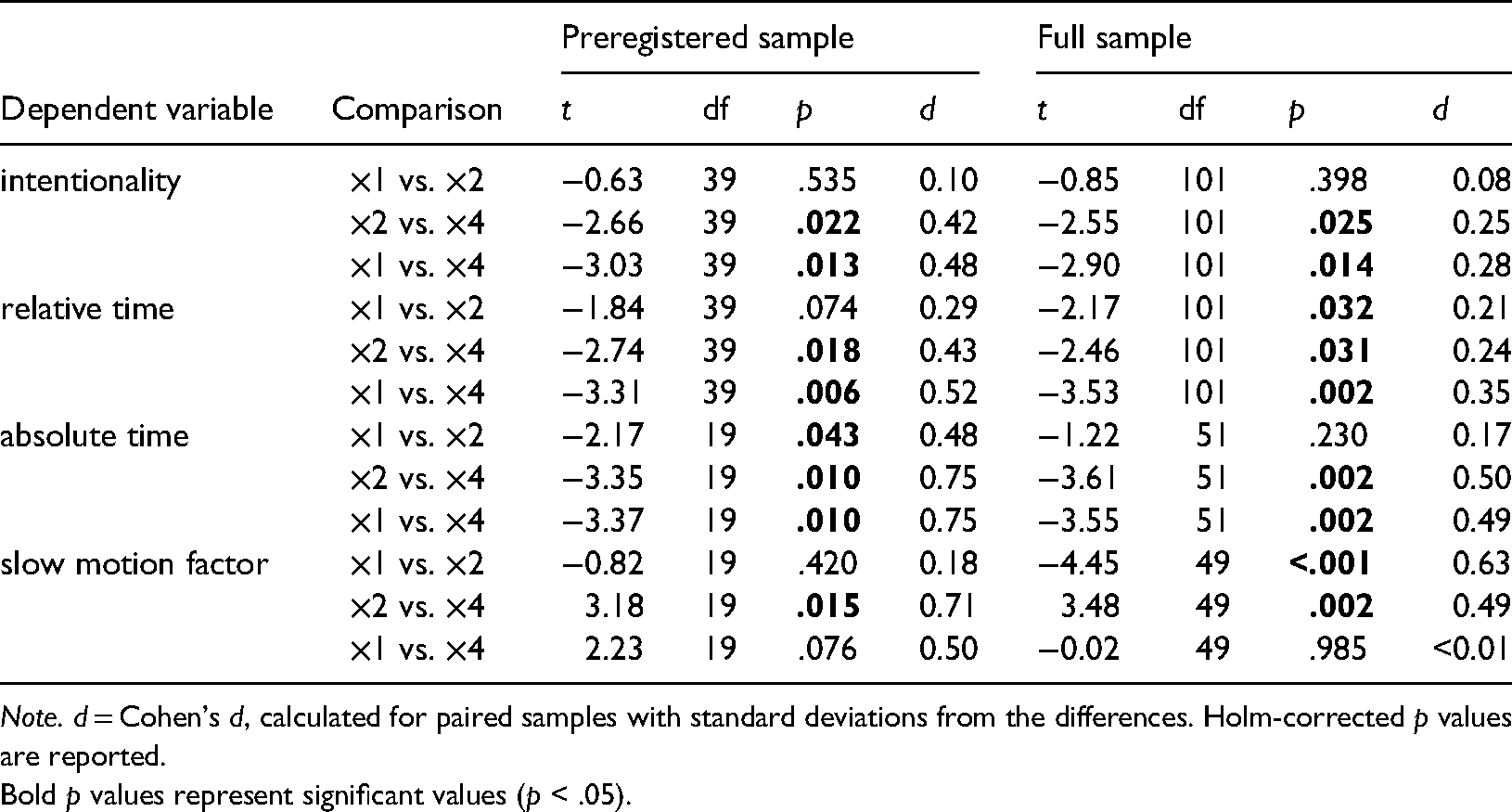
Note. d = Cohen's d, calculated for paired samples with standard deviations from the differences. Holm-corrected p values are reported. Bold p values represent significant values (p < .05).
Analyses With Full Sample Size
As the time overestimation effect from our previous study for absolute time estimation (Sperl et al., 2021) could not be replicated in the preregistered sample, we repeated the analyses with the entire number of subjects who participated in this experiment (total: N = 102; uninformed group: N = 46; informed group: N = 56; absolute time estimation: N = 45; slow motion factor estimation: N = 57). Again, no participant had to be excluded for not detecting more than 50% of the foul play, and overall, only 15.8% of the foul plays could not be identified. 1.0% of the absolute time estimation ratings and 3.7% of the slow motion estimation ratings were excluded from the analyses following the outlier analysis.
The ANOVA on the intentionality rating revealed a main effect of slow motion factor, F(2, 200) = 14.06, p = .005, ηp2 = 0.05, (×2 vs. ×4: t[101] = −2.55, p = .025; normal vs. ×4: t[101] = −2.90, p = .014; for a complete overview, see Table 1) and, in contrast to the preregistered sample, a main effect of group, F(1, 100) = 5.19, p = .025, ηp2 = 0.05, indicating lower intentionality ratings in the informed group, but no interaction, F(2, 200) = 0.20, p = .817, ηp2 = 0.05. None of the other post-hoc t-tests reached significance (Figure 2).
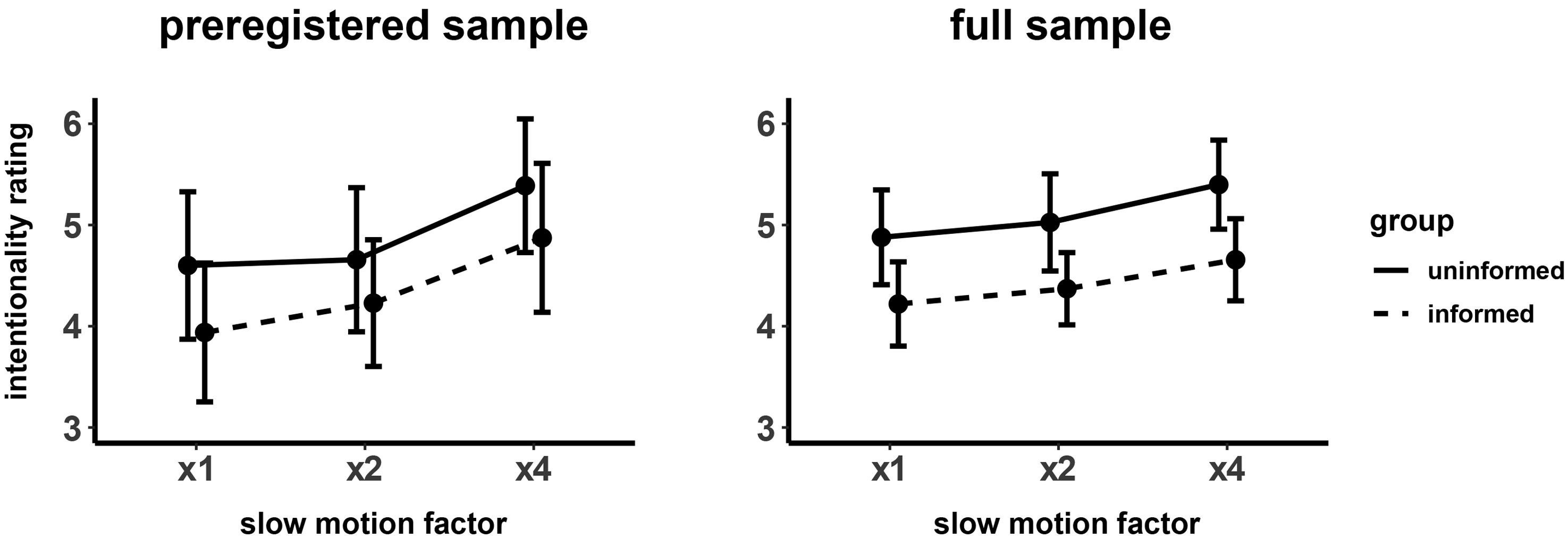
Intentionality ratings per slow motion factor and group compared between preregistered and full sample. Note. Means and within-subject confidence intervals are plotted.
In the ANOVA on relative time rating, no different patterns compared to the preregistered sample emerged, that is, there was a significant main effect of slow motion factor, F(1.68, 168.28) = 8.76, p < .001, ηp2 = 0.08 (normal vs. ×2, t[101] = −2.17, p = .032; ×2 vs. ×4, t[101] = −2.46, p = .031; normal vs. x4, t[101] = −3.53, p = .002; for a complete overview, see Table 1) while a potential main effect of group, F(1, 100) = 18.56, p = .127, ηp2 = 0.02, and interaction were not significant, F(1.68, 168.28) = 0.53, p = .557, ηp2 = 0.01 (Figure 3).
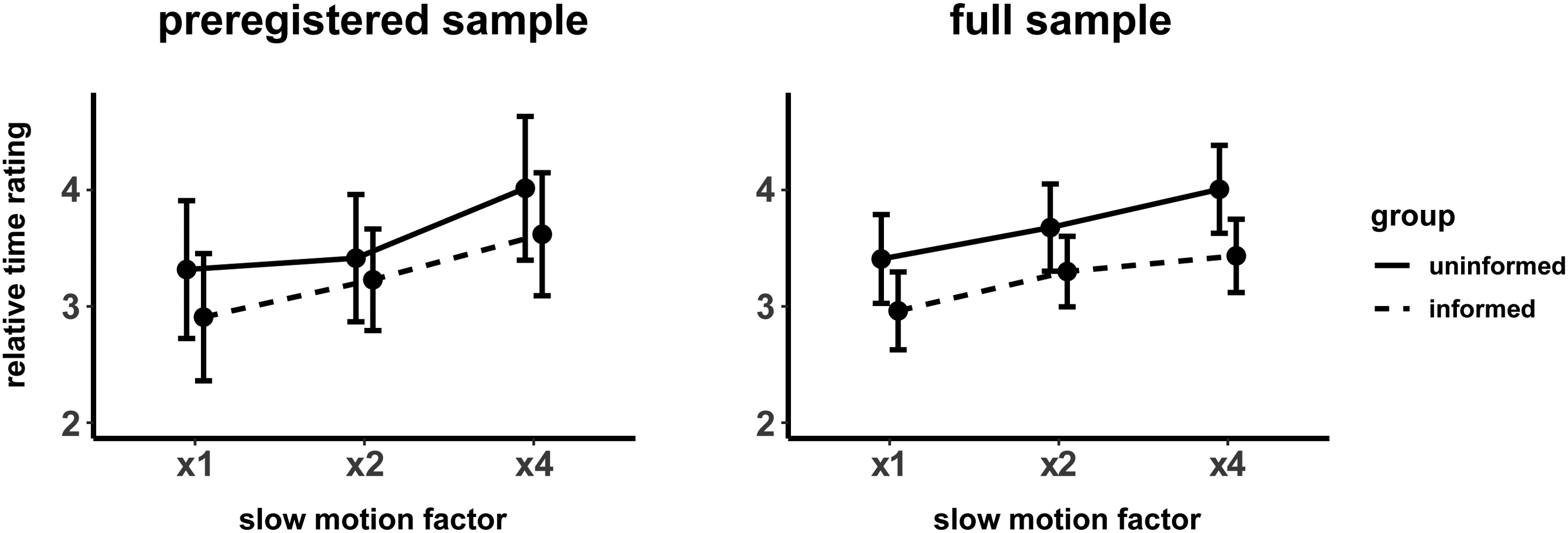
Relative time ratings per slow motion factor and group compared between preregistered and full sample. Note. Means and within-subject confidence intervals are plotted.
The ANOVA for absolute time estimation showed a significant main effect of slow motion factor, F(1.59, 79.92) = 11.21, p < .001, ηp2 = 0.18 (×2 vs. ×4, t[51] = −3.61, p = .002; normal vs. ×4, t[51] = −3.55, p = .002; for a complete overview, see Table 1), and, different to the preregistered sample, of group, F(1, 50) = 4.88, p = .032, ηp2 = 0.09, and approached significance in the interaction, F(1.59, 79.92) = 2.76, p = .081, ηp2 = 0.05. Indeed, post-hoc Holm-corrected t-test showed that, in the uninformed group, the duration of the original action was rated significantly longer in the ×4 than in the ×2 condition, t(24) = −3.98, p = .003. This, however, was not the case in the informed group (all comparisons across slow motion intensities p > .05) (Figure 4).
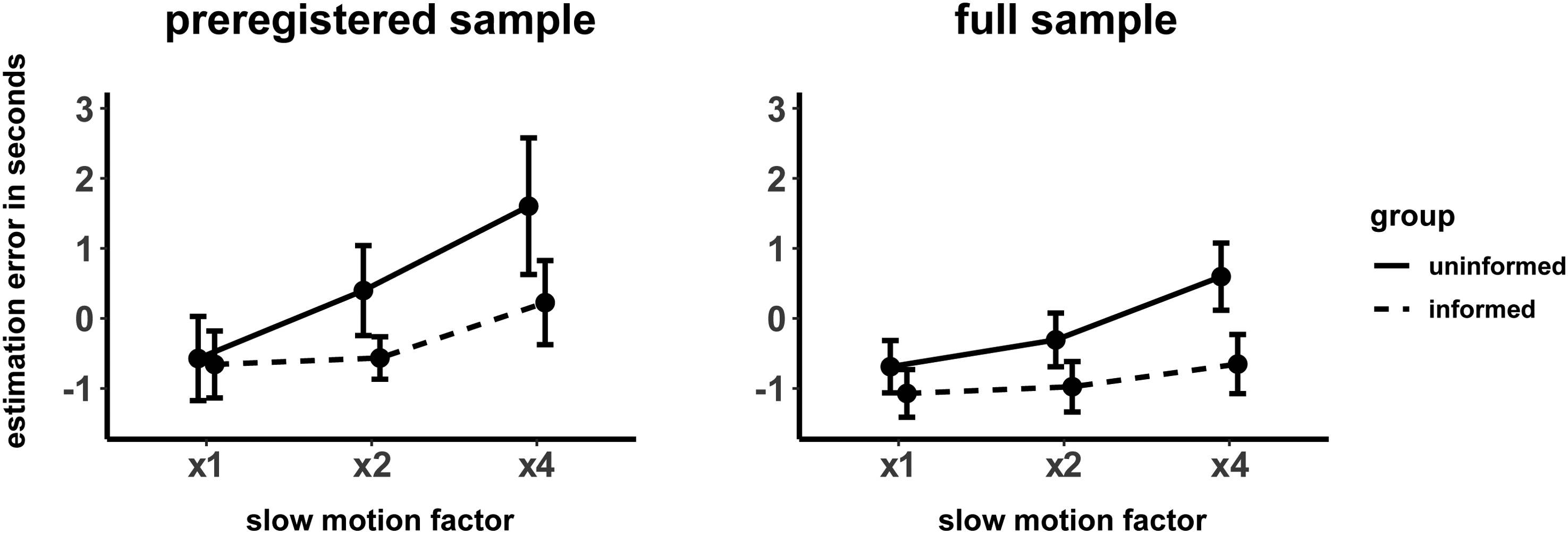
Absolute time estimations per slow motion factor and group compared between preregistered and full sample. Note. Means and within-subject confidence intervals are plotted.
Finally, for the ANOVA on slow motion factor estimation, similar to the result with the preregistered sample a main effect for slow motion factor could be observed, F(1.37, 65.53) = 6.38, p = .008, ηp2 = 0.12. However, in contrast to the analyses with the smaller sample the post-hoc t-tests showed that only the ×2 condition differed significantly from the two other slow motion conditions (normal vs. ×2, t[49] = −4.45, p < .001; ×2 vs. ×4, t[49] = 3.48, p = .002; for a complete overview, see Table 1). No main effect for group emerged, F(1, 48) = 0.02, p = .961, ηp2 < 0.01, and there was no significant interaction, F(1.37, 65.53) = 0.02, p = .942, ηp2 < 0.01 (Figure 5).
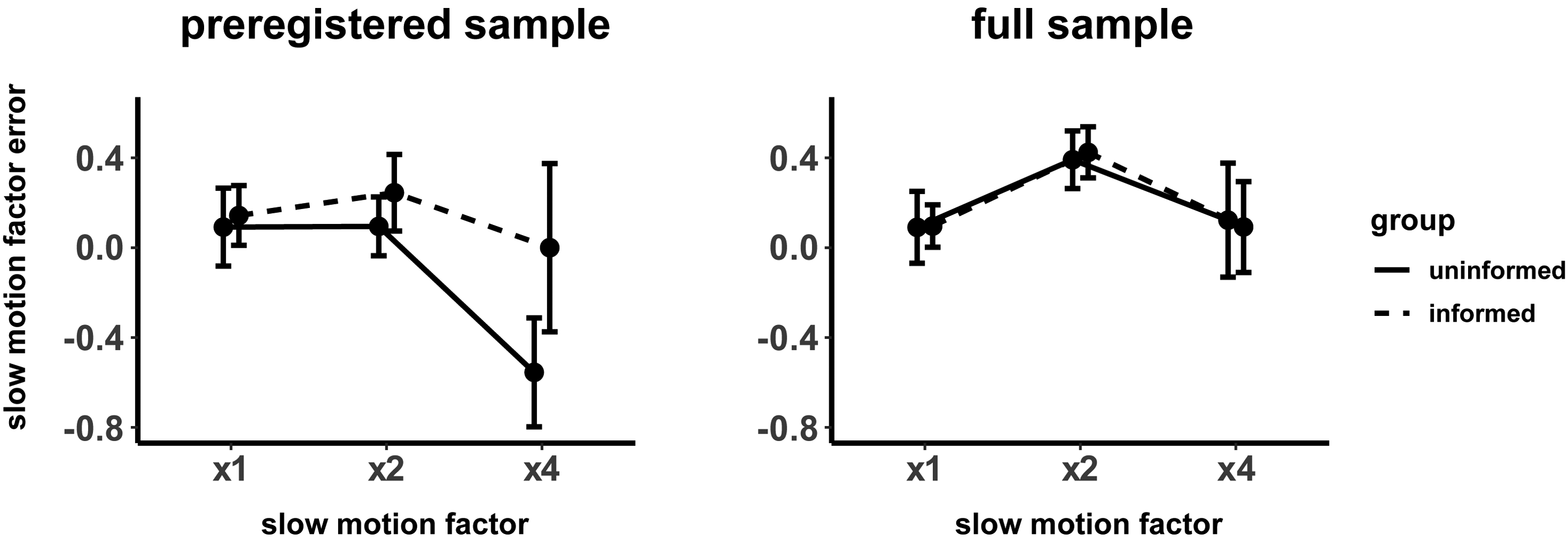
Slow motion factor estimation error (difference of given rating from actual factor) per slow motion factor and group compared between preregistered and full sample. Note. Positive values stand for an overestimation (i.e., slower video speed experience) and negative values for an underestimation (i.e., higher video speed experience) of the original factor. Means and within-subject confidence intervals are plotted.
Correlational Analyses
With regard to the dependent variables, it could be observed that relative time estimation and intentionality rating are highly significantly correlated (full sample: r = .57, p < .001), that is, participants who rated durations longer also rated foul plays to be more intentional (but only for the relative time rating). There was no significant correlation among the other dependent variables (p > .276; see Table 2 and Figure 6).
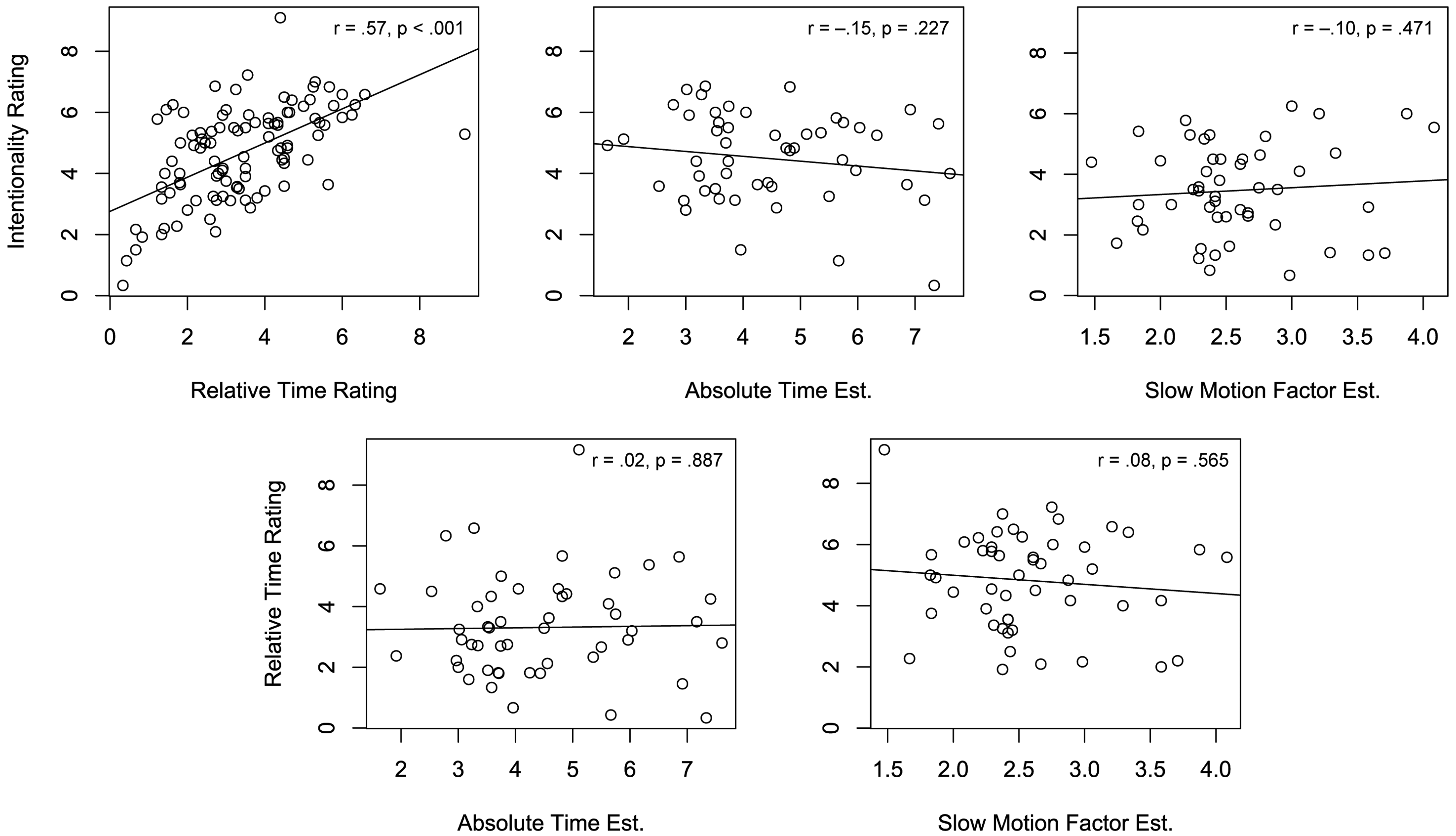
Correlational analyses for the full sample regarding intentionality (top-row) and relative time (bottom-row) with each of the remaining variables. Each dot represents the aggregated data of one participant.
Correlations among the dependent variables.
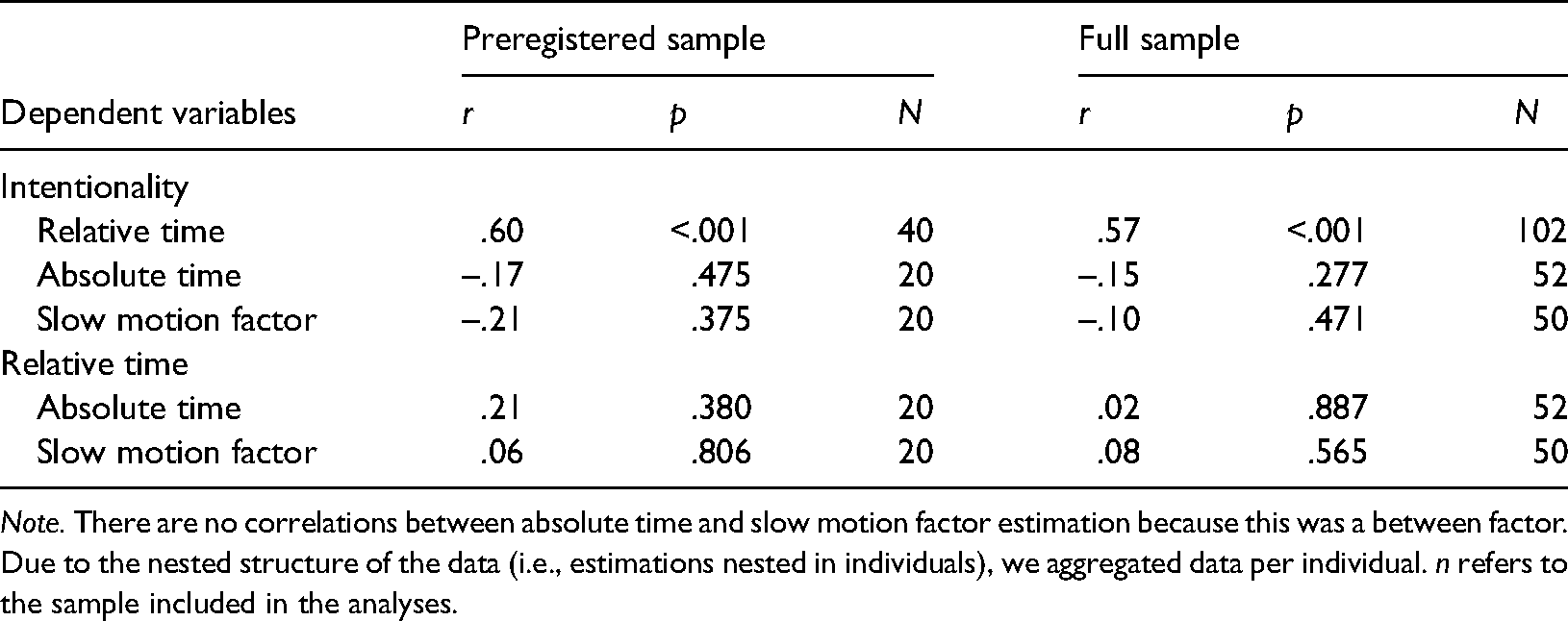
Note. There are no correlations between absolute time and slow motion factor estimation because this was a between factor. Due to the nested structure of the data (i.e., estimations nested in individuals), we aggregated data per individual. n refers to the sample included in the analyses.
Analyzing the full sample, age did not correlate with the accuracy of absolute time (r = –.08, p = .566), slow motion factor estimation (r = .07, p = .615), or intentionality rating (r = –.02, p = .823). Interestingly, age was negatively associated with the relative time rating (r = –.26, p = .009), that is, with increasing age, participants judged the time the players had to commit the foul to be lower.
With regard to foul identifications, we found that, overall, fouls were more likely to be identified in slow motion than at original speed, χ2(2) = 25.38, p < .001 (Fisher's exact test in full sample; normal vs. ×2: p < .001; ×2 vs. ×4: p = .609). Two individuals indicated to have experiences as basketball referees, both of which were able to detect all the fouls compared to the non-referees who, on average, did not recognize 16.2% of the foul plays. Referees compared to novices were not more accurate in the absolute time estimation, t(25.42) = 0.79, p = .439. However, the referees rated the foul plays to be more intentional (M = 5.71 vs. M = 4.65, on a scale from 0—not at all to 10—totally intentional), t(49.4) = −2.67, p = .011, and that the foul players would have more time for their foul plays (M = 5.50 vs. M = 3.37, on a scale from 0—no time at all to 10—plenty of time), t(48.88) = −5.48, p < .001. Regarding the experiences as spectators, a linear regression predicting absolute time estimation errors approached significance, F(1,50) = 3.85, p = .056, β = −0.45, that is, the more experience they had, the shorter the time was rated. For slow motion factor estimation, intentionality and relative time ratings, no correlations were found. In total, 36 participants reported to have experiences as basketball players (as part of studies/education: N = 4, in free time: N = 29, as active player: N = 3). Compared to participants without any experiences, participants with basketball experience had higher deviations in their absolute time estimation, t(47.30) = 2.58, p = .013 (Kruskal-Wallis H test: χ2(3) = 7.76, p = .051). However, there was no difference in the slow motion factor estimation error, t(39.186) = −1.39, p = .171, in the relative time estimations, t(81.10) = −0.92, p = .359, and in their intentionality ratings, t(81.82) = −0.21, p = .834.
Discussion
The aim of this study was to investigate the impact of explicit video speed information on intentionality ratings and time estimation. Specifically, we wanted to replicate the findings by Caruso et al. (2016) showing that (i) actions appear to take longer and (ii) are rated as more intentional when replayed in slow motion (for related findings, see also, Schütz et al., 2021; Spitz et al., 2018). We additionally aimed at replicating the findings by Sperl et al. (2021) suggesting that (iii) this bias on duration estimation can be reduced or even eliminated when informing participants about the factor by which the video was slowed down. Most importantly, following the argumentation that increased intentionality ratings result from time overestimation (Caruso et al., 2016), we examined whether (iv) information about the slow motion factor can also reduce biases in related cognitive-evaluative processes, that is here, intentionality ratings.
Importantly, since this study constitutes a registered report, analyses in this study were conducted with both a small sample (main analyses using the pre-determined sample size) and the full sample of all participants that took part in the study (exploratory analyses). If not indicated differently, discussed effects were present in both samples.
Absolute Time Rating
First and foremost, we were able to replicate the core findings from previous research (Schütz et al., 2021; Sperl et al., 2021), that is, the more the video was slowed down, the longer the original duration of the displayed action was perceived (previously labeled as overestimation bias, Sperl et al., 2021). The second core finding regards the influence of additional video speed information (Sperl et al., 2021): While visual inspection of the data of the full sample also indicated that the informed group showed less overestimation, the interaction between group and video speed did slightly fail to reach statistical significance (see Figure 4). Only a trend was observable (and possibly, despite a-priori power analyses, would have become significant with a higher sample size, as also a comparison of sample sizes might suggest, cf. n = 239 in the previous study, Sperl et al., 2021, vs. only n = 45 in the full sample of the current study).
Relative Time Rating
According to Caruso et al. (2016) increased intentionality ratings in slow motion replay are caused by the erroneous impression that the actor in the video clip had more time at disposition to reflect upon and plan their action. To scrutinize this relation, we included such a relative time rating in the current study. Similar to the absolute time ratings in seconds, results showed that increasing levels of slow motion led to higher relative time ratings of the foul action. However, this bias in relative time ratings was not reduced when participants knew the slow motion factor (see Figure 3).
Intentionality Rating
In accordance with the current literature (Caruso et al., 2016; Spitz et al., 2018), our data indicated that fouls were rated as more intentional with increasing slow motion factors. Data of the full sample additionally showed a main effect indicating that providing explicit information on the video's slow motion factor lowered the intentionality ratings overall (see Figure 2). However, contrary to our expectations, the interaction was not significant in either of the samples, that is, there was a comparable effect of video speed in both, the informed and the uninformed group. Hence, providing slow motion factor information overall reduced intentionality ratings, but did neither lower nor eliminate the bias of video speed.
Overall, the pattern of results highly resembles that of the relative time ratings indicating a tight link between both ratings. Indeed, higher relative time estimations were associated with higher intentionality ratings as suggested by the positive correlations in both samples. Note that, in the current study, and likewise in Caruso et al. (2016), this might also represent a methodological issue since both measures are simultaneously inquired potentially suggesting participants to rate them similarly. Given that information on the slow motion factor did not reduce the intentionality bias as it did for absolute time (Sperl et al., 2021), and that there was no association between absolute time and intentionality ratings, we argue that two different systems of time processing might be involved, which will be discussed below. Potentially, intentionality ratings depend on relative rather than absolute time ratings (see also, Caruso et al., 2016).
Importantly, despite the fact that the reported slow motion effects are often referred to as “biases” that “distort” reality (see also, Spitz et al., 2018), it also has to be acknowledged that there is no objective measure of “veridical intentionality” (see also, Caruso et al., 2016). In other words, we do not know whether the increase with slow motion as well as the lower levels of intentionality ratings for informed participants reflect more or less accurate evaluations. A recent study tried to tackle the problem of veridical evaluations by using expert committee ratings as reference for correct foul card decisions in soccer (Spitz et al., 2018). They showed that disciplinary decisions (e.g., yellow card) did not differ regarding their accuracy between original speed and slow motion, whilst in a previous study they found technical decisions (e.g., offside) to be more accurate in slow motion (Spitz et al., 2017). Still, the authors also reported a general bias to sanction actions after slow motion replay more severely, similar to the current and previous findings on intentionality (Caruso et al., 2016). Integrating both findings (the constant accuracy and the overall bias), this might indicate that intent for actions at original speed is underestimated while it is overestimated in slow motion and might be an important direction for future research.
Estimating Slow Motion Factor
In order to approach the question how well participants are actually able to estimate the actual video speed of a displayed scene, in this study, we also asked participants to explicitly estimate the slow motion factor, hence the degree to which the video was slowed down. In fact, the results from Sperl et al. (2021) suggested that the observed overestimation of absolute time might be caused by an underestimation of the slow motion factor resulting in an erroneous backward calculation to real time.
Surprisingly, in the present study, there was no underestimation in neither of the groups but a rather accurate or even slightly overestimated rating of the slow motion factor, at least in the normal speed and × 4 condition of the full sample data, with a higher variance with increasing slow motion 8 . Moreover, there was a zero correlation of slow motion factor estimation error and both intentionality and relative time rating. 9 While Rossi et al. (2018) observed an underestimation of video speed (matching the overestimation of slow motion factor which we observe here), they reported video speed and duration ratings to be uncorrelated. Therefore, the authors presumed that biases in video speed estimation might be able to occur more or less independently of duration perception (note, however, that duration in their study is referring to the actual duration of the video clip and was assessed via a reproduction task). Understanding the relation between video speed and duration estimation and therefore also building up on the approach by Rossi et al. (2018) would definitely be an insightful task for future research to more deeply comprehend the mechanisms behind human inferences regarding temporal features of stimuli. Note also, that the slow motion factor estimation task in the present study was realized as an additional task which was only absolved by half of the participants while the other half rated absolute time (in addition to the division into informed vs. uninformed group). Hence, the sample size for this measure was considerably smaller than for the main variables and thus, future work focusing on this estimation and administering higher sample is advisable.
Different Temporal Processing Systems?
The question remains why providing information on the slow motion factor (video speed) tended to affect the absolute time overestimation bias (see also Sperl et al., 2021) but did neither eliminate the bias for relative time ratings nor for intentionality ratings except for lowering the ratings on intentionality overall. These patterns may possibly indicate that there are two temporal processing systems working more or less independently. Already Eagleman (2008) argued that subjective time is not a unitary phenomenon and that even if one temporal judgement changes, this may not necessarily be true for other temporal judgments. In our case, overestimations of absolute time ratings, that is, evaluating the time in seconds that an action took, have been shown to be reduced by providing explicit information about the current slow motion factor (Sperl et al., 2021). However, apparently, for intentionality and relative time ratings the slow motion bias cannot be reduced by simply informing participants. An additional observation pointing towards two dissociable systems was the missing association between these (relative) measures and absolute time estimation (see also, Caruso et al., 2016). For animals, a dissociation between relative and absolute time representations was already demonstrated (Akdoğan et al., 2020). Hence, it seems plausible that relative and absolute time representations in humans are similarly based on different mechanisms (for a review on the neural basis of different time processing systems including both human and animals studies, see Ivry & Spencer, 2004). Future studies should therefore focus on disentangling the underlying processes of those explicit temporal processing systems and their relation to evaluations of intent.
Despite the fact that both temporal measures were clearly not associated, we argue that they both represent explicit subjective measures of duration (Soltanlou et al., 2020; Thönes & Stocker, 2019). Note, that the decision to choose explicit measures of time compared to implicit might have large influences on the expected outcomes (Di Bono et al., 2019; Droit-Volet & Coull, 2016; Michon, 1980; Soltanlou et al., 2020). Soltanlou et al. (2020), for instance, showed higher precision, but also a tendency towards underestimation (similar to the present study) of explicit compared to implicit time. Besides, it may be interesting to consider implicit time representations since this is the actual in-game situation of referees. If there is a foul situation, the referee has to evaluate the intentionality, thus, in our argumentation, has to evaluate the available time online and without explicitly evaluating time. The video replay on the other hand is a kind of review (i.e., explicit) evaluation of intentionality. If intentionality ratings are merely dependent on implicit measures, it might be helpful to also include implicit cues on the slow motion factor to reduce biases of video speed. For instance, additional sound information, speed symbols or for example animated figures moving at different speeds might be used as implicit cues of slow motion (see also, e.g., Mioni et al., 2015).
The Role of Expertise
In order to scrutinize the role of visual and motor expertise in this context, we also assessed experiences with basketball in a short exit questionnaire. Specifically, basketball spectators showed a trend towards shorter ratings of absolute time than non-spectators, possibly due to having more experiences in watching games and slow-motion recordings of play scenes. Basketball referees rated the foul plays to be more intentional and that the players had more (relative) time, however, this finding is based on a very small subsample of only two referees. Interestingly, basketball players showed larger effects of overestimation regarding absolute time, possibly due to having more motor expertise, but less opportunities for spectating. In contrast, spectators are much more familiar with the perspective presented in the videos. Future studies that focus on the influence of visual/motor expertise on such time and intentionality evaluations are promising as they might be able to examine whether novices or experts might be more prone to the different types of reported slow motion biases. Moreover, while in the present study mainly naïve participants judged the scenes (with the aim to assess basic mechanisms of temporal-evaluative judgements), a more specific sample, such as expert referees, who are regularly exposed to such decision situations, might also be a promising sample for future studies since data suggested an influence of expertise (cf. Spitz et al., 2017, 2018).
Methodological Considerations
First, we would like to emphasize that a large part of the analyses were exploratory, that is, they were conducted based on a sample size which exceeded the a-priori calculated value. Specifically, built up on the findings of our previous study (Sperl et al., 2021), data-based effect size estimations and respective power calculation revealed a relatively small sample for absolute time estimation. For the other measures, to-be-expected effects sizes were less clear. Assuming that an effect on intentionality ratings is mediated by the effect on time estimation, we argued that the expected effect size for intentionality could not exceed the one of time estimation. That means that smaller effects are expected, and, in turn, potentially larger samples would be needed to reveal those. Even though we doubled sample sizes and also conducted exploratory analyses, sample sizes might still have been too small to detect the effects regarding the newly included variables and future studies might be conducted with higher sample sizes (in fact, our work from Sperl et al., 2021, showed large effects regarding absolute time, while assessing a much larger sample size of 239 participants).
One large difference compared to our previous study (Sperl et al., 2021) was that in the present study, participants watched every scene in total nine times (including the different video speeds, the video repeat and the additional rating round). Even if, following extensive piloting, we had good reasons to play the video twice before assessing participants’ responses, and aware of potential influences, we intentionally moved the side variables (absolute time and slow motion factor estimation) to the second rating round in order to keep the main variables unaffected, this frequent exposure might have influenced (at least part of) our data. Indeed, Caruso et al. (2016) observed that repeated replay (in different video speeds) did not eradicate, but reduced the bias. Together with the non-significant interaction trend and the considerably smaller sample size it might be the case that some effects were substantially weakened and possibly more difficult to statistically detect. Beside such potential familiarization effects, the dependent variables from the second rating round (i.e., absolute time and slow motion factor estimation) must also be interpreted with caution as it cannot be excluded that the previously given ratings on intentionality and relative time might be included implicitly in the evaluations and thereby having potentially influenced these additional ratings. A between-subject design could possibly help to rule out such potential memory effects. With the current study, we aimed to conceptually replicate the results of Sperl et al. (2021) which is why we decided to use an analogous mixed design. To counteract memory effects, we presented stimuli in randomized order and used several different video scenes. Most importantly, given our previous findings, namely that participants did not seem to rely on previous ratings of absolute time, we deemed it unlikely that they should do so for intentionality and/or relative time ratings in the current study.
Also, important to mention at this point is that in the ×4 condition, the videos were rendered at a different frame rate. Specifically, the videos in the ×4 condition were presented at 15 fps whereas in the other conditions (original speed and ×2), we exported the videos at 30 fps given that the maximum original video frame rate available on YouTube was 60 fps. This drop of frames might have been detected when watching the videos. While future studies could address this drawback by generating own video stimuli with HD devices, the present approach constitutes a high ecological validity by using this real-life online video material (for an interesting approach regarding the interaction between framerate and video playback speed, see also Nyman et al., 2017).
Additionally, research on super slow motion found that from a certain slow motion deceleration, movement becomes unhuman. As a result, spectators lose the impression that the actors have a mental state and are acting as intentional agents (Caruso et al., 2016; Morewedge et al., 2007). Thus, it may be that different result patterns emerge for intentionality ratings in high slow motion intensities and therefore a careful selection of appropriate slow motion intensities is advised.
Moreover, research suggests that whenever video scenes do not meet expectations this may generate misleading speed biases (Rossi et al., 2018). In this context, Richard et al. (2022) recently argued that increased exposition to speeded-up videos in a nowadays visually hyper-stimulating world (generated by television and social media) may make normal speed videos appear slower. In fact, previous research showed that temporal processing appears to be indeed highly dependent on clip content (Rossi et al., 2018; Sperl et al., 2021). In the context of basketball, for instance, different foul plays, presence or absence of camera movement, and panning or zooming might influence accuracy and processes of judgements. Surely, also other real-life scenes beyond sports might be insightful within the approach to vary clip content (Caruso et al., 2016). Hence, more research using more divergent stimulus material is advisable.
Open Questions & Future Research
All in all, while this study is one of very few investigating biases of intentionality and time due to slow motion replay (Caruso et al., 2016; Mather & Breivik, 2020; Schütz et al., 2021; Spitz et al., 2017, 2018) and certainly revealed valuable new insights into the interplay of different variables influencing subjective time processing and ratings of actors’ intentions, further research is needed to more deeply understand how the different variables are intertwined and how, why, and under which circumstances these biases emerge. In fact, many open questions arise, methodology offers alternative pathways and there is a lot of potential for future research to build on.
For instance, while in this study a mixed design turned out to be the best solution for our purposes, alternative designs are conceivable, such as manipulating video speed as a between-subject variable (resulting in only one single exposition to a scene per participant), conversely, designing video speed information as a within-subject variable, or instructing participants only after watching the video (retrospective time ratings) to prevent cognitive preparation for the task (with however the need to drastically reduce trial numbers).
Finally, we would like to emphasize that, of course, video playback speed is only one of numerous factors that are known to influence subjective time perception and might have played a role also in our design and, hence, are worth to be considered. It is well known that time perception is highly variable and depends on many aspects, such as situational factors (e.g., attention, Tse et al., 2004; cognitive load, Block et al., 2010; spatial context information, Abe, 1935; modality, Goldfarb & Goldstone, 1964), stimulus characteristics (e.g., stimulus intensity, Matthews et al., 2011; temporal frequency, Kanai et al., 2006; speed of motion, Kaneko & Murakami, 2009), and individual characteristics (e.g., age, Block et al., 1999; gender, Block et al., 2000; cognitive functions, Zakay & Block, 2004). While, in this novel approach, it was reasonable to set the focus on video speed, evaluating the impact of these factors as well as their interaction with video speed might be a fruitful task for future research. Further investigating these interrelations might not only support a more thorough understanding of cognitive-evaluative mechanisms underlying time perception, but also bear a high potential of practical relevance on how this bias may be controlled when deliberated decisions need to be taken on the basis of slow motion video material.
Conclusion
The study replicated previous findings that durations are rated longer (Schütz et al., 2021; Sperl et al., 2021) and actions are perceived as more intentional (Caruso et al., 2016) when videos are presented in slow motion. We further found a similar trend as in our recent study, showing that information about the slow motion factor can reduce the bias on absolute time, but—contrary to our hypotheses—not on relative time or intentionality ratings potentially questioning the causal dependence of the intentionality bias on subjective expansion of absolute time. Importantly, information about the slow motion factor in general reduced intentionality ratings (for all speed levels). These divergent patterns of results suggest that it might be necessary to dissociate between absolute and relative temporal measures, which may indeed be differently affected by slow motion and differently influence intentionality ratings. It still remains unclear how slow motion factor estimation relates to the subjective judgements of time and intentionality and how visual/motor expertise might contribute to these complex interplays.
Footnotes
Acknowledgements
We thank the reviewer and editor for valuable comments on this manuscript as well as the students of the B.Sc. psychology program of FernUniversität Hagen, students of Friedrich Schiller University Jena, and students of Justus Liebig University Gießen for participating in this study.
Author Contribution(s)

Declaration of Conflicting Interests
The author(s) declared no potential conflicts of interest with respect to the research, authorship, and/or publication of this article.
Funding
The author(s) received no financial support for the research, authorship, and/or publication of this article.