




Abstract
The illusion of self-motion (vection) is a multisensory phenomenon elicited by visual, auditory, tactile, or other sensory cues. Aging is often associated with changes in sensory acuity, visual motion perception, and multisensory integration, processes which may influence vection perception. However, age-related differences in vection have received little study to date. Thus, the objective of the present study was to investigate age-related differences in vection during multisensory stimulation. Nineteen younger adults and 19 older adults were exposed to rotating visual, auditory, and tactile stimuli (separately or in combination) at a speed of 45°/s inside a VR laboratory inducing circular vection. The size of the field-of-view (FOV) was large (240°), medium (75°), small (30°), or contained no visuals. Vection intensity and duration were reported verbally after each trial. Overall, older adults experienced significantly stronger and longer vection compared to younger adults. Additionally, there were main effects of FOV and sensory cues, such that larger FOVs and the presence of auditory and tactile stimulation increased vection ratings for both age groups. These findings support the idea that vection is a multisensory experience that can be elicited by visual, auditory, and tactile stimuli and demonstrates these effects for the first time in older adults.
Keywords
Vection typically describes the sensation of self-motion in the absence of actual physical movement (Dichgans & Brandt, 1978; Palmisano et al., 2015). Vection often occurs when a globally moving visual stimulus covers a large portion of an observer's visual field, producing an illusory sensation of self-motion in the opposite direction of the moving stimulus. Vection can be frequently experienced in real life (e.g., when sitting in a stationary train while an adjacent train begins to move), but also in virtual environments or while viewing dynamic visual content on large-scale displays such as movie theatre screens (for an overview, see Hettinger et al., 2014). Vection is particularly relevant in the context of Virtual Reality (VR), as the subjective feeling of self-motion has been shown to increase the realism of VR applications (Riecke, 2011) and enhance the feeling of presence (i.e., the feeling of “being there”; Heeter, 1992) within the virtual world. Traditionally, vection has been classified as a visual phenomenon (Dichgans & Brandt, 1978) with faster-moving visuals covering a larger fields-of-view (FOV) typically resulting in stronger vection than slower, smaller FOV stimuli (Allison et al., 1999; Keshavarz et al., 2017). However, more recently, it has been acknowledged that vection is in fact a ‘multisensory’ phenomenon with auditory cues (Keshavarz et al., 2014; Riecke et al., 2005a; Väljamäe et al., 2008; Väljamäe, 2009), tactile/haptic cues (Kooijman et al., 2021; Nilsson et al., 2012; Nordahl et al., 2012; Tinga et al., 2018), and biomechanical cues (Riecke et al., 2015) contributing to this sensation. For instance, a previous study by Murovec et al. (2021) demonstrated that adding synchronous auditory and tactile cues to a rotating visual stimulus resulted in enhanced vection intensity and duration compared to unisensory visual stimulation. When investigating multisensory vection, the reliability of individual sensory inputs (e.g., the visual stimulus) may influence the extent to which these individual inputs contribute to multisensory vection percepts. For example, manipulating visual reliability by changing the size of the visual FOV or the stimulus speed may down-weight the relative influence of the visual-input and up-weight the relative influence of other non-visual sensory inputs.
Vection and Age
Although age differences in vection have received little study to date, several lines of evidence suggest that vection perception may change across the lifespan. In a series of studies, Shirai et al. (2012, 2014, 2018) demonstrated that school-aged children experience significantly more rapid and stronger visual vection than adults. This finding was thought to be explained by children's underdeveloped ability to use non-visual information (such as vestibular and/or proprioceptive) relevant to self-motion. To our knowledge, only two studies have investigated vection in healthy older adults. Paige (1994), whose main objective was to investigate age-related changes in reflexive eye movements, collected subjective reports on the onset/offset of circular vection during trials of prolonged optokinetic stimulation (eliciting the optokinetic nystagmus). It was found that the likelihood and intensity of circular vection during exposure to an optokinetic stimulation was associated with age wherein the proportion of participants who experienced visually-induced vection was 75% in younger adults (18–44), 82% in the middle-aged adults (45–69), and 87% in older adults (70–89). The authors speculated that these age differences in vection were due to an overweighting of visual information during self-motion perception, potentially to compensate for age-related declines in vestibular acuity. Haibach et al. (2009) used a virtual moving room to investigate postural sway and vection in younger adults (18–20), young-old adults (60–69), and old-old adults (70−79). Across all conditions, old-old adults exhibited significantly greater postural sway than the young and young-old adults as evidenced by larger deviations in their center-of pressure; however, younger adults reported higher vection intensity ratings compared to both groups of older adults. Taken together, these studies offer inconsistent findings regarding age differences in vection, making this area of study ripe for further investigation.
Outside the limited literature on vection and aging, research in other domains suggests that age-related changes in sensory systems may influence vection. For example, older adults often experience declines in visual (Owsley, 2016; Spear, 1993), auditory (Liu & Yan, 2007), and vestibular acuity (Anson & Jeka, 2016) which may contribute to the sensation of vection under multisensory conditions. In the visual domain, older adults show a reduction in the useful FOV (i.e., the area from which useful visual information can be extracted; Beurskens & Bock, 2012), reduced contrast sensitivity (Rubin et al., 1994), and a decline in the processing of visual motion cues (Bennett et al., 2007; Kavcic et al., 2011; Snowden & Kavanagh, 2006). For instance, it has been shown that older adults have higher perceptual thresholds for discerning their heading direction on the basis of visual cues (i.e., optic flow) alone compared to younger adults (Lich & Bremmer, 2014; Ramkhalawansingh et al., 2018; Warren et al., 1989). In addition to the sensory declines experienced by older adults, central processing of sensory information has also been shown to change across the lifespan (Cliff et al., 2013; Hillock et al., 2011; Ostroff et al., 2003), including the integration of inputs across multiple sensory systems (de Dieuleveult et al., 2017). Specifically, older adults have been shown to exhibit heightened integration, with the simultaneous presentation of congruent sensory stimuli eliciting a greater bimodal relative to unimodal benefit in task performance compared to younger adults (Diaconescu et al., 2013; Diederich et al., 2008; Laurienti et al., 2006; Peiffer et al., 2007). This effect may be explained, in part, by the ‘inverse effectiveness’ principle of multisensory integration, which states that multisensory gains are increased when the reliability across several congruent unisensory inputs are poor compared to when reliability across the sensory inputs are strong. Therefore, in the context of vection, older adults may be more strongly affected (e.g., more intense, more frequent vection) by the presence of multiple sensory cues (e.g., visual + auditory + tactile) compared to younger adults.
The Current Study
The objective of the current study was to investigate the role of multisensory cues on vection in younger and older adults. To achieve this, visual, auditory, and tactile vection-inducing cues were presented to younger and older adults either individually (unimodal) or in bi- and trimodal combinations. We manipulated the size of the horizontal FOV for the visual cues (small, medium, large, no-visual) to investigate whether the reliability of the visual inputs influences the magnitude of multisensory effects.
Consistent with previous work on multisensory vection (Farkhatdinov et al., 2013; Kitazaki et al., 2019; Kruijff et al., 2016; Murovec et al., 2021), we hypothesized that both younger and older adults would experience more vection when multiple congruent sensory cues (visual, auditory, tactile) were presented. Specifically, we expected that this multisensory enhancement would be most apparent in conditions where the visual field was restricted and less compelling (e.g., small and medium FOV). With respect to a general age effect in vection, we did not have a directed hypothesis given the heterogenous findings in previous studies; instead, the present study aimed to further explore potential differences in the sensation of vection between younger and older adults. However, we hypothesized that older adults in particular would show a multisensory enhancement effect wherein vection would be increased (e.g., increased intensity, increased duration) under multisensory conditions relative to unisensory conditions compared to younger adults.
Method
Participants
To be eligible to participate in the study, younger and older participants were screened for self-reported health conditions that may impact vection or task performance, including a recent history of stroke, vestibular disorders, dementia or mild cognitive impairment, neurological disorders, acute psychiatric disorders, epilepsy, or musculoskeletal disorders. In addition, older adult participants’ cognitive functioning was assessed using the Montreal Cognitive Assessment (MoCA; Nasreddine et al., 2005), a brief test designed to assess a variety of cognitive functions such as visuospatial abilities, memory, and language. Finally, the Early Treatment Diabetic Retinopathy Study (ETDRS) chart was used to assess participants’ visual acuity (Ferris et al., 1982). All participants had visual acuity within normal range (20/30 or better) to be eligible to participate, but no cut-offs for cognitive functioning were used for eligibility (four older adult participants scored below 26 on the MoCA).
In total, 20 younger and 22 older healthy adults were recruited. Of the 42 individuals recruited, four participants (1 younger, 3 older adults) were deemed “non-responders” to vection. That is, these participants did not experience vection at all in a substantial number of trials (38%-84% of trials) and reported a total mean intensity score of less than 1 across all conditions
1
. Because these participants were determined to be non-responders, we decided to remove these four participants from the data analysis. Thus, the final sample consisted of 19 younger adults (7 male, 12 female, Mage = 27.0, SDage = 5.01, age range: 18–35 years) and 19 older adults (9 male, 10 female, Mage = 73.1, SDage = 6.64, age range: 65–84 years). The sample size was a priori calculated using MorePower (Campbell & Thompson, 2012). The final sample size allowed to detect large effects (
Study Design
To investigate the effects of age and sensory cues (and their interactions) on vection, a 2 × 4 × 2 × 2 mixed design including the between-subject factor age group (younger, older) and the within-subject factors FOV (no-visuals, small FOV, medium FOV, large FOV), auditory cues (present, absent), and tactile cues (present, absent) was implemented. Participants completed the paradigm reported in Murovec et al. (2021), in which visual, auditory, and tactile cues are presented in unimodal, bimodal, or trimodal conditions. In the unimodal conditions, sensory cues were presented independently, with trials containing either visual, auditory, or tactile cues. In the bimodal conditions, the sensory cues were grouped in pairs of two, where trials contained either audio-visual, visuo-tactile, and audio-tactile stimuli. In the trimodal conditions, all three sensory cues were presented simultaneously (i.e., visual-auditory-tactile). A condition in which no sensory cues were presented (i.e., no visual, auditory, or tactile cues—quiet sitting in the dark) was also included to serve as a control (no vection expected). Across all conditions, the horizontal FOV was manipulated across four levels: no-visuals, small FOV (30° horizontal), medium FOV (75° horizontal), and large FOV (240° horizontal). Similar dimensions for the small and medium FOVs have been used in previous literature involving circular vection (Allison et al., 1999) while the large FOV utilized the laboratory's full projector capacity. For the no-visual trials, participants were required to put on a blindfold in addition to blackening out the screen. Restriction of the FOV was achieved by blackening out the perimeter of the screen in accordance with the respective FOV dimensions.
Stimuli and Apparatus
The stimuli and apparatus used in this study were identical with those reported in a previous study (Murovec et al., 2021). The experiment was conducted in StreetLab, a dome-shaped immersive VR laboratory at the KITE Research Institute. The visual stimuli were presented on a sound-permeable, curved projection screen (240° horizontal and 105° vertical FOV; floor projection) with a stimulus brightness of 800 lumens and a contrast ratio of 1800:1. Surround sound was presented through seven speakers positioned at head level across the dome behind the screen. The center loudspeaker was positioned at 0° azimuth while the other six loudspeakers were distributed at + /-28° (right front and left front), + /-90° (right side and left side), and + /-127° (right rear and left rear), all of which were positioned 2.14 m in-depth away from the participant.
The stimuli contained visual, auditory, and/or tactile elements and rotated synchronously in a counter-clockwise direction with a constant speed of 45°/s (with a short acceleration and deceleration phase at the beginning and end of each trial). A speed of 45°/s was chosen as previous literature has shown that similar stimulus speeds are effective at inducing strong sensations of vection (Riecke et al., 2004). The visual stimulus consisted of a 360° photograph (taken with an Insta 360 EVO camera; picture resolution: 6080 × 3040 pixels) of a regular office at KITE (Figure 1). The scene contained several office-typical objects such as a desk fan, a telephone, a printer, a computer, chairs, and filing cabinets. The picture was presented as a panoramic skybox within Unity and the scene was rendered through six virtual cameras matching the layout of the projectors in the lab.
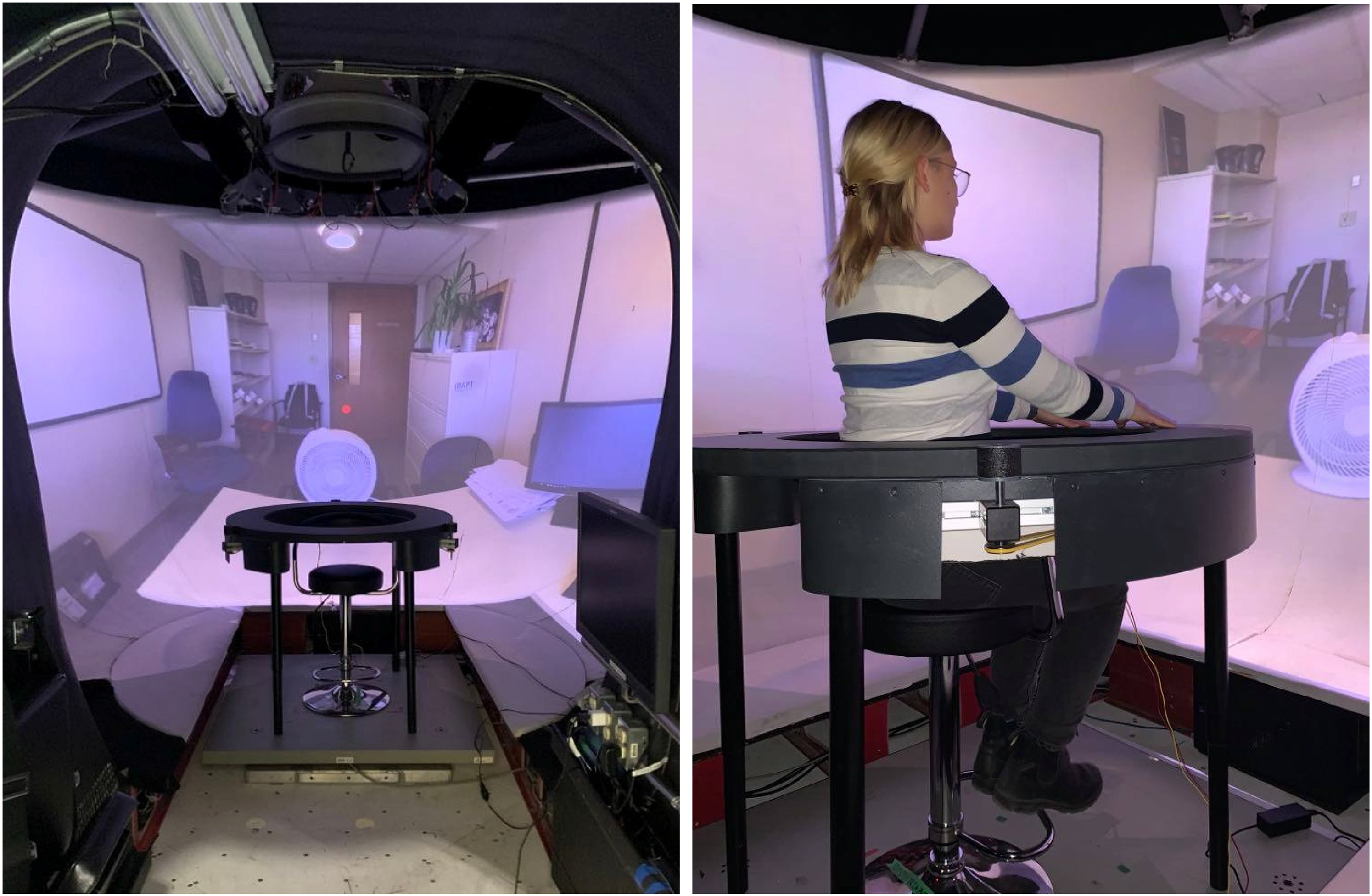
Experimental set-up inside StreetLab (left) showing a participant positioning their hands on the tactile stimulus (right).
The auditory stimuli contained three sounds corresponding to static objects within the office scene: the sound of a telephone ringing, a printer printing, and a fan blowing. In trials including auditory cues, these sounds were presented continuously and simultaneously. The average sound pressure level measured for each sound source was similar (telephone: 65.5 dB, printer: 62.1 dB; fan: 67.0 dB) and resulted in a combined averaged sound pressure level of 68.8 dB. The sounds were all positioned in the virtual world at the exact position of the corresponding visual object with equidistance to the center of the laboratory where participants were seated. That is, the sounds rotated around the participants in the same direction and with the same velocity (45°/s) as the visual scene.
Tactile cues were administered through a customized, table-like structure supporting a foam ring that encircled participants (“tactile ring”). The foam ring was mobilized by a string and pulley system powered by a motor discreetly positioned underneath the tabletop, out of view from participants. The motor was programmed such that the tactile rings’ movement was in sync with the acceleration, speed, and direction of the auditory and visual stimuli. For trials that involved tactile stimulation, participants were instructed to lightly place both hands on the top surface such that the foam ring could graze underneath their fingertips. For non-tactile trials, participants were asked to keep their hands in their lap. The texture of the tactile ring was smooth with minor bumps and divots that occur naturally in the polystyrene foam material. The motor powering the tactile ring produced a slight but noticeable background noise and was therefore running during all tactile and non-tactile trials to avoid any confounding effects of the background noise.
Dependent Measures
Vection intensity and vection duration were measured with subjective rating scales after each trial. Participants rated their vection intensity on a scale ranging from 0 (no vection at all) to 10 (fully saturated vection) and their vection duration on a scale ranging from 0% (never perceived vection) to 100% (constantly perceived vection during the trial). The use of subjective rating scales to quantify different aspects of vection is well established in this domain (Kooijman et al., 2022) and has been applied by many vection researchers (Lind et al., 2016; Riecke et al., 2011). These scales are anchored by a minimum and a maximum and can be further divided into categories which imply “low,” “middle,” and “high” response ranges (i.e., relative to the anchors). As a measure of well-being, participants also reported their level of discomfort related to simulator sickness (Keshavarz et al., 2015). Simulator sickness was measured using the Fast Motion Sickness scale (FMS; Keshavarz & Hecht, 2011), where participants were asked to rate their level of discomfort (related to nausea) on a scale from 0 (no sickness at all) to 20 (severe sickness) after each trial. In general, sickness ratings were very low (i.e., overall mean FMS score < 1), and none of the participants had to terminate the experiment prematurely, suggesting that simulator sickness was not an issue in this study. The results of the sickness ratings will not be reported any further.
Procedure
Participants were informed that the purpose of the study was to investigate the subjective sensation of vection, and vection was described using the “train-moving-next-to-you” analogy. All participants confirmed that they were familiar with and understood the concept of vection before proceeding. To ensure audibility and accurate sound identification, each of the three auditory cues were presented individually inside StreetLab and participants were asked to verbally identify “telephone,” “printer,” and “fan” correctly after each auditory cue was presented. Participants were then seated in a height-adjustable rotatable chair with their feet positioned on a footrest. Prior to starting the actual experiment, participants completed a brief practice session where they familiarized themselves with hand placement on the tactile ring as well as the vection intensity, vection duration, and simulator sickness scales. The practice session consisted of two trials identical to the trimodal conditions (i.e., large FOV, auditory, and tactile cues all presented).
The experimental trials began after the practice trials were completed and participants were confident in their understanding of the study instructions. The duration of each trial was 45 s, which included 2.5 s of acceleration, 40 s of constant velocity rotation at 45°/s, and 2.5 s of deceleration. Together, the unimodal, bimodal, and trimodal conditions were presented in four blocks distinguished by FOV size (no-visual, small, medium, and large FOV). Each block contained four unique sensory conditions with the no-visual block consisting of trials without a visual component (no sensory cues, auditory-only, tactile-only, audio-tactile), and the small, medium, and large FOV blocks consisting of trials with a visual component (visual-only, visuo-tactile, audio-visual, and trimodal). Each condition was repeated four times per block resulting in a total of 64 trials overall. The order of the blocks was randomized, and the trials within each block were also randomized. On trials that involved tactile stimulation, the experimenter reminded participants to place their fingertips on top of the moving ring structure, otherwise they were instructed to keep their hands in their lap. After each trial, the screen was blacked out and participants were asked to verbally indicate vection intensity, vection duration, and their level of simulator sickness. After completion of all experimental trials, participants exited the lab, were compensated, and debriefed. The entire the study took approximately 1.5 h per participant to complete.
Data Analysis
To examine the main effects and interactions of age, FOV, auditory, and tactile cues, a 2 (older, younger) × 4 (no visual, small, medium, large FOV) × 2 (auditory-ON, auditory-OFF) × 2 (tactile-ON, tactile-OFF) mixed analysis of variance (ANOVA) was conducted for vection intensity and duration. Significant effects were followed up with Bonferroni-corrected pairwise comparisons. If the assumption of sphericity was violated, Greenhouse-Geisser corrections were applied.
Results
Vection Intensity
Figure 2 shows the average intensity scores across all conditions for each FOV size and for both participant groups. The ANOVA showed a main effect of age, F(1, 36) = 4.53, p = .04, ɳp2 = .11, indicating that older adults reported higher vection intensity overall compared to younger adults (Molder = 4.84, SD = 3.66; Myounger = 3.72, SD = 2.72). Additionally, significant main effects for all within-subject variables were found. The main effect of FOV, F(2.49, 89.47) = 77.27, p <.001, ɳp2 = .68 (
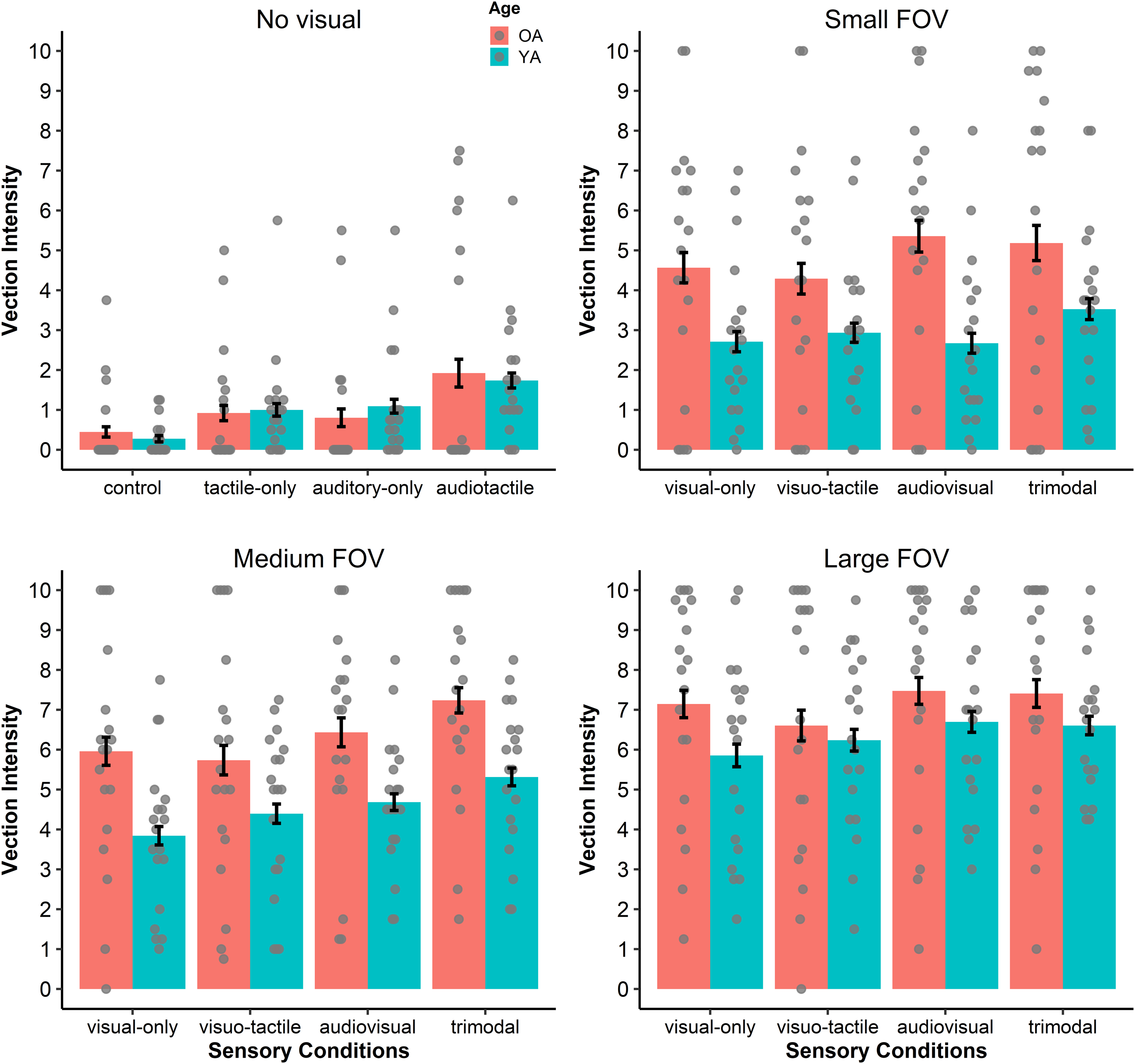
Average vection intensity scores across sensory conditions for each FOV size. Older adults (OA) and younger adults (YA) are represented by the red and blue lines, respectively. Error bars represent standard error. Gray dots are individual data points.
Vection Duration
Similar to intensity, a main effect of age was found for duration, F(1, 36) = 5.67, p = .02, ɳp2 = .14, suggesting that older adults generally experienced longer-lasting vection relative to younger adults (Molder = 55.49, SD = 43.08; Myounger = 37.0, SD = 30.31). Significant main effects of FOV, F(2.30, 82.78) = 86.07, p <.001, ɳp2 = .71 (
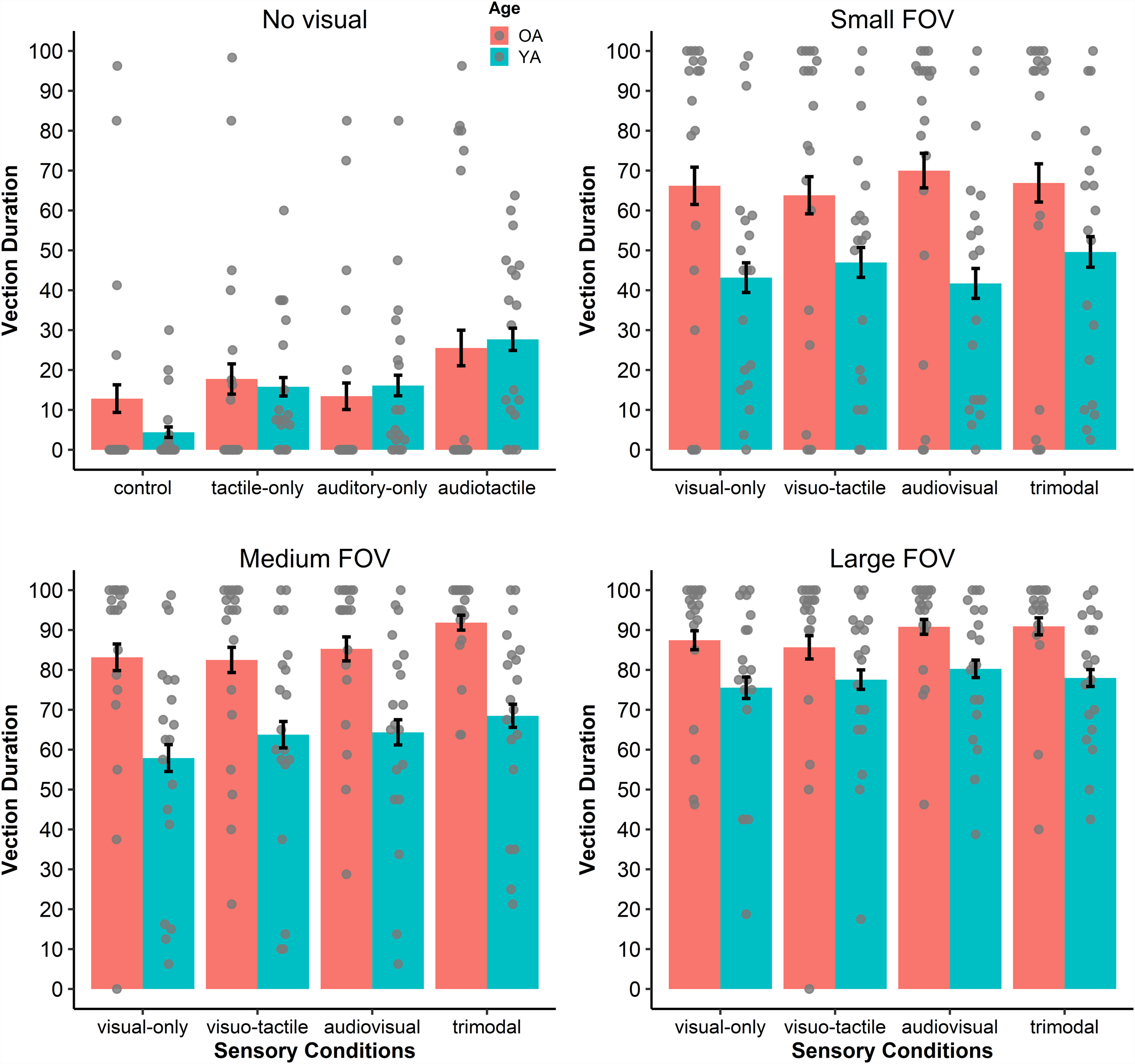
Average vection duration scores (%) across sensory conditions for each FOV size. Older adults (OA) and younger adults (YA) are represented by the red and blue lines, respectively. Error bars represent standard error.
Discussion
The primary aim of this study was to investigate age-related changes in the perception of vection under multisensory stimulation. To achieve this, different sensory cues (visual, auditory, and tactile) were presented to younger and older participants in a VR setting. Consistent with previous literature, we found a main effect of FOV indicating that vection was enhanced with larger compared to smaller FOVs (Allison et al., 1999; Keshavarz et al., 2017). Additionally, we found main effects of auditory and tactile cues suggesting that the presence of these cues increased the vection sensation. These results are consistent with our previous work (Murovec et al., 2021) as well as the larger body of multisensory vection literature (Kooijman et al., 2021; Väljamäe, 2009). These findings support the general idea that vection is a multisensory phenomenon and can be facilitated by the addition of non-visual sensory cues to visual stimuli (Hettinger et al., 2014; Palmisano et al., 2015). With regards to age, our results demonstrated that overall older adults experienced significantly more intense and prolonged vection compared to younger adults. In contrast to our hypothesis, however, an age-related difference with regards to the effect of multisensory cue combinations was not observed; instead, both younger and older adults benefited from the presence of multiple sensory cues equally. We will discuss these findings in more detail in the following sections.
Multisensory Cue Contributions to Vection
In line with our previous work (Murovec et al., 2021), we found significant contributions of visual, auditory, and tactile cues on vection. That is, for both vection intensity and duration, a robust effect of FOV was found such that ratings increased as the size of the FOV increased. This finding is consistent with the previous literature which has reliably shown that stimuli presented on larger visual fields elicit stronger vection compared to smaller or restricted visual fields (Allison et al., 1999; Dichgans & Brandt, 1978; Flanagan et al., 2002; Keshavarz et al., 2017). Slight, but significant enhancement effects from the addition of auditory and tactile cues were also found, substantiating the growing body of research demonstrating that vection is not just a visual phenomenon, but rather a multisensory sensation (Hettinger et al., 2014; Palmisano et al., 2015). Previous work has demonstrated that auditory cues (Keshavarz et al., 2014; Seno et al., 2012) as well as tactile cues (Kruijff et al., 2016; Nordahl et al., 2012) can increase vection intensity when added to visual stimuli. For example, Riecke, Väljamäe et al. (2009) presented participants with a rotating image of a marketplace while manipulating the availability of concurrently rotating auditory stimuli that matched visual landmarks (i.e., fountain sound). The addition of the auditory cues resulted in a facilitatory effect, whereby vection intensity was increased relative to the visual-alone condition. Relatedly, a study by Riecke et al. (2005b) demonstrated that adding tactile stimuli (in the form of vibrations to the participants’ seat and floor plate) significantly reduced vection onset latencies when added to a rotating visual stimulus. The results of the present study support these findings.
At the same time, we expected that the addition of auditory and tactile stimuli would particularly enhance vection when the visual cues were less dominant (e.g., for the no visual, small, and medium FOVs). However, this prediction was only partially supported. Specifically, there was an FOV by tactile interaction suggesting that tactile cues were especially helpful in facilitating vection in the no-visual and medium FOV conditions (although not small FOV as would be expected).
Age Effects
Given that vection has been largely understudied in older adults (Haibach et al., 2009; Paige, 1994), and the knowledge that older adults experience age-related changes to multisensory integration, we sought to investigate age-related differences in the context of multisensory vection. Specifically, we expected to find an age-related multisensory enhancement effect wherein, compared to younger adults, older adults would experience greater increases in vection when redundant sensory cues were presented (bimodal, trimodal conditions); however, this effect was not found. Instead, both older and younger adults showed a similar increase in vection intensity and duration across unimodal, bimodal, and trimodal conditions. It is possible that heightened multisensory integration observed for older adults in studies using very basic stimuli and tasks (Laurienti et al., 2006; Peiffer et al., 2007) may not be observed during more complex and realistic tasks, such the vection-inducing stimuli used in the current study. Another explanation could be that the sensory stimuli utilized in the current study were all highly supra-threshold, and thus multisensory benefits are less likely to be observed compared to if the stimuli were closer to threshold (Stein & Meredith, 1993), which has been used to explain age-related multisensory enhancements in previous literature (Diederich et al., 2008; Laurienti et al., 2006). Future studies could include degraded sensory inputs to better investigate multisensory integration in the context of vection.
Although we did not find age-related differences in the multisensory enhancement of vection, our findings demonstrated that older adults reported more intense and longer lasting vection overall. This general age effect could be potentially explained by differences in the integration of visual and vestibular information. For instance, Alberts et al. (2019) examined age-related reweighting of visual and vestibular cues in a spatial orientation task using the Rod-and-Frame task in a group of participants aged 19–76. In this task, participants were asked to indicate whether the orientation of a line (i.e., the rod) was clockwise or counter-clockwise relative to gravitational vertical, when presented within a square visual frame which varied in orientation. The Rod-and-Frame task is commonly used to estimate an individual's level of visual field dependency, describing the tendency to rely more strongly on visual or vestibular/proprioceptive cues with regards to the perception of verticality (Boccia et al., 2016; Witkin & Goodenough, 1977). Compared to younger adults, older adults’ estimations were biased toward the frame orientation, suggesting that this age group was more field-dependent, making them more influenced by the visual over the vestibular cues. The authors argued that due to age-related declines in the vestibular system, older adults engage in a sensory reweighting process, where visual dominance is favoured while vestibular inputs are down-weighted. Interestingly, previous research has reported a positive correlation between the level of field dependence as measured by the Rod-and-Frame task and vection (D’Amour et al., 2021), which may partially explain why older adults reported more vection in general in the present study. In another study, Ramkhalawansingh et al. (2018) presented older and younger participants with either congruent or incongruent visual-vestibular stimulation using a head-mounted-display coupled with a motion platform. Participants completed a heading estimation task where they judged which of two movements was more rightward across unimodal conditions (optic flow—visual-only; passive movement in darkness—vestibular-only) and bimodal conditions (visual + vestibular; congruent vs. incongruent). In the unimodal conditions, older adults had less reliable visual heading estimates than younger adults but similar vestibular heading estimates, and both groups demonstrated overall poorer visual than vestibular heading discrimination abilities. However, during the incongruent visual-vestibular conditions (large conflict), older adults’ weighted visual cues higher than would have been optimal compared to younger adults. Specifically, older adults relied more strongly on visual heading cues during bimodal estimates than they should have given the poor reliability of the unimodal visual estimates. This may be due to the fact that older adults persist in integrating sensory inputs over a larger temporal and/or spatial conflicts (i.e., demonstrate larger binding windows) than younger adults. These effects of age-related differences in integration in the context of large sensory conflicts could have important implication for vection, given that vection often occurs in the context of large inter-sensory conflict (e.g., strong visual motion during physical stasis).
The age-related difference in vection ratings found in the present study is consistent with previous work (Paige, 1994); however, this finding contradicts results reported by Haibach et al. (2009), where younger adults reported more intense vection compared to older adults. It is possible that the inconsistent age-related result is due to differences in the participant groups and/or the experimental settings. With regards to the former, for instance, the study by Haibach et al. did not screen their older participants for cognitive functioning, which may have affected the vection ratings. With regards to the experimental settings, Haibach et al. asked their participants to stand on a force plate during stimulus presentation and exposed them to a visual scene comprised of black and white vertical bars representing a ‘moving room’. It seems possible that asking participants to estimate their level of self-motion (vection) while engaging in a postural task may have added a level of complexity to the study which could be overwhelming for older participants, as previous research has shown that dual tasks involving postural performance have a stronger impact on the performance of older adults compared to younger adults (Bernard-Demanze et al., 2009). In fact, Haibach et al. note that the task of estimating vection while standing was potentially “more challenging for older adults,” which may have been a reflection of sensory decline caused by healthy aging according to the authors (p. 643).
Limitations
One of the main limitations of the present study concerns the sample size. As previously stated, the power analysis indicated our study had excellent power to detect large effects involving the factor FOV; however, test power was much lower for detecting medium or small effects. Based off of visual inspection of the data shown in Figures 2 and 3, an age × FOV interaction wherein older adults reported more vection in the small and medium FOVs specifically seems possible. However, this interaction did not reach significance (see Supplementary Material). Given the small sample size of the present study, it is still possible that a small or medium effect exists that we were unable to detect. Another limitation was the effectiveness of the visual stimulus. Surprisingly, in the most compelling visual condition (i.e., the full FOV), participants’ intensity ratings were significantly below the rating scale's maximum (M = 5.89 out of a possible 10). This could be due to distortions in the visual image (e.g., objects closer to the viewer seem proportionally bigger than object farther away), which is a common issue when capturing 360° panoramic images (Azevedo et al., 2018). Alternatively, it is possible that the speed of the stimulus was too slow. Future studies could address this issue by providing additional motion cues such as motion parallax or vestibular/proprioceptive cues to increase the sensation of vection.
Another limitation was the design of the tactile stimulus. Given that the ring rotation was powered by a small motor and string-and-pulley system, a noticeable slow-down occurred when participants placed their hands on the top surface of the moving foam ring. In other words, the speed of the tactile stimulus was sensitive to the pressure exerted by the weight of the participants’ hands. Thus, for the ring to move at the desired speed, participants could only lightly place their fingertips atop the ring allowing for a gentle, minimal tactile contribution. It is possible that the effect of adding tactile cues could have been stronger if the motor was more powerful and allowed for a stronger haptic sensation. In addition, using a more textured material for the tactile stimulus could be considered to increase the haptic sensation.
Additionally, the experimental control condition with no sensory cues (no-visuals, no auditory cues, no tactile cues) surprisingly induced vection in some participants (see Figures 2 and 3, top left quadrant). It is possible that this occurred as a result of prolonged exposure (e.g., after viewing many trials with visual motion, a motion after-effect lingered into the control trials where participants were suddenly blindfolded). Alternatively, it is possible that the noise produced by the motor and sliding ring of the tactile stimulus served as a moving auditory input, and thus induced auditory vection.
Lastly, in the current study, we confirmed audibility of the auditory stimulus using a simple sound identification paradigm (see procedure section in Methods). However, using a standardized audiometric assessment to measure hearing acuity would confirm clinically normal hearing abilities. As hearing acuity is known to decline with age and has been shown to contribute to accurate self-motion perception (Campos et al., 2018), a more comprehensive test would be useful for understanding the relationship between age-related changes to hearing and multisensory vection. Similarly, our inclusion criteria required all participants to have normal or corrected to normal vision. This means that we exclusively selected older adults who have good vision, and thus, this sample may not necessarily accurately reflect the typical older adult population. To expand the scope of our findings, participants with visual declines/impairments could be included in future studies. In fact, previous studies involving individuals with age-related eye disease and visual impairment such as age-related macular degeneration (AMD) reported relatively higher vection intensity scores compared to healthy age-matched controls when motion in depth was simulated (Luu et al., 2021). These authors and others (Tarita-Nistor et al., 2008) have suggested that those with AMD may be more sensitive to their peripheral vision to compensate for deficits in their central visual field, and thus experience increased vection as a result.
Conclusion
The aim of the present study was to investigate age-related differences in the sensation of vection under multisensory cue conditions. Overall, we found that the addition of auditory and tactile cues increased vection intensity and duration, supporting the idea that vection is a multisensory phenomenon. This multisensory effect was observed in younger and older adults equally. Our study also demonstrated that older adults experienced more intense and prolonged vection, regardless of the unimodal, bimodal, trimodal presentations of sensory stimuli.
Supplemental Material
sj-docx-1-pec-10.1177_03010066221113770 - Supplemental material for Enhanced vection in older adults: Evidence for age-related effects in multisensory vection experiences
Supplemental material, sj-docx-1-pec-10.1177_03010066221113770 for Enhanced vection in older adults: Evidence for age-related effects in multisensory vection experiences by Brandy Murovec, Julia Spaniol, Jennifer L. Campos and Behrang Keshavarz in Perception
Footnotes
Declaration of Conflicting Interests
The author(s) declared no potential conflicts of interest with respect to the research, authorship, and/or publication of this article.
Funding
The author(s) disclosed receipt of the following financial support for the research, authorship, and/or publication of this article: This work was supported by the Natural Sciences and Engineering Research Council of Canada (grant number RGPIN-2017-04387).

Supplemental Material
Supplemental material for this article is available online.
Notes
References
Supplementary Material
Please find the following supplemental material available below.
For Open Access articles published under a Creative Commons License, all supplemental material carries the same license as the article it is associated with.
For non-Open Access articles published, all supplemental material carries a non-exclusive license, and permission requests for re-use of supplemental material or any part of supplemental material shall be sent directly to the copyright owner as specified in the copyright notice associated with the article.
