




Abstract
Expertise in familiar face recognition has been well-documented in several studies. Here, we examined the role of context using a surprise lecturer recognition test. Across two experiments, we found few students recognised their lecturer when they were unexpected, but accuracy was higher when the lecturer was preceded by a prompt. Our findings suggest that familiar face recognition can be poor in unexpected contexts.
Research has shown we are experts at recognising familiar faces but perform poorly with unfamiliar faces (Young & Burton, 2018). For example, Burton et al. (1999) examined how familiarity affects face recognition using videos captured from a security camera. Participants viewed poor-quality video clips, each of which showed a psychology lecturer walking in a university building. For one group of participants (psychology students), the targets were familiar, while for the other two groups (non-psychology students and police officers) the targets were unfamiliar. Participants who had previous familiarity with the targets were good at recognising them, while those who were unfamiliar with the targets performed rather poorly.
Although familiar is superior to unfamiliar face recognition on a number of dimensions, Young et al. (1985) demonstrated real-world recognition of familiar people is far from infallible. Young et al. conducted a diary study to collect data about the types of recognition problems people experience in everyday life. Over an eight-week period, they asked participants to record all errors or difficulties with person recognition they experienced. The diarists’ reports included situations where they mistook one person for another as well as failures to recognise even very familiar people.
Therefore there is reason to suspect that although familiar face identification is highly accurate relative to unfamiliar face identification, there are limits, and contextual factors are likely to play a role. While the study by Burton et al. (1999) underlined the advantages conferred by familiarity, the targets all belonged to the same group (psychology lecturers) and were seen in a predictable context (university building). Little is known about our ability to recognise familiar faces when they are unexpected. It seems intuitive that if we are not expecting to see a familiar person then we might fail to recognise them, even if presented with a relatively clear view of their face. Indeed, Don Thomson (1986) reported a situation where the parents of one of his students visited London from Australia, unaware their daughter was also in London. The student was instructed to stand near the parent’s lodgings and show no signs of recognition when her parents emerged. The parents thought they recognised their daughter but concluded it could not be her. These findings suggest familiar face recognition is prone to error when familiar faces are unexpected/out of context.
To assess the role of context, we presented participants with a surprise lecturer recognition test at the end of an unrelated experiment measuring how well participants could learn the faces of unfamiliar male targets from videos captured at night. In the videos the male targets walked up to the camera, paused briefly, then walked away. Participants either viewed the video footage once or multiple times before completing a face recognition test. To measure the effect of context on familiar face recognition, we added two videos to the end of the experiment. These were in the same format as the first 10 videos, except that the penultimate video showed an unfamiliar woman standing slightly behind the male target, and the final video included a female lecturer (see Figure 1) who would likely be familiar to most of our participants. We recorded the number of participants who recognised their lecturer.
Students in the School of Psychology at Keele University took part in Experiment 1. Participants were asked whether they recognised anyone from the final video. If participants correctly identified the lecturer, then the experiment ended. If participants did not identify the lecturer, then they were instructed to watch the video again and were asked again if they recognised anyone from the video. Upon completion, all participants were asked whether they were familiar with the lecturer and had been taught by her.
Few people recognised their lecturer in the surprise recognition test. Of 57 participants, 42 were familiar with, and had been taught by the lecturer, but not one participant (0%) identified the lecturer immediately after completing the face recognition test. After viewing the video a second time, four participants (9.5%) correctly identified her, and one participant thought the woman in the video was the experimenter. The remaining 15 participants reported being unfamiliar with the lecturer and three of them falsely identified the experimenter as the person in the video.
Our findings contrast with those of Burton et al. (1999), who found participants were very good (73% accuracy) at recognising their lecturers when they were expected. In the present experiment participants were not expecting to see someone familiar. If contextual information plays a role in familiar face recognition then informing participants there is a lecturer in the video should improve performance. In Experiment 2, we tested this using the same format as Experiment 1 except that participants viewed the video of the lecturer again if they did not recognise her the first or second time. The extra video was preceded by a prompt informing participants that one of the actors was a lecturer in the School of Psychology. After watching, participants were asked if they recognised anyone in the video.
Thirty-six participants (out of 40) were familiar and had been taught by the lecturer. Twenty-four (66.67%) familiar participants recognised the lecturer from the video: six (16.67%) recognised her before the prompt (Video 1, n = 3; Video 2, n = 3) and 18 (50.00%) recognised her after the prompt. This suggests that they were good at recognising their lecturer when given some context.
Theories of face recognition suggest expertise in recognising familiar faces is characterised by highly accurate responses, even from degraded images (Young & Burton, 2018). However, consistent with Thomson (1986), our findings suggest familiar face recognition is not infallible. When encountered in an unexpected context, many students failed to recognise their lecturer. This has potential real-world implications, such as for recognising acquaintances from poor quality footage in police wanted appeals. While we ensured the lecturer in our experiment was someone who had contact with students, recent evidence suggests enhanced neural responses to close friends compared with lecturers and celebrities (Wiese et al., 2019). Therefore, future research should determine whether context can similarly impair recognition of highly familiar faces, such as friends or family.
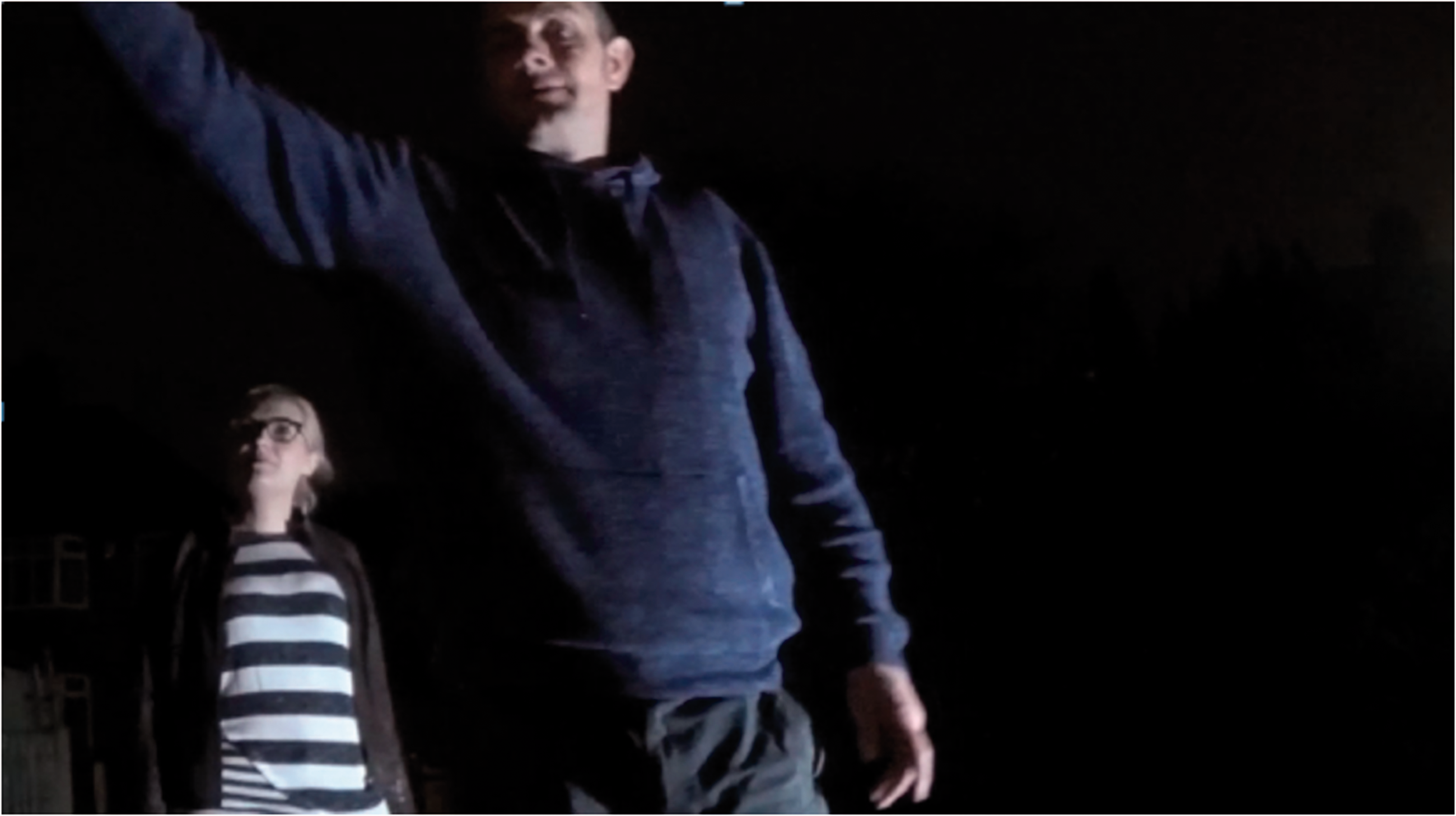
A Screenshot of the Video Containing the Lecturer in the Background.
Footnotes
Acknowledgements
The authors would like to thank Isabella Martinelli for her help with data collection and Dr. Graham Hole for his useful comments on an earlier version of this manuscript. Dr. Sarah Laurence worked at Keele University when the manuscript was submitted and the Open University when it was accepted.
Declaration of Conflicting Interests
The author(s) declared no potential conflicts of interest with respect to the research, authorship, and/or publication of this article.
Funding
The author(s) received no financial support for the research, authorship, and/or publication of this article.
