




Abstract

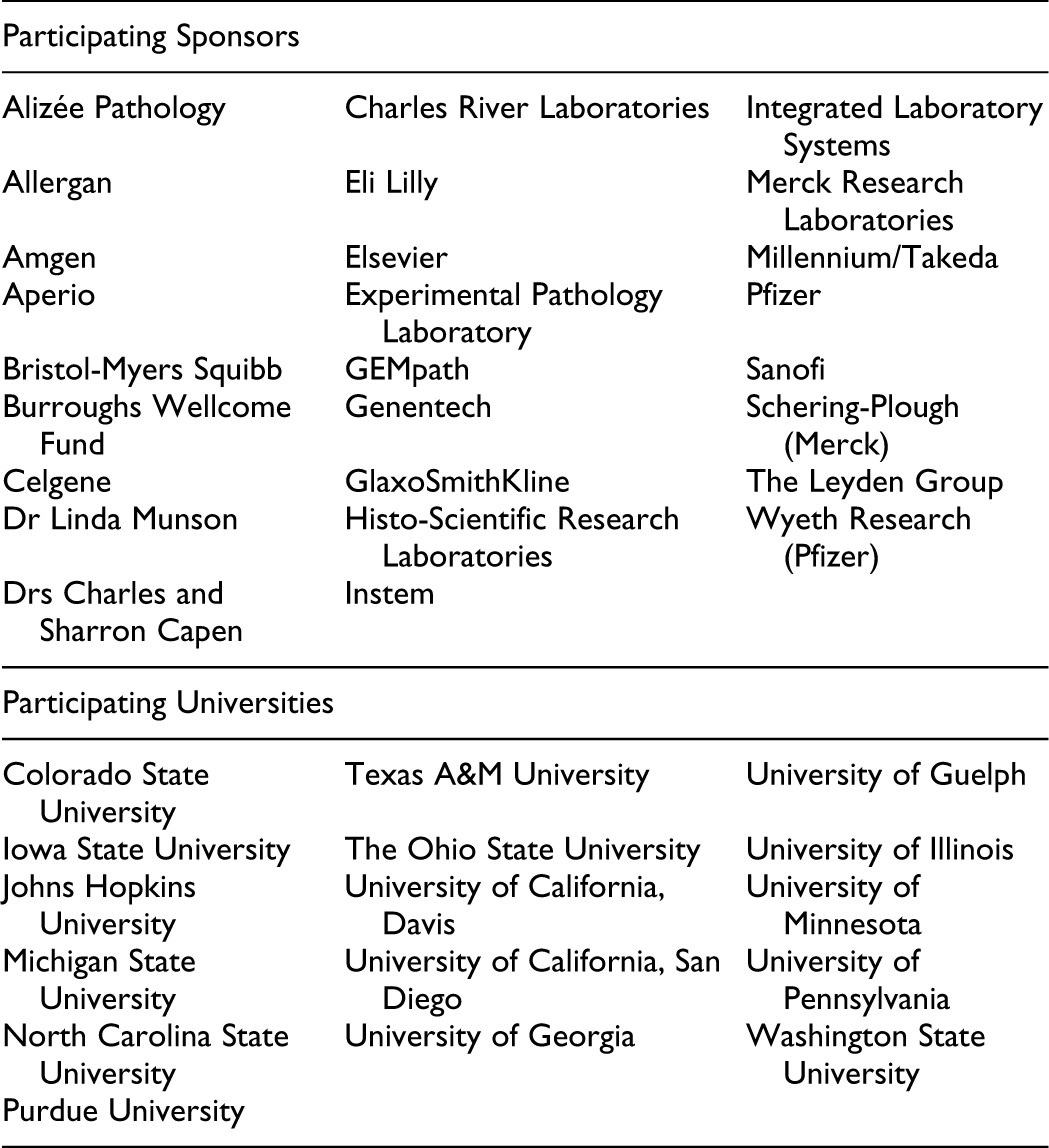
In late 2004, the American College of Veterinary Pathologists (ACVP) and Society of Toxicologic Pathology (STP) partnered to form the ACVP/STP Coalition for Veterinary Pathology Fellows. The purpose of the Coalition was to provide a unified mechanism to solicit and allocate funds for new training positions in response to the well-documented shortage of veterinary anatomic and clinical pathologists at that time. Sponsors and training institutions enthusiastically responded to this educational initiative; to date, the Coalition has established 29 new training positions at 16 North American universities, supported by >$6.8 million in financial commitments from sponsors, as detailed in the following table.
Notwithstanding the Coalition’s efforts, the shortage of veterinary pathologists remained until relatively recently. In a 2007 North American veterinary pathology supply and demand survey, training programs reported 278 graduates in the past 5 years and 258 currently enrolled trainees, and employers reported 142 job openings and an additional 370 anticipated openings in the next 5 years, 2008–2012 (http://www.toxpath.org/acvp_workforce.asp). Despite this relatively optimistic employment forecast, continuing mergers, acquisitions and reorganizations within industry, and state and federal budgetary restrictions imposed on academia have clearly affected traditional job opportunities for veterinary pathologists in recent years. These changes in employment demographics, as well as the scope of investigations and introduction of new diagnostic tools, have required the Coalition to continue to enhance training opportunities in veterinary pathology to supply traditional and emerging markets. The purpose of this communication is to highlight 3 recent efforts that reflect these adaptations.
First, owing to its experience in implementing new training positions, the ACVP asked the Coalition to administer fellowships created through the generosity of 2 recently deceased prominent veterinary pathologists, Drs Charles Capen and Linda Munson. Accordingly, the Coalition is in the process of implementing the “Charles and Sharron Capen Fellowship in Veterinary Pathology” and the “Linda Munson Fellowship for Research in Wildlife Pathology Research.” These 2 fellowships are unique for several reasons; they are the first to be supported with funds other than from industry, they require specific areas of PhD dissertation research, and they require cost sharing by the training institution. It is hoped that other ACVP and STP members will consider similar contributions while the Coalition continues to secure traditional industrial support and search for opportunities with other partners with a philanthropic educational platform.
Second, an initiative called “A Matching Program to Facilitate Funded Foreign Veterinarians Applying for North American Pathology Training” was recently implemented (for details, see http://www.vetpathcoalition.org/news.cfm). The program is aligned with efforts of the STP Globalization Limited Duration Team Task Force and the ACVP International Alliances Committee. The objective is to establish a unified system for foreign-trained veterinarians with funding from their own country and with the express intent of returning to their home country for employment as veterinary pathologists, to efficiently apply for post-DVM pathology training positions at North American universities. The program does not guarantee that foreign students will be accepted into a North American training institution but simply makes it easier for such students to be considered by training institutions and for those institutions to have broad, competitive access to these students.
Third, the Coalition recently issued a “Request for Concepts” to existing and potential future sponsors. To date, sponsors have provided broad-based support for anatomical or clinical pathology residencies, or postresidency PhD graduate research positions, generally without stipulating further disciplinary specialization. The purpose of the Request for Concepts was to identify specific areas of research where companies needed more veterinary pathologists to support their research and development goals, with the aim of aligning sponsors’ needs with training institutions’ capabilities. Sponsors responded by listing a broad range of research areas, including (1) toxicologic pathology; (2) primate toxicology; (3) mechanisms of liver, kidney, gastrointestinal, ocular, dermatologic, and cardiovascular injury/toxicity; (4) translational models for human disease; (5) safety biomarker identification and validation; (6) medical device pathology; (7) quantitative immunohistochemistry; (8) morphometry and image analysis; (9) birth defects with a focus on regenerative medicine and stem cells; (10) basic structural and functional mechanisms of regeneration and healing; and (11) tissue cross-reactivity. North American training institutions were urged to consider these research areas in the context of their own training programs and to think about other creative approaches such as cost sharing with industry and joint training positions with other institutions to take advantage of each other’s expertise as future funding for new training positions becomes available.
These efforts will allow the Coalition to continue to assist industry, training programs, and trainees to meet their objectives. The educational mission of the ACVP and STP is a strategic tenet for the veterinary medical profession, and veterinary pathologists are critical to the success of the business, teaching, service, and research goals of industry and academia. The Coalition remains committed to enhancing training in veterinary pathology; however, providing exceptionally well-trained candidates for employment in a global market will require renewed financial commitments.
Footnotes
*This article will be published in both Veterinary Pathology and Toxicologic Pathology, official journals of the ACVP and STP, respectively.