




Abstract

Dr. Floris Melbourne “Dick” Garner was born November 5, 1922, in Chicago but shortly thereafter moved to Phoenix, Arizona. He graduated from Phoenix Union High School in 1939, at which time, having “misrepresented” his age, he had already joined the Arizona National Guard’s 158th Rifle Division, The Bushmasters. He attended Arizona State College and served as a sergeant in the Panama Canal Zone before attending Officer Candidate School in Fort Benning, Georgia. In 1944, he participated in the Normandy Campaign as a platoon commander in the 35th division, 134th infantry. First Lieutenant Garner was severely wounded by mortar fire in Conde-Sur-Viere and was awarded a Purple Heart. Dick was recovering from wounds stateside when he married Anita Campiglia in 1945. (By her own account, Dick was so weak that Anita had to carry him across the threshold!) Dick retired from active duty and obtained his BS degree (1948) and DVM degree (1950) at Washington State College. After graduation in 1950, he practiced for 6 months at a small animal clinic in Phoenix, but by then the Korean War had broken out and he was called to active duty again.
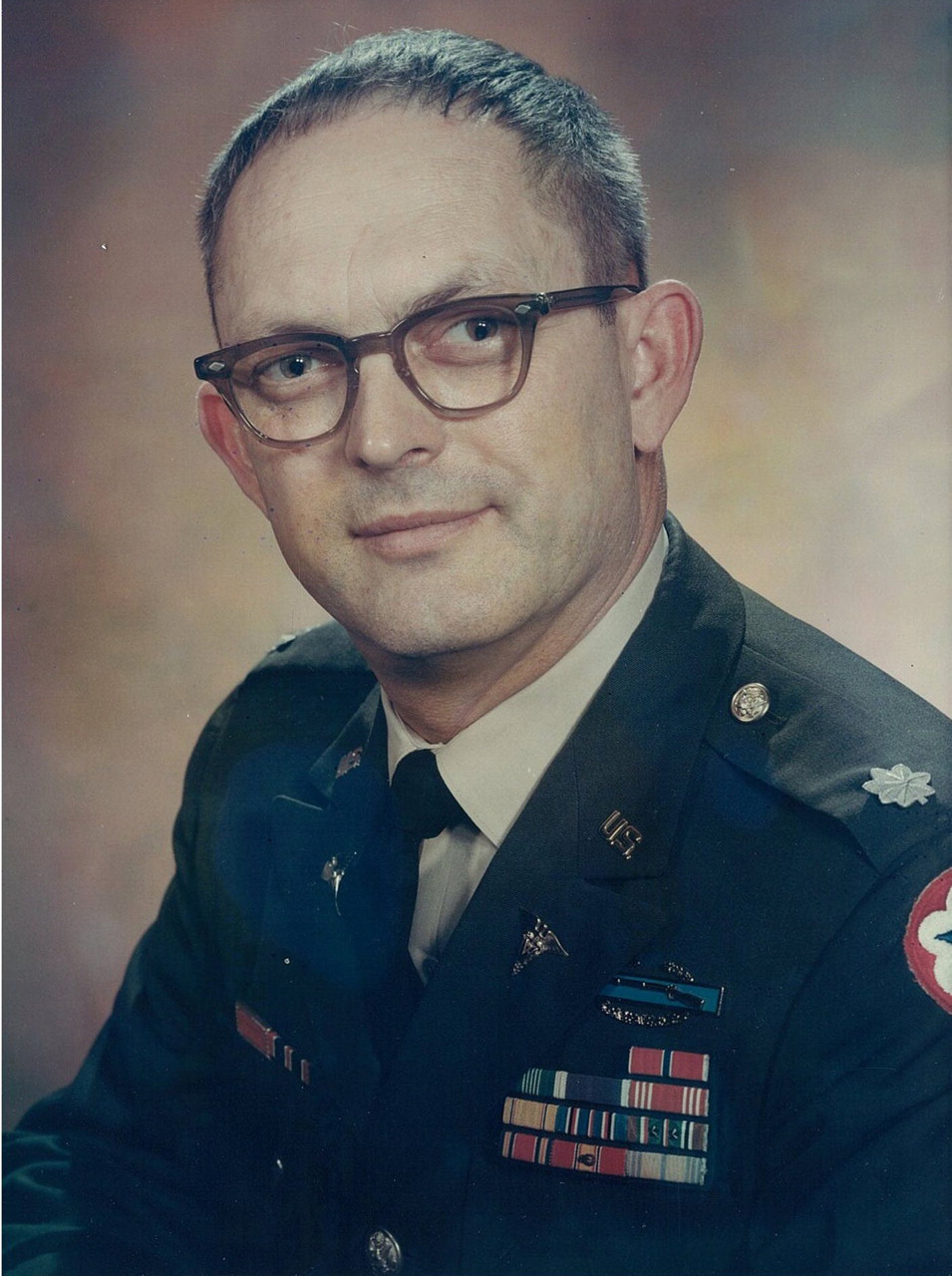
After a brief training period at the US Army Meat and Dairy Hygiene School in Chicago, Dick served as a meat and dairy inspector at Fort MacArthur in Maywood, California, and as the post veterinarian at Ft Douglas, Utah. He was then transferred to Taiwan as a meat and dairy inspector for the US Army, where he broke a leg in a jeep accident. Dick was moved stateside again and became the Veterinary Detachment Commander at the Quartermaster Depot in Richmond, Virginia. In 1958, he moved his family to Maryland after taking a position as one of the first two residents in the training program of the Veterinary Division of the Armed Forces Institute of Pathology.
Dick passed his pathology boards in 1962 and served as Assistant Chief of the division (1960-1964) and then Chief (1964-1971). During his tenure at the Armed Forces Institute of Pathology, Dick participated in the training of approximately 40 residents. He served as the registrar for the American Registry of Veterinary Pathology and registrar for the American Registry of Comparative Pathology and Biomedical Materials Exchange; he was the course director for the popular short course “Pathology of Laboratory Animals” and was renowned for his informative and colorful lectures. He was instrumental in coordinating the activities of the International Reference Center for Comparative Oncology (World Health Organization) as well as the Collaborating Laboratory on the Ocular Tumors of Domestic Animals. Dick also served as consultant to the Surgeon General, assistant clinical professor of pathology at George Washington University, associate scientist for the Universities Associated for Research and Education in Pathology, and president of the Washington, D.C. Veterinary Medical Association (1970).
In addition to receiving a Purple Heart, Dick received the Bronze Star Medal, Army Commendation Medal, European-African Campaign Medal, American Defense Service Medal, Legion of Merit, National Defense Service Medal, Air Force Outstanding Unit Award, and Army Good Conduct Medal. Dick was awarded the “A” prefix, the highest recognition of professional attainment within the Army Medical Department. Dick also served as treasurer (1967-1973) and as president (1975) for the American College of Veterinary Pathologists.
Dick retired as a full colonel in 1971, working briefly as assistant director of the Smithsonian Institute’s National Zoo and as scientific director at Litton Bionetics before becoming an industrial consulting pathologist, primarily for NIH- or USDA-funded toxicological and drug studies. He is the editor of two textbooks, including the important two-volume set Pathology of Laboratory Animals, and authored or coauthored 90 scientific papers and book chapters. Dick established the Floris and Anita Garner Endowed Scholarship at WSU in 1986 to provide support for veterinary students who excelled in pathology, and he provided annual support for the veterinary pathology training program of the Department of Veterinary Microbiology and Pathology. In 1996, Dick was awarded the WSU Distinguished Veterinary Alumnus Award for Excellence in Veterinary Teaching and Research. In 2002, he was honored by members of the ACVP at the opening ceremonies for the D-Day Museum in New Orleans, Louisiana, at the time one of only two living veterinary pathologists in the Allied Forces who had participated in the Normandy campaign. In 2004, during a reunion of the 35th Division in Normandy, a street was named after him in the town where he was wounded, “Dr. F.M. Garner Way.”
Off the clock and outside of earshot, our father was referred to as “The Colonel.” We were fortunate army brats, spending all of our primary and secondary school years in Maryland while the Colonel held down the fort in DC. He went to work early, came home late, and grumbled a lot about traffic. He and Anita collected antiques, refinishing them at night and on the weekend. “This old pie cabinet took two cases of Black Label to finish,” he would boast to savvy visitors. Gardening was another off-duty passion, mostly flowers and any vegetables that would grow in the sweltering heat and with limited well water. We would shuck corn and shell peas and watch the Senators lose yet again on the old TV. The Colonel was a wood hoarder and chopper and nearly every day in late fall and winter made an evening fire on the hearth for Anita and the cats. The Colonel loved to hike in the desert outside Phoenix and on the Appalachian Trail. He jogged every other day into his 70s, when his knees finally quit. He was an avid photographer, a voracious reader, and a dedicated student of military history, visiting every regional civil war battlefield. The Colonel supported and often participated in the interests of his children, including fishing, wrestling, falconry, and even music (“that guitar strumming hippie kid will never amount to anything”).
The Colonel was a survivor, and he never complained. Fifty percent disabled from war wounds, he outlived 20 years of prostate cancer and a squamous cell carcinoma that took his right ear. When he blandly informed his family that he was diagnosed with acute myelogenous leukemia, we kidded him that he had more tumors than a boxer dog. His predictable retort: “And like a boxer dog, I will outlive that one, too.” Sadly, though, we lost him on March 8, 2011. The Colonel was 88. He is to be interred at the Arlington National Cemetery with full military honors on July 1, 2011.
He is survived by Anita, his wife of 66 years; son Richard and wife Patty; son Timothy; son Michael (also a veterinary pathologist) and wife Patricia; and three grandchildren, Hannah, Tera Thompson-Garner, and Jessica Draper. The family asks that in lieu of flowers, memorials be addressed to the Humane Society of Somerset County, Crisfield, Maryland (410-422-2497) or Greyhound Pets Inc, Woodinville, Washington (www.greyhoundpetsinc.org/).