




Abstract

The American College of Veterinary Pathologists' (ACVP’s) 2007–2012 strategic plan recognized the crisis confronting academic training programs and formed a task force to address these concerns. One area of concern identified by the ACVP Training Program Development Task Force was the lack of guidelines to make training more consistent across all programs and provide justification for maintaining or increasing faculty numbers and training resources. Training guidelines for clinical pathology have been outlined in three publications. 1,2,4 The current document addresses the need for training guidelines in veterinary anatomic pathology.
Objectives of Anatomic Pathology Training
Anatomic pathology training programs strive to base the content of their programs on the knowledge and skills required to perform the tasks expected of pathologists in a diversity of careers. To define the current scope of these knowledge and skills, the ACVP conducted a role delineation study in 2007 to guide training program curricula and the content of the certifying examination. Detailed results from the 2008 Role Delineation Survey are available (http://www.acvp.org/roledelin/index.php; accessed June 21, 2010). 3 Only those elements of practice that ACVP diplomates considered essential for a new diplomate to be proficient were deemed appropriate for training programs. Tasks considered critical were those frequently performed by most diplomates, as well as those for which competence was essential to prevent harm.
Based on the 2008 Role Delineation Study, the goals of anatomic pathology training are to (1) develop skills in examining, recognizing, and interpreting lesions at the gross, histological, and ultrastructural level; (2) interpret histochemical, immunohistochemical, and molecular test results; (3) understand the underlying disease process, from the molecular to the organism level; (4) correlate results with clinical findings and clinical laboratory data; (5) communicate pathology findings through written and verbal means; (6) acquire knowledge of diseases in domestic, laboratory, and wildlife species, as well as an appreciation for comparative pathology (One Medicine); and (7) learn appropriate approaches to disease investigations, including an introduction to research methods. Table 1 lists the tasks identified through the role delineation that are expected of residents completing a training program.
Critical Tasks Required of Veterinary Anatomic Pathologists
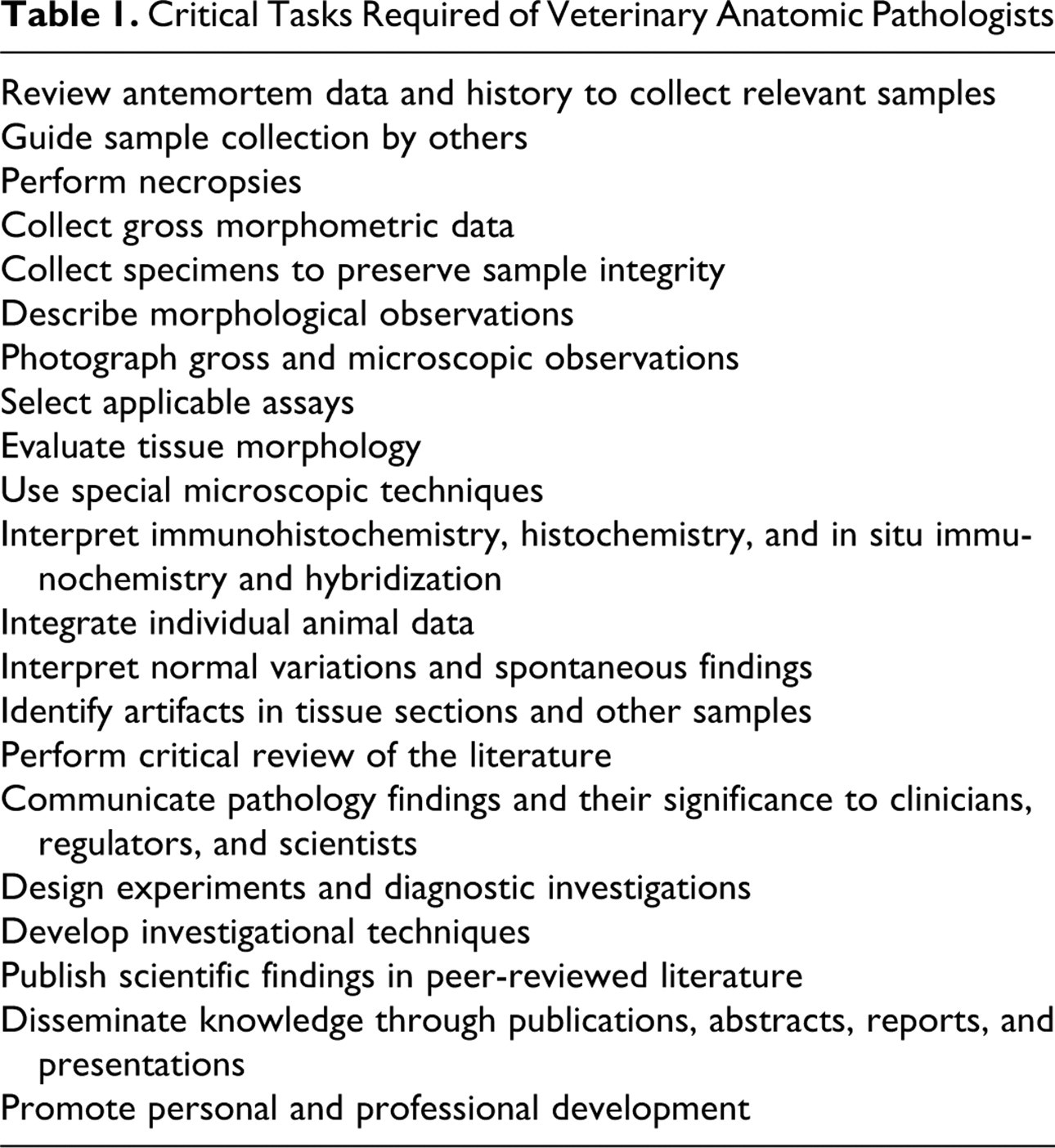
During their program, trainees need to acquire knowledge and skills sufficient to assume increasing responsibility for a broad spectrum of assessments and interpretation of specimens, as well as problems and situations encountered by veterinary anatomic pathologists. These skill s ets and knowledge also prepare them for the ACVP certifying examination and enable career-long learning and adaptability to changes in practice. These skills are essential for most careers in anatomic pathology whether in academia, industry, diagnostic laboratories, or government agencies. Accomplishing these objectives requires a combination of appropriate case material, strong mentoring, access to libraries and other training resources, as well as programmatic support.
Case-Based Mentored Learning
The skills of anatomic pathology are best learned through independent evaluation of spontaneous disease case material, then one-on-one gross and microscopic review with credentialed pathologists. Critical technical skills in anatomic pathology training follow: (1) performing a comprehensive necropsy; (2) conducting thorough and appropriate tissue sampling for histopathology and ancillary procedures; (3) trimming necropsy and biopsy tissues for histology; and (4) documenting, measuring, and photographing gross and histological lesions. Scholarly skills include (1) recognizing, interpreting, and integrating gross and histological lesions; (2) correlating lesions with clinical parameters; (3) understanding the pathogenesis of lesions; (4) determining a diagnosis, prognosis, and cause of death; and (5) communicating findings through succinct, timely, and accurate descriptions, morphologic diagnoses, and comments. Trainees should demonstrate increasing competence, knowledge, and accountability for case management throughout the program and recognize the need to be actively involved in their training success through self-learning.
Necropsy and biopsy cases from a variety of species are essential training tools. The complexity and ambiguity of natural cases provide important challenges to lesion interpretation and to becoming competent in case management—challenges that cannot be replaced by teaching sets of classic lesions. The learning environment is enhanced when trainees are mentored by several pathologists who provide different perspectives. Consultations with specialty pathologists further enhance interpretative skills. Access to ancillary procedures, such as immunohistochemistry, microbial diagnostics, and electron microscopy, also are necessary for the learning experience. Clinical pathology training should be integrated into biopsy and necropsy cases but should also include additional hematology, clinical chemistry, endocrinology, and cytology cases, as mentored by clinical pathologists.
Literature Review and Rounds
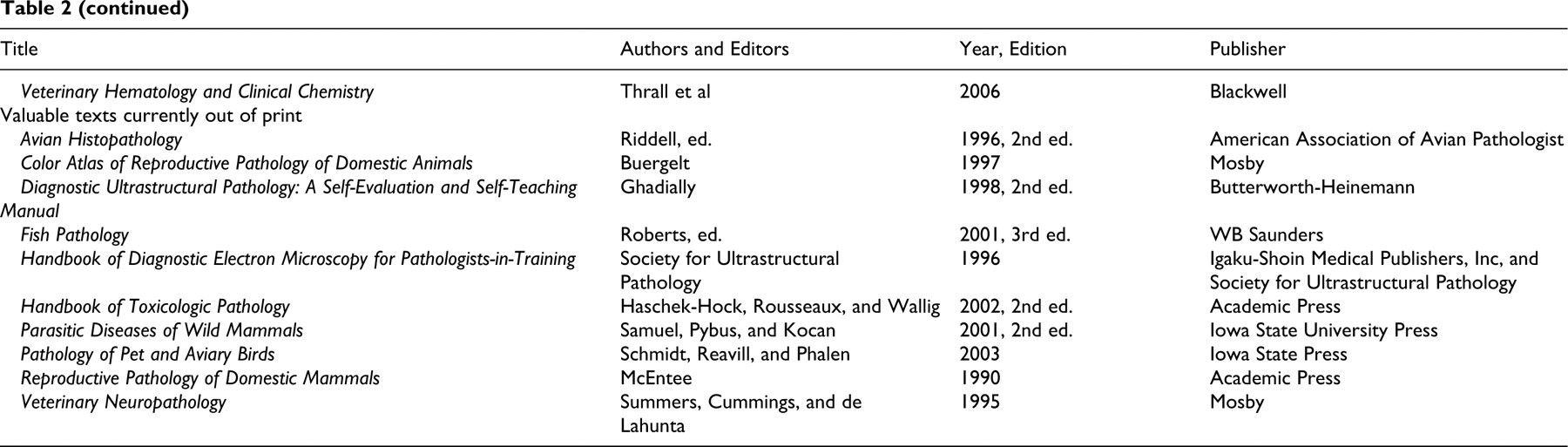
Successful trainees demonstrate a high level of self-motivated learning that extends from the case material into the literature throughout the program. Case-based learning requires trainees to read literature relevant to their cases and then summarize their findings in their reports. Case-based learning alone does not usually provide the breadth and depth of knowledge needed for a career in pathology, because case diversity is limited in many programs. Building a solid foundation of knowledge from textbooks and peer-reviewed literature can begin from reading cases, but it should then expand to cover topics not encountered during the program. Access to searchable databases of scientific literature (eg, PubMed), a variety of textbooks, and other reference materials are essential for training in anatomic pathology. Table 2 lists recommended textbooks, and Table 3 lists useful websites. A journal club mentored by pathologists, provides the venue for learning the critical review of the literature and the structure for lifelong learning. Table 4 offers a suggested list of journals for training programs.
Recommended Textbooks for an Anatomic Pathology Training Reference Library

Useful Websites for Anatomic Pathology Training

Recommended Journals to Review During a Training Program

In addition to a journal club, other rounds and seminars are an essential part of training. Gross rounds with fresh tissues from necropsy cases are an excellent venue for demonstrating the diversity of lesions, for discussing disease pathogenesis, and for integrating clinical history with necropsy findings. Gross pathology reviews with projected images can supplement necropsy case material, especially for lesions or species not routinely seen at the training site. Histopathology rounds based on biopsy or necropsy cases and/or the Armed Forces Institute of Pathology’s Wednesday slide conferences are crucial for learning microscopic descriptive skills; they provide the venue for discussing the evaluation and interpretation of lesions, from the experience of numerous pathologists. Also useful are rounds focused on systems (ophthalmic pathology, neuropathology, etc) or species (zoo/wildlife, laboratory animal, aquatic animal, etc), especially when there is terminology particular to a specialty. Clinical pathology rounds, including cytology, hematology, and clinical chemistry case reviews, are invaluable. General pathology group reviews, practice exercises, and didactic lectures are also beneficial.
The pathology of species or topics not adequately covered by case material alone can be studied with nationally available resources, such as NOAH’s Archive, Cornell’s Necropsy Show and Tell, and Charles Louis Davis DVM Foundation, and the Armed Forces Institute of Pathology’s slide sets. Programs should provide training resources for all the species identified by the 2008 ACVP Role Delineation Study as those most frequently encountered by veterinary anatomic pathologists, including rodents, dogs, primates, cats, rabbits, horses, cows, small ruminants, and pigs. Access to training materials should also be provided from the less frequently encountered species, such as birds, wildlife, zoo animals, pocket pets, reptiles, amphibians, poultry, fish, and marine mammals. Trainees in programs with limited case numbers or species diversity should consider externships in complementary programs.
Research Skills
Research training can be acquired through case series investigations or hypothesis-based research discovering new mechanisms of disease. More extensive research training is usually acquired in doctoral degree programs or through postdoctoral research training. Skills acquired from research training include (1) hypothesis generation and experimental design, (2) cellular and molecular laboratory methods, (3) data interpretation and statistical analysis, and (4) scientific writing. Given the critical shortage of research-trained veterinary pathologists as principal investigators, collaborators, and mentors in biomedical research, trainees should be aware of the benefits of such training and should be strongly encouraged to pursue further training in research. The 2008 ACVP Demographic Survey indicated that more than one-third of employers considered research training an important requirement and that 22% of positions required a doctorate. Enhanced skills in rigorous scientific investigation benefit the trainee in the practice of academic, diagnostic, and research pathology. These skills enable him or her to be competitive in a variety of academic and industrial positions and flexible in assuming multiple roles, thus leading to more diverse career options. This competitive advantage will become more important as the practice of pathology embraces technologies that have the potential to reduce the need for routine tissue evaluation (eg, automated image analysis) and allow more in-depth investigation of natural or drug-induced diseases at the molecular level. Recognizing (1) the importance of research training for veterinary anatomic and clinical pathologists, (2) the difficulty of integrating research into a 3-year residency program, and (3) the need to produce veterinary pathologists with doctoral-level research training, the ACVP Training Program Development Task Force is currently evaluating how best to address research training in more depth.
Communication Skills
Learning the communication skills necessary for professional success is a critical part of training. Clear and relevant communication of pathology findings to clinicians or other stakeholders should be learned during training. As trainees progress through their program and assume increasing responsibility for their cases, their appreciation for the importance of communication with clinicians and other services is enhanced. Scientific writing skills can be acquired through preparing manuscripts of research projects or case reports under the mentorship of a pathologist. Public speaking skills can be developed through presentation of cases in rounds, as well as presenting cases or research findings at regional and national meetings. Didactic teaching of professional veterinary students by pathology trainees is also encouraged, especially for those interested in careers in academia.
The Role of Mentors
Continuous active mentoring is an essential component of any training program. Mentoring of trainees should be provided by credentialed pathologists, as well as by senior trainees and graduate students. Areas of mentoring should include case management, one-on-one case review of gross and histopathologic findings, critical review of necropsy and biopsy reports, necropsy and tissue-trimming techniques, gross and microscopic photography, research project design and implementation, scientific writing, and creation of individualized study plans. Although all faculty should contribute to trainee mentoring, each trainee should be assigned (or should choose) a single faculty mentor to guide him or her through the program.
Faculty pathologists should periodically evaluate the trainees' progress. Annual evaluations are essential, and biannual evaluations are recommended, especially during the first year of training. Multiple pathologists should be involved in the evaluation of each trainee. Areas to evaluate include pathology knowledge, diagnostic ability and investigative skills, descriptive skills, communication skills, and workplace interaction. Progress on accepting responsibility for cases should also be assessed. Table 5 shows a sample evaluation form. The training coordinator and/or faculty mentor should personally meet with the trainee to discuss evaluations, make plans for improvement, and set specific goals. Study plan adjustments can be based on the evaluation results. Because mentoring is an interaction and all parties have responsibilities for its success, it can be valuable to have the trainees provide periodic evaluation of the program.
Sample Trainee Evaluation Form a

a This sample form can be modified to fit different training programs. Most programs use a 5-point scale and include room for comments in each category.
Preparation for the ACVP Exam
Although training programs should not focus exclusively on preparation for the ACVP certifying examination, certification is the immediate goal of most trainees. The 2008 ACVP Role Delineation Study determined the skills and knowledge needed by current pathologists, and the 2009 ACVP Test Plan aligns the exam with these parameters. Thus, the ACVP exam is structured to test the entry-level knowledge and skills needed to be a competent anatomic pathologist. Imparting this knowledge and skills should be the goal of training programs regardless of the exam. Trainees often view preparation for the examination as a task that is independent of their training program, yet the extensive reading and practice of pathology performed in preparation for the examination make the trainee a better pathologist and thus are essential activities in any training program.
Individualized study plans depend on the backgrounds of the trainees, including quality of veterinary medical education, time spent in practice or research since DVM degree, and learning style. Study plans should include preparation for all four sections of the certifying examination through recommended textbook reading, journal article review, gross pathology review, and histopathology description and interpretation. A study plan schedule should also be developed to ensure timely completion of study plan goals. Regular meetings with fellow trainees and mentors aid in adherence to that plan. Table 6 offers an example of a study plan.
Sample Study Plan for a 3-Year Anatomic Pathology Training Program a

a This plan can be modified depending on the background of the trainee, but regardless of the specifics, it is important to establish a plan early in training and keep on schedule.
In addition to supplying a study plan to guide preparation, training programs should provide practice examinations for trainees. Practice examinations can reduce trainees' anxiety by acclimating them to the format and terminology of the certifying examination. Practice multiple-choice tests are especially valuable for trainees who were educated where multiple-choice questions were not frequently used in testing. Having trainees write board-style multiple-choice questions from current literature helps them understand how questions are structured, and it helps them learn to distill the important facts from each article. Timed handwritten practice microscopic examinations help trainees develop skills in efficient evaluation and description of lesions (handwritten because many trainees routinely write descriptions on word processors). Timed practice gross examinations prepare the trainees to be decisive and commit to an answer within a time limit. The examination instructions and sample questions listed on the ACVP website are helpful in this regard.
Summary
These recommended elements of training are the accumulated wisdom of individuals from multiple diverse programs, and they align with the results of the 2008 Role Delineation Study. These recommendations are intended to guide the development of new programs and improve existing programs. These guidelines intentionally lack the specifics of ideal number of cases, species requirements, and minimum numbers of pathologists because the ACVP does not currently accredit programs. However, self-assessment and improvement to ensure that all training programs meet the minimum standards outlined above are essential to produce the highly skilled veterinary pathologists needed to fulfill the ACVP vision of being “innovative and integral contributors to global health solutions.”