




Abstract
Background:
Despite past progress, smoking and secondhand smoke (SHS) remain major public health concerns in Italy. The absence of recent regulations and the spread of novel products highlight the need for continued monitoring.
Methods:
We conducted a nationally representative survey in Italy in 2024 using face-to-face interviews on 3125 participants aged 15 years and older. Smoking prevalence, daily SHS exposure in indoor settings and their relationship with sociodemographic and behavioural factors were analysed using unconditional multiple logistic regression models.
Results:
In 2024, 26.6% of Italian adults reported to be current conventional cigarette smokers (31.1% in men and 22.3% in women), 11.7% former smokers, and 61.7% never smokers. Compared to never, current smoking was more common among middle age groups (adjusted odds ratio; aOR=2.0; 95% confidence intervals; CI: 1.5–2.7 for individuals aged 25–64 compared with <25 years) and was related to higher levels of education (p for trend=0.008). Current smoking was also more frequent among users of electronic cigarettes (e-cigs; aOR=25.5; 95% CI: 10.8-60.2) and heated tobacco products (HTP; aOR=100.3; 95% CI: 35.4-284.2). Among nonsmokers, 16.3% reported daily indoor exposure to SHS, mainly at work (6.4%) and in other indoor places (7.1%). Daily SHS exposure at home and in private and public transport was 4.3%, 4.3% and 1.4%, respectively. Being exposed to SHS decreased significantly with age (p for trend<0.001).
Conclusion:
This study highlights that smoking prevalence remains high and that SHS exposure continues to represent a significant public health concern in Italy. The results underline the need to update and enforce evidence-based tobacco control measures.
Introduction
Cigarette smoking is the leading preventable cause of mortality and morbidity worldwide, with a devastating impact on public health. Tobacco consumption is estimated to be responsible for about 8 million deaths per year, of which about 1 million are attributable to exposure to secondhand smoke (SHS).1,2 Tobacco use also remains a major public health challenge in Italy. Indeed, it is estimated that more than 70,000 deaths are attributable to tobacco use each year in Italy. 3 In addition, smoking poses a significant economic burden on the Italian healthcare system, with hospital admissions attributable to this risk factor exceeding €1.5 billion annually. 4
Over the past two decades, Italy has experienced a significant decline in smoking prevalence, particularly in the early 2000s, driven by increased awareness of the associated health risks and the implementation of stricter tobacco control policies. Since 2014, however, an interruption in the positive trend has been observed. 5 In 2022, the prevalence of cigarette smoking had risen to 24.2%, the first significant increase since 2009. 6 In parallel, Italy has been a pioneer in the fight against SHS exposure. In 2005, it became the first large country in the world to enact comprehensive smoke-free legislation banning smoking in indoor public places, including restaurants, bars and workplaces. 7 Although tobacco control policies have been successful, 8 no new national measures have been implemented in Italy since 2005, 9 and SHS exposure remains an important public health issue.10-12 Local jurisdictions have implemented noteworthy policies, such as outdoor smoking ban in Milan since January 2025, 13 or smoke-free beach areas in selected beaches, such as in Bibione. 14 These initiatives represent important steps toward expanding smoke-free environments in Italy and could serve as valuable models for national-level policies.
On the other hand, the growing popularity of electronic cigarettes (e-cig) and heated tobacco products (HTP) is raising concerns about the renormalisation of smoking and tobacco use. 15 These products are particularly widespread among young people, increasing the risk of nicotine addiction and long-term health consequences. 16 While often marketed as less harmful alternatives, there is no conclusive scientific evidence proving that e-cigs and HTPs carry a lower health risk than traditional cigarettes. 17
Despite the progress made in tobacco control and the considerable amount of research on smoking prevalence and SHS exposure, significant gaps remain in the current knowledge base in Italy. The most recently published comprehensive data on smoking prevalence from Italy date from 2023 and do not explore factors associated with smoking habits. 18 Furthermore, while there is a considerable amount of research on SHS exposure for children and in outdoor settings,12,19-21 data on indoor SHS exposure in general population remain scarce, with the most recent published comprehensive study using data from 2010. 11
These figures highlight the need for continued monitoring and updated data on both active smoking and SHS exposure in Italy. Given the observed stalling in smoking prevalence decline and persistent SHS exposure, there is an urgent need to better understand current trends. This study aims to provide an updated assessment of the prevalence of smoking and SHS exposure in Italy, with a focus on stratified analyses by demographic characteristics. This study seeks to fill critical knowledge gaps in order to guide future public health strategies and interventions.
Methods
The data used in this study come from a cross-sectional survey conducted between March and September 2024. The sample was composed of 3125 participants (1515 men and 1610 women), representative of the Italian population aged 15 and over in terms of sex, age, geographic area, and socio-economic characteristics.
The study used a multistage representative sampling approach to select participants. First, municipalities were sampled from all 20 Italian regions, stratified by region and municipality size. Next, a random sample of electoral districts was drawn within each selected municipality. Finally, individuals were randomly selected from the electoral lists, further stratified by sex and age. To capture young people aged 15-17 who were not on the electoral rolls, a quota sampling method based on sex and exact age was employed. If a selected participant was unavailable or declined to participate, they were replaced with an individual who matched the sex, age group, and area of residence (same municipality and same district). This substitution process was designed to preserve the representativeness of the final sample.
Interviews were conducted by trained interviewers using a structured questionnaire administered through computer-assisted face-to-face interviews at participants’ homes. The questionnaire collected general sociodemographic information, smoking status, and number of cigarettes smoked per day. Participants’ level of education was classified as low for those who completed middle school or less, intermediate for high school graduates, and high for university graduates or beyond. Never smokers were defined as individuals who reported having smoked fewer than 100 cigarettes in their lifetime. Former smokers were those who had smoked 100 or more cigarettes in their lifetime but had not smoked for at least one year. Current smokers were defined as those who reported having smoked 100 or more cigarettes in their lifetime and who were currently smoking cigarettes or had quit within the past year. In addition to conventional cigarette smoking status (hereafter referred to as “smoking”), the questionnaire also collected information on the use of electronic cigarettes (e-cig) and heated tobacco products (HTP). Individuals were categorised as e-cig users if they reported current use (daily or occasional) of any type of e-cig, including disposable, cartridge-based or rechargeable e-cigs containing nicotine salts. For HTP use, individuals were categorised as users if they reported current use (daily or occasional) of any type of HTP, such as IQOS or Glo.
The study also investigated SHS exposure from conventional cigarettes in indoor settings. Nonsmokers (former and never smokers combined) were asked about their exposure to SHS in five different indoor settings: at home, at work (or at school for students), on public transport (e.g., trains, trams, buses and underground trains), in private cars, and in “other indoor settings” (e.g., bars, restaurants, cafeterias and other leisure venues). Participants reported the average amount of time (in minutes per day) they were exposed to SHS in each of the five indoor settings during an average working and non-working day. Nonsmokers were classified as “daily exposed to SHS” if they reported being exposed for at least one minute per day during working and/or non-working day in any indoor setting. Otherwise, they were classified as “non-exposed to SHS”.
Statistical analysis
Statistical weights were generated and used in phase of data analysis to ensure representativeness of the Italian population aged 15 years and over. Descriptive statistics were used to describe the main results, including percentage prevalence and the corresponding 95% confidence intervals (CI) for categorical variables and mean and standard deviation (SD) for continuous variables. To explore how selected sociodemographic characteristics are independently related with different smoking outcomes and to identify target subpopulation for prevention strategies, while reducing the influence of potential shared associations with third variables that could distort the observed relationships, we used unconditional multiple logistic regression models including terms for sex, age, level of education, and geographic area. We estimated the adjusted odds ratios (aOR) and corresponding 95% CIs for current smokers versus never smokers, former smokers vs current smokers, and nonsmokers daily exposed to SHS in indoor settings vs nonsmokers non-exposed to SHS in indoor settings.
All statistical analyses were conducted using SAS version 9.4 statistical package (SAS Institute).
Results
In 2024, 61.7% of Italian adults aged 15 years and over described themselves as never smokers, 11.7% as former smokers, and 26.6% as current smokers (31.1% of men and 22.3% of women; Table 1). The proportions of current and former smokers were higher among men (31.3% and 15.1%, respectively) than among women (22.3% and 8.5%, respectively). Male current smokers reported smoking a higher number of cigarettes per day (14.0 cigarettes per day; SD=6.2) than female ones (12.4 cigarettes per day; SD=5.7). In 2024, 16.3% of nonsmokers in Italy reported a daily exposure to SHS in at least one indoor setting, 17.7% in men and 15.1% in women. Indoor SHS exposure from conventional cigarettes was 4.3% at home (4.3% among men and 4.2% among women), 6.4% in workplaces (7.6% among men and 5.4% among women), 1.4% in public transports (1.1% among men and 1.7% among women), 4.3% in private transports (4.6% among men and 4.1% among women), and 7.1% in other indoor settings (7.7% among men and 6.6% among women).
Smoking status and secondhand smoke (SHS) exposure in the Italian population aged ⩾15 years, overall and by sex, Italy, 2024.
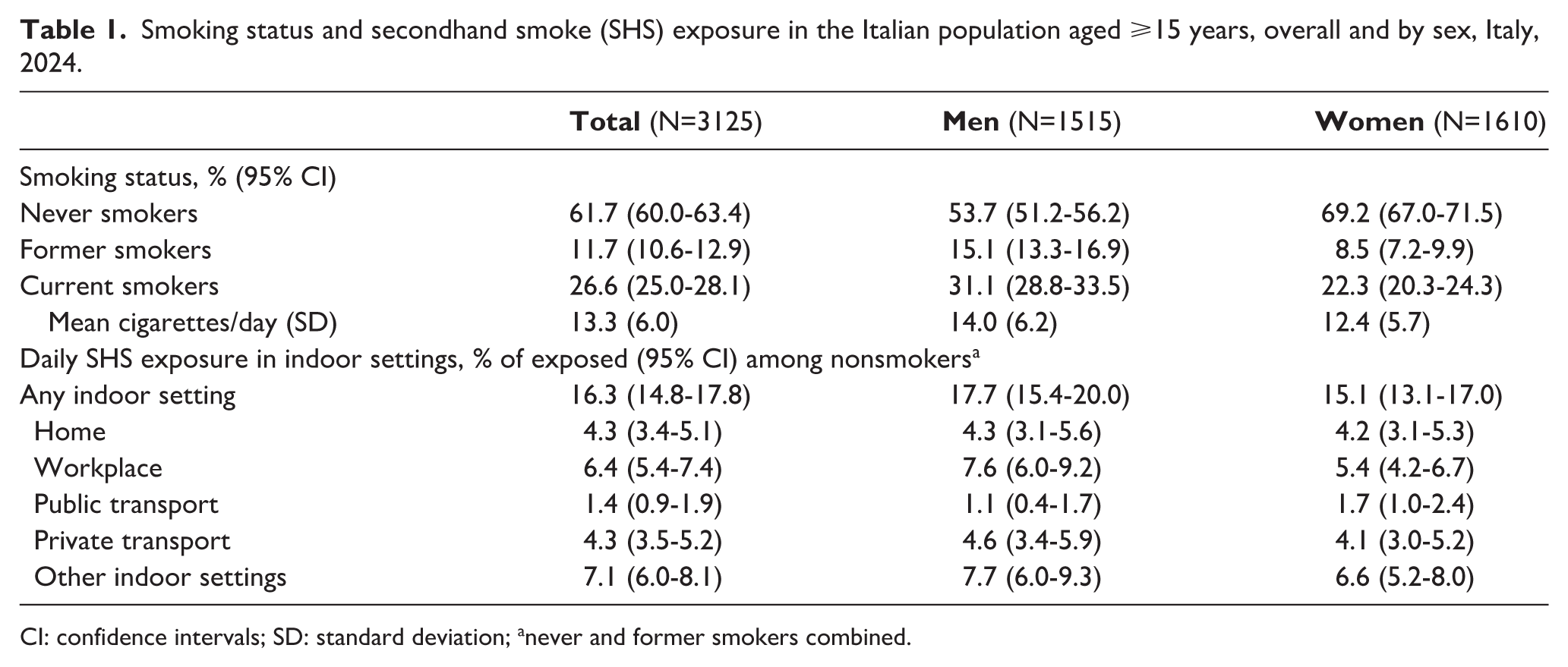
CI: confidence intervals; SD: standard deviation; anever and former smokers combined.
The analysis of determinants for current smoking is described in Table 2. Men were significantly more likely to be current smokers than women (aOR=1.78, 95% CI: 1.52-2.13). Compared with those aged 25 years or younger, the frequency of current smokers was significantly higher among those aged 25-64 (aOR=1.99; 95% CI: 1.50-2.3), whereas no significant difference was observed for those aged 65 years or older (aOR=1.27; 95% CI: 0.92-1.76; p for trend=0.400). Individuals with intermediate (aOR=1.61; 95% CI: 1.30-2.00) or high (aOR=1.40; 95% CI: 1.05-1.85) education were significantly more likely to be current smokers than those with low education (p for trend=0.008). Geographical differences were observed, with higher odds of current smoking in southern Italy and the islands (aOR=1.50; 95% CI: 1.24-1.82) compared with northern Italy. Current smoking was strongly related with use of novel nicotine and tobacco products, with significantly higher odds for e-cig users (aOR=25.49; 95% CI: 10.80-60.16) and HTP users (aOR=100.25; 95% CI: 35.36-284.23) compared with non-users. Among e-cig users and HTP users, 87.8% and 92.5% respectively reported being current smokers.
Adjusted odds ratios* (aOR) of current smokers vs never smokers (excluding former smokers), according to selected characteristics, Italy, 2024.
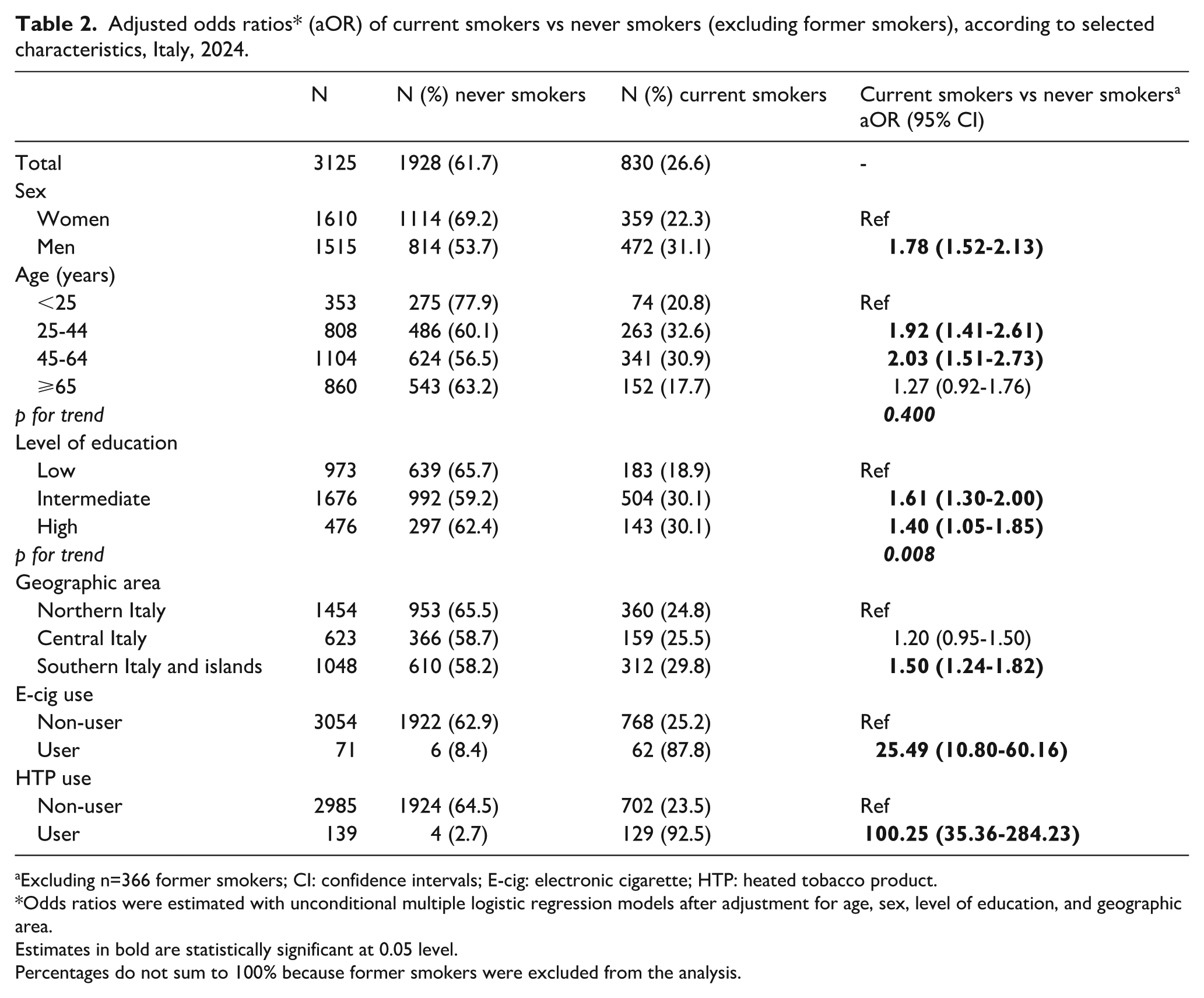
Excluding n=366 former smokers; CI: confidence intervals; E-cig: electronic cigarette; HTP: heated tobacco product.
Odds ratios were estimated with unconditional multiple logistic regression models after adjustment for age, sex, level of education, and geographic area.
Estimates in bold are statistically significant at 0.05 level.
Percentages do not sum to 100% because former smokers were excluded from the analysis.
The aORs for being a former smoker compared with a current smoker (i.e., having quit smoking among ever smokers) are shown in Online Supplementary Table 1. Men were more likely to be former smokers than women (aOR=1.32; 95% CI: 1.01-1.72). The odds of being a former smoker increased with age (p for trend<0.001) and decreased with education (p for trend<0.001). HTP use (aOR=0.19; 95% CI: 0.08-0.41) and e-cig use (aOR=0.16; 95% CI: 0.05-0.53) were significantly related with a lower likelihood of having quit smoking compared with non-users. Among ever users of e-cigs and HTPs, 10 and 15, respectively, were former smokers (totalling 18 individuals without overlap).
Online Supplementary Table 2 explores the relationship between sociodemographic and behavioural factors and current cigarette smoking among young adults aged 15-24 years. In this subgroup, no significant relationship was observed between sex and current smoking. Geographical differences were observed among the youngest, with higher odds of current smoking in southern Italy and the islands (aOR=1.93; 95% CI: 1.07-3.48) compared with northern Italy. In the youngest age group, current smoking was strongly related with use of novel nicotine and tobacco products, with significantly higher odds for e-cig users (aOR=16.27; 95% CI: 3.06-86.70) and HTP users (aOR=110.83; 95% CI: 19.15-641.39) compared with non-users.
Table 3 shows the relationship between different demographic and socio-economic factors and daily exposure to SHS in any indoor setting. No significant associations emerged between sex and SHS exposure. The odds of exposure to SHS decreased significantly with age, with the aOR being 0.55 (95% CI: 0.38-0.79) for those aged 45-64 years and 0.54 (95% CI: 0.37-0.78) for those aged 65 years and over, compared with those aged 25 years or less (p for trend<0.001). No significant relationship was observed between educational level and SHS exposure (p for trend=0.181). Individuals from central Italy (aOR=2.60; 95% CI: 1.92-3.52) and from southern Italy and the islands (aOR=2.81; 95% CI: 2.14-3.68) were significantly more likely to be exposed to SHS than those from northern Italy.
Adjusted odds ratios* (aOR) of exposure to secondhand smoke (SHS) in any indoor setting vs non-exposure, among nonsmokers, according to selected characteristics, Italy, 2024.
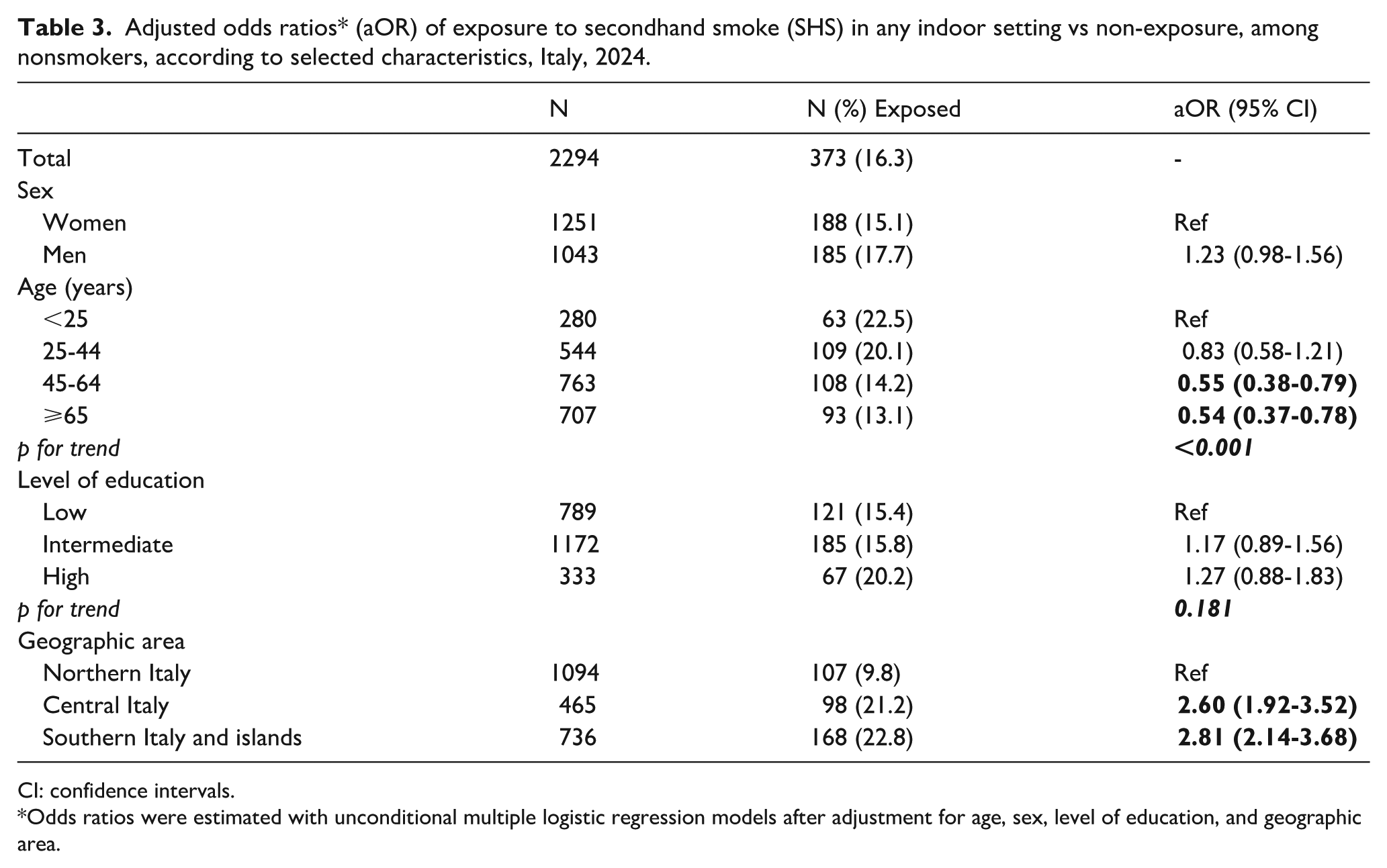
CI: confidence intervals.
Odds ratios were estimated with unconditional multiple logistic regression models after adjustment for age, sex, level of education, and geographic area.
Discussion
This cross-sectional study, conducted in 2024 on a representative sample of over 3000 Italians, found that about one in four Italians were current smokers. In addition, among nonsmokers, one in six reported daily exposure to secondhand smoke (SHS) in indoor settings.
Since the early 2000s, Italy has consistently seen a significant decline in smoking prevalence, driven by increased awareness of health risks and stronger tobacco control policies, reaching around 20% in 2014. 5 However, this positive trend seems to have stalled in the last decade,22,23 as reflected in official ISTAT and Eurobarometer data.24-26 Our results, together with previous surveys using analogous methods,5,22,23 confirm that the downward trend in smoking prevalence has ceased, and even suggest a possible increase in conventional smoking. This is also confirmed by cigarette sales data, which recorded an increase in 2024.
Compared to other European countries, Italy has historically exhibited some distinctive patterns in cigarette smoking. Less recent studies have shown Italy to be one of the countries with the lowest smoking prevalence, likely due in part to historically low smoking rates among women.27,28 However, according to the present study and the most recent data, Italy’s current smoking prevalence (27%) is now beginning to surpass the EU average (24%) (European Commission 2017).>24 This suggests the need to strengthen cessation efforts and support smoking cessation services in order to accelerate progress in tobacco and nicotine control.
However, according to the present study and most recent data, overall current smoking prevalence in Italy (27%) is now beginning to surpass the EU average (24%), (European Commission 2017). This may indicate a need to strengthen cessation efforts and support smoking cessation services, in order to accelerate progress in tobacco and nicotine control.
The urgent need for new and more effective tobacco control measures is further highlighted by the recent increase in the average number of cigarettes smoked per day, which rose to 13.3 cigarettes in 2024. This level corresponds to the average observed in 2015, 23 and represents a notable increase from the 11.5 cigarettes per day recorded in 2022. 6
Sex and age differences in smoking prevalence provide additional insights into the tobacco consumption landscape in Italy. Consistently with results from prior Italian and European studies,6,25 men maintain higher smoking rates compared to women. However, the proportion of female smokers and their daily cigarette consumption have seen a concerning rise in recent years,5,6,22,29 highlighting the need for targeted interventions to counteract this trend. The results confirm that older age groups exhibit a higher prevalence of smoking compared to younger cohorts.5,22 However, the escalating use of novel tobacco products among youth is particularly concerning, as these devices may foster nicotine addiction and renormalise smoking behaviour, potentially serving as a gateway to conventional tobacco and thereby increasing long-term cigarette smoking rates.22,30-32
Smoking prevalence was higher in the central, southern and island regions of Italy than in the north. These differences may reflect differences in cultural attitudes or in the implementation and enforcement of tobacco control policies. Further research is needed to better understand these regional differences and develop targeted interventions. Although our multivariable models adjusted for educational level, residual confounding cannot be completely ruled out. Given the well-known economic and cultural differences between northern and southern Italy, regional variations in smoking prevalence may be partly attributable to unmeasured aspects of socio-economic status or other contextual factors correlated with both education and geographic area.
The analysis revealed that socio-economic level, as measured specifically by educational level, is related with smoking behaviour, with individuals with intermediate and high levels of education showing higher smoking rates. This pattern does not reflect the conventional inverse gradient typically observed in Europe, 33 nor does it align with earlier Italian data.5,22 However, it is similar with more recent findings from other Mediterranean populations, such as Greece and Spain.33,34 This may reflect a different stage of the tobacco epidemic in Mediterranean countries compared with the rest of Europe. However, this finding should be interpreted with caution, as residual confounding by age cannot be ruled out.
The use of novel products, such as e-cigarettes and heated tobacco products, was associated with a higher likelihood of cigarette smoking and a lower likelihood of quitting smoking. This is further supported by the strikingly low number of former smokers among ever users of these products – only 0.05% of the population. This finding suggests that only a negligible fraction of people could have successfully used these devices to quit smoking, reinforcing important concerns about their promotion as smoking cessation tools. Indeed, several studies have observed that smokers who use novel products are less likely to quit smoking.30,35 Furthermore, evidence from studies conducted in Italy suggests that these products may even act as a gateway to cigarette smoking, especially among young people.16,30 These results highlight the need for new tobacco control strategies aimed at regulating novel products.
An additional analysis focused on young people aged 15–24, who are a key target group for tobacco and nicotine prevention. Compared to data from over a decade ago (2013–2014), the prevalence of smoking in this age group has slightly increased, rising from 19.9% to 20.8%. 5 This increase is primarily due to a rise of cigarette smoking among young women, whose smoking prevalence increased from 18.0% to 20.7%, whereas the prevalence among young men has remained essentially unchanged. This pattern might be a reflection of targeted marketing strategies employed by the tobacco industry. Throughout history, the tobacco industry has positioned smoking as a symbol of independence or modernity, particularly appealing to young women. Moreover, the strong association between smoking and the use of e-cigs and HTPs among young people highlights the increasing influence of these novel products on tobacco-related behaviours. This is in stark contrast with the narrative that portrays these products as cessation tools for long-term smokers.
The proportion of people reporting indoor exposure to SHS in this study is lower than both the last Eurobarometer report 25 and a 2012 study, 11 which reported exposure between 20 and 30%. However, differences in the way the questions are asked, particularly when they involve subjective assessments of exposure, could be a significant challenge in comparing results. In addition, the use of a threshold of only one minute/day to define SHS exposure might be considered too sensitive. Nevertheless, we found that changing the threshold for SHS exposure had only a minimal impact on prevalence estimates (total SHS exposure was 15.0% using a threshold of one hour/week instead of 16.3% using one minute/day). A study based on 2017-2018 data, which used the same questions and thresholds as our survey, found that one in four nonsmoking Italians was exposed to SHS. 36 This may indicate that recent initiatives aiming at protecting people from the harmful effects of SHS, such as the European Directive 40/2014 (Legislative Decree 6/2016) adopted in 2016 37 , which bans smoking in cars in the presence of minors, have had a positive impact, although there is still much work to be done. The fact that workplaces and other indoor settings, such as bars and restaurants, are the most common settings for SHS exposure is striking, as it suggests that the Sirchia Law, which bans smoking in indoor public places, is not being fully respected. This highlights the need for stricter enforcement of the law to protect people from harmful exposure to tobacco smoke in workplaces and leisure venues. 38 It should be noted that our study did not assess exposure to aerosols from other tobacco and nicotine products, which appears to be increasingly widespread. 39 Given the rising popularity of electronic cigarettes and heated tobacco products, future research should consider monitoring exposure to these aerosols.
SHS exposure was highest among younger individuals, which is especially concerning given its heightened harm at a young age. Previous studies have shown that early exposure to SHS can have long-term negative effects on respiratory and cardiovascular health, 40 as well as influence attitudes toward active smoking. 41 This underscores the need for targeted strategies to protect younger populations from exposure, including stricter enforcement of existing regulations and awareness campaigns on the risks of SHS.
Exposure to SHS was more common in the central, southern and island regions of Italy. This is consistent with the latest PASSI surveillance data, which highlight lower compliance with indoor smoking bans in these areas compared to northern regions. 42 The regional variation may be due to cultural factors and is of particular concern given the well-documented health risks of SHS exposure, including its association with breast and lung cancer.43,44 These findings highlight the need for targeted strategies to raise awareness and reduce exposure, particularly in these areas, in order to mitigate the harmful effects of SHS.
The study has several limitations that should be considered. First, its cross-sectional design precludes the ability to infer causality, allowing only the identification of relationships. Second, the self-reported nature of the data introduces the potential for information bias, such as underreporting of smoking habits. This concern is particularly relevant for SHS exposure, as the subjective nature of the questions may make comparisons with other populations particularly challenging. However, the face-to-face interview approach with trained interviewers helped to minimise this bias. Despite limited information on non-respondents, the rigorous sampling strategy and the substitution method employed ensured the representativeness of the final sample. Another limitation is that SHS exposure was assessed exclusively with reference to exposure to conventional cigarette smoke, without including exposure to secondhand aerosol from novel nicotine products such as e-cigs and HTPs. This limits the comprehensiveness of our estimates of secondhand exposure. Future studies should incorporate specific measures of secondhand aerosol exposure, to better reflect the evolving landscape of tobacco and nicotine use and its potential public health impact. Furthermore, our study lacks data on smoking prevalence and SHS exposure among children and adolescents under 15 years of age, since these annual surveys are aimed at providing information on smoking habits in the Italian adult population. These data are however available in multiple surveillance systems available at a national level. Since this age group represents a critical population for tobacco and nicotine control efforts, future research should prioritise the youth population to better understand smoking initiation and inform targeted prevention strategies. Finally, while the sample size was sufficient to estimate overall prevalence with a small standard error, it was inadequate to provide precise estimates for smaller subpopulations. Conversely, a key strength of the study is the representativeness of the sample, which ensures the generalisability of the findings to the Italian adult population. Additionally, the use of the same standardised survey instrument and methodology allows for appropriate comparisons to be made with previous and future studies.
Conclusion
In conclusion, this study provides valuable insights into the current situation of smoking and SHS exposure in Italy, highlighting the persistently high prevalence of current smoking and ongoing challenges related to SHS exposure. These findings suggest that existing tobacco control measures may need to be updated and enforced to effectively address emerging issues, such as the increased use of novel nicotine products. Given the strong association observed between the use of e-cigs or HTPs and cigarette smoking, our findings raise important concerns about the current role of these products in supporting smoking cessation and underscore the importance of closely monitoring their impact on smoking patterns in the population. Moreover, we recommend the implementation of new policies and interventions, such as enforcing stricter regulations on novel products and strengthening public awareness campaigns, particularly in areas where SHS exposure remains high. These targeted interventions are essential to reduce the burden of tobacco-related disease and protect public health.
Supplemental Material
sj-pdf-1-tmj-10.1177_03008916251378261 – Supplemental material for Prevalence of cigarette smoking and secondhand smoke exposure in Italy in 2024
Supplemental material, sj-pdf-1-tmj-10.1177_03008916251378261 for Prevalence of cigarette smoking and secondhand smoke exposure in Italy in 2024 by Irene Possenti, Marco Scala, Anna Odone, Luc J.M. Smits, Silvano Gallus and Alessandra Lugo in Tumori Journal
Footnotes
Declaration of conflicting interests
The authors declared no potential conflicts of interest with respect to the research, authorship, and/or publication of this article.
Funding
The authors disclosed receipt of the following financial support for the research, authorship, and/or publication of this article: The research leading to these results has received funding from AIRC under MFAG 2021 - ID. 25840 project - P.I. Lugo Alessandra. The work of Silvano Gallus, Irene Possenti and Marco Scala is supported by funding from AIRC under IG 2021 – ID 25987 project - P.I. Gallus Silvano. The work of Silvano Gallus is partially supported by the Italian League Against Cancer (Lega Italiana per la Lotta contro i Tumori, LILT, Milano Monza Brianza).
Ethical considerations
The Ethics Committee of Istituto Neurologico Carlo Besta–Milano acknowledged the collection of anonymous data in face-to-face population-based, observational, cross-sectional studies (File number 37, 2017).

Supplemental material
Supplemental material for this article is available online.
References
Supplementary Material
Please find the following supplemental material available below.
For Open Access articles published under a Creative Commons License, all supplemental material carries the same license as the article it is associated with.
For non-Open Access articles published, all supplemental material carries a non-exclusive license, and permission requests for re-use of supplemental material or any part of supplemental material shall be sent directly to the copyright owner as specified in the copyright notice associated with the article.
