



Abstract
Although neurological/ophthalmologic side effects including headache, vertigo, somnolence, paresthesia, optic neuritis, and optic neuropathy are listed as side effects in the medication guidelines for ibuprofen, transient tunnel vision and altered consciousness after a single dose of ibuprofen have not been reported. The patient was a 48-year-old man who experienced sudden-onset tunnel vision for a few seconds, followed by an altered state of consciousness for 20 minutes, during which he was communicating with his boss in an altered manner, 15 minutes after having taken 200 mg of ibuprofen. After awakening, he required 2 to 3 hours to return to his premorbid condition. No tongue biting or secessus occurred. Because his blood pressure, blood tests, blood gas analysis, electrocardiography, and electroencephalography results were normal and cerebral magnetic resonance imaging only showed non-specific spots in the subcortical white matter, the condition was attributed to ibuprofen. This case shows that a single dose of ibuprofen can cause severe side effects in the form of tunnel vision and altered consciousness. In some patients, single doses of ibuprofen may cause severe side effects.
Keywords
Introduction
Ibuprofen is a non-steroidal anti-inflammatory drug (NSAID) that was first approved by the British Health authorities as an analgesic, anti-inflammatory, and anti-pyretic drug in 1969. The most frequent side effects are heartburn, nausea, and diarrhea. 1 Occasionally, gastrointestinal bleeding, ventricular ulcers, or gastritis have been reported.2,3 Bone marrow edema and agranulocytosis have been rarely noted. 3 Although neurological or ophthalmologic side effects including headache, vertigo, somnolence, paresthesia, optic neuritis, and optic neuropathy are listed as side effects in the medication guidelines, transient tunnel vision and altered consciousness after a single dose of ibuprofen (200 mg) have not been reported. This report contributes to the knowledge of the side effects of ibuprofen. The reporting of this study conforms to the CARE guidelines. 4 All patient details have been de-identified. Verbal consent for treatment was obtained from patients.
Case report
The patient was a man in his 50 s with a previous history of hyperlipidemia and smoking until 8 years prior to presentation. His history was negative for migraine, seizures, recent infection, head trauma, hypoxia, neurological disease, and ophthalmologic disease. The family history was positive for hyperlipidemia (father) and aortic aneurysm (father). He was regularly taking only atorvastatin (20 mg/day). He regularly drank 1 to 1.5 L of non-alcoholic beverages per day and regularly participated in sports as a Kung-Fu fighter; he did not drink alcohol.
At presentation, he reported that 15 minutes after having taken ibuprofen (200 mg) for the first time in his life for non-specific headache, he experienced sudden-onset tunnel vision for a few seconds, followed by an altered state of consciousness for 20 minutes, during which he was communicating with his boss in an altered manner. After awakening, he required 2 to 3 hours to regain his premorbid condition. A clinical neurologic examination showed normal results. His Glasgow Coma Scale score was 15, and his National Institutes of Health Stroke Scale score was 0. No tongue biting or withdrawal occurred. His blood pressure was within normal limits, and his blood test results were entirely normal (Table 1). A routine drug screen was non-informative. His blood gas analysis and electrocardiography results were normal. Electroencephalography recordings were free of paroxysmal activity. Cerebral magnetic resonance imaging only showed non-specific spots in the subcortical white matter.
Results of blood tests on the day of presentation.
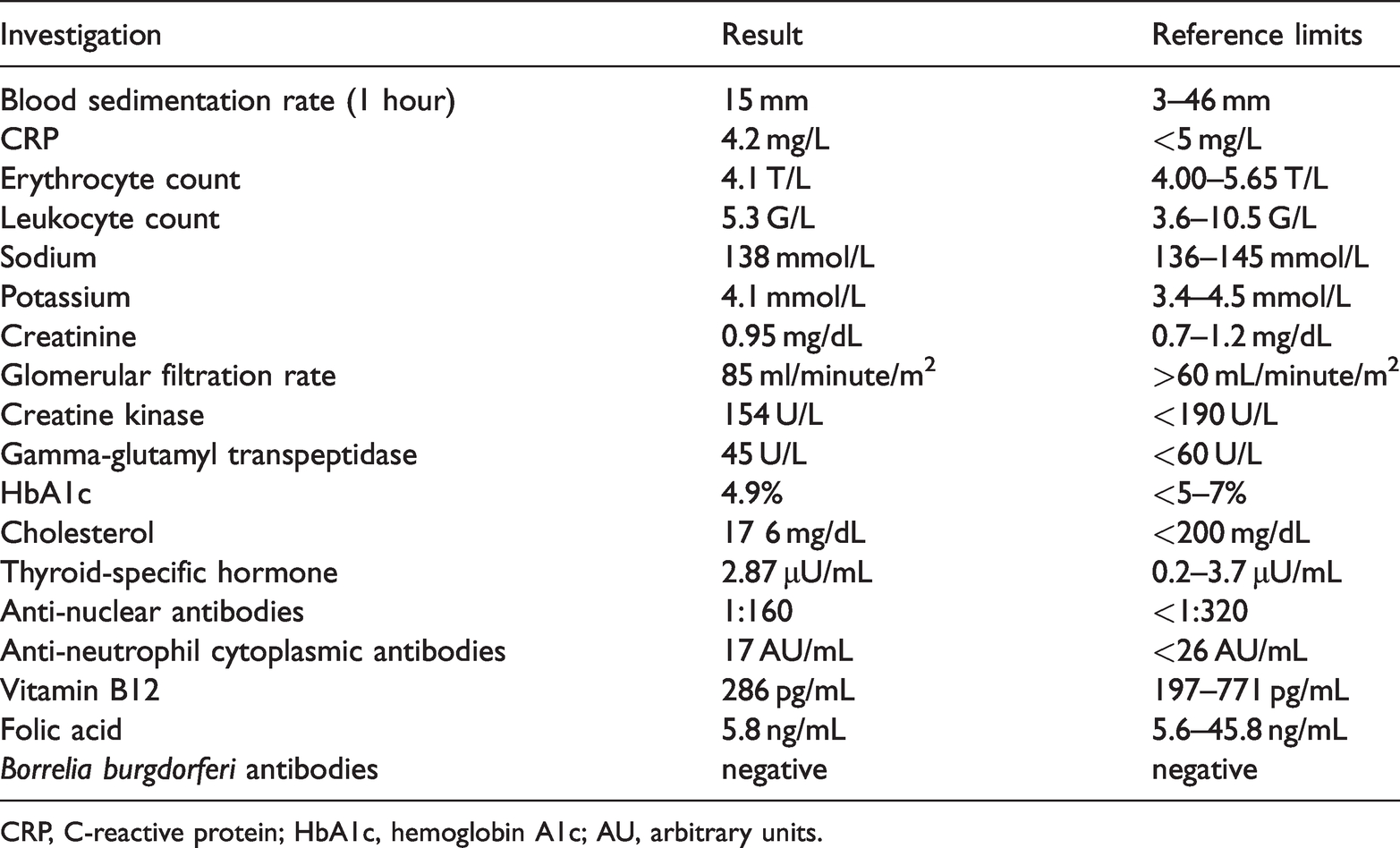
CRP, C-reactive protein; HbA1c, hemoglobin A1c; AU, arbitrary units.
Discussion
This case is interesting because a single episode of tunnel vision followed by an altered state of consciousness occurred shortly after the patient took a single dose of ibuprofen. The phenomenon was attributed to ibuprofen use after the following were excluded: episodic arterial hypertension (no history of arterial hypertension, normal blood pressure on admission), transitory ischemic attack (no previous report), reversible cerebral vaso-constriction syndrome (no cytotoxic edema), venous sinus thrombosis (no cytotoxic edema, no venous sinus occlusion), subarachnoid bleeding (no blood on imaging), migraine accompagnée (negative history of migraine), stroke (no cytotoxic edema), epilepsy (no epileptiform discharges), infection (normal infectious parameters), intoxication, and other drugs. There was no contributing factor that could explain the unusual episode. Whether the combination of ibuprofen/atorvastatin was the trigger remains speculative. Ibuprofen was regarded as causative because altered consciousness has been previously reported to be caused by ibuprofen intoxication and overdose. 5 There is also a single report of coma in a 19-year-old male after ingestion of 90 g of ibuprofen (1200 mg/kg). 6
Death after ibuprofen poisoning was reported in a 26-year-old woman after deliberate ingestion of 105 g of extended release ibuprofen. 7 Induction of coma was also attributed to ibuprofen in a woman with Willebrand’s disease who had received ibuprofen and desmopressin for her coagulation disorder 2 days prior. 8 A recent review discussing ibuprofen-induced hypokalemia and metabolic acidosis showed that in the case of acute ingestion, an altered state of consciousness is a major feature, even in patients with intake of a normal dosage. 9 A further argument for ibuprofen as the causative agent in the present case is that visual impairment has been previously described in cases of ibuprofen overdose. 10 Furthermore, visually-evoked potentials may show prolonged latencies and reduced amplitudes in patients with ibuprofen overdose. 10 Visual impairment has also been reported in three patients taking over-the-counter ibuprofen. 11 In a 41-year-old man, ibuprofen intoxication was complicated by optic neuritis. 12 Disregarding these severe side effects, discontinuation of ibuprofen usually results in complete resolution of the conditions described above. 9
A possible explanation of the unusual effect of a single ibuprofen dose could be the pro-thrombotic side effect of NSAIDs resulting in the development of a transitory ischemic attack. NSAIDs not only inhibit coagulation by inhibiting thromboxane synthesis but also cause pro-thrombotic states by inhibiting prostacyclin production. 13 Another mechanism that could explain the side effect of ibuprofen could be the NSAID-induced reduction in prostaglandins resulting in vasoconstriction of arterioles with prolonged reduction of afferent blood flow. 14 Whether hypokalemia and renal tubular acidosis caused by distal tubular dysfunction were involved in the pathophysiology of the described side effects remains speculative, but an inability to decrease the urine pH to less than 6, as has been found in several cases, argues in favor of this speculation. 9
This case newly shows that a single dose of ibuprofen may cause severe side effects in the form of tunnel vision and altered consciousness. However, differential causes must be considered. Whether co-medication with atorvastatin or inadequate fluid intake triggered these side effects remains unknown. However, a single dose of ibuprofen can cause serious side effects in individual patients.
Footnotes
Author contributions
JF: design, literature search, discussion, first draft, critical comments, and final approval
Declaration of conflicting interests
The author declares that there is no conflict of interest.
Ethics statement
The institutional review board of the Neurology & Neurophysiology Center, Vienna, approved publication of the study. The study complies with the tenets of the Declaration of Helsinki. The report does not contain any personal information that could lead to the identification of the patient.
Funding
This research received no specific grant from any funding agency in the public, commercial, or not-for-profit sectors.
