



Abstract
Objective
This study aimed to investigate the correlation between KAI1 (CD82) and miR-633 expression and prognosis and survival time of patients with melanoma combined with colorectal cancer (CRC).
Methods
Clinical and follow-up data of melanoma and CRC patients were recorded, and the expression levels of KAI1 and miR-633 were detected. Pearson chi-square tests and Spearman correlation coefficient were used to analyze the relationship between prognosis and related parameters in these patients. Cox proportional risk regression and receiver operating characteristic curve analyses were used.
Results
Overall, 195 patients were included. KAI1 and miR-633 expression levels were significantly correlated with the prognosis of patients with melanoma combined with CRC. Spearman correlation analysis showed that the expression levels of KAI1 and miR-633 were significantly correlated with the prognosis of patients. Multivariate Cox regression analysis suggested that low expression levels of KAI1 and high expression levels of miR-633 indicated shorter survival time for patients.
Conclusions
KAI1 expression was significantly correlated with melanoma and CRC patient prognosis. When KAI1 expression levels were low, the patient survival time was poor.
Introduction
Melanoma refers to the malignant formation of nevus. 1 Malignant melanoma is the most aggressive form of skin cancer and occurs most frequently in adults. The incidence is slightly higher in men than in women, with complications. 2 In recent years, the incidence and mortality of malignant melanoma are increasing each year. Other than early surgical resection, melanoma lacks special treatment and patients often have a poor prognosis. 3
Colorectal cancer (CRC) is one of the most common cancers worldwide. 4 In recent years, its morbidity and mortality have been increasing, 4 with the disease mainly occurring in middle-aged and elderly people. 4 The cause of melanoma combined with CRC is unclear. It may be related to genetics, chromosomal abnormalities, gene fusion, and other factors. Therefore, it is particularly important to further study the molecular mechanism of melanoma and CRC.
Bioinformatics is an interdisciplinary subject in biological science that uses modern information technology to simulate and predict protein structure based on DNA sequencing analysis, functional genomics, and large datasets. It is used in the drug design process and plays a very important role in promoting the development and evolution of life sciences. 5
Cell migration and invasion are key processes in tumor metastasis. MicroRNAs (miRNAs/miRs) have been demonstrated to play important roles in regulating tumor metastasis. 6 One particular miRNA called miR-663 can inhibit the proliferation, migration, and invasion of glioblastoma cells, and is a potential candidate gene for preventing the metastasis of this cancer. KAI1 (CD82) is a member of the quadocytosine glycoprotein superfamily and has been reported as a tumor metastasis suppressor gene in many tumor types without affecting tumor formation. 7
It should be noted the relationship between KAI1 and miR-633 and melanoma combined with CRC remains unclear. Therefore, the goals of this study were to explore the core genes between melanoma combined with CRC and normal tissues by using bioinformatics techniques, then verify the role of KAI1 and miR-633 in melanoma combined with CRC by examining clinical specimens.
Methods
Patients and ethics
Patients diagnosed with melanoma combined with CRC in Xi’an No. 3 Hospital were selected using the following inclusion criteria: 18 to 80 years old, diagnosed with melanoma and CRC, normal cardiopulmonary function, and normal coagulation. The exclusion criteria included individuals less than 18 years old or those above 80 years old who did not meet the above inclusion criteria or were unable to participate in the study for other reasons.
This study was approved by the Ethics Committee of Xi’an No. 3 Hospital (Xi’an, 9 February 2016, Number: XA2016312). All patients provided written informed consent. The reporting of this study conforms to STROBE guidelines. 8
Clinical parameters
According to clinical data, the patients were classified by sex (male/female), age (≤60/>60 years), tumor size (≤1 cm/ >1 cm), family history (no/yes), tumor grade (low/high), KAI1 expression level (low/high), miR-633 expression level (low/high), tumor stage (low/high), and prognosis (good/poor).
Detection of blood related parameters
Venous blood samples obtained from patients were immediately sent for examination to detect the expression levels of KAI1 and miR-633. Briefly, 1 mL of whole blood was taken from each patient and cellular components were isolated using standard centrifugation procedures. RNA was extracted from the samples using the trichloromethane method. RNA was precipitated using isopropyl alcohol and 75% ethanol. KAI1 and miR-633 expression levels were detected using real-time fluorescence quantitative PCR.
Statistical methods
Data are expressed as a percentage of the total. Pearson chi-square tests and Spearman correlation coefficients were used to analyze the clinical parameters and prognosis of melanoma combined with CRC. Cox proportional risk regression analysis was conducted to explore the correlation between survival time and related factors in patients with melanoma combined with CRC. The Receiver Operating characteristic (ROC) curve was obtained by MedCalc software (Ostend, Belgium), and the patient survival curve was plotted.
All statistical analyses were performed using SPSS software, version 21.0 (IBM Corp., Armonk, NY, USA). P-values < 0.05 were considered statistically significant.
Results
Pearson chi-square analysis
Overall, 195 patients diagnosed with melanoma combined with CRC were selected for this study. Pearson chi-square tests were used to summarize the relationship between melanoma combined with CRC and prognosis. Prognosis was significantly negatively and positively correlated with KAI1 and miR-633 expression levels, respectively (P < 0.001). However, sex (P = 0.908), age (P = 0.135), tumor size (P = 0.410), family history (P = 0.863), tumor grade (P = 0.444), and tumor stage (P = 0.773) were not significantly correlated with prognosis (Table 1).
Relevant characteristics of patients with melanoma with colorectal cancer.

Pearson’s chi-square test, *P < 0.05.
Spearman correlation analysis
Further analysis of Spearman correlation coefficients showed that the expression levels of KAI1 (ρ = −0.674, P < 0.001) and miR-633 (ρ = 0.754, P < 0.001) were significantly correlated with the prognosis of patients. However, sex (ρ = 0.008, P = 0.909), age (ρ = 0.107, P = 0.137), tumor size (ρ = 0.059, P = 0.413), family history (ρ = 0.012, P = 0.864), tumor grade (ρ = 0.055, P = 0.446), and tumor stage (ρ = −0.021, P = 0.775) had no significant correlation with prognosis (Table 2).
Relationship between characteristics and prognosis of patients with melanoma combined with colorectal cancer.
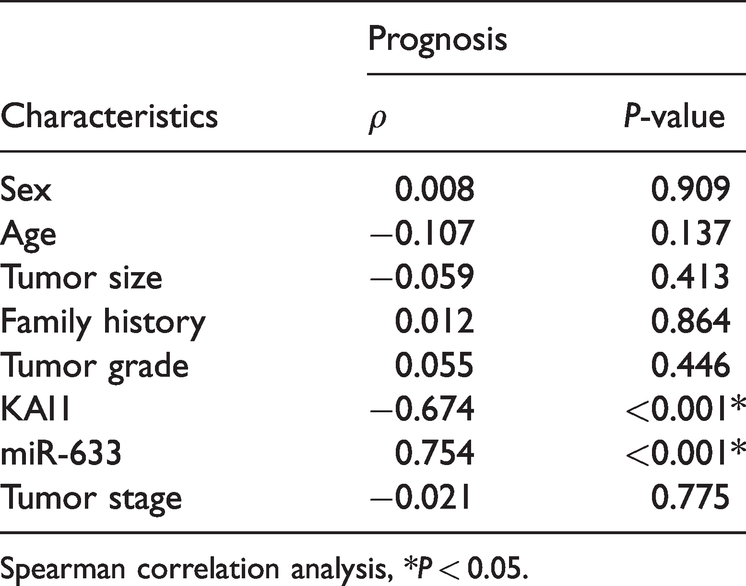
Spearman correlation analysis, *P < 0.05.
Univariate Cox regression analysis
Table 3 shows the hazard ratios (HRs) and 95% confidence intervals (95% CIs) for melanoma and CRC. KAI1 (HR = 0.244, 95% CI = 0.172–0.348, P < 0.001) and miR-633 (HR = 5.016, 95% CI = 3.481–7.226, P < 0.001) expression levels were significantly correlated with patient survival time. Higher miR-633 expression correlated with lower KAI1 levels and shorter survival time of patients with melanoma combined with CRC. However, sex (HR = 1.294, 95% CI = 0.941–1.778, P = 0.113), age (HR = 0.804, 95% CI = 0.579–1.115, P = 0.190), tumor size (HR = 0.848, 95% CI = 0.619–1.163, P = 0.307), family history (HR = 0.982, 95% CI = 0.716–1.347, P = 0.909), tumor grade (HR = 1.220, 95% CI = 0.890–1.671, P = 0.216), and tumor stage (HR = 0.906, 95% CI: = 0.662–1.239, P = 0.536) had no significant correlation with patient survival time (Table 3).
Univariate Cox regression was used to analyze the proportional risk of survival time in patients with melanoma and colorectal cancer.

HR, hazard ratio; 95% CI, 95% confidence interval; *P < 0.05.
ROC analysis
The ROC curve results showed that KAI1 (area under the curve (AUC) = 0.838, P < 0.05, Figure 1) and miR-633 (AUC =0.893, P < 0.05) expression analyses were sufficiently sensitive and specific to predict melanoma and CRC patient survival time (Figure S9–S10).

Receiver operating curve analysis of KAI1 expression levels in patients with melanoma combined with colorectal cancer.
Discussion
CRC and melanoma are two kinds of malignant tumors, and patients having a combination of the two has become a difficult problem in medical treatment. In-depth exploration of the molecular mechanism of melanoma and CRC is extremely important for researching and developing targeted drugs. The main results of this study demonstrated that miR-633 was significantly upregulated in melanoma combined with CRC tumor samples, and its expression levels were significantly correlated with poor prognosis and survival time of patients. In addition, KAI1 was found to have low expression levels in melanoma combined with CRC, which were significantly associated with poor prognosis.
Metastasis is the leading cause of cancer-related deaths. Tumor metastasis refers to the process in which malignant tumor cells leave the primary site, enter the blood and lymph circulatory systems of the host via blood vessels, and eventually form malignant tumors at distant sites in other tissues. 9 This may be influenced by a variety of molecular components. 10 Tumor metastasis suppressor genes encode specific proteins that negatively regulate tumor metastasis without affecting the growth of the primary tumor. Therefore, targeting these inhibitors is a promising therapeutic strategy for inhibiting tumor metastasis in clinical practice.
KAI1 is a tumor suppressor gene that is involved in signal transduction pathways, the regulation of a variety of cellular biological processes, and plays an important role in tumor metastasis. 11 Recently, it has been observed that KAI1 can reduce tumor invasiveness by inhibiting alternative splicing of CD44 mediated by U2 small nuclear RNA auxiliary factor 2 (U2AF2).12,13 This may have potential prognostic and therapeutic implications for melanoma. Extensive experiments have shown that differential expression of KAI1 is closely related to the presence of malignant tumors and can be used as a tumor biomarker. The decreased expression of KAI1 is closely associated with the progression, metastasis, and prognosis of malignant tumors, including breast, colon, lung, ovarian, nasopharyngeal, liver, and pancreatic cancers. 14 KAI1 mRNA is also considered to be a direct target of miR-338-5p and is associated with tumor stage, metastasis, and survival. 15 For example, it can inhibit the invasion and migration of melanoma cells. 16 KAI1 is a well-characterized solid tumor metastasis inhibitor that does not affect the growth of the primary tumor and is a recognized biomarker for predicting its metastatic potential. 17 KAI1 deletion was associated with aggressive tumor behaviors, such as high drug resistance, low differentiation, high recurrence rate, and shortened disease-free survival and overall survival times. According to the abovementioned studies, KAI1 is an independent prognostic factor that can help predict patient survival for multiple tumor types, suggesting that it can be used as a new biomarker for the diagnosis and prognosis of melanoma combined with CRC.
There is increasing evidence that miR-663 is involved in the development and progression of human cancers. 18 Two recent studies have shown that miR-663 has tumor suppressive effects. 19 MiRNAs are about 18 to 22 nucleotides in length, making them much shorter than protein-coding RNAs. MiR-663 is reportedly involved in many important pathological processes, especially in cancer. 20 MiR-663 plays an important regulatory role in ovarian cancer and can promote disease progression by targeting TUSC2. 19 MiR-663 has been reported to affect apoptosis by controlling mitochondrial outer membrane permeability (MOMP) by directly targeting PUMA/BBC3 and BTG2 in non-small cell lung cancer (NSCLC) and acts as an oncogene in this disease. 18 MiR-663 may be an important regulatory factor in the development and progression of human cancer, and may also be a candidate biomarker. Therefore, it is speculated that miR-633 plays a significant role in the growth and development of melanoma combined with CRC.
The data from relevant studies described above are consistent with our results, suggesting that abnormal expression patterns of miR-633 and KAI1 are involved in tumor progression.
Despite the rigorous bioinformatics analysis performed in our work, some shortcomings remain. Animal models of gene overexpression or knockout should be conducted in the future to further verify the functions of KAI1 and miR-633. Therefore, this will be the focus of future research.
Conclusion
The expression levels of miR-633 and KAI1 may play roles in the occurrence and development of melanoma combined with CRC. MiR-633 expression was significantly upregulated in melanoma combined with CRC tumor samples, while KAI1 displayed low expression in these samples. These expression patterns were significantly correlated with patient prognosis and survival time. Higher miR-633 levels were associated with lower KAI1 levels and worse prognosis and shorter survival time of patients with melanoma combined with CRC.
Supplemental Material
sj-pdf-1-imr-10.1177_03000605221116758 - Supplemental material for Lower expression of KAI1 as a biomarker of poor survival prognosis of melanoma combined with colorectal cancer metastasis
Supplemental material, sj-pdf-1-imr-10.1177_03000605221116758 for Lower expression of KAI1 as a biomarker of poor survival prognosis of melanoma combined with colorectal cancer metastasis by Xudong Du, Bo Wang, Lei Liu, Yang Li, Zheng-xiang Wang, Guang-jing Zhang and Xiu-fang Yang in Journal of International Medical Research
Supplemental Material
sj-pdf-2-imr-10.1177_03000605221116758 - Supplemental material for Lower expression of KAI1 as a biomarker of poor survival prognosis of melanoma combined with colorectal cancer metastasis
Supplemental material, sj-pdf-2-imr-10.1177_03000605221116758 for Lower expression of KAI1 as a biomarker of poor survival prognosis of melanoma combined with colorectal cancer metastasis by Xudong Du, Bo Wang, Lei Liu, Yang Li, Zheng-xiang Wang, Guang-jing Zhang and Xiu-fang Yang in Journal of International Medical Research
Footnotes
Declaration of conflicting interest
The authors declare that there is no conflict of interest.
Funding
The authors disclosed receipt of the following financial support for the research, authorship, and/or publication of this article: This research was supported by the Youth Science and Technology Project of Health and Health Commission of Xi’an City (China; Grant No. 20160333).

Supplemental material
Supplemental material for this article is available online.
References
Supplementary Material
Please find the following supplemental material available below.
For Open Access articles published under a Creative Commons License, all supplemental material carries the same license as the article it is associated with.
For non-Open Access articles published, all supplemental material carries a non-exclusive license, and permission requests for re-use of supplemental material or any part of supplemental material shall be sent directly to the copyright owner as specified in the copyright notice associated with the article.
