




Abstract
Objective
To investigate the clinical significance of cyclin-dependent kinase (CDK) 15 in breast cancer.
Methods
This prospective observational study enrolled 154 patients with breast cancer. Tumor tissues and paired paracancerous normal tissues were collected. Additionally, 85 samples of benign breast lesions were obtained from patients with mammary gland hyperplasia. Patient characteristics were recorded, and CDK15, human epidermal growth factor receptor (HER)2, estrogen receptor, progesterone receptor, and Ki67 immunohistochemical expression were determined.
Results
The rate of strong CDK15 expression was 63.6% (98/154) in breast cancer tissues, which was remarkably higher than that in benign breast lesions (34.1%, 29/85). Similarly, the ratio of strong CDK15 expression was markedly higher in tumor tissues (63.6%, 98/15) than in paracancerous normal tissues (27.3%, 42/154). Pearson’s analysis showed that the CDK15 expression score was positively correlated with HER2 and Ki67. Patients with high CDK15 expression showed markedly higher ratios of TNM stage III to IV, lymph node metastasis, and increased tumor diameters but a significantly lower rate of ductal carcinoma in situ. The median survival time of these patients was significantly shorter. Kaplan–Meier curve analysis showed that low CDK15 expression predicted longer survival times.
Conclusion
Upregulated CDK15 predicted poor clinical outcomes in breast cancer.
Keywords
Introduction
Breast cancer, the most common malignant cancer in the female population, accounts for 23% of all new cancer cases in women worldwide.1–3 Although the available treatment methods reportedly enhance the quality of life for patients, the prognosis of patients with advanced stages or recurrence remains poor.4–6 Thus, revealing the molecular mechanisms underlying breast cancer progression is important for the identification of new biomarkers and research targets for early diagnosis.
Cyclin-dependent kinase (CDK) 15 is a member of the CDK family.7,8 In recent years, several members of the CDK family have been reported to be involved in cancer development. Studies have shown that the inhibition of CDK4 and CDK6 is an effective treatment strategy in breast cancer, including hormone receptor-positive advanced or metastatic breast cancer.9,10 The inhibition of CDK9 also demonstrated antitumor activity in breast cancer in vitro and in vivo.11–13 Furthermore, CDK11 was found to promote the development of osteosarcoma. 14 In contrast, CDK12 appears to play both anti-cancer and cancer-promotor roles in breast cancer and ovarian cancer. 15 However, very few studies have focused on CDK15 in breast cancer.
In the present study, we aimed to demonstrate the clinical significance of CDK15 in patients with breast cancer and found that increased CDK15 levels predicted the poor prognosis of these patients. This study might provide clinical evidence and a novel research target in breast cancer.
Methods and materials
Subjects and tissue samples
The present prospective observational study enrolled 154 patients with breast cancer who were admitted to our hospital from March 2010 to December 2014. The inclusion criteria were as follows: 1) patients consecutively enrolled and diagnosed with primary breast cancer for the first time and 2) diagnosis confirmed by histological analysis and imaging methods. The following patients were excluded: patients who received any prior anti-tumor treatment, including chemotherapy, radiotherapy, and immunotherapy; patients with other primary cancers; patients with severe renal or heart diseases; and patients with severe infections. For patient enrollment, we included all patients who met the inclusion criteria during the study period. Only the tissue samples of the patients were obtained. In addition, follow-up was conducted, and clinical characteristics and outcomes were assessed. No intervention was performed during the treatment process.
Tumor tissue samples and paired paracancerous normal tissues collected for histological analysis or surgical resection were obtained from all patients. Additionally, 85 tissue samples of benign breast lesions were obtained from patients with mammary gland hyperplasia. Written informed consent was obtained from all patients. The present study was approved by the Ethics Committee of Jiangxi provincial People’s Hospital Affiliated with Nanchang University (approval no.: 20161BBG70133).
Immunohistochemistry (IHC) for the measurement of CDK15
The tissue samples were immediately collected after resection and stored at −80°C until use. For IHC, the samples were fixed, embedded, sectioned into 4-µm slices, and stained with hematoxylin and eosin. Samples were then immersed in 3% H2O2 and incubated with an anti-CDK15 primary antibody (LS-B15719, Lifespan Bioscience, Seattle, WA, USA) at 4°C overnight. After incubation with the corresponding second antibody (Abcam, Cambridge, MA, USA) at 37°C for 30 minutes, samples were stained with diaminobenzidine. For IHC scoring, the Allred scoring system was used as follows: the sum of staining intensity [0 (no staining), 1 (weak staining), 2 (moderate staining), and 3 (strong staining)] and the percentage score of the stained area [0 (0%–10%), 1 (11%–25%), 2 (26%–50%), 3 (51%–75%), and 4 (76%–100%)] was regarded as the final IHC score [>3 strong (high), ≤3 weak (low)].
Data collection and follow-up
The patients’ age, body mass index (BMI), cancer stage, pathological type, tumor diameter, and medical history were recorded. The expression of HER2, estrogen receptor (ER), progesterone receptor (PR), and Ki67 was also determined by the IHC methods described above. All patients were followed-up for at least 5 years or until death. The survival duration was defined as the time from admission to death or the last follow-up.
Statistical analysis
Data were presented as the mean ± SD or median (range). The Chi-squared test was used to analyze the ratios, and Student’s t-test was used for the analysis between two groups. For comparisons among three groups, one-way analysis of variance (ANOVA) was used, followed by the Tukey post hoc test. The correlation was assessed by Pearson’s rank correlation analysis, and the Kaplan–Meier method was used for survival and recurrence analysis. P < 0.05 indicated a statistically significant difference. All statistical analysis was performed using IBM SPSS Statistics for Windows, Version 20.0 (IBM Corp., Armonk, NY, USA).
Results
CDK15 was upregulated in breast cancer tissues
All patient characteristics are shown in Table 1. Among all 154 patients with breast cancer, the mean age was 46.72 ± 11.00 years, and the mean BMI was 23.81 ± 2.53. In addition, 96 (62.34%) and 58 (37.66%) cases had TNM stage I to II and TNM stage III to IV, respectively. The pathological types included invasive ductal carcinoma in 74 (48.05%) cases, invasive lobular carcinoma in 63 (40.91%) cases, and ductal carcinoma in situ in 17 (11.04%) cases. Additionally, luminal A was found in 55 (35.71%) cases, luminal B in 37 (24.03%) cases, HER2 in 39 (25.32%) cases, and triple-negative breast cancer in 23 (14.94%) cases. No significant difference was found in age or BMI between patients with breast cancer and patients with benign breast lesions. The expression of CDK15 was determined by IHC, and the results showed that the rate of strong CDK15 expression was 63.64% (98/154) in patients with breast cancer, which was remarkably higher than the 34.12% (29/85) in patients with benign breast lesions (P < 0.05, Table 1). Additionally, the ratio of strong CDK15 expression was found to be markedly higher in tumor tissues (63.64%, 98/154) than in paracancerous normal tissues (27.27%, 42/154) (P < 0.05, Figure 1). The mean IHC score was also markedly higher in tumor tissues than in normal tissues. No significant difference was found between the normal tissues and the tissues from benign breast lesions.
Patient characteristics.

BMI, body mass index; HER2, human epidermal growth factor receptor 2; CDK15, cyclin-dependent kinase 15.

CDK15 expression determined by IHC. (a) IHC results for CDK15 expression in tumor tissues, normal tissues, and benign breast lesions. (b) Mean IHC scores in different tissue samples. *P < 0.05 compared with paracancerous tissues, #P < 0.05 compared with benign lesions.
Correlations among CDK15 expression with HER2, ER, PR, and Ki67
To further investigate the clinical significance of CDK15 in patients with breast cancer, the relationships of CDK15 with HER2, ER, PR, and Ki67 was analyzed. Patients with elevated CDK15 expression also showed markedly higher rates of strong HER2 and K167 expression than patients with weak CDK15 expression (P < 0.05, Table 2). However, no significant difference was found for ER and PR. Pearson’s analysis revealed that the IHC scores of CDK15 expression were positively correlated with those of HER2 and Ki67 (P < 0.05, Table 3).
Relationships between CDK15 expression and HER2, ER, PR, and Ki67 in patients with breast cancer.
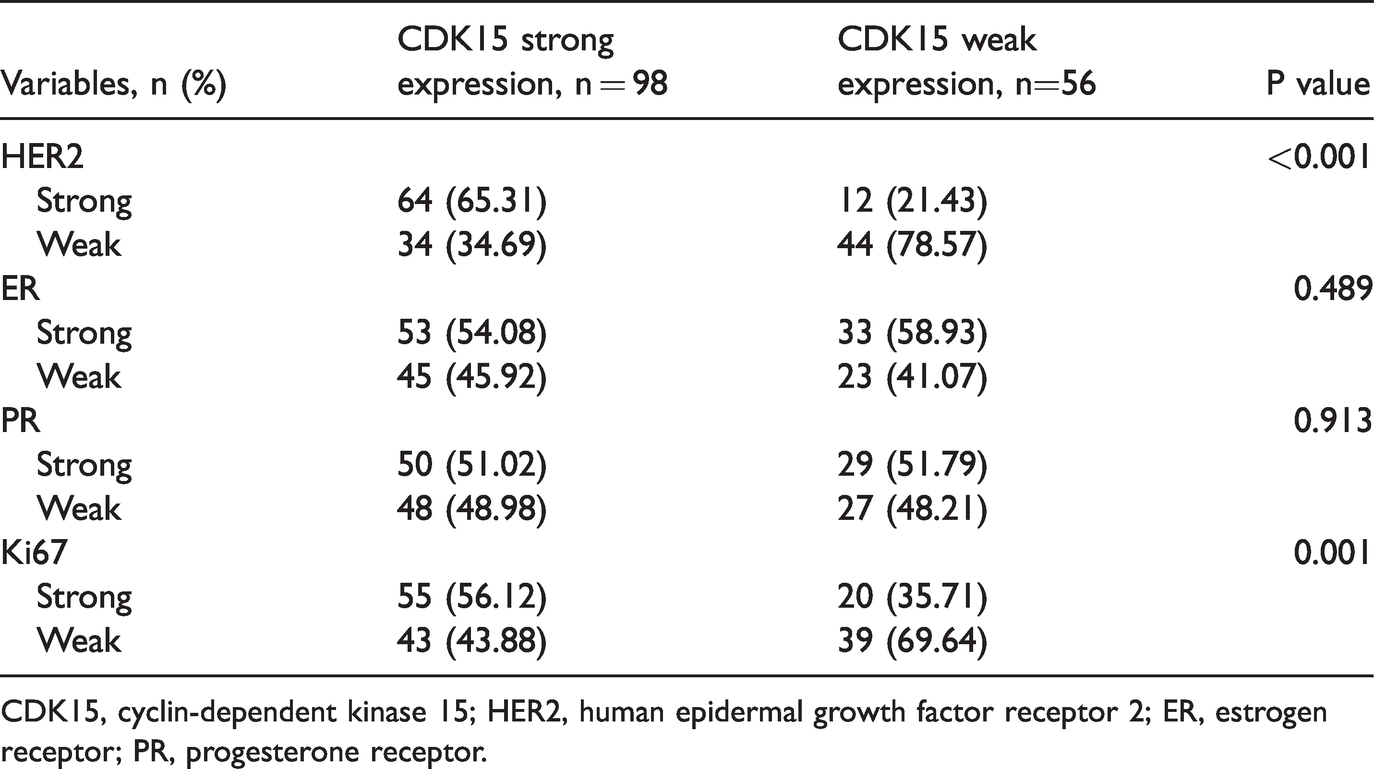
CDK15, cyclin-dependent kinase 15; HER2, human epidermal growth factor receptor 2; ER, estrogen receptor; PR, progesterone receptor.
Pearson’s analysis of correlations between CDK15 expression and HER2, ER, PR, and Ki67.

CDK15, cyclin-dependent kinase 15; HER2, human epidermal growth factor receptor 2; ER, estrogen receptor; PR, progesterone receptor.
CDK15 was correlated with the clinical characteristics of patients with breast cancer
Next, the clinical characteristics of patients were analyzed to determine their correlation with CDK15. In patients with high CDK15 expression, the ratios of TNM stage III to IV and lymph node metastasis were markedly higher than those in the patients with low CDK15 expression (P < 0.05, Table 4). In addition, the proportion of patients with a tumor diameter >2 cm was significantly higher in patients with increased CDK15 expression (P < 0.05). Furthermore, the mortality rate of patients with strong CDK15 expression was remarkably higher than that in patients with weak CDK15 expression (P < 0.05). Together, these results indicated that high CDK15 expression might predict advanced breast cancer stages.
Characteristics of all patients classified by CDK15 expression.
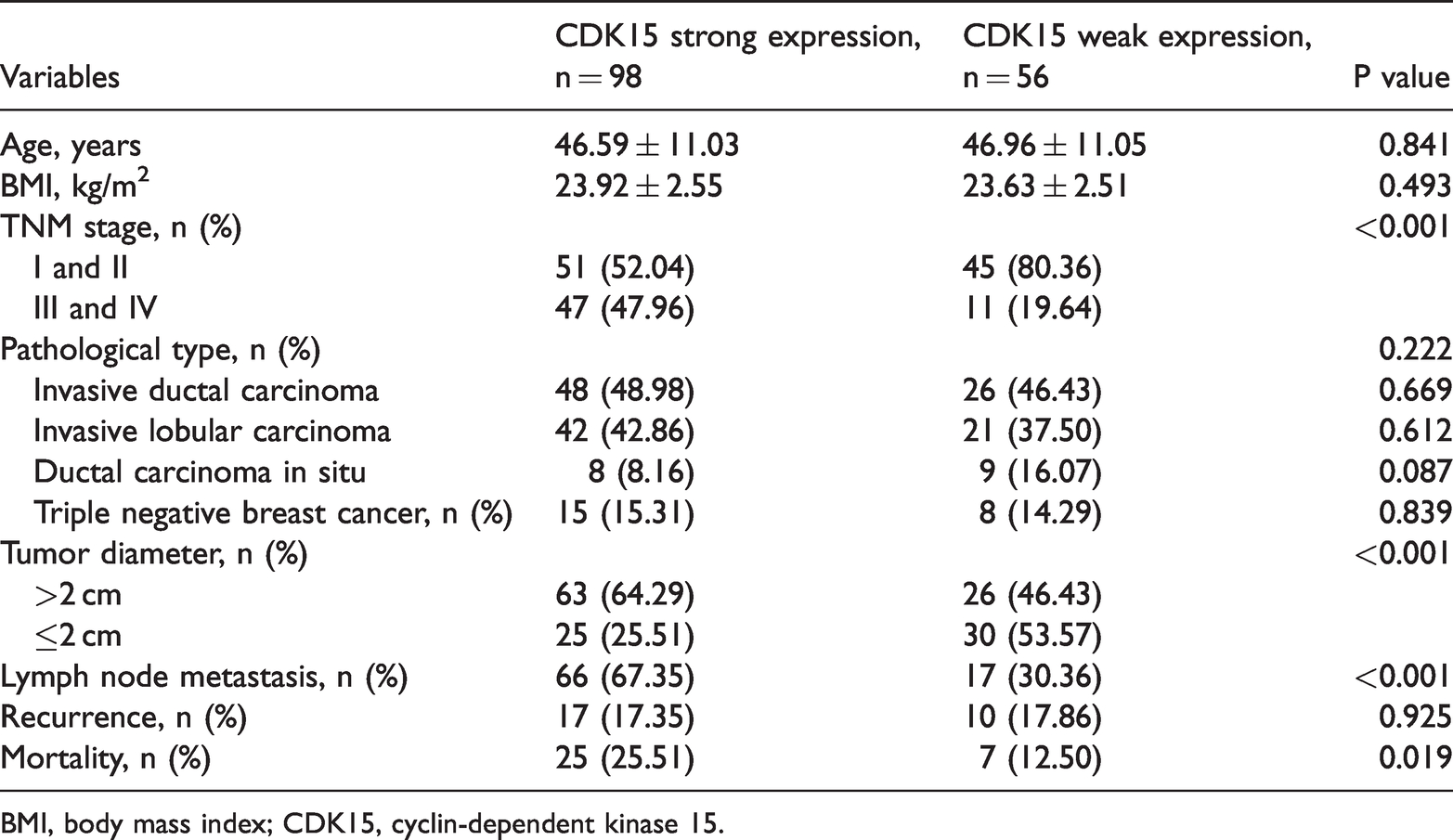
BMI, body mass index; CDK15, cyclin-dependent kinase 15.
Increased CDK15 was associated with reduced survival of patients with breast cancer
Finally, we determined the association between CDK15 and the prognosis of patients with breast cancer. The median survival time of patients with high CDK15 expression was significantly shorter than that of patients with low CDK15 expression (P < 0.05). Kaplan–Meier curve analysis also showed that low CDK15 expression predicted longer survival times (P < 0.05). However, no significant difference was found for recurrence (Figure 2).
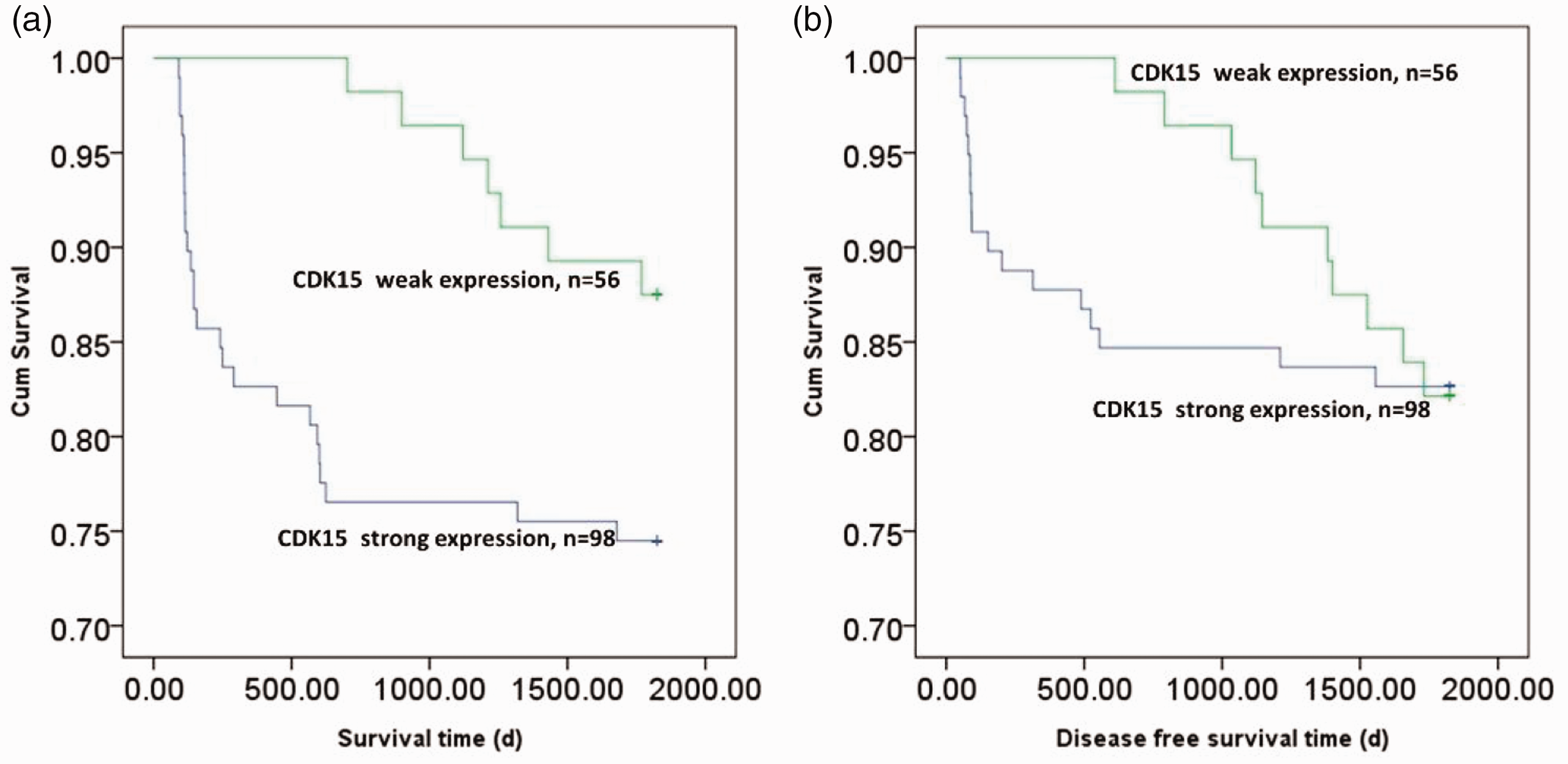
Kaplan–Meier curve for 5-year survival (a) and recurrence (b) in patients with breast cancer and high or low CDK15 expression.
Discussion
With advances in research, an increasing number of oncogenes and anti-cancer genes and proteins have been found to be involved in breast cancer development. However, the underlying molecular mechanisms of breast cancer remain unclear, and the identification of new biomarkers is needed for early diagnosis. In the present study, we demonstrated that CDK15 was upregulated in breast cancer tissues and that enhanced CDK15 expression was correlated with poor clinical outcomes and shorter 5-year survival in patients with breast cancer.
Few studies have focused on the role of CDK15 in cancer development; however, several reports have elucidated the molecular mechanisms underlying its oncogenic effects. In an earlier study, it was found that CDK15 attenuated cell apoptosis induced by TNF-related apoptosis-inducing ligand in MDA-MB-231 cells. 16 However, in recent research, the authors found that CDK15 was downregulated by proteasome activator 28α/β, leading to the enhanced cell invasion and migration of breast cancer cells, indicating potential differences in the role of CDK15 in various breast cancer types. 17 Additionally, other studies have shown that CDK15 is upregulated in lung cancer 18 and hepatocellular carcinoma. 19 All of these studies indicated that the role of CDK15 is likely pro-cancer, but more studies are needed. In the present study, we found that CDK15 was upregulated in breast cancer tissues and that its increased expression predicted a shorter overall survival. However, the molecular mechanisms by which CDK15 regulates breast cancer remain to be confirmed.
Several novel biomarkers have been reported in breast cancer. For example, 12 miRNAs were found to be upregulated in breast cancer, and miR-320a, miR-361-5p, and miR-21-5p might predict longer survival in these patients. 20 Ye et al. 21 demonstrated that patients with breast cancer and elevated levels of cell division cycle-associated protein 7 exhibited a worse metastatic relapse status and poorer disease‐free survival, and the effects might be mediated through enhancer of zeste homolog 2 in triple‐negative breast cancer. In a recent study, chromobox 6 was identified as a consistently downregulated gene in breast cancer and found to suppress the development of cancer cells. 22 Moreover, CDK family members have been found to facilitate the development of other cancers, including CDK11 in osteosarcoma, 23 CDK12 in prostate cancer, 24 and CDK14 in glioma. 25 In this research, we showed for the first time that increased levels of CDK15 were also associated with the poor prognosis of patients with breast cancer.
In conclusion, our observational study found that patients with breast cancer and strong CDK15 expression exhibited higher rates of TNM stage III to IV and lymph node metastasis, increased tumor diameters, a lower rate of ductal carcinoma in situ, and poorer 5-year survival. We also showed that CDK15 expression was correlated with HER2 and Ki67 levels. The present study has some limitations. First, the molecular mechanism underlying the role of CDK15 in breast cancer remains unknown. Additionally, the sample size was small, and the relationship of CDK15 expression with luminal A, luminal B, and H subtypes requires further investigation. Thus, more studies are needed in the future.
Supplemental Material
sj-pdf-1-imr-10.1177_0300060521999552 - Supplemental material for Cyclin-dependent kinase 15 upregulation is correlated with poor prognosis for patients with breast cancer
Supplemental material, sj-pdf-1-imr-10.1177_0300060521999552 for Cyclin-dependent kinase 15 upregulation is correlated with poor prognosis for patients with breast cancer by Xiquan Zhang, Qin Wang, Yijun Luo, Meijiao Song, Zhiyong Zhou, Lin Zeng, Meng Hu and Chuyan Yang in Journal of International Medical Research
Footnotes
Declaration of conflicting interest
The authors declare that there is no conflict of interest.
Funding
The authors disclosed receipt of the following financial support for the research, authorship, and/or publication of this article: This study was funded by the Department of Science and Technology of Jiangxi Province (project name: Trastuzumab combined with belamanin targeted therapy for breast cancer based on HER2 resistance in the EGFR family, No. 20161BBG70133).

Supplemental material
Supplemental material for this article is available online.
References
Supplementary Material
Please find the following supplemental material available below.
For Open Access articles published under a Creative Commons License, all supplemental material carries the same license as the article it is associated with.
For non-Open Access articles published, all supplemental material carries a non-exclusive license, and permission requests for re-use of supplemental material or any part of supplemental material shall be sent directly to the copyright owner as specified in the copyright notice associated with the article.
