



Abstract
Objective
To retrospectively analyze the clinical outcomes of two intramedullary fixation devices, the INTERTAN nail and Gamma3 nail, for treatment of AO/OTA 31-A2 trochanteric fractures in elderly patients.
Methods
In total, 165 elderly patients underwent treatment for AO/OTA 31-A2 trochanteric fractures in our hospital from June 2017 to June 2018 (INTERTAN group, n = 79; Gamma3 group, n = 86). All patients underwent radiological and clinical investigations and were followed up for an average of 12 months. Age, sex, fracture type, surgical time, intraoperative blood loss, fracture healing time, and complications were compared between the two groups.
Results
The surgical time was significantly shorter and the intraoperative blood loss volume was significantly lower in the Gamma3 than INTERTAN group (58.2 ± 2.5 vs. 81.7 ± 14.2 minutes and 170 ± 29 vs. 220 ± 16 mL, respectively). However, there were no significant differences in the reduction quality, hospital stay, fracture healing time, Harris hip score, postoperative complications, or 1-year postoperative mortality.
Conclusion
Both INTERTAN and Gamma3 nails may be effective for surgical treatment of AO/OTA 31-A2 trochanteric fractures in elderly patients. However, the Gamma3 nail was superior to the INTERTAN nail in terms of surgical time and intraoperative blood loss.
Introduction
Orthopedic surgeons have found that trochanteric fractures most commonly occur in the elderly population. 1 Such fractures have a high mortality rate and can lower the quality of life of elderly patients.2–4 Elderly patients often have more underlying diseases, and elderly patients with trochanteric fractures must fully understand the risk factors for perioperative mortality and receive timely treatment to increase their safety during the perioperative period.5,6 If the patient’s condition allows, treatment should be performed as soon as possible to prevent complications.7,8 Surgery is the preferred treatment method for trochanteric fractures because it reduces the risk of complications within the shortest time possible. 9 Internal fixation can be performed using an extramedullary or intramedullary system; of these, intramedullary systems have many advantages and are widely used in the treatment of trochanteric fractures. 10 Knobe et al. 11 reported that the AO/OTA classification, which is widely used in Germany, provides information on fracture stability to help guide the choice of treatment. They also suggested that the most appropriate treatment for AO/OTA 31-A2 fractures is controversial because such fractures are unstable. 11 The comminuted medial cortex and fractures involving the lesser trochanter also contribute to the controversy regarding treatment of this type of fracture. 12 Therefore, the optimal treatment for AO/OTA 31-A2 fractures is not clear. 13
The INTERTAN nail (Smith & Nephew GmbH, London, UK) was introduced to treat trochanteric fractures. 14 It possesses two proximal screws for insertion into the head–neck fragment, thus allowing linear intraoperative compression. Some studies have shown that use of the INTERTAN nail has good clinical effects and few complications.15,16 Another intramedullary nail system, the Gamma3 nail (Stryker Leibinger GmbH, Freiburg, Germany), has only a proximal screw for insertion into the femoral neck bone and is considered a less invasive device. 17 Although the older Gamma3 system was associated with complications such as thigh/hip pain, screw cut-out, and femoral shaft fractures,18,19 the system has been further developed and can now provide stronger biomechanical stability and better clinical outcomes. 20
To our knowledge, no studies have been conducted to compare the clinical outcomes between the INTERTAN and Gamma3 systems in elderly patients with AO/OTA 31-A2 trochanteric fractures. In the present study, we retrospectively analyzed the clinical outcomes between the INTERTAN and Gamma3 nails to provide a scientific basis for better clinical selection of internal fixation.
Materials and methods
Patients
In total, 194 elderly patients with AO/OTA 31-A2 trochanteric fractures were treated in our hospital from June 2017 to June 2018. Among these 194 patients, 165 were followed up. The study flowchart is shown in Figure 1. All patients (52 men, 113 women) were >65 years of age (mean age, 78.6 ± 13.5 years; range, 65–94 years). Patients with pathological fractures, primary or metastatic tumors, or multiple fractures were excluded from the study. Seventy-nine patients were treated using the INTERTAN nail, and 86 patients were treated using the Gamma3 nail (Figures 2, 3). There were no statistically significant differences in the basic characteristics between the two groups (Table 1). If no other severe diseases were present, the operation was performed within a mean of 48 hours after the fracture (range, 24–72 hours). Patients were given a first-generation cephalosporin 30 minutes before the operation. The same group of doctors performed all operations and followed the manufacturer’s specifications for each device used. The patients were followed up for an average of 12 months. The follow-up examinations were performed at our outpatient clinic. Written informed consent was obtained from all patients, and the study protocol was approved by the Ethics Committee of Beijing Luhe Hospital affiliated to Capital Medical University, Beijing, China (8 December 2016; ethics approval no. 2000029296). This study complies with the relevant EQUATOR Network reporting guidelines.
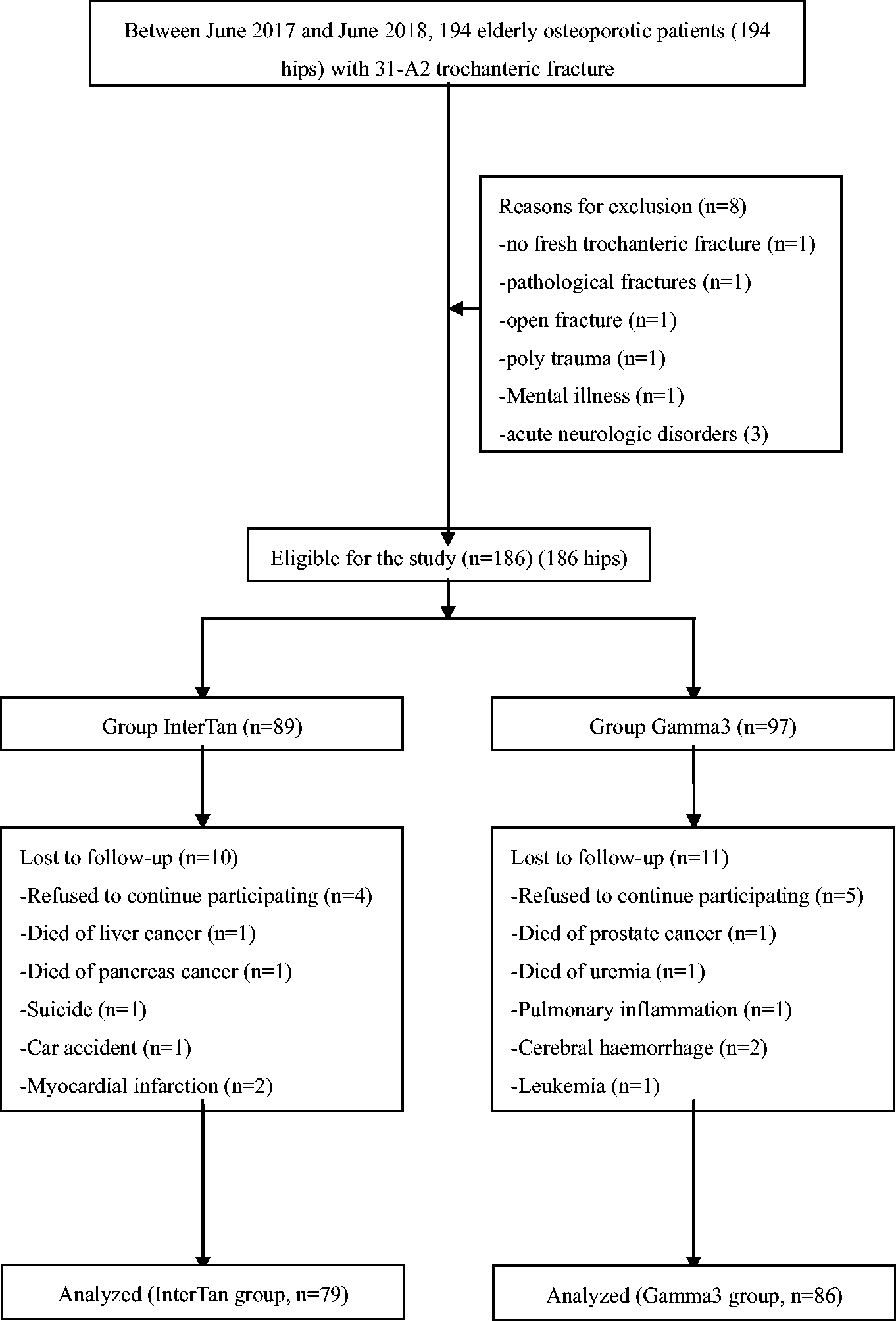
Flow diagram demonstrating the treatment of AO/OTA 31-A2 trochanteric fractures in elderly patients using either the INTERTAN nail or Gamma3 nail.
Patient demographics in the INTERTAN and Gamma3 nail groups.

Data are presented as mean ± standard deviation or number of patients. F, female; M, male; BMI, body mass index; BMD, bone mineral density.

(a, b) Anteroposterior and lateral X-ray views of a 79-year-old man with an intertrochanteric fracture (AO/OTA 31-A2) of the right hip. (c, d) Postoperative anteroposterior and lateral X-ray views of the same patient 12 months after Gamma3 nail fixation of the intertrochanteric fracture of the right hip.

(a, b) Anteroposterior and lateral X-ray views of an 81-year-old woman with an intertrochanteric fracture (AO/OTA 31-A2) of the left hip. (c, d) Postoperative anteroposterior and lateral X-ray views of the same patient 12 months after INTERTAN nail fixation of the intertrochanteric fracture of the left hip.
Postoperative management
Postoperative antibiotics were not routinely administered. Quadriceps exercises were initiated on the second postoperative day. The stitches were removed 2 weeks after surgery. When the X line became vague, the limb could be used to perform activities that were not completely weight-bearing. Patients were allowed to gradually abandon their canes 2 months after the operation. The initiation of activity was appropriately delayed for patients with poor fitness and patients with osteoporosis. Patients underwent postoperative follow-up once monthly until they were completely engaged in activities. Follow-up examinations included imaging studies and evaluation of pain, function, lower limb deformities, and hip motion.
Statistical analysis
Statistical analyses were performed using IBM SPSS Statistics for Windows, Version 22.0 (IBM Corp., Armonk, NY, USA). Data are expressed as mean ± standard deviation and were evaluated using the χ2 test. A P value of <0.05 was considered the threshold for statistical significance.
Results
The intraoperative and postoperative indicators that were compared between the two groups are shown in Table 2. The Gamma3 and INTERTAN groups showed significant differences in the surgical time (58.2 ± 2.5 vs. 81.7 ± 14.2 minutes, respectively; P < 0.05) and blood loss (170 ± 29 vs. 220 ± 16 mL, respectively; P < 0.05). No significant difference was found in the other indicators, including the reduction quality, hospital stay, healing time, and 1-year postoperative mortality. The Harris hip score increased in each group with prolongation of the follow-up time. The score was not significantly different between the two groups postoperatively. Additionally, no significant differences were found in postoperative complications including hip pain, pulmonary embolism, varus collapse, screw cut-out, implant loosening, nonunion, deep venous thrombosis, and infection.
Comparisons of clinical variables in the INTERTAN and Gamma3 nail groups.
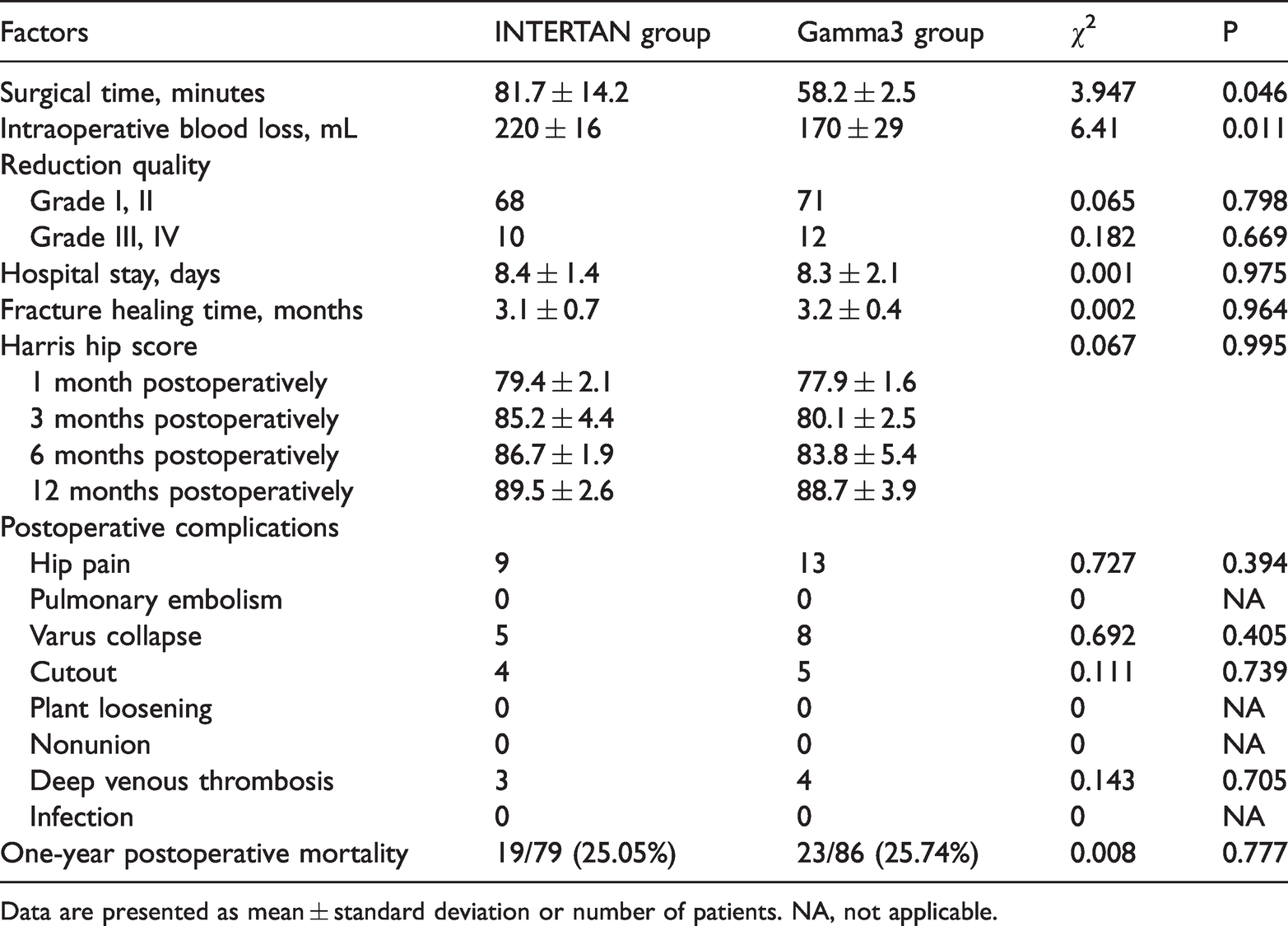
Data are presented as mean ± standard deviation or number of patients. NA, not applicable.
Discussion
The present study showed that the Gamma3 nail was associated with a shorter surgical time and less blood loss than the INTERTAN nail when used to treat AO/OTA 31-A2 trochanteric fractures in elderly patients. However, no significant differences were found in any other indicators between the two groups, including the reduction quality, hospital stay, healing time, 1-year postoperative mortality, and Harris hip score.
Although several studies have focused on trochanteric fractures,21–24 few have evaluated AO/OTA 31-A2 trochanteric fractures in elderly patients; thus, how to choose the ideal implant for these fractures remains unclear. 25 Scientific biomechanical proof for the rotational stability of INTERTAN nails has been established. 26 This nail offers an integrated interlocking screw option to increase stability, reduce rotational movement of the femoral head, eliminate excessive sliding, and greatly reduce the possibility of the Z-effect.27,28 The Gamma3 system features an anti-rotation screw and head–neck lag screw, which promotes fracture healing by dynamically compressing the fracture segments and thus effectively improving the rotational stability of head–neck fractures.29,30 Theoretically, the stability and anti-rotation ability of the INTERTAN nail are superior to those of the Gamma3 nail system. However, previous studies have shown no differences.31,32
In the present study, the mean operating time was significantly shorter in the Gamma3 group than in the INTERTAN nail group. This significant difference in the surgical time is consistent with the findings of previous studies.33–35 Interestingly, Su et al. 36 showed that the mean operative time was longer in the Gamma3 group than in the INTERTAN group. However, Berger-Groch et al. 37 found that the mean operating time was not significantly different between the two groups. The difference in the operation time between the two nail systems may stem from a combination of factors. For example, may be related to different fracture types. Unstable fractures are more difficult to reduce, and repeated reduction will prolong the operation time. It may also be related to the skill level of the surgeon. In addition, the proximal trapezoidal form of the INTERTAN nail may make insertion into the bone marrow cavity more difficult. Large-sample multicenter studies may be needed in the future. The results of the present study showed significantly less blood loss in the Gamma3 group than in the INTERTAN group, confirming the findings of previous studies.35,38 Generally, as the operation time increases, the amount of intraoperative bleeding increases. The statistical analysis of the two groups revealed no significant difference in the fracture healing time, consistent with the findings by Su et al. 36 No significant difference in complications was observed between the two groups during follow-up. The 1-year mortality rate was 25.45% (42 patients died). This result is consistent with a previous study. 39 Establishment of a framework for regional inclusion may reduce mortality after discharge. 5
Our study had several limitations. First, this study was not a randomized trial, and the efficacy of the two methods was not fully evaluated. Therefore, a randomized controlled trial will be required in the future. Second, the relatively small total sample size may have affected the accuracy of the statistical analysis. Third, the postoperative follow-up was only 1 year, which does not allow for determination of the long-term efficacy of the two methods, especially with regard to complications.
In conclusion, both the INTERTAN nail and Gamma3 nail may be effective for surgical treatment of trochanteric fractures. The reduction quality, hospital stay, healing time, 1-year postoperative mortality, and Harris hip scores were not significantly different between the two groups. The Gamma3 nail may result in a shorter surgical time and less blood loss in elderly patients with AO/OTA 31-A2 trochanteric fractures.
Footnotes
Author contributions
Conception and design: FZ, XW. Data collection: FZ, LG. Statistical analysis: YZ, LG. Data analysis and interpretation: FZ, XW. Composition of the manuscript: XW, YZ. Revision of the manuscript for important intellectual content and approval of the final draft: all authors. Responsibility for the paper as a whole: XW.
Declaration of conflicting interest
The authors declare that there is no conflict of interest.
Funding
This research received no specific grant from any funding agency in the public, commercial, or not-for-profit sectors.
