



Abstract
Objective
In recent years, a number of case–control studies have focused on the association between the DJ-1 g.168_185del polymorphism and the risk of Parkinson's disease (PD). However, the results have been conflicting. To estimate the relationship between the DJ-1 g.168_185del polymorphism and PD susceptibility, a comprehensive meta-analysis was performed.
Methods
Eligible studies concerning the DJ-1 g.168_185del polymorphism and PD susceptibility were searched for in the PubMed, Web of Science, Embase, Wanfang, CNKI, and VIP databases. Odds ratios and 95% confidence intervals were calculated to estimate the strength of the associations. In total, 11 studies were included in this meta-analysis, including 13 case–control studies with 2890 cases and 3043 controls.
Results
This meta-analysis revealed that DJ-1 g.168_185del variants are associated with PD susceptibility in the non-Asian population, but not in the Asian population.
Conclusions
Our meta-analysis suggests that DJ-1 gene variants are not associated with the risk of PD in the overall population.
Introduction
Parkinson's disease (PD) is one of the most common neurodegenerative movement disorders worldwide, affecting more than 1% of the population over 65 years of age. 1 It is characterized by variable combinations of bradykinesia, rigidity, resting tremors, and postural abnormalities. 2 In the human brain, PD is pathologically typified by the degeneration of dopaminergic neurons and the presence of Lewy bodies.3,4 The etiology of PD remains unclear. However, genetic factors such as PARK16, 5 SNCA, 6 or VPS13C variants, 7 as well as certain environmental factors, have been shown to contribute to the increased risk of PD.
In humans, the DJ-1 (PARK7) gene is located on chromosome 1p36. It contains eight exons, spanning 24 kb, and encodes a protein consisting of 189 amino acids that belongs to the ThiJ/PfpI superfamily.8,9 Oxidative stress and mitochondrial damage reportedly play important roles in the pathology of PD. 10 Notably, DJ-1 is considered to play a key role in protecting neurons from oxidative stress and mitochondrial damage.11,12 DJ-1 is also regarded as a chaperone, protease, and oncogene in glial cells and neurons of the substantia nigra and striatum.13–17 With regard to the DJ-1 gene g.168_185del polymorphism, numerous case–control studies have estimated the association between this polymorphism and PD susceptibility.18–28 However, results have been conflicting. We therefore performed a comprehensive meta-analysis in the present study, to clarify the relationship between the DJ-1 gene g.168_185del polymorphism and PD risk.
Materials and methods
The present meta-analysis was performed according to the Preferred Reporting Items for Systematic Reviews and Meta-Analyses (PRISMA) statement. 29
Literature and search strategy
Two investigators (J Liu and WS Deng) identified all studies with a focus on the association between the DJ-1 g.168_185del polymorphism and PD risk using the PubMed, Web of Science, Embase, Wanfang, CNKI, and VIP databases, dating to March 15 2019. The keywords “(DJ-1) and (polymorphism) and (Parkinson's disease or PD or parkinsonism)” were used to search within the English electronic databases, and the Chinese electronic databases were searched using the corresponding Chinese characters. Only studies published in English or Chinese were included in this meta-analysis. The two investigators also reviewed the references of the relevant and included studies to identify any additional studies.
Inclusion and exclusion criteria
The published studies adhered to the following inclusion criteria: (1) focused on the association between the DJ-1 g.168_185del polymorphism and PD susceptibility; (2) case–control or cohort studies; (3) provided the genotype distributions of the cases and controls, so that odds ratios (ORs) and 95% confidence intervals (CIs) could be calculated; (3) published in English or Chinese; (4) the genotype distribution of the controls was consistent with the Hardy–Weinberg equilibrium (HWE). Reviews, abstracts, case reports, and duplicate reports were excluded.
Data extraction and quality assessment
For each eligible study, the following information was independently extracted by two investigators: first author, publication year, region or country, HWE in controls, sample size, and the numbers of case and controls. Any disagreements between the two investigators were resolved through discussion. In addition, the Newcastle–Ottawa Scale (NOS) was used to estimate the quality of eligible studies; 30 a score above 5 was considered to be of moderate-to-high quality.
Statistical analysis
The strength of the association between the DJ-1 gene g.168_185del polymorphism and PD susceptibility was assessed using ORs and their 95% CIs under the five genetic models (allelic model: D vs. I, dominant model: DD+DI vs. II, homozygous model: DD vs. II, heterozygous model: DI vs. II, and recessive model: DD vs. DI+II). The degree of heterogeneity among the included studies was determined using the Q test and inconsistency index (I2) statistics (no heterogeneity: I2 < 25%, moderate heterogeneity: I2 = 25% to 50%, significant heterogeneity: I2 > 50%). 31 If I2 > 50%, the random-effect model was used to calculate the OR and 95% CI; otherwise, the fixed-effect model was adopted. 32 To assess the reliability of the present meta-analysis, a sensitivity analysis was performed according to the leave-one-out method. 33 Begg’s funnel plots and the Begg’s test were conducted to evaluate potential publication bias. Here, an asymmetrical funnel plot and a Begg’s test P-value of < 0.05 implied potential publication bias. 34 The Hardy–Weinberg equilibrium (HWE) was estimated using the chi-squared test in the genotype distributions of the control groups. 35 In addition, a subgroup analysis was performed based on ethnicity (Asian and non-Asian) within the overall population. All statistical analyses in this study were performed using Stata software, version 12.0 (Stata Corporation, College Station, TX, USA).
Results
Characteristics of selected studies
A total of 132 studies were identified from several electronic databases (PubMed, Web of Science, Embase, Wanfang, CNKI, and VIP databases). A flow diagram describing the selection process is presented in Figure 1. After strictly screening the identified studies based on the inclusion and exclusion criteria, 11 studies containing 2890 cases and 3043 controls were finally included in this meta-analysis.18–28 Of these studies, seven22–28 were published in English and four18–21 were published in Chinese. The characteristics of all eligible studies are listed in Table 1. All selected studies scored > 5 stars in the NOS test, indicating that the quality of the eligible studies was moderate or high (Table 2).

Flow diagram of the literature selection process.
General characteristics of the 13 case–control studies.

DD: del/del; DI: del/ins; II: ins/ins; HWE: Hardy–Weinberg equilibrium; NA: not available; NOS: Newcastle–Ottawa Scale.
Meta-analysis of the association between the DJ-1 gene g.168_185del polymorphism and Parkinson’s disease susceptibility.

CI: confidence interval; D: del; DD: del/del; DI: del/ins; I: ins; II: ins/ins; OR: odds ratio
Association of the DJ-1 gene polymorphism with PD susceptibility
All eligible studies (including 2890 cases and 3043 controls) were used to estimate the association between the DJ-1 gene g.168_185del polymorphism and PD susceptibility. The pooled ORs and their 95% CI are summarized in Table 2. There were no significant associations in the overall population in any of the five models (Figure 2 and Table 2). The fixed-effect model was used in all genetic models (Table 2). In the subgroup analysis by ethnicity (Asian and non-Asian), the DJ-1 gene g.168_185del polymorphism was associated with a significantly increased risk of PD in the non-Asian population, but not in the Asian population (Table 2).

Forest plot of the associations of DJ-1 gene g.168_185del variants with Parkinson’s disease susceptibility in overall populations under the dominant model. CI: confidence interval; OR: odds ratio.
Sensitivity analysis and publication bias
A sensitivity analysis was performed to assess the influence of each study on the pooled ORs and 95% CIs by omitting each study in turn. There were no significant changes in the pooled ORs or 95% CIs in the dominant model (Figure 3), indicating the stability of the present meta-analysis. Begg’s funnel plot and Begg’s test were used to assess the publication bias of the included case–control studies. The shapes of the funnel plots were roughly symmetrical (Figure 4), and Begg’s test revealed no significant publication bias in this meta-analysis (DD+DI vs. II: P = 0.161).

Sensitivity analysis of the summary odds ratio coefficients under the dominant model. CI: confidence interval.
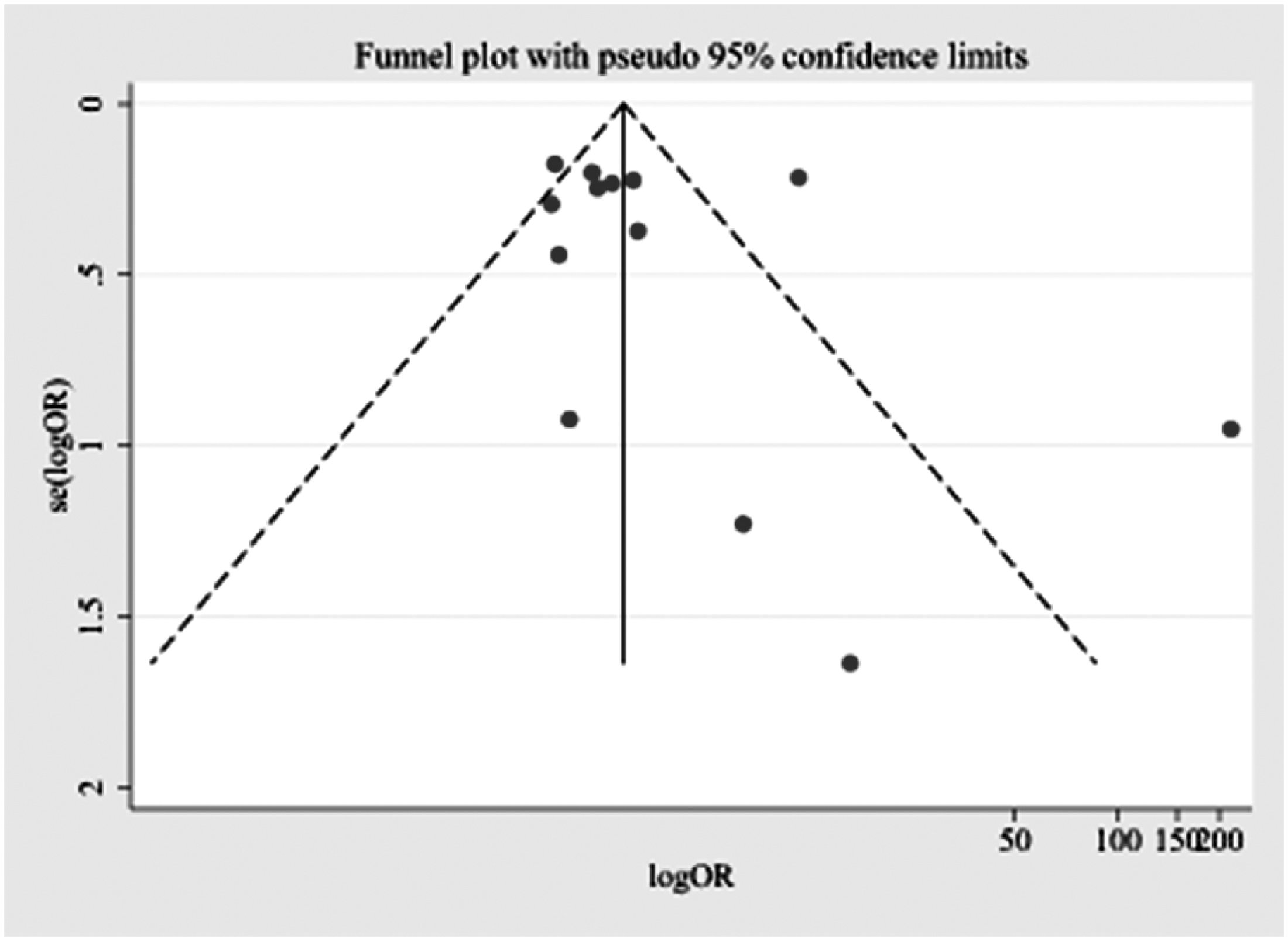
Begg's funnel plot of publication bias for the associations between the DJ-1 gene g.168_185del polymorphism and Parkinson’s disease under the dominant model. OR: odds ratio.
Discussion
PD is a common neurodegenerative movement disorder in individuals over 65 years of age. In recent years, numerous case–control studies have focused on the relationship between the DJ-1 gene g.168_185del polymorphism and PD susceptibility. However, the results of these studies have been inconsistent. To assess if any such association exists, we performed a comprehensive meta-analysis of 11 studies, including 13 case–control studies with 2890 cases and 3043 controls.
Variants in promoter regions are involved in gene transcription activity because of the DNA-binding ability of transcription factors. Siegel et al. 36 reported that the Ins allele of g.168_185del variants might affect the transcriptional activity of DJ-1 by binding to nuclear factors. The DJ-1 protein, which was initially identified almost a century ago, is expressed in many different tissue types.14,37,38 DJ-1 is considered to play a key role in protecting neurons from oxidative stress and mitochondrial damage.11,14 In addition, DJ-1 gene polymorphisms are closely associated with autosomal recessive early-onset PD.9,39 Moreover, DJ-1 can eliminate hydrogen peroxide by undergoing self-oxidation. In doing so, reactive oxygen species are decreased. 12 DJ-1-related oxidative damage is reportedly evident within the brains of sporadic PD patients.40,41 In addition, Waragai et al. 42 reported that DJ-1 levels in the cerebrospinal fluid of sporadic PD patients are significantly higher than in healthy controls. Furthermore, DJ-1 was found to promote the expression of anti-apoptotic genes and suppress apoptosis-associated pathways.43–46 Overall, it seems that DJ-1 is associated with PD, although one study reported no significant difference between PD patients and controls in serum levels of DJ-1 protein. 47
In the present study, the DJ-1 gene g.168_185del polymorphism was associated with an increased risk of PD under both the allelic and dominant models, based on data collected from 13 case–control studies (2890 cases and 3043 controls in the overall population). No significant heterogeneity was present in the five models that were used (Table 2). Additionally, in the subgroup analysis, we revealed that DJ-1 gene g.168_185del variants were not associated with PD susceptibility among the Asian population (Table 2). However, the DJ-1 gene g.168_185del polymorphism was associated with an increased risk of PD among the non-Asian population (Table 2). Furthermore, no obvious publication bias was detected in this meta-analysis (DD+DI vs. II: P = 0.161). In summary, this comprehensive meta-analysis indicated that the DJ-1 gene g.168_185del polymorphism is associated with an increased risk of PD in the non-Asian population, but not in the Asian population.
Several potential limitations exist in this meta-analysis. First, the included studies were published only in Chinese or English. Thus, potential publication bias may exist. Second, only four studies focused on the associations between the DJ-1 gene g.168_185del polymorphism and PD risk among Caucasians, while one study 25 targeted mixed and black populations. Hence, a sub-group analysis was conducted based on ethnicity (Asian and non-Asian). Third, we were unable to test environmental factors and gene–gene or gene–environment interactions because insufficient information was collected.
Conclusion
This comprehensive meta-analysis of 13 case–control studies demonstrated that the DJ-1 gene g.168_185del polymorphism is associated with PD susceptibility among the non-Asian population, but not among the Asian population. However, considering the limitations of this study, the present results should be interpreted with caution. Further studies with larger sample sizes and diverse ethnic groups should be conducted to validate the resulting associations.
