



Abstract
Objective
The prevalence of overweight/obesity in China has increased dramatically in recent years; being overweight/obese can increase the risk of type 2 diabetes and cardiovascular disease. The purpose of this study was to determine the population in China at high risk of being overweight or obese, to explore the relationships between various relevant factors and overweight/obesity, and to identify preventive efforts for high-risk populations.
Methods
We administered a questionnaire survey among a group of 536 social workers in Shijiazhuang City in 2017. We used the Pearson chi-square test, Spearman’s rho test, multivariate linear regression, univariate and multivariate logistic regression, and receiver operating characteristic curve analysis to investigate factors that influence overweight/obesity.
Results
The prevalence of overweight/obesity was 13.7% among the study participants. Urban residence, eating speed, number of daily meals, overeating, and a high-fat diet were associated with overweight/obesity. In multivariate linear regression analysis, overweight/obesity was correlated with sex, urban residence, eating speed, number of daily meals, and a high-fat diet.
Conclusion
Among all influencing factors, dietary factors, place of residence, and sex were most closely related to being overweight/obese. Furthermore, living in an urban area and male sex were independent risk factors for being overweight/obese.
Introduction
Being overweight or obese are common conditions caused by a variety of factors including genetic, environmental, behavioral, socioeconomic, and cultural factors. Overweight and obesity lead to excess energy (lipid) storage in the body. Over the past few decades, the prevalence of overweight/obesity has increased dramatically worldwide. The prevalence of overweight/obesity is similarly rising in China.1,2 According to a 2016 World Health Organization report, approximately 39% of adults globally are overweight/obese. 3 Being overweight/obese has become a serious global public health problem, affecting improvements in quality of life among populations worldwide. Overweight/obesity increases the risk of cardiovascular disease and cancer and can affect the functioning of multiple body systems. Overweight and obesity not only affects a person’s physical appearance but also causes challenges in daily life. 3 In addition, being overweight or obese can cause joint and soft tissue damage, decrease reproductive capacity, and limit the development of intelligence and psychological characteristics.4–7
Overweight and obesity can also cause various psychological problems, such as behavioral changes and psychological trauma. Viitasalo et al. 8 conducted a study among 9,895 European children and found that overweight and obesity were early risk factors for future chronic diseases, including coronary heart disease, cerebrovascular disease, type 2 diabetes, and hypertension. Research into risk factors and preventive measures for overweight and obesity has received increasing attention in the public health field. Poor eating habits are a major cause of being overweight and obese. 9 Recent studies have shown that eating speed plays a role in obesity9–11 and diabetes.12–14 In addition, some studies have suggested that in people who are overweight or obese, blood glucose levels increase gradually to avoid continuous and rapid secretion of insulin, which can lead to overworking the pancreas. 15 Other studies have shown that several risk factors are linked to being overweight or obese, such as increased intake of high-fat and energy-dense foods, excessive consumption of carbonated beverages, reduced plant fiber intake, snacking, and skipping breakfast. 9 However, when considering the lifestyle habits outlined above, several questions remain. Which behaviors are the greatest risk factors for being overweight or obese? Are these risk factors independent of each other? Is there a group in China at higher risk of becoming overweight/obese? If so, what type of people comprise this group? These issues have yet to be studied simultaneously.
Given the close relationship between the prevalence of being overweight/obese and diet, in this study, we aimed to further explore the relationship between the Chinese diet and being overweight or obese. In-depth analysis and determination of unhealthy eating behaviors are the most critical factors in investigating overweight and obesity, to verify independent risk factors for being overweight or obese. We also sought to determine those groups with a higher risk of becoming overweight within the Chinese population. In the present study, we analyzed cross-sectional survey data, to provide a scientific basis for the control and prevention of overweight and obesity and help reduce the impact on human health.
Methods
Study population
Participants in the present study comprised individuals living in Shijiazhuang, China, representing a variety of professions, including teacher, farmer, office workers, homemaker, civil servant, doctor, unemployed, and other professions. In 2019, the total resident population of Shijiazhuang was just over 11 million, according to data from the Shijiazhuang Municipal People’s Government. This survey was conducted in 2017 and included a physical examination and questionnaire survey. The study was approved by the Ethics Committee of Hebei Medical University (Shijiazhuang, Hebei, 15 March 2014). The purpose of the study was explained to participants, who all gave their signed informed consent to participate.
Measurement criteria
We measured participants’ body mass index (BMI) according to Chinese standards; BMI between 24.0 and 27.9 kg/m2 is considered overweight and BMI ≥28 kg/m2 is considered obesity.
Inclusion criteria for the study were as follows: age between 18 and 65 years and no history of major surgery, major trauma, or diseases within the previous 3 months. Exclusion criteria were individuals age less than 18 years or more than 65 years; individuals with a history of major surgery, major trauma, or diseases within the previous 3 months, including hypertension, diabetes, arteriosclerosis, cerebrovascular disease, or other serious diseases.
Questionnaire
The survey included a self-administered questionnaire. For each question, participants responded by choosing one of several possible answers. For example, “Compared with family and friends who you eat together with, how fast do you normally eat?” (response options were: I always chew slowly; I eat at the same speed as everyone else; I eat slightly faster than other people; I always eat very quickly). The questionnaire also queried participants’ lifestyles, such as the number of meals they ate each day (one, two, three, or more); whether participants ate meals on time (yes/no), habitually ate breakfast (yes/no), habitually overate (yes/no), and habitually snacked and ate supper (yes/no); weekly frequency of consuming a high-fat diet (never, 1–2 days, 3–6 days, or daily); whether participants ate vegetables regularly (yes/no), ate fast food or Bento (yes/no), and regularly ate dessert (yes/no); frequency of consuming sugary drinks (never, 1–2 servings per week, 3–6 servings per week, daily), whether participants exercised regularly (yes/no), and frequency of consuming alcohol (never, less than 1 time per week, 1–2 times per week, more than 3 times per week). We also collected general demographic information on participants’ age, sex, urban or rural residence, height, and weight.
Sampling method
In our study, a random number table method was used to conduct simple random sampling. The steps are as follows: 1) determine the overall range and arrange the unit number; 2) determine the sample capacity; 3) select the sample unit, that is, start from any number in the random number table, read according to the interval, and select the number within the number range; do not select the number beyond the range, and do not select a repeated number until the predetermined sample capacity is reached; and 4) arrange the selected number and list the corresponding unit name scale.
Statistical methods
All statistical analyses were performed using IBM SPSS software version 24.0 (IBM Corp., Armonk, NY, USA). A p-value < 0.05 was considered to be statistically significant. The statistical results are expressed as both sample sizes and percentages.
Pearson’s chi-square test was used to analyze the relationship between BMI and demographic/behavioral characteristics. Spearman’s rho correlation test was used to compare demographic variables and behavioral variables. All demographic/behavioral characteristics were input into a multivariate linear regression model, and the degree of multicollinearity was quantified by calculating the variance inflation factor (VIF). Univariate and multivariate logistic regression analyses were used to calculate the odds ratios (ORs) with 95% confidence intervals (CIs) of overweight/obesity, based on the statistical results. Finally, we constructed a receiver operating characteristic (ROC) curve to assess the credibility of each factor affecting a participant’s degree of overweight/obesity.
Results
A total 536 participants were included in this study. Among the surveyed population, 48% of participants were male, and the mean age was 19.57 years. The demographic and behavioral characteristics associated with the surveyed population are presented in Table 1. Among participants, the rate of overweight/obesity was as high as 13.4% (Table 1). Table 1 also shows the relationships between overweight/obesity and various demographic and behavioral characteristics, with statistically significant correlations between overweight/obesity and sex (p = 0.008), urban residence (p = 0.024), eating speed (p < 0.001), number of meals per day (p = 0.003), and frequency of eating a high-fat diet (p = 0.048).
Population-related demographic and behavioral characteristics.

*Significant variables.
To further explore whether sex, being an urban resident, number of daily meals, and a high-fat diet had significant correlations with obesity in the surveyed population, we applied the Spearman correlation test to verify the relationship between each demographic/behavioral characteristic and BMI. Our results showed that sex, being an urban resident, eating speed, number of daily meals, overeating habits, and a high-fat diet were associated with overweight/obesity (Table 2). Using multivariate linear regression analysis, we found that overweight/obesity was correlated with sex (p = 0.022), being an urban resident (p = 0.021), eating speed (p < 0.001), number of daily meals (p = 0.004), and a high-fat diet (p = 0.039) (Table 3). In addition, in collinearity analysis, we confirmed that the VIF between all factors was < 2, indicating that there was no collinearity between any of the factors (Table 3).
Correlation analysis between demographic and behavioral characteristics and degree of obesity in the study population.

#Spearman rank correlation coefficient between weight and demographic/behavioral characteristics.
ρ, Spearman correlation coefficient.
x2, Pearson chi-square.
**Significant variables.
Correlation between demographic and behavioral characteristics of study population and obesity degree using multiple linear regression.
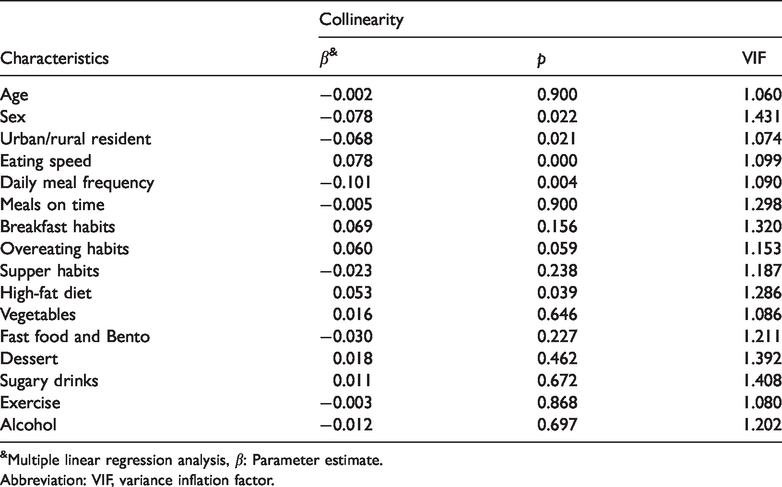
&Multiple linear regression analysis, β: Parameter estimate.
Abbreviation: VIF, variance inflation factor.
Table 4 shows the results of univariate logistic regression. Univariate logistic regression showed that the following characteristics had clear correlations with obesity: sex (OR = 0.505, 95% CI = 0.303–0.841, p = 0.009), being an urban resident (OR = 0.562, 95% CI = 0.339–0.932, p = 0.026), eating speed (OR = 2.243, 95% CI = 1.593–3.157, p < 0.001), number of meals per day (OR = 0.364, 95% CI = 0.193–0.685, p = 0.002), overeating habits (OR = 1.733, 95% CI = 1.050–2.860, p = 0.031), and frequently consuming a high-fat diet (OR = 1.685, 95% CI = 1.156–2.456, p = 0.007). Table 5 shows the results of multivariate logistic regression, The degree of obesity among participants in the first step was associated with the following factors: sex (OR = 0.463, 95% CI = 0.243–0.881, p = 0.019), urban residence (OR = 0.559, 95% CI = 0.320–0.974, p = 0.040), eating speed (OR = 2.019, 95% CI = 1.401–2.909, p < 0.001), and meals per day (OR = 0.384, 95% CI = 0.189–0.778, p = 0.008). Based on these results, we began with participants’ sex and whether they were an urban resident and conducted an in-depth study on the relationship between obesity and these demographic/behavioral characteristics. In Table 6, we show the interaction between sex and being an urban resident using binary logistic regression; we found an interaction between these two characteristics (p = 0.003). We then divided study participants into four categories: urban men, urban women, rural men, and rural women. By again applying binary logistic regression verification, we found that the risk of obesity in urban women (OR = 0.435, 95% CI = 0.218–0.869, p = 0.018), rural men (OR = 0.493, 95% CI = 0.253–0.960, p = 0.038), and rural women (OR = 0.318, 95% CI = 0.157–0.642, p = 0.001) was significantly lower than that in urban men (p < 0.05). This result illustrates that being overweight/obese is highly associated with being a male urban resident. We then investigated the interactions between sex and urban residence with eating speed, a high-fat diet, and number of meals per day (Table 6). In binary logistic regression, we confirmed an interaction between sex and urban residence and the number of daily meals. Thus, we reached the following conclusion: the average risk of being overweight/obese in urban men who had one meal per day (OR = 22.000, 95% CI = 4.920–98.370, p < 0.001) and those who had two meals per day (OR = 2.567, 95% CI = 1.224–5.381) was higher than that in rural women who had more than three meals per day (p < 0.05).
Demographic and behavioral characteristics and their effect on obesity degree based on univariate logistic proportional regression analysis.

Abbreviations: CI, confidence interval; OR, odds ratio.
**p < 0.05.
Demographic and behavioral characteristics and their effect on obesity degree based on multivariate logistic regression analysis.

Abbreviations: CI, confidence interval; OR, odds ratio.
**p < 0.05.
Interactions and effect on obesity degree based on univariate logistic proportional regression analysis.

Abbreviations: CI, confidence interval; OR, odds ratio.
**p < 0.05.
Finally, we constructed an ROC curve (Figure 1, Table 7) to determine the effect of sex, urban residence, interaction between sex and being an urban resident, and interactions of sex and urban residence with number of meals per day on the proportion of the population who were overweight/obese. The area under the ROC curve (AUC) was used to judge the effect of various factors on the population who are overweight/obese: sex (AUC = 0.584, p = 0.022, 95% CI = 0.514–0.654), urban residence (AUC = 0.571, p = 0.052, 95% CI = 0.501–0.642), sex × urban residence (AUC = 0.614, p = 0.002, 95% CI = 0.543–0.685), and sex × urban residence × number of daily meals (AUC = 0.704, p < 0.001, 95% CI = 0.649–0.759).
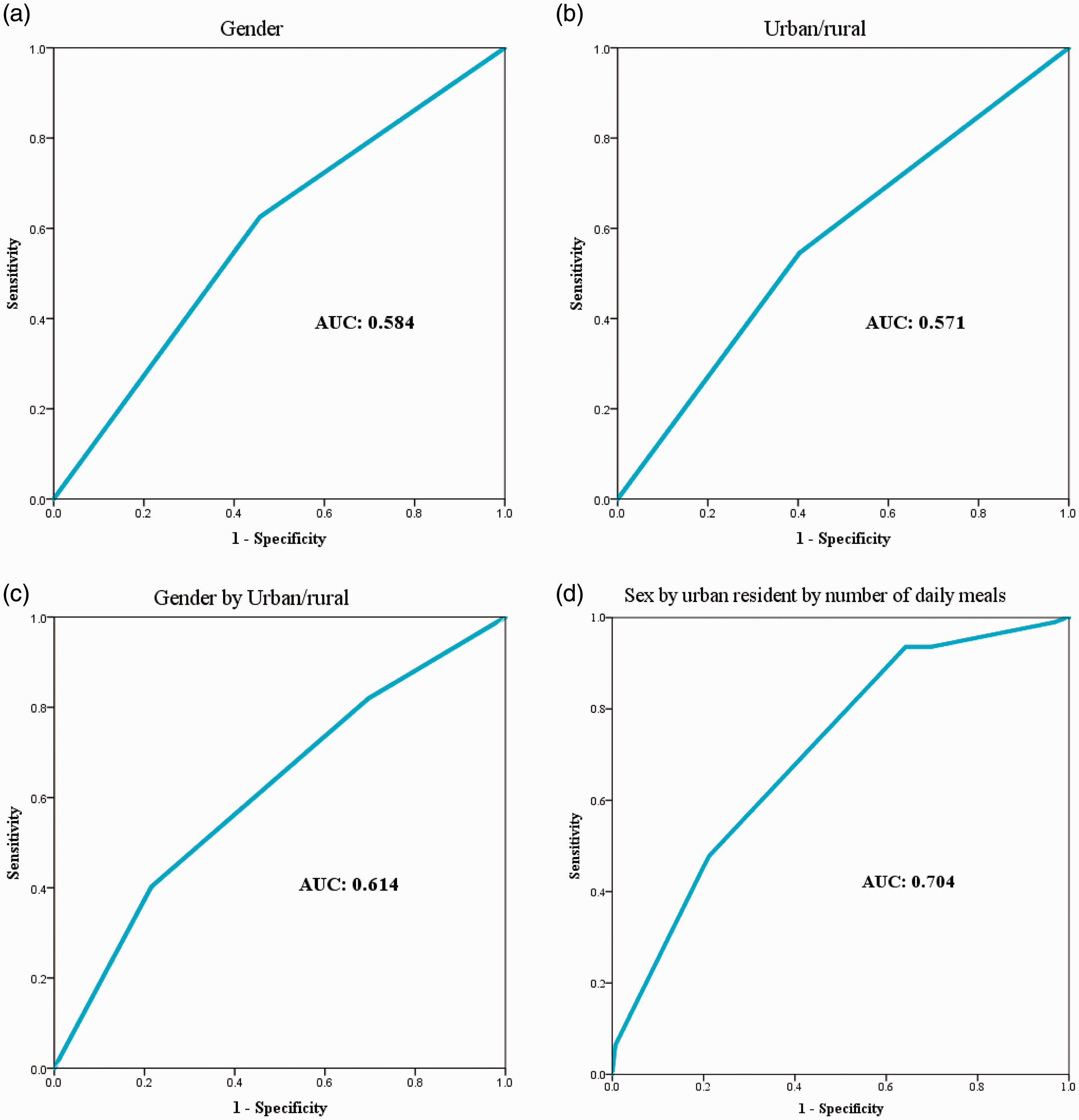
Receive operating characteristic (ROC) curves (a) ROC curve to determine the effect of sex. (b) ROC curve to determine the effect of urban/rural residence. (c) ROC curve to determine the effect of sex × urban/rural residence. (d) ROC curve to determine the effect of sex × urban/rural residence × daily meal frequency.
Receiver operator characteristic (ROC) curve analysis of sex, urban/rural residence, sex × urban/rural residence, and sex × urban/rural residence × daily meal frequency for overweight/obesity.

Abbreviation: AUC, area under ROC curve; CI, confidence interval.
*Significant variables.
In summary, by screening the risk factors obtained in univariate/multivariate logistic regression, we defined significant risk factors as independent risk factors, that is, male sex, being an urban resident, fast eating speed, eating one or two meals per day, and frequently consuming a high-fat diet. In addition, by studying the interaction between risk factors and overweight/obesity in the population, we found that urban men had a high incidence of overweight/obesity. We further found that urban men who ate one or two meals per day had a greater risk of being overweight/obese than those who ate more meals a day. In other words, the group at high risk of being overweight/obese were urban male residents who ate one or two meals per day. The increasing AUC in the ROC curve analysis further confirmed the accuracy of our results.
Discussion
In this study, we aimed to identify groups at high risk of being overweight/obese. Of the 536 participants surveyed, the rate of overweight/obesity was as high as 13.4%. Many studies have focused on exploring the risk factors involved in overweight/obesity, such as smoking, drinking, dietary structure, sex, age, occupation, and amount of exercise.9,16 However, few studies have focused on exploring the interactions among risk factors and accurately determining the specific distribution of high-risk groups. This study identified independent risk factors associated with overweight/obesity, including male sex, urban residence, eating quickly, eating only one or two meals per day, and a high-fat diet. In addition, we identified urban male residents as a group at high risk of being overweight/obese, with those who eat one or two times a day at greater risk.
In this study, five factors were considered to be independent factors that were significantly associated with a high risk of overweight/obesity. Many earlier studies demonstrated a significant correlation between individual factors and being overweight/obese. Zhang et al. 9 investigated the prevalence of overweight and obesity among children in Guangzhou from 2007 to 2011, analyzing the early life and behavioral determinants of obesity; those authors concluded that eating speed is a high risk factor for obesity. Ohkuma et al. 10 conducted a meta-analysis of 23 published studies and concluded that the average difference in BMI between individuals who reported fast eating and those who reported slow eating was 1.78 kg/m2 (95% CI: 1.53–02.04 kg/m2); the OR of fast eating among obese people was 2.15 (95% CI: 1.84–2.51). Evidence indicates that there is significant quantitative heterogeneity in the degree of association between studies (I2 = 78.4%, heterogeneity p-value < 0.001; BMI: I2 = 71.9%, heterogeneity p-value < 0.001).
Previous studies have supported the recommendation not to limit healthy fat intake to maintain weight. Tobias et al. 17 compared the long-term effects of low-fat and high-fat diet interventions on weight loss by performing a systematic review of randomized controlled trials and a meta-analysis of random effects; the authors determined that the long-term effect of a low-fat diet intervention on body weight depends on the intervention intensity of the control group. Evidence from randomized controlled trials does not support low-fat diets for long-term weight loss when compared with long-term weight loss from dietary interventions of the same intensity. However, the question remains of why a high-fat diet was a risk factor for obesity in our results (OR = 1.600, 95% CI = 1.068–2.398, p = 0.023). We believe that this can be explained as follows. First, compared with the traditional high-calorie, high-fat, high-protein Western dietary structure and the Mediterranean-style dietary structure that features olive oil as a primary component, the Eastern dietary structure is very different, with pork in particular comprising the main meat in the Chinese diet. The fat content of pork is much higher than that of chicken, fish, rabbit, or beef. Intake of large quantities of pork will lead to a large intake of calories, causing overweight and even obesity. Second, compared with Western dietary habits, China’s dietary habits are also quite different. The daily diet of Chinese people is usually based on rice and pasta, with high-fat dishes in Chinese cuisine usually containing a high salt and sugar content, which leads to an increased intake of rice, pasta, and even alcohol. What follows is a large accumulation of calories and excess energy, causing overweight and obesity.
Finally, in terms of the effects of sex, being an urban resident, and the frequency of daily meals on being overweight/obese, we analyzed the interactions among these three factors and found that urban men who eat one or two meals per day (OR = 22.000, 95% CI = 4.920–98.370, p < 0.001 and OR = 2.567, 95% CI = 1.224–5.381, p = 0.013, respectively) have a high risk of being overweight/obese. Our study also showed that participants who lived in urban areas had significantly higher BMIs than those living in rural areas (OR = 1.935; 95% CI: 1.178–3.240).
Yu et al. 18 reported a high prevalence of overweight and obesity in middle-aged and older people living in Beijing. In addition, Herrera et al. 19 conducted surveys in 2009 and 2013 and found that people with poor living conditions in rural areas had the lowest risk of obesity. In urban and rural areas, the prevalence of obesity in 2009 among the population with the worst living conditions was OR = 0.85 (95% CI = 0.82–0.88) and OR = 0.70 (95% CI = 0.64–0.75), respectively. The prevalence of obesity in people with moderate living conditions in urban and rural areas was OR = 0.94 (95% CI = 0.91–0.97) and OR = 0.81 (95% CI = 0.74–0.88), respectively. In 2013, the corresponding values for groups with the worst living conditions in urban and rural areas were OR = 0.96 (95% CI = 0.93–0.98) and OR = 0.89 (95% CI = 0.82–0.96), respectively; the corresponding values for participants with moderate living conditions in urban and rural areas were OR = 0.99 (95% CI = 0.96–1.02) and OR = 0.94 (95% CI = 0.86–1.02), respectively. These findings provide a regional basis for further research into the risk factors for overweight and obesity.
Woman living in urban areas who only eat one to two times a day are usually considered to be seeking to lose or maintain their weight, according to many existing social customs. In such cases, reduction in the number of meals is usually accompanied by a reduction in the amount of food consumed and a reduction in caloric intake, to achieve or maintain a slim figure. In urban men, however, the opposite is true. Men living in urban areas tend to be under different social pressures, such as pressures from work, academics, and family pressure. Our study suggests that the fewer meals eaten by urban men may be owing to these life stressors. Various pressures reduce the time these men can spend eating. Therefore, urban men may be forced to involuntarily postpone meals until they have more time to eat, such as after work or school. Our research suggests that urban men who eat only one or two meals a day are also at high risk of becoming obese. When urban men who are working under high pressure are unable to eat or simply do not have enough time to eat after a stressful day, they can remain in a state of low energy for a long time and feel tired and hungry. This group urgently needs calorie support to relieve their pressure and hunger. Therefore, they may overeat during their few daily eating opportunities. For these meals, these men may choose fast food containing high levels of salt, fat, and sugar or high-calorie junk food to satiate their hunger, and they may consume alcohol to relieve stress. In addition, based on the small number of meals eaten by this group, people may think that “I only eat one meal a day; I will not get fat if I overeat.” Although this manner of eating can relieve hunger, tiredness, and pressure accumulated over the course of a day, it can also lead to excess energy and eventually to overweight and obesity. In this study, we identified such high-risk groups; advocacy and education about how to resolve stress in ways other than by overeating are needed in these populations.
Although our sample size was small in comparison with the entire population and wide variety of lifestyles in China, we consider that our findings can, at least in part, be generalized to the entire Chinese population living in urban areas, as follows. People across China have different eating habits and living standards. However, with ongoing urbanization in the country, similar changes have taken place in the lifestyle and eating habits of urban residents in different cities of China. Intake of high-energy food with higher fat and sugar content has increased. Urban residents in China are engaged in more sedentary forms of work, with decreased physical activity and changes in the modes of transportation accompanying accelerated urbanization. Importantly, this phenomenon is not only happening in China; it is a global trend. 3
Our research has some limitations. The horizontal design of this study makes it challenging to impossible any causal relationships based on the collected data. Prospective and/or interventional studies will be necessary to determine the relationship between eating speed, meals consumed, sex, place of residence, and being overweight/obese.
Conclusion
To sum up, urban men in China constitute a high-risk group for overweight and obesity, and those who eat one or two times a day are at greater risk. Specific high-risk groups should be targeted in health campaigns that advocate eating less at each meal but eating more frequently and increasing regular exercise, to prevent overweight and obesity.
