




Abstract
Objective
With the development of human genomics, the genetic factors associated with dental caries have receiving increasing attention. This study was performed to evaluate the relationship between lactoferrin (LTF) and mannose-binding lectin 2 (MBL2) gene single nucleotide polymorphisms (SNPs) and dental caries susceptibility in Chinese children.
Methods
This prospective case–control study included 360 unrelated children (aged 12–15 years) who received oral health examinations and questionnaire surveys. The children were divided into two groups by counting the numbers of decayed, missing, and filled teeth (DMFT/dmft): case group (n = 162, DMFT/dmft ≥ 1) and control group (n = 198, DMFT/dmft = 0); non-invasive saliva samples were collected to extract genomic DNA. Six SNPs (rs2073495C/G, rs1042073C/T, rs10865941C/T, and rs1126477A/G in LTF; rs7096206C/G and rs7095891G/A in MBL2) were tested by mass spectrometry.
Results
The study included 360 individuals with (85 boys and 77 girls) and without a history of caries (96 boys and 102 girls). There were no statistically significant differences in alleles and genotypes among the six SNPs between the two groups.
Conclusion
There is no evidence that polymorphisms of LTF and MBL2 genes are associated with dental caries susceptibility in populations from northwest China; further confirmation is needed with larger sample sizes.
Keywords
Introduction
Dental caries is one of the most common and multifactorial chronic infectious diseases worldwide. 1 It can cause pain and discomfort, and may lead to poor quality of life in modern society. If dental caries spreads to the tooth nerve, it can produce sharp pain. In patients with severe dental caries, only the root or residual crown remains, which reduces mastication efficiency; affects digestion and nutrient absorption; and may cause indigestion, gastrointestinal diseases, and other infectious diseases.2–4
In China, according to the 4th National Oral Health Survey, the dental caries rates in permanent teeth are 38.5% for 12-year-old children, 41.2% for 13-year-old children, 43.3% for 14-year-old children, and 44.4% for 15-year-old children; notably, these caries rates are high and increase with age. 5 It has been reported that dental caries is highly prevalent worldwide, affecting 60% to 90% of school-aged children. 6 However, prevention measures are limited and dental caries control is a serious public health problem that merits global attention. 7
Because of advances in molecular biology and the development of human genomics, genetic factors are increasingly presumed to play important roles in the development of dental caries.8–10 This notion is supported by data from familial aggregation 11 and twin studies 12 regarding the heritability of dental caries. Genes associated with dental caries susceptibility are generally concentrated mainly in four categories: enamel formation, salivary proteins, immune response, and taste. 13 However, these findings have been inconsistent and additional research is needed to confirm the precise relationships of the genes with dental caries susceptibility. Therefore, this study was performed to evaluate the relationships of six SNPs (rs2073495C/G, rs1042073C/T, rs10865941C/T, rs1126477A/G, rs7096206C/G, and rs7095891G/A) in two candidate genes (LTF and MBL2) with dental caries susceptibility in Chinese children.
Materials and methods
Participants
This prospective case-control study consisted of unrelated children aged 12 to 15 years living in Diebu County, Gansu Province (in the northwestern region of China). All children were recruited from the two junior high schools in the county. Inclusion criteria were as follows: (i) permanent residency in Diebu County; (ii) comprehension of the study content and voluntary participation. Exclusion criteria were as follows: (i) presence of syndromic or systemic diseases; (ii) biological relationship with other children in the study (e.g., siblings); (iii) ongoing or prior orthodontic treatment.
All participants underwent dental examinations and received questionnaire surveys administered by two attending stomatologists with standardized training who exhibited an interobserver Kappa of 0.8. Tooth decay was diagnosed by using a magnifying glass, in accordance with a modified version of the protocol recommended by the World Health Organization. 14 Participants were divided into two groups based on the numbers of decayed, missing, and filled teeth in primary and permanent dentition (DMFT/dmft indexes; third molars, sealed teeth, and aesthetic restorations were excluded): case group (DMFT/dmft ≥ 1) and control group (DMFT/dmft = 0). The study was approved by the ethics committee of Northwest Minzu University (approval no. XBMU-YX-2019001); written informed consent was obtained from all participants and their parents/legal guardians.
SNP selection
In accordance with the functional SNP strategy, site optimization was performed as follows: (i) LTF and MBL2 genes were identified in the NCBI SNP database (http://www.ncbi.nlm.nih.gov/snp/), using the GeneView interface (i.e., Clinical Source and gene in region); the gene promoter, 5′-untranslated region, exon (missense or synonymous), and 3′-untranslated region were selected (minor allele frequency in Han Chinese of Beijing >0.05 was required, according to the HapMap or 1000 Genomes database); (ii) LTF and MBL2 genes were identified in the Ensembl database (http://asia.ensembl.org/index.html/), using the Variation table interface; the gene in the Splice region variant and Upstream gene variant data were selected (minor allele frequency in Han Chinese of Beijing >0.05, according to HapMap or 1000 Genomes database) and these data were added to the Functional SNP loci; (iii) Functional predictions were made for the selected SNP loci (http://snpinfo.niehs.nih.gov/). The SNP site information selected in this study is shown in Table 1.
SNPs selected in present study.

LTF, lactoferrin; MBL2, mannose-binding lectin 2; SNP, single nucleotide polymorphism.
DNA isolation and genotyping
Non-invasive saliva samples (2 mL) were collected and DNA was extracted using a Genomic DNA Isolation Kit (BioMiao Biological Technology, Beijing, China), in accordance with the manufacturer’s instructions; DNA was then stored at −20°C until SNP analysis. All six SNPs in the two candidate genes were genotyped using an iPLEX Mass ARRAY® system (Agena Bioscience, San Diego, CA, USA); the main methods were identical to those used in our previous study. 15 The polymerase chain reaction primer sequences are shown in Table 2.
Primer sequences and Tm for polymerase chain reaction analysis.
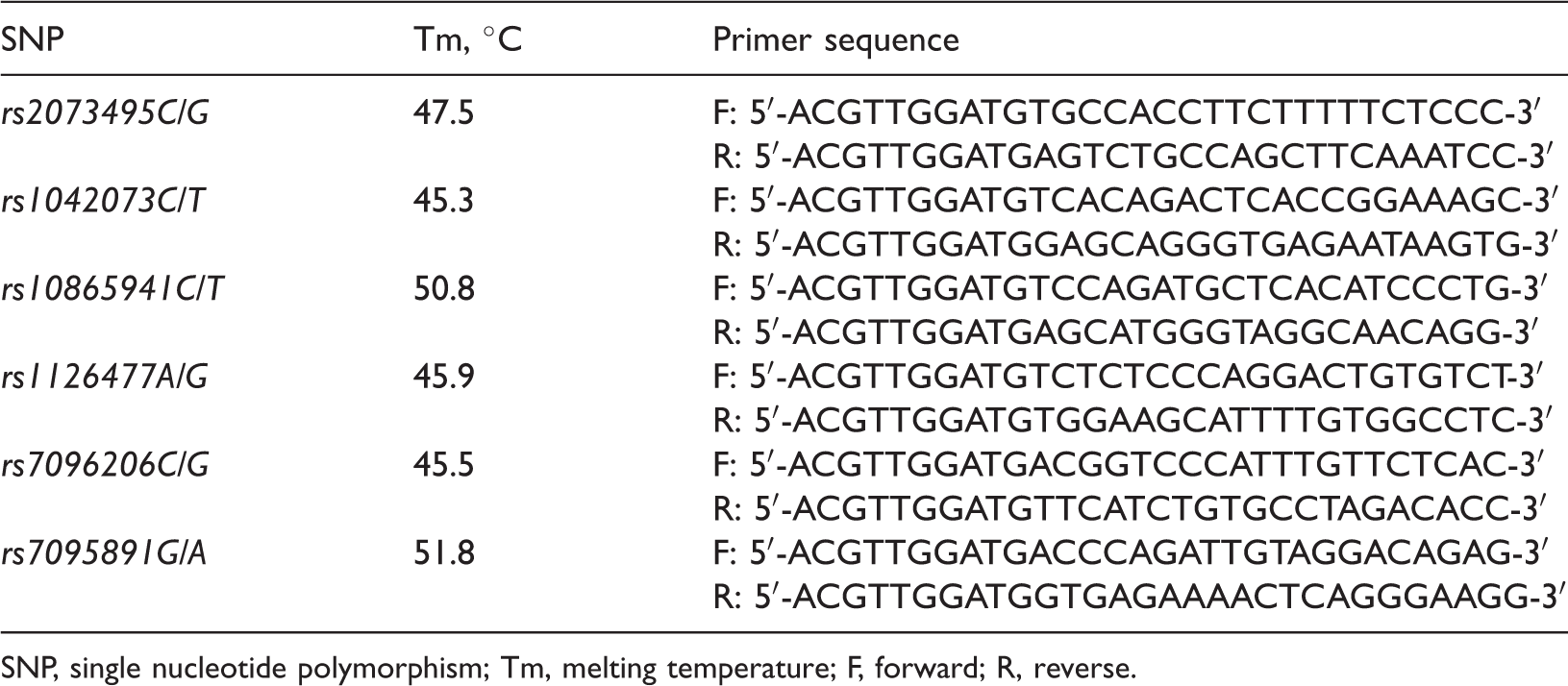
SNP, single nucleotide polymorphism; Tm, melting temperature; F, forward; R, reverse.
Statistical analysis
All data were entered in a double-blinded manner to ensure accuracy. Data analysis was performed by SPSS Statistics for Window, version 17.0 (SPSS Inc., Chicago, IL, USA). To evaluate differences in terms of allele, genotype, sex, and age between case and control groups, odds ratios were calculated and the χ2 test was used. P values <0.05 were considered to indicate statistical significance.
Results
The study included 360 children with (n = 162; 85 boys and 77 girls; case group) and without a history of caries (n = 198; 96 boys and 102 girls; control group). Table 3 shows the participants’ demographic and oral characteristics.
Demographic and oral characteristics of participants.

Data presented as n (%), except where indicated.
Abbreviation: DMFT, numbers of decayed, missing, and filled teeth.
The distributions of the six SNP frequencies in the LTF and MBL2 genes were in Hardy–Weinberg equilibrium in both case and control groups (data not shown). Allele and genotype frequencies of LTF and MBL2 gene polymorphism in the case and control groups are shown in Table 4. No significant differences were found in the frequencies of the six SNPs between the two groups.
Allele and genotype frequencies of LTF and MBL2 gene polymorphisms in 12- to 15-year-old children.

Data presented as n (%).
aTotal sample sizes differ among SNPs because the genotypes of some SNPs were unreadable.
bAdjusted for sex and age in the allele.
Abbreviations: LTF, lactoferrin; MBL2, mannose-binding lectin 2; SNP, single nucleotide polymorphism.
Discussion
The age of 12 to 15 years is a period of susceptibility to permanent caries, during which the caries rate begins to rise. Caries prevention measures are crucial to strengthen the young permanent teeth of children in this age group. 5 This analysis was undertaken to improve the oral health of children aged 12 to 15 years and better understand the dental caries susceptibility factors in children by through epidemiological investigation and genetic testing; the results may aid in formulation of health policies by local health authorities.
Dental caries is a chronic disease that is mainly caused by environmental and host factors; thus, early detection, early diagnosis, and early treatment are important considerations for prevention and treatment of dental caries. 6 , 16 In the present study, all participating children were permanent residents of a relatively small region of China, which minimized sample heterogeneity. Our epidemiological investigation showed that these children had similar socioeconomic backgrounds, diets, water fluoride concentrations, and oral hygiene statuses (some data not shown). Notably, 34.4% of the children in the survey population did not brush their teeth daily; the rates of floss and fluoride toothpaste use were very low. However, there were no statistically significant differences between the case and control groups. Nevertheless, environmental factors may play an important role in the development and progress of dental caries, and further systematic research is needed to determine their contributions.
In addition to environmental factors, many reviews and systematic evaluations have shown that genetic polymorphisms are associated with dental caries susceptibility.17–19 LTF is a gene encoding a multi-functional iron-binding glycoprotein in mammals. This protein is secreted mainly by eosinophilic neutrophils and is present in various biological body fluids (e.g., saliva, tears, and other fluids); thus, it is an important non-heme iron-binding protein in the human body. 20 The LTF protein exhibits anti-infection and immunomodulatory effects; by reducing the concentration of iron in the oral cavity, it can inhibit bacterial adhesion that contributes to the formation of plaque biofilm, thereby inhibiting bacterial growth, reducing bacterial virulence, and preventing dental caries occurrence.21–22 The LTF gene is located in human chromosome region 3p21; it contains 17 exons encoding approximately 700 amino acid residues (23–25 kb). 23 , 24 Changes in its gene-coding sequence may cause abnormal protein structure, thereby affecting its function. 25
Studies regarding the relationship between LTF gene polymorphisms and dental caries have previously focused on rs1126478. Azevedo et al. 26 found that the rs1126478 polymorphism was associated with caries susceptibility in a Brazilian population; the DMFT index of individuals carrying allele A was significantly reduced, suggesting that allele A may be a protective factor against caries. Fine et al. 27 also found that the risk of caries was significantly lower in individuals with the AA genotype. However, Volckova et al. 28 and Wang et al. 29 showed no significant associations between this polymorphism and caries susceptibility in a Czech population (aged 11–13 years) and a Chinese population (aged 4 years). Subsequently, researchers analyzed other LTF polymorphisms (rs6441989, rs2073495, rs11716497, rs1126477, rs67994108, rs28365893, rs4637321, rs35869674, and rs5848800) and found that rs6441989 allele A was associated with protection against the occurrence of caries; no associations were found with other polymorphisms.30–32 However, the role of the LTF gene in caries susceptibility is not yet fully clear. In the present study, we analyzed the relationship between LTF gene polymorphisms (rs1126477, rs2073495, rs10865941, and rs1042073) and dental caries susceptibility among children in northwestern China; we found no associations in this population, and the exact role of LTF in dental caries susceptibility requires further investigation.
MBL2 is a gene encoding serum agglutinin secreted by the liver, which plays an important role in the natural immune defense system; the protein contributes to complement activation, opsonophagocytosis, inflammatory response regulation, and apoptosis. 33 The MBL2 gene contains four exons and three introns; it is located on chromosome 10. 34 MBL2 is a candidate susceptibility gene for infectious diseases: the association between MBL2 gene polymorphisms and caries susceptibility was first reported by Pehlivan et al., 35 who analyzed two SNPs (codons 54 and 57) using polymerase chain reaction restriction fragment length polymorphism assays; however, they did not find any significant associations. Subsequently, Olszowski et al. 36 studied the relationships of MBL2 (rs1100325 and rs1800450) gene polymorphisms and caries in children; they found that allele G was a risk factor for caries. Other studies have revealed similar results. 37 , 38 In the present study, no relationships with dental caries were found involving MBL2 (rs7096206C/G) (odds ratio, 0.721; 95% confidence interval, 0.449–1.156) or MBL2 (rs7095891G/A) (odds ratio, 1.076; 95% confidence interval, 0.675–1.177). The distribution of MBL2 (rs7096206C/G) genotype in our study was similar to that of Shimomura-Kuroki et al.; 33 however, they found that the enhanced buffering capacity and CC genotype in the MBL2 gene led to significant reduction of the DMFT index. However, the precise nature of the relationship between dental caries and MBL2 requires further investigation.
In summary, because of differences in sample size, participant ethnicity, and experimental design, our results differ from the findings of some published literature, which suggests a need for future verification studies. The present study showed no evidence that polymorphisms of these genes (LTF and MBL2) are associated with dental caries susceptibility in children from northwest China. However, it is generally believed that salivary flow, pH, and salivary composition are important factors in the occurrence and development of dental caries; 39 , 40 this study did not include assessments of these parameters, which may have influenced the findings. In addition, the sample size was limited, which may reduce the generalizability of the findings. Therefore, further studies are needed with larger sample sizes and more comprehensive investigation methods.
Footnotes
Acknowledgements
We thank Limei Jin from Gansu University of Traditional Chinese Medicine for aid with statistical analysis. We also thank all volunteers who agreed to participate in this study.
Declaration of conflicting interest
The authors declare that there is no conflict of interest.
Funding
This study was funded by the Fundamental Research Funds for the Central Universities (Northwest Minzu University; grant no. 3192020082) and the Innovation Group Project of Basic Research in Gansu Province (grant no. 17JR5RA274).
