



Abstract
Objective
To investigate the association between three single nucleotide polymorphisms (SNPs) of the ATP-binding cassette (ABC) gene family and susceptibility to type 2 diabetes mellitus in a Chinese Han population.
Methods
A total of 1086 type 2 diabetes patients and 1122 healthy controls were included in this retrospective study. Three genetic variants, rs1800977 and rs4149313 in ABCA1, and rs1128503 in ABCB1 were included in the study. Susceptibility to type 2 diabetes was evaluated under three genetic models.
Results
A significant association between rs1800977 and type 2 diabetes was identified in three different genetic models (TT vs CC, odds ratio [OR] = 0.611 [95% confidence interval (CI), 0.469–0.798]; T vs C, OR = 0.841 [95% CI, 0.745–0.950]; and the recessive model, OR = 0.606 [95% CI, 0.474–0.774]). Additionally, a significant association between rs4149313 and type 2 diabetes was identified in three different genetic models (AA vs GG, OR = 0.467 [95% CI, 0.326–0.670]; A vs G, OR = 0.819 [95% CI, 0.717–0.935]; and the recessive model, OR = 0.478 [95% CI, 0.336–0.680]).
Conclusion
We found that SNPs rs1800977 and rs4149313 in ABCA1 are significantly associated with susceptibility to type 2 diabetes in a Chinese population, although this should be confirmed in a larger study.
Keywords
Introduction
Currently, 422 million patients have been diagnosed with diabetes mellitus worldwide, of whom 95% have type 2 diabetes mellitus (T2DM). 1 Diabetes is an endocrine disease 2 characterized by an absolute or relative lack of insulin secretion and a lower sensitivity of target organs or cells to insulin. 3 Specific clinical symptoms include abnormalities of glucose and lipids in the blood.
T2DM occurrence and development are related to both genetic and environmental factors. Single nucleotide polymorphisms (SNP) are one of the most common human genetic variations, accounting for more than 90% of all known polymorphisms, and hundreds have been found to be associated with T2DM.4,5 However, reported studies only explain some of the causes of T2DM, and further investigation is needed to fully understand the relationship between SNPs and T2DM.
ATP-binding cassette transporter A1 (ABCA1) is a member of the ATP-binding cassette transporter family which binds and hydrolyzes ATP, using the energy generated to transport substances including lipids, sterols, and cell metabolites.6–8 ABCA1 was previously shown to play a key role in the reverse transport of cholesterol. 9
Recent studies have shown that ABCA1 is essential for normal glucose regulation, such as on islet β cells. 10 Functional ABCA1 SNPs can change expression levels and activity, leading to differences in blood lipid levels and atherosclerosis levels. 11 However, the effects and mechanisms of functional ABCA1 SNPs on T2DM susceptibility remain unclear. Here, we aimed to investigate the association between three ABCA1 SNPs (rs1800977, rs4149313, and rs1128503) and susceptibility to T2DM in a Chinese Han population.
Materials and methods
Study participants
A total of 1086 hospitalized diabetic patients who were diagnosed according to American Diabetes Association Criteria and 1122 age-matched control individuals with no family history of diabetes recruited from Renmin Hospital of Wuhan University were included in this retrospective study. Clinical data including age, sex, and body mass index (BMI) were measured using standard laboratory techniques. Biochemical parameters including low-density lipoprotein cholesterol (LDL-C), high-density lipoprotein cholesterol (HDL-C), and glycated hemoglobin (HbA1c) were determined by an automatic biochemical analyzer using commercial kits (Shenzhen Renova Technology Industry Co., Ltd, Shenzhen, China). Blood pressure, including systolic blood pressure (SBP) and diastolic blood pressure (DBP), was measured by a sphygmomanometer with cuff. All assessments of clinical characteristic data were blinded for genotyping results. The study protocol was approved by the Ethics Committee of Renmin Hospital of Wuhan University, and written informed consent was provided by all participants.
DNA extraction and genotyping
Genomic DNA was extracted from 200 μL whole blood using the QIAamp blood kit according to the manufacturer’s protocol (Qiagen Inc., Valencia, CA, USA). Genotyping was conducted via the SNaPshot method. 12 Data were analyzed using GeneMapper™ 4.0 software (Applied Biosystems, Foster City, CA, USA). For quality control, genotyping was performed without knowledge of the subjects’ status, and 50 samples (2.26% of the cases) were randomly selected for replicate genotyping by a different technician.
Statistical analyses
SPSS version 11.0 software (SPSS Inc., Chicago, IL, USA) was used to carry out statistical analyses. Hardy–Weinberg equilibrium (HWE) was assessed in patients and controls by the chi-square test. Odd ratios (ORs) with 95% confidence intervals (95% CIs) were calculated to assess the associations between SNPs and susceptibility to T2DM. Associations between SNPs and T2DM were evaluated using three genetic models including the allele frequency model, dominant model, and recessive model. Clinical data between patients and controls were compared with the Student’s t test. Multivariate logistic regression analysis was used to assess the influence of clinical data on results. Multifactor dimensionality reduction analysis was used to assess the effect of a combination of SNPs. P < 0.05 was considered statistically significant.
Results
Population characteristics and genotype results
Clinical baseline characteristics in patients and controls are shown in Table 1 and the genotype distribution of the three SNPs is shown in Table 2. There were no significant differences in sex or age between patients and controls. However, BMI, SBP, DBP, and levels of LDL-C, HDL-C, and HbA1c were significantly increased in patients compared with controls (P < 0.001). Genotype distributions of the three SNPs also differed between patients and controls. Chi-squared analysis showed that SNPs in the control group did not deviate from HWE.
Characteristics of patients and controls.
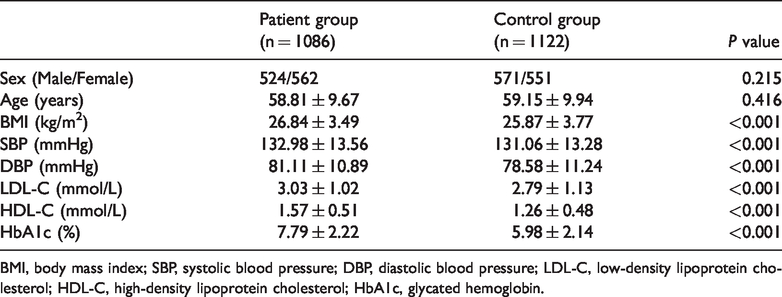
BMI, body mass index; SBP, systolic blood pressure; DBP, diastolic blood pressure; LDL-C, low-density lipoprotein cholesterol; HDL-C, high-density lipoprotein cholesterol; HbA1c, glycated hemoglobin.
Genotype distributions of SNPs and Hardy–Weinberg equilibrium test.

SNP, single nucleotide polymorphism.
*P for Hardy–Weinberg equilibrium test in the control group.
Association between rs1800977, rs4149313, and rs1128503 and T2DM
Table 3 shows that there were significant associations between rs1800977 and T2DM in three genetic models (TT vs CC, OR = 0.611 (95% CI, 0.469–0.798), P < 0.001; T vs C, OR = 0.841 (95% CI, 0.745–0.950), P = 0.005; and the recessive model, OR = 0.606 (95% CI, 0.474–0.774), P < 0.001).
Association between rs1800977 and susceptibility to T2DM.

T2DM, type 2 diabetes mellitus; OR, odds ratio; CI, confidence interval; BMI, body mass index; HbA1c, glycated hemoglobin.
*Represents the values after adjustment for age, sex, BMI, blood pressure, and HbA1c.
As shown in Table 4, there were also significant associations between rs4149313 and T2DM in three genetic models (AA vs GG, OR = 0.467 (95% CI, 0.326–0.670), P < 0.001; A vs G, OR = 0.819 (95% CI, 0.717–0.935), P = 0.003; and the recessive model, OR = 0.478 (95% CI, 0.336–0.680), P < 0.001).
Association between rs4149313 and susceptibility to T2DM.

T2DM, type 2 diabetes mellitus; OR, odds ratio; CI, confidence interval; BMI, body mass index; HbA1c, glycated hemoglobin.
*Represents the values after adjustment for age, sex, BMI, blood pressure, and HbA1c.
Genetic model distributions of rs1128503 are shown in Table 5. There were no significant differences between patients and controls in any of the five genetic models.
Association between rs1128503 and susceptibility to T2DM.

T2DM, type 2 diabetes mellitus; OR, odds ratio; CI, confidence interval; BMI, body mass index; HbA1c, glycated hemoglobin.
*Represents the values after adjustment for age, sex, BMI, blood pressure, and HbA1c.
Association between genotype and clinical data in patients
Table 6 shows that the rs1800977 CC genotype and rs4149313 AA genotype were associated with significantly lower levels of LDL-C, HDL-C, and HbA1c than other genotypes (P < 0.05).
Association between genotype and clinical data in T2DM patients.

T2DM, type 2 diabetes mellitus; LDL-C, low-density lipoprotein cholesterol; HDL-C, high-density lipoprotein cholesterol; HbA1c, glycated hemoglobin.
*Compared with wild-type homozygote, P<0.05.
Association between haplotype and T2DM susceptibility
As shown in Table 7, CG and TA haplotypes of rs1800977 and rs4149313 were associated with significantly higher risks of T2DM (P < 0.05).
Association between haplotype and susceptibility to T2DM.
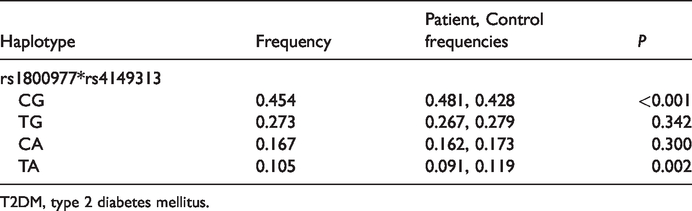
T2DM, type 2 diabetes mellitus.
Discussion
T2DM is a polygenic disease closely associated with hundreds of mutations.13–15 It is characterized by a reduced sensitivity of target organs or cells to insulin, resulting in metabolic disorders of protein and fat16,17 and clinical symptoms including an abnormal increase of blood glucose and lipids.
ABCA1 is a member of the ABC cell membrane transport family. Human ABCA1 has 50 exons and is located on chromosome 9q31.1. It is mainly expressed in the plasma cell membrane and the Golgi complex, where its encoded protein transports cholesterol and phospholipids via vesicles. 18
In this study, we investigated the association between ABCA1 variants rs1800977 and rs4149313 and ABCB1 variant rs1128503 with susceptibility to T2DM, and found that rs1800977 and rs4149313 were associated with a significantly higher T2DM risk in a Chinese Han population. In 2018, Li et al. 19 conducted a case–control study including 508 T2DM patients and 614 controls to explore the association between the ABCA1 rs1800977 polymorphism and T2DM risk in a Chinese Han population. They showed that the rs1800977 TT genotype and T allele were associated with a reduced risk of T2DM compared with the CC genotype. In 2019, Yan et al. 20 assessed the relationship between ABCA1 polymorphisms C69T and R230C in literature from PubMed, Web of Science, EMBASE, Wanfang Database, China National Knowledge Infrastructure, and Cochrane databases. They found that the ABCA1 R230C T allele was associated with a significantly reduced risk of diabetes (OR = 0.75, 95% CI, 0.57–0.98, P = 0.04).
Some studies have shown that ABCA1 rs4149313 is associated with coronary heart disease,21,22 while we identified a significant association between rs4149313 and T2DM in three genetic models in this study. Conversely, while ABCB1 rs1128503 has previously been associated with hepatocellular carcinoma and breast cancer,23,24 we found no association between rs1128503 and T2DM in this study. A possible reason for this is because rs1128503 is located in an intron of ABCB1, and introns lose their function during evolution.
It has been reported that the ABCA1 rs 2230806 polymorphism provides clinically relevant information for predicting the therapeutic response to donepezil therapy. 25 On the basis of this finding, ABCA1 gene therapy has been attempted for diabetes mellitus treatment. In another form of ABCA1-related treatment, thiazolidinediones are insulin sensitizers related to the ABCA1 gene receptor which enhance the sensitivity of cells to insulin by activating peroxisome proliferator-activated receptor (PPAR) to improve the function of islet cells. 26 For example, rosiglitazone activates PPAR-gamma, which increases ABCA1 transcription, enhances sensitivity to insulin, and reduces blood glucose levels. 27
Differences in reported associations of ABCA1 and ABCB1 SNPs with disease between studies may reflect the variation in SNP detection methods used. For example, reported techniques include restriction fragment length polymorphism analysis, allele-specific PCR, single-stranded conformation polymorphism, high-throughput DNA sequencing, and denaturing high-performance liquid chromatography.28–31 A limitation of our study was that we did not determine all lipid profile parameters. Additionally, we did not explore the possible mechanism by which ABCA1 was affected by rs1800977 and rs4149313 in T2DM. Moreover, our findings need to be verified in a larger study.
In conclusion, we showed that ABCA1 SNPs rs1800977 and rs4149313 are significantly associated with susceptibility to T2DM in a Chinese population.
Footnotes
Author’s contributions
RY, JL, and XH were responsible for the conception and design of the study. RJ and SL performed the experiments. XH and SL analyzed and interpreted the data. RJ and JL drafted the article. SL was responsible for the revision of the manuscript.
Availability of data and materials
All data generated or analyzed during this study are included in this published article.
Declaration of conflicting interest
The authors declare that there is no conflict of interest.
Funding
This research received no specific grant from any funding agency in the public, commercial, or not-for-profit sectors.
