



Abstract
Objectives
We investigated the association between the consumption of fresh and processed fish and glioma risk using a meta-analysis approach.
Methods
We selected and analyzed observational studies that discussed the relationships between fresh and processed fish intake on glioma risk from PubMed, Web of Science, Embase, and the SinoMed and Wanfang databases from inception to 31 March 2020. Studies were selected according to pre-established eligibility criteria and data were extracted separately by two researchers. A meta-analysis was conducted based on a random-effects model to provide pooled odds ratios (OR) and 95% confidence intervals (CIs).
Results
Eight studies considered the relationship between fish intake (seven fresh and seven processed fish) and glioma risk and were included in this meta-analysis. The OR effect size for fresh fish intake and glioma risk was 0.72 (95%CI 0.53–0.97) and the overall OR effect size for processed fish intake and glioma risk was 1.88 (95%CI 1.06–3.34).
Conclusion
Dietary intake of fresh fish may reduce the risk of glioma, but consumption of processed fish may increase the risk of glioma. This study had some limitations, and further studies are therefore required to clarify the associations between fish intake and glioma risk.
Introduction
Gliomas originate from glial cells and are the most common type of brain cancer, accounting for nearly 80% of all malignant primary intracranial tumors. 1 The incidence of gliomas is relatively high at about 4–5/100,000 people per year, with the highest incidence in the sixth decade of life.1,2 In addition to genetic factors, studies aimed at identifying lifestyle factors that may affect the risk of glioma have suggested that dietary intake, such as intakes of fruit and vegetables, 3 vitamins,4–6 tea and coffee, 7 and poultry and eggs, 8 may influence the development of glioma. Mozaffari et al. 9 recently reviewed the association between dietary fish intake and the risk of inflammatory bowel disease. However, the role of fish consumption on the risk of glioma is unclear. Fish are rich in polyunsaturated fatty acids (PUFAs), which can reduce the production of free radicals and carcinogens, suggesting that fish intake may reduce the risk of glioma. Although previous studies have examined the effects of fish intake on glioma risk, the results have been inconsistent. For example, Boeing et al. 10 indicated that fresh fish consumption reduced the risk of glioma, but the results were not significant, while Giles et al. 11 found an increased, but also non-significant, association between glioma risk and fresh fish intake in men. Although Hu et al. 12 showed that eating processed fish significantly increased the risk of glioma, other studies have failed to find any positive results. We therefore conducted a meta-analysis to evaluate the effects of eating fresh and processed fish on the risk of glioma.
Methods
The current meta-analysis was performed according to Preferred Reporting Items for Systematic Reviews and Meta-Analyses (PRISMA) guidelines (Figure 1). 13
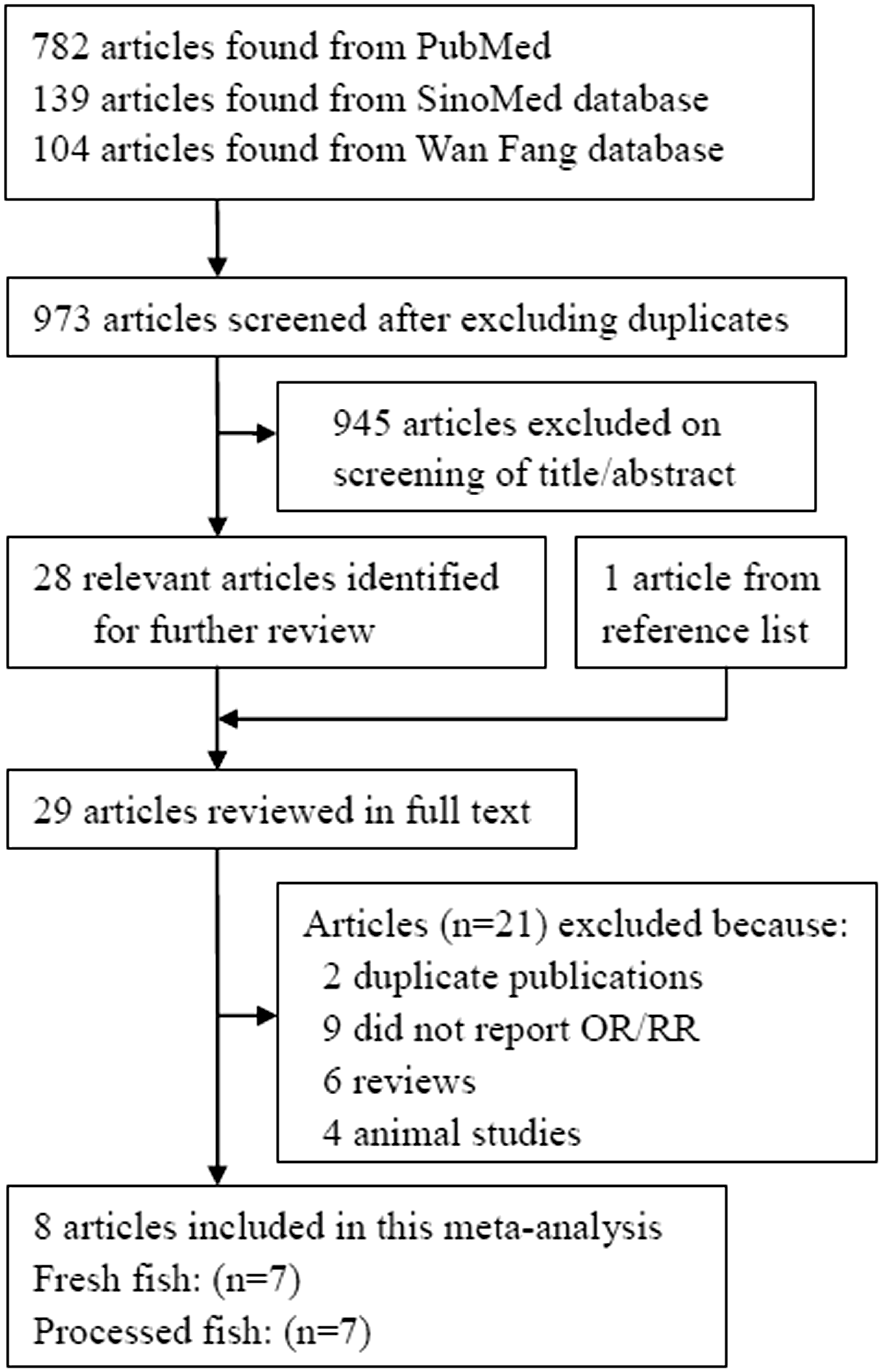
Flow chart of meta-analysis for exclusion/inclusion of studies.
Data sources and search strategies
We conducted an extensive search of PubMed, Web of Science, Embase, the SinoMed database, and the Wanfang database (from inception to 31 March 2020) using the following keywords: (“fish” OR “seafood”) combined with (“glioma” OR “brain cancer” OR “brain tumors”) with no restrictions. If the reported data were ambiguous, we contacted the original authors. The search was carried out by two authors independently, and any disagreements between these two authors were resolved by a third author. This study was a meta-analysis and was therefore exempt from approval by an ethics review committee.
Eligibility criteria
Eligible studies were selected in accordance with the following inclusion criteria: (a) observational studies, including cohort and case control studies; (b) observational studies of patients with glioma aged ≥18 years; and (c) studies that reported the association between fish intake and glioma risk and provided enough data on odds ratios (OR) and 95% confidence intervals (CIs). Case reports, review articles, preclinical studies, and other non-relevant studies, and studies with inadequate information on ORs were excluded.
Data extraction and quality assessment
Two reviewers evaluated the observational studies using the same eligibility evaluation form. Conflicting evaluations were discussed with a third investigator until the reviewers reached consensus. The detailed information listed in Table 1 was extracted by one reviewer and verified by another. The quality of each study was evaluated according to the Newcastle-Ottawa-Scale (NOS). 14
Characteristics of all studies.
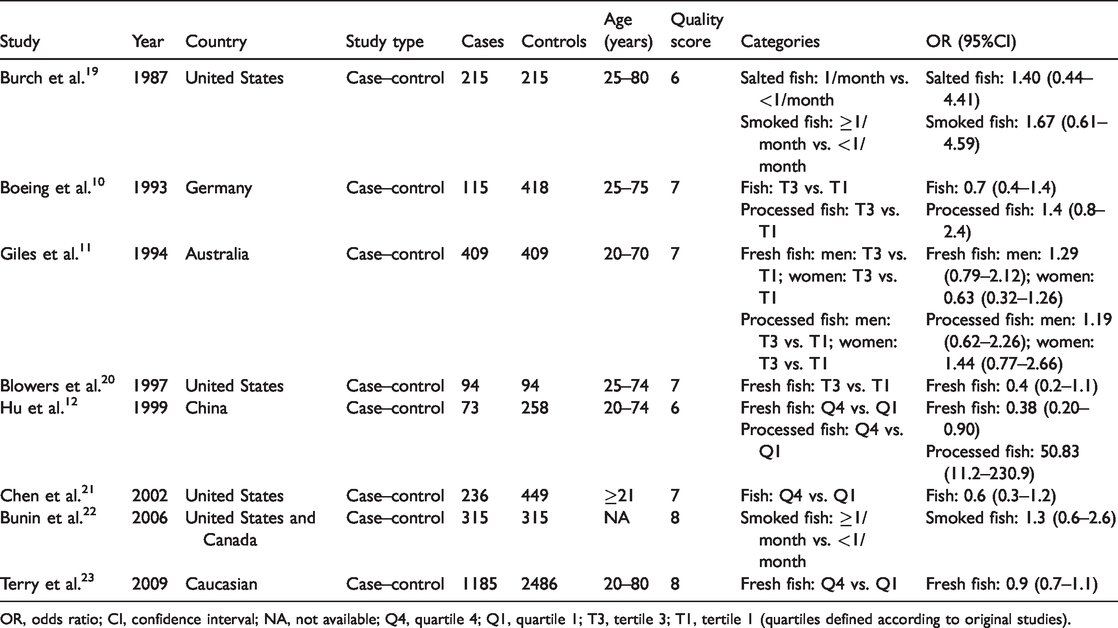
OR, odds ratio; CI, confidence interval; NA, not available; Q4, quartile 4; Q1, quartile 1; T3, tertile 3; T1, tertile 1 (quartiles defined according to original studies).
Data synthesis and analysis
This meta-analysis was based on a random-effects model and conducted using RevMan version 5.3.15,16 Outcomes were pooled with ORs and 95%CIs. Egger’s test 17 and funnel plots 18 were carried out to assess publication bias, using R 3.5.2. The I2 statistic, which describes variations across trials rather than sampling errors, was calculated to assess heterogeneity, and I2 values >50% indicated significant heterogeneity. 16 Statistical significance was set at P<0.05 for all analyses. The robustness of the results was evaluated by sensitivity analysis by excluding each study sequentially. The results were considered robust or reliable if the pooled OR of the sensitivity analysis did not differ significantly from the overall results.
Results
Study selection
A total of 782 citations from PubMed, 139 from the SinoMed database, and 104 from the Wanfang database were retrieved during the first search (Figure 1). After screening the titles/abstracts, the full texts of 29 relevant articles were reviewed, and eight articles,10–12,19–23 including 2674 glioma cases and 7350 participants, were finally subjected to quantitative synthesis and meta-analysis.
Study characteristics
Fish consumption was categorized as indicated in Table 1. Among the included studies, Boeing et al., 10 Giles et al., 11 and Hu et al. 12 reported on both fresh and processed fish intake and glioma risk. Giles et al. 11 reported the risks for men and women, respectively, and Burch et al. 19 reported risks for salt fish and smoked fish, respectively. Seven studies thus analyzed the relationship between fresh fish intake and glioma risk and seven studies analyzed the effect of processed fish intake on glioma risk. Seven of the included studies were conducted in Caucasians and the remaining one was conducted in Asians. All eight studies showed relatively high quality (>6 stars), with an average NOS score of 7. Detailed information is shown in Table 1.
Relationships between fish intake and glioma risk
The relationships between fish intake and risk of glioma stratified according to fresh and processed fish was shown in a forest plot (Figure 2). The OR effect size for fresh fish and glioma risk was 0.72 (95%CI (0.53–0.97, P = 0.032), and the overall OR effect size for processed fish intake and glioma risk was 1.88 (95%CI 1.06–3.34, P = 0.032). Subgroup analysis by quality assessment (quality score <7 or ≥7) was performed. Six of the seven included studies had quality scores ≥7 for the association between fresh fish and glioma risk, and the association was similar to the overall result (OR 0.79, 95%CI 0.60–0.98, P = 0.049). Three studies had quality scores <7 and four studies had quality scores ≥7 for the association between processed fish intake and glioma risk. The association was significant in the studies with a quality score ≥7 (OR 1.34, 95%CI 1.01–1.83, P = 0.041), but not in the studies with a quality score <7 (OR 4.59, 95%CI 0.62–33.78, P = 0.135).

Forest plot of association between fish intake and risk of glioma stratified according to fresh and processed fish.
Heterogeneity
Although we found significant associations between both fresh and processed fish intakes on glioma risk, high heterogeneity existed in both groups. We therefore conducted sensitivity analysis to assess the stability of the results. We excluded one study of fresh fish intake and glioma risk (Giles et al. 11 ), which might have influenced the substantive results. The OR effect size for the association between fresh fish and glioma risk was lower than the overall result (OR 0.65, 95%CI 0.48–0.88), and the heterogeneity was reduced to 40.4% (P = 0.136). Similarly, exclusion of one study of processed fish intake and glioma risk (Hu et al. 12 ) that carried a high risk of bias resulted in an overall OR of 1.37 (95%CI 1.02–1.83) and reduced the heterogeneity to 0.0% (P = 0.996).
Risk of bias across studies
We used funnel plots to check for possible publication bias for fresh fish (Figure 3a) and processed fish (Figure 3b). Egger’s tests for publication bias were negative for both fresh fish (P = 0.102) and processed fish (P = 0.081).

Funnel plot for the analysis of publication bias in studies analyzing effects of intake of (a) fresh fish and (b) processed fish on glioma risk.
Sensitivity analysis
Sensitivity analysis was conducted by excluding each study sequentially to identify their respective influence on the pooled OR. The results showed that removal of any study had no significant effect on the combined OR.
Discussion
Numerous studies have examined the relationship between dietary fish intake and glioma risk, with conflicting results. We therefore conducted a meta-analysis to clarify if higher intakes of fresh and processed fish affected the risk of developing glioma. Eight publications, involving 2674 glioma cases and 7350 participants, were included in the meta-analysis. The pooled results suggested that the highest category of fresh fish intake was significantly associated with a lower risk of glioma, compared with the lowest category of fresh fish intake. In contrast, however, processed fish intake could increase the risk of glioma.
A previous meta-analysis indicated that fish intake and n-3 polyunsaturated acids (PUFAs) could reduce the risk of inflammatory bowel disease. 9 Moreover, a meta-analysis by Sepidarkish et al. 24 suggested that PUFAs and vitamin E supplementation could affect oxidative stress. Fresh fish is rich in PUFAs, and may thus have anti-inflammatory effects, as well as reducing the production of free radicals and carcinogens.25,26 This could explain why increased consumption of fresh fish reduces the risk of glioma. However, processed fish may contain nitrates and nitrites, which could conversely increase the risk of glioma. 27 The current study accordingly distinguished between fresh and processed fish because of their potentially different roles in terms of glioma risk.
Seven of the eight included studies involved Caucasians and the remaining one involved Asians. The associations in the Caucasian subgroup were all consistent with the overall results. However, more studies in other ethnicities are warranted to further explore the related association.
This meta-analysis had some limitations, which should be considered when designing future studies. First, the small number of included studies might have led us to overestimate the effects of fresh fish and processed fish on the risk of glioma. Second, all the included studies were case-control studies, which may be subject to some bias. Further prospective studies are therefore needed to confirm the relationships between fish intake and glioma risk. Third, we only searched for published papers and may therefore have missed some unpublished and meeting papers, which might have influenced the results of our study. Fourth, we did not conduct subgroup analyses by age, sex, and other related factors. The included studies did not involve any subjects younger than 20 years, and there was no detailed age-stratified information in any study. Furthermore, no sex-related data were reported in any study. We aim to update this meta-analysis with additional relevant studies with fewer potential biases one age- and sex-related information becomes available.
In conclusion, dietary intake of fresh fish may decrease the risk of developing glioma, but intake of processed fish intake may increase the risk of glioma. More studies are required to explore these associations and to overcome the limitations of the current study.
