



Abstract
Objective
The functions of E-selectin, interleukin (IL)-23, and soluble intercellular adhesion molecule (sICAM) in patients with non-small cell lung cancer (NSCLC) patients before and after radiotherapy (RT) are poorly understood. The purpose of our study was to investigate serum IL-23, E-selectin and sICAM levels in NSCLC patients before and after RT.
Methods
Forty-four patients with pathologically confirmed NSCLC and 30 healthy individuals were included in the study. All patients received 66.6 Gy of concurrent RT.
Results
Significant differences were observed between serum IL-23, E-selectin and sICAM levels in controls and NSCLC patients both before and after radiotherapy. Inverse correlations were detected between serum IL-23 and E-selectin levels in NSCLC patients before and after RT. Positive correlations were detected between serum sICAM levels of NSCLC patients before and after RT and RT dose. No associations were observed between RT dose and IL-23 or E-selectin levels in patients before and after RT.
Conclusion
Serum IL-23, E-selectin and sICAM levels were elevated in NSCLC patients. While our results demonstrate the prognostic value of these parameters, further molecular studies of NSCLC patients are warranted.
Introduction
Lung cancer is very common cancer with a high mortality rate, and is the principal cause of cancer-associated mortality worldwide. Treatment of lung cancer may be individualized depending on etiological factors including tumor genetic modifications. 1 Accurate identification of etiological factors is therefore particularly important. In addition to smoking, numerous genetic and environmental factors have also been implicated in the etiology of lung cancer.
Inflammation plays an important role in various cancer types. The initiation, progression, surveillance, and control of malignancy may all be related to inflammation. 2 Inflammation and its associated cytokines also play critical roles in lung carcinogenesis. 3 Chronic inflammation may lead to structural, genetic, and epigenetic alterations that promote tumor initiation. Tumor-associated inflammation also increases tumor growth and metastatic spread. Cancer-associated alterations have been reported in inflammatory markers including C-reactive protein and high-density lipoprotein. These changes may be of prognostic value in lung cancer. 4 Interleukin (IL)-23 is a member of the wider IL-6/IL-12 superfamily. Two subunits, p19 and p40, are covalently linked to form IL-23. 5 IL-23 is released by activated dendritic cells and mononuclear macrophages. 6 IL-23 and IL-12 share a common receptor subunit known as IL-12β1. A complex of IL-12β1 and IL-23R subunits makes up the IL-23 receptor. 5 IL-23R is expressed by T cells, natural killer cells and natural killer T cells. 7 IL-23 is involved in cancer immunoediting and formation of the tumor microenvironments, and is associated with poor prognosis. 8 Increased expression of IL-23 and IL-23 receptor has been reported in colorectal cancer (CRC) patients. 6 However, the role of IL-23 in non-small cell lung cancer (NSCLC) remains unclear.
As type-I transmembrane glycoproteins, selectins play a direct role in interactions between leukocytes/platelets and endothelial cells. 9 Selectins are also known as lectin adhesion proteins and consist of three members: P-(CD62P), L-(CD62L) and E-selectin (CD62E). 10 During inflammatory responses, endothelial activation occurs through the action of pro-inflammatory factors, and E-selectin is shuttled from the cytoplasm onto the endothelial cell surface. As they migrate, tumor cells act like leukocytes, adhering and achieving extravasation using a similar mechanism. 11 The aggregates formed through interactions between normal cells and tumor cells are not recognized by the host immune system. 12 Köhler et al. 13 reported that the absence of P- and L-selectin significantly decreased the numbers of thrombi and tumor metastases in mouse models.
Soluble intercellular adhesion molecule (sICAM) is a member of the immunoglobulin superfamily and together with selectins, plays an important role in adhesion and transmigration of leukocytes at sites of inflammation. Similarly to E- and P-selectin, sICAM is expressed by endothelial cells. 14 Selectins and sICAM cooperatively mediate optimal leukocyte responses to inflammation, a process that depends on the expression of other adhesion molecules. sICAM is the circulating form of a transmembrane molecule and is involved in numerous essential processes including endothelial transmigration of leukocytes, cell signaling, cell–cell interaction, cell polarity, and tissue stability. 15 ICAM and sICAM are expressed at high levels under inflammatory conditions, in chronic diseases and in various malignancies.15–18
The functions of E-selectin, IL-23, and sICAM in lung cancer are not fully understood. Here, we investigated serum IL-23, E-selectin, and sICAM levels in NSCLC patients before and after radiotherapy (RT).
Methods
Patients with pathologically confirmed NSCLC as well as healthy individuals were included in the study. Mean age at NSCLC diagnosis was 61±8.15 years (mean ± standard deviation; range: 43 to 76 years). Consent was obtained from all patients before proceeding with sample collection. Ethical approval for this study was obtained from the Atatürk University Medical Faculty Medical Ethics Committee (reference number: B.30.2.ATA.0.01.00/119).
All patients were diagnosed at the radiation oncology outpatient clinic. None of the subjects were taking any medications affecting platelet and lipid function. Patients with chronic diseases, hypo- or hyperthyroidism, history of steroid use, or cardiac disease were excluded. All subjects were staged based on the American Joint Committee on Cancer criteria. Tumor volume was defined as the gross volume of the primary tumor and also included the lymph nodes. All patients received intensive modulated radiotherapy and volumetric arc therapy throughout the course of RT. RT was applied 5 days per week for 6 weeks in 1.8- to 2-Gy fractions (total 66–66.6 Gy) using a Varian Trilogy Version 13.6 device (Series No: 6196; Varian, Palo Alto, CA, USA).
Blood pressure was recorded with patients in the supine position and the cuff applied to the right arm. Following 12-h overnight fasting, 10 mL blood specimens were collected by venipuncture into heparinized glass tubes. The samples were centrifuged at 4000 rpm for 10 minutes and plasma samples were stored at −80°C. Serum IL-23, E-selectin and sICAM levels were measured using commercial kits (Human IL-23 Coated ELISA Kit, BMS2023-3/BMS2023-3TEN; Human sE-Selectin Platinum ELISA Kit BMS205/BMS205TEN; and Human sICAM-1 Immunoassay Kit, KHS5412/KHS5411; Invitrogen, Vienna, Austria).
Data were presented as mean ± standard deviations. Statistical analysis was performed using SPSS version 20.0 (SPSS Inc., Chicago, IL, USA). Differences between groups were assessed using the Student’s t-test for continuous data. Linear regression analysis was used to examine associations between variables. Values of p < 0.05 were considered statistically significant.
Results
Forty-four NSCLC patients (6 women and 38 men) and 30 healthy individuals were enrolled in this study A summary of patient demographic characteristics is shown in Table 1. Nine patients had a history of alcohol consumption and 18 patients had a family history of cancer. Twenty patients were diagnosed at stage 3A and 24 at stage 3B. Twenty-nine patients were receiving paclitaxel–carboplatine (P-C) chemotherapy, while the remaining patients were receiving cisplatine–vinorelbine (C-V) chemotherapy. Electrocardiograms were normal for all subjects.
Clinical and demographic characteristics of study subjects.

Abbreviations: BMI, body mass index; P-C, paclitaxel-carboplatine; C-V, cisplatine-vinorelbine; KPS, Karnofsky performance status. Data represent means ± standard deviations or numbers of subjects.
Serum IL-23, E-selectin and sICAM levels were higher in NSCLC patients before and after RT compared with control subjects (Table 2). Serum IL-23 and E-selectin levels were negatively correlated in NSCLC patients before and after RT, although these associations did not reach the threshold for statistical significance (r = −0.275 and r = −0.293, respectively). Serum sICAM levels before and after RT and RT dosage were positively correlated in NSCLC patients (r = 0.365, p < 0.01; r = 0.374, p < 0.01, respectively). No statistically significant associations were observed between RT dose and serum IL-23 or E-selectin levels in patients before and after RT. No correlation was identified between serum IL-23 and sICAM levels before and after RT in NSCLC patients. There was a significant difference in serum E-selectin levels of patients receiving both P-C and C-V chemotherapy before and after RT (p < 0.05 for both groups). However, there was no correlation between chemotherapy regimen and serum IL-23 or sICAM levels before and after RT. C-V chemotherapy was administered more often than P-C chemotherapy before and after RT. There were no correlations identified in serum IL-23, E-selectin and sICAM levels before and after RT.
Levels of serum IL-23, E-selectin and sICAM in controls and patients.
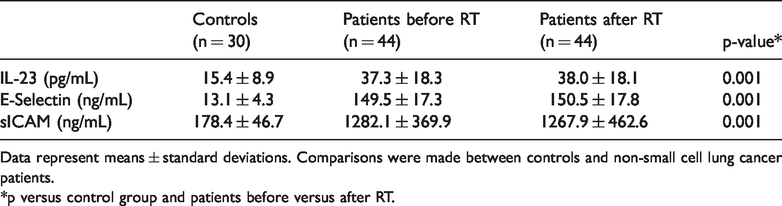
Data represent means ± standard deviations. Comparisons were made between controls and non-small cell lung cancer patients.
*p versus control group and patients before versus after RT.
Discussion
This study investigated serum E-selectin, sICAM and IL-23 levels in NSCLC patients before and after RT. We found that serum E-selectin, sICAM and IL-23 levels were elevated in NSCLC patients before and after RT. IL-23, one of the cytokines investigated in this study, supports Th17 cell proliferation. Development of Th17 cells is initiated by IL-6 and transforming growth factor-β. 19 IL-17 is involved, together with IL-23, in various biological processes. Similarly to IL-17, the association between cancer and IL-23 has been examined in previous studies. Elevated levels of IL-23 have also been identified in the tumor microenvironment 8 and were linked with poor prognosis. 20 Elevated serum IL-23 levels have also been reported in cancer patients. Ljujic et al. 21 reported higher serum IL-23 levels that were significantly correlated with expression of vascular endothelial growth factor (VEGF) in tissue in subjects with CRC. Adamo et al. 22 observed higher serum IL-23 levels in resected CRC patients and post-chemotherapy CRC patients compared with healthy individuals. Stanilov et al. 23 investigated the relationship between serum levels of IL-23 and IL-12p40 and survival of CRC. Gangemi et al. 24 reported higher IL-23 levels in breast cancer patients compared with healthy controls. However, to the best of our knowledge, serum IL-23 levels have not previously been investigated in lung cancer patients. Our findings document, for the first time, serum IL-23 elevations in NSCLC patients after RT compared with healthy controls and with serum samples before RT. We speculate that IL-23 is released in response to the secretion of growth factors, signaling molecules and anti-apoptosis proteins. Additionally, increases in IL-23 levels may be triggered by the release of cell adhesion molecules such as sICAM and activation of the SMAD, STAT3 and NF-κB pathways. Soluble E-selectin has been reported to exert chemotactic effects on various cell types, including endothelial cells and leukocytes.25–27 However, little is known regarding its effects on tumor progression and metastasis. ICAM-1-dependent adhesion at low shear stress obviates the need for interaction with endothelial E-selectin. Initial adhesion by means of endothelial E-selectin can be bypassed when abundant CD44+ cells and circulating soluble E-selectin interact with the ICAM-1-expressing endothelium at low shear stress. Our study examined the effect of soluble E-selectin on shear-resistant adhesion and on non-small cell lung cancer cell migration. Adhesion of CRC cells to E-selectin has been reported to be of great significance in cancer progression. 28 Interaction between E-selectin and its receptor DR3, found on cancer cells, is believed to trigger intracellular signaling, thus improving both the motility and survival of transformed cells. Signal transmission is a reciprocal phenomenon involving stimulation of endothelial cells, while their permeability increases. 29 The principal role of selectins in cancer growth is believed to be in formation of metastases. 30 Uner et al. reported higher E-selectin levels in cases with metastases to the liver. Ye et al. 31 showed significantly higher expression of E-selectin in endothelial cells of microvessels supplying metastatic foci compared with the primary tumor vascular endothelium. This finding may also explain the higher E-selectin levels observed in metastatic subjects in the present study. Our findings revealed that soluble E-selectin levels were correlated with the presence of metastases and tumor dimensions. However, further studies with larger patient numbers are needed to confirm this finding. Soluble E-selectin levels were significantly higher in NSCLC patients before and after RT compared with healthy controls. E-selectin is believed to be a marker of endothelial cell activation. High E-selectin levels in plasma probably reflect endothelial activation in NSCLC patients, and implicate this selectin in cancer development.
ICAM-1 expression is upregulated in malignant pancreatic tissue compared with normal tissue. This may indicate that increased ICAM-1 expression its involved in the migration of cancer cells to distant organs. 32 The results of functional studies examining the effect of ICAM-1 on metastasis in pancreatic cancer cells have been inconsistent, with ICAM-1 reported to play both pro- and anti-metastatic roles. Various studies have proposed that enhanced ICAM-1 expression in senescent human omentum-derived mesothelial cells can enhance peritoneal adhesion of selected pancreatic cancers. 33 Various cytokines and growth factors, such as tumor necrosis factor-α, interferon-γ, IL-1β, and transforming growth factor-β, regulate the expression of ICAM-1. 34 Hypoxia and antiangiogenic therapy both enhance the epithelial to mesenchymal transition in a number of epithelial tumors. 35 Hypoxia-inducible factor (HIF)-1α expression has been shown to promote tumor growth, angiogenesis, and disease progression in the majority of human cancers, including malignant gliomas. 36 Studies have linked hypoxia and HIF-1α expression to RT and chemotherapy resistance. These studies observed that p-STAT3 upregulated ICAM-1 expression under hypoxic conditions in both in vivo and in vitro settings. Various nuclear transcription factors other than HIF-1α have also been identified as regulating ICAM-1 gene expression. These include activator protein-1, NF-κB, CCAAT/enhancer binding protein, E26 transformation-specific transcription factor, STAT, and specificity protein-1. 37 In 1997, Naik et al. 38 identified the ICAM-1 interferon-γ response element as a palindromic STAT binding site, and described it as being homologous to interferon-γ-activating sequences. More recently, ICAM-1 expression in glioma was shown to be upregulated by the activation and interaction of NF-κB and STAT3. ICAM-1 expression was also determined to play a role in mediating tumor cell invasion and migration in response to RT. 39 In one study, SNB75 glioma cells were implanted into nude mice. RNA was subsequently isolated from the tumor site and exposed to chromatin immunoprecipitation. The results showed that STAT3 binds to ICAM-1. 40 In our study, inhibition of STAT3 suppressed expression of ICAM-1 under hypoxic conditions in an in vitro setting. ICAM-1 has been linked to invasion and metastasis in various forms of cancer. Adhesion molecules including integrins and ICAM-1 mediate monocyte adhesion to the vessel wall. 41 sICAM may be significantly involved in this process, regulating NSCLC metastasis through different cell adhesion mechanisms and transcription factors such as p53 and p21.
In conclusion, serum IL-23, E-selectin and sICAM levels were increased in NSCLC patients before and after RT. While our results demonstrate the prognostic value of these parameters, further molecular studies of NSCLC patients are needed to achieve a better understanding of underlying factors.
Footnotes
Acknowledgement
We gratefully acknowledge Dr. Seda Askin who helped with the study design and with the biochemical study.
Declaration of conflicting interest
The authors declare no potential conflicts of interest with respect to the research, authorship, and/or publication of this article.
Funding
The authors received no financial support for the research, authorship, and/or publication of this article.
