



Abstract
Objective
To describe clinicoradiological features and outcomes of reversible splenial lesion syndrome (RESLES) in children.
Methods
Data from 23 children (25 RESLES episodes; two patients had recurring episodes) was retrospectively reviewed at the Department of Pediatric Neurology, Shandong Provincial Hospital Affiliated with Shandong University, China. Primary disease, central nervous system manifestations, treatments, outcomes, and laboratory examination, electroencephalogram, and magnetic resonance imaging (MRI) results were assessed.
Results
Fourteen boys and nine girls (23 patients; 8 months to 11 years old) with 25 RESLES episodes (20 type-1, 5 type-2) were enrolled. Epileptic seizure and infection were the most common pathogenesis. Prominent clinical manifestations were disturbance of consciousness and visual disturbance. Cranial MRI of 20 RESLES type-1 episodes showed oval lesions in the splenium of corpus callosum (SCC), and five RESLES type-2 episodes showed lesions in the entire corpus callosum that were associated with the symmetric cerebral white matter. Lesions were hyperintense on diffusion-weighed images (DWI) and disappeared when later reviewed (range, 4–30 days).
Conclusions
RESLES etiology in children is complex, and its clinical manifestations are nonspecific. Diagnosis mainly depends on cranial MRI, especially DWI, showing highly intense lesions on SCC. RESLES has a good prognosis and excessive treatment should be avoided.
Keywords
Introduction
Reversible splenial lesion syndrome (RESLES) is a new clinicoradiological syndrome with typical imaging characteristics. It can be divided into two types based on the region that is involved.1,2 Type-1 shows an isolated splenium of corpus callosum (SCC) lesion, which is the typical type. Type-2 is rarely seen and it shows extensive white matter and/or entire callosal lesions.
Previous reports3,4 illustrated that there is no significant difference in etiology, presentation, imaging performance, and outcome between child- or adult-onset RESLES. It can develop in association with various factors, such as infection, epilepsy-related factors (epileptic seizures, antiepileptic drug use, and antiepileptic drug withdrawal), and metabolism disorders. However, the underlying pathogenesis and overall clinical and radiological features of RESLES are not completely clear. RESLES has attracted an increasing amount of attention with the popularity of cranial magnetic resonance imaging (MRI).5,6 However, studies with larger sample sizes and that include children, especially those with RESLES type-2, are rare.
In this study, we described the clinical and radiological features and outcomes of 23 RESLES children (25 episodes: 20 type-1 and five type-2). We summarized data for the main etiology, central nervous system (CNS) manifestations, laboratory examination results, electroencephalogram (EEG) findings, MRI findings, treatment, and outcomes, and we also discussed potential RESLES mechanisms.
Patients and methods
Patients
The study was approved by the ethics committee of Shandong Provincial Hospital affiliated with Shandong University, and written informed consent was obtained from the parents or legal guardians of all patients. We performed a retrospective study of 25 RESLES episodes that occurred in 23 children (8 months to 11 years of age) from December, 2011 to January, 2019 in the Department of Pediatric Neurology, Shandong Provincial Hospital affiliated with Shandong University. We identified patients based on the following inclusion criteria, in accordance with Garcia-Monco et al. 7 : 1) presented with or without neurological deficits; 2) MRI images showing cytotoxic edema in typical locations (type-1 lesions limited to the SCC and type-2 lesions spread to the entire corpus callosum, adjacent white matter, or both); and 3) both the imaging findings and clinical symptoms were reversible. The exclusion criteria include the following: 1) lesions were persistent or lack of follow-up; and 2) other demyelinating disorders involving the splenial lesions, such as acute disseminated encephalomyelitis (ADEM).
Methods
Data from our patients (14 boys and 9 girls) were collected via medical records and the patients were followed up. Clinical data including the primary disease, CNS manifestations, laboratory examination results, EEG findings, MRI findings, treatment, and patient outcomes were reviewed by all authors. Cranial MRI was performed on a 3T magnetic resonance system (Signa HDx 3.0T, General Electric Healthcare, Milwaukee, IL, USA) using a standard 16-channel head coil at the Shandong Medical Imaging Research Institute. The sequences and parameters were as follows: transverse T1-fluid attenuated inversion recovery (FLAIR); transverse and sagittal T2-weighted images (T2WI) with periodically rotated overlapping parallel lines with enhanced reconstruction; transverse T2-FLAIR; transverse diffusion-weighted images (DWI; echo-planar imaging sequence; b-value, 0; 1000 seconds/mm; TR, 5300 ms; TE, 74.3 ms; FOV, 240 × 240 mm; matrix, 160 × 160; slice thickness, 5.0 mm; intersection gap, 1.5 mm; number of excitations, 1), and apparent diffusion coefficient (ADC) map. Images were analyzed by at least two radiologists who had over 5 years of experience with neuroradiologic imaging.
Results
Main etiology
The primary diseases that were associated with the 25 RESLES episodes that occurred in 23 children (two patients had recurring episodes) are as follows (Table 1): eight epilepsy (one was caused by sudden withdrawal of an antiepileptic drug), nine respiratory tract infection, three digestive tract infection, two bacterial meningitis, one viral encephalitis, one acute lymphoblastic leukemia, and one primary adrenocortical insufficiency. Among the 25 RESLES episodes that occurred in 23 children, 18 had an epileptic seizure (four patients had status epileptics) and 16 had an accompanying infection with fever (seven patients had a specific etiology, five of which were viral and two of which were bacterial). Nine patients had both epileptic seizure and infection.
Clinical data from the patients with RESLES.

RESLES, reversible splenial lesion syndrome; y, years; m, months; M, male; F, female; CNS, central nervous system; CSF, cerebrospinal fluid; EEG, electroencephalogram; MRI, magnetic resonance imaging; I, RESLES type I; II, RESLES type II; DEX, dexamethasone; ↑, increase; -, normal; ↓, decrease; LOC, level of consciousness; SE, status epileptics; EB virus, Epstein–Barr virus.
*Cases with recurrence.
CNS manifestations
Except for the manifestations of primary disease, CNS manifestations of RESLES were mild or non-existent. Five RESLES episodes appeared as a disturbance of consciousness including two comatose patients in whom the symptoms lasted for 4 to 8 days, and two RESLES episodes where the child showed a visual disturbance that lasted for 1 to 2 days (Table 1).
Laboratory examinations
Among the episodes, 19 were associated with normal serum sodium levels and 6 were associated with hyponatremia (minimum, 125 mmol/L). Fifteen episodes were associated with a cerebrospinal fluid (CSF) examination, and the results of 13 CSF examinations were normal; the results of 2 of them showed a primary disease, which was bacterial meningitis (Table 1).
EEG findings
All the episodes were associated with an EEG examination and 3 of the examination results showed epileptiform discharges, 6 showed the slow-down electroencephalogram background, and 16 showed normal results (Table 1).
MRI findings
All the episodes were checked using MRI at 2 to 7 days after the episode occurred. Lesions in the SCC with or without symmetrical cerebral white matter were found. These lesions were characterized by a hyperintense signal on T2WIs, FLAIR images, and DWIs, and a hypointense signal on ADC maps. The lesions had clear border and no obvious enhancement. The peripheral lesions also had no obvious edema or mass effect. In 20 RESLES type-1 episodes, MRI showed the oval-shaped lesions in SCC (Figure 1). In the five RESLES type-2 episodes, MRI indicated that the lesions involved the entire corpus callosum associated with the symmetrical white matter of the periventricular and centrum semiovale (Figure 2). All the lesions had resolved when the patients were re-scanned (at an interval of 4 to 30 days, Table 1).
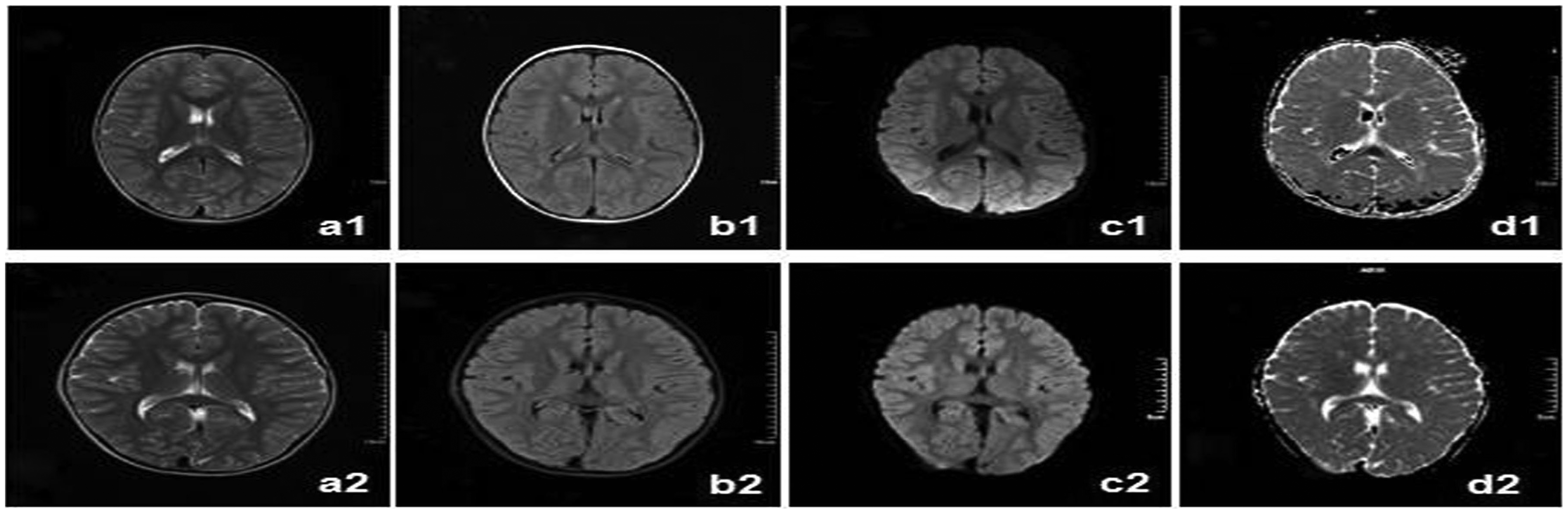
RESLES type I in pre-treatment and post-treatment (case 9).

RESLES type II in pre-treatment and post-treatment (case 1).
Treatment and outcomes
Patients received drug therapy for primary diseases and symptomatic treatment with each episode, and six of these treatments included steroid therapy (five with dexamethasone and one with hydrocortisone). The symptoms resolved in 1 to 8 days (Table 1). All patients were followed up for 1 to 7 years. The symptoms that were observed in their early stages resolved and the patients had a good prognosis. One child with acute lymphoblastic leukemia died of pneumorrhagia.
Discussion
RESLES is a new clinicoradiological syndrome that was initially reported as mild encephalitis/encephalopathy with a reversible splenial lesion (MERS) by Tada et al. 8 In 2011, Garcia-Monco et al. 7 described the clinical imaging syndrome in detail and proposed this new term. RESLES is characterized by reversible lesions in the SCC, and most patients have an excellent prognosis. However, some patients 9 might have severe neurological sequelae. Therefore, Starkey et al. 10 suggested that the syndrome be named “cytotoxic lesions of the corpus callosum,” to highlight the partial irreversibility of the disease.
Clinically, RESLES is associated with a wide range of diseases and conditions. Epileptic seizure and infection are the most common reasons, 7 which is similar to our findings in the study. However, the mechanisms underlying RESLES are not fully understood. 11 Signal changes on DWI and ADC indicate that transient cytotoxic edema is the main pathogenesis of RESLES. 12 In the past, several hypotheses have been suggested including intramyelenic or interstitial edema. 8 Recently, some experiments13,14 have confirmed that there is no significant decrease in the fractional anisotrophy (FA) value in the SCC, which suggests that the integrity of the myelin sheath and the function of the axons in the myelin sheath are almost unaffected. In addition, there was an 8-month-old baby who contracted purulent meningitis in our series and five neonatal RESLES cases. 15 Because myelin sheaths in these infants are not yet developed, some researchers10,16 suggested that the exact pathogenesis of RESLES is located in astrocytes rather than inside or beneath myelin, as it was previously thought. Various conditions16,17 have recently been reported to trigger the reversible lesions in the SCC, and this can also affect AQP4 protein expression, leading to increased expression levels through a complex cell–cytokine interaction or an intracranial microenvironment osmotic mechanism. This pathogenic mechanism for RESLES appears to explain the most possible causes of inducing RESLES. However, it is possible that several mechanisms are involved considering the diversity of the etiologies.
The CNS manifestations of RESLES were nonspecific, and they were mainly related to the event that caused this condition. In our series, a decreased level of consciousness and visual disturbances were the most common abnormal presentations. Most children were had no specific nervous system signs and symptoms, which is consistent with other studies.18,19 The corpus callosum serves as a bridge that permits a constant exchange of information between the right and left hemispheres of the brain. The SCC connects bilateral occipital fibers, which suggests that the common clinical manifestation of RESLES involves a disturbance of awareness and vision. Among the five episodes of disturbance of consciousness, there were three RESLES type-2 episodes, which suggests that the increased frequency of lesions outside of the SCC was associated with the increased incidence of consciousness disorders. 18 Many studies have reported that seizure was the most common neurological symptom, but this cannot be explained by the involvement of cerebral white matter in imaging. Thus, there are likely other mechanisms involved. For example, febrile convulsion that occurs during acute infection may have other causes such as high intracranial pressure. Some scholars stressed that the seizure may not be the specific clinical manifestation of RESLES. 4
Similar to previous studies, 20 MRI in our study showed characteristic evidence of SCC involvement, which is sometimes associated with the entire corpus callosum and symmetrical cerebral white matter. These lesions all showed hyperintense signals on DWI with a low ADC value, which indicated the presence of cytotoxic edema in this disease. A limitation in the diffusion on DWI is particularly useful for detecting early changes in the brain. Awareness of its imaging features allows us to differentiate it from other demyelinating diseases, such as ADEM. ADEM presents as bilateral white matter lesions as RESLES type-2, but ADEM lesions are usually asymmetrical and can persist for months on cranial MRI. Takanashi et al. 21 speculated that RESLES type-1 and type-2 were two stages in the evolution of RESLES. They assumed that type-2 resolved completely by passing through a type-1 stage or that other parts of the corpus callosum and adjacent white matter were only slightly involved and could not be seen using routine DWI. This speculation was supported by Qing et al. 17 In our series, MRI results of the five RESLES type-2 episodes were re-examined at 11- to 28-day intervals, and all lesions had disappeared completely. Thus, whether type-1 existed as a mid-evolution process is not known. However, understanding the extent of RESLES is an important step toward understanding the pathology of this disease.
In addition to treating the primary disease, RESLES treatment is non-specific, and the most common treatment is steroid therapy. There were 16 patients (16/54, 29.6%) and 7 patients (7/23, 30.4%) who received steroid therapy in a previous article, 16 and all the patients had a good prognosis. In our series, six patients were administered steroid therapy (one patient with primary adrenocortical insufficiency; one patient with acute lymphoblastic leukemia; four patients with serious clinical symptoms or imaging results). Nineteen patients with a RESLES episode (17 RESLES type-1 and 2 RESLES type-2) had mild clinical symptoms and they did not receive steroid therapy. All of these patients had no neurological sequelae after follow-up. Whether the steroid therapy was a necessary treatment requires further study with more patients and longer follow-up observation.
There is a limitation to our study. The patients were all from only one hospital and the number of subjects was relatively small. Further studies with a larger number of patients from multiple centers are necessary to confirm our results.
In conclusion, RESLES has various etiologies and pathogenesis with a very particular clinical course. Cranial MRI, especially DWI, is an essential tool to identify this condition. Clinicians should be aware of how to identify it and ensure that these patients undergo close follow-up observation. Specific interventions do not seem to be warranted.
Footnotes
Acknowledgments
We would like to thank staff at the Shandong Medical Imaging Research Institute for kindly providing the relevant information.
Declaration of conflicting interest
The authors declare that there is no conflict of interest.
Funding
This work was supported by Shandong Natural Foundation, China to Prof. A. Ma (no. ZR2017MH021).
