



Abstract
Objective
Hajj is an important component of Islam. This study aimed to determine the effect of wearing a cotton towel or plain cotton ihram on the onset of respiratory symptoms and fractional exhaled nitric oxide (FeNO) levels in Hajj pilgrims.
Methods
One hundred male nonsmoking subjects (age: 20–60 years) without a previous clinical history of respiratory illnesses were included. Fifty subjects were dressed in a cotton towel ihram and 50 wore a plain cotton ihram (control group). Respiratory symptoms and FeNO levels were recorded on the day before leaving for Hajj, when ihrams were removed, and when the pilgrims had returned home.
Results
Pilgrims who wore cotton towel ihrams showed significantly higher rates of respiratory symptoms, including being generally ill, coughing, a sore throat, and a runny nose, than those who wore plain ihrams. FeNO levels also tended to be higher in pilgrims who wore a cotton towel ihram compared with those with a plain cotton ihram during and after Hajj.
Conclusions
Hajj pilgrims who wear cotton towel ihrams may have a risk of respiratory symptoms, including a cough, sore throat, and runny nose. Therefore, a plain cotton ihram is advisable while performing Hajj to minimize respiratory illness.
Introduction
Hajj is a unique Islamic religious event where approximately 2.5 million Muslims from various parts of the world travel to Makkah, Saudi Arabia each year to perform Hajj rituals from the 8th to 12th Dhul-Hijjah (lunar calendar). 1 While performing Hajj, Muslim men must wear a special dress called ihram, which consists of two white un-stitched sheets of cloth. During Hajj, pilgrims dress up in ihram from the early morning of the 8th Dhul-Hijjah and remove the ihram on the afternoon of the 10th Dhul-Hijjah. From the 10th to 12th Dhul-Hijjah, all Hajj pilgrims perform their remaining Hajj rituals without an ihram.
Usually there are two types of ihrams, cotton towel ihrams (ihram with fibers) and plain cotton ihrams (ihram without fibers). The majority of pilgrims tend to wear a cotton towel ihram, which attracts dust and becomes a source of air pollution because of the cotton fibers. The respiratory system is the most vulnerable system in the body for air pollution. Cotton fibers elicit pro-inflammatory mediators that are involved in acute or chronic respiratory inflammation. 2 Exposure to cotton fibers and associated dust is associated with specific and non-specific respiratory symptoms. 3
Respiratory symptoms are commonly reported during Hajj season in Hajj pilgrims. 4 Multiple factors can cause health problems in Hajj pilgrims; however, we believe that wearing a cotton towel ihram with fibers may be a leading factor for respiratory complaints in Hajj pilgrims. Therefore, this study aimed to determine respiratory symptoms and fractional exhaled nitric oxide (FeNO) levels in Hajj pilgrims wearing a cotton towel ihram compared with those wearing a plain cotton ihram before, during, and after Hajj.
Methods
This cross-sectional study was carried out in accordance with the Declaration of Helsinki. The study protocol was approved by the Institutional Review Board, Ethics Committee, College of Medicine Research Centre, King Saud University, Riyadh (IRB No: E-14-1245). The subjects provided verbal consent for the study.
Exclusion criteria
Subjects who had diabetes mellitus, chronic respiratory diseases, a cough, a sore throat, a runny nose, asthma, malignancy, and cigarette or shisha smoking were excluded. Subjects working in an industry that generates dust or fumes were also excluded from the study.5,6
Selection of subjects
In this study, 160 male Hajj pilgrims were enrolled, However, following a clinical history, 100 were selected for respiratory complaints and FeNO measurements. During the course of the study, 10 participants were unable to adequately perform the FeNO test and were excluded from the study. Besides anthropometric parameters, respiratory symptoms and FeNO levels were recorded on the 5th Dhul-Hijjah, which was the day before leaving Makkah, as baseline data.
On the evening of the 6th Dhul-Hijjah, 50 participants were dressed in cotton towel ihrams and 50 in plain cotton ihrams (control group), and they traveled to Makkah in separate buses. On arrival in Mina, which is located near Makkah where all the pilgrims gather for Hajj rituals, separate tents were allotted to each group of pilgrims and they were instructed not to mix. Ihrams were removed on the 10th Dhul-Hijjah in the afternoon. Respiratory symptoms and FeNO levels were then recorded for a second time. All Hajj rituals were completed on the 12th Dhul-Hijjah in the evening and pilgrims traveled back to Riyadh in designated buses. On the 15th Dhul-Hijjah, all of the above-mentioned parameters were evaluated.
Measurement of FeNO levels
Measuring FeNO levels is easy, and it is a noninvasive biomarker of airway inflammation. Because our study involved measuring airway inflammation due to cotton fibers, we used this technique for evaluating airway inflammation. 7 FeNO levels were measured by using the Niox Mino (Aerocrine, Solna, Sweden). The FeNO device was pre-calibrated by the manufacturer for a fixed life span (300 measurements). The well-defined procedures in performed the FeNO test were based on the official statement of the American Thoracic Society of standardization procedures for FeNO measurements. 7 The participants of the study were provided a brief description about the whole procedure before the actual test was conducted. Three measurements were recorded as follows. The first sample was taken before Hajj, the second sample was taken after Hajj, and the last sample was taken when the pilgrims returned from in Riyadh. The test was performed with the subject in the standing position using a nose clip. The results were visualized on the screen of the Niox Mino.
Statistical analysis
The data were analyzed by using the Statistical Package for Social Sciences (SPSS) version 20.0 for Windows (IBM Corp., Armonk, NY, USA). The Student’s t-test was applied to determine the difference in means between two quantitative variables. The level of significance was assumed at p < 0.05.
Results
Fifty subjects had respiratory complaints and 45 subjects had FeNO measurements taken. There were no significant differences in age, height, and weight between subjects who were wearing a cotton towel or plain cotton ihram. Both groups were well matched for age, height, and weight (Table 1).
Comparison of anthropometric parameters of subjects wearing a plain cotton ihram with those of subjects wearing a cotton towel ihram.

Vales are presented as mean ± standard error of the mean.
Participants with respiratory complaints were excluded. Therefore, we were unable to report respiratory complaints before Hajj. Hajj pilgrims developed respiratory complaints after Hajj. Pilgrims who wore cotton towel ihrams showed more clinical symptoms after Hajj compared with pilgrims in plain cotton ihrams. Pilgrims who wore cotton towel ihrams showed significantly higher rates of being generally ill (p = 0.004), a cough (p = 0.0002), a sore throat (p = 0.006), and a runny nose (p = 0.0001) compared with those who wore plain cotton ihrams (Table 2).
Comparison of respiratory symptoms in subjects wearing a plain cotton towel ihram with those in subjects wearing a cotton towel ihram after Hajj.
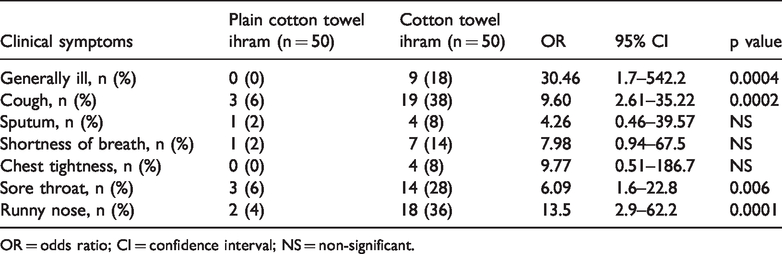
OR = odds ratio; CI = confidence interval; NS = non-significant.
Before Hajj (5th Dhul-Hijjah), there tended to be higher FeNO levels in Hajj pilgrims who were wearing cotton towel ihrams compared with those who were wearing plain cotton ihrams, but this was not significant (p = 0.081, Table 3). There was no significant difference in FeNO levels during and after Hajj in pilgrims who were wearing cotton towel ihrams compared with those who were wearing plain cotton ihrams.
Comparison of FeNO levels in subjects wearing a plain cotton ihram with those in subjects wearing a cotton towel ihram.

Values are presented as mean ± standard error of the mean. FeNO = fractional exhaled nitric oxide.
Discussion
In this study, FeNO levels in pilgrims who were wearing cotton towel ihrams tended to be higher than those in pilgrims who were dressed in plain cotton ihrams (Table 3). Although there was no significant difference in FeNO levels between the two groups, mean FeNO levels during and after the Hajj pilgrimage appeared to be higher compared with baseline FeNO levels. Respiratory symptoms, such as a cough, sore throat, and runny nose, were more pronounced in the group of pilgrims who were wearing cotton towel ihrams compared with those with plain cotton ihrams (Table 2).
Mass gatherings are associated with transmission of infectious and non-infectious diseases. Hajj is an important religious event, which is attended by more than 2 million people from various countries and geographical locations of the world. Overcrowding during different Hajj rituals, such as circumambulation (Tawaf) of the holy Kaaba and stoning the devils, occurs when pilgrims stay in tents in Mina and Arafat. In these locations, pilgrims have close contact with each other. Another factor is air quality in Makkah and the surrounding area, which is affected by road traffic, windblown dust, and sand particles. 8 Therefore, air pollution and mass gatherings during Hajj increase the prevalence of respiratory tract complaints among Hajj pilgrims. 9
Nitric oxide is a gaseous molecule that is endogenously produced in the airways by an α-amino acid, L-arginine, involving the enzyme nitric oxide synthase in response to inflammation. 10 FeNO is a noninvasive marker of airway inflammation and asthma. Therefore, FeNO levels are regarded as a biomarker for assessing the inflammatory status of individuals who have health problems. 11 Air pollution is a source of the inflammatory process in the airways and lungs. There is a correlation between FeNO levels and air pollution.11–14 Elevated levels of FeNO have been observed following short- or long-term exposure to air pollution. 15
The dust generated from cotton is a source of air pollution and accounts for increased respiratory symptoms, such as chronic cough, dyspnea, asthma, and expectorations. Cotton dust is usually contaminated with infectious material and is responsible for respiratory symptoms, including chronic cough, dyspnea, asthma, and chronic bronchitis.16,17 Elevated FeNO levels are associated with increased respiratory complaints in cotton mill workers. 18 Furthermore, increased respiratory symptoms and pulmonary function abnormalities are higher in cotton workers compared with matched controls. 19 Therefore, cotton dust plays an important role in initiation of respiratory health problems. Higher FeNO levels and elevated respiratory symptoms observed in our study in pilgrims dressed in cotton towel ihrams might have been due to the cotton fibers generated from the ihrams, in addition to other factors.
The main limitations of this study are the nature of Hajj gatherings and the small sample size. Hajj is one of the largest gatherings in the world, and spreading of respiratory infections due to pathogenic (viral, bacterial) and non-pathogenic (dust) sources is common during Hajj rituals. Initially, the pilgrims who were wearing cotton towel ihrams and plain cotton ihrams were transported to Makkah in separate coaches and every possible effort was made to keep them separate. However, the pilgrims from both groups had chances to mix together during Hajj rituals, increasing the possibility of cross infections. Therefore, our findings need to be confirmed with a larger sample size and enforcement of more stringent arrangements for pilgrims.
Conclusions
Ihrams containing cotton fibers may increase respiratory illness and lung inflammation in Hajj pilgrims. Therefore, a plain cotton ihram (without fibers) is advisable while participating in Hajj to minimize the onset of respiratory illness.
Footnotes
Acknowledgement
The authors are thankful to the National Plan for Science and Technology and Innovation (MAARIFAH), King Abdulaziz City for Science and Technology, Kingdom of Saudi Arabia for supporting the research project (Award # 13-MED 1349-02).
Declaration of conflicting interest
The authors declare that there is no conflict of interest.
Funding
National Plan for Science and Technology and Innovation (MAARIFAH), King Abdulaziz City for Science and Technology, Kingdom of Saudi Arabia (Research Project Award # 13-MED 1349-02).
