



Abstract
Objective
To investigate the effect of plasma homocysteine (Hcy) and C-reactive protein (CRP) levels in patients with craniocerebral injury.
Methods
A retrospective analysis of data from patients with craniocerebral injury who underwent surgery. Patients were stratified according to the extent of the craniocerebral injury into severe, moderate and mild craniocerebral injury groups. Serum Hcy and CRP levels were determined at admission, at 7 days after treatment and at 3 months after injury. Univariate and multivariate Cox regression analyses were undertaken to identify prognostic factors.
Results
The study enrolled 96 patients: 29 patients with mild injury; 33 patients with moderate injury; and 34 patients with severe injury. Serum Hcy and CRP levels at admission were significantly higher in the severe craniocerebral injury group than in the other two groups; and they were significantly higher the moderate craniocerebral injury group compared with the mild craniocerebral injury group. Serum Hcy and CRP levels of the three groups of patients were significantly lower after 7 days of treatment than those before treatment. The levels of Hcy and CRP were positively correlated in all three groups.
Conclusion
Serum Hcy and CRP levels in patients could be used to monitor the condition and prognosis of patients with craniocerebral injury.
Introduction
Craniocerebral injury is sudden damage to the brain caused by a blow or jolt and it has one of the highest mortality and disability rates in the world.1,2As a consequence of rapid economic developments, the incidence of craniocerebral injury has increased. 3 Because craniocerebral injury depends not only on the extent of the primary craniocerebral injury, but also on the secondary craniocerebral injuries caused by other factors, the treatment of patients remains a major clinical problem.4,5 Therefore, it is very important to monitor the condition of patients with craniocerebral injury and to judge the prognosis through appropriate clinical detection indicators. 6
Homocysteine (Hcy) is an important factor leading to atherosclerosis. 7 Increased Hcy levels are related to the prognosis of cerebrovascular disease. 8 High levels of Hcy are associated with a poor prognosis in patients with craniocerebral injury.8,9However, the association between serum Hcy levels and different degrees of craniocerebral injury and their effect on the condition and prognosis of patients with craniocerebral injury remains unclear. This current study also evaluated the C-reactive protein (CRP) levels because these have been shown to be a predictor of persistent unfavourable symptoms in patients with mild traumatic brain injury. 10 The current study measured the serum Hcy and CRP levels in fasting blood from patients with acute craniocerebral injury and recorded the condition and prognosis of the patients simultaneously. The correlation between the levels of CRP and Hcy and the severity of the disease was investigated in order to determine their prognostic value.
Patients and methods
Study population
This retrospective study enrolled consecutive patients with craniocerebral injury that were treated in the Department of Neurosurgery, Guigang People's Hospital, Guigang City, Guangxi Zhuang Autonomous Region, China between September 2017 and January 2018. The patients were divided into three groups based on the extent of their craniocerebral injury according to the Glasgow Coma Scale score (GCS score): 11 mild injury (GCS score 13–15); moderate injury (GCS score 9–12); and severe injury (GCS score 3–8). The inclusion criteria were as follows: (i) patients with craniocerebral injury that had visited the hospital within 12 h and were hospitalized for surgical treatment; (ii) patients met the diagnostic criteria for craniocerebral injury. 12 The exclusion criteria were as follows: (i) abnormal blood coagulation, lung function or renal function; (ii) infectious diseases; (iii) mental illness.
The study was approved by the Ethics Committee of Guigang People's Hospital, Guigang City, Guangxi Zhuang Autonomous Region, China. All patients and their families were informed in advance of the study and provided written informed consent.
Study methods
All patients were treated upon hospital admission according to the extent of their craniocerebral injuries. The vital signs were closely monitored and basic life support treatment was provided. Venous blood sampling (4 ml) was performed in all patients. The serum was separated immediately and stored at –20°C for later laboratory analyses. Serum Hcy levels were determined using a chemiluminescence detection kit (Beckman Coulter, High Wycombe, UK) and a UniCel DxI 800 Access Immunoassay System (Beckman Coulter) according to the manufacturer’s instructions. The normal reference range of serum Hcy is 5–15 µmol/l. Serum CRP levels were determined using a BS-600 Chemistry Analyser and the relevant CRP detection kit (Shenzhen Mindray Biomedical Electronics, Shenzhen, China). The normal reference value for serum CRP was ≤ 10 mg/l.
Study measurements
Based on the GCS score at hospitalization, the serum Hcy and CRP levels of patients with different degrees of craniocerebral injury were measured before treatment. The changes in serum Hcy and CRP levels in patients with different degrees of craniocerebral injury before and after treatment for 7 days were measured. The correlation between the serum Hcy and CRP levels of patients with different degrees of craniocerebral injury was determined. The patient's prognosis was evaluated according to the Glasgow Prognostic Score (GPS) at 3 months after injury. 13 The patients were divided into two groups according to the GPS: a favourable prognosis group with a good prognosis and a GPS > 3; and an unfavourable prognosis group with a poor prognosis and a GPS ≤ 3. The serum Hcy and CRP levels of the two prognosis groups were compared at 3 months after injury.
Statistical analyses
All statistical analyses were performed using IBM SPSS Statistics for Windows, Version 19.0 (IBM Corp., Armonk, NY, USA). Data are presented as mean ± SD. Paired t-test was used to compare continuous data before and after treatment. Independent sample t-test was used to compare groups at the same time-point. single-factor analysis of variance was used for more than two groups, represented by F. Partial correlation analysis was used to analyse the correlation between the serum levels of Hcy and CRP in patients with different degrees of craniocerebral injury. Cox regression was used to analyse independent prognostic factors for patients with craniocerebral injury. A P-value < 0.05 was considered statistically significant .
Results
This retrospective study analysed the data from 96 patients with craniocerebral injury: 29 patients (14 males and 15 females; mean ± age, 34.0 ± 6.3 years) with mild injury (GCS score 13–15); 33 patients (15 males and 18 females; mean ± age, 32.0 ± 4.3 years) with moderate injury (GCS score 9–12); and 34 patients (16 males and 18 females; mean ± age, 33.0 ± 5.5 years) with severe injury (GCS score 3–8).
Before treatment, serum Hcy levels of patients in the severe craniocerebral injury group were significantly higher than the other two groups (P < 0.05), while the serum Hcy level of the moderate craniocerebral injury group was significantly higher than the mild craniocerebral injury group (P < 0.05) (Table 1). The serum CRP levels in the patients in the severe craniocerebral injury group were significantly higher than that of the other two groups (P < 0.05), while the serum CRP level in the moderate group was significantly higher than that in the mild group (P < 0.05).
Serum levels of homocysteine (Hcy) and C-reactive protein (CRP) at hospital admission before treatment in patients stratified according to the severity of the craniocerebral injury.

Data presented as mean ± SD.
aBetween-group comparisons made using paired t-test; *Hcy level in this group is significantly different compared with the other groups (P < 0.05); **CRP level in this group is significantly different compared with the other groups (P < 0.05).
The results of a partial correlation analysis showed that the serum levels of Hcy and CRP were positively correlated in patients with severe craniocerebral injury (r = 0.865, P < 0.001) (Figure 1); in patients with moderate craniocerebral injury (r = 0.880, P < 0.001) (Figure 2); and in patients with mild craniocerebral injury (r = 0.452, P < 0.001) (Figure 3).

The correlation between serum levels of homocysteine (Hcy) and C-reactive protein (CRP) in patients with severe craniocerebral injury (r = 0.865, P < 0.001).

The correlation between serum levels of homocysteine (Hcy) and C-reactive protein (CRP) in patients with moderate craniocerebral injury (r = 0.880, P < 0.001).

The correlation between serum levels of homocysteine (Hcy) and C-reactive protein (CRP) in patients with mild craniocerebral injury (r = 0.452, P < 0.001).
The serum Hcy levels before and after treatment for 7 days in patients with different levels of craniocerebral injury are presented in Table 2. The serum Hcy level in the severe craniocerebral injury group was significantly higher than that of the other two groups after 7 days of treatment (P < 0.05), while the serum Hcy level of the moderate craniocerebral injury group was significantly higher than that of the mild craniocerebral injury group after 7 days of treatment (P < 0.05). Within-group comparisons showed that the serum Hcy level of all three groups after treatment for 7 days was significantly lower than that of the three groups before treatment (P < 0.001 for all comparisons).
Changes in serum levels of homocysteine (Hcy) between before and after treatment in patients stratified according to the severity of the craniocerebral injury.
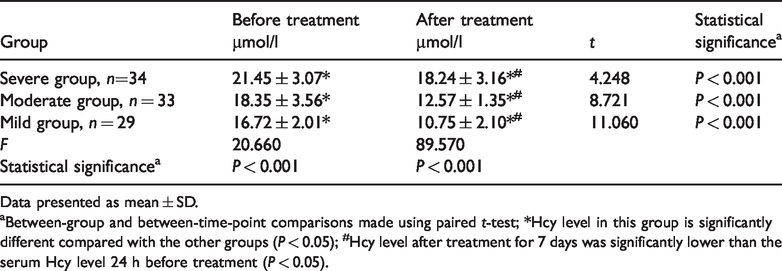
Data presented as mean ± SD.
aBetween-group and between-time-point comparisons made using paired t-test; *Hcy level in this group is significantly different compared with the other groups (P < 0.05); #Hcy level after treatment for 7 days was significantly lower than the serum Hcy level 24 h before treatment (P < 0.05).
The serum CRP levels before and after treatment for 7 days in patients with different levels of craniocerebral injury are presented in Table 3. The serum CRP level in the severe craniocerebral injury group was significantly higher than that of the other two groups after 7 days of treatment (P < 0.05), while the serum CRP level of the moderate craniocerebral injury group was significantly higher than that of the mild craniocerebral injury group after 7 days of treatment (P < 0.05). Within-group comparisons showed that the serum CRP level of all three groups after treatment for 7 days was significantly lower than that of the three groups before treatment (P < 0.001 for all comparisons).
Changes in serum levels of C-reactive protein (CRP) between before and after treatment in patients stratified according to the severity of the craniocerebral injury.

Data presented as mean ± SD.
aBetween-group and between-time-point comparisons made using paired t-test; *CRP level in this group is significantly different compared with the other groups (P < 0.05); #CRP level after treatment for 7 days is significantly lower than the serum CRP level 24 h before treatment (P < 0.05).
The serum Hcy and CRP levels at 3 months after the craniocerebral injury in patients stratified according to their prognosis are shown in Table 4. The level of Hcy in the favourable prognosis group after 3 months of injury was significantly lower than that in the unfavourable prognosis group (P < 0.001). The level of CRP in the favourable prognosis group after 3 months of treatment was significantly lower than that in the unfavourable prognosis group (P < 0.001).
The serum levels of homocysteine (Hcy) and C-reactive protein (CRP) in patients stratified according to their prognosis at 3 months after the craniocerebral injury.

Data presented as mean ± SD.
aBetween-group comparisons made using paired t-test.
A univariate Cox regression analysis demonstrated that the type of injury, admission GCS score, admission Hcy level, admission CRP level and duration of hospitalization were all prognostic factors in patients with craniocerebral injury (Table 5). A multivariate Cox regression analysis found that the type of injury, admission GCS score and admission Hcy level were independent prognostic factors in patients with craniocerebral injury (Table 6).
Univariate Cox regression analysis of prognostic factors in patients with craniocerebral injury.

HR, hazard ratio; CI, confidence interval; GCS, Glasgow Coma Scale; Hcy, homocysteine; CRP, C-reactive protein; NS, no significant association (P-value ≥ 0.05).
Multivariate Cox regression analysis of prognostic factors in patients with craniocerebral injury.

HR, hazard ratio; CI, confidence interval; GCS, Glasgow Coma Scale; Hcy, homocysteine; CRP, C-reactive protein; NS, no significant association (P-value ≥ 0.05).
Discussion
Craniocerebral injury is a common trauma in clinical practice. Neurosurgeons can accurately determine the severity of craniocerebral injury, which is crucial for effective treatment. 14 At present, neurosurgeons in many countries use the GCS score to determine the extent of acute craniocerebral injury and the patient’s prognosis. 15 In recent years, with the advancement of detection technology, the use of serum cytokine levels for the dynamic monitoring of the occurrence and development of disease has been evaluated. 16 CRP is an important acute phase protein. 17 Research has confirmed that CRP plays an important protective role in the body's own immune process, and when tissues are damaged, the increased CRP level is a protective response by the body. 18 CRP is generally considered to be the main acute phase protein, the levels of which rise rapidly during infection and tissue damage. The change of CRP level is related to the progression of acute craniocerebral injury and cerebrovascular events.19,20 Research into the specific mechanisms involved in the occurrence and development of cerebrovascular diseases has also found that increased Hcy levels are closely associated with cerebrovascular diseases. 21 However, the mechanism that links serum Hcy level and craniocerebral injury remains unclear. Therefore, this current study aimed to determine the relationship between admission Hcy and CRP levels and the condition and prognosis of patients with craniocerebral injuries.
When patients in this current study were stratified according to the severity of their craniocerebral injuries, the serum Hcy and CRP levels at admission were significantly higher in the severe craniocerebral injury group than in the other two groups; and they were significantly higher the moderate craniocerebral injury group compared with the mild craniocerebral injury group. The levels of Hcy and CRP were correlated with the extent of the acute craniocerebral injury. A partial correlation analysis found that the levels of Hcy and CRP were positively correlated in the serum of patients with severe, moderate and mild craniocerebral injury.
The findings of this current study suggest that the serum levels of Hcy and CRP vary with the degree of craniocerebral injury; with patients with more severe craniocerebral injuries having higher serum levels of CRP and Hcy. Previous studies have demonstrated significantly higher serum levels of Hcy and CRP in patients with severe craniocerebral injury compared with patients with mild and moderate injuries.20,22 This current study also observed changes in the serum Hcy and CRP levels before and after 7 days of treatment in the three groups of patients stratified according to the severity of their craniocerebral injuries. The within-group comparisons showed that the levels of serum Hcy and CRP in the three groups of patients with different degrees of craniocerebral injury were significantly lower after treatment compared with before treatment. Despite the levels of Hcy and CRP being significantly reduced in all three groups after treatment for 7 days, the levels remained significantly higher in the severe craniocerebral injury group than in the other two groups. The levels of Hcy and CRP in the moderate craniocerebral injury group remained significantly higher than that in the mild craniocerebral injury group after 7 days of treatment.
Homocysteine is generally considered to be an acute stress/inflammatory protein. For example, when the body is experiencing stress or an inflammatory reaction, the levels of Hcy are significantly upregulated.23,24 Therefore, the findings of the current study with regard to Hcy and CRP levels suggest that that the stress or inflammatory response of the body to the craniocerebral injury has been relieved after 7 days of treatment in each study group. This current study also used the GPS score to determine the prognosis of the patients at 3 months after the craniocerebral injury whilst simultaneously measuring the Hcy and CRP levels. It was found that patients with a good prognosis had significantly lower Hcy and CRP levels at 3 months of injury than those with a poor prognosis.
In our opinion, the downregulation of Hcy and CRP is closely related to the prognosis of patients with craniocerebral injury; and the greater the degree of the downregulation of Hcy and CRP, the better the prognosis of patients with craniocerebral injury. Using clinical data from patients with craniocerebral injury, the current study conducted univariate and multivariate Cox regression analyses of the prognostic factors. Injury type, admission GCS score, Hcy, CRP and duration of hospitalization were all prognostic factors of patients with craniocerebral injury. The multivariate Cox regression analysis identified that the type of injury, admission GCS score and admission Hcy level were independent prognostic factors of patients with craniocerebral injury. There have been several reports that Hcy is an important prognostic factor for patients with craniocerebral injury.25–27
This current study had several limitations that might have affected the results. First, the observation time was only 3 months. Secondly, the patients were from a single centre and all came from the same geographical region. Future research will conduct regular follow-up of these patients over a longer period of time.
In conclusion, the degree of craniocerebral injury and the prognosis of patients were related to the serum levels of HCY and CRP at hospital admission. Monitoring the dynamic changes in the levels of serum Hcy and CRP in patients with craniocerebral injury will not only help to correctly assess the clinical condition of the craniocerebral injury, but also help to determine the patient's condition and prognosis following treatment.
