




Abstract
This paper employs a qualitative case study research strategy to investigate local-level major incident management in the United Kingdom during the COVID-19 pandemic. On 25 June 2020, thousands of people took advantage of a short respite from COVID-19 lockdown measures and flocked to Bournemouth's beaches in Southeast England. The crowd surge heightened unruly and anti-social behaviour leading to unprecedented social disorder in the city's town and beaches. Since the local authorities could not contain the crowd, a major incident was declared to seek assistance in managing the crowd. Aiming to assess the effectiveness of the major incident management, this research generated empirical data from local authorities and emergency responders who attended to the incident. Anchored by a conceptual framework that links the research enquiries to the methodology, this research is underpinned by a triangulation approach to data collection and analysis. The key findings underscore the critical role of major incident declaration in mobilising emergency responders; uncertainty on the type of major incident that was declared albeit justified by overcrowding at the beach; challenges in preparation for the incident response and multi-agency collaboration; and issues with situational awareness, coordination, and early warning for response. This study exposes the vulnerability of local authorities in dealing with uncertain, residual, or unanticipated risks. Informed by the findings, this paper proffers recommendations on ways to enhance local response to major incidents in the United Kingdom. It enriches the core knowledge base in incident response and adds value to the literature on crowd-related risks, especially during situations of uncertainty.
Keywords
Introduction
On 25 June 2020, tens of thousands of people ignored COVID-19 warnings and flocked to the beaches in the southeast of England after months spent in lockdown. This led to a major incident (MI) declaration that activated a multi-agency response to mitigate the chaos/risks associated with the unprecedented crowd surge. The MI is the focal point of this research given the heightened emphasis on preparation for uncertain/sudden human-induced hazards.
Measures to adequately tackle societal risks are increasingly being scrutinised by governments and disaster management frameworks (Bello, Bustamante and Pizarro 2021). The Sendai Framework for Disaster Risk Reduction (UNISDR 2015) established that disaster risks/impacts in one region can impact risks in another, as experienced during the COVID-19 pandemic. The framework foregrounds the renewed global intent to tackle existing, growing, and new disaster risks (ibid). One such risk is crowd/mass-gathering events.
Crowd events are increasing worldwide due to the high frequency of entertainment-induced mass gathering episodes (Moussaïd, Helbing and Theraulaz 2011), presenting safety and health risks (Memish et al. 2019). In the 20th century, crowd events in large sports venues caused 1,509 fatalities and 10,642 injuries (Huang and Jia 2014). The average number of crowd disasters has been increasing since 2000, including the risk of death from crush injuries. The collapse of infrastructure, fire incidents, riots/violence, and terrorist attacks can induce crowd surge/panic and stampedes leading to injuries and fatalities (Ahmed and Memish 2019). Furthermore, crowd settings increase the risk of contracting communicable diseases (Liu et al. 2022).
Large gatherings like musical/religious festivals and sporting events can lead to crowd disasters without any malicious intent (Barr et al. 2023). For instance, in 2022, 150 people were killed during a Halloween party in Seoul (The Guardian 2022), and 125 fatalities were recorded in a stadium crush on 1 October 2022, in Indonesia (Boren 2022). These deadly incidents underscore the relevance of robust crowd disaster mitigation/response strategies. With increasing population growth worldwide, crowd risks/MIs will continue to occur, including in the United Kingdom.
Declaring a MI is often the first step in enacting the response and recovery process (Enia 2016). That could happen before the incident to facilitate contingency planning or during a postincident phase to mobilise response (McCarthy 2009). This process is informed by the U.K.'s Civil Contingencies Act (CCA) 2004 which recommends a MI declaration during an emergency.
The paradox of a crowd-induced MI when stringent anti-gathering measures were in place at the peak of the COVID-19 pandemic was the incentive for this research. The aim was to assess the effectiveness of the 2020 Bournemouth major incident management (MIM). The objectives were to (1) understand the process and motivation of the MI declaration, (2) analyse the effectiveness of the response to the MI and (3) based on the findings, suggest recommendations for improving MIM in the United Kingdom. This paper enriches a core knowledge base in U.K. MIM and supplements the literature on crowd risks/management.
After this introduction, the next section concisely reviews the literature on key aspects of MIs and MIM in the United Kingdom. The conceptual framework and the methodology are next, followed by the discussion and recommendations sections, and finally, the conclusion.
Literature review
MIs
There are various conceptualisations of MIs. Hunt and Greaves (2017) define a MI as ‘any incident which requires the mobilisation and use of extraordinary resources, including where the location, number, severity or type of live casualties requires extraordinary resources’ (p. 2). The London Resilience Partnership perceives a MI to be ‘An event or situation with a range of serious consequences which requires special arrangements to be implemented by one or more of the emergency responder agencies’ (LRG 2021, 7). Cullingworth (2004, 356) perceive a MI as ‘any emergency that requires the implementation of special arrangements by one or all of the emergency services (ESs) and will generally include the involvement, either directly or indirectly, of large numbers of people’. These definitions highlight a potentially dire situation requiring the mobilisation of emergency responders and exceptional resources, which could vary between ESs. What one emergency responder may consider a MI may not necessarily constitute a MI for another (LRG 2021). Nevertheless, the primary aim of all ES during a MI is to save lives (Bello, Bustamante and Pizarro 2021; LRG 2021).
Classification of MIs
There are various conceptualisations of MIs relevant to this paper. A useful/conventional classification of MIs considers whether the incident is (1) natural versus human induced, (2) simple versus compound and (3) compensated versus uncompensated (Hunt and Greaves 2017). Natural hazards are predominantly geological and climatic, while human-induced hazards are associated mainly with anthropogenic activities. Nevertheless, some hazards may be caused by both human and natural factors (potentially socionatural hazards), for instance, climate change-induced risks (Bang 2022). A simple incident occurs when the local infrastructure remains operational without disrupting the transportation of people/goods and services. For compound incidents, ES, transportation and other critical infrastructures and capabilities are disrupted. Nonetheless, simple incidents may metamorphose into compound incidents over time by overwhelming vital services and infrastructure. A compensated incident can be controlled/managed by sourcing for extra resources while an uncompensated incident cannot be managed whether available resources are mobilised or not. As resources get depleted or become available, incidents may shift from being compensated to uncompensated or vice versa (Hunt and Greaves 2017; LRG 2021). Based on this classification, the incident analysed in this paper was human-induced, simple, and compensated.
Additionally, the U.K.'s CCA (2004) categorises MIs (natural hazards, transport/industrial accidents, terrorist attacks and incidents at sports stadiums are frequent in the United Kingdom) into three emergency levels – Level 1(significant emergency) requires central government assistance since it has a broader scale. Level 2 (serious emergency) could have a prolonged/wide effect requiring sustained support/coordination from the central government. Level 3 (catastrophic emergency) has a potentially very extensive and exceptionally high effect/impact that will need immediate support from the central government (Cabinet Office 2013a). Due to the potential socioeconomic and political consequences of these incidents, there has been a growing research interest in MIM (Anthony 2011; Kapucu 2012; Benn 2013; Cocking 2013; McAleavy 2016; Environment Agency 2022; Kenyon, Binder and Baker-Beall 2022; Bang and Burton 2021; LGA 2023), which is the motivation of this study which focuses on crowd-induced MIM in Britain.
MIM in the United Kingdom
This section provides an overview of MIM in the United Kingdom. The issues addressed are the occurrence of MIs, mass gathering events, the institutional and legislative frameworks for MIM, preparedness/response for MIs, MI declaration and multi-agency cooperation.
Occurrence of MIs in the United Kingdom
MIs in the United Kingdom are mostly associated with spontaneous events leading to large casualties. Carley, Mackway-Jones and Donnan (1998) reported 108 MIs in the United Kingdom between 1968 and 1996. The study highlighted limited data for this period and questioned the accuracy of the annual incident figures. Nevertheless, interest in U.K. MIM research has been increasing in the last five decades (Anthony 2011; Kapucu 2012; Benn 2013; Cocking 2013; Pollock 2013; Allen, Karanasios and Norman 2014; McAleavy 2016; Bliss 2019; Crowd Safety Magazine 2019; Environment Agency 2022; Kenyon, Binder and Baker-Beall 2022; Bang and Burton 2021; LGA 2023), although the number of fatalities and MIs has been fewer in recent years.
A critical literature review shows that since the 1950s, several human-induced MIs in the United Kingdom have caused between 50 and 270 fatalities – the 1915 Quintinshill rail disaster (226 deaths); the 1952 Harrow and Wealstone rail crash (112 fatalities); the 1957 Lewisham rail crash (90 deaths); the 1987 Herald of Free Enterprise ferry capsize – albeit in Belgian waters (193 fatalities); the 1988 Pipe Alpha oil rig fire (167 fatalities); the 1988 Lockerbie Pan-Am flight bombing (270 fatalities); the 1989 Hillsborough stadium crowd crush (96 deaths); and the 2005 London bombings (52 deaths). Recent years have witnessed a few MI declarations. In 2017, London had three MI declarations (the Grenfell Tower Fire and the terrorist attack on London and Westminster Bridges). In 2021, London declared one MI due to a surge in Omicron cases (Mayor of London 2021). During Storm Eunice in February 2022, many local resilience forums (LRFs) in England declared a MI in preparation for the impending storm (Hampshire and IOW FRS 2022).
Overview of mass gatherings and crowd incidents
Mass gatherings like sporting events, entertainment venues and religious gatherings increase the likelihood of crowd incidents (Moussaïd, Helbing and Theraulaz 2011). Risks from mass gatherings occur through crowd crushes, stampedes or disease transmission (Memish et al. 2019). How these risks are managed is a priority for disaster management stakeholders, as people's desire for more outdoor entertainment increases (Kingshott 2014). The literature shows that crowd-induced incidents have been increasing, while the associated fatalities have been decreasing. The decreased fatalities can be interpreted as an improvement in crowd management/control. However, the frequency of crowded events is not necessarily an indication of success in crowd management/control. For instance, the annual regularity of the Hajj pilgrimage to Mecca has seen several instances of crowd crushing due to inadequate crowd management and control – in 2015, a stampede caused 1,849 deaths (France-Presse 2015). Furthermore, death within crowd settings may be decreasing but could pose grave health risks through transmissible diseases (Liu et al. 2022). An appropriate legislative framework can mitigate these risks.
In the United Kingdom, several pieces of disjointed legislation guide crowd management. The Football Spectators Act governs crowd management and control at football matches. The Health and Safety Executive and The UK Crowd Management Association have guidance for safe crowd management practices for commercial businesses, event organisers and event security services (HSE 2022; UKMCA 2022). Perhaps an all-inclusive legislative framework for crowd risk management would be more helpful, especially if it appropriately deals with crowd dynamics. Crowd behaviour/dynamics during the COVID-19 pandemic when mass gatherings were restricted is the core of this research. Although regular street protests were prohibited, some countries like Israel allowed 2,000 demonstrators in Tel Aviv on 16 April 2020, provided the demonstrators wore face coverings (Kowalewski 2020). At the beginning of the pandemic, shops/supermarkets in the United Kingdom were unusually crowded due to ‘panic buying’ (Drury et al. 2021), although the authorities informed the populace that there were sufficient goods/items in stock for several months.
There were challenges in implementing crowd control measures, not least, employing sensors providing space-time information on individuals, developing algorithms to discern strangers from family members and implementing contact-tracing apps (Pouw et al. 2020). This was no exception in the United Kingdom, which experienced high adherence rates on quarantine and social distancing measures (Drury et al. 2021). Nevertheless, structural inequalities prevented some disadvantaged demographics from effectively complying, for instance, commuters on sometimes crowded trains and exercising in busy public spaces (Templeton et al. 2020). Demotivation to continue respecting lockdown measures was probably the reason for people crowding Bournemouth's beaches on 23 June 2020, when lockdown measures were eased, leading to a MI declaration, which is the focus of this research.
Institutional and Legislative Framework for MIM
The CCA (2004) informs MIM in the United Kingdom. The act places different duties on Category 1 and 2 responders. Category 1 responders (local/port authorities; the environment/maritime/coastguard and U.K. health agencies; police/fire/rescue/ambulance services and trusts – primary care, acute and foundation, etc.) are mainly responsible for risk assessment, developing emergency/business continuity plans, informing the populace on civil contingency matters, enhancing local emergency coordination and assisting local voluntary organisations. Category 2 responders (energy/water/telecommunication providers; train/transportation operators, etc.) are required to share relevant information with Category 1 responders (Cabinet Office 2013b). Furthermore, an annual National Risk Register (NRR) containing public information/advice on how to prepare for risks is produced (Cabinet Office 2021, 2013b). The NRR is replicated at the local level by the community risk registers, which is expected to reflect the unique characteristics of the local region. Hence, emergency plans should align with identified hazards to enhance local-level decision making (Cabinet Office 2010), which facilitates MI preparation and response.
MI preparation and response
Preparation for a MI is conducted at the local/regional levels through LRFs, which facilitate multi-agency collaboration, coordination and communication between Category 1 and 2 responders. Duties under the CCA rest with responders but are often exercised through the LRFs who can facilitate developing the risk profile of an area and preparation for multi-agency plans (Cabinet Office 2012). Liaison and cooperation between the responders are critical for a compelling and efficient MI response. Effective emergency response to any MI relies on effective multi-agency coordination (O'Brien, Read and Salmon 2020). When responding to an incident at each level of command (strategic, tactical and operational), there should be a clear and identifiable commander who has the responsibility of coordinating the activities of the organisation (JESIP 2021).
MI declaration
After a MI declaration, local ES are alerted to tackle the situation if the incident fulfils the criteria for an emergency, perceived as an event/situation that threatens serious damage to human welfare, the environment or the security of the United Kingdom (CCA 2004). Therefore, from a technical perspective, categorised responders do not ‘declare a MI’ – though they still do – rather they should declare an emergency under the CCA. When an incident is perceived to be an emergency, the first responder will report a ‘MI standby’ – if the emergency response does not need extraordinary resources or ‘MI declared’ – if the response requires extraordinary resources (Hunt and Greaves 2017). After a rapid assessment of the scene, the first responder should provide an initial situational report to his/her command quickly, usually in the format with the acronym METHANE (M = major incident ‘standby’/‘declared’; E = exact location; T = type of incident; H = hazards encountered; A = access routes in/out and other limiting factors; N = number/type/severity of casualties and E = ES present/required). An estimate should be provided for any unavailable information. As the situation evolves, information should be frequently updated, and more METHANE reports sent to the command.
Multi-agency cooperation
The interoperability of the ES is underpinned by the ‘Joint Emergency Services Inter-Operability Principles’ (JESIP). JESIP recognises the importance of a multi-agency response to MI in collaboration with Category 1 and 2 responders (JESIP 2021) and enhances a shared situation awareness that is achieved via the ‘joint decision model – facilitates joint decision making from different ES. The joint decision model is underpinned by three key considerations – direction, situation and action. ‘Direction’ is derived from the overarching priorities of the response with a focus on the anticipated end state. ‘Situation’ refers to the potential risks and effects including their mitigation measures, and ‘Action’ indicates what should be done to achieve the desired result (Hunt and Greaves 2017). These reviewed themes inform the research aim/objectives and the key enquiries.
The main research enquiry of this paper is: how effective was the 2020 Bournemouth MIM? The subquestions are: (1) What was the process and motivation for declaring the MI, (2) How effective was the response to the MI and (3) based on the findings, what recommendations can be proffered to improve MIM in the United Kingdom?
Conceptual Framework: Stages of MIM
This research has utilised the four phases/stages of MIM—initial response, consolidation, recovery and restoration after which there is a stand -by or stand down (Hunt and Greaves 2017; LRG 2021) as the conceptual framework that focuses on MI response. Conceptually, with the inclusion of a preparation phase, the identified MI response phases (Figure 1) are key activities that should be addressed by government institutions to enhance resilience to MIs.
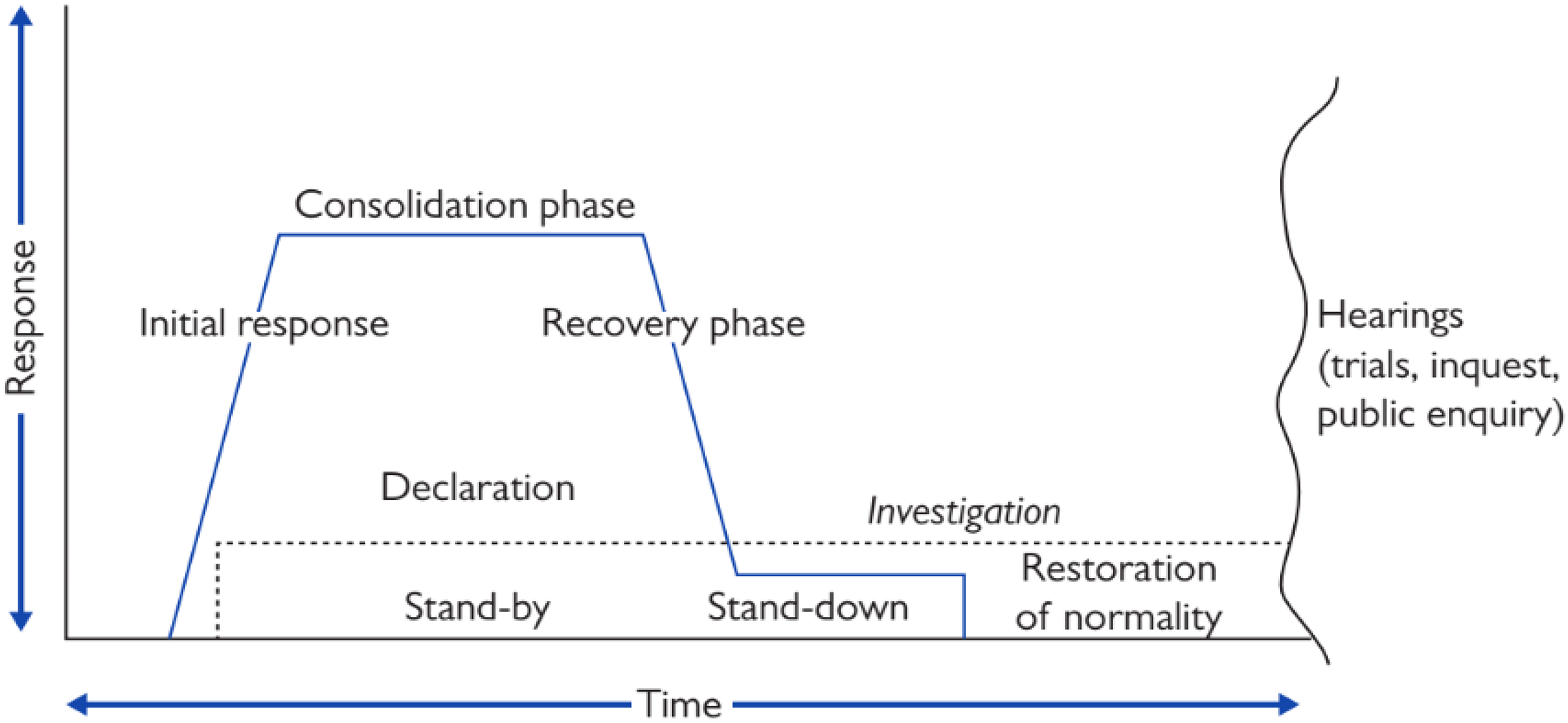
The phases of a major incident (London Resilience Partnership 2021; Hunt and Greaves 2017).
Resilience is conceptualised in this paper as: The ability of a system, community or society exposed to hazards to resist, absorb, accommodate and recover from the effects of a hazard in a timely and efficient manner, including through the preservation and restoration of its essential basic structures and functions. (UNISDR 2015, 9)
This paper focuses on local authority MIM, with organisational resilience at the core – underpinned by the need to create ‘… stable institutions/frameworks and procedures/plans…to tackle subsequent hazards as well as stable channels to use/share multi-disciplinary knowledge for contingency planning…’ (Bang, Miles and Gordon 2019, 268).
After a MI declaration, other response agencies are informed via the METHANE format. Then the ‘Initial Response Phase’ begins and consists of identifying the incident and deciding/assembling the ESs required for the response. A chosen incident manager coordinates the ESs ensuring the appropriate stakeholders are informed on the progress of the incident resolution. During the ‘consolidation phase’, the ES investigates/analyses the incident to determine its seriousness. That determines whether it should be escalated, or additional resources are requested. The incident management plan is then activated but regular communication is maintained with stakeholders to provide regular updates on progress in resolving the issue. At the ‘recovery phase’, the ES may start to evaluate and/or assess their performance. Nevertheless, monitoring should continue to ensure the incident and its consequences are resolved. While recovery after a MI might take a long time, the experience will be different for each service/victim. The ‘restoration of normality phase’ happens after some normality is restored, albeit not necessarily to the preincident state. The focus should be on restoring essential services for daily life to resume before building back better. During the normality phase, investigations on the cause of the incident can be done. The decision to stand down should be jointly taken at the highest multi-agency level following the incident response. The rationale should be cascaded to the concerned ES. The ‘stand by’ and/or ‘stand down’ are contiguous because the MI can be called off in the middle of an incident (stand by) or when it has been largely resolved (stand down), and the lead ES must ensure the incident has been contained. Ongoing issues should be relinquished to the recovery coordinating group or relevant agencies (LRG 2021). The framework contributes to knowledge on understanding the duties/responsibilities of stakeholders involved in a MI declaration/response. It provides guidance, structure and better clarity to this paper, including the methodology.
Methodology
The research strategy/approach, data collection/analysis, ethical considerations and research limitations are discussed in this section.
Qualitative case study research
This qualitative case study research adopts an interpretive and exploratory paradigm to investigate contemporary MIM in the United Kingdom. Interpretive research approaches lay more emphasis on qualitative data and focus on context through informant interviews (Nickerson 2022). This method is suitable since it digs deep to get insights into the case study. Case study approaches to research seek to answer specific questions about an event and rely on utilising a range of evidence, including primary/secondary data (Gilham 2010).
Case study: The June 2020 Bournemouth MI
Bournemouth (southeast England) is the case study of this research. On 23 March 2020, the U.K.'s government announced the first national lockdown. On 23 June 2020, the lockdown measures were eased leading to the reopening of some leisure facilities and tourist attractions. People were now allowed to mix with one other household in groups of six. Venues deemed ‘proximity venues’ were required to remain shut, including restaurants, pubs, nightclubs and indoor gyms (Johnson 2020).
On 25 June, Bournemouth recorded one of the highest temperatures (31°C) and thousands of people descended on the region's beaches (Morris, Pidd and Bland 2020). The consequences were an overcrowded beach, anti-social behaviours, excessive waste (over eight tons of waste between Bournemouth and Boscombe Piers), illegal parking (a record 558 parking enforcement fines issued), gridlock roads, prohibited overnight camping, excessive alcohol and fights. These factors caused the services of the local authorities to be overstretched, forcing the Bournemouth Chirstchurh and Pool (BCP) Council to declare a MI on 25 June 2020 (BCP Council 2020; Morris, Pidd and Bland 2020). Empirical data were collected to answer the research enquiries regarding this incident.
Data collection
This study utilises primary and secondary data collected between May and July 2022. Empirical data collection was principally done through semistructured interviews, which relied on the participants expressing their opinions/perceptions/feelings and allowed the researchers to further explore these opinions in detail (Kallio, Pietila and Kangasniemi 2016).
Initially, purposive sampling was used to recruit informants with specific qualities related to their role/knowledge about the MI response. Those targeted were the leaders/managers, workers and staff/field operational personnel of the local government and Category 1 respondents. The plan was to interview at least three leaders of the BCP council, and at least two senior police and fire service (ambulance) personnel who had leadership roles during the incident, including at least three staff or field/operational personnel of the various local agencies that participated in the incident. This research strategy aimed to achieve representativeness and heterogeneity in the Dorset category 1 respondents involved in the MI response (Maxwell 2005). A snowballing technique was employed to get referrals for another three participants (Harding 2018). Finally, the research succeeded in interviewing nine members of the Dorset LRF who are involved in preparation for a MI and were part of the response. The interviewees comprised a heterogeneous mixture of top/senior and low-level staff/personnel within the agencies, facilitated by the snowballing, which enabled the capturing of decision making and operational issues during the MI. The interviews were conducted face to face, online and through a written response. The initial plan was to conduct face-to-face interviews, which was adjusted to the preferred interview method of the respondents in consideration of their schedules, availability, and the limited research time. Four respondents were interviewed over MS Teams and the interviews were recorded and subsequently transcribed; two respondents were sent a questionnaire (Word document) for written response; and face-to-face semi-structured interviews were conducted with three informants. On average, the recorded interviews lasted for 75 min. The research generated sufficient in-depth data from the subjective realities of the informants (ibid). With a pledge to keep their identity anonymous, signed informed consent to engage with the research was received from the respondents, including their right to withdraw at any time.
The interview questions addressed key themes like the type of MI that was declared; understanding the term ‘MI’; the motive, justification and benefits of declaring the MI; crowd control measures implemented, preparation for a MI; response to the MI, inter-agency communication/collaboration in MI preparation and responding to the incident, early warning leading to the incident, perception of the incident response success and how COVID-19 impacted the incident response.
Secondary data were generated from a comprehensive review of relevant literature (published peer and nonpeer-reviewed articles, press reports and releases); U.K. Civil Contingency legislation; organisational and sector reports; emergency management records, policies, guidance and frameworks for MIM related to the study (Bryman 2016). Apart from gaining knowledge/theories on the topic, secondary data were also used for triangulation to complement the empirical data and seek convergence and corroboration to reduce the effects of biases on the findings.
Data analysis
The data were mainly analysed qualitatively. The qualitative analysis began with listening and writing down recorded interviews. The process continued via a content analysis technique by initially perusing the transcripts to better understand and familiarise oneself with the information, and then transcribing the textual/written responses (Neuman and Robson 2015). Next was coding and categorising the primary and secondary data.
The coding involved sieving out data from the data sets relevant to the research enquiries, creating categories from the sieved information and collating the information based on the number of respondents who provided the information. This helped to identify patterns, trends, and themes in the data, whether and how they relate and their frequency with various respondents (Hammarberg, Kirkman and Lacey 2016). Categorisation involved identifying patterns and trends in both data sets. Similar themes/categories from the empirical data were merged with those from secondary data and used to discuss/analyse the findings (Sutton and Austin 2015).
The identified themes influenced the structure/reporting of the research findings. The themes were further reviewed, appraised and systematically arranged into specific categories, informed by the research aim/objectives. The reporting was supplemented with descriptive and verbatim quotations extracted from the transcripts. Basic statistical analysis (percentages) was used to quantitatively analyse the responses. To enhance the validity of the research, a triangulation technique that employed both empirical and secondary evidence was used to report the findings (Acharyya and Bhattacharya 2019).
Research limitations
More interviews would have broadened the scope of analysis. This was hindered by the impromptu absences of respondents in preplanned interview sessions, their hectic schedules and non-response to invites for interviews. A few senior officials perceived the topic to be sensitive to their positions/careers and eventually bailed out of the research. Nevertheless, these challenges were compensated by the heterogeneous participation of top/senior and junior informants and the depth and nuance of the interviews rather than the quantity. Hence, sufficient in-depth data were generated for the analysis and triangulation of the results (Bryman 2016; Acharyya and Bhattacharya 2019), which ensured the reliability and validity of the results.
Findings
The findings have two sections consistent with the research objectives 1 and 2. The first section deals with the first objective (to understand the process and motivation of the MI declaration), which addresses two main themes – the MI declaration and justification for the MI declaration.
The MI declaration
Findings indicate uncertainty/confusion on the type of MI declaration. While officials of the BCP Council claimed to have declared a formal MI, a senior respondent felt a ‘standby MI’ was instead activated. Further probing for an understanding of the terms MI and MI standby confirmed the uncertainty. Most interviewees (seven of nine) assert the phrase ‘MI standby’ is not formalised within Dorset LRF, although it is used internally by some ES. A few respondents mentioned that the health services use that phrase. Nevertheless, all the informants remarked that despite the confusion, their response was based on a fully declared MI. Notably, local authority informants and their press releases stated clearly that the MI was declared by the BCP Council. In a press release, the council leader was quoted as saying, ‘The major incident decision itself was taken by the multi-agency team based on a number of factors…’ (Goldman 2021).
Justification for declaring the MI
An inquiry focused on the motive for declaring the MI, which yielded results associated with the consequences of too many visitors in Bournemouth, overstretched local services and reports of anti-social behaviour at the overcrowded Bournemouth beaches. Regarding inquiries on the unprecedented visitors in Bournemouth, an interviewee stated that there were reports of 500–600 people arriving at Bournemouth train station every half an hour with ‘car parks overflowing, especially in Sandbank’. The MP for Bournemouth East was concerned that around half a million people had flocked to Bournemouth beaches (Morris, Pidd and Bland 2020). A press release from BCP Council stated that ‘Roads in and out of the area were heavily congested into the early hours’ and the Council responded to many cars wrongly causing obstructions. Indeed, the BCP Council issued the highest parking enforcement fines on record (558) for a single day (BCP Council 2020). A police respondent commented that ‘the cumulative effect of isolation and lockdown seemed to imbibe the population with a greater need to get out and go to the coast for their leisure time’.
A senior BCP Council official stated that an ‘overwhelmed BCP Seafront team’ was a key motive for declaring the MI. Further interviews gathered that measures taken by the government had impacted the council's workforce. This was amplified by a respondent who said, ‘Up to 25% of BCP's seafront team were on furlough due to the ongoing pandemic restrictions’. The implications of the staff shortage were highlighted in a BCP Council press release, Services were left completely overstretched as visitors arrived in large volumes resulting in widespread problems of illegal parking, excessive waste, anti-social behaviour, gridlock on roads and prohibited overnight camping… Crews received widespread abuse and intimidation as they attempted to empty overflowing bins on the seafront. In the stretch between just the piers, eight tonnes of waste were collected yesterday on the second collection run of the day. This morning, a further 33 tons of waste was removed along the full stretch of coastline … This influx of visitors to our area places a significant increase in demand on our service and we would ask people to please bear with us. (BCP Council 2020)
News reports also complained of chaos, the irresponsible behaviour of people at beaches and that local services were overstretched. Indeed, the Council leader complained that We are absolutely appalled at the scenes witnessed on our beaches, particularly at Bournemouth and Sandbanks in the last 24–48 h. The irresponsible behaviour and actions of so many people are just shocking, and our services are stretched to the absolute hilt trying to keep everyone safe. (ITV News 2020)
She further explained the decision to activate the MI was based on the unavailability of NHS resources, stretched/overwhelmed services, good weather attracting visitors to the beach and unprecedented visitor behaviour (Goldman 2021).
When issues of crowd control were further explored, BCP Council informants painted the picture of an unprecedented crowd characterised by some groups of people manifesting anti-social and violent behaviour. Senior personnel observed that although Bournemouth's beaches are usually busier in summer, beach attendees have always behaved reasonably. In this instance, beach staff were threatened. An interviewee reported that some front team beach workers had to ‘lock themselves in the office’ and wondered whether the sudden uplifting of the lockdown roles had led to people being ‘unsure of what they could and couldn’t do’. Another informant described antisocial behaviour on the day as ‘open and apparent drug taking, big gangs of youths and heavy drinking’, which further complicated ensuring the safety of the Council staff and implementing effective crowd management.
The interview gathered that the MI declaration was not informed by fears about the proliferation of the pandemic or concerns about the potential future impact of COVID-19 cases. Nevertheless, the Bournemouth East parliamentarian was concerned the crowded beaches could be the precursor for a second COVID-19 spike in Bournemouth. The Health Secretary declared on radio that the government could close Bournemouth beaches if people failed to respect social-distancing rules especially if there was a spike in the number of COVID-19 cases (Morris, Pidd and Bland 2020). These results reveal that while the local authorities and emergency responders were more concerned about what they perceived as anti-social behaviour, politicians were more worried about the spread of the virus albeit responsible for easing lockdown rules that allowed free movement and gatherings.
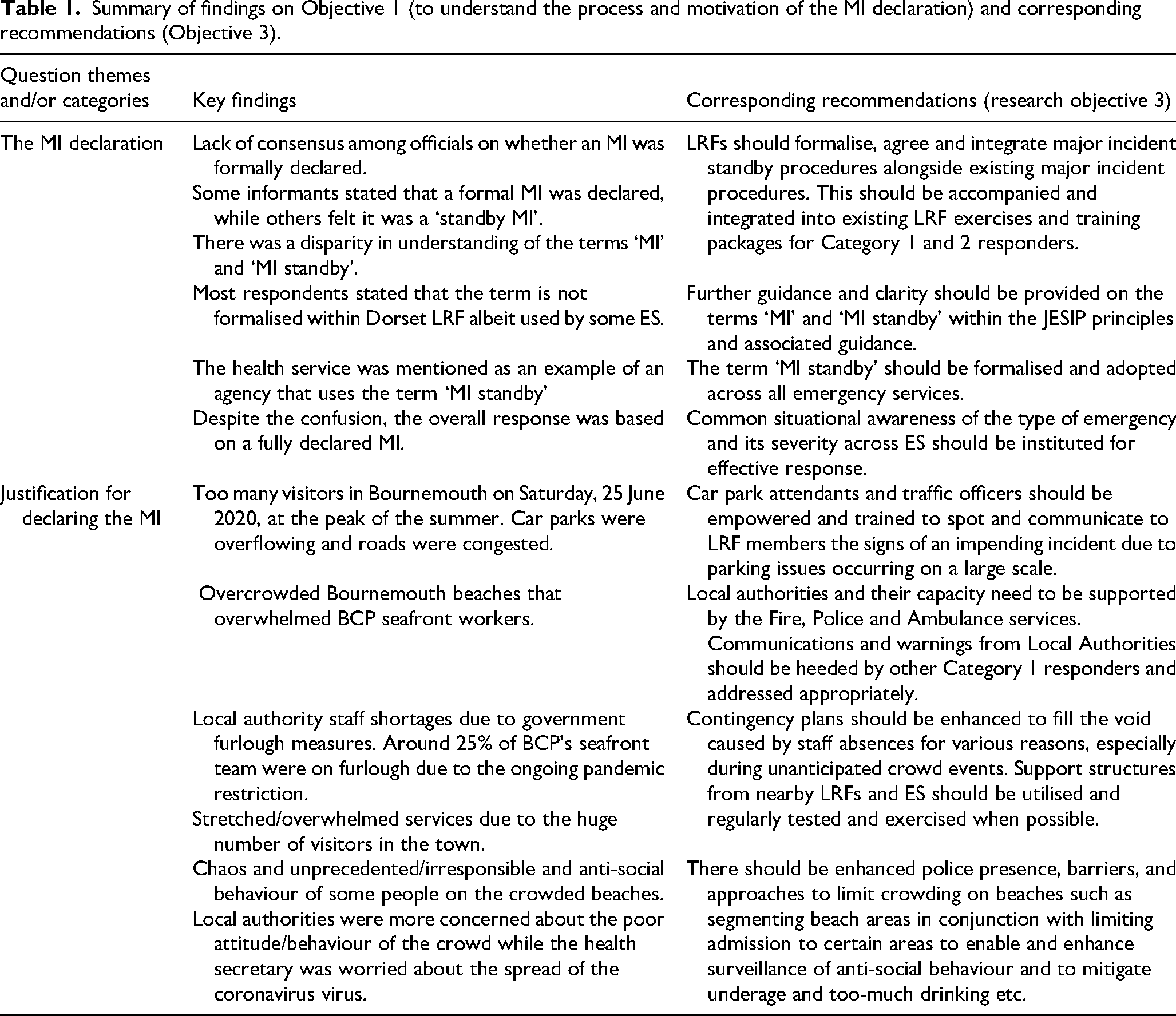
A summary of the findings that address the first research objective is presented in Table 1, including the corresponding recommendations or third objective in the last column.
Summary of findings on Objective 1 (to understand the process and motivation of the MI declaration) and corresponding recommendations (Objective 3).
The second section of the findings addresses the second objective (to analyse the effectiveness of the response to the MI) with key themes being incident preparation, incident response and how the coronavirus impacted the MI management.
Incident preparation
Regarding enquiries on adequate incident preparation, all interviewees indicated that preparation for this incident was challenging. In response to the local authority's state of preparedness, a member of the Dorset Civil Contingency Unit stated, ‘They knew something was going to happen, but they weren’t sure exactly what it would be’, while the view from a BCP Council respondent was that ‘the local authority was prepared to a point since they have experience in planning for crowd events’. He justified the experience by mentioning the annual air shows held at the beach that attract thousands of people to the region. Another informant asserted the role of existing beach crowd management plans had been discussed in the tactical coordinating group (TCG) meetings. Others commented that they had been warned of an impending hot day with soaring temperatures with potential health implications for preparation due to the high risk of sunstroke and sunburn to beachgoers.
Regarding their MI response procedures and processes, a Dorset police representative said they felt prepared. He clarified that ‘the TCG process is tried and tested, from our call-out procedure (known as Operation Link) through the joint decision-making model framed agenda and working within the JESIP principles’. However, when prompted about preparation for this incident, their thoughts aligned with those of other respondents who felt the incident was unprecedented and they were not adequately prepared for it.
Assessing early warning within the context of interagency cooperation was an inquiry. Empirical and secondary data suggest trains ferried a majority of the crowd to Bournemouth (BCP Council 2020). Train companies are Category 2 responders but failed to warn Bournemouth's LRFs about the unusually high number of passengers travelling to Bournemouth. We contend that proper cooperation and coordination with the train companies and the Dorset LRFs would have mitigated the overcrowding, for instance, by having notices at train stations informing the public that Bournemouth Beach was already overcrowded.
Incident response communication
Interviewees were asked to provide insights into the incident response communication. The view from the BCP Council team was that inter-agency communication was challenging. An informant claimed the council struggled to effectively convey the need to ‘maintain a police presence on the beach’ to stem the growing rise of anti-social behaviour. He further asserted that ‘it is hard to get people round a table for something that could happen’, which often requires the Category 1 agencies to ‘stick their hand up and say we are struggling to cope now’.
The research learned from police representatives that there was effective communication with the council in the respond and a MI declaration was not required to communicate effectively. A police respondent stated that ‘we happen to have open and well-used lines of communication with the two unitary authorities…and there was healthy buy-in to communicating at an early stage with most agencies in Dorset’. Nevertheless, the research gathered that the police were called to attend to incidents affecting the sea-front team but could not respond on time.
Interviews with respondents regarding communication with the public before the event also highlighted significant challenges. Most (seven of nine) informants did not have clear communication on the unprecedented attitude of the crowd. All interviewees mentioned the benefits of having warning messages aimed at those travelling to Bournemouth. Notwithstanding, one stated, ‘the global messaging about Dorset and visiting it hadn’t been established and designed properly yet’. Most of the informants said it was not until the council had declared a MI and TCG/SCGs were established that the issue gained national attention. A few informants believed the national media attention helped ‘communicate the potential severity and risk such an event poses to the population’.
Incident Response
Communication
When prompted about inter-agency communication once the MI had been declared, all informants portrayed a positive view. A respondent submitted that ‘TCG management provides an excellent opportunity to work collaboratively on communication and external messaging so that there is a shared situational awareness amongst the agencies’. The informants also opined on messaging and ways to communicate with the wider community including the relevance of developing a ‘single inter-agency communications message to the community’, as suggested by a senior official. A representative of the council observed that the issues in multi-agency messaging were due to challenges in seeking approval before messages are transmitted. When asked, an informant stated that it was a challenge to know the issues they were dealing with and to whom they should be directing their communication messages.
Multi-agency collaboration
A question sought to get the perspective of the interviewees on multi-agency collaboration and cooperation. Interview transcripts revealed a lack of national guidance on how to operate and that interagency collaboration and integration could be helpful. An informant remarked that once the response phase was initiated, ‘multi-agency partnerships were tricky’. He clarified that response procedures and protocols are dictated by the individual agency's approach and training, but the priorities and specific response needs are dictated by TCG/SCG meetings following the specific incident. The challenge, as mentioned by other interviewees, is how the agencies discharge their duties in response to a MI.
The informants stressed their organisations have learned lessons from this incident, especially the need to develop multi-agency partnerships. According to a respondent, ‘multi-agency work no longer hangs off the banner of emergency planning’ and agencies now see the value of effective ‘multi-agency cooperation before an event, not just in response’. Another informant observed that multi-agency work has been ‘expanded into business-as-usual operations’, and the approach will benefit the resilience of emergency responders since that does not rely on ‘emergency or MI type scenarios’.
Perception of the response
Perspectives on the overall response revealed that MI was characterised by many small and concurrent issues. One member of the Dorset Civil Contingencies Unit discussed how the incident was a ‘rising tide event with a slowly escalating picture’ that made it challenging to make appropriate response plans and mitigation measures due to the short lead time between the MI declaration and the response. Another respondent stated the event ‘was a very difficult situation to get in front of’ and ‘information sharing was the key to being able to prepare’. Furthermore, a BCP Council worker said the MI ‘felt like an air festival without any air festival structure behind it’. From interview transcripts, we can deduce that all the respondents perceived the overall response to the MI was satisfactory. One was very positive when he stated: ‘… the MI response was a success and helped bring the situation to a close and begin the recovery process’.
How the Coronavirus impacted the MIM
Interviewees were keen to comment on the impact of the COVID-19 pandemic on the MI. The dominant response aligned with a lack of warning to local authorities/ES about easing lockdown restrictions, which made them vulnerable since they were unprepared for the beach overcrowding. The research learned from ES respondents that the pandemic increased health risks in the workplace, coupled with the fact that all lockdown restrictions had not been lifted. A respondent drew attention to the new working conditions since the pandemic had not been integrated into standard operating preparation and response procedures. Consequently, it was challenging to ensure the safety and security of the emergency respondents, and consequently, the crowded population at the beach. Some informants were keen to inform the research that the businesses that remained closed could have eased the pressure on beachfront services.
The habit of attending online meetings due to lockdowns was addressed with mixed feelings. Some informants questioned the effectiveness of SCG/TCG online meetings and performing multiagency tasks online through MS Teams, Zoom, and so on. A BCP Council respondent aligned with this view felt this process was ‘more fractured’ when done online. A police respondent had a different view and commented that the new online approach of using ‘MS Teams to host the TCG meetings is efficient as it prevents unnecessary travel and can be stood up for quicker than a physical meeting at a central location’.
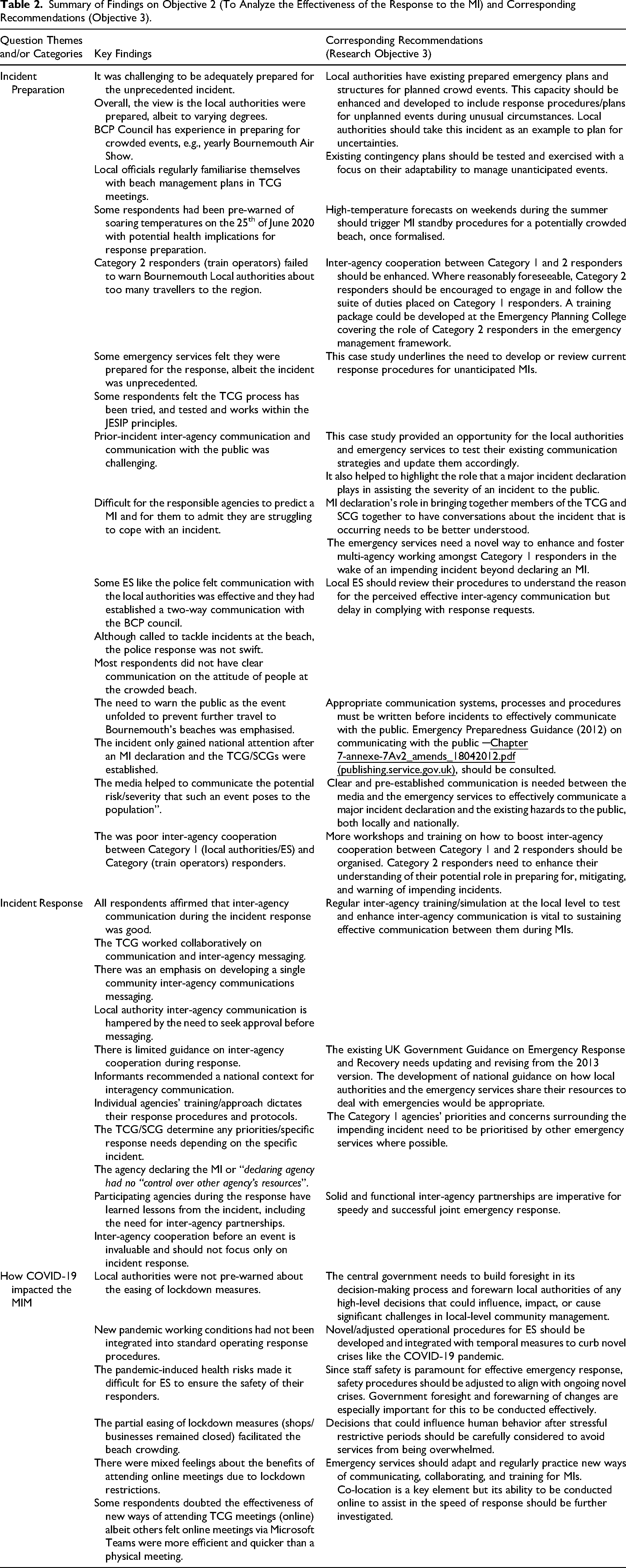
A summary of the above-mentioned findings that address the second research objective is presented in Table 2, including the corresponding recommendations or third objective in the last column.
Summary of Findings on Objective 2 (To Analyze the Effectiveness of the Response to the MI) and Corresponding Recommendations (Objective 3).
Discussion and recommendations
This section focuses on a structured discussion with highlighted recommendations. The details of the structured recommendations, which have been derived from the findings, can be found in the last columns of Tables 1 and 2.
Confusion in MI declaration
This study has exposed challenges in local-level MI declaration in the United Kingdom. Confusion on the use of the phrase ‘MI’ or ‘MI standby’ by the various ES needs clarification. While the health service may use the term ‘MI standby’ due to its experience dealing with high casualty numbers (Hunt and Greaves 2017), its application in other ES is vague. The term should be formalised and integrated into U.K. LRF structures. Since MI declarations in the United Kingdom are often associated with potentially high risks from natural hazards, the term ‘MI standby’ could be integrated into the operational MIM language for less severe risks requiring local resources.
MI declaration benefits to responders
Once the BCP Council declared the MI and it had been picked up by several news outlets, public awareness was heightened. Since ESs have different motives for declaring MIs (LRG 2021), the request by the BCP Council to deal with the emerging risks at the beach could be considered a genuine motive for the MI declaration. The declaration helped convey nationally the seriousness of the event and the challenges it presented to emergency responders. As community communication plans had not yet been established, the declaration helped to overcome the increasing vulnerability of the local authorities. Hence, we can argue that MI declarations mitigate challenges in responding to rapid-onset hazards.
Communication challenges with the local resilient forums
The CCA recommends collaboration of LRFs via multi-agency communication (Cabinet Office 2012); yet, the BCP Council as the declaring agency, found it hard to engage some emergency responders. The council struggled to convey the need to maintain a police presence at the beach to enhance staff safety. Arguably, if the local authorities and the police had shared situational awareness of the increasing population at the beach, both agencies might have successfully managed the crowd without enacting crowd control measures, which is more desirable (Hoggett and Stott 2010; Gorringe, Stott and Rosie 2012). By differentiating and appropriately dealing with distinct groups/people misbehaving within the crowd, the police can minimise the risk of disorder (Reicher et al. 2004). Nonetheless, the police also had issues dealing with staff shortages, a problem that the BCP seafront team was also facing. This highlights the need to have contingency plans to easily fill voids created by staff shortages and develop a system for local authorities/agencies to easily indicate such challenges without relying formally on declaring a MI.
MI preparedness
The Bournemouth incident has instigated the need to develop more effective preparedness and response procedures and how a MI declaration should facilitate enacting these procedures. Although crowd-related deaths may be low worldwide, this incident demonstrates that crowded places pose a risk of communicable disease transmission. Despite the BCP Council's regularity in successfully managing huge crowds during the annual air festival, the crowd dynamics on 25 June 2020, exhibited signs of aggression and hostility which was challenging for the local authorities. Resilience was further reduced since crowd-absorbing services like restaurants and bars were closed. This highlights the lack of national-level understanding of the requirement to increase local resilience during a health crisis.
The lack of foresight on the decision to ease coronavirus restrictions indicates a lack of national decision-making integration into local resilience. While there could have been valid economic, social and political reasons for easing the COVID-19 restrictions (O’Connor et al. 2020), the local authorities should have been prewarned about such a decision. That would have enabled them to reassess emerging risks from the populace in line with the decision. Arguably, decision makers in the central government did not understand that impromptu suspension of travel restrictions and easing lockdown measures during good weather conditions could increase the crowd risks. Lessons must be learned from this incident and the required consultation done the next time similar decisions are to be made.
The preparedness process for MIs in the U.K. emergency management system underscores the need for LRFs to access the community risk register and NRR to identify and plan for impending risks in collaboration with other stakeholders (Goble and Bier 2013). This fosters preparedness; yet, when incidents occur outside of prepared plans, the capacity of the agencies that have been built for known hazards is likely to be overwhelmed as this case study has unveiled. In line with the Sendai Framework for Disaster Risk Reduction, this research demonstrates the requirement for the U.K.'s emergency management system to adapt to cope with known, residual and emerging risks.
Issues with early warning
Challenges in developing and working collaboratively and sharing situational awareness have emerged from this research. The beach was overcrowded mostly by visitors to Bournemouth, with most arriving by train. Train companies under current CCA duties are Category 2 responders who are subject to information sharing and cooperation with other responders, although the train companies did not notice the increasing number of passengers to Bournemouth and the need to inform the local authorities in BCP Council. This limitation informs the need to review the legislative framework regarding situational awareness and information sharing between Category 1 and 2 responders.
MI response resource provision
This research highlights the disconnect between Category 1 responders and their empowerment to declare a MI and request appropriate response assistance. Despite declaring the MI, the BCP Council had limited resources to contain the situation and had no control over resources from assisting ES. The authorities could not instantaneously request, obtain and deploy national resources to contain the rapidly evolving incident. Indeed, Bournemouth East MP requested the national government to contain and manage this incident (Morris, Pidd and Bland 2020). A call that was not heeded. This highlights the need for contingency planning to rapidly deploy national resources for local emergency assistance.
The critical issues raised in this paper have the potential to inform operational MIM worldwide. This research also contributes to academic and theoretical knowledge that will enrich the relatively sparse literature on crowd-related MIM during rapidly evolving risks. Future research could focus on training for unanticipated risks and a nuanced understanding of emergency responder cooperation/collaboration following a MI declaration.
Conclusion
The irony of a crowd-induced MI during the coronavirus pandemic when most infection control measures focused on preventing gatherings and social distancing was a key motivation for this research. Bournemouth is the case study following the crowd-related chaos at Bournemouth Beach in June 2020 that led to the declaration of a MI.
Ultimately, national decision making to ease lockdown restrictions at the peak of the pandemic during rare, good weather conditions led to the chain of events that resulted in the crowded beach and MI declaration. Under the prevailing circumstances and with the knowledge that beaches attract thousands of people during the summer, a blend of psychological, economic, health, environmental and social factors influencing individual/group behaviours should be thoroughly considered before the decision to ease lockdown measures inducing public movements and/or gatherings on that fateful day. The authorities should have known that psychological issues like people's memory of staying indoors for long; the need to relieve lockdown stress; the social/emotional quest for outdoor relaxation after several months of restricted outdoor activities and sunny/warm weather conditions on 20 June 2020 is a combination that would inspire crowding of public spaces. These heightened risks should have informed rational decision-making, begging the question of how decisions are taken during crises/emergencies. Consequently, we recommend a rigorous risk assessment for decision making during crises and under conditions of uncertainty that would systematically identify potential imminent and cascading risks. The risk assessment tool can be underpinned by the findings of this study in consideration of various crowd incidents and other emergencies.
Arguably, the local authorities might have been complacent in assessing their abilities to deal with the MI due to the experience garnered over the years in organising the annual Bournemouth air shows that have been drawing huge crowds to Bournemouth's beaches. Being successful in dealing with huge crowds under normal situations does not automatically guarantee success in future events, especially in an emergency as findings of this research have uncovered. Therefore, meticulous preparation is still needed to deal with uncertain risks/emergencies. With a focus on safety/security, thorough preparation/planning should also consider potential new/additional crowd-related risks, likely crowd composition, resource needs like inter-agency cooperation/coordination, anticipated problems, and the appropriate contingencies to mitigate and manage them (Cabinet Office 2013a).
The objectives of this study have been accomplished. The first objective on the role of MI declaration has been achieved through findings that show benefits as well as challenges in the process. The research underscored the role MI declaration plays in aiding response, situational awareness, risk communication among Category 1 responders and enactment of response procedures. It also highlights a non-integrated emergency management system without effective coordination between Category 1 and 2 responders. A key limitation is the lack of clarity on how to differentiate between specific incidents that require external assistance beyond those available in the local region.
While findings on the second objective show the BCP Council is experienced in dealing with crowded events, there seem to be issues responding to unforeseen risks. Preparation relies on risk assessments conducted through LRFs, which is not well suited to cope with unknown hazards happening in circumstances with a reduced workforce. Being able to prepare effectively for such incidents could depend on the robustness of early warning systems which arguably depends on a strong liaison with Category 2 responders.
Overall, we would argue that the Bournemouth MIM though successful to a certain degree, was hampered by national decision making, lack of warning, and reliance on archaic plans and procedures to deal with an unprecedented incident during a novel health crisis. The response, although swift and timely, was hampered by virus containment restrictions. A summary of the research findings has been presented in Tables 1 and 2. From the findings, it can be deduced that there is insufficient research into this area and more work is needed to assess the role MI declarations have in response.
Informed by the research findings, we have proffered some recommendations to enhance MIM in the United Kingdom. Together with those highlighted in the previous section and the last columns of Tables 1 and 2, these include the need for the UK emergency management system to:
Update the legislative and institutional framework for MIM to inculcate uncertain, unforeseen and unanticipated incidents, especially those related to health crises. Integrate the central government more closely with local provisions for MIM resources. Allow preparedness for emergencies to adopt an all-hazards approach that will allow it to cope with both known, residual and unforeseen risks. Improve the guidance and understanding of the role and use of MI declarations. Update and amend the CCA to improve and facilitate greater risk reduction through the expansion of duties to wider categories of emergency responders, including the national government. Develop and adopt a systematic and central reporting framework that will improve MI understanding across the United Kingdom and allow for more investigations and lessons to be learned from such incidents.
Footnotes

Funding
The authors received no financial support for the research, authorship, and/or publication of this article.
Declaration of conflicting interests
The authors declared no potential conflicts of interest with respect to the research, authorship, and/or publication of this article.