




Abstract
Recovering from a disaster while simultaneously living in a barely habitable home poses significant challenges for residents. Although the process of recovering in-situ is common following hurricanes, it remains understudied in the disaster science literature. This study explores this experience through the examination of two primary questions. First, given its inherent challenges, why do residents live in their significantly damaged dwellings during recovery? Second, what is the nature of this experience, physically, emotionally, and perceptually? This article explores the experiences of ten Hurricane Sandy (2012) survivors who undertook housing recovery while living in barely habitable dwellings. Data were gathered from focus groups conducted with Superstorm Sandy Survivors from New Jersey five years after the hurricane. An inductive qualitative content analysis was used to understand housing recovery processes from the perspectives of residents recovering in situ. Findings examine the physical, emotional, and perceptual nature of this experience, highlighting reasons why households recover in-situ, the hazards and vulnerabilities associated with that experience, and the elusive nature of emotional recovery. This study contributes to the growing body of literature surrounding recovery experiences, and it introduces valuable insights into the challenges that survivors face while recovering in-situ.
Introduction
The experience of households undertaking post-disaster recovery while living in barely habitable dwellings is relatively common in the United States but has yet to receive sufficient study. The ubiquitous blue tarps covering roofs in hurricane-impacted regions hint at the potential pervasiveness of this experience, as demonstrated by the 76,500 blue tarps installed in Florida, Puerto Rico, and the U.S. Virgin Islands following Hurricanes Irma and Maria in 2017 (USACE 2021). Other events, such as the 2018 Camp Fire in California resulted in residents recovering in garages, trailers, or camping on their properties without utilities or appliances (Chase and Hansen 2021; Sacks 2019). Similarly, existing recovery research mentions households recovering in severely damaged dwellings and alludes to the challenges inherent in doing so (Aldrich 2015; Chang et al. 2014; Freeman, Nairn, and Gollop 2015), yet detailed examination of the nature of these experiences is not prevalent in the disaster science literature.
Existing models of household and housing recovery (Quarantelli 1982, 1995; Rathfon et al. 2013) also fail to capture the experience of recovering in “barely habitable damaged homes” (Peacock et al. 2018, 572). For the purpose of this study, a barely habitable home is one that was impacted by the disaster event and causes occupants a persistent and high degree of discomfort. This discomfort may be felt emotionally from the distress of remaining within their damaged home and their damaged community, or physically while staying in homes that may lack utilities, secure roofing, and insulation. Damaged dwellings may include significantly damaged homes that are tarped, lacking utilities, or are actively undergoing significant repairs such as mold remediation, flood recovery, or drywall removal. In this study, significantly damaged homes include dwellings classified by FEMA (2012, 2) as either sustaining “…major damage (e.g. structural damages to walls, foundation, flooring that makes the home uninhabitable and will take more than 30 days to repair) or destroyed (e.g. loss of home or home rendered uninhabitable due to collapse of foundation, walls, and/or roof).” This phenomenon of undertaking recovery while living in barely habitable homes eludes Quarantelli's (1995) foundational typology of sheltering and housing since aspects of the experience simultaneously reflect characteristics of temporary shelter, temporary housing, and permanent housing. For instance, even though households have returned to their domicile for the foreseeable future (i.e. permanent housing), their ability to reestablish routines—a prerequisite of the transition from sheltering to housing—is curtailed by the primitive state of the accommodations. Classifying the experience as a temporary shelter also seems inappropriate because a severely damaged dwelling offers households substantially more privacy than a public shelter, the home of a relative/friend, or a hotel/motel room. Furthermore, households living in damaged dwellings must obtain their own basic provisions (e.g. food and water) in contrast to public or mass shelters, which regularly supply these items. Rathfon et al.’s (2013) model refocuses attention on the status of the damaged structure itself. While the experience of recovering in a damaged dwelling is intimately linked to the nature and extent of home repairs needed, the experience does not neatly align with existing recovery frameworks. Moreover, both these frameworks and others (e.g., Cole 2003) neglect the emotional and perceptual dimensions of the household recovery process.
The current study explores the experiences of ten Hurricane Sandy (2012) survivors from nine New Jersey households who undertook housing recovery while living in barely habitable dwellings. Two basic questions guide this research. First, given its inherent challenges, why do residents live in their significantly damaged dwellings during recovery? Second, what is the nature of this experience, physically, emotionally, and perceptually? Forming the basis of this study are homeowners’ accounts drawn from focus groups conducted in Ocean and Monmouth Counties, New Jersey, approximately 5 years after Hurricane Sandy. All focus group participants (n = 28) had either rebuilt or were in the process of rebuilding their homes after the storm. While many focus group participants reported recovering ex situ (i.e. living off-site during reconstruction), this study analyzes only those accounts of residents (n = 10) who recovered in situ and inside a dwelling that received significant damage (i.e. not in a travel trailer or other temporary on-site housing). Using inductive thematic analysis, this research responds to a need for embedded, qualitative work that seeks to understand housing recovery processes from the perspectives of residents themselves, rather than only in aggregate (Peacock, Dash, and Zhang 2007; Peacock et al. 2018). This study also seeks to refine the relatively coarse, yet pervasive housing recovery typologies that frame much current literature on post-disaster housing recovery.
Literature review
Decades of research on the post-disaster period show housing to be a linchpin of successful recovery. Post-disaster housing plays a crucial role in restoring population to neighborhoods and communities, providing stability and security to individuals and households, and supporting the recovery of business, industry, and public sector services (e.g., education, parks, and transit). Despite its primacy in the recovery process, research on undertaking household recovery while living in barely habitable homes and other precarious post-disaster housing conditions remains understudied (Chase and Hansen 2021).
Prevalent theoretical frameworks: Previous research on housing recovery describes how households transition through this process. Quarantelli (1985) conducted one of the initial assessments of household recovery when defining the earliest concepts of “shelter” and “housing.” The resulting typology produced the definitions of emergency and temporary shelter, and temporary and permanent housing that are widely applied today. Within Quarantelli's typology are clear distinctions between the different phases of shelter and housing, though there is a stated potential for an overlap between temporary and permanent housing (Quarantelli 1995). The current study investigates one understudied housing situation that occurs within this overlap.
Rathfon et al. (2013) built upon Quarantelli's (1995) framework when distinguishing household recovery from residential building (or physical dwelling) recovery to examine how the separate processes may affect the overall recovery timeline of households. In their model, household members go through Quarantelli's phases of sheltering while their physical dwelling undergoes its own phases of reconstructive recovery. These phases include a damaged state, temporary protections such as blue tarps, demolition or reconstruction efforts, and achieving recovery either as a repaired or completely rebuilt structure (Rathfon et al. 2013). This model by Rathfon et al. (2013) acknowledges that the physical dwelling's recovery process is distinct from the recovery process of household members, yet connected. In their model, the household cannot experience permanent shelter until their residential dwelling reaches reconstruction or repair. Hence, their model best captures the traditional displaced-while-building (ex situ recovery) situation. In cases where household members undertake major repairs to their physical dwelling while living inside, connections between the physical dwelling's recovery and the household's recovery may be less distinct. To date, existing disaster literature has overlooked the possibility of significant impacts on both physical and emotional recovery as households recover in-situ in barely habitable dwellings.
Connections between physical and emotional recovery: While objective studies are useful for monitoring trends, reconstruction processes, and recovery timelines (Cutter, Schumann, and Emrich 2014; Kates et al. 2006; Peacock et al. 2014), they often fail to encompass the emotional and more subjective dimensions of the recovery experience. Cox and Perry (2011) noted that in disaster recovery, there can be a tendency to emphasize physical recovery over emotional recovery; however, both are simultaneously necessary for disaster survivors to feel they have actually achieved recovery. Bolin and Bolton (1986) described emotional recovery as the perceptions held by disaster survivors as to when they feel they have overcome the emotional impacts incurred as a result of experiencing a disaster. This type of recovery can include perceptions about reestablishing familial and economic well-being, as well as feeling that they have overcome the duress and stresses inherent in disaster recovery. Recent studies have examined various dimensions of emotional recovery through the lens of psychological well-being and resilience (Mao and Agyapong 2021) and describe how substandard living conditions can exacerbate stress and decrease psychological health in those undertaking difficult disaster recoveries (Borah et al. 2023). Other studies highlight how disaster recovery can be emotionally taxing, and that, while access to insurance and other financial resources can facilitate physical and emotional recovery, the psychological and emotional impacts of experiencing a disaster and undertaking the recovery process may persist even after reestablishing one's physical dwelling and normalcy (Ericksen and de Vet 2021).
Given that one's sense of self is often closely linked to place, and more specifically, to one's home (Fothergill 2004), the emotional and subjective dimensions of recovery manifest early after a disaster and often influence return and recovery decisions. These subjective meanings of recovery entail a household's ability to obtain a satisfactory recovery (Bolin 1982; Bolin and Bolton 1983; Schumann 2018) and the emotional labor that goes into a household's recovery (Whittle et al. 2012). As Bolin and Bolton (1983) discussed, housing recovery is not achieved simply when the household returns to the spatial location of their dwelling, but when their living conditions are perceived as equally “satisfactory” (p. 131) to their living conditions prior to the disaster. This distinction is important when investigating the recovery rates of those living in damaged dwellings, as these households have regained the spatial aspect of recovery, and perhaps even permanent housing under the Quarantelli (1995) classification, but they have in no way reached the subjective satisfactory levels of recovery that Bolin and Bolton discuss.
Those living in damaged dwellings exist in an understudied transitional state not well-captured by the theoretical frameworks. This is because they use their permanent dwelling as temporary shelter, gradually modifying it to serve as temporary housing, and eventually permanent housing functions. Though under-researched in disaster science literature, recent studies offer important insights into the challenges inherent when initiating recovery in a barely habitable home. Living in damaged homes can be dangerous. For example, flood-damaged homes often contain secondary hazards, such as mold growth and the presence of pests, which are especially harmful to the health and safety of occupants (Azuma et al. 2013). Specific to challenges that often hinder the progress in housing reconstruction, Rouhanizadeh, Kermanshachi, and Nipa’s (2020) systematic review of previous studies examining hurricane recovery found that the incompetence of contractors, subpar, and illegal construction practices, and a lack of awareness about resources available to support household reconstruction all posed significant barriers when rebuilding homes and communities. Silverman (2006) noted that deliberate predatory practices by contractors, such as inflating the cost of carrying out repairs and price gouging of recovery materials, revictimizes disaster survivors. Similarly, Greer and Trainor (2021) described how the administrative burden placed on residents by opaque and shifting disaster recovery program requirements contributes to feelings of frustration and hopelessness.
Living in a damaged dwelling increases the likelihood of experiencing mental health-related issues (Graham et al. 2019). Neighborhoods and businesses may remain vacant or sparsely populated for the long term, creating greater social isolation for returnees and thus lowering the quality of life relative to before the event (Annang et al. 2016; Inoue et al. 2014). One study on the 2011 Tohoku Earthquake and Tsunami in Japan found that when compared to individuals in temporary shelters, those recovering in significantly damaged homes reported higher levels of dissatisfaction with their quality of life, experienced losses of their pre-disaster social networks, and suffered higher instances of sleep-related issues (Matsumoto et al. 2015). This is similar to Warsini et al.'s (2014) who observed that those undertaking recovery from a significantly damaged dwelling may experience higher degrees of dissatisfaction and emotional distress throughout the process. As demonstrated in previous scholarship, undertaking disaster recovery in a barely habitable home is a complex process that entails both physical and emotional dimensions of recovery. This study aims to offer a more nuanced understanding of residents' experiences during both the short-term and long-term recovery of their homes.
Methods
Superstorm Sandy: Sandy made landfall on the Brigantine, New Jersey shoreline on 29 October 2012. The names Hurricane Sandy and Superstorm Sandy are applied interchangeably to the event since the storm's structure changed from tropical to extra-tropical as it approached landfall. According to Blake et al. (2013, 17), the damage that resulted from Sandy's storm surge, inland flooding, and high winds was “unprecedented” in New Jersey's history, and a majority of structures along the coast were “flooded, badly damaged, or destroyed.” According to FEMA (2021), roughly 346,000 homes in New Jersey sustained damage during Superstorm Sandy, with ∼ 37,000 properties categorized as having major damage (FEMA 2013) and ∼ 20,000 classified as destroyed and uninhabitable (US Senate Hearing 2012). Additionally, in the week following the storm, much of New Jersey experienced prolonged power-outages and near-freezing temperatures, which contributed to fatalities resulting from hypothermia and carbon monoxide poisoning (Blake et al. 2013).
Following the disaster, federal, state, and local organizations sponsored various housing resources for impacted residents. These resources ranged from short-term solutions (such as FEMA-funded hotel rooms, temporary housing, and rental assistance) to long-term rebuilding guidelines and construction grants (Stafford Township 2015). In all, over 60,500 residents received FEMA Individual Assistance funding, and additional housing grants averaging $6,088 per applicant were made available to qualified households (FEMA 2013). Financial housing assistance following the storm also included Small Business Administration (SBA) loans, grants made through the state's Homeowner Reconstruction, Rehabilitation, Elevation and Mitigation (RREM) program, and grants from the Sandy Homeowner/Renter Assistance Program (SHRAP) (Stafford Township 2015).
Data collection: Data were gathered through six focus groups conducted over a three-day period in May 2017, approximately 5 years after Superstorm Sandy. As described by Siebeneck et al. (2020) and Lee et al. (2020), local contacts from the Salvation Army and Ocean County Long-Term Recovery Group (OCLTRG) advertised the research opportunity via email to the households that utilized their resources in the aftermath of the storm. Prospective participants had to be homeowners whose primary dwelling had been damaged in Superstorm Sandy. Eligible participants were then able to sign up for one of the two focus group sessions planned for their community. Everyone interested and eligible to participate was able to register for a focus group, and no one was excluded from the study. Each focus group consisted of three to six people. Notably, the participants relied on these organizations for support and resources while undertaking household recovery in the 5 years following Superstorm Sandy. Focus groups were audio recorded and lasted ∼ 2 h each. The focus groups were guided by a protocol that solicited each participant's description of their household's experiences during evacuation, return, and recovery. Next, focus group participants collectively generated a list of barriers to and facilitators of recovery based on their experiences following the storm. The focus group protocol included probes about the status, functionality, and restoration of physical infrastructure (e.g. utilities, communication, and transportation) as well as secondary hazards (e.g. gas leaks, live wires, encountering insects, and wild animals). To ensure that audio recordings of focus groups accurately captured who was speaking, the facilitator requested that participants state their names before sharing. Participants also wore name tags, so the facilitator could recognize them by name if they forgot to introduce themselves. Additionally, participants completed a background questionnaire to collect basic information on household composition, damage, and other demographics. At the conclusion of the focus group, participants were paid US$40 for their time.
In all, 28 participants from Manahawkin (Ocean County), Hazlet (Monmouth), and Seaside Heights/Tom's River (Ocean County) took part in the focus groups. While data from all 28 participants was utilized to understand the conditions of the entire community following the disaster, 10 participants explicitly stated they recovered in-situ in significantly damaged dwellings at some point in their recovery process. These 10 participants represent nine households, as two participants were a couple. This study focuses on the experiences of these ten participants who reported recovering in-situ. It should be noted, that participants were assigned pseudonyms during analysis to maintain their confidentiality. Hence, the names used in this article are not the participants’ real names.
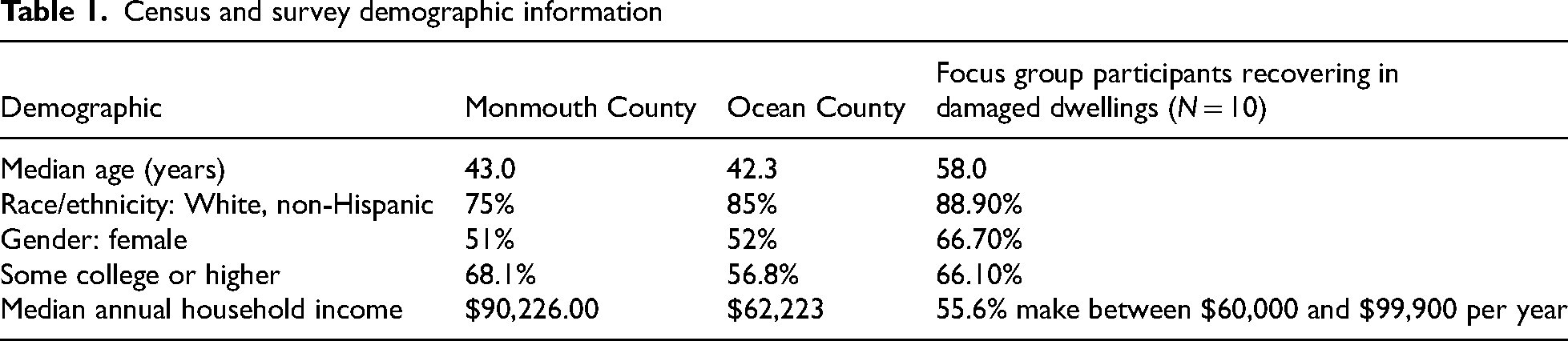
Overall, the sample of 10 participants that recovered in-situ in damaged dwellings was homogeneous and representative of the surrounding area: they were primarily white, middle-to-older aged (median age 60.5) residents with some college education, whose self-reported yearly household incomes ranged from < $30,000 to $99,999. However, females and older residents were overrepresented in this study when compared to the census data for the region (Table 1). Additionally, at the time of the storm, participants from three households indicated that they had children under 18 living at home, and at the time the focus groups were conducted, six participants were either married or living with a partner. In terms of damage, all 10 participants reported recovering in homes that sustained storm surge damage (Table 2). Participants’ homes also incurred damage from freshwater flooding (44.4%), water damage not from freshwater flooding or storm surge (e.g. precipitation coming in from the roof) (33.3%), roof damage (44.4%), and downed trees or other property damage (66.7%). Over half of the participant households experienced three or more types of damage to their homes: two homes (Monica's and Traci's) sustained all five types of damage, while three homes (Frank's, Jim's, and David & Ginny's) sustained three or four types of damage. One household (Loretta's) received damage from two sources, and the remaining three households (Beth's, Adam's, and Ben's) received only one type of damage (storm surge).
Census and survey demographic information
Participant-reported damages (N = 9 households).

Data analysis: Audio recordings of the focus groups were transcribed verbatim, and an inductive qualitative content analysis was performed on the transcripts. Transcripts were uploaded into Atlas.ti, then coded and analyzed following an iterative approach. Our analysis process enabled the systematic examination of both manifest (or literal) and latent (or interpretive) meanings in our textual data (Cho and Lee 2014).
Focus group transcripts were read and audio recordings were listened to in their entirety multiple times. After a thorough immersion in the data over several weeks, the initial coding process began. Initial coding efforts identified overarching, emergent codes such as “aid,” “displacement,” and “recovery.” These broad codes were each then searched for “signaling” codes, or codes that could lead to promising analysis (Phillips 2014). The “recovery” code was chosen for further development because of the breadth of content and novelty of the subject.
Within the “recovery” code, the experience of recovering in-situ emerged as unique to ten participants. Instances of these ten participants sharing experiences of recovering within damaged dwellings were analyzed separately for new signaling codes. Within this new subset, signaling codes such as “hazards,” “housing conditions,” and “emotional recovery” emerged. At this stage, one signaling code, “reasons,” presented an opportunity for examining the rationale behind participants’ decisions to recover in-situ in damaged dwellings. This research question was added to the scope of analysis. As a final step, selective coding was used within each signaling code to identify primary themes that answered each of our research questions (Phillips 2014). To ensure reliability in signaling and selective codes, research team members convened at each stage of the coding process to reach an agreement on code names and definitions. Emergent themes from this iterative coding process are discussed in the next section.
Results
This study addresses two primary research questions: (1) given its inherent challenges, why do residents live in their damaged dwellings during recovery? and (2) what is the nature of this experience, physically, emotionally, and perceptually? Table 3 identifies themes resulting from the content analysis of focus group data.
Summation of findings.

Reasons for recovering in-situ
To understand the experience of recovering in-situ, it was essential to examine why participants made the decision to return and recover within their severely damaged homes after Superstorm Sandy. Participants alluded to three reasons as they described their experiences. These included (1) the inherent uncertainty of the housing recovery process immediately following the disaster, (2) the delicate negotiation of personal boundaries in accepting (or avoiding) assistance from family members, and (3) concerns about the looting of homes and properties. We elaborate on each theme below.
Uncertainty during early housing recovery: Duration, stability, and affordability
Soon after reentering their communities, participants recognized that decisions needed to be made about where to live and that some of these decisions had to be made in spite of extreme uncertainty about timing and process. Some of the uncertainty stemmed from not knowing when residents would be allowed to reenter, how long they would be permitted to stay, or when the recovery of one's home could be initiated: [When] we went to go to Union Beach they [the National Guard] wouldn't let us in because we couldn't get into town, and we were like “No, you don't understand. This is our driver's license, we live over there down the hill a couple blocks down, we have no place to stay.” And they're like “what do you mean you don't have a place?” and we're like “we don't have a place to stay.” Monica, Hazlet …I knew I had to stay there [in my home], because there were so many unknowns. We didn't know how long they would take to get insurance money and … you didn't know what was to come… Loretta, Manahawkin
For these participants, the decision to return and remain in their damaged homes was made soon after returning to their property. Other participants felt the need to return home after experiencing uncertainty about the duration and stability of temporary shelter and housing accommodations in the weeks and months following the storm: …now sometimes you were told “no, you have to check out.” So you would gather all your stuff, check out, drive around to do whatever only to find out that you were then allowed back into the hotel. So they would displace you, ok, you'd be out looking around, the mental exhaustion, the mental stress, the mental pressure of going “ok, I don't have a place to stay, ok.” Donna, Hazlet
As described above, evacuees who secured the FEMA-funded temporary hotel housing following Superstorm Sandy were only issued the housing on a weekly or biweekly basis, meaning that at the end of each week, they would need to seek approval to stay for another continuous week. The uncertainty surrounding the duration of these accommodations created stress and sometimes led to additional displacements for residents.
Uncertainty about how long housing recovery would take also made survivors hesitant to either start living in costly hotel rooms for an extended period of time or to start searching for vacant apartments for short-term housing. Financial uncertainty stemming from concerns about the cost of repairing and rebuilding homes became especially salient in the weeks following the storm. Regardless of whether a household lived in their damaged dwelling or recovered from elsewhere, many were expected to continue making their mortgage payments on their damaged homes and simply could not afford to pay both their mortgage and the rental costs of an apartment or an extended stay hotel. As two participants explain: …we came home, we got [to] the house and we stayed there. We lived on concrete floors and started walls until the insurance finally gave us money … that was my house, I was not moving out. I couldn't afford to rent and pay my mortgage. My mortgage company called, and they were like “well, yeah, you still have to pay your mortgage,” so you have to live. Beth, Manahawkin The mortgage company tried to foreclose. I think they saw a cash cow in the location of where my property was even though it was on the mainland. I think all of a sudden it occurred to the mortgage company “well, if we can” … I was, obviously in tough financial straits, and so, “if we can push the envelope on this guy and foreclose on him, we got a sure property.” And they tried hard, and I ended up, in order to close out the mortgage, I ended up having to use some of the pittance of an insurance settlement I got to pay off the mortgage company to stop them. So I even have less than that quarter of what I was going to need to rebuild because it was the only way I could even hold on to the property. That's how vicious they got, the mortgage company. Jim, Seaside Heights
Needing to continue to make regular payments on a mortgage while also covering the costs of living elsewhere was not feasible for some of the focus group participants. Affordability was one of several reasons participants recovered in-situ, and in Jim's case, he also lived in his vehicle on his property rather than live offsite. Additionally, both quotes highlight an element of territoriality. Despite the financial uncertainty and challenges, these residents were determined to maintain possession of their homes, even if it meant living in barely habitable dwellings.
Negotiating familial boundaries
While some of the participants from the focus groups were able to stay with family and friends at various points during the recovery process, others expressed a reluctance to rely on family for extended periods of time, and they cited this as a reason for returning and remaining in their damaged home soon after the storm. One participant went so far as to claim that while one may expect families to open their doors, in reality, the survivors are often left on their own with limited options following a disaster: That's why we stayed in our house until we gutted it and we had it up and running because there was not a place. Like you couldn't get a hotel room—there was nothing available. And we didn't want to burden … I know this sounds horrible, but you think that in a moment of crisis that people that you know come to your aid, and they do maybe for a day or two, and then they all run and turn the other way. And that's what we encountered. We had no place to stay because it's not like we're gonna call people up and beg “can we stay at your house a couple of days?” I’m sorry, but when you’re going through something like that you expect people close to you to offer their home, so that's a whole “nother issue.” Monica, Hazlet
Disasters can strain relationships, and although staying with family and friends in the short-term was a good option for some, participants from the focus groups did express concerns about overstaying their welcome. Displaced participants who were frequently relocated to FEMA-funded hotels also expressed hesitancy at the prospect of burdening family hosts long-term, but those recovering in situ identified familial boundaries as clear justification for their course of action. These participants would rather experience the hardship of recovering in damaged homes than risk damaging relationships.
Security against looters
Following the storm, reports of looters using boats to cross over onto barrier island communities quickly spread across local news platforms. In response to the media coverage on this issue, National Guardsmen and local law enforcement were tasked with establishing checkpoints to verify that returnees were permitted to enter damaged neighborhoods and communities. Although some participants felt no choice but to return to their homes as described in the “Uncertainty during early housing recovery: Duration, stability, and affordability” section, others actively sought to return and remain at their homes to protect their property and valuables against looters. We put a sign out saying “you loot, we shoot.” I mean, we had a plywood board 4 × 8, we were serious. My son had a gun and I'll tell ya, I'll be damned, we were going to shoot because they were driving by looking for things … they were coming in on the property brazenly and they were chasing me off my own property, the looters. Adam, Manahawkin I fixed up the house good enough that we could move ourselves back in. We would get a bed in, there was heat. A lot of us use the term “camping,” because we made the house good enough, you know, you could run the water, you could flush the toilet. So I moved back into the house because I wanted to protect the house, and my wife wouldn't come back because when you look at our house at night, it was not another person, not a light in any house [on the street]. Ben, Manahawkin
While only two participants across the six focus groups directly experienced looting behavior at their homes firsthand, several other participants reported hearing secondhand accounts that groups of people in boats were crossing to the island communities and stealing things like televisions, refrigerators, copper pipes, and other valuables. The spread of misinformation and rumors, especially those pertaining to looting, posed challenges for residents and emergency managers alike (Manandhar and Siebeneck 2018). Although widespread looting in the aftermath of a disaster is not common (Alexander 2007; Tierney et al. 2006), the perception that looting poses a significant risk to one's home and property may motivate residents to remain at home in the evacuation zone during a hurricane (Baker 1991). Other studies have shown that while returnees often expect to encounter looting upon returning home following a disaster, the vast majority do not (Siebeneck et al. 2013). In the case of Superstorm Sandy, this issue was a significant concern for several participants, mostly males, which in turn influenced them to return and remain in damaged homes and communities.
Experience in recovering in-situ
Whatever the reason(s) that motivated survivors to return and recover in damaged homes, community conditions exposed these residents to a variety of risks. Additionally, survivors’ recollections depicted a holistic view of recovery itself, including how their physical, psychological, and cognitive appraisals were linked. Five aspects defined residents’ experiences of undertaking housing recovery in their damaged dwellings: (1) coping with secondary hazards, (2) adapting to a lack of utilities and basic services, (3) the feeling of being revictimized through the rebuilding process, (4) the perception of “full” recovery as a moving goalpost, and (5) the discovery of the elusiveness of emotional recovery. We elaborate on these aspects below.
Secondary hazards
Many participants reported encountering various secondary hazards such as mold, fires from downed power lines, debris from fallen trees, and damaged structures. Although some participants returned home within days following the storm, they were surprised by how quickly they needed to begin mold remediation. As one participant recalled: We had mold, sure, real quick. Which you would think, “how would you get mold?” Because we were there, and the next day we cleaned everything, but that mold started to grow. Beth, Manahawkin
In this instance, participants seemed to understand what actions they needed to take to immediately begin remediation; community organizations aided this process by passing out buckets, cleaning solutions, and even offering courses to those inexperienced in mold removal. However, these actions were only useful if someone had returned early enough to perform them. The health hazards stemming from mold often lingered for years after the storm. Given that some homes in these communities acted as secondary or vacation homes, meaning they were not regularly occupied, these damaged homes often sat untouched until the remote homeowners could send someone to assess for repairs. Many residents expressed concern about nearby houses that were not remediated immediately after the storm and the consequential health effects they experienced several years after the initial disaster: The house was just still there, building up more and more mold. Traci, Hazlet …and rodents and… Monica, Hazlet You all had a problem with mice, Monica? Focus group moderator No, no. We didn’t. I’m saying the house next to us that just sat there, rodents and pests, and you know, all that… Monica, Hazlet …you had to deal with people not doing their houses like we did so some people—it was a long time before they went in and cleaned out their houses. My nextdoor neighbor was a long time before she had got somebody to come, and I was like, oh my God, what am I going to catch? Beth, Manahawkin Yeah, the mold. Adam, Manahawkin Yeah, I mean it was horrific. Was that one and then two houses down—they just kind of just cleaned that house not long ago. I don’t understand what it looked like. They even had furniture still in there, so whatever. Beth, Manahawkin
Other residents described frequent fires in homes that were not repaired properly after the storm. Here, geography plays an important role in the types of secondary hazards experienced. With inland flooding, the floodwaters are typically freshwater and come from rain or inland lakes and streams. However, coastal storm surge flooding contains salt water, which can corrode a home's wiring and, if not remediated properly, cause fires once power is restored. Since many of these neighboring houses were vacation homes, permanent residents experienced the risk of fires in their neighborhoods several years after the storm initially hit. One participant explains: …To give you an example, last week [five years after the storm] we passed this one house on fire. There was one house on fire, the contractor, the guy was in Florida. It was a rental. He was moving out because he had just bought the house. He paid the contractor, a reputable one … I don't want to mention the name but it was a reputable one which you would think he would use. He went into the house that—in January, after that year, and the wall started smoking. They never replaced the wiring. Adam, Manahawkin
Secondary hazards stemming from unrepaired or improperly repaired homes were a constant source of concern for many residents. Several participants expressed frustration with the fact that the risk to their own homes arose from other homes not being maintained and recovered. These frustrations compounded over time.
Lack of utilities and basic services
The challenges arising from secondary hazards were further complicated by the lack of utilities in the homes. The storm flooded sewage lines, while electricity and gas lines took months to be restored since sand and debris covered major roadways. As residents explained: We lived in our house with nothing, with the baby for weeks, I don't even know when I had utilities … We froze, literally, and didn't have hot food to eat for probably a good almost two months… Monica, Hazlet What got me was the realization that this could go on for a long time, and months. The second winter was cold, the first winter was pretty mild. The second winter I had mice coming [in] and I could not do anything about it. Loretta, Manahawkin
Finding warmth was particularly challenging in the early weeks following Superstorm Sandy. This region is typically damp and cold throughout the winter, and a snowstorm that followed the hurricane worsened conditions. The lack of utilities paired with the freezing temperatures led some to depend on gasoline-powered generators or cars to stay warm. Others depended on their generator or cars to begin recovery activities such as charging their cell phone to call insurance, searching for resources, and powering tools to begin reconstruction. However, gasoline quickly became a limited resource due to the blocked roads. Gasoline shortages meant residents were given strict refueling limits. One resident explains: When you'd go to put in gas you'd have to wait two, three hours to put gas in your car. I mean there were lines, and we used a lot of gas because that's where I would take the baby sometimes during the day, put her in her car seat and turn the car on just so we could warm up. Monica, Hazlet
Residents struggled to find the resources they needed to survive within their damaged dwellings. In addition to difficulties securing gasoline and utilities, residents also struggled to purchase groceries in the weeks following the storm. The lack of power throughout the community meant grocery stores and banks could not access digital funds, so everything purchased had to be purchased with any cash the residents had remaining from before the storm.
Revictimization through rebuilding
Residents recovering in damaged homes reported feelings of gradually mounting exasperation as they interacted with the plethora of individuals, organizations, and programs that played a role in the housing recovery process. These actors ranged from contractors and public adjusters to insurance companies and government-sponsored relief programs. Residents, who were at the mercy of these entities for rebuilding assistance, described feeling vulnerable to scams and practices they perceived as unfair due to a lack of transparency or control. In the words of one participant: The way I would sum that up is you became victimized twice: once by Hurricane Sandy destroying your home or severely damaging it, and the second time by all this bureaucracy and red tape that you were running into. Jim, Seaside Heights
Subpar contractors, subcontractors, and insurance adjusters (public and private) were mentioned. Public adjusters are independent insurance consultants licensed by the state and hired by policyholders as advocates. Adjusters use their expertise on insurance policies to guarantee that the policyholder receives the maximum possible payout. This advocacy is designed to benefit both parties: the public adjuster earns a percentage of the overall payout as payment, so the higher the insurance payout for the policyholder, the higher the adjuster's paycheck (Poliakoff 2006). Within several days of the storm, public adjusters and contractors were traveling door-to-door to offer their services to residents living within these damaged homes. As one participant explains: …right after the storm you had contractors, handymen, a million public adjusters, all coming to your house, knocking on your door, leaving the cards. We were out pulling all the contents of the house out and they were coming up to you, and as the days went on, you became more and more vulnerable. Loretta, Manahawkin
The longer these residents lived in damaged homes and communities—and the more mentally and emotionally exhausted they became in rebuilding their dwellings—the more appealing it seemed to hire a contractor who promised to restore your heat, walls, and furnishings, or to hire an adjuster who promised a high insurance payout. However, many residents soon found that they had signed contracts with individuals who would not advocate on their behalf but would still take their percentage of the payout for work not performed. What they did, they have so many clients, they were not having the best interest of the clients at heart … once you signed it was like 5% or whatever you get from the insurance company. They would pay, some of them 5 to 10 [percent]. What they would do, is that they would leave you high and dry, because if they had 300 clients, and they got the money from 300 clients, they could care less if they got 60 [thousand dollars] or $70,000 because it didn't make that much of a difference to them. Adam, Manahawkin So the public adjuster came in, did this whatever, then the insurance, the NFIP came in, more or less than the public adjuster said “okay.” Supposedly these public adjusters were going to fight for you to get you the most amount of money that you're supposed to get, because the regular insurance people weren't going to give you [what you’re supposed to get]. So therefore, they were supposed to make sure. Well, we heard from the insurance person, public adjuster says “okay.” So, I said “where are you fighting for me?,” and “why am I now paying you if you are just going by what he did?” Beth, Manahawkin
Many residents had to wait years to begin receiving insurance payouts from the National Flood Insurance Program (NFIP) or recovery grants from FEMA, and often for amounts insufficient to cover damages. On top of receiving what they deemed unfair insurance settlements, participants now had to pay a percentage of their settlement to a public adjuster who they felt did not perform any service worth paying for.
Other participants described feeling cheated and being treated unfairly by contractors. Many contractors flocked to the area following the storm knowing that people needed repairs and were in vulnerable positions. Those recovering within their damaged homes were some of the most vulnerable; they had nowhere else to stay, winter was approaching, and they had no operable heating system to stay warm. The contractors knew they would be paid by the highly anticipated insurance payouts, and they could therefore demand inflated prices for their services. Some contractors capitalized on this vulnerability and profiteered. As one participant explains: …I'm in construction myself, so it was so obvious to me when people would come in and give me bids to do certain work that I could tell they were just trying to rip me off because they thought I didn't know anything. So I'd have to go through 5 or 6 contractors to get somebody that was honest and just doing the job, didn't care about Sandy, was just making the same amount of money that he would before or after … so I just, I felt for all the seniors and people like that that took the first person that came by “cause they were desperate. They all, I mean they lost so much money and so much stuff, you know, people went broke because of that. I mean besides, the contractors ripped them off, subs [subcontractors], everybody overcharging … starting a job and not finishing it…” David, Seaside Heights
Many participants felt violated and frustrated at these instances of price gouging and perceived scamming. Compared to survivors who found housing ex-situ, residents living in-situ in damaged homes felt a more potent sting. If work ceased, they would have to live in a partially reconstructed home lacking working utilities or weatherproofing for an extended period of time until a reputable contractor could resume the work with credible subcontractors. Since contractors tended to be backlogged, procuring another one required waiting for them to finish other rebuilds, thus delaying construction for many months or even years.
Housing recovery as a moving goalpost
The ways in which participants assessed their housing recovery progress appeared to shift over time. Although our study design was not longitudinal, we make this observation on the basis of quotes from the ten participants in different stages of their post-Sandy recovery. When asked when they expected to be fully recovered, each participant had a different metric for predicting their recovery. Those early in the recovery process foresaw the completion of their home rebuild project as a benchmark for reaching recovery: But right now it's been over four years and we built a new house and I should be in it within a month. Ben, Manahawkin They say about a month or two, so it's almost like getting there. I'm now just starting to think that maybe I'm actually going to live there again, because it seems like it's never going to end. Loretta, Manahawkin
Participants further along in housing recovery who had already completed reconstruction realized that simply being back in their homes did not give them the satisfaction of recovery they expected. The stressors of rebuilding simply gave way to new ones. As these participants explain: I was back in my house in 14 months, so that went well… and the ugly is the clawbacks. I have a substantial, substantial clawback that I'm fighting over 8 months as of today, and it keeps getting worse, and worse, and worse. They keep changing what they want daily and it's not going away. Adam, Manahawkin …yeah well the letter before this one saying that I was completely done—it did say, because my neighbor down the street, she had her final inspection, and they sent their final paperwork, and they got [notice] back saying that they owed $80,000. It's like, are you kidding me? So I was in sheer panic. And again, I sent everything [copies of receipts]. Beth, Manahawkin
Physical home reconstruction, so long as it was not stalled, provided a useful measure of progress and suggested a finite end to housing recovery. However, in time, participants came to realize this metric was limited. Numerous stressors continued long after residents reoccupied their homes. These included filing compliance paperwork after the fact to justify housing grant monies already received and spent, and ultimately, learning that potential claw-backs may return them to the throes of housing recovery programming. Adding to these stressors, participants also struggled to accept that their post-storm homes could never fully replicate their pre-storm homes physically or emotionally.
The elusiveness of emotional recovery
Survivors who recovered in-situ began the physical recovery process within days following the storm. They ripped out soaked drywall, cleaned up debris, salvaged furniture and personal belongings, and were able to begin recovery processes almost immediately. Circumstances forced them to quickly adapt to their surroundings. For instance, “mucking out” could not wait. Approaching cold weather necessitated makeshift repairs to insulate homes. Bills still needed to be paid on time, and food for the household still needed to be procured. In describing their early immersion in the time-sensitive tasks of repairing and restoring their damaged homes, survivors’ tones ranged from pragmatic to optimistic. The quicker residents recovering in-situ were able to begin patching their homes, the quicker they felt in control of their situation and capable of adjusting to the realities of the housing recovery process: I ended up, it was Thanksgiving Day, that year after the storm. It was 70 degrees, and I insulated myself, my open cut out walls, because I figured it was going to be pretty cold, I might as well do it now. Loretta, Manahawkin It was my oldest son and his friend and me and my husband. We just ripped and gutted, and did whatever we needed to do, to get it to where we … you know it's funny because it's amazing how you adapt to your situation. Do you know how you had things? I had no bottom kitchen cabinets, that all got ripped out because it was in two-and-a-half feet of water. So we started to sheetrock, studded walls, we had a tarp between my bedroom and the living room. My husband made plywood base cabinets for me, put the sink in there, but it didn't bother me. After a while it just did not bother me. It didn't bother me that I had no dishwasher anymore, did not bother me one iota … I just didn't miss anything anymore. So, it's really amazing how you adapt and you adjust, so I'm fine. Beth, Manahawkin
However, as time went on and short-term restoration efforts transitioned into major home reconstruction, participants lost agency over the process and began to experience a plateau or drop in their progress toward emotional recovery. For most participants, major reconstruction was handled by a contractor who then went on to hire subcontractors to perform the actual labor. Several participants lamented that these subcontractors were not competent and/or did not complete their work as agreed. Some participants discussed the overwhelming amount of mental energy they invested in rebuilding their homes. The emotional labor expended on reconstruction, especially the energy involved in correcting contractors’ mistakes, took a toll on residents’ mental health. As they explain: I didn't want to spend the last 5 years of my life … dealing with this stuff, you know? I wanted to retire and enjoy myself. So there's been many mental breakdowns… David, Seaside Heights …to tell you the truth, the first six months were nothing. It seemed really easy compared to what it's been since then, I mean the storm was nothing, compared to trying to recover. Ginny, Seaside Heights …and you know, I'm never going to recover. It's a possibility that I will, in fact, never recover from Hurricane Sandy. I'll never be back and so, I think about all the times I was told, don't worry, we've learned from our mistakes. All we did was experience either new mistakes or the same mistakes… Jim, Seaside Heights
Emotional recovery languished as residents transitioned from their roles as active agents of their own physical recovery to increasingly more passive observers of the process. Furthermore, even after homes were rebuilt to an acceptable standard, residents were still coping with the intangible, emotional aspects of recovery. Completion of a fully reconstructed dwelling failed to spark the sense of emotional recovery that residents had anticipated. It is telling that of the 10 participants who recovered in-situ in their damaged dwellings, none reported that they had yet emotionally recovered. These findings underscore both the protracted nature of housing recovery itself and the persistence of stressors and uncertainties that disaster survivors experience long after they are permanently rehoused.
Discussion
Summary of findings: The aims of this analysis were to explore the physical, emotional, and perceptual nature of recovering in-situ. Our findings illustrate that the constrained decision to recover in-situ was often riddled with uncertainty. Concerns about finances, family relationships, and security all contributed to households recovering in damaged dwellings. The experience of recovering in-situ was also shown to be frustrating, time-consuming, and dangerous. In fact, the experience exposed households to a variety of secondary vulnerabilities and hazards. During the weeks and months after Superstorm Sandy, participants endured the wet, freezing conditions of a New Jersey winter, vulnerability to fraud, difficulty with contractors, and environmental hazards like mold, pests, and fire from neighboring homes. Many participants also voiced reluctance to ask relatives for a place to stay in the medium to long term for fear of straining relationships. These circumstances clearly weighed on the participants and added to the emotional exhaustion and frustration of living in a damaged home in an impacted community. Nonetheless, many found an unexpected resolve that allowed them to begin their own reconstruction efforts and take their housing recovery into their own hands-up to a point.
As households navigated the recovery process, participants often saw their physical recovery as a means for achieving emotional recovery, citing benchmarks like having drywall completely ripped out, utilities restored, or a new roof installed as triumphs. Their tone of language when describing this early portion of household recovery was one of accomplishment, satisfaction, and often hopefulness. Participants were proud they had ripped out their own drywall or installed tarps and insulation to protect themselves after the storm. When the participants were active agents in their recovery, and they could measure their physical progress in terms of actions done themselves, they experienced high morale and seemed to make strides in their emotional recovery. However, as household recovery transitioned from short-term to long-term, the participants lost agency over this process; instead of remaining active agents of their reconstruction, they became increasingly passive observers dependent on others. Participants had to hire contractors, work with insurance adjusters, and rely on governmental officials and employees at all levels to manage their housing recovery. During this phase, which could have started weeks or years after the storm, participants expressed frustration and exhaustion at having to keep up with changing rules, lost paperwork, and subcontractors who required supervision. Losing direct control of the physical recovery of their home seemed to hinder their emotional recovery.
Furthermore, many recovery activities were codependent: a contractor could be hired to repair a house, only to have policymakers decide that it needed to be elevated several years after reconstruction was presumably complete; or delays in payouts with insurance companies may have left participants unable to pay contractors upfront, preventing their ability to move forward in the recovery process. The time to achieve housing recovery was highly dependent on the ability of contractors and public adjusters to satisfactorily complete their work, which was often out of the control of the participants. This lack of control or inability to foresee an endpoint left many feeling hopeless and frustrated.
The latter stages of the recovery processes were characterized by a series of attempts to determine when housing recovery would be achieved. Participants used construction activities as indicators of full recovery, such as noting that once their house was elevated they would be recovered, or once some piece of paper work was officially filed they would consider themselves recovered. Initially, this seemed a satisfactory way for participants to measure progress, and for many, recovery seemed to be just a few steps away. However, as contractors supplanted the role of residents in rebuilding and as residents finished their paperwork and sat waiting for the bureaucracy to process their claims, recovery seemed to stall and its endpoint appeared ever more distant and elusive. Finally, for participants who had finished construction on their dwellings, the prevailing uncertainty of recovery returned with the announcement of claw-backs, or the reclaiming of funds deemed improperly spent by the federal or state government. The mere possibility of claw-backs reintroduced the metaphorical moving goalpost for households who presumed they had already achieved full recovery. The experience left participants feeling haunted, anxious, and distraught because it deprived them of desperately needed closure.
Connections to previous research: These findings complement and extend the frameworks developed by both Quarantelli (1995) and Rathfon et al. (2013). Quarantelli (1995) developed the distinctions between shelter and housing based on what function a place serves. A shelter is used for temporary means, only to provide basic necessities, whereas housing allows for the resumption of household routines. There is an acknowledgement that different types of shelter (sheltering vs. housing) allow for the resumption of different levels of normalcy within the household. In this model, only once households resume living in housing, whether temporary or permanent, can emotional recovery begin. Rathfon et al. (2013) adapt Quarantelli's model to account for the physical reconstruction of a single-family housing unit. In the Rathfon et al. model, households undergo the initial phases of sheltering and housing separately from the housing unit before rejoining with the previously damaged residential building upon completion of repairs or reconstruction. Our study is unique in that participants underwent the functional phases of sheltering and housing within the residential building that was simultaneously undergoing repair or reconstruction.
The experience of recovering in-situ in a damaged dwelling complicates the standard (ex situ) recovery process as previously modeled. Based on our findings, there are several conditions that we contend are unique to—or at least more pronounced in—the in-situ recovery experience compared with the ex situ experience. First is the dynamic interplay between resident agency and perceived uncertainty during the housing recovery process. While uncertainties of all kinds arise and compound during recovery, residents seemed more capable of coping with these uncertainties whenever they felt like they controlled their own fate. This finding suggests that optimism and locus of control, which are frequently discussed concepts in risk perception research (cf. Bahk and Neuwirth 2000), may also be pertinent to recovery. Second, the primitive and often precarious living conditions of in-situ recovery lead to high levels of desperation, which in turn, contribute to residents’ vulnerability and (re)victimization throughout the recovery process. Vulnerability stems from increased hazard exposure (e.g., to mold and extreme temperatures) as well as heightened sensitivity (e.g., from lack of financial or social safety nets). Akin to Wisner et al.’s (2004) notion of “dynamic pressures” in their Pressure and Release model, these conditions build up tension within households that opens them to victimization (i.e., further vulnerability) through fraud or scams. Thus, the duress in the early stages of recovery mounts to produce cascading challenges over the longer term. Third, for residents recovering in-situ, physical and emotional recovery processes are tightly coupled because of residents’ constant and total immersion in an unsettled, semi-functioning dwelling. Whereas previous models of household recovery emphasize household behavior (Quarantelli 1995) and physical recovery of the residential structure (Rathfon et al. 2013), our findings acknowledge and illuminate the concomitant emotional and perceptual dimensions of recovery that also define the experience.
The literature explains that recovery can be accomplished by achieving satisfaction in living conditions (Bolin and Bolton 1983). This study found that when the survivors were living in functionally reconstructed homes, they still did not feel recovered. “Functionally” is emphasized here because many participants noted that they planned on abandoning cosmetic reconstruction efforts due to the stresses of negotiating with insurance companies and/or federal/state officials. Based on this distinction, we conclude that while participants recovering in-situ follow previously established theoretical frameworks within their dwelling, they may divert emotionally before achieving permanent housing or completing reconstruction. This emotional roadblock or diversion hinders participants from achieving a satisfactory recovery. Owing to their distinct experiences when transitioning through the sheltering phases and to their prolonged exposure to risks, disaster survivors who begin recovery in-situ may follow an altogether different road to emotional recovery than those who begin recovery ex-situ.
Recovery in-situ within damaged dwellings: The results of this study can be demonstrated via a proposed phased model, chronologically moving through the physical, emotional, and perceptual phases of recovery experienced by residents who recover in-situ (Figure 1). Building upon the phases identified by Quarantelli (1995) and Rathfon et al. (2013), as the conditions of the damaged dwelling change and as residents' control over these conditions shifts, so do the attendant emotions and risks experienced. We first describe the phases of post-disaster emotional experience relative to the traditional phases of sheltering, housing, and residential structure conditions before detailing the accompanying risks.
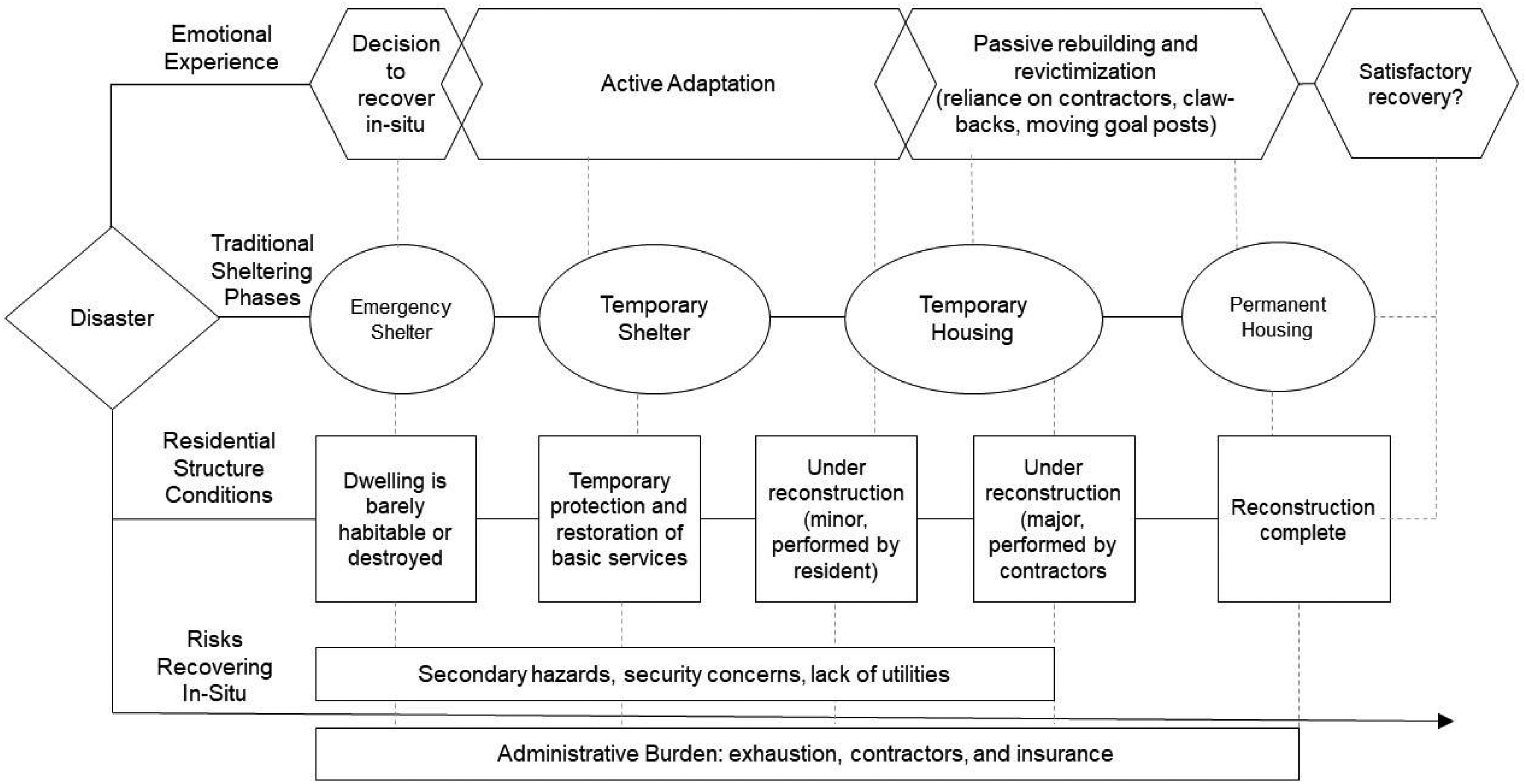
Phases of recovery for households recovering in-situ. Adapted from Quarantelli (1995) and Rathfon et al. (2013).
Upon determining they have “nowhere else to stay” or that other accommodations are unsatisfactory, individuals in impacted households make the constrained decision to recover in-situ in their damaged dwelling. At this first stage, the barely habitable dwelling serves as an emergency shelter. Immediately after making this decision, households take action to adapt to their environment. Households perform makeshift repairs to transform their home into temporary shelters, such as removing moldy drywall, excavating mud and debris, tarping roofs, or installing insulation. As time progresses and aid is slowly coming, individuals grow confident enough to take on increasingly challenging reconstruction tasks. We recognize that some of these actions are prerequisites for reoccupying the damaged dwelling and others may be completed after reoccupation, so we show an overlap between the decision to recover in-situ and active adaptation. This adaptation-fueled, resident-driven reconstruction ceases once the house reaches a critical level of functionality such that normal household routines can resume. This coincides with the dwelling's transition to temporary housing. Again, we note an overlap between the end of active adaptation and the next phase, passive rebuilding and revictimization, as residents’ reconstruction roles may end suddenly or gradually. In this passive rebuilding phase, dependence on outside sources (e.g., public adjusters, contractors, and subcontractors) leaves individuals with less control over their own recovery. Although the physical recovery continues forward, often in fits and starts as resources become available, the relinquishing of control disrupts the psychological healing process and emotional recovery slows. Changing rules, protracted insurance claims, unexpected claw-back threats, and elusive recovery goalposts compound to disempower residents and produce stress. At this stage, residents begin to feel like their homes will never be fully recovered. Even once reconstruction is complete and they have achieved permanent housing, residents question whether they will ever attain the idyllic satisfactory recovery once envisioned.
The risks inherent in the recovery process and heightened for these residents living in damaged dwellings are formative of their emotional experience; however, we choose to separate these into their own tracks in our model because they transcend many of the phases just described. Risks to health (e.g., extreme temperatures, mold, and pests) and risks to property (e.g., theft and house fires) extend into recovery as far as the passive rebuilding phase. The administrative burden for residents also begins early, as they document losses and file insurance claims with adjusters, and it continues for the duration of recovery as residents sign with contractors or work with attorneys to fight claw-backs. Given that uncertainty undergirds all aspects of their recovery experience, residents recovering in-situ cling to the physical and emotional certainties that their home can either provide in the present or to the promise it holds for the future, once recovered.
Conclusion
Recovering in barely habitable damaged homes following a disaster is a challenging experience for residents. Although this circumstance is not uncommon following an event, it is under-examined in the disaster science literature. This study offers new insights into the experience of residents initiating recovery in-situ in damaged dwellings; however, much work remains to improve knowledge of this process.
Despite its new insights, this research has several limitations. First, while the sample was representative of the study area, it was limited to one homogeneous demographic group: white, middle-to-older-aged, educated homeowners. These results may not be generalizable to other demographic groups, so future studies will need to examine how this recovery phenomenon may differ for racial/ethnic minorities, renters, and lower-income populations. While outside the scope of this paper, future works should examine the reported uncertainty of housing recovery against its relative affordability. For instance, those with less access to liquid financial assets, charitable resources, and other material and information may have vastly different recovery processes. Our small sample of four men and six women also limited our ability to draw conclusions about the extent to which gender may have influenced the recovering in-situ experience. For example, while we noted that males mostly identified looting as a reason for returning and recovering in situ, females also noted instances of and raised concerns about looting. Future work should examine the extent to which gendered knowledge and experience manifested and influenced in-situ household recovery. Second, our sample for this study was limited to participants who sought assistance from long-term recovery groups, such as the Salvation Army and the Ocean County Long-Term Recovery Group. Therefore, this study cannot assume that the experiences of households that did not seek assistance from these groups align with our sample, especially in terms of experiences during the later phases of long-term recovery. Third, this sample group faced regional geographic challenges; being in the north presented a rapid need for heat when the temperatures began to seasonally drop. Other regional hazards such as oil spills from heating fuel tanks and sand inundation may not be present in other areas that are at risk of hurricanes. Fourth, it is important to mention that these themes highlight the nature of the recovery journey for this subset of disaster survivors. However, while there are notable differences between those who recovered in-situ versus ex-situ in the early weeks and months following the disaster, some of the observations pertaining to shifting assessments of recovery may apply to both groups. Lastly, this research was derived from a broader study that did not intend to specifically examine the experience of recovery in-situ within a damaged dwelling. A study focused exclusively on this experience could yield additional insights.
Despite these limitations, future studies can build upon this work in several ways. To date, few studies examine recovery in a damaged dwelling, and how this experience may fundamentally alter the recovery duration and distinct actions that these households undertake. Future work is needed to understand the impact that recovering in a damaged dwelling has on overall physical and emotional recovery trajectories compared to recovering in other living arrangements. Additionally, given the infrequency of hurricane impacts in the northeastern US, questions remain as to the similarities between the experiences of Hurricane Sandy survivors and the experiences of residents recovering from other hurricanes in areas where they are more frequent. Finally, future studies should examine the extent to which these findings are transferable to recovery following non-hydrometeorological hazard events, such as wildfires and earthquakes.
The findings of this work can inform practitioners of an often-overlooked situation, ensuring that the plight of households recovering in-situ is considered in future disasters. First, housing security in the weeks and months following Superstorm Sandy was a significant issue for many participants in our study. Uncertainties of finding adequate short-term living accommodations and undertaking multiple relocations were time-consuming for participants, and frustrations surrounding these circumstances influenced some to seek refuge in their significantly damaged homes. In conjunction with existing sheltering plans, local communities and officials could consider options for extended sheltering that would allow survivors time to access their properties and make important decisions about recovery without also needing to worry about where they will live on a week-to-week basis. More secure sheltering options could reduce or eliminate households’ exposure to secondary hazards and hardships stemming from a lack of utilities, resources, and services.
Second, participants in this study articulated frustration in not knowing where to start or what to expect during disaster recovery. While local communities typically do collaborate with local, state, and federal organizations following a disaster on public education about recovery, increased outreach to communities may improve the utilization of existing resources by community members. Establishing connections with communities prior to the disaster may also improve relations and confidence in the recovery process. The ideal communications would provide residents with guidelines for documentation, lists of volunteering groups and other available resources to the community, as well as timelines for recovery. Many participants’ frustrations were related to lack of closure, or an inability to determine where exactly they were in the recovery process. Claw-backs amplified this frustration, as many participants believed their cases to be closed and finalized when they received notice. Similar to the recommendations offered by Greer and Trainor (2021), local governments could mitigate these frustrations with community-wide outreach initiatives focused on pre- and post-disaster event education, effective communication about program changes, and preparation for disaster recovery beyond the typical survival guidance.
Enhanced understanding of common household experiences while navigating the recovery process in-situ can guide the creation of strategies and policies to aid disaster survivors. Additionally, an improved understanding of the vulnerabilities individuals face in these situations, especially in the days, weeks, and months following the disaster, can assist emergency managers in the creation and dissemination of information tailored to recovering in situ, such as how to minimize exposure to secondary hazards, how to cope with lack of basic resources, and how to avoid falling victim to predatory or unlicensed contractors. As climate change continues to stress modern hazard mitigation and response systems, studies about disaster coping behaviors in ever more desperate circumstances will become increasingly valuable. The recent reduction in affordable housing stock, especially in post-disaster situations, could further complicate household recovery (U.S. Department of Homeland Security 2021). More households may find themselves in the position of those in this study, and recovering in-situ may become a common trend as disasters increase in severity, spatial extent, and frequency.
Footnotes
Declaration of conflicting interests
The author(s) declared no potential conflicts of interest with respect to the research, authorship, and/or publication of this article.
Funding
The author(s) disclosed receipt of the following financial support for the research, authorship, and/or publication of this article: This work was supported by the National Science Foundation (grant number NSF #1638311 CRISP Type 2/Collaborative Research).
