



Abstract
Despite a wide recognition of the importance of learning capacity and diversification, enabling and constraining factors, and external assistance in facilitating long-term livelihood recovery (LTLR), there is a paucity of comparison for a nuanced understanding of interconnections among the three themes (learning capacity and diversification, enabling and constraining factors, and external assistance) in different societal and disaster scenarios. Accordingly, this article employs a cross-national comparative approach in examining the interplay of these three factors in LTLR, within rural communities, following the two international post-disaster case studies, the 2007 Cyclone Sidr, Barguna, Bangladesh and the 2008 Wenchuan earthquake, Sichuan, China. This cross-national comparison indicates that the affected communities in both cases experienced extreme challenges in LTLR while illustrating the differences. Learning capacity and diversification facilitated asset loss recovery and risk mitigation in the Sidr case, while the Wenchuan case demonstrated a limited learning opportunity for livelihood diversification. Enabling and constraining factors were identified in both case studies. Particularly, people-place connections positively shaped the LTLR in the Wenchuan case while producing negative results in the Sidr case. External assistance facilitated livelihood provisioning, protection, and promotion for the Sidr case; in contrast, giving little, if any, credence to the local traditional livelihood practice, the top-down external interventions in the Wenchuan case jeopardized the rural communities LTLR. This article defends that promoting grassroots participation in community reconstruction and recovery and strengthening grassroots livelihood learning and practice capacities would advance LTLR.
Keywords
Introduction
The United Nations’ Sendai Framework for Disaster Risk Reduction (2015–2030) identifies recovery, rehabilitation, and reconstruction as one of the priority areas of action for building resilience and achieving sustainability (UNISDR 2015). Sustainable post-disaster livelihood recovery associated with catastrophic losses and damages has received significant attention among international researchers, practitioners, policymakers, and other stakeholders. Community capacity to achieve long-term livelihood recovery (LTLR) is a critical measure of their resilience and sustainability (Oloruntoba and Asare-Doku 2021). This has been recognized by the public, private, and not-for-profit sectors domestically and internationally (Oliver-Smith 2006), such as the Department of Disaster Management, Bangladesh, and the United Nations Development Programs (UNDP). Therefore, investigating the dynamics of LTLR fundamentally contributes to building livelihood resilience and supporting sustainability.
The dynamics of LTLR processes, however, are complex, non-linear, and relate to multi-interconnected factors at the individual, household, community, and society levels, with cooperation from ongoing interventions from the public, private, and not-for-profit sectors (Wu 2021a). Accordingly, this article intends to unveil such complexities in the livelihood recovery domain—where community members recover from losses and damages of their livelihood assets in the short- and medium-term, and build their resilience for future extreme events (Wisner et al. 2004). Thus, LTLR essentially incorporates the idea of resilience and sustainability, shaped by various societal factors (i.e. social, cultural, economic, and political). This article recognizes that LTLR essentially depends on the capacity of disaster survivors to learn and combine different forms of knowledge, diverse livelihoods, and necessary external supports to overcome constraints.
Learning from experience and diversifying livelihood are critical to enabling livelihood resilience for future extremes. Despite the broad recognition of LTLR for building resilience (Comfort, Oh, and Ertan 2009; Wisner et al. 2004), examining the long-term recovery process from a livelihood resilience perspective has been under-researched. The potential reason is that addressing long-term recovery requires a longitudinal approach. In the face of the close affinity between LTLR and livelihood resilience, a collection of meaningful interactions between these two domains remains sparse. This article, therefore, intends to narrow this research deficit by examining the role of learning and diversification in LTLR and the factors that shape the recovery processes at the individual, household, and community levels. Livelihood resilience (capacity to absorb shocks and disturbances) creates the possibility of making livelihood sustainable.
It is difficult for communities to take a sustainable trajectory, in terms of livelihood recovery, without external assistance, especially after catastrophic disaster losses and damages (Berkes 2007; Goulden et al. 2013). In such cases, it is vital to recognize the role of external supports in facilitating LTLR, reflecting the importance of cross-scale institutional linkage (Choudhury, Haque, and Doberstein 2021a; Gunderson 2010). This article, rather than taking a normative stance, critically examines the role of external assistance in LTLR, arguing that external assistance is more likely to be successful when aligned with prevailing local livelihood practices and when it is people-centered, culturally sensitive, and community-engaged (Gaillard and Peek 2019). LTLR critically depends on the grassroots capability to develop adaptation strategies to avoid a downward trajectory in the recovery process. External assistance is supposed to facilitate the process and foster this capacity in the promotion of sustainable livelihoods.
Taking a comparative approach based on two case studies, this research aims to elucidate the challenges and barriers of LTLR dynamics that took place in the two worst-hit communities, namely the coastal communities in Barguna, Bangladesh, affected by the 2007 Cyclone Sidr, and rural communities in Sichuan, China that were devasted by the 2008 Wenchuan earthquake. In both cases, the original community-based livelihoods, which depended on the local ecosystem and societal environments (i.e. fishing and agriculture, respectively), were threatened by both catastrophes. The comparative perspective enables this article to answer the following questions by focusing on learning capacity and diversification, enabling and constraining factors, and external assistance: (1) How does learning contribute to livelihood diversification to achieve LTLR? (2) How do individual, household, and community level factors interact and shape the livelihood diversification and recovery process from disaster loss? (3) How does intervention by external institutions shape the LTLR process of community people? The comparative approach will deeply examine the complex process of LTLR through the two case studies, particularly by examining how different factors play out in two different contexts and how external assistance result in success or failure. Comparing critical aspects associated with recovery dynamics contributes to a nuanced understanding of the LTLR processes and determinants of the two case studies of resources-dependent communities. The comparative approach provides an evidence-based reference to improve LTLR, build resilience, and achieve sustainability among other international communities affected by extreme events.
LTLR: Resilience and sustainability
Disaster recovery is a multi-faceted concept (Peek et al. 2014), subject to multiple interpretations (Jordan and Javernick-Will 2013). LTLR in particular is a complex, non-linear, and dynamic process (Han, Wang, and Wei 2021). Wisner et al. (2004) posit that household-specific recovery not only completes the reconstruction of physical, social, and livelihood dimensions, but more importantly, builds the adaptive capacity for and resilience against future extreme events. Concurring with Wisner et al. (2004), this article is rooted in the long-term recovery stage with a particular focus on the livelihood dimension. According to Ellis (2000, 10), a livelihood is defined as “the assets (natural, physical, human, financial and social capital), the activities, and the access to these (mediated by institutions and social relations) that together determine the living gained by the individual or household.” Applying this concept to the long-term recovery stage, livelihood recovery should integrate assets and access to resources into the community settings (Prado, Seixas, and Berkes 2015).
According to Smith, Martin, and Wenger (2018), long-term recovery entails livelihood resilience and sustainability. Other scholars have also investigated long-term recovery from disaster losses in relation to livelihood resilience and sustainability (Han 2014; Joakim and Wismer 2015). A livelihood is sustainable when the individuals, families, and communities can cope, adapt, transform, and enhance livelihood assets without compromising the natural resource base, while livelihood resilience implies the capacity of livelihood to absorb shocks and disturbances while maintaining essential structures and functions (Gyawali et al. 2020; Speranza, Wiesmann, and Rist 2014). Thus, resilience is implicit in the definition of sustainable livelihood and long-term recovery (Prado, Seixas, and Berkes 2015; Sallu, Twyman, and Stringer 2010; Speranza, Wiesmann, and Rist 2014). Livelihood security fundamentally supports resilience by guaranteeing entitlement and access to resources (Twigg 2001); in turn, livelihood stability becomes a core measure of resilience evaluation (Adger 2000). The interconnections between livelihood resilience and sustainability promote the success of post-disaster long-term recovery. It is argued that the capacity of communities to learn from disaster experience and diversify their livelihood portfolio foster livelihood resilience (Hurlbert 2016). However, such a connection between learning capacity and diversification is often subject to variation due to multiple intervening factors at the individual, household, and community levels (Peek 2021). Moreover, communities sometimes need external assistance to recover from loss and damage and attain livelihood resilience, especially after a mega-disaster (Berkes 2007). Recognizing such complexity of LTLR, this article draws insights from disaster recovery and livelihood resilience scholarship and focuses on three interrelated themes, namely learning capacity and diversification, enabling and constraining factors, and external assistance to investigate the dynamic process of LTLR.
Learning capacity and diversification
Learning from disasters has been recognized as a critical component for sustainable recovery from disaster losses and damages and as a key attribute of livelihood resilience to disaster shocks (Adger et al. 2005; Zhou, Zhang, and Evans 2022). The learning capacity of individuals or communities refers to the ability to learn from past disaster experiences, and acquire and transmit different forms of knowledge to take proactive and innovative measures to recover from disaster losses sustainably (Yan, Xi, and Weihong 2022). A limited number of studies have attempted to measure learning capacity quantitatively in disaster settings, using different indicators. Li et al. (2022), for example, have used three indicators to measure learning capacities, such as knowledge transfer capability, exposure to social and cultural norms, and knowledge identification capacity while Yan, Xi, and Weihong (2022) have used four indicators, paying more attention to education. The indicators they have used are the education level of household heads, non-agricultural work experience, information acquisition capability, and education investment. Despite such efforts to quantify learning capacity, there is still a lack of research in terms of understanding the process through which learning capacity fosters livelihood resilience in disaster settings. This study, therefore, does not attempt to quantify learning capacity, but rather qualitatively investigates processes of it.
Speranza, Wiesmann, and Rist (2014) have identified three characteristics of livelihood resilience: (1) buffer capacity resulting from endowment and entitlement of livelihood assets; (2) self-organization where the role of formal and informal institutions and cross-scale and -level institutional linkages are critical; and (3) capacity for learning, both individually and collectively, as well as sharing and transferring knowledge. These three attributes can contribute to the diversification of livelihoods. While recognizing the importance of the capacity to learn new knowledge and develop new skills, Li, Deng, and Zhou (2022) expanded the first two aforementioned attributes in the capacity-building spectrum, namely, buffer capacity as the capacity to utilize accessible resources or assets and self-organization as the capacity to exploit external resources. Other authors have also highlighted the ongoing learning process in the achievement of livelihood resilience (Cooper and Wheeler 2015; Li, Deng, and Zhou 2022). The capacity to learn from experience appears to be an essential attribute of livelihood resilience, as does the capacity to access and utilize resources within and outside the community.
Diversity in its various forms is key to livelihood sustainability and resilience (Brown and Sonwa 2015, 2017; Lade, Walker, and Haider 2020). Diversification of livelihoods implies “the process by which (rural) households construct an increasingly diverse portfolio of activities and assets to survive and to improve their standard of living” (Ellis 2000, 14). Goulden et al. (2013) documented three forms of diversification. Concurrent diversification entails simultaneous engagement in several income-generating activities with the goal of reducing risk. Temporal diversification implies moving from one form of livelihood activity to another. Spatial diversification refers to livelihood activities that are spatially separated, such as temporary migration to raise income. Two different forms of livelihood diversification have also been documented, those being intra-sectoral or vertical diversification and inter-sectoral or horizontal diversification (Haque et al. 2015; Salagrama and Koriya 2008).
Learning needs to be translated into action for livelihood resilience (Choudhury, Haque, and Hostetler 2021b). A wide array of literature on climate change adaptation and social-ecological system resilience demonstrated the connection between learning capacity and livelihood resilience (Galappaththi et al. 2019; Plummer and Armitage 2007). However, there is still a lack of empirical studies to demonstrate such a connection in disaster settings. This article attempts to fill in this knowledge gap by answering the question: how does learning contribute to livelihood diversification to achieve LTLR?
Enabling and constraining factors
Diverse factors influence livelihood diversification and resilience. Specifically, Sina et al. (2019b) documented three factors that shape livelihood resilience, with each category concerning a unique social unit, such as individual/household, community, and institutions. Factors such as age, education, gender, skill, and expertise belong to the individual/household category. In contrast, community-level factors include infrastructure and basic services, social network and capital, and location/distance of workplace. A community is not a homogeneous unit. Instead, it comprises inhabitants with multiple and often competing interests, livelihoods, ideologies, and stakeholders (Drolet and Wu 2017).
From the perspective of resilience and sustainability, disaster recovery needs to be considered long-term, considering the systemic properties such as power, inequality, cross-scale, and -level institutional linkages, and in particular the issues of justice and equity, which are critical in post-disaster recovery (Peek 2021). Examples of institutional-level factors are the nature of livelihood support, temporal aspect (immediate and long-term) of support, and cultural appropriateness of support. Moreover, an endowment of livelihood assets, such as human (education, skill), natural (land), financial, physical (boat and net), and social capital, also shape livelihood diversification and resilience. However, there remains a gap in understanding how factors at different levels interact to shape learning and diversification and, in turn, influence the LTLR process. This article attempts to narrow this research deficit and answer the second research question: how do individual, household, and community-level factors interact and shape the livelihood diversification and recovery process from disaster loss?
External assistance
Sometimes a community may be unable to absorb the impact of hazards with their existing capacities (Shaw, Gupta, and Sarma 2003). In the post-disaster livelihood context, this may imply the lack of capacity to restore livelihood and recover from losses and damages to assets. This is where external deliberation is required to enhance livelihood resilience. Resilience scholarship highlights the importance of cross-scale and cross-level institutional linkage and collaboration (Choudhury, Haque, and Doberstein 2021a; Gunderson 2010). Evidence suggests that long-term recovery and resilient livelihood trajectory can be achieved through coordinated efforts put forth by different levels (local, national, and international) and types (formal and informal) of institutions (Sallu, Twyman, and Stringer 2010; Sina et al. 2019b).
In line with resilience thinking, such external assistance must focus on two aspects: (1) differential needs and supports required on a short-, medium-, and longer-term basis; and (2) a people- or community-centered approach. Concerning the former, Gyawali et al. (2020) argue that community residents require livelihood provisioning (i.e. relief) immediately following a disaster, livelihood protection (i.e. rehabilitation or creating new livelihood) in the medium term and livelihood promotion for LTLR and resilience. An example of livelihood promotion involves making livelihoods more resilient to future risks by diversifying livelihoods, providing appropriate skill development training, and sharing knowledge and information (Sanderson 2012). A community-driven approach aims to build local capacity, connect people with the market mechanism, and intervene in culturally sensitive ways (Little 2021; Mulligan et al. 2012; Oliver-Smith 2013).
A significant disaster always draws the attention of public, private, and not-for-profit sectors domestically and internationally. Consequently, an influx of external support provided by these agencies in the form of relief immediately following a disaster aims to support the affected communities to overcome various challenges (Imperiale and Vanclay 2021). However, such attention and support gradually fade away with time. Comfort, Oh, and Ertan (2009) explain this phenomenon as social entropy—energy, effort, and support dissipate over time. Therefore, more coordinated efforts are required among different external institutions based on livelihoods needs in the short-term, medium-term, and long-term (Sina et al. 2019b). A resilient livelihood is achievable through involvement and coordinated efforts among various types (i.e. governmental organizations and non-governmental organizations) and forms (i.e. formal and community-based) of institutions (Peek 2018; Sallu, Twyman, and Stringer 2010). This research critically examines the role of external institutions involved in the long-term recovery process and attempts to answer the third research question: how does external assistance shape the LTLR process of community people?
Concisely, learning capacity and diversification, enabling and constraining factors, and external assistance play critical roles in LTLR, contributing to livelihood resilience and sustainability in the communities affected by disasters (Figure 1). This article employs a comparative approach to further explore the influences of and interplay among these three themes in LTLR through case studies of two international disasters, namely the 2007 Cyclone Sidr Bangladesh and the 2008 Wenchuan earthquake, in China.
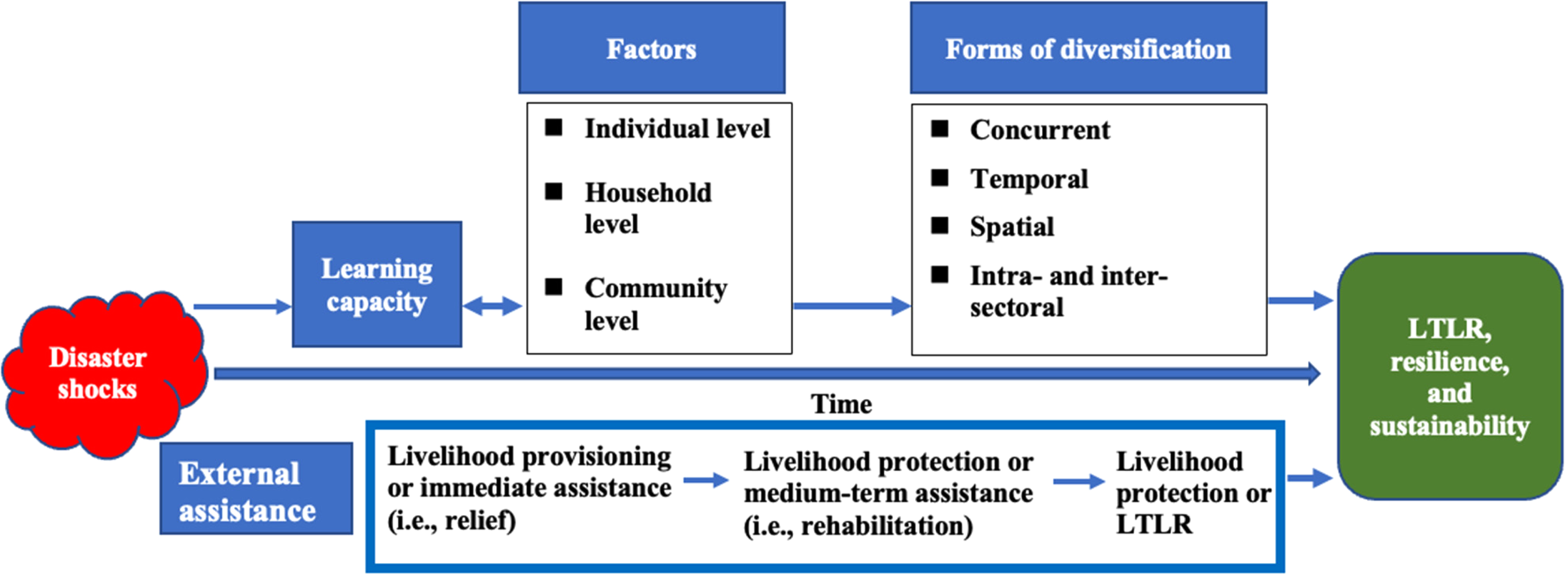
The connection among learning capacity and diversification, enabling and constraining factors, and external assistance in facilitating long-term livelihood recovery (LTLR) and building livelihood resilience and sustainability.
Methods
Aiming to understand the role of learning capacity and diversification, enabling and constraining factors, and external assistance in the LTLR process, this article adopts a comparative approach (Bartlett and Vavrus 2017; Goodrick 2014). A case study as a strategic inquiry explores a phenomenon in a real-life context; it identifies where it is difficult to draw a clear boundary between a phenomenon and its context (Yin 2014). Bartlett and Vavrus (2017) argue that a comparative case study approach supports a nuanced understanding regarding the consequences of similar processes with different outcomes and/or differential impacts. Adopting a comparative approach in this research has enabled the examination of the processes and multi-faceted factors that shaped LTLR while engaging the societal differences from two post-disaster case studies. The two cases identified in this article are the 2007 Cyclone Sidr, Barguna, Bangladesh, and the 2008 Wenchuan earthquake, Sichuan, China.
The coastal communities in Bangladesh are prone to cyclones and storm surges. The Intergovernmental Panel on Climate Change (IPCC) (2014) scenario-building model identifies the coastal region of Bangladesh as a climate hotspot. Around 35 million people live in the coastal areas of Bangladesh; among these, seven million are at high risk of cyclonic disasters. The southern coastal communities (Barguna district), where the first case study was carried out, experienced Cyclone Sidr, which, in 2007, claimed more than 1292 lives in the locality and 3406 overall (including other communities) (Ministry of Disaster Management and Relief 2013). Barguna district is comprised of six upazilas (sub-district), 42 union parishad (UP), and 560 villages. This study selected Amtali and Taltali upazilas as these were most severally affected by Cyclone Sidr.
For empirical investigation in the coastal community in Barguna, a qualitative approach was supplemented by a household survey. During the first stage, 240 household surveys were conducted to document the socio-demographic and livelihood profiles of the community, as well as the loss and damage from Cyclone Sidr. For the household survey, six villages were randomly selected (three villages from each upazila). The sample size (n = 240) was determined using a standard sample size determination formula, assuming that such a sample size would generate an estimate with 95% precision (see Islam 2018, 580). The number of households from each village was proportionately selected (i.e. 40 households from each village). The socio-demographic profile of survey respondents is provided in Table 1; however, only some characteristics, such as household size and types of livelihoods, were engaged in the data analysis.
Socio-demographic profile of respondents.
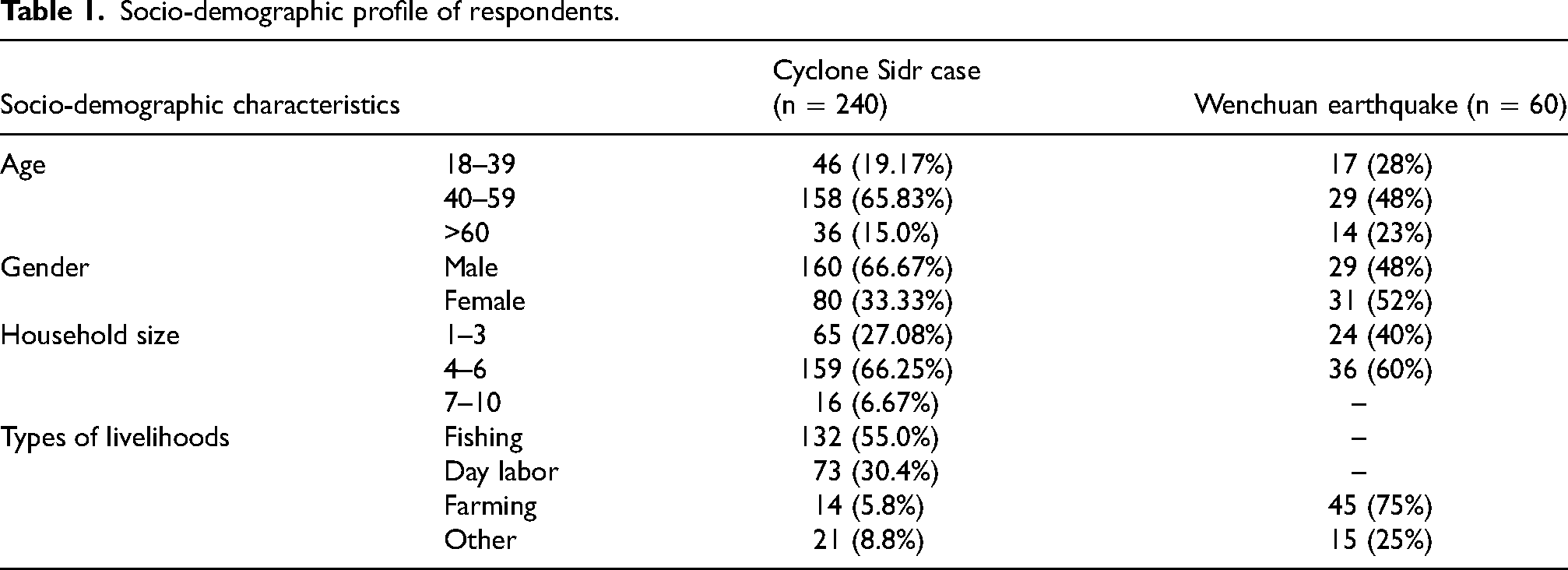
Socio-demographic profile of respondents.
In the second stage, qualitative interviews were conducted to discern the process and factors of LTLR. The qualitative data collection techniques involved: Focus Group Discussions (FGDs), Semi-Structured Interviews (SSIs), and Key Informants Interviews (KIIs). Household survey facilitated recruiting participants for qualitative interviews in two ways. First, during the household survey, it was noted that some participants were willing to share their stories in detail related to disaster recovery and the challenges they faced in the recovery process. They were recruited for qualitative interviews. Second, visiting the community for a household survey helped build rapport that facilitated inviting participants for interviews. Participants were communicated (verbally) to check their willingness, availability, and convenience. Once they agreed, interviews were conducted at their convenient time and place. Six FGDs (three with farmers and three with fishermen) helped document livelihood recovery processes, barriers of recovery, and diversification options. Each from each village. Each FGD had eight to 10 individuals and discussions lasting from 75 to 105 min. Ten SSIs helped understand the recovery constraints at the household/individual level, such as age and level of education. Lastly, understanding livelihood resilience and recovery requires knowledge of systemic properties, such as power and inequality. Five KIIs helped unpack the fishermen's and farmers’ struggle against the unequal power structure and how that shaped their recovery processes. All the interviews were conducted in Bengali language and audio recorded with appropriate informed consent. Recordings were transcribed into verbatim for thematic analysis. The reported quotations (see below) were translated from Bengali into English. The field investigation was carried out from August 2018 through January 2019 and was approved by the Joint-Faculty Research Ethics Board (JFREB), University of Manitoba (Protocol J2018:049; HS21814).
The 8.0 magnitude Wenchuan earthquake, which was one of the deadliest earthquakes since the founding of the People's Republic of China in 1949, devastated the rural areas in the western and northern regions of Sichuan, causing over 69,000 deaths, and propelling more than 11 million people into homelessness (Hooker 2008; The World Bank 2006). The earthquake effectively destroyed the local built environment (i.e. housing and infrastructure systems), collapsing 7444 schools and demolishing over 34,000 km of highways (The World Bank 2012). In order to swiftly accommodate 5.4 million earthquake survivors, the post-disaster reconstruction, led by the national and provincial governments, predominately focused on the built environment reconstruction while for the most part neglecting the social and other societal dimensions (Wu 2020). Furthermore, due to the time-sensitive issue of housing for the tremendous number of disaster survivors, local residents’ participation in the government-led built environment reconstruction of communities was very limited (Wu 2021b). Hence, the long-term recovery began from the moment that disaster survivors moved into their new communities (Wu 2021a).
There were two stages of fieldwork that took place in the examination of the LTLR in the worst-hit and second-to-worst-hit rural communities hit by the Wenchuan earthquake. The first stage of fieldwork was conducted from August 2012 through January 2013. Since the short-term built environment reconstruction was officially completed by the fourth anniversary of the Wenchuan earthquake (12 May 2011) (International Recovery Platform n.d.), the subsequent fieldwork focused on the disaster survivors’ long-term recovery experiences in the new communities. Walking-along interviews were employed to support the data collection during this fieldwork, involving 60 participants from 13 worst-hit and second-to-worst-hit rural communities. A community-based snowball sampling approach was used to identify the eligible participants who experienced the earthquake and the post-earthquake reconstruction and recovery. There were 60 eligible participants who illustrated their interests during the first stage of fieldwork and they were all invited for interview (see Table 1).
Among these 60 participants, 52% were women and 48% were men, falling into three age groups, 18–39 (28%, n = 17), 40–59 (48%, n = 29), and 60 and above (23%, n = 14), respectively. Each audio-recorded interview lasted for approximately 60–90 min, and open-ended and behavior-based interview questions were asked to assist the participants in recalling their long-term recovery experiences. While walking in the old or new communities, the interview was contextualized in the community setting, encouraging the participants to identify their challenges, experiences, and solutions regarding their utilization of the built environment to facilitate their LTLR. These interviews were conducted in the Sichuan dialect. The interview quotations presented in the next section were translated into English.
From 2014 to 2017, the second fieldwork stage was facilitated through annual summer field trips to the same communities that were visited during the first stage of fieldwork. An observation approach (i.e. participating in the disaster survivors’ daily activities and identifying their life/livelihood-related changes) was utilized to track the process of their ongoing recovery. The observation notes were integrated into the interview transcripts obtained from the first stage, enabling the data analysis. The first fieldwork stage was approved by the Research Ethics Board at the University of British Columbia (Ethics Certificate Number: H12-00326).
Comparative analysis
Data collected in each disaster event were thematically analyzed individually by the two authors. The content analysis approach assisted the authors in developing codes and categories and then margining sub-themes and themes. The analysis process of the Sidr case was conducted through a paper-based analysis approach. The Wenchuan case was analyzed by NVivo 10. The two authors collaboratively facilitated the comparison based on the initial themes and categories through the following two-round process.
During the first-round comparison, the two authors shared their initial themes and categories and identified the livelihood-related themes. These themes built a common foundation to integrate concepts from the two cases. Developed from this foundation, the two authors used a self-reflective approach to introduce the societal backgrounds (i.e. social, cultural, economic, and political) within which each case study was rooted. This societal background-specific understanding enabled the two authors to choose practical perspectives to identify the similarities and manage the differences. Then the authors criticized each other's reflection and confirmed three themes for a comparative analysis, notably (1) learning capacity and livelihood diversification; (2) enabling and constraining factors for LTLR; and (3) external assistance and livelihood resilience.
Keeping these three themes in mind, the authors conducted the second-round analysis by screening related codes and categories. This round of analysis enabled the two authors to identify the potential connections which could strengthen the comparison and inform their understanding of the complex trajectory of LTLR. They chose suitably comparative sub-themes from these case studies and synthesized them into a comparison. As presented in the findings section, the outcomes were presented aligned with the three themes contextualized in each case study. Then, the comparison results were synthesized in the discussion section.
Findings
This section outlines findings from two case studies. The common themes and subthemes were selected, aiming to facilitate the cross-national comparison. The Sidr case first provides the livelihood profile of the community and the loss and damage incurred by the cyclone; followed by the role of livelihood diversification in long-term recovery, the factors that constrained LTLR, and the role of external assistance in facilitating LTLR. The Wenchuan case documents how short-term built-environment-oriented reconstruction was unfriendly for original agricultural livelihoods, followed by barriers to LTLR, and the nature of self-sufficient LTLR.
Case study 1: 2007 Cyclone Sidr, Bangladesh
Cyclone Sidr severely damaged the means of livelihood of the coastal community of Barguna. Learning from cyclone helped community people to diversify their livelihood portfolio and attaining LTLR. A host of intervening factors are found to either enable or constrain learning-based livelihood diversification. Assistance from external agencies was helpful in terms of attaining LTLR. This case study elaborates on these three themes.
Livelihood profile and loss and damage from Cyclone Sidr
People in the coastal areas of Bangladesh depended upon varied sources of livelihood, yet the majority relied upon fishing for their livelihood. The household survey revealed that 55.0% of the respondents’ primary source of earning was fishing, followed by daily labor (30.4%) and agriculture. A homogeneity test (χ2 = 244.458; df = 4, p < .001) indicated that a proportion of different occupations was not equal at a 95% level of confidence, confirming that a majority of the people relied on fishing for their livelihood.
During Cyclone Sidr, community residents suffered from loss and damage of livelihood assets. These losses included crops, boats, fishing nets, and livestock. In terms of the monetary value of the losses, a total of 63.75% of the households in the study suffered losses up to US$2000, while a quarter (25%) of the households suffered losses from US$2001 to 4000 (household survey). It is worth mentioning that most of the households (55%) lived in extreme poverty (i.e. US$3.2/day). A homogeneity test (χ2 = 106.725; df = 2, p < 6.68283 × 10⁻²⁴) indicated that the proportion of loss and damage was not equal at a 95% confidence interval, implying that a large majority of the population experienced some degree of loss and damage from Cyclone Sidr in 2007.
Livelihood diversification and LTLR
Two forms of sectoral livelihood diversifications helped coastal communities in Bangladesh in LTLR: (1) vertical or intra-sectoral livelihood diversification and (2) horizontal or inter-sectoral livelihood diversification. These two forms of sectoral diversification were also undertaken concurrently, temporally, and spatially. Intra-sectoral diversification of fishing activities involved catching, sharing fishing, fresh fish business, and dry fish business. At the same time, day laborers were able to engage themselves in different forms of labor-intensive activities, such as boats, sand quarries, soil digging, and goods carrying.
Inter-sectoral livelihood diversification also helped community residents in LTLR. Fishermen with agricultural land could also do some crop cultivation (i.e. concurrently). Some fishermen were also involved in sharecropping. Many people whose primary occupation was fishing, also worked as day laborers during the fishing ban period or off-season (i.e. temporally). Some farmers also caught fish from nearby rivers, while small farmers worked as day laborers. Day laborers engaged in the fishing and agricultural sectors while operating small businesses. Inter- and intra-sectoral diversifications were also spatial. For example, fishermen migrated to town to work in industry (i.e. garments) or to operate a small business and to do a fish business.
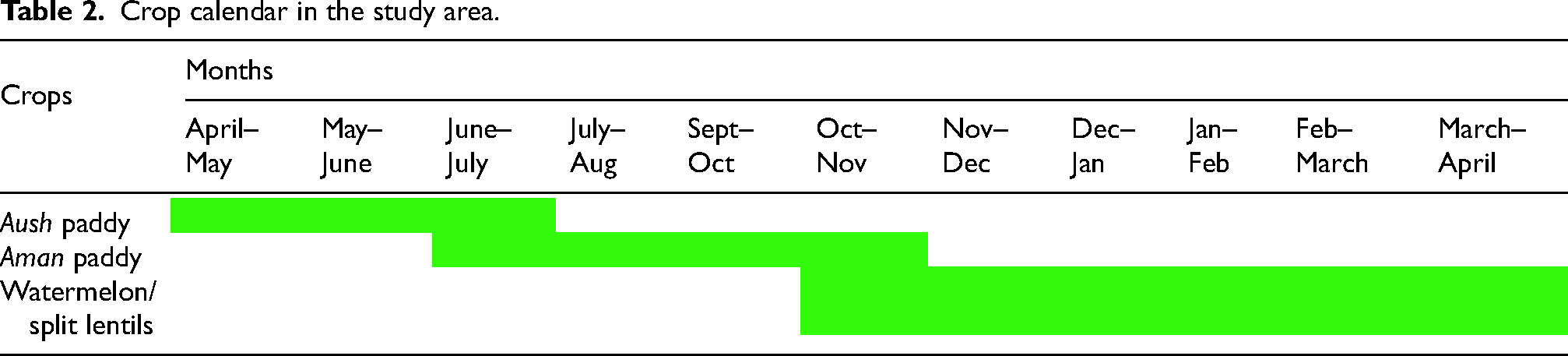
Learning and knowledge integration is found to be an essential attribute of livelihood resilience and recovery. For instance, farmers’ adoption of modern technology, innovation, and learning from other places helped diversify crops (intra-sectoral). Farmers stated that adopting modern technology enabled them to produce crops three times a year, while innovation and cross-learning helped them diversify crops
1
(Table 2). During an FGD, one farmer shared his innovative thinking and practice in crop diversification. Other farmers learned from him and started to diversify crops. He stated: Once I had visited Kuakata and observed that farmers are producing watermelon on land that gets sufficient sunlight. After watching that, I cultivated on a small portion of land on an experimental basis. It was successful. Other farmers later started producing watermelon. Now many of us grow watermelon.
Crop calendar in the study area.
We have recently started producing yellow lentils, mainly in the last ten years. Once, I planted seeds of yellow split lentils after harvesting watermelon. The yield was poor in the first year but relatively better in the second year, and the third year was even better. Since then, we are all producing yellow lentils
The adoption of modern technology by fishermen helped them reduce the risk of cyclones, save livelihood assets, such as boats and nets and enhance livelihood resilience. During an FGD, fishermen mentioned that they used a compass for navigation and listened to radio broadcasting for weather bulletins. Some boats had a unique device that directly received warnings from the weather station. However, many fishermen lacked the sufficient financial capacity to avail themselves of that technology. A fisherman mentioned during an FGD: “That machine cost six to seven thousand taka [Bangladeshi currency]. A boatman always keeps his eyes on it for a weather forecast. Not all boats have that technology.”
LTLR constraints
In terms of LTLR, fishermen and farmers encountered multiple problems. Due to the asymmetrical power structure, farmers often did not get access to water for irrigation and were unable to trade a fair price for husked rice. Asymmetrical power structure refers here to a system of relationships where the powerful groups control the course of action of subordinate groups. In this case, local elites and political leaders control the flow of water for their benefit. Fishermen suffered both human- and nature-induced stresses. Examples of human-induced pressures are the vicious cycle of Dadon (money lending system) and exploitation by Mohajans (money lenders). Dadon is an informal practice of money lending based on verbal agreement between parties involved, which in this case are fishers and Mohajans. Fishers borrow money from Mohajans during the lean period to feed their families and payback with interest by fishing in the sea. Moreover, Mohajans provide all supplies (i.e. boats, nets, and fuels) for fishing for one- or two-week-long fishing trips. If the profit is lower than the cost, fishers then shoulder the burden of the major portion of the loss. Thus, further indebting them to Mohajans. At the same time, income instability due to unpredictable sea weather is an example of nature-induced stress. Both fishermen and farmers often did not get appropriate institutional support, for instance, agricultural loans for farmers and financial aid during the fishing ban period.
Several other factors impeded community dwellers from being proactive and taking long-term recovery measures. First, the age determined the likelihood of whether they would or would not take bold steps. Younger people were found to alter their livelihood activities to raise income. Indeed, younger people migrated to towns and cities to work in garment factories to increase revenue. Savings also helped some of them to start small businesses in the locality. Contrastingly, middle-aged and older people were reluctant to change their livelihoods. One middle-aged man opined: “We learned fishing from our ancestors. This is what we know and can do for a living. We do not have any other skills.”
The second obstructive factor is a lack of sufficient training and education, limiting an individual's ability to undertake entrepreneurship or professional jobs. It is observed from survey data that most of the study respondents had no formal years of schooling. A homogeneity test confirmed (χ2 = 174.5; df = 3, p < .001) that the majority of the community inhabitants had no formal education, which is significant at a 95% confidence interval.
The third factor that impeded proactive community measures was a connection to the land. Disaster survivors indicated emotional attachment to the land and rejected opportunities to migrate out of the disaster-prone zones. FGD respondents mentioned: Here, we have a graveyard of our fathers and grandfathers. How could we leave this place?
At the household level, several interrelated factors constrained household members from recovering from disaster losses and damages and taking long-term recovery measures, including a high level of poverty, limited earning members, and several dependent household members. It was found that 75.0% of households surveyed had only one earning member. The household's sole earning member had to support up to six household members with limited earnings. A total of 75.0% of household had four to six dependent members. A significantly large (89.2%) portion of the household lived either in extreme (i.e. US$1167/year) or moderate poverty (i.e. US$ 1168–2336/year). Thus, a high level of poverty along with the dependency of several household members on a single earning member posed a problem for households to take long-term recovery measures.
External assistance and LTLR
A successful livelihood provisioning was evident in the aftermath of Cyclone Sidr. There was an influx of relief (i.e. clean drinking water, dry food, and clothes) from different national and international donor agencies, private organizations, and governmental entities that helped community people deal with immediate livelihood instability. This also reduced the necessity to sell off livelihood and productive assets, thereby providing some form of longer-term livelihood protection. One respondent stated: “It would have been difficult for us to survive without relief. We could not drink water from our tube wells. We received clean potable water, salt, and dry foods.”
Livelihood protection supported assets (mainly housing) reconstruction and provided technical support to farmers. 2 Many donor agencies provided cash and building materials, such as concrete pillars and metal sheets. However, there were issues surrounding the equitable and fair distribution of housing materials. Some people could receive building materials because they had good social connections with local elites and influential groups. In contrast, others were forced to provide bribes to get the building materials they needed. Those who were not able to pay did not get any housing materials. One elderly woman who lived on her own mentioned that she was asked to pay 20,000–25,000 taka (Bangladeshi currency) to get housing materials.
Concerning technical advice to farmers, storm surge from Cyclone Sidr carried in saline water and sand from the beach, reducing the fertility of the agricultural land. During Sidr's aftermath, district and sub-district agricultural extension offices provided technical advice that helped regain land productivity. However, it took farmers three to four years to bring the agricultural land back to its total productivity. During an FGD, farmers stated: That time [after Sidr] was very hard for us. We could not produce paddy or vegetables for at least three to four years. During that time, we could not feed our family from agriculture. We had to work as day laborers to feed our family.
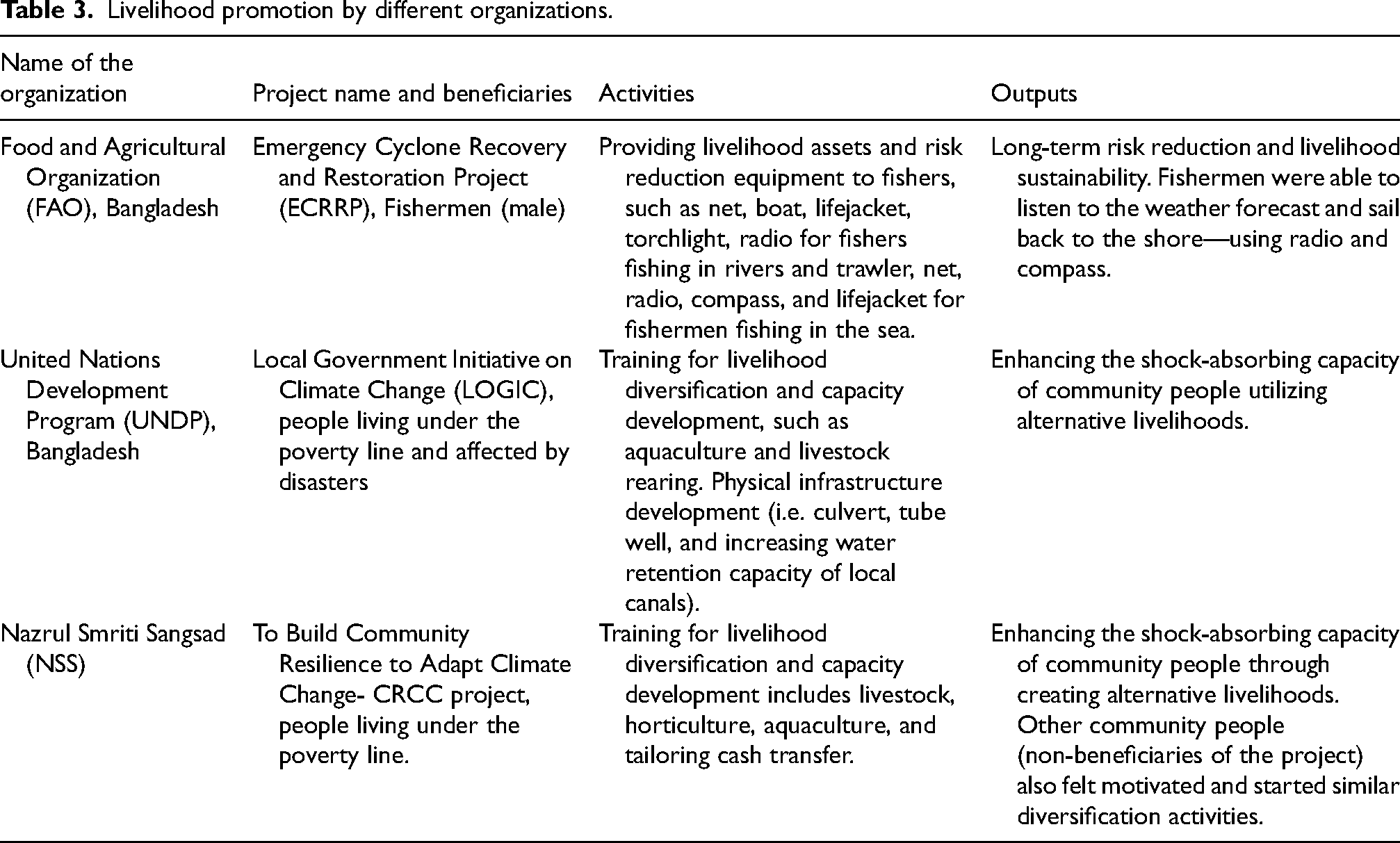
Assistance provided by several local, national, and international organizations played a positive role in terms of livelihood promotion (Table 3). Following a participatory and community-based approach, local, national, and international organizations formed community-based organizations (CBOs) engaging diverse occupational groups in the locality. They also held courtyard meetings to assess the needs and challenges of the people in order to enhance their buffering capacity against cyclonic shocks. For example, FAO's ECRRP project involving fishermen helped their peers reducing the risk of cyclones and enhancing livelihood sustainability (please check the link details: https://projects.worldbank.org/en/projects-operations/project-detail/P111272). Other international organizations, such as the UNDP intervened to improve inhabitants’ shock-absorbing capacity, building people's capacity and training them so that they would be able to diversify their livelihoods (for further details on the LOGIC project, please check the link: https://www.undp.org/bangladesh/projects/local-government-initiatives-climate-change-logic). Apart from international organizations, local NGOs, such as NSS, with support from the SIDA (Swedish International Development Agency), also worked to enhance the capacity of the local people.
Livelihood promotion by different organizations.
However, there were two significant problems with such assistance. First, projects were not sustainable in most cases. Before the end of a project, NGOs assigned responsibilities to community people so that they could take responsibility to train other community people with the same skills. However, after the end of the project, there was a lack of continuation of such activities and monitoring. Lack of coordination among NGOs in geographical areas of interventions and activities often resulted in duplication and exclusion.
Case study 2: 2008 Wenchuan earthquake, Sichuan China
The Wenchuan earthquake devastated surrounding rural areas, negatively affecting the farmers’ traditional agricultural livelihoods. To swiftly provide accommodation for these homeless disaster survivors, the government-led, short-term reconstruction was predominately focused on built environment development (i.e. housing, transportation system, and telecom). Unlike the short-term reconstruction stage, the long-term recovery dimensions (i.e. economic, cultural, and social) were not effectively engaging. This case study presents different challenges and related strategies that the local residents identified to fully utilize these built environment structures to support their LTLR.
Short-term built-environment-oriented reconstruction was unfriendly for original agricultural livelihoods
In the rural communities of Sichuan Province, houses were traditionally built close to the farmlands. This spatial layout highlights how agriculture and related incomes were central to these disaster survivors’ livelihoods. The earthquake survivors have lived in the same place for many generations. Since the earthquake shifted the topology of the natural environment, some areas were no longer livable and/or made very difficult to continue agricultural activities. One middle-aged man indicated that: I lost most of my farmland. Some of my neighbors in the same village were in the same boat … I did not have other skills, and I am no longer young. My son is a sophomore, and my daughter is in Grade 12 will go to university next year. I need to save more money for their tuition. I had a labor job in [the city of] Dujiangyan. My body is still OK. The income just barely keeps us surviving.
An older woman expressed her concerns when she moved into the urban-style residential community. My great-great-grandparents lived here. Here is my home [for several generations]. Young people, like you, love cities and would like to move there for jobs. But older adults, like me, prefer to stay here … I am a farmer; farmlands make me feel safe. Working on the farm is also suitable for my body. I no longer work on my farmland. I need to drive at least an hour to my farmland. The cost of gas, car repair, and maintenance were all increased. In addition to that, moving here [a residential community], the water, gas, cable, condo fee all are extra [as compared to pre-earthquake]. We even have to pay for our vegetables. Adding these together, our [agricultural] income is no longer enough. We have to give up [farming]. My husband has a temporary job in Chengdu; I am thinking about moving there and getting a job.
A middle-aged man pointed out other complex issues in his new residential community, making it not possible to support their original agricultural livelihoods: We used to live in houses. We had a yard for our farming tools, equipment, and vehicle. We had enough storage space for grains. [In the residential community], every family has only a condo unit. Where can we put our farming tools and our grains? Even the parking space is not enough for our farming vehicle. I know some of my neighbors found other jobs, like truck drivers. Some are planning to move to other places.
Barriers for LTLR
In Sichuan, generally, the overall development of rural communities has been slower than in their urban counterparts. Livelihood stability has always been the major push factor encouraging rural residents to become migrant workers in urban centers. Although the earthquake generated tremendous redevelopment opportunities for the rural communities, the uneven economic development accelerated this rural-urban migration.
An older woman used her family's situation as an example: After high school, my son and daughter went to Chengdu for college. I knew from that point they would not come back. Then they have their families, and they are urban residents. After the earthquake, my son and daughter asked us to move to Chengdu to live close to them. But we still love our rural life. So, they help us rebuild our house. You can only see kids in my village during the holidays when visiting their grandparents. After the earthquake, more people moved out. Young people always believe that rural areas are backward. My son would rather work as a waiter in a restaurant in Chengdu; he does not want to come back. He believes as a farmer, he needs to work very hard. There are a lot of traditional skilled workers in our rural communities, like carpenters, masons, and embroiders. They cannot find apprentices to learn. Their children are neither interested nor would like to learn and stay here. When my generation dies, these traditional skills and our livelihoods will be lost.
Supporting reemployment for existing residents would retain them in the rural communities, contributing to LTLR. After the earthquake, the National Post-Disaster Reconstruction and Recovery Plan required that public, private, and non-profit sponsors provide reemployment training for the earthquake survivors. However, external assistance was predominately focused on the post-earthquake short-term reconstruction. These sponsors no longer continued their support when moving to the long-term recovery stay.
A middle-aged woman described her personal experience: I heard there are some computer trainings, but that is not good for me at all. I only finished elementary school; how could I handle that? There is a nail factory close to my community. However, they only accept young people. I know how to farm, but I do not have farmland. Now I have a cleaning job in my community. The training programs did not consider our needs at all. I expected that some training program would help us to increase our income. I have an online store to sell our agricultural products, such as dry mushrooms, wood ears, peppercorns, and bamboo shoots. I believe some marketing skills would help us to sell our products.
These two examples illustrate the necessity for external sponsors to develop community-driven training programs, which fundamentally support the disaster survivors’ short-term and long-term recovery requirements. As the first woman mentioned, the IT training might not be suitable for her age. But the IT training might help some rural residents to develop an e-store to sell their local agricultural products, as shown in the second case. Unlike these two participants, who still lived in the urban-style residential communities, some rural residents, without special skills, gave up their condos and moved back to their original homes.
Self-sufficient LTLR
Rural residents’ long-term engagement with their surroundings developed their strong place attachment. These place-based connections motivated some rural residents to return to their original places to resume their rural lives.
One middle-aged couple, who lost their daughter in the earthquake, gave up condominium living in the new residential community and moved back to their original house, resuming their farming life. We have hands, and we could work. We repaired the damaged house. We have chickens, ducks, pigs, and goats. All those are enough for us, and we could share them with my son's family. We feel comfortable here, and we repeat our old life. My relatives help me find a job in [the city of] Deyang. After working for a while, I decided to move back. Deyang is very nice, but it is not my home. My old neighbors had moved out, and I could borrow farmland from them. My roots are here, and my life is here as well. Some of my neighbors moved to the residential communities; some moved to the cities. I decided to stay. I used to have this family hotel. Before the earthquake, every weekend, I had a lot of urban people stay in my hotel and enjoy our rural life. After the earthquake, my hotel was rebuilt. Our village leader encouraged us to develop rural tourism. I think these agencies could let more people know about us. This is the best way to rebuild our livelihood. Some of my previous neighbors regretted their decision to move out. They would like to move back as well.
Moving back to their original places and resuming their rural life provided a self-sufficient way for some farmers to rebuild their livelihood. Their traditional agricultural skills supported their decision. This return also provided these residents with a sense of stability, namely finding their roots, which played a positive role in their health and well-being recovery. Although the utilization of tourism as a long-term recovery strategy has been under debate, the family hotel owner highlighted the feasibility of their livelihood recovery. She also suggested that external supporters could utilize their networks to attract more tourists, supporting these survivors’ long-term recovery.
Comparison, recommendations, and limitations
This study documented the LTLR process and resilience of two resource-dependent communities from disaster shocks: cyclone-affected coastal communities in Bangladesh and earthquake-affected communities in China. This research compares these two cases in terms of (1) learning capacity and livelihood diversification; (2) enabling and constraining factors for LTLR; and (3) external assistance and livelihood resilience.
Learning capacity and livelihood diversification
Diversity, in various forms, is a crucial attribute of resilience (Folke, Colding, and Berkes 2003). In relation to livelihoods, diversification of livelihoods helps recovery from loss and damage and, in turn, creates a more resilient livelihood (Brown and Sonwa 2017; Lade, Walker, and Haider 2020). Both the Barguna and Wenchuan cases documented different forms of livelihood diversification that facilitated LTLR. Different stressors triggered the diversification (see Table 4). The rural communities affected by the Wenchuan earthquake attempted to maintain the previous livelihood activities (i.e. farming) while residents in the Barguna communities engaged in other livelihood activities.
Learning capacity, diversification, and external assistance: comparative analysis outcomes.
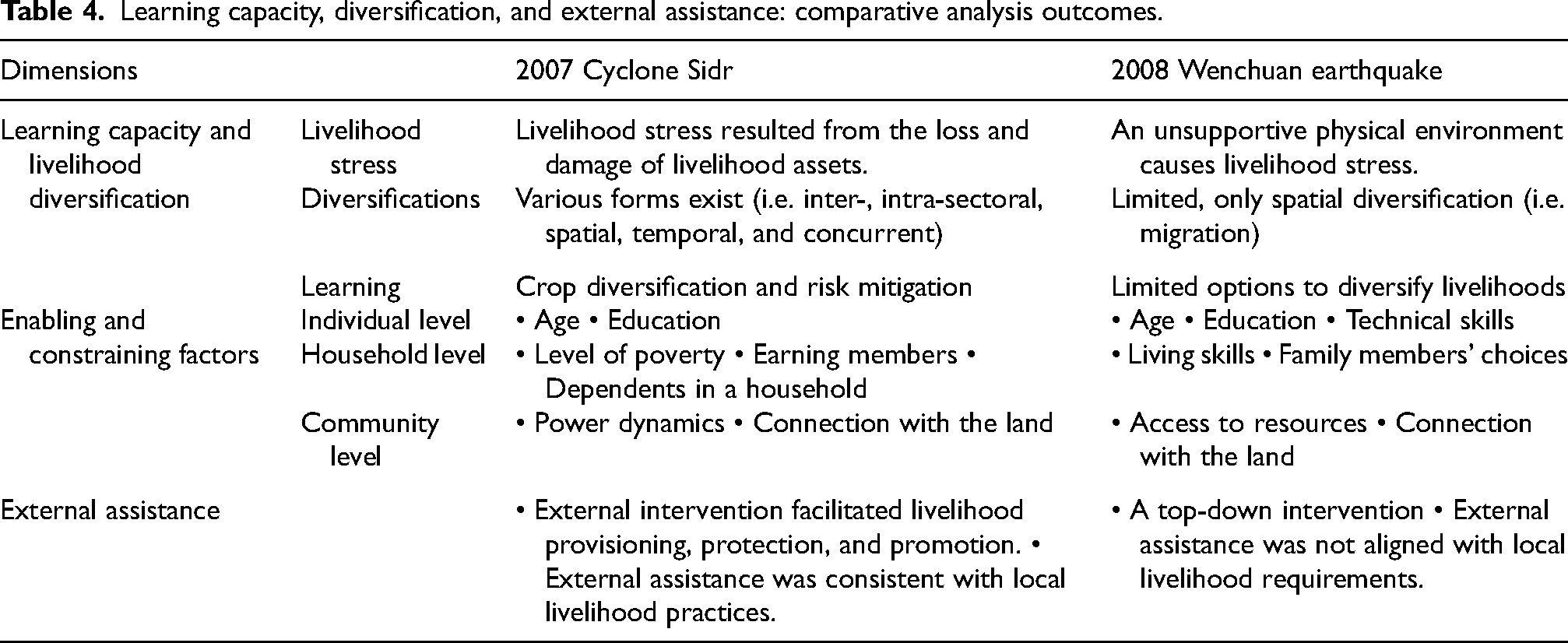
Different forms of diversification (i.e. inter-, intra-sectoral, spatial, temporal, and concurrent) were observed in the case of the coastal communities. In contrast, diversifications were limited in the case of the earthquake-affected communities, where the earthquake completely altered the ecological landscape and the reconstruction adjusted the physical environment, making it difficult for farmers to retain their original livelihood practices or initiate intra-sectoral diversification. Such stress on farmers’ livelihoods further extended into spatial diversification (i.e. migration to the urban centers or return to their original houses). These outcomes confirmed the previous studies’ findings that spatial diversification is inevitable in post-disaster LTLR due to a lack of opportunity and increasing stress on the resumption of their original livelihoods (Saha 2017).
Scholarship on livelihood resilience in a post-disaster context widely recognizes the role of learning and knowledge integration (Choudhury et al. 2021c; Cooper and Wheeler 2015; Li, Deng, and Zhou 2022). This study documented that education, in the case of the coastal communities, promoted the diversification of livelihoods (i.e. intra-sectoral) and helped mitigate disaster risks. For instance, cross-learning by farmers enabled them to diversify crops, while fishermen were able to adopt new technology that would help them avoid impending cyclonic risks. However, in the case of the earthquake-affected communities in China, learning-based intra-sectoral livelihood diversification by farmers was not possible for two reasons: (1) the earthquake altered the original ecological environment, destroying the farmers’ original livelihood practices and also did not support the initiation of intra-sectoral diversification; (2) many of the disaster survivors were relocated far from their original agricultural mechanism (moved into urban-style residential communities). Along this line, some authors argue for transformational adaptation where community residents fundamentally alter their behavioral and livelihood practices when original livelihood practices are untenable (Islam et al. 2021; Panda 2018). Some studies indicate that relocation and starting a new livelihood practice are possible options (Liu et al. 2020; Sina et al. 2019a). These endeavors, however, require a different set of skills and training that impede recovery and transformation in livelihood practices, especially when relocation takes place outside of the original locality.
Enabling and constraining factors for LTLR and resilience
This research illustrates enabling and constraining factors pertaining to LTLR. Age, education, and skill allow and/or constrain an individual from taking long-term recovery measures (Table 4). In both case studies, it was found that younger people have greater mobility compared to middle-aged and older adults. As a result, those in the former category were more willing to migrate to cities to raise income or shift livelihood practices. Despite willingness, lack of appropriate skill, training, and formal education constrained people from livelihood diversification, such as undertaking entrepreneurship or professional jobs. These findings concur with other conclusions that document age and education as essential determinants of livelihood diversification, resilience, and long-term recovery (Goulden et al. 2013; Pu et al. 2021). This study further documented household characteristics, such as level of poverty, number of earning members, and dependents in a household that shape disaster recovery measures (Table 4). In this connection, some studies highlighted the importance of providing credit support to households for entrepreneurial activities, building the capacities and skills of individuals, and connecting people with markets (Han 2014; Little 2021).
At the community level, asymmetrical power structure and human–environment attachment shape the LTLR process. In the case of the coastal communities affected by the cyclone, it was observed that entitlement and access to resources were constrained by the asymmetrical power structure, which in turn adversely affected recovery and diversification initiatives. By way of illustration, access to water for irrigation, fare price for husked rice, lack of appropriate institutional support to obtain a loan, and exploitation by middlemen constrained farmers’ long-term recovery. While income instability due to the unpredictable weather, the vicious cycle of Dadon (money lending system), exploitation by Mohajans (money lenders), and lack of institutional support during fishing ban periods constrained fishermen's long-term recovery. Similarly, in the Wenchuan case, the lack of access to farmland jeopardized long-term recovery. The findings in this study confirm previous studies that the asymmetrical power structure creates livelihood instability in the post-disaster context, especially for resources-dependent communities (Adger 2000; Marchezini 2015; May 2021).
People-place attachment plays a dual role in shaping livelihood resilience and LTLR. Some studies document a positive connection, while others document a negative association. As an illustration, according to Marshall et al. (2012), human–environment connection limits people's capacity to transform livelihood activities, while others found that it is an essential attribute of resilience (Maclean, Cuthill, and Ross 2014; Scannell et al. 2016). Place attachment positively functioned in the earthquake-affected communities in the Wenchuan case and negatively in the cyclone-affected communities in terms of LTLR.
External assistance, livelihood resilience, and LTLR
Communities’ capacities vary in their ability to swiftly absorb the impact of catastrophic events, resulting in different long-term recovery trajectories (Mayer 2019; Thanh, Tschakert, and Hipsey 2021). In the domain of livelihood-specific recovery, this may indicate a lack of capacity to restore livelihood and recover from asset losses and damages. Assistance provided by external institutions, organizations, and other stakeholders may positively and even negatively influence the recovery process and the enhancement of livelihood resilience (Wu 2020). Although both cases demonstrate that external assistance has been focused on restoring livelihood and facilitating the recovery process, the long-term outcomes of such interventions have varied.
In the Sidr case, external assistance enhanced community residents’ capacity to absorb the immediate impact of cyclones through livelihood provisioning (i.e. making the basic living requirements, such as clean drinking water, dry food, and clothes. Medium-term recovery (i.e. livelihood protection) was ensured when the disaster survivors were provided housing materials and technical advice was given to farmers. Assistance by national and international NGOs fostered livelihood resilience and facilitated LTLR (i.e. livelihood promotion). External assistance for LTLR and resilience was largely successful because such assistance was aligned with existing local livelihood practices. Indeed, fishermen were provided with fishing gear and radios to obtain the weather forecast while out at sea. Training programs were carried out to build the capacity of local people so that they could diversify their livelihood. However, there were issues regarding the fair distribution of relief items, coordination among implementing agencies, and ongoing activities to build local capacity (Table 4).
In contrast, in the Wenchuan case, the short-term reconstruction predominantly concentrated on housing and infrastructure; this enabled the physical foundation for earthquake survivors to continue their long-term recovery. However, this short-term reconstruction was delivered via a top-down approach, predominantly ignoring the local rural communities’ unique characteristics (i.e. traditionally have been close to their farming resources and able to support their farming activities) and their rural residents’ unique needs (i.e. nothing other than agricultural-related skills), as well as preventing the local residents’ participation during the short-term reconstruction. This prevented them from their traditional agricultural livelihoods. Consequently, these earthquake survivors’ resilience capacity was, to a great extent, undermined (Table 4).
Lessons learned are that external assistance are more likely to build livelihood resilience and facilitate LTLR from disaster shocks when they are people-centered, livelihood-centered, and aligned with local livelihood practices. Moreover, such interventions can jeopardize long-term recovery if not livelihood-focused and community-centered. Several studies documented that external interventions are more likely to succeed when aligned with local strengths and practices (Shahidullah, Choudhury, and Haque 2020; Haque, Kalam Azad, and Choudhury 2022; Imperiale and Vanclay 2020).
Recommendation
Based on the comparative analysis, the following suggestions regarding improving LTLR practice and informing LTLR-specific policy decision-making have surfaced. Firstly, in regard to grassroots participation: past studies have identified the importance of disaster survivors’ involvement in reconstruction, which has been proven to promote long-term recovery (Mulligan et al. 2012; Pomeroy et al. 2006). This article contextualizes this argument in the context of livelihood. Remarkably, the Sidr case documented that a participatory and community-based approach involving locals in the reconstruction process facilitates LTLR and risk mitigation. In contrast, the Wenchuan case illustrated that the lack of grassroots participation in community reconstruction presented barriers to the survivors’ continuation of their original agriculture-based livelihood and obstructed the development of new livelihoods. Hence, guaranteeing grassroots participation in post-disaster efforts would have promoted their LTLR.
Most post-disaster efforts compete with time. After the Wenchuan disaster, being led by external supporters, these efforts might not always feasibly engage the rural residents (Wu 2018). Hence, it is critical to provide a time-sensitive communication approach between external supporters and the residents (Wu 2018). The frontline voices are the most valuable references in improving how external assistance addresses the special needs of the residents and communities. The Sidr case documented that community residents were provided relief immediately after the cyclone, housing materials, and cash to rebuild their houses, later, after accomplishing a needs assessment. The Wenchuan case illustrated that local communities’ livelihood-related unique characteristics were not addressed. Hence, the frontline voice should reflect the external supporters’ practice and policy, largely avoiding a downward LTLR.
Interventions to facilitate LTLR should focus on building skills and capacity at the local level and removing barriers that impede the recovery process. Past studies also have documented that a lack of skills and education impedes livelihood diversification and LTLR (Joakim and Wismer 2015). As evident from the Sidr case, local residents’ capacity to diversify their livelihood and recover from loss and damage was constrained due to a lack of education and skills. The Wenchuan case also illustrated that people lack sufficient training and skills to engage in other livelihood activities other than what they already knew, especially when relocated to other places.
Limitations
Although the outcomes of this cross-national comparative analysis are valuable, the challenges of facilitating this comparison indicate the following limitations. First, short-, medium-, and long-term recovery processes are often linked without clear temporal boundaries (Tierney 2019). Reconstruction and recovery occurred immediately after the disaster, while the two authors’ field works did not begin immediately after the disasters, respectively. The data collection for the Wenchuan case was administered in a longitudinal manner for over six years, since the fourth anniversary of the earthquake. While the data of the Sidr case were collected in 2018 for the coastal communities, and there has not been a follow-up during the last three years. Therefore, there is a paucity of understanding of all the reconstruction and recovery dynamics and the influences of these dynamics on LTLR.
Second, LTLR and resilience are multi-scalar processes that require the examination of drivers at regional and national levels that, in turn, impact LTLR and resilience (Fazey et al. 2018). Ideally, a comparative strategy should be engaged in the research design stage, covering primary drivers of LTLR and resilience. The two case studies, however, were developed and conducted independently and the comparison was engaged in the data analysis stage. Although common themes were identified, other related variables might be ignored. For instance, both case studies employed a predominantly community-based approach in the investigation. The examination of social, political, and policy processes at regional and national levels was limited. LTLR, at the individual and household levels, features gender-based division, namely, those men and women engaged in different disaster activities (Drolet et al. 2015; Goulden et al. 2013). The Wenchuan case documented some gender-disaggregated data, while the Sidr case did not. As a result, there is a lack of understanding of how drivers and processes at multiple scales and levels shape LTLR and resilience. This, in turn, limited the scope of comparative analysis.
Third, researchers’ positionality and background often influence data collection, analysis, and presentation (Bourke 2014). Both authors worked to navigate their positionality between being insiders (who grew up in similar societal backgrounds) and outsiders (who used their Western-trained knowledge to interpret the local phenomena) during the entire research process. Keeping these factors in mind, both authors “pulled them out during the data analysis process,” aiming to limit personal bias and utilizing a more unbiased lens to interpret the data. The participants’ demographic information was not completely engaged in data analysis. Hence, the interconnections among demographic information and the three themes identified in this research need further investigation.
Conclusion
Based on the comparison of the Sidr and Wenchuan case studies, this article elucidates the processes and barriers of LTLR dynamics through three critical aspects, namely, (1) learning and livelihood diversification; (2) enabling and constraining factors for LTLR; and (3) external assistance and livelihood resilience. Learning capacity and diversification facilitated asset loss recovery and risk mitigation in the Sidr case, while the Wenchuan case demonstrates a limited learning opportunity for livelihood diversification. Multiple factors enabled and/or constrained people's capacity to translate learning into action and diversify livelihoods. Such factors are found to operate differently depending on the context. Particularly, the people–place connections positively shaped LTLR in the Wenchuan case while producing negative results in the Sidr case. External assistance facilitated livelihood provisioning, protection, and promotion for the Sidr case; in contrast, the top-down external interventions that prevailed in the Wenchuan case jeopardized the rural communities LTLR, primarily because of the powers that ignored the local traditional livelihood practice. Findings from this study concur with previous studies on learning capacity (Lade, Walker, and Haider 2020; Yan, Xi, and Weihong 2022), enabling and/or constraining factors (Sina et al. 2019b; Pu et al. 2021), and external assistance (Imperiale and Vanclay 2020; Shahidullah, Choudhury, and Haque 2020). Additionally, a comparative analysis, in this study, revealed the contextual variability of three themes and identified causes of such variations.
Based on the comparison outcomes, future research would do well to focus on examining how the different learning capacities (i.e. experiential and transformative) shape livelihood diversification and eventually contribute to LTLR. A longitudinal study will help illustrate the processes of different types of learning from disaster shocks and their outcomes in terms of livelihood diversification and LTLR. Prospective studies should also engage more societal variables (i.e. social, demographical, and political) that shape LTLR at the individual, household, and community levels. A quantitative analysis will help demonstrate the effects of these societal variables on LTLR at different levels while a mixed-method approach will alternatively assist in elucidating how learning processes and societal variables interact to shape LTLR. Lastly, further research can focus on finding innovative ways to align external interventions to local learning, experience, and livelihood practices. Previous research, such as social-ecological system resilience and natural resources management, has suggested several innovative ways including co-sharing, co-learning, and co-designing between community residents and external institutions (Armitage et al. 2011; Xavier, Jacobi, and Turra 2018). Hazards and disaster researchers, practitioners, and decision-makers can draw insights from these studies, promoting their understanding and their interventions regarding LTLR.
Footnotes
Acknowledgements
The authors would like to thank all research participants in the two case studies; the editorial team, Drs. Sara Hamideh, Sabine Loos, Alessandra Jerolleman, Jason Rivera, Haorui Wu, and Ms. Heather Champeau; and the journal's peer reviewers for their thoughtful comments that helped to improve this article. The second author received funding from the Canada Research Chairs (CRC) Program (Award#CRC-2020-00128) and the Faculty of Health, Dalhousie University.
Declaration of conflicting interests
The author(s) declared no potential conflicts of interest with respect to the research, authorship, and/or publication of this article.
Funding
The author(s) received no financial support for the research, authorship, and/or publication of this article.