




Abstract
Understanding and defining the meaning of “action” is substantial for robotics research. This becomes utterly evident when aiming at equipping autonomous robots with robust manipulation skills for action execution. Unfortunately, to this day we still lack both a clear understanding of the concept of an action and a set of established criteria that ultimately characterize an action. In this survey, we thus first review existing ideas and theories on the notion and meaning of action. Subsequently, we discuss the role of action in robotics and attempt to give a seminal definition of action in accordance with its use in robotics research. Given this definition we then introduce a taxonomy for categorizing action representations in robotics along various dimensions. Finally, we provide a meticulous literature survey on action representations in robotics where we categorize relevant literature along our taxonomy. After discussing the current state of the art we conclude with an outlook towards promising research directions.
1. Introduction
In the beginning was the action 1 (von Goethe, 1808: p. 81). Inspired by the Gospel of John, Goethe used this nowadays famous quotation in the third scene, first act of his famous play “Faust.” Like Dr. Faust who back then struggled with a proper translation for the Greek word “logos,” similarly we nowadays struggle with the exact meaning of the word “action.” Despite various attempts at formalizing the notion of an action early in this decade (e.g., Davidson, 2001; Jeannerod, 2006), the controversy on the exact nature of action is still active (see Section 2). Clearly, such a lack of understanding and of an accepted definition hampers research related to understanding human actions, e.g., in neuroscience or psychology, but also computational descriptions of action, e.g., in the field of robotics research.
Krüger et al. (2007) published a thorough review on action recognition and mapping in the fields of computer vision, robotics, and artificial intelligence. They, however, stop short of providing a clear definition of action itself. Yet, Krüger et al. already provided a preliminary discussion of some criteria relevant for characterizing the notion of action. In our work, we build on these criteria (see Section 3).
More recently, Weinland et al. (2011) published a survey on vision-based methods for action representation, segmentation and recognition. Despite providing a thorough overview of existing approaches, their survey is limited to categorizing approaches according to their (i) spatial representation, (ii) temporal model, (iii) temporal segmentation, and (iv) view-independent representation. In contrast, in our work we aim to categorize action representations along many more dimensions (see Section 3). Further, Weinland et al. did not provide an underlying definition of action as a foundation for their classification. Last but not least, Weinland et al. did not consider the notion of an action’s effect which not only since Jeannerod (2006) is considered an integral aspect of an action representation but already dates back at least to Bernstein (1996).
The goal of our survey is to define classification criteria that are instrumental for a formal treatment of action representations in robotics. We thus aim at capturing the notion of action over a sufficiently broad range of analytical viewpoints that have emerged from both their theoretical interrogation but also from practical applications. We further present a thorough investigation of existing neurally inspired action-related research in robotics by categorizing relevant publications according to these criteria in a systematic way (see Section 4). As a result of this classification we then provide a comprehensive and qualitative discussion of existing research to identify both promising and potentially futile directions as well as open problems and research questions to be addressed in the future (see Section 6). To the best of the authors’ knowledge, our work is seminal in both introducing a taxonomy for neurally inspired action representations in robotics and an in-depth discussion of existing research motivated by a quantitative study.
1.1. Contribution
The core contribution of this article is the introduction of a comprehensive taxonomy for categorizing action representations in robotics. A meticulous literature search (see Section 4) of the keywords action and representation resulted in 1,575 hits, which were systematically reduced to 469 considered papers. Out of those, we identified and categorized 152 major contributions in the field of robotics. For each publication it was possible to categorize the employed action representation as applicable. Given the resulting classification we then discuss the current state of the art of action representation in robotics (see Section 5). Finally, on the basis of this discussion, we identify promising directions for future research (see Section 6).
1.2. Intentional limitations
In this survey, only action representations that have an application in the field of robotics will be considered. Further, we deliberately decided to not look into research in industrial robotics but chiefly focus on neurally inspired research. Apart from that, we avoid categorizing papers that just build on existing models (see Section 4). Another limitation we impose on our survey is the deliberate exclusion of any papers or articles discussing plain controllers for implementing some movement. Though one could consider such a controller an action representation in some sense by arguing that it represents an “action” by its goal, i.e., a setpoint, we argue that controllers do not comprise an action representation simply by missing most of the aspects discussed in Section 3.
2. What is an action?
Despite being subtle in its form, the question of what is an action has a long history and probably first was investigated by Aristotle in his study on animal movement De motu animalius, where he contends that actions are justified as of a logical connection between goals and knowledge of effects (Nussbaum, 1985; Russell and Norvig, 2016), But how does it happen that thinking is sometimes accompanied by actions and sometimes not, sometimes by motion, and sometimes not? It looks as if almost the same thing happens in case of reasoning and making inference about unchanging objects. But in that case the end is a speculative proposition . . . whereas here the conclusion is which results from the two premises is an action . . . I need covering; a cloak is covering. I need a cloak. What I need, I have to make; I need a cloak. I have to make a cloak. And the conclusion, the “I have to make a cloak” is an action.
Aristotle pursued his studies further in his third book of the Nicomachean Ethics (Aristotle, 1934). In his treatise, though now primarily focusing on ethics by attempting to answer the Socratic question of how men should best live, Aristotle already apprehended the imperative notion of human actions by attributing them a primary role in shaping a virtuous character. He thence introduces three categories of actions relevant to virtue, but also whether they are to be blamed, forgiven or even pitied.
Voluntary actions are the righteous actions done by choice, i.e., on purpose. They result in increased happiness (eudaimonia).
Involuntary or unwilling actions are neither praised nor blamed as in such cases no wrong action is chosen. This strongly builds on ignoring of what aims are good and bad.
Non-voluntary or non-willing actions are bad actions done by choice, i.e., on purpose. They are preferred as all remaining options would be worse.
Admittedly, Aristotle did not discuss more specifically what an action is and also how it may be represented in our minds. Nevertheless, his thoughts are essential by clearly outlining different types of actions, thus ultimately implying that there must exist some internal representation that allows choosing among which action to do given a deliberate purpose. In contrast, if all actions are just hard-coded motor responses to external stimuli and no higher-level cognitive planning would precede action execution, such internal representations of actions would be pointless.
2.1. Action in psychology
In his article “Action-oriented representation,”Mandik (2005) discussed the nature of mental representations. Motivated by decade-lasting discussions between proponents of both underdetermined and determined (or active) perception, Mandik presents arguments from both conservative embodied cognition (CEC; or representationalism) and radically embodied cognition (REC) towards the nature of an internal representation of perception culminating in what he calls action-oriented representation (AOR).
Classically, the school of CEC calls for the need of an internal mental representation. This theory may be roughly identified as (Mandik, 2005: p. 287) [. . . ] the view that one has a perceptual experience of an F if and only if one mentally represents that an F is present and the current token mental representation of an F is causally triggered by the presence of an F.
Mandik then argues that the representationalist analysis of perception yields two crucial components: the representational component and the causal component. Whereas the former’s job is to account for the similarity between perception on the one hand and imagery and illusion on the other hand, the latter is required to articulate the idea that in spite of similarities, there are crucial differences between perceptions and other representational mental phenomena (e.g., the relevant mental representation of an F must be caused by an F to count as percept of an F; Mandik 2005).
REC in contrast argues against the explicit need for internal representations by relying on active perception. This essentially capitalizes on a perception–action cycle on the sensorimotor level in that actions are directly triggered by stimuli in the environment without the need for internal representations (cf. Gibson, 1966, 1979). Mandik argues however that active perception can be explained in terms of the representational theory of perception by acknowledging (Mandik, 2005: p. 292) [. . . ] that there are occasions in which outputs instead of inputs figure into the specification of the content of a representational state. I propose to model these output-oriented—that is, action-oriented—specifications along the lines utilized in the case of inputs. When focusing on input conditions, the schematic theory of representational content is the following: A state of an organism represents Fs if that state has the teleological function of being caused by Fs. I propose to add an additional set of conditions in which a state can come to represent Fs by allowing that a reversed direction of causation can suffice. A state of an organism represents Fs if that state has the teleological function of causing Fs.
Mandik then defines AOR as any representation that has, in whole or in part, imperative content. Mandik thus argues that active perception, instead of rejecting the representational theory of perception, can contribute to the representational content of perception and, further, that percepts themselves may sometimes be AORs (Mandik, 2005).
It is evident from Mandik’s argument that internal mental representations are necessary for perceiving and understanding as well as interacting in the world. Further, it is obvious that these representations are required to subsume a certain amount of present perceptual experience and action knowledge, i.e., knowledge that comprises representations of complex actions that mediate object utilization (Gerlach et al., 2002), allowing an agent to plan for desired effects in the world. However, this still leaves us with our initial question of what is an action? What are the fundamental bits and pieces of both perceptual and sensorimotor experience that require internal symbolization to account for a mental representation of an action A?
Apart from Mandik, Jeannerod, in his famous book Motor Cognition: What the Body Tells the Self (Jeannerod, 2006) provides an alternate treatment of action representations. First of all, Jeannerod argues that action representations must allow for mental simulation. Consequently, he distinguishes between covert and overt actions, where the former are the mental representations and the latter the actual, overt movements. He thus immediately attributes to action representations a functional nature (Vosgerau, 2009) and, hence, argues that representing and executing an action is functionally equivalent. Second, Jeannerod states that actions are represented by their anticipated effect, that is, action representations essentially entail a mental model of a needed future environmental state. De Kleijn et al. (2014) further argue that such a representation in terms of an action’s effects is unrenounceable as it unlocks contextualization of action control. This submission immediately relates to Jeannerod’s third characteristic criterion of actions which is related to the actual type of an action. Jeannerod submits that there are two types of actions, namely conceptual and non-conceptual actions. The crucial difference is that action representations with a conceptual content require an explicit representation of the goal, whereas for non-conceptual actions the goal is readily present in front of the agent and the action can be executed automatically without an explicit internal representation of the goal. This difference crystallizes in Jeannerod’s example of intending to call someone via a phone. The first part of this action is to grasp the handset which clearly requires an internal representation of the goal, the phone itself, prior to executing the action. At the time of the execution however, the representation loses its explicit character and the remaining action, i.e., dialing, is executed automatically.
Similar to Mandik’s treatise, it is also evident from Jeannerod’s work that actions are internally represented. Contrarily to Mandik, however, Jeannerod attributes to these representations a functional view by arguing that representing and executing an action is functionally equivalent. Whether one imagines or actually does an action employs the same neural substrates and processes (Jeannerod, 2006). Jeannerod immediately provides a clear distinction between the resulting types of actions, i.e., conceptual and non-conceptual, as well as their manifestation, overt and covert, namely being actually executed or just imagined.
2.2. Action in philosophy
Independently of the discussions in psychology, philosophy, most notably Donald Davidson with his philosophy of action, was looking for an answer to the question of what is an action. Contrarily to CEC and REC, however, he aimed at identifying the relevant bits and pieces that physically constitute an action, independently of its mental representation. According to Davidson, an action, in some basic sense, is something an agent does that was intentional under some description (Davidson, 2001). Davidson discusses this proposition in his famous example of someone accidentally alerting a burglar by illuminating a room, which she does by turning on a light, which she does by flipping the appropriate switch. Davidson is then concerned with the relation between the agent’s act of turning on the light, her act of flipping the switch, etc., to answer the question which configuration of events, either prior to or contained within the extended causal process of turning on the light, really constitutes the agent’s action. It is clear that there exists no unique answer to this question. Yet, the discussions caused by Davidson’s example provide some insight into what may comprise an action. One may for example favor the overt arm movement that the agent performs, or the initiated causal process, but also the event of trying that precedes and “generates” the rest, i.e., the overt action. If for one second we stick to the latter definition of action, i.e., the mental act of trying, according to O’Shaughnessy (1997), this implies willing. Now according to O’Shaughnessy, an action then is defined as this mental act of willing that subsequently causes neural activity, muscle contractions and an overt actuation; happenings in the environment are just effects in the extended causal chain but not part of the action anymore. This, however, stands in stark contrast to De Kleijn et al. (2014) who submit that actions are events that unfold in time and that must be structured in such a way that their outcome satisfies current needs and goals. Clearly, such a planned execution requires effects to chain the various deliberate events together.
2.3. Action in neuroscience
From a biological perspective, neuroscientists tried to link action with the neural substrates that generate it. These studies belong to the more general research on the production of task-adapted serial behavior in human beings. We summarize here the results from a roboticist’s perspective but for in-depth studies on action representation and neural substrates of motor control, see Grafton et al. (2009) and Hardwick et al. (2017) among others.
Researchers initially suggested that the hierarchy in information related to action (i.e. the goal constrains the motor programs to be executed) was reflected by a hierarchical organization of the brain areas. Keele and Jennings (1992) used serial reaction time tasks in combination with attention to assess sequence learning. Their results suggest that learning is easier when structure exists in the sequence, implying that the learnt representation relies on the combination of elementary patterns ordered given the task, hence some hierarchy.
Grasping studies also highlighted the influence of abstract information on motor execution. Jeannerod (1984, 1986) highlighted the interdependency between the formation of the grasp and the reaching movement, the latter depending on the former, whereas Rosenbaum et al. (2001, 1992) highlighted how the hand shape of the grasp depends on the geometry of the object, how the tool will be used and how comfortable is the final posture.
Computational models have included action representation with both explicit (Cooper and Shallice, 2006) and emergent hierarchy (Botvinick, 2008) and successfully explained behavioral results. However, these models stayed at a representational level and did not directly address the question of which neural substrates support the representation of action itself. A first proposition by Fuster (1999) tried to map anatomy with the expected hierarchy in the action representation. Imaging studies (Roland et al., 1980a,b) showed that motor cortex is only active during real movement execution whereas the supplementary motor area (SMA) is active during both executed and imagined movement. These results were interpreted as a sign that motor cortex and SMA play a role at different levels of abstraction and, thus, support the anatomical/functional hierarchy hypothesis.
However, several arguments come in opposition of a direct mapping between anatomy and functional hierarchy. We focus here on two of the four developed by Grafton et al. (2009: p. 643). First, a hierarchical model assumes a clear separation between the different levels and that only the lowest level is in charge of producing movement. However, it has been shown that even higher-level areas (premotor and parietal cortex, extrapyramidal brain stem pathways) project to the spinal cord and, thus, potentially influence the movement (Dum and Strick, 1991, 1996). Second, the conceptual implication of a strict anatomical hierarchy raises the problem of the homonculus: if there is a decisional component on top of the architecture, this component itself may be organized hierarchically including a decisional component, etc. The resulting model would be complex, which does not fit with the results on how fast and adaptable the action decision-making process actually is (Desmurget and Grafton, 2000).
More recent studies of the anatomy have highlighted the existence of multiple parallel parietal–premotor–prefrontal loops in the brain. These loops seem to integrate multimodal sensory information rather than being tied to one modality only. They have been associated with object-centered action, tool use and reaching (Johnson and Grafton, 2003; Rizzolatti and Luppino, 2001; Rizzolatti and Matelli, 2003). Grafton et al. (2009: p. 643) suggest that the hierarchy of action representations is, thus, not tied to the anatomy itself but rather that [. . . ] an anatomical organization with multiple parallel parietal–prefrontal and premotor pathways supports a multitude of relative hierarchies that can be flexibly recruited as a function of task demands, experience, and context. In this framework, there are dissociable functional anatomic substrates, but these are not constrained by a fixed hierarchy. This shifts the focus of inquiry to understanding representational hierarchies that are highly flexible and goal based.
This second hypothesis has been investigated by focusing on the goal representation in motor execution studies involving grasping and bimanual coordination tasks. Grasping tasks directly map the goal to the target object, thus the task can be reframed as the problem of finding the proper transform between the perceived object and the hand. The anterior intraparietal sulcus (aIPS) in the parietal cortex has been shown to be critical for computing these sensorimotor transformations. The problem is then how the transformation information and goal representation are merged, that is, how does the aIPS perform the sensorimotor integration of the information?
Owing to its connectivity to aIPS, the ventral premotor cortex is supposed to hold the goal representation. The hierarchical anatomy hypothesis would suggest that the sensorimotor information related to the target object is transformed into a goal representation. However, the hypothesis of a flexible hierarchy suggests that aIPS merges the sensorimotor and goal information and produces the constraints on the motor commands. This is supported by transcranial magnetic stimulation (TMS) studies (Tunik et al., 2005). Tunik et al. studied reaching and grasping tasks where the target object orientation (thus, the goal) was changed very fast. The TMS was shown to disturb the ability of subjects to adapt to changes of the goal. The TMS blocks not only the adaptation of the grasp aperture but also the arm orientation. The authors claim that these results are better explained by the fact that aIPS does sensorimotor integration of the goal information rather than that TMS disrupts lower motor processes such as grip aperture. Consistent results are found in bimanual coordination: the change in the task goal changes the amplitude of the neural activity, but does not change which regions are activated. Hence, there are areas (ventral premotor cortex and anterior intraparietal sulcus) in charge of maintaining the goal information, consistently recruited over tasks, that, when disturbed, have an effect on the adaptation of movement.
A similar dichotomy is shown in action observation tasks: Using the fMRI adaptation phenomenon (repetition suppression (RS)), Hamilton and Grafton (2006) were able to show that the left aIPS is sensitive to which object is grasped (thus, the “goal” of the action) whereas the information on the object position produces RS in other parts of the brain. They interpret this double dissociation as a result in favor of hierarchy between the goal of the action and the kinematic information of the action. In further studies, they manipulated the shape of the grasp (Hamilton and Grafton, 2007) or the outcome of actions (Hamilton and Grafton, 2008) and were able to highlight segregated RS effects in specific areas of the brain. In the end, they argue that (Grafton et al., 2009: p. 648) [. . . ] together, these three experiments support a model of representational hierarchy that distinguishes action means, kinematics, object-centered behavior, and ultimately, action consequences. The decoding of object-centered action appears to be strongly left lateralized, whereas the decoding of more complex action intentions arising as a consequence of the action engaged bilateral frontal-parietal circuits.
Actions are thus not uniquely represented in the brain but the representation is rather generated by the recruitment of several areas, with an apparent distinction between the goal-level information and the motor-related information. Moreover, Hardwick et al. (2017) recently performed a meta-analysis on more than 1,000 works from the literature on motor imagery (the mental rehearsal of an action), action observation (observing others’ action execution), and movement execution (the overt interaction in the environment). They identified a consistent recruitment of a network of cortical or subcortical regions for each function. Both motor imagery and movement execution recruit the putamen, which is involved in movement regulation. The body representation, encoded by the cerebellum, is also involved in motor imagery and movement execution along with the anterior and posterior midcingulate cortex for motor control. Action observation, however, does not recruit subcortical structures. It recruits the premotor parietal and occipital regions but less than during motor imagery.
These results from biology should teach roboticists two main lessons:
The outcome of an action is a crucial part that defines it. There are dedicated areas to encode the goal and use the goal information to constrain the movement. Thus, an action in robotics should be defined by the goal it is intended to achieve, that is, its expected effects. The production of movement is then adapted to this goal. Thus, robot controllers should be flexible rather than reproduce stereotypical motions.
Action requires multiple types of information that are not encoded in a central representation but rather distributed over and shared among multiple brain areas depending on the functional goal. For robotics, this argues in favor of a flexible representation of an action that links goal, movement, and the currently perceived scene.
Summarizing the above discussion clearly shows that despite being a core aspect of mammalian behavior, today we still lack a precise answer to the question of what is an action. Yet, this discussion however also shows that actions (i) are internally represented (cf. Rizzolatti and Craighero, 2004; Rizzolatti and Luppino, 2001), (ii) are tightly bound to perception as a genuine source of information for action selection (Tunik et al., 2005), and (iii) yield effects which play a crucial role in shaping one’s behavior (Hamilton and Grafton, 2008).
2.4 Action in robotics
The notion of action occupies a paramount role in robotics. This simply stems from the circumstance that in order to meaningfully and intentionally interact with the world a robot requires knowledge about when to apply a specific action in order to achieve desired effects in the world. As Newton writes in her recent work on understanding and self-organization (Newton, 2017: p. 5), Understanding is tightly coupled with the need of a living organism to take action. Understanding involves knowing how we might perform goal-directed actions relative to the environment. The experience of understanding is a feeling that the action affordances of a situation are not entirely unclear. Action (as opposed to reaction) requires imagery, including motor imagery, that can be used in the guidance of action.
Clearly, appropriate action representations are, thus, paramount for bootstrapping the development of an understanding of the world and ways an autonomous agent can meaningfully interact with this very world.
This paramount role of action representations was already pointed out by Krüger et al. (2007). In their survey they discuss the meaning of action at different levels in robotics from plain low-level sensory observations to high-level cognitive recognition and planning tasks. Krüger et al. argue that in order to nail down the meaning of action in robotics needs to address several areas, namely observing and imitating others, control of one’s own body, and learning of affordances (Zech et al., 2017). Their subsequent discussion provides an initial but yet unsatisfying answer to what is an action. However, we can clearly see that perception, embodiment, actuation and goal representation are core aspects of actions. We thus conjecture that such information requires a representation in order to be recallable. On the other hand, it is necessary to talk about representations in the context of robotics as symbolic information, i.e., representations of knowledge, is crucial for computation. Aligned with the above discussion, we propose the following seminal definition of the notion of an action from a roboticist’s stance in the next section.
2.5. A seminal definition of action from a roboticist’s stance
Motivated by the discussions so far we define that the notion of an action for robotics entails at least:
something an agent does that was intentional under some description, that
is caused by both the agent’s current internal state and external percepts,
is adaptive and deterministic to achieve desired effects,
is learnt and symbolized either while observing and imitating other agents, or by exploration,
is mechanically effective,
and primarily represented by both its direct and indirect, anticipated effects, that is, the goal.
Clearly, this definition is not final. However, we believe that it provides an initial basis for discussing what information, and especially in which form, eventually is required in order to elicit a general representation of actions for robots. It is obvious that perceptual aspects play a crucial role by virtue of the mutual relationship between perception and action (Bamert and Mast, 2009). Further, lifelong robot learning plays an important role (Thrun and Mitchell, 1995). Analogously to human development, one of the long-term goals in robotics research is to equip agents with robust learning capabilities about their environment and their own embodiment. Learning new means to interact with the environment, i.e., new actions, is paramount as not all situations an autonomous agent will experience are predictable. Thus, whereas providing initial knowledge about action bootstraps an agent’s autonomy, the capability to adapt motions related to actions and subsequently learn new actions from experience is necessary to allow the agent to achieve novel effects that go beyond its current experience. As highlighted in Section 2.3, this can be achieved by integrating observations and experience from early sensory areas to higher-order cortical areas (cf. Hasson et al., 2015).
Another important aspect of actions is their mechanical effectivity by causing overt changes in the environmental state; lacking a mechanically effective nature reduces an action to a mere gesture (Hobaiter, 2017). Last but not least, actions, at least in the context of robotics, require external information that can be symbolized internally for goal-driven, behavioral planning. As already pointed out by Steels (2003), action representations are inevitable for planning. Given this seminal definition, in the next section we introduce our taxonomy for action representations in robotics.
As a final remark, we want to point out that we do not consider reflexes as actions as such as of their indeliberate nature. Our definition clearly indicates that an action is something deliberate thus requiring cognitive thought. Contrary to that, reflexes are indeliberate reactions to stimuli, where these stimuli usually do not even reach the brain itself or require cognitive thought.
3. Classification criteria for action representations
Given our discussions from Section 2 we can now introduce our taxonomy and its classification criteria for action representations in robotics. A sound notion of action is paramount in that its representation for a robot is successful. Motivated by this we define an action representation in robotics as the union of an underlying action model and a computational model. The action model deals with perceptual, structural, developmental, and effect-related aspects, that is, the nature and embodiment of actions. In contrast, the computational model addresses low-level, implementational aspects of the mechanics of actions. Figure 1 gives an overview of our taxonomy and its classification criteria.
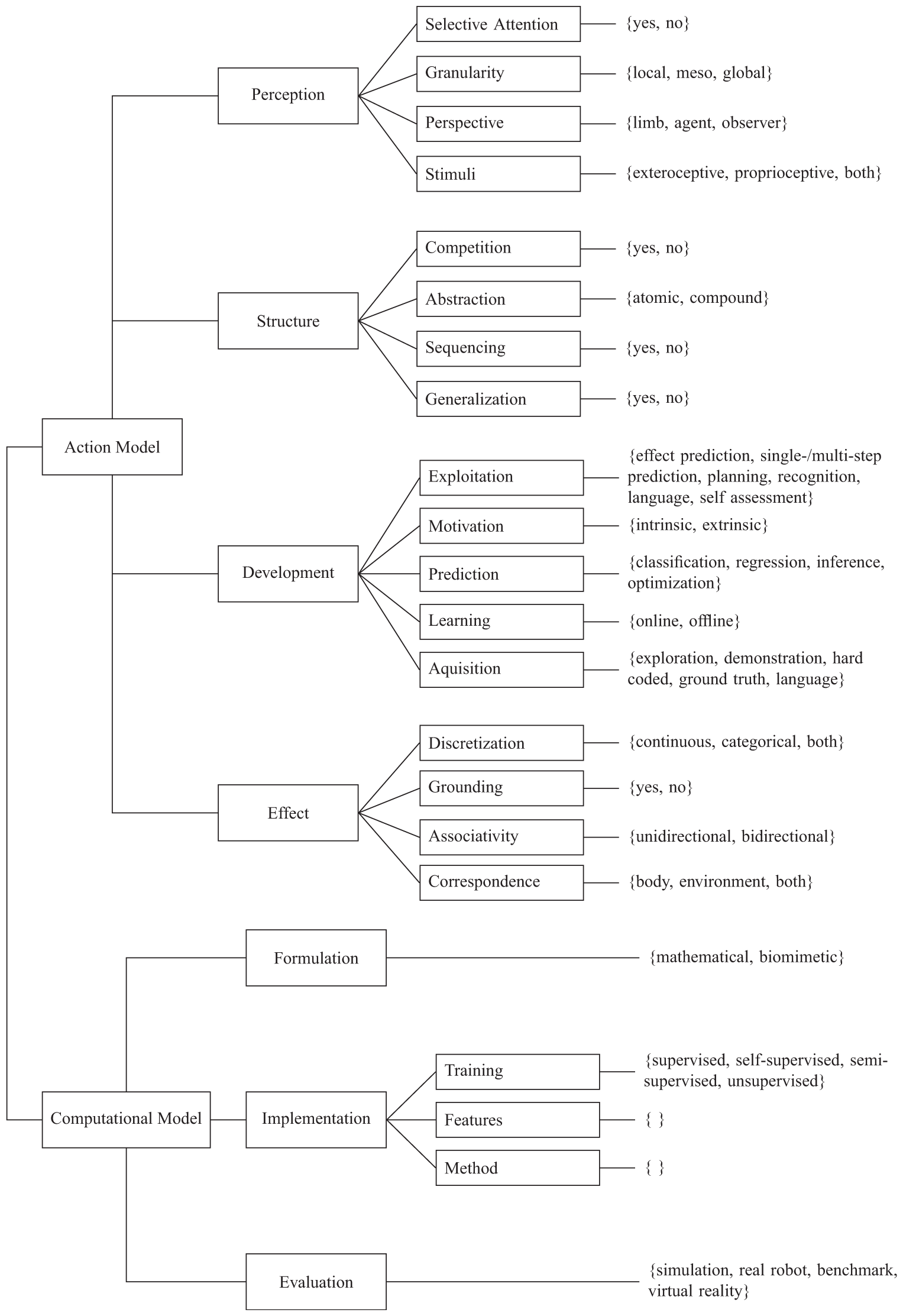
Overview of our taxonomy for categorizing action representations in robotics. For the sake of clarity, the choice not specified is excluded.
Before now discussing the criteria from Figure 1 in detail in Sections 3.1 and 3.2, we want to remark that if a criterion is not specifically addressed in a given publication, it is assigned not specified.
3.1. Action model criteria
Action model criteria serve to asses the underlying “mental” action model of an action representation regarding its perceptual, structural, developmental, and effect-related aspects.
3.1.1. Perception
Perceptual aspects study the means by which an autonomous agent employs different aspects of perceptual input for recognizing and memorizing actions in the environment. This dimension is standing in reason when considering Mandik’s claim that perception and action are tightly coupled (Mandik, 2005). An even stronger argument towards this tight linkage is given by Tucker and Ellis (1998) in arguing that seen objects automatically potentiate components of the actions they afford. Thus, one should consider visual inputs as one of the main drivers demarcating representations of actions.
3.1.1.1. Selective attention
Selective attention is becoming more and more popular in vision research, not least because of the impressive success of Deep Q-Learning (Sorokin et al., 2015). Naturally, selective attention is an important process for early action selection (Cisek and Kalaska, 2010). Further, it allows noise and irrelevant information to be filtered out, focusing on what is important and relevant, thus raising awareness of one’s own actions and ultimately culminating in conscious motor control (Webb et al., 2016). Thus, selective attention is either present or not (see rows 1 or 7–11, and 2–6 or 16–39, respectively, of Table C1).
3.1.1.2. Granularity
The granularity of the perceptual aspects of an action are important when it comes to generalizing actions. Clearly, in the context of a scene, actions can be perceived at different levels of granularity.
Local implies that an action model only considers local information, i.e., the part of an object that is relevant for doing the action like the handle of a hammer. As in the case of the perspective (cf. Section 3.1.1.3) this comes with both advantages and disadvantages. For example, the agent may be capable of immediate interaction with the object upon recognizing a part but may fail to generalize its knowledge to different situations owing to the lack of additional semantic information regarding the context in which the action is performed (see rows 34, 69, or 72 of Table C1).
Meso implies that an agents perceives an action at the level of complete objects instead of only specific parts. This immediately allows an agent to acquire additional semantic information on the object itself enabling easier generalization of an action to different contexts as the agent has a more elaborate idea of what it can and cannot do with an object (see rows 1, 2, or 35–38 of Table C1).
Global implies that an agent perceives an action at the scene level. That is, not only does it perceive the concrete movements and objects involved but is also able to perceive the environmental context in which the action is performed, thus enabling consideration of interactions in the environment. Clearly, this allows an agent to easily generalize actions to novel contexts as it has acquired a complete picture of the circumstances under which an action can be performed. Observe however that this level of granularity does not readily imply generalization of the action (cf. Section 3.1.2.4; see rows 3, 4, 9, 11, or 12 of Table C1).
3.1.1.3. Perspective
The perspective eventually nails down the reference frame of the perceived action. In the case of autonomous agents, multiple perspectives may apply given how the agent perceives and memorizes an action. We claim that there are three relevant perspectives autonomous agents can employ.
Limb implies that an agent learns actions with respect to one of its limbs, e.g., an arm or the end-effector only. The rationale is that our limbs are the primary means of interaction with the environment. This perspective has the advantage that an agent may easily plan and adapt its actions locally, however may fail to do so at a global scale (see Section 3.1.1.2). Observe that this choice may imply the need for selective attention to properly isolate observations (see Section 3.1.1.1; see rows 27, 38, or 42 of Table C1).
Agent implies that an agent perceives actions with reference to its whole body. This clearly has the advantage that an agent is able to plan and redo actions at a scale relevant for his body, yet it may fail to capture fine-grained local aspects of an action. Compared with limb this choice usually refers to whole-body actions (see rows 2, 5, or 6 of Table C1).
Observer implies that an agent learns actions by observing them and associating them to the frame of reference of the agent executing the action, e.g., agents perceive actions from a third-person perspective. Clearly, the resulting action is represented at a global scale, yet the agent is required to, prior to execution, map the action into its own reference frame (see rows 22–24 or 30–32 of Table C1).
3.1.1.4. Stimuli
Stimuli, either external or internal, play an important role for action learning and representation as they encode relevant information that (i) triggers, (ii) monitors, (iii) allows adaption of an action both prior and during execution. Clearly, such stimuli may have different sources, e.g., internal or external. This criterion thus considers two types of stimuli.
Proprioceptive stimuli which relate to stimuli that are produced within the agent and its embodiment, e.g., force readings. Such stimuli are essential in that they enable monitoring the self during action execution (see rows 72–73 or 83 of Table C1).
Exteroceptive stimuli which relate to stimuli that are generated in the external environment, i.e., interaction possibilities in the environment (affordances). Such stimuli are necessary for an agent to perceive the effects of its actions in the environment and subsequently replan or perform online adaptation of its movements to achieve its intended goals (see rows 30–38 or 40–60 of Table C1).
Observe that this is a multi-choice criterion, i.e., an agent may as well consider both proprioceptive and exteroceptive stimuli for establishing an action model (see rows 2 or 5–7 of Table C1).
3.1.2. Structure
Structural aspects of the action model discuss the capacities of the representation in terms of cognitive capabilities it opens up to an agent. They are crucial for planning and reasoning for action selection in any given context. From an environmental perspective, structural aspects additionally discuss how the actions are organized in the environment.
3.1.2.1. Competition
Obviously there may not always exist a single action that achieves an intended effect but instead a variety of actions equally allowing an agent to reach its goal, i.e., multiple actions are equivalent in terms of their effects but differ in their overt manifestation. To be able to select the ideal action, an action model is thus required to allow for competition among actions such that the agent may always choose the most suitable and efficient action. However, we do not attempt to study the internals of action competition but rather whether a model allows for it or not. Thus, Competition is either present or not. (see rows 1–7 or 10–14, and 8, 9, 15, 16, 18, or 19, respectively, of Table C1).
3.1.2.2. Abstraction
Traditionally, an action is considered atomic by triggering a specific movement applied in a specific context to achieve an intentional effect. However, considering actions only at such an atomic level subsequently hinders an agent to plan in terms of action sequences composed of a set of atomic actions. Our taxonomy thus considers both of these levels of abstraction as this ultimately enables an agent to reason in terms of higher-level actions and their goals.
Atomic actions encapsulate a single intentional effect. Atomic at this implies that an action cannot be further decomposed into smaller actions. Observe however that this does not restrict an atomic action to consist of a series of movements. For example, opening a drawer requires placing the gripper by moving the arm towards it, closing the hand around the handle, and subsequently retracting the arm (see rows 1–7 or 9–22 of Table C1).
Compound actions on the contrary are actions that themselves consist of multiple atomic actions. That is, compound actions describe sequences of actions where these actions are combined and conditioned on their intermediary, intentional effects. Similarly to atomic actions, the agent usually aims at achieving again a single intended effect, yet at a larger timescale (see rows 23, 59, 60, or 63 of Table C1).
Observe that this is a multi-choice criterion, i.e., an agent may as well consider both atomic and compound actions when building its internal repertoire of action models (see rows 8, 58, or 100 of Table C1).
3.1.2.3. Sequencing
Being able to sequence actions eventually allows an agent to join both atomic and compound actions to reason about higher-level action goals and to achieve a variety of intended effects. Yet, we want to clarify that sequencing of actions does not readily imply that an agent is able to represent compound actions (see Section 3.1.2.2). Sequencing solely refers to the ability to generate long-term plans that may yield a variety of effects. Further, this criterion by no means studies the means of sequencing. Thus, sequencing is either present or not (see rows 1, 5, 39, or 40, and 2–4 or 29–34, respectively, of Table C1).
3.1.2.4. Generalization
One of the most crucial aspects of autonomous robots is the capacity to generalize acquired knowledge to novel situations. Clearly, such a capacity places demands on the action representations. What would be the benefit of learning an action if it cannot be generalized to novel situations? Our taxonomy thus also studies this aspect of action representations as it holds a crucial factor for the success of an action representation. Again, however, we are not interested in the actual means of generalization at a computational level but just in whether the model allows it or not. Thus, generalization is either present or not (see rows 1–21 or 23–60, and 84, 104, or 132, respectively, of Table C1).
3.1.3. Development
Developmental aspects of an action relate to the means by which an agent is able to process new information to extend its action knowledge. Observe that this dimension is strongly tied to the perceptual aspects (see Section 3.1.1) of the action model in that the percepts ultimately constrain what can be learned. However, contrary to perceptual aspects which study how the agent perceives the environment for interacting with it, developmental aspects study how the agents learns to interact with its environment.
3.1.3.1. Exploitation
Available action knowledge can be exploited in different ways. However, different ways of exploiting one’s knowledge result in different ways of how one subsequently interacts with the environment. Over the last decades roboticists have studied different ways of exploiting action knowledge where the range varies from selecting actions for reactive behavior to reasoning about actions for higher-level cognition.
Effect prediction of actions is an important capacity for autonomous agents as it allows them to understand both their environment but also their embodiment in terms of what they are capable of achieving. In addition, effect prediction is a precursor for planning at large timescales (see rows 25, 64, or 76 of Table C1).
Single-/multi-step prediction enables agents on the grounds of their immediate percepts and motivation to first search applicable actions and subsequently sequence them together given the predicted effects, or just to execute the most suitable action (see rows 1, 2, 6, or 9–12 of Table C1).
Planning, in contrast to single/multi-step prediction, cannot be done by exhaustive search. Rather, planning is implemented by reasoning over symbolic representations of both the environment and the agent’s percepts and motivation, as well as its internally symbolized action repertoire (see rows 13, 19, or 22 of Table C1).
Recognition of actions and activities of others is crucial for autonomous agents that are supposed to help in our daily lives. Observe that this choice relates to effect prediction, yet at a different level. Whereas effect prediction ultimately allows an agent to predict what was the intention, action recognition allows an agent to already reason about how to achieve the intended goal instead of just capturing the sole intention (see rows 3, 4, 7, 8, or 16–18 of Table C1).
Language enables agents to communicate with other agents by an important high-level cognitive ability. Agents exploiting their action knowledge by language ultimately are capable of communicating this knowledge in order to instruct others by means of teaching. Similarly, agents can also learn from spoken instructions (see Section 3.1.3.5; see row 52 of Table C1).
Self-assessment of one’s own capabilities unlocks to an autonomous agent the possibility of reasoning about its developmental state. This readily aligns with Jeannerod’s famous idea that our actions tell us about ourselves (Jeannerod, 2006). Further, being able to assess one’s self and one’s capacities and consequently knowledge gaps immediately allows one to tackle the exploitation versus exploration trade-off by improving learned or acquiring new knowledge (cf. Section 3.1.3.2).
3.1.3.2. Motivation
Clearly an agent needs some kind of motivation that drives its process of knowledge acquisition. Such a motivation may either be external or internal. The former relates to external triggers, usually externally imposed goals the robot is to achieve. The latter refers to internal motivations with no separable (clearly observable) outcome by an instrumental value (Ryan and Deci, 2000). Consequently, this criterion has two possible choices.
Extrinsic motivation generally relates to external triggers that drive a robot to acquire new action knowledge. Observe that such extrinsic motivations may at some point overlap with intrinsic motivation (see below) in the case that an agent “realizes,” despite being externally imposed, that following some trigger may result in an overall improvement. In such an event we argue similarly to Ryan and Deci (2000) that this still should be considered external, as the original trigger is externally imposed (see rows 1, 26, or 33 of Table C1).
Intrinsic motivation relates to internal triggers that drive the robot towards fostering or acquiring novel actions. The difficulty arising here is that robots generally are not able to deal with non-separable consequences such as joy or satisfaction, which commonly are considered as triggers for intrinsically motivated behavior (Ryan and Deci, 2000). Yet, discussing this question is not the goal of our work, which is why we deliberately leave this question unanswered. Apart from that, intrinsic motivation has the disadvantage that the robot has to confront the exploration versus exploitation trade-off, i.e., does it learn new actions or foster existing actions? In contrary, being intrinsically motivated enables an agent to learn what it is capable of and thus to develop an understanding of its embodiment (see rows 9, 106, or 152 of Table C1).
Observe that this is a multi-choice criterion, i.e., an agent may be both extrinsically and intrinsically motivated in learning new actions.
3.1.3.3. Prediction
After having learned new actions an agent needs the capacity to predict when a certain action is applicable (or required) given both its percepts and its motivation. Obviously, this criterion has a strong relation to the underlying computational model of our taxonomy (see Section 3.2) by relying on the mathematical tools employed. However, we argue that there still is a need for this criterion in the developmental dimension of our taxonomy, as properly deciding which action to take is a core aspect of developing sound and complete action knowledge.
Classification relates to agents which relate their perceptual input patterns to concrete categorical outputs. In this spirit, an agent identifies classes of actions which it implicitly relates to similar input patterns by defining a mapping from continuous to discrete spaces. Observe that classification transparently enables generalization (see Section 3.1.2.4; see rows 1–4, 6, or 7 of Table C1).
Regression relates to agents whose actions are defined on continuous spaces given relations in its perceptual inputs. That is, given its stimuli an agent learns a regression function that maps from continuous to continuous spaces (see rows 9, 11, or 15 of Table C1).
Inference is a naturally inspired mechanism where an agent uses a set of acquired facts (existing knowledge) and hard-coded rules to infer new facts (novel knowledge), i.e., which action to take in a specific context. The rules may be represented as logical formulas, connections within graphs, or decision trees. Formally, this defines a mapping from discrete to discrete spaces (see rows 14, 19, or 31 of Table C1).
Optimization is a purely mathematically-inspired mechanism to learn the best expected outcome given some input. Using it, an agent chooses an action that either maximizes a reward or minimizes a loss. Formally, this defines a mapping from either discrete or continuous to continuous spaces (see rows 5, 8, or 26 of Table C1).
3.1.3.4. Learning
Acquisition (see Section 3.1.3.5) of new information is an important capacity for autonomous agents to avoid stagnation. However, acquisition is only part of the deal. An agent also needs to be able to learn from this newly acquired knowledge in order to evolve. The means of learning are crucial for the development of both the agent and its internal action model. Our taxonomy studies this criterion by two possible choices.
Offline learning characterizes agents that first acquire data (or are provisioned with already-collected data) and subsequently employ this data for offline learning to acquire new knowledge. A drawback of this is that the agent may not be able to immediately react to changes in the environment or its embodiment, or to validate the learning outcomes itself in the real world (see Section 3.1.4.2). Yet, learning can be shaped more efficiently compared with online learning (see below; see rows 1–8 or 11–13 of Table C1).
Online learning poses novel challenges to an agent, i.e., incomplete data and a large amount of noise and irrelevant data. That is, an agent, while exploring its environment to collect new data, is faced not only with the challenge to learn from this very data but also to filter out the relevant bits and pieces (cf. Section 3.1.1.1). Despite this disadvantage, online learning comes with the advantage of immediate adaptability to changes in both the environment and the embodiment (see rows 9, 10, 14, 15, or 25 of Table C1).
3.1.3.5. Acquisition
To be able to learn something new an agents needs to be provided with information it is able to process. Over the years, the robotics and machine learning community have drawn on various formats of information provision for agents. Clearly, each of those come with their unique advantages and disadvantages, which however are not the focus of this article. This criterion thus does not study advantages or disadvantages of the means of information provision but instead how the agent is provided with this novel information.
Hard coded implies that an agent generally does not acquire new knowledge but rather is provided with an initial set of, e.g., rules and facts about the world which allow it to shape its behavior. Clearly, such an agents stagnates until its knowledge base is manually extended (see rows 17, 48, or 52 of Table C1).
Ground truth implies that an agent acquires new knowledge by learning to relate specific input stimuli to actual outputs (e.g., motor commands) for achieving a desired effect. Agents thus are able to learn but only if provided with valid feedback on their choices. Observe that ground truth traditionally is a manually specified feedback signal that does not adapt to changes and may bias the learner (see rows 16 or 18–20 of Table C1).
Demonstration implies that an agent learns from another agent or human teacher by being instructed on how to perform specific actions. This kind of acquisition comes with the advantage that the agent can immediately relate what it is shown to itself resulting in more efficient learning (see rows 1, 3, or 5–8 of Table C1).
Exploration relates to agents that learn by exploring their environment by their own means, e.g., motor babbling. Being able to acquire new knowledge by exploring however requires the agent to be able to perceive and classify effects and changes in the world such that it can make sense of its actions (see rows 9, 14, or 33 of Table C1).
Language probably is the most difficult but also most advanced means of acquiring novel action knowledge. The format may have lots of different variations, from direct imperative instructions (which are arguably the easiest to understand) to scene explanations from which the agent is required to extract the relevant bits and pieces that describe the action it is observing and is supposed to acquire. Clearly, being able to learn actions by language is an advanced, high-level cognitive ability and thus hard to achieve (see rows 22, 60, or 70 of Table C1).
Observe that this criterion is again multi-choice, i.e., the means by which an agent acquires new knowledge are not restricted to just one source (e.g., an agent may learn about new actions by both being demonstrated what to do and at the same time being told what is actually done; see rows 11, 58, or 86 of Table C1).
3.1.4. Effect
As already claimed by Jeannerod (2006), in humans, actions are represented by their effects. Our taxonomy reflects this claim by containing a distinct dimension to study effect-related aspects of action models. Clearly, our notion of effect does not immediately correspond to a “mental” representation of an action. Nevertheless, it is an important aspect for studying the faithfulness of an action representation and its underlying action model.
3.1.4.1. Discretization
Effect discretization studies the granularity of effect predictions that an action model supports. Effects may be either easily categorizable by clustering similar effects or they may reside in a continuous spectrum. In our taxonomy, the discretization of effects thence can fall into one of two categories.
Categorical effects generally relate to individual and different effects. Hence, effects under this category generally describe fixed amounts or clearly distinguishable events as a result of performing an action. Observe that both numeral and symbolic effects are subsumed by this choice (see rows 2–4, 7, or 8 of Table C1).
Continuous effects relate to fuzzy, boundless effects along a continuous dimension. Consequently, effects under this choice generally relate to real-valued action outcomes that are measurable along continuous spectra (see rows 5, 9, 10, or 12 of Table C1).
Observe that this is a multi-choice criterion, i.e., an agent may as well consider both categorical and continuous effects for establishing an action model (see rows 1, 5, or 37 of Table C1).
3.1.4.2. Grounding
Grounding of effects relates to the circumstance whether an action has or has not been executed in a real-world environment by observing the intentional effects at the same time. Obviously, this criterion is of utter importance as it expresses the maturity of an action model. If once executed in a real-world setting with the intended effects observed, the action is both feasible and properly represented, whereas if not (i.e., only executed in simulation) one cannot guarantee that an action is actually doable as intended. Hence, grounding binds intended effects to observable real-world events. Thus, grounding is either present or not (see rows 1, 2, 5–7, or 9, and 3, 4, 8 or 10–13, respectively, of Table C1).
3.1.4.3. Associativity
Associativity of effects relates to the capacity of both predicting the effects of an action as well as predicting a necessary action to achieve a desired and intentional effect (Paulus et al., 2011). More precisely, this dimension does not directly investigate the mechanism for such capacities but instead whether the action model possesses this capacity and further, the nature of this capacity. Effect associativity can fall into one of two categories.
Unidirectional action–effect associativity categorizes an action model as only being able to infer the effects of executing a specific action. Consequently, an action representation lacks the capability of imagining which actions to execute to achieve a desired effect. On the contrary, given an action the model is readily capable of predicting the effects (see rows 2–13, 17, 19, or 20 of Table C1).
Bidirectional action–effect associativity categorizes an action model as possessing the capacity to predict relevant actions given some desired effect. This is ultimately related to mirror neurons which upon observation of an action (that involves and object) immediately activate neural populations relevant for motor control. This immediately allows for mental simulation of actions. However, observe that imagining does not readily trigger a representation (Elsner and Hommel, 2001; Rizzolatti and Craighero, 2004; Rizzolatti and Luppino, 2001) (see rows 1, 14, 15, or 36 of Table C1).
3.1.4.4. Effect correspondence
As argued by Newton (2017), usually we exercise an action to achieve a desired effect. Here we argue that one needs to carefully consider the actual frame of reference, or correspondence, of the effect. On the one hand, an effect may relate to changes in the environment, that is, displacing some object or opening a drawer. However, desired effects may also relate to changes in one’s own bodily configuration, consequently treating the change in the environment as a consequence of the bodily change (cf. O’Shaughnessy 1997; Section 2). Hence, the latter does not exclude changes in the environment, but rather treats them as an indirect effect of executing an action triggered by the bodily effect. This criterion allows for three choices, namely environment and body or the combination of both (see rows 4 or 9, 1, 2, or 5–7, and 3 or 8, respectively, of Table C1).
3.2. Computational model criteria
Computational model criteria serve to assess implementational aspects of an action representation by how characteristics of the action model are realized. Hence, the computational model discusses the mathematical and theoretical underpinnings of action representations.
3.2.1. Formulation
Here we consider whether a computational model is mathematically or biologically motivated. Clearly, there is a strong overlap between both categories, as, e.g., nature has inspired countless learning algorithms. Thus, the question of where we draw the exact line between mathematical and biological motivation is valid. Our answer to this question is that a mathematically-formulated model solely draws on mathematical tools without the claim of being biologically plausible, whereas a biologically inspired, or biomimetic, model aims at grounding its workings in biological and neural processes.
Mathematical implies that a computational model is purely relying on existing mathematical tools with no claim to be biologically inspired (see rows 1–11 or 13–20 of Table C1).
Biomimetic implies that a computational model uses biology and cognition as a precursor for selecting proper mathematical tools. Such models thus are inspired from biology and neuroscience (see rows 12, 21, or 33 of Table C1).
3.2.2. Implementation
The implementational dimension of an underlying computational model of an action representation studies relevant aspects of the programmatic implementation. This subsumes (i) the concrete mathematical tools that are employed for learning and prediction, (ii) the environmental features that are used by the model, and (iii) the kind of training that is applied to the model, and thus entails a purely technical dimension.
3.2.2.1. Training
The last dimension of the implementational aspects of the computational model of action representations studies the training used to train the predictive aspects of the developmental dimension of the action model (see 3.1.3). Our taxonomy supports the four most common types of training prevalent in robotics research.
Unsupervised learning relates to procedures where no, direct or indirect, feedback signal is used to drive the learning process. Eventually this requires an agent to detect relevant statistical patterns in as well as the underlying structure of data without guidance. With respect to developmental robotics, this conceptually relates to the autonomous discovery of patterns or concepts from perceptual inputs in all available channels (exteroceptive and proprioceptive, see Section ; see rows 3, 8, or 10 of Table C1).
Supervised learning refers to learning given concrete feedback signals. That is, each input datum comes with a label informing the agent whether its prediction (or classification) was correct or not. Ultimately the agent learns to predict novel target values for previously unseen inputs. Common drawbacks of this kind of training are under- or over-fitting resulting from too little or biased training data (see rows 1, 2, or 4–7 of Table C1).
Self-supervised learning refers to agents capable of applying different views on data for learning patterns and concepts. Subsequently, one view, e.g., a specific sensor modality, is used to drive learning in another data view. For example, an agent may use clustering for learning low-level concepts in data (e.g., different obstacles). Subsequently, the cluster outputs are then used as target values for learning higher-level concepts using supervised learning (e.g., navigation). The term self-supervised refers to the supervision emerging from the learning agent instead of an external source (see rows 15, 27, or 73 of Table C1).
Semi-supervised learning is a hybrid form of learning relying on techniques from supervised as well as unsupervised learning. It most naturally resembles human learning in that it is initially bootstrapped from supervised learning by a caregiver, followed by life-long, unsupervised learning by autonomous exploration (see rows 70, 87, 111, or 112 of Table C1).
3.2.2.2. Features
To be able to make meaning of inputs in terms of computation, an action model requires extraction of features present in the inputs. Clearly, it may also directly rely on the inputs without any further processing. This criterion thus subsumes all kinds of representations from pixel intensities over salient points to features yielding from outputs of deep neural nets. Similar to the previous criterion this is also an open choice criterion, as again, the multitude of available and possible feature representations is too vast to be captured formally.
3.2.2.3. Method
The method relates solely to the employed mathematical mechanisms that underpin the various perceptual, structural, developmental, and effect-related aspects of the corresponding action model. It is an open choice criterion as providing choices for the multitude of mathematical tools that may be employed is too vast to be captured formally.
3.2.3. Evaluation
The last dimension of the computational model underpinning an action representation discusses the means by which the action representation under study has been evaluated. The purpose of this dimension is two-fold: first, it indicates whether a model is just a theoretical musing or has practical relevance; second, it indicates the maturity of a model. We thus claim that this dimension is of substantial importance. The choices are as follows.
Benchmark refers to action representations that compete with others in terms of being evaluated on an unbiased, explicitly devised data set. Doing so immediately allows comparing representations with each other in terms of their representational and functional capacity. Benchmarks can fall into two categories distinguished by how the baseline is established. In one case, the baseline is computed from a specially-devised training data set and compared against a test data set. In the other case, a baseline is established from the results of reference studies investigating the same hypothesis to be then compared against the own model using the same data as the reference studies (see rows 3, 4, 7, or 8 of Table C1).
Real robot implies that an action representation has been evaluated on a real, physical robot. Clearly, this kind of evaluation is the strongest one as it requires a model to be robust against real-world noise and to be able to deal with potentially incomplete data (see rows 1, 2, 5, 6, or 9–15 of Table C1).
Simulation categorizes models as having only been evaluated in a simulated environment. Clearly, such an evaluation is weaker as the inevitable physics approximations and imperfect noise models fail to catch a real-world environment. Thus, for action representations only evaluated in simulation one cannot assess much more than that they may be practically feasible but not whether they truly are or not (see rows 21, 22, 26, or 39 of Table C1).
Virtual reality is a relatively recent type of evaluating, among others, action representations (Zech et al., 2017). It refers to a type of evaluation where a human agent provides non-simulated interactions in an otherwise simulated environment with a simulated agent (see rows 31 or 95 of Table C1).
Observe that this is a multi-choice criterion, i.e., a computational model of an action representation may well be evaluated in multiple settings, e.g., preliminary evaluation in simulation with subsequent evaluation on a benchmark (see rows 91 or 110 of Table C1).
4. Selection and classification of papers
Paramount to performing a literature review together for categorizing papers is a carefully designed search and selection procedure. This section will thus introduce our search and selection procedure for identifying papers relevant for classification. In addition, we identify relevant threats of validity to our study. The resulting classification of action representations in robotics covered in the selected publications is then used in the next section to indicate the adequacy of the defined criteria and for further discussions (see Sections 5 and 6).
4.1. Selection of publications
The selection of relevant, peer-reviewed, primary publications requires the definition of a search strategy as well as paper selection criteria together with a selection procedure applied to the collected papers.
4.1.1. Search strategy
The initial search conducted to collect candidate papers was done automatically on 1 December 2017 by consulting the following digital libraries:
IEEE Digital Library (http://ieeexplore.ieee.org/);
ScienceDirect (http://www.sciencedirect.com/);
SpringerLink (http://link.springer.com/);
SAGE (http://journals.sagepub.com); and
Frontiers in Neurorobotics (https://www.frontiersin.org/journals/neurorobotics).
These libraries were chosen as they cover most of the relevant research on robotics. The search string was kept simple, i.e.,
in order to keep the search general enough and to avoid missing any publications employing more precise terminology. Observe that the search was applied to all of the following search fields: (i) paper title, (ii) abstract, (iii) body, and (iv) keywords. The search produced a set of 1,575 retrieved papers, thus a paper selection process was subsequently employed to further filter the results.
4.1.2 Paper selection
Figure 2 summarizes the paper selection process which comprised three phases. In the first phase, papers were excluded based on their title: if the title did not indicate any relevance to robotics and action representations, papers were discarded from the classification. This reduced the initial set of 1,575 papers to 686 remaining papers. In the second phase, papers were excluded based on their abstract, reducing the number of relevant papers to 469. In the third and final phase, papers were rejected based on their content, reducing the set of relevant papers to 152. Thus, our classification, as discussed in Section 6, includes a total of 152 papers. Note that during the last iteration, a number of relevant papers were rejected on the basis that they either failed to introduce a novel representation or to sufficiently reevaluate an existing representation. Further, we deliberately excluded papers focusing solely on gesture recognition, as these generally are not considered mechanically-effective motions compared to actions (Hobaiter, 2017).
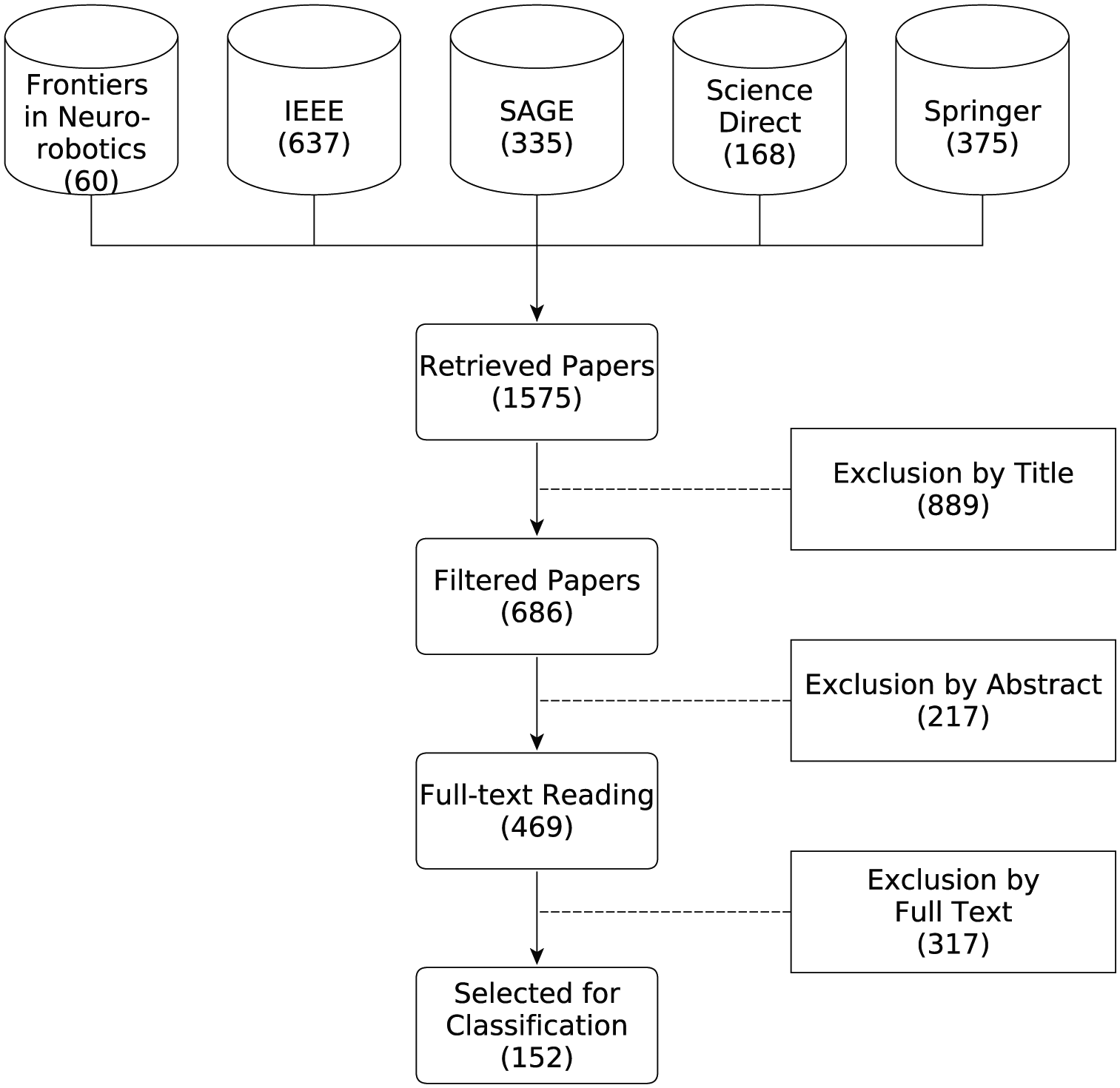
Selection of publications studied in this survey.
4.2. Paper classification
The 152 selected publications were categorized according to the classification criteria as defined and discussed in Section 3 by four researchers. For this purpose, the remaining set of primary publications was randomly split into four sets of equal size for data extraction and classification. A classification spreadsheet was created for this purpose. In addition to bibliographic information (title, authors, year, publisher) this sheet contains classification fields for each of the defined criteria. To avoid misclassification, the scale and characteristics of each classification criterion were additionally implemented as a selection list for each criterion. As explained above, the list also contained the item “not specified,” to cater for situations where a specific criterion is not defined or could not be inferred from the contents of a paper. Problems encountered during the classification process were remarked upon in an additional comment field. The resulting classification of all publications was then reviewed independently by all four researchers. Finally, in multiple group sessions, all comments were discussed and resolved among all four researchers.
4.3. Threats to validity
Naturally there exist various issues that may influence the results of our study, e.g., the defined search string as discussed previously. Threats to validity include multiple factors, most relevant to us (i) publication bias, (ii) identification, and (iii) classification of publications, as well as the (iv) terminology employed.
4.3.1. Publication bias
This threat relates to the circumstance that only certain approaches, that is, those producing promising results or promoted by influential organizations are published (Kitchenham, 2004). We regard this threat as moderate since the sources of publications were not restricted to a certain publisher, journal, or conference. Therefore, we claim that our study sufficiently covers existing work in the field of action representations and robotics. However, to balance the trade-off between reviewing as much literature as possible while nevertheless accumulating reliable and relevant information, gray literature (technical reports, work in progress, unpublished, or not peer-reviewed publications) was excluded (Kitchenham, 2004). Further, the required number of pages was set to four to guarantee that publications contained enough information in order to categorize them appropriately.
4.3.2. Threats to the identification of publications
This threat is related to the circumstance that, during the search and selection of publications, relevant papers may have been missed. To address this, we employed a very general search string to avoid missing potentially relevant publications during the automated search. Yet, to additionally reduce the threat of missing important publications, we informally checked papers referenced by the selected papers. We did not become aware of any frequently cited papers that were missed.
Apart from that, we also want to point out that we deliberately excluded any papers discussing just plain reactive open- or closed-loop controllers, e.g., dynamic movement primitives (DMP) or central pattern generators (CPG), as these, to the best of the authors’ knowledge, do not readily address the topic of action at a cognitive level but rather at the control level. Clearly, reactive control does not relate to the cognitive concept of an action being represented in terms of its effects and usually not readily coupled to some specific motor program. In addition, we also excluded a large number of papers studying the application of reinforcement learning (RL). In general, RL assumes actions are already given (observe that we are interested in action representations and means of populating them by learning) and, further, RL also does not employ any notion of effect whatsoever.
A further limitation we applied to the identification of papers was the deliberate exclusion of research in industrial robotics motivated by our strong focus on neurally inspired research in robotics.
4.3.3. Threats to the classification of publications
Given the rather large number of publications selected for classification according to a substantial number of defined criteria, the threat of misclassification needed to be addressed. Various measures were implemented in order to mitigate this threat. First of all, all criteria were defined precisely, as presented and discussed in Section 3, prior to the commencement of the paper selection and classification process. There was scope for the refinement of the concepts by the researchers during the process, but this was restricted mainly to descriptive adjustments. Second, for each of the criteria we added a list of possible selections in the classification sheet to avoid misclassification. Third, the classification was conducted in parallel by four researchers who are experts in the field and who repeatedly cross-checked the classification independently. Finally, weekly meetings were held by the four researchers to discuss and resolve any comments that arose during independent classification.
4.3.4. Terminology
We are aware that the way we use specific terminology, e.g., action and motion, or learning and inference, or understanding may not be perfectly in line with their use in other areas of research. However, this survey has been written with a robotics research background, which is why we stick to the terminology as used in this field. Thus, given both this circumstance and the fact that the notion of an action representation, at least for now, is not that widespread in robotics we took the liberty to rigorously decide on our own when to use which term and whether some representation is an action representation or not. However, readers from different fields should not face any problems in properly interpreting the content of this work, as the terminology as used in robotics research, to a high degree, has been coined by relevant concepts from psychology and neuroscience. On the other hand, we hope that our work stimulates a discussion about the state of the art of action representations in robotics to advance this field and contributes to the establishment of a common and well-defined terminology.
5. Results and discussion
This section comprises the main contribution of this article by presenting and discussing the classification of the selected papers (see Section 4). The complete classification of all 152 papers by the introduced taxonomy (see Section 3) is shown in the appendix of this article (see Tables C1 and C2 in Appendix C) and is also available online. 2 .
For each of the selected publications it was possible to categorize the presented action representation according to the criteria defined in Section 3. This indicates the pertinence of these criteria for the classification of action representations in robotics, hence supplying a framework for understanding, categorizing, assessing, and comparing action representations in robotics. In addition to validating the criteria introduced in Section 3, our classification, having been conducted in a systematic and comprehensive manner, provides an aggregated view and investigation of current state of the art of action representations in robotics.
Figure 4 shows the summary statistics by a co-occurrence matrix of category values as defined in Section 3 that arise in the analyzed papers, thus providing the foundation for subsequent discussions. Figure 3 gives the category distributions of the selected papers.
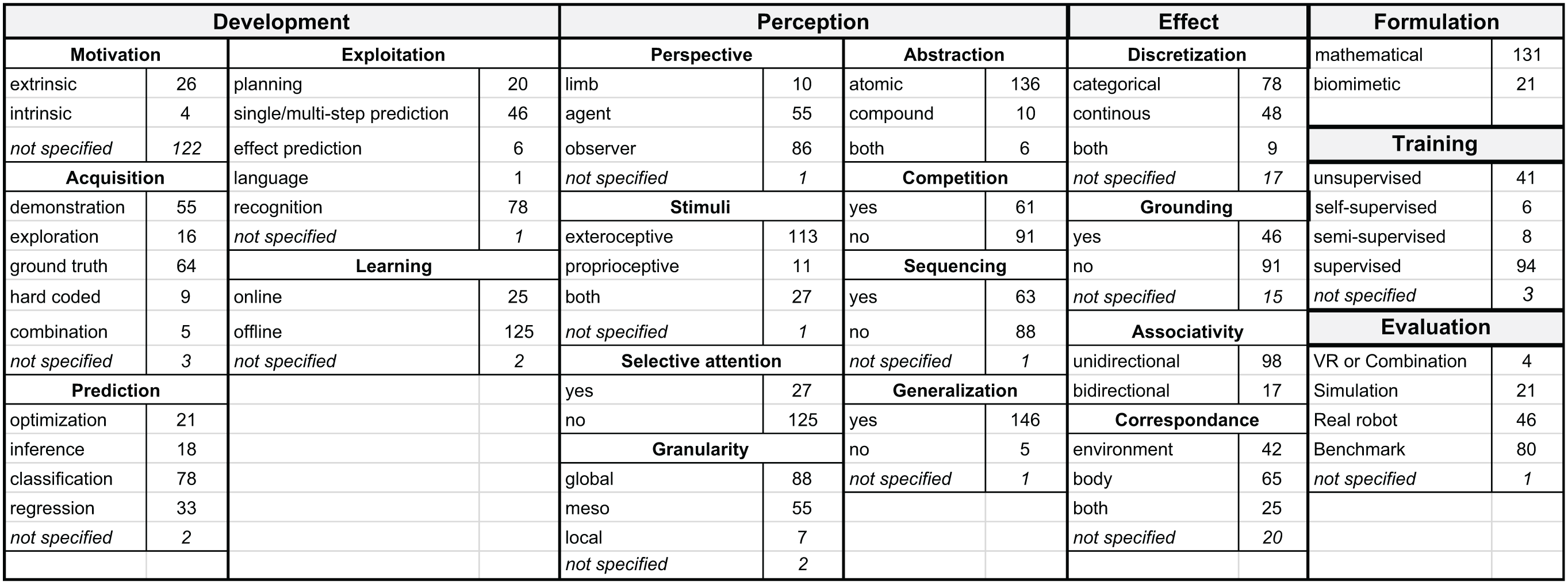
Numbers of papers falling into each category for all criteria.
In the following discussion of the results from Table C1 we will repeatedly refer to the abbreviations defined in Tables A1 and A2 allowing the reader to easily track down the papers classified according to a specific criteria, e.g., (Abs:c, Seq).
5.1. Learning of action representations
Learning, that is, the process of acquiring new or modifying existing knowledge, behaviors, skills, values, or preferences (Gross, 2015), is one of the central aspects of action representations. Clearly, this usually requires proper motivation (Mot) for learning to take place. Looking at Figure 3 shows that in great measure, the question of how to motivate (extrinsically or intrinsically) a learner is hardly addressed (30 out of 152) and where it is, learning is chiefly extrinsically motivated (26 out of 30; Mot:ex). Correlating this with the kind of training (see Figure 4), we conjecture that this in general is because of the prevalence of supervised and offline learning (79 and 110 out of 152, respectively; Train:S, Lrn:off) which traditionally imposes the motivation of reducing some externally prescribed loss. In accordance to that, exploratory learning (Acq:exp) has also received very little attention (16 of out 152). Clearly, such kind of learning would require switching to semi- or self-supervised online learning (1 and 4 of out 16 that do online learning; Train:SELF, Lrn:on). Furthermore, doing so would require a valid model of a robot’s embodiment in order to learn what is possible given the available motor skills. In line with this, we also argue that manually provided ground truth (Acq:gt) should be avoided as a means of a feedback signal for learning owing to its static nature (69 out of 152). Using such manually defined ground truth drastically impedes autonomous learning on a real robotic platform due to the dependence on teacher-dependent supervision (54 out of 69; Train:S). Again, if learning is done on a real robotic platform we suggest the use of semi- or self-supervised online learning for immediate relation to the robot’s embodiment.
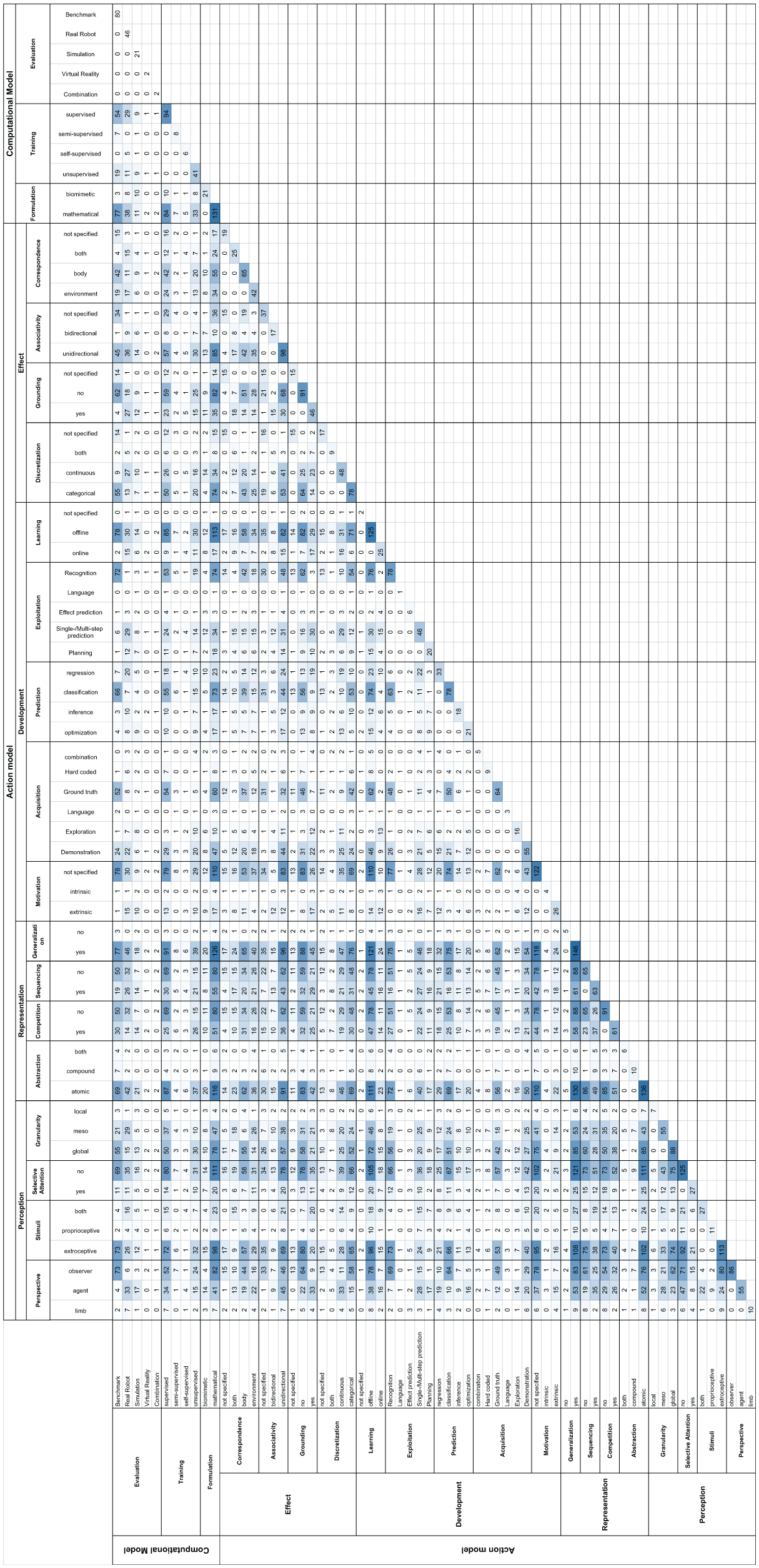
Co-occurrence matrix of all criteria for all categorized papers (best viewed on a computer display; numbers missing for each criteria to sum to 152: not specified).
The majority of the considered methods uses the observer perspective (86 out of 152; Per:ob). Clearly, learning from such a perspective hinders the emergence of action representations for purposes other than plain recognition due to the yet-unsolved correspondence problem (cf. Zech et al., 2017) and the consequent difficulty of relating observed actions to one’s own embodiment. Admittedly, one can learn from observation but only in combination with subsequent exploration. Yet, we did not identify any such paper. On the bright side, however, there is still a substantial number of approaches that learn from the agent’s perspective (55 out of 152; Per:ag), though only 14 of those acquire new knowledge by exploration (Acq:exp) and 20 by demonstration (Acq:d). This readily corresponds to the prevalent use of only exteroceptive stimuli (113 out of 152; St:e). Observe that this again drastically foils relation to an agent’s own embodiment.
Noteworthy further drawbacks we currently see in learning action representations are (i) a lack of employing selective attention (27 of out 152; SA), (ii) scarcity of language use (3 out of 152; Acq:l), (iii) negligence of learning with reference to an agent’s limbs (10 out of 152, Per:li), and (iv) only considering discrete instead of continuous (or both discrete and continuous) effects (78 out of 152; Disc:ca). Obviously, selective attention allows the curse of dimensionality to be tackled by focusing on what is relevant. Further, learning with respect to the limbs eases re-execution of trained actions due to the simplified planning problem, i.e., there is no need to do whole-body planning. Third, using language enhances structuring and understanding of action knowledge thanks to the tight relation between language and action (Guerra-Filho and Aloimonos, 2007). Observe that this claim is in line with Stenmark and Nugues (2013) who already submitted the importance of natural language for fast programming of robots in an industrial setting. Finally, enabling agents to reason about not only discrete but also continuous effects unlocks the ability to plan with respect to local changes in both the environment and the embodiment, and not only at a global environmental scale.
To conclude, in the area of learning action representations, the current multiple drawbacks stem in general from the prevalent combination of supervised, offline learning from an observer’s perspective. We suggest that in the future, online learning in a semi- or self-supervised way from the agent’s perspective merits more emphasis to resolve issues such as the correspondence problem or proper motivation for learning.
5.2 Maturity of action representations
Two of the central criteria of our taxonomy directly relating to the maturity of an action representation are the means of exploitation and evaluation. Clearly, representations that allow only for recognition and that further are only evaluated on a benchmark lack maturity, missing empiricism yielding from real-world experiments on an actual robotic platform. In this respect, Figure 3 draws a rather disappointing picture in that more than half of the categorized papers have only been evaluated in terms of benchmarks (80 out of 152; Eval:BM). Correlating this to the type of exploitation (see Figure 4) we see that the bulk of these papers (72 out of 80; Exp:r) only perform recognition. The main drawback coming along with such methods is the use of only exteroceptive stimuli and features which undermine construction of internal representations of one’s own embodiment due to the missing relation between observation and embodiment. Yet, as neuroscience conjectures, such representations of one’s embodiment seem paramount for action recognition to enable mapping of observed actions onto one’s own embodiment for reexecution (Sokolov et al., 2010). Such a mapping then immediately would solve the correspondence problem. On the other side, the nastiness of the correspondence problem in combination with lacking representations of the self (and thereof emerging relations to an agent’s embodiment) explains why the works that address action recognition fail to close the gap towards re-execution of observed actions.
Another problem that emerges if looking closer at the plethora of papers doing action recognition is their stopping short of action sequencing (0 out of 72 address action sequencing; Seq). However, looking at Figure 3 immediately reveals that papers not focusing on recognition (Exp:r) but rather on single- and multi-step prediction (Exp:sp) as well as planning (Exp:p) are capable of sequencing actions (27 and 16 out of 63). Unfortunately however, these methods only allow sequencing single actions together but fail to represent resulting action sequences as compound actions. In contrast, those action representations that are able to handle compound actions (4 out of 152; Abs:c) do not address sequencing of such compound actions.
The ability to handle action competition (Com) in the representation is another key aspect regarding the maturity of a model. Clearly, in every situation an agent is faced with multiple actions that yield similar or identical effects; thus it has to choose which action, among the feasible ones, to ultimately execute. In total, however, the number of approaches able to handle competition is less than half the papers we categorized (61 out of 152). Yet, using proper mathematical mechanics one actually can get competition for free, e.g., by employing neural networks or any other type of regressor/classifier that intrinsically handles competition at the decision level. However, we see a further potential reason for this general lack of handling competition, motivated by the circumstance that most works are only able to handle a couple of actions, possibly rendering competition useless for now. Yet, future work should put more emphasis on action competition, rendering agents more autonomous.
A last but very important indicator for the maturity of an action representation is the way it represents and handles effects. In general, the works we categorized focus on categorical effects (75 out of 152 papers; Disc:ca) with only unidirectional associativity (95 out of 152; Asso:ud). Correlating this to the category of exploitation, we again see that the majority of the representations that are only able to handle categorical effects are exploited for action recognition (54 out of 75; Exp:r). Clearly this is due to only recognizing classes of actions but not the continuous changes that the effects yield in both the agent’s embodiment and its environment. However, this substantial lack of handling continuous effects has a further reason: a shortcoming in grounding effects in the real world (46 out of 152; Gnd). Real-world physics in general are not discrete but continuous dynamical systems. Only by verifying estimations by real-world observations can we expect an agent to truly learn about the effects that it causes as well as its potential control over its environment. Finally, a last major drawback from our perspective is the prevalent unidirectional effect association (98 out of 152; Asso:ud). This immediately yields scarcity of inverse models for inferring what to do to achieve a desired effect, consequently reducing the autonomy of the agent.
To sum up, we submit that the majority of existing action representations are not in a very mature state. This follows from three major observations. First, evaluation mostly is not done on real robotic platforms. Second, researchers presently mainly focused on constructing representations only for recognition that neglect the self. Third, for most of the categorized works effects are not grounded in real-world physical environments. By putting more emphasis on these issues we claim that existing drawbacks, e.g., the shortcoming of proper inverse models, could readily be addressed.
5.3. Formalizing action representations
One of the central yet quite disappointing insights of our classification is the realization that in robotics, usually, there is no widespread use of specifically devised data types (think about an abstract data type) for storing and managing action-specific knowledge. Clearly, such data types are however necessary as our earlier treatise in Section 2 shows where in general one can see strong arguments in favor of internal representations of both actions and the self (cf. Jeannerod, 2006; Mandik, 2005; Naito et al., 2016; Tunik et al., 2005). Yet, except for the work of Beetz et al. (Bartels et al., 2013; Tenorth and Beetz, 2012), Wörgötter et al. (Aksoy et al., 2013, 2016b; Vuga et al., 2015; Worgotter et al., 2013), or Stenmark and Malec (2015) there has been little effort towards the design of appropriate data structures for storing, accessing, and transferring action knowledge. Quite the contrary, what is done in most categorized papers is to leverage existing vision-based feature extractors (e.g., convolutional neural networks (CNNs)) and descriptors, and to subsequently use a combination of those as input to some regressor/classifier. Obviously these vision-based features and descriptors in general do not express anything related to a specific action except for maybe what it “looks like,” but doubtlessly no information regarding how to actually perform the action (cf. our earlier writing on closing the gap between recognition and re-execution in Section 5.2). Apart from that, in respect of Searle’s famous definition of a computer being a device that manipulates formal symbols (Searle et al., 1997), we conjecture that for artificial agents, valid representations of both actions and the self are inevitable. Formal symbols are representations. Thus, at the end of the day, an artificial agent needs internal representations to be able to compute.
Since Francis’ influential article on the internal principle of control theory (Francis and Wonham, 1976) it is generally accepted that one of the central pillars of mammalian motor cognition strongly builds on inverse models for motor control (Wolpert and Kawato, 1998). In the course of our survey we identified exactly one paper out of 152 (see Tables C1 and C2 in the appendix) that makes use of explicit inverse models for single-/multi step prediction. Obviously this astonishing ignorance of inverse models only fortifies what we already argued earlier regarding the maturity of action representations. Yet, this lack of inverse models readily can be tackled by carefully revising existing representations and their mathematical underpinnings. We claim that doing so is paramount to verily advance the current state of the art in action representations in robotics. From a present-day perspective, in the long run this would also aid in effect modeling for action representations, as one readily obtains bidirectional effect associativity which currently is only addressed by a fraction of all categorized papers (17 out of 152; Asso:bd). We guess that the concurrent absence of inverse models as just discussed is further fostered by also not attributing neuroscientific results enough consideration in terms of building biomimetic models for action representations (21 out of 152; Form:BIO).
Another blind spot we revealed in the context of formalizing action representations is that, to a great extent, model formalizations are only done at the subsymbolic level. That is, looking at Tables C1 and C2 one sees a strong predominance of methods that purely operate at a subsymbolic level by means of the used features. Clearly, higher-level cognition requires symbolization of acquired knowledge for high-level abstract task planning. The results of our classification as shown in Figure 3 reinforce our observation in that only a small fraction of categorized action representations are exploited for high-level task planning (20 out of 152; Exp:p). We argue that action representations require proper symbolization for unlocking high-level abstract task planning.
Finally, a last point to discuss in the context of action representation formalizations is the scant use of optimization (21 out of 152; Pred:opt). We argue that optimization should be a first-class choice as ultimately one wants to optimize behavior by choosing the most fitting action. Correlating these papers to the kind of exploitation we at least see that eight out of those use single- and multi-step prediction (Exp:sp), and nine perform planning (Exp:p), respectively, indicating that if optimization is used, then it is for optimizing behavior. Nevertheless, we argue that more emphasis should be put on optimization for action selection and behavior shaping. Observe that this however does not call for an increased use of RL at this point. RL in general is not about optimizing an action but rather the sequence of actions that is taken to fulfill a task. Optimization of the action itself should take place before policy optimization.
5.4. Usability of action representations
One of the paramount questions when talking about formal models in a general sense is their usability. The Oxford English Dictionary defines usability as “the degree to which something is able or fit to be used.” Now, this definition is very broad and does not really investigate what it means to be usable or how to actually measure whether something is usable. Let us therefore expand this definition by introducing three characteristics that we consider relevant for quantifying the usability of an action representation:
effectiveness, i.e., the completeness and accuracy of a representation;
efficiency, i.e., how long does a representation need to be learned and also how easily can it be leveraged for executing a desired action;
robustness, i.e., how well does the representation generalize, but also deal with incomplete/corrupt data.
Regarding effectiveness we clearly see a large shortcoming in currently available action representations. Looking at Figure 3 (and as already mentioned) the bulk of existing methods solely do action recognition (78 out of 152; Exp:r). Despite being aware that recognition capabilities are crucial for action representations, we however claim that this is only the first step towards more powerful representations that also allow for motor imagery and actual execution of the abstracted action. In particular, single- and multistep prediction is of high importance (46 out of 152; Exp:sp) owing to its immediate relation to deciding what to do next. Unfortunately, however, this again boils down to closing the gap between recognition and execution (as already mentioned) as well as the correspondence problem for properly learning from demonstration. Further, this also comprises consideration of continuous effects for being able to come up with precise and accurate predictions regarding dynamic changes in the environment.
Regarding efficiency we submit that current models are learnable with reasonable expense, at least in the event of supervised, offline learning (85 out of 152; Lrn:off). However, one has to keep in mind the general shortcoming of such models in that they generally only allow for action recognition (53 out of 85; Exp:r). Clearly, one has to keep in mind that in the case of exploratory, self- or semi-supervised learning, learning a representation will take substantially longer. Unfortunately, as our survey shows, exploratory learning has not been sufficiently addressed for learning action representations (16 out of 152; Acq:exp). Observe that this lack of exploratory learning immediately relates to the maturity of a model by means of whether a representation is evaluated on a real robot or not. Clearly, learning and evaluating action representations on real robotic platforms strengthens the maturity of a representation.
One of the hallmark features of the human mind is its robustness to noisy or corrupt sensory inputs. This capacity stems for one central feat of human development: lifelong learning in a noisy and dynamic environment. Hence, only by grounding observations in real-world experiences, our minds are able to develop robust motor control (Harnad, 1990). It is hence evident that for action representations in robotics we conjecture that such robustness yielding from grounding experiences in real-world observations is paramount. In addition, the capacity to generalize to new situations also plays a major role when it comes to robustness. Obviously, not being able to generalize to novel situations likely indicates a very weak model. Looking at Figure 3 we see that nearly all categorized methods generalize to novel situations (146 out of 152; Gen) indicating high robustness of most approaches. Yet, looking at how many of those ground effects shows quite a different picture. Not even a third of those (46 out of 146; Gnd) actually ground effects by real-world experiences, hence now undermining the robustness of the remaining approaches. Correlating these numbers with the means of exploitation however immediately reveals that 73 of the models not grounding effects are exploited only for recognition (observe that the remaining three recognition models do ground effects). Undoubtedly, recognition is feasible without grounding effects. For the remaining 27 models we unfortunately either lack the relevant data or, in the other case, these models mostly do single- and multi-step prediction using models trained by video sequences. The above epitomizes again the prevalence of recognition models that just do not require effect grounding. In the remaining cases, we conjecture that this due to a neglect of selective attention (only 27 out of 152 do so; SA). Naturally, selective attention allows the curse of dimensionality to be tackled by focusing only on the stimuli that are relevant, thereby catalyzing the grounding of effects. Figure 4 however reveals that only 11 out of those 27 models ground effects. We claim that future action representations need to capitalize on selective attention for facilitating effect grounding thus drastically improving robustness.
Compiling the above, usability is essential for action representations. Current issues as discussed however could be tackled by implementing and especially evaluating a representation directly on a real robotic platform. Such an approach immediately unlocks the grounding of effects and consequently strengthen the maturity of the evaluated representation. By additionally considering selective attention one readily ends up with a representation substantially more robust than most current approaches.
5.5. A few last words on action and activity recognition datasets
Inspired by a recent survey of Chaquet et al. (2013) we also investigated the use and wide-spread uptake of datasets as reported by the categorized papers. Table 1 shows the resulting distribution of datasets as reported by our classification. In total, 40 different datasets have been used by various papers if evaluating an action representation using a benchmark (80 out of 152, see Figure 3). Investigating the actual usage count of the various datasets, Table 1 shows a similar preference pattern as Table 5 of Chaquet et al.’s (2013) survey. For example, KTH, Weizmann, and IXMAS are all among the top five datasets used. If learning of action representations is possible from datasets for action recognition, evaluating the relevance of the representation for robotics should be similarly straightforward (cf. computer vision (Russakovsky et al., 2015; Wu et al., 2015)). It is thus critical to define suitable, standardized datasets to learn action knowledge and corresponding benchmarking setups to properly evaluate the representation. This would greatly enhance quantitative comparison of different approaches, simply because the baseline is the same.
Datasets used for benchmarking in various categorized papers with respective usage count.
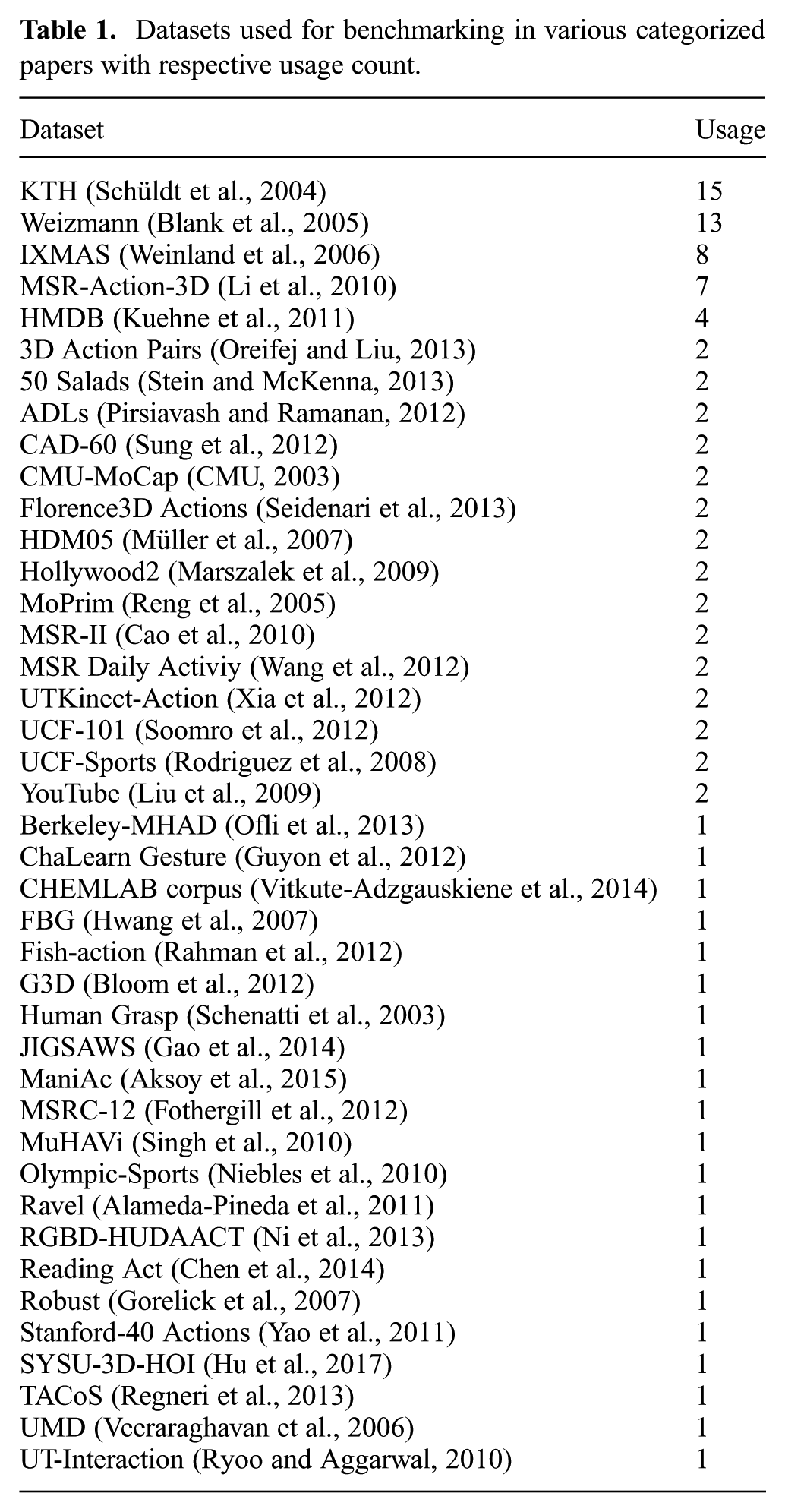
A more severe usage pattern is shown by Table 2 in that only a small fraction of papers evaluated on benchmark datasets used more than two datasets. Evaluating a model only on one or two datasets may drastically falsify results regarding generalization capabilities, simply because of focusing only on a small set of actions captured in just a couple of environments. Considering multiple datasets for evaluation, in line with the above, further allows for more insight into the behavior and capabilities of a model, and therefore for more robust models by virtue of better understanding.
Total number of datasets used by various categorized papers.
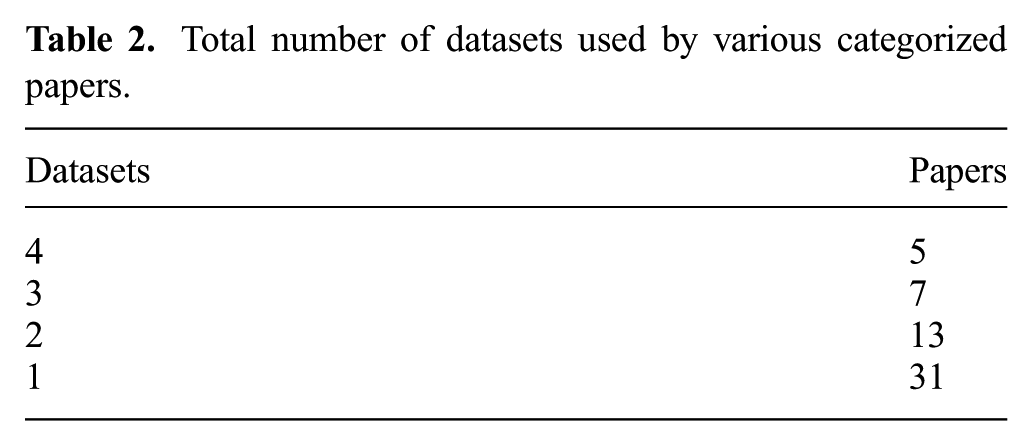
We submit that applying more diversity in evaluating models on benchmarks, that is, using multiple and especially commonly used datasets, would greatly advance research on action representations in robotics. This advancement eventually capitalizes on deeper insight and understanding of how these various models actually achieve their desired outcome by meaningful quantitative comparisons.
6. Open research challenges
Our classification and the resulting discussion from the previous section show that action representations in robotics have been intensively studied in recent years. However, our discussions from Sections 5.1–5.5 also reveal that the current state of the art regarding action representations in robotics is still in an early stage and currently suffers from multiple issues. In the following, we provide an overview of the central research challenges as revealed by the results of our analysis. We believe that addressing these is paramount to successfully advance research on action representations in robotics.
Intensifying effect-centricity and effect grounding. Grounding of effects in real-world percepts is one of the key challenges from our point of view. Clearly, owing to the vast amount of information available at each moment from both the self and the environment this is a hard challenge. Yet, doing so is critical to improve the quality of a model. As mentioned below, selective attention is one of the keys in handling this vast amount of data. Yet, we further claim that the capability of processing multi-modal percepts also substantially catalyzes the grounding of effects.
Coupled forward and inverse models. One of the central advantages of biomimetic models, especially in the field of motor control and hence action representations, is their postulation of the need for inverse models. It is hence necessary to carefully reconsider current results in neuroscience and motor cognition (cf. Section 2) to tackle the prevalent lack of inverse models. Doing so, among other benefits, readily unlocks the capacity of bidirectional effect associativity as well as performing motor imagery (Jeannerod, 2006).
Exploiting language for action understanding. The compositional and semantically rich nature of language is a strong prior for action understanding. Language provides precise and unambiguous semantics when it comes to describing actions. Therefore, we claim that in addition to grounding of effects in real-world observations, rooting the meaning of an action in natural language further boosts both learning and properly understanding an action. In the long run, this allows learning of more abstract, i.e., disembodied, and hence useful action representations. In addition, the importance of natural language for robot programming, though in an industrial setting, has already been mentioned by Stenmark and Nugues (2013).
Intrinsically motivated, exploratory, semi- and self-supervised learning. Importantly, humans learn by observation and subsequent exploration and interaction with their environment. Following this central motive, it is crucial to allow computational agents to learn relevant concepts with minimal prior information. This allows for progressive learning of representations of the external world as well as of the self. Clearly, this requires an agent to be accordingly motivated as well as the capacity of self-supervising its learning efforts. This ultimately culminates in using already-learned concepts, to both drive and supervise the learning autonomously. We claim that learning in such a way yields stronger autonomy compared to classic supervised learning and, hence, merits more attention.
Selective attention. Again, we argue similarly to Zech et al. (2017) that selective attention is an important aspect for focused perception by blocking out clutter and noise. In contrast to our reasoning in the case of affordance however, here we claim that selective attention should be ascribed a central role as a precursor for grounding effects by successfully tackling the curse of dimensionality by only considering those stimuli which are relevant for grounding the observed effects, thus drastically boosting the robustness of different representations. Observe the immediate complementarity to the above challenge regarding effect centricity and grounding of effects.
Solving the correspondence problem. Similarly to Zech et al. (2017) we claim here that it is of utmost importance to solve the correspondence problem in robotics, i.e., mapping of observed motions. This would address current drawbacks in both learning from demonstration and in understanding actions from an observer’s point of view. In particular, in the event of action representations this would allow closing the gap from recognition to re-execution. Observe that this also requires intensified research towards constructing internal models of the agent’s self.
Sequence-based modeling. The capability of composing compound actions, e.g., pick-and-place, out of more granular, atomic actions is a central capacity of mammalian motor control. Our minds do not store complete motor programs for each and every action but rather dynamically synthesize them out of more general building blocks for seamless action execution (cf. Section 2). Clearly, such a capacity is also paramount for action representations in robotics especially with regards to generalizability but also scalability at a computational level.
Observe that there exists a substantial intersection of the above challenges with those identified by Zech et al. (2017) in the case of affordance research in robotics. This, however, is not surprising given the strong relation between actions and affordances, the latter being a key driver in action selection. This intersection clearly resembles the strong interrelation of these two complementary fields of research and thus motivates joint research efforts.
7. Conclusion
Action representations are a key ingredient of autonomy in robots. In this article, we thus made three major contributions relevant for this field of research. After a thorough survey of the meaning of action as well as contemporary definitions and opinions from various associated scientific disciplines we ended with a seminal definition of action relevant to robotics (cf. Section 2). This treatise hence paved the way for the first major contribution of our article, a taxonomy of action representations in robotics (cf. Section 3). This allowed us to conduct our second major contribution, a meticulous review of existing work on neurally inspired action representations in robotics. Identified publications subsequently were categorized using our taxonomy, yielding the results for our third contribution in the form of an in-depth discussion of existing research on action representations in robotics (cf. Section 5). This discussion finally culminated in the identification of key research challenges we deem fundamental for advancing research on action representations in robotics (cf. Section 6).
Summarizing our work we report that for now one of the central drawbacks in action research in robotics is the crucial lack of a common notion of both action and action representation in robotics. However, this shall not raise the impression that current state-of-the-art work is useless. On the contrary, existing results act both as a foundation and guidance towards how to advance action research in robotics. Accordingly, in Section 6 we identified future courses of actions for action research in robotics. We believe that intensifying research in these fields holds great promise to unlock novel motor-cognitive capabilities in autonomous agents towards both more autonomy and dexterity.
Footnotes
Appendix A. Abbreviations for classification
Appendix B. Abbreviations for methods and features
Appendix C. Classification of selected publications
Tables C1 and C2 show the full classification of all selected publications. These results are also available online at https://iis.uibk.ac.at/public/survey/ActionRepresentation/.
Funding
The author(s) disclosed receipt of the following financial support for the research, authorship, and/or publication of this article: The research leading to these results has received funding from the European Union’s Horizon 2020 research and innovation programme (grant agreement number 731761, IMAGINE).
