




Abstract
For centuries, global political economic relations have been informed by a model of growth premised on transforming plants, animals, knowledge, labor, water, and land into scarce commodities. Growing production, consumption, and profit remain unquestioned goods across many sectors of contemporary life. Through our evolving relationships with colonialism, capitalism, and Western science, ethnobiologists are increasingly interrogating the political and economic consequences of our interdisciplinary scholarship. Thus, we offer a valuable perspective on a diverse ecological and social science agenda: degrowth. In this review essay, I explore how ethnobiology might contribute to degrowth research through its empirical approach, alternative valuation, focus on relationships over commodification, emphasis on local context, and recognition that humans shape and are shaped through the environments in which we live. Ethnobiologists meticulously describe systems of social, ecological, and economic interaction. In doing so, we fill a need for studies that document life under degrowth conditions. Similarly, degrowth research offers a vocabulary for ethnobiologists to recognize how we make a unique, data-rich contribution to discussions of political economy and political ecology. Ethnobiologists and degrowth researchers have much to say to each other through our shared commitment to action-oriented, imaginative research that explores socioecological relationships of care and interconnection.
Introduction
Ethnobiology combines multiple disciplines, methods, and approaches at the intersection of biological and social sciences to explore humanity's dynamic relationships with the environments in which we live. While the discipline of ethnobiology only emerged in the latter half of the twentieth century, and the first issue of the Journal of Ethnobiology was not published until 1981, the practice of studying the intersections between people and local ecologies predates nation states, colonization, and global capitalism. Written accounts of plant medicines and agricultural strategies are found in divine texts like the Vedas or the Bible, medical compilations across Mayan, Greek, and Chinese scholars, and in ancient farm and kitchen guides for those elites who could read them. Oral traditions and the ethnobiological knowledge encoded in them extend much farther into the past, of course. Increasingly, ethnobiologists are interrogating the economic and political consequences of our interdisciplinary scholarship as we confront the increasingly unequal challenges of living in the twenty-first century across layers of species, language, race, ethnicity, gender, class, sexuality, geography, and cultural expression. Not only do ethnobiologists have a wealth of knowledge to offer political economic analyses, our discipline can also benefit when we explicitly ask about political economic conditions in own research practices. This review addresses the opportunities for generative collaborations between degrowth and ethnobiology research.
The trajectory of scientific thinking about humans and ecology that became ethnobiology is similar to that of many academic sciences because they were shaped through Western university research practices, capitalist incentives for commodification, and colonial notions of race, gender, and power over the past 500 years. A genuine curiosity about the world intersected with these sociopolitical hierarchies in fields including anthropology (Graves and Goodman 2021; Said 1979; Smith 2012), nutrition (Carpenter 2000), gynecology (Briggs 2000), botany (Subramaniam 2024), and astrophysics (Silver 2023; Swanner 2017). Six paradigms have been recognized in ethnobiological research, ranging from apolitical description to engaged activism (for more on these phases, see: Hidayati, Franco and Bussmann 2015; Hunn 2007; McAlvay et al. 2021; Wolverton 2013). Recognizing that social and biological sciences were part of the toolkit used to extract and profit from ecological knowledge (Albuquerque et al. 2024; McAlvay et al. 2021; Wolverton 2013), the Society of Ethnobiology first met in 1978 to articulate an explicit rejection of colonial bioprospecting, an embrace of multidisciplinary research, and a commitment to respect for plural ways of being in the world.
Ethnobiological research takes place in a world that has been shaped through colonial hierarchies and capitalist extraction. While political economic relations themselves tend to be implicit in or beyond the scope of ethnobiological scholarship, this review centers these economic provocations to describe what our field offers to a world increasingly critical of unchecked growth. Ethnobiology offers cases, data, and theories to describe these worlds otherwise. Against scientific research that seeks to distill knowledge and apply it broadly, ethnobiological scholarship arises through relations with others. It produces context-specific knowledge that cannot be implemented as a universal solution to world problems. Instead, as Fernández-Llamazares et al. (2024) suggest, it is the ethnobiological approach toward and respect for local knowing, rather than any particular technology or plant that appears in our studies, that ought to scale.
I write as an ethnobiologist interested in building solidarity across different ways of knowing our shared world. Below, I briefly discuss the context of colonialism and capitalism in which Western academic research has developed over the past few centuries. As ethnobiologists know, the same impulse to grow production, consumption, influence, and capital permeates scholarly institutions. Then I discuss how ethnobiology might articulate with degrowth research, being mindful of the problematic adjacent discussions of economic downshifting (just as ethnobiologists confront our own problematic adjacent discussions around natural resource extraction). The rest of the review essay is dedicated to considering the diverse social, ecological, and economic relations ethnobiologists study with respect to degrowth, and encouraging us to speak to growth, capitalism, and degrowth directly. In documenting the complex and varied relationships among living beings, much of our research is poised to show how life can flourish outside limitless growth. Solidarity with degrowth research can help us to share these conclusions more widely.
Colonial and Capitalist Extractions of Socio-Ecological Relationships
Historians have placed the origins of global capitalism in long-distance trade, insurance, and speculation across the Indian Ocean after the tenth century (Chaudhuri 1985), developing through the excision of women's household labor from the formal economy in Europe (Bhattacharya 2017; Federici 2004), and accelerating across the Atlantic political economic relations that transformed plants, animals, knowledge, extracted labor, water, and land into scarce commodities to be sold at a profit after the sixteenth century (Braudel 1982; Dale 2017; Marx 1867; Moore 2015). Markets and speculation existed before and outside colonial Europe (Chaudhuri 1985). But seventeenth century European theories of capitalism, empire, and growth (Dale 2017) offered new ways to transform labor and natural resource wealth into capital through a combination of social hierarchy and militarized extraction (Davis et al. 2019; Moore 2017b; Wolford 2021). Plantation crops, studied as an object of economic botany, provided the basis for a new political world order funded by commodity cotton (Beckert 2014; Flachs 2024), sugar (Bastos 2024; Mintz 1985; Moore 2010; Wynter 1971), tobacco (Benson 2012; Gately 2007; Goodman 1994), rubber (Dove 2019; Jackson 2008), and tea (Besky 2020; Jegathesan 2019; Liu 2020) systems. During the colonial period, much European scientific research into human–ecological relations took the form of bioprospecting: extracting knowledge of useful plants, animals, and ecology so that it could be accumulated in colonial centers without returning value or credit to the Indigenous communities who developed that knowledge. These plantation relationships continue today (Chao 2022; Terán-Mantovani and Scarpacci 2024).
Marx (1867) described capitalism as both a political and an ecological shift. In accumulating capital by dispossessing people of land, capitalists created a metabolic rift between human beings and the environmental conditions of their wellbeing (Foster 1999; Moore 2017a; Saito 2023; Schneider and McMichael 2010). Contemporary growth and profit arise not only from seizing land but from financial speculation about land's future worth (Fairbairn 2020; Rissing and Jones 2022); not just commodities but derivatives of their projected earnings (Ofstehage 2018; Souleles 2019); not just whole living organisms but chemicals or genes isolated from them (Aga 2021; Kloppenburg 2004; Rajan 2006); not only the sales of human beings but sales of our eye movements and mouse clicks in digital spaces (Foster and McChesney 2014, july 1; Zuboff 2019). Importantly, each new frontier offers a growth opportunity. This unceasing quest for growth fuels an ontological change in how people relate to the world around them: each relationship between people and other living beings is reimagined as a growth opportunity in which soil fertility, nitrogen, animal breeds, or plant genes can be more efficiently squeezed for profit.
While commodities arise through the alienation of use and exchange value, the pursuit of growth intensifies this alienation. Limitless growth is not a precondition of markets or complex exchange (Chaudhuri 1985; Graeber 2012; Kallis et al. 2018; Schmelzer, Vetter and Vansintjan 2022). Rather the ideology of growth is a political invention that sees (and constructs) human–ecological relationships as a site of extraction, accumulation, and dispossession. Capitalism offered a new vocabulary for bifurcating social and natural systems: quantifying extraction; building wealth through capital rather than resources in and of themselves; inventing new financial tools for debt, interest, and speculation; and committing terrible violence at the colonial frontier (Arrighi 2010; Dale 2017; Graeber 2012; Moore 2015).
Amid an imperial economic botany that studied how to grow capital for global elites, scholars past and present apply their work to vest legal and political rights with partner communities (Posey 2002; Posey and Dutfield 1996; Zanotti 2016). Other ethnobiologists collaborate to produce knowledge so that partner communities can share or keep it on terms of their own choosing (Goldstein 2019; McDonough 2024; Portilla 2002; Zent et al. 2022). Like allied scholars in anthropology, geography, or ecology, ethnobiologists can draw on an intellectual tradition of co-produced and consensual research that connects humans and the ecologies around them (Armstrong and Brown 2019; Blair 2019; Flachs et al. 2019; Liboiron 2021b; Marglin 1996; McAlvay et al. 2021). Much of that work describes the evolving relationships that comprise the web of life. Ethnobiologists undertake this research not to commodify these relationships or support capital growth, but to co-produce research that that supports Indigenous sovereignty and critiques extraction.
Questioning Growth
Ethnobiologists recognize that questions around growth and planetary limits are not uniquely recent. Carrying capacity, a technical biological concept developed through Thomas Malthus and Charles Darwin, informs ecological thinking by providing a model for resource strain and population pressure at a given moment. Carrying capacity helped Darwin (1859) explores the role of environmental limits on competition between individuals in a population, while Peter Kropotkin (1902) studied cultures of commons to understand how environmental limits intersected with mutual aid and cooperation. In traditional ecological teachings, we find numerous cautionary tales about selfish beings who consume more than their share (Anderson 1996; Berkes 2012; Deur, Recalma-Clutesi and Dick 2020; Turner 2005). Over-harvesters are punished for their arrogance, and in some narratives worlds have already been destroyed through greed and negligence. Religious and philosophical traditions across the world including Gilgamesh, the Vedas, the writings of Confucius, the Iliad, and the Bible all warn against wanton growth and human hubris in the face of environmental strain. Disrespecting the relationship between humans and other life by taking too much is a moral, social, and ecological failing (Lepofsky and Caldwell 2013; Thornton and Moss 2021). This shows that questions of limits, growth, and how to manage change have informed much human thinking about the environment, including caution against overuse and lessons for making the world more abundant.
Degrowth is a radical social, political, and economic theory of reorganizing society to achieve socio-ecological sustainability. It builds from twentieth century thermodynamic and ecological research exploring limits, as well as from heterodox economic research that questions infinite growth by critiquing the conditions under which environmental degradation, uneven development, or social inequality can be externalized (Costanza 1989; Daly and Farley 2011; Georgescu-Roegen 1975; Gibson-Graham 2006b; Kallis et al. 2018; Latouche 2018; Rockström et al. 2009; Schumacher 1973). Degrowth is also a diverse political project that seeks to reduce the consumption and production of commodities at a global scale, change systems of energy use to reduce the consumption of extractive fuels, improve social outcomes, sustain nonhuman life, and lower economic inequality (Demaria, Kallis and Bakker 2019; Domazet and Ančić 2019; Eversberg and Schmelzer 2018; Hickel 2020; Schmelzer, Vetter and Vansintjan 2022). Against the Malthusian logic whereby population must be limited to maintain production and consumption, degrowth researchers contend that systems of production and consumption must change in order to maintain human and environmental stability.
Degrowth scholars generally argue for a planned reduction in overall resource extraction that would curb the accumulation of profit and reduce consumption and production that serves the wealthy few at the expense of ecology, public services, or reparations to historically marginalized groups (Hickel 2019; Kallis 2011). In doing so, this planned reduction abandons the pursuit of economic growth measured through gross domestic product in favor of organizing economic activity around wellbeing, repair, and stability (D’Alisa, Demaria and Kallis 2015; Eastwood and Heron 2024; Hickel et al. 2022; Kallis et al. 2018; van den Bergh 2011). This work criticizes unfettered economic expansion in the form of a capitalism that grows through a process of privatizing profits while communizing costs (Saito 2023; Schmelzer, Vetter and Vansintjan 2022). It can also be critical of alternative political economic organizations like state socialism that seek to grow production, increase resource use, or limit democratic participation in economic life (Boillat, Gerber and Funes-Monzote 2012; Kallis 2019b). Degrowth scholars may advocate ecosocialist partnerships with states (Barca 2019; Boillat, Gerber and Funes-Monzote 2012; Hickel et al. 2022; Kallis 2019b) or may reject central governance and embrace anarchic, small-scale collectivism (Calvário and Otero 2015; Gibson-Graham, Cameron and Healy 2013; Mocca 2020; Roman-Alcalá 2017).
Many of the scholars cited in this review paper discuss degrowth as a political economic theory focused on restructuring capitalist economies, but degrowth scholarship also includes work focused around ethics, practical agroecology, and ecosociality. Such scholars consider how interpersonal relationships shift outside of growth conditions (Romano 2019; Singh 2019) and explore ways of designing a world that promotes equitable organizations of work and play (Heikkurinen 2021; Hickel 2019; López 2018). The diverse economies framework advanced by Gibson-Graham (2006b, 2006a, 2014) is influential for many degrowth thinkers because it provides for a political economy where capital growth is not central (Smith 2024). Diverse economies scholarship looks to decenter capitalism, viewing it as merely one of the many economic arrangements that link people. Far more important in daily life, such thinkers argue, are the moments of caregiving, trading, gifting, helping, listening, waiting, asking, and teaming up that comprise most human interactions.
Smith (2024) suggests that diverse economies scholars are sometimes hesitant to embrace degrowth research because of the ways in which some degrowth writers emphasize direct confrontations with capitalism. This centers capitalism as the most relevant force in daily life in a way that is at odds with how diverse economies scholars seek to read for difference against the dominance of capitalism. However, anthropological studies of production and consumption outside of capitalist relationships can bridge this divide by describing aspects of social and ecological exchange that are not governed by growth imperatives (Burke 2022; Paulson et al. 2024; Renkert 2019).
Growth Skepticism Apart From Degrowth
Growth skepticism is a diverse conversation even as it springs from a shared criticism of externalizing the costs of life and exacerbating inequality (Fitzpatrick, Parrique and Cosme 2022; Robbins 2020). This scholarship and its associated politics are diverse. All scholarly conversations fight mischaracterizations and seek to transcend problematic histories: contemporary ethnobiology is vigorously opposed to extraction and appropriation, while scholars who write in degrowth spaces reject Malthusian and ecofascist efforts to preserve natural spaces for a global elite. Unfortunately, these problematic histories continue to inform public conversations around human–ecological relationships and economic downscaling, so it remains important to acknowledge these discussions so that allied scholars can continue working to create better ways of knowing and being in the world. This work is never finished.
When I refer to degrowth conversations where ethnobiology can contribute, I am speaking largely to the writers cited above, who share important commitments to supporting equitable wellbeing for humans and other living beings. While I do not wish to spend too much time on a discussion of growth skepticism that both degrowth writers and ethnobiologists reject, it is an important departure point—just as ethnobiologists working against a colonial paradigm must continue to address colonial harms. Many thinkers who critique economic growth do so in a way that is not embraced by degrowth researchers. I frame this work as “growth skepticism” here to differentiate it from degrowth.
The most obviously problematic framing of growth skepticism includes Malthusian notions of population control (Ehrlich 1971), fortress conservation (Wilson 2016), and ecofascism that eschews growth as a corruption of racial, gendered, religious, and environmental purity (Taylor 2019). Degrowth writers criticize these currents as apolitical or as supporting a politics of exclusion and injustice. Just as Thomas Malthus’ original call to limit population ignored the political context of harm caused by British imperial rule, degrowth writers note that contemporary calls to limit population weaponize a fear of scarcity to police marginalized people (Kallis 2019a; Linnér 2023; Martinez-Alier 2015; Ross 1998).
But even apart from rejecting these positions, degrowth writers do not always agree about how to work for material uplifting in a world shaped by the unequal extraction of resources. Informed by a combination of Marxist, feminist, and environmentalist critiques, degrowth research considers how people experience the conditions of growth and scarcity differently as a function of social power like patriarchy and racism (Paulson 2017). This is a potential tension as well as a potential bridge to environmental justice scholars and activists based in the Global South (Rodríguez-Labajos et al. 2019). To fully realize this integration, critical gender and race scholars insist that degrowth thinking must not assume that undercompensated migrants, informal workers, women, and careworkers will continue to work harder in order to make the societal shifts of a degrowth economy possible (Abazeri 2022; Ajl 2023; Mehta and Harcourt 2021; Nirmal and Rocheleau 2019). Similarly, scholars critical of the dominance of European and North American voices in degrowth writing note that there are intellectual lineages of degrowth outside the Global North (Gerber and Raina 2018) and urge researchers to consider Global South perspectives when they make policy suggestions.
Critics of degrowth obviously abound in neoclassical economics, which is premised on capitalist growth as the best, and usually the only, path for human wellbeing. However, degrowth is also criticized by some socialists who see degrowth as a form of austerity that punishes the poor (Foster 2011; Huber 2022; Phillips 2015); economists who criticize degrowth scholarship for lacking statistical modeling or generalizable evidence (Savin and van den Bergh 2024); and social scientists who caution against a romanticized vision of economically downscaled life that lacks state infrastructure or fails to deliver material improvements in labor conditions (Correia 2012; Mocca 2020; Schwartzman 2012).
While the challenges of creating a livable world are global, the responsibilities, obligations, and drivers are highly variable. Research skeptical of growth that focuses on global challenges like climate change, does not always differentiate resource use along lines of justice (Schwartzman 2012). For example, although it has gained widespread attention, many degrowth researchers are hesitant to call our epoch of environmental degradation “the Anthropocene.” This critique recognizes that all humans, the Anthropos-, are not equally responsible for a crisis driven by capital and the unequal distribution of resources (Davis et al. 2019; Moore 2017b). Environmental historian Jason Moore, writing from a Marxist but not necessarily a degrowth perspective, emphasizes that growth is a class issue and must be addressed because it reinforces social inequalities and Cartesian binaries. As such, Moore (2018, 2021) prefers to name our epoch “the capitalocene” to call attention to political and economic elites who drive conditions of environmental degradation to their benefit.
Efforts to support species and habitats under threat from the growth of state infrastructure or private enterprise can be similarly critiqued by ethnobiologists and degrowth researchers. This critique usually stems from a position concerned with local justice and autonomy. Environmentalist groups seeking to curb fossil fuel extraction and whaling in the Alaskan arctic (Sakakibara 2020) or build wind farms in southern Mexico (Avila-Calero 2017) may seek to reduce the production of carbon emissions, but those efforts also erode local sovereignty and deny rights to cultural heritage. Many ethnobiologists would argue that marginalized communities who face disproportionate losses from climate change maintain the right to determine how they interact with their world on their own terms. Amid this diverse landscape of growth skepticism, ethnobiologists, and degrowth researchers explore questions of intersectional power alongside socioecological wellbeing.
Degrowth and Ethnobiology
Ethnobiology and degrowth share an intellectual interest in describing a world of diverse relationships between humans and other living beings, as well as a political commitment to supporting the sovereignty of communities to know and be in the world on their own terms. This shared context suggests that ethnobiologists can contribute to degrowth and vice versa in generative ways. Below, I argue that ethnobiologists can fill a need for more descriptive, empirical, field-based studies of life under degrowth conditions. Similarly, degrowth research offers a vocabulary for ethnobiologists to explicitly contribute to larger discussions of political ecology.
In some cases, these fields already speak to each other. Important ethnobiology research takes a political ecology approach (Bubandt and Tsing 2018; Wolverton 2013) while degrowth research has provided influential analyses of agriculture and natural resource management (McAlvay et al. 2021; Gerber 2020; Roman-Alcalá 2017). But more generally, neither economic growth nor its discontents, tends to be the subject of ethnobiology scholarship. For its part, prominent degrowth scholarship tends to focus on industrial political economy, built technologies, social relationships between people, and energy usage (D’Alisa, Demaria and Kallis 2015; Eastwood and Heron 2024; Hickel 2020; Kerschner et al. 2018; Romano 2019) rather than on the thick descriptions of human–ecological relationships in landscapes that comprise much ethnobiological research. However, it is not for lack of shared interest. This is an opportunity for solidarity.
Review articles assess the thinking of a discipline as discussed through its publications. Publications by allied scholars across journals in the field offer a sense of the kinds of conversations we are having and the themes that emerge through this writing. This is difficult for a review of degrowth ideas in ethnobiology because ethnobiologists hardly ever use this term in the titles, abstracts, or texts of our articles. Although we write frequently about alternative social, economic, and ecological relationships transcending growth, this ontology itself is rarely the subject of our analyses. This is a space where we ethnobiologists could learn from degrowth researchers and speak more explicitly to the political, economic, and historical contexts in which ethnobiological relationships exist. Across the most significant journals in our field since 2000, the Journal of Ethnobiology, the Journal of Ethnobiology and Ethnomedicine, Economic Botany, Ethnobiology Letters, Ethnopharmacology, Ethnobiology Research and Applications, and Ethnobiology and Conservation, we have spoken directly about degrowth only a few times (Table 1).
Discussions of Capitalism and Degrowth in Major Ethnobiology Journals.
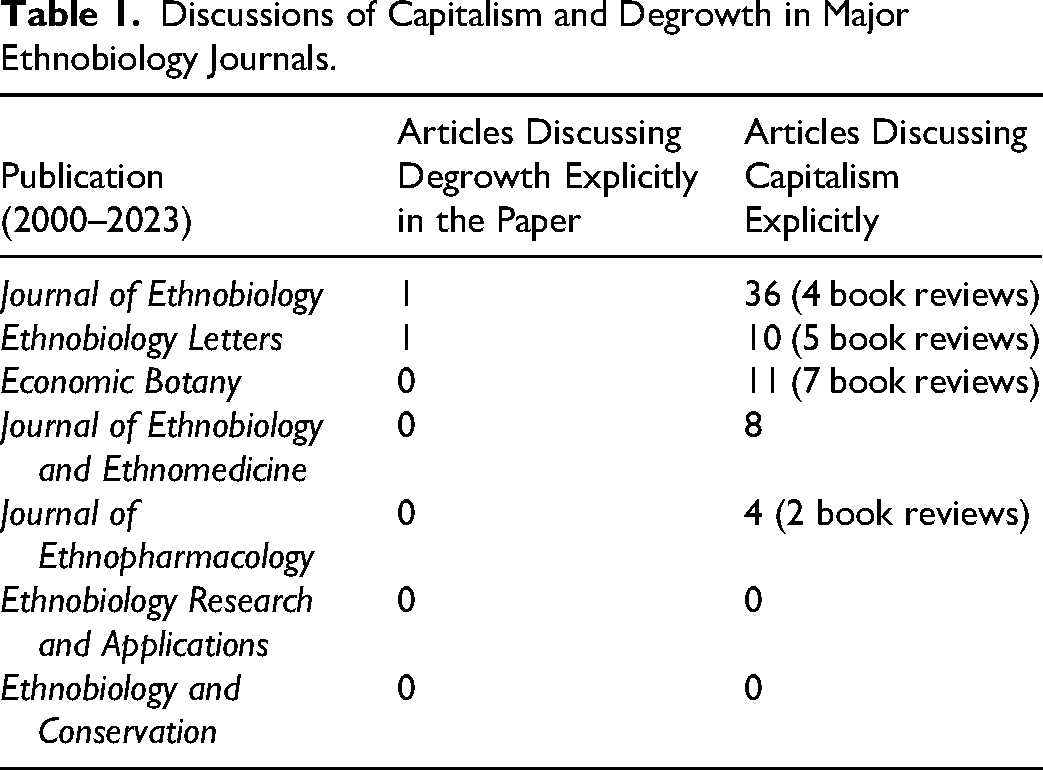
Recent special issues in Society of Ethnobiology journals grapple with postindustrial ethnobiology (Bubandt and Tsing 2018) and diverse economy conservation (Gillette, Shebitz and Singleton 2023), but even if we search for explicit discussions of “capitalism” in the text of our publications, this list remains small. Of course, many ethnobiologists publish outside of these journals, and many people write about socioecological relationships who may not call themselves ethnobiologists. Degrowth is also a newer term: ethnobiology scholars discuss limits, planetary boundaries, and fights against extraction. So, this new vocabulary is an opportunity for ethnobiologists. As researchers dedicated to exploring the real-world struggles and joys of humanity's dynamic relationships within the environment, ethnobiologists can both learn from and contribute to issues of degrowth.
Opportunities for Allyship Between Ethnobiology and Degrowth
Both ethnobiologists and degrowth researchers are interested in exploring alternative worlds that reject the pursuit of limitless growth. Ethnobiologists can offer descriptive studies of socioecological systems; we discuss traditional knowledge that blends place, identity, and belief; we interrogate cultural notions of value that intersect but transcend cash market values; and, above all, our research describes the relationships between living beings. Below, I highlight areas where ethnobiology research could be used to enhance degrowth arguments and perspectives.
Empirical Studies of Relational World-Making: Documenting Exchange, Care, and Reciprocity
First and foremost, ethnobiologists meticulously describe living systems and provide detailed lists of species and interactions. Our work counts the ways that people actively co-create a wider ecology (Lepofsky et al. 2017; Molnár 2017; Morales, Lepofsky and Berkes 2017; Mueller et al. 2020) and details the human relationships that sustain ecological knowledge and practice (Calvet-Mir et al. 2012; Calvet-Mir and March 2019; Campbell and Veteto 2015; Nazarea 2014; Zarger and Stepp 2004). In aggregate, these studies document the ebb and flow of biodiversity in context (Clarke and Jenerette 2015; Das and Das 2005; Wall et al. 2019; Zhang et al. 2020). Such research reveals how communities work to achieve stability, continuity, and specific aesthetic values apart from growth in production or consumption. Rather than documenting a form of production or land management that can be isolated and scaled up to achieve a particular goal, our work explains how these ethnobiological relationships provide multiple kinds of connection to other people, to plants, to heritage senses (Shepard and Daly 2022), or to a broader ecosystem.
While growth economics derives value through market exchanges and seeks to grow production, ethnobiological values are often affective, resisting scale and sale. Ethnobiologists document the specific aesthetics of taste, and color that give rise to heirloom seeds (Nazarea 2014), memories entangled with landrace tomatoes (Rhodes and Keeve 2023), the sense of belonging found in gardens (Calvet-Mir and March 2019; Klepacki and Kujawska 2018; Nazarea and Gagnon 2021), or the layered meaning of sweetness (Wall, Teixidor-Toneu and Dafni 2020). These transcend market exchanges even as they effect material consequences in the landscape. To sell these foods would, ironically, strip them of their social value.
As anti-utilitarian degrowth researchers have also seen (Romano 2015), gifting and sharing strengthen social ties outside of markets. Their purpose is not to grow or satisfy an individual need but to reciprocate and contribute to a collective wellbeing. Such gifts extend beyond the human to animal and plant agency, as with animals who gift themselves to hunters as part of a respectful exchange with the wider ecology (Nadasdy 2007; Sakakibara 2020; Welch 2015). This exchange can also be broken if humans overhunt and thus violate our part of the deal, requiring acts of restitution and reparation (Berkes 2012). This kind of reciprocity is an economics of respectful exchange rather than one of extraction, artificial scarcity, and growth—a point explored in depth by one of ethnobiology's most elegant and insightful thinkers, Robin Wall Kimmerer (2024). As Hunn (2014) suggests, neoliberal capitalist growth creates structural conditions of alienation from the natural world that deny or externalize affects like love because they cannot be universalized, scaled, and sold.
When ethnobiologists write about growth, we are often explaining how growth in production or consumption affects a wider web of relationships (Fernández-Llamazares et al. 2021; Turner, Cuerrier and Joseph 2022; Vandebroek et al. 2020). Aesthetic values of taste or perception can align with growth by creating pricing bubbles around commodities like beautiful tulips, vanilla (Osterhoudt 2020), Brazil nuts (Peres et al. 2003), sonorous frogs (Hoshina 2020), resonant guitar woods (Bennett 2016; Greenberg 2016), or consciousness-extending hallucinogenic drugs (Tupper 2009). Ethnobiologists have also documented the passions driving legal and illegal trade in horticultural and decorative plants and animal pets, where desires for aesthetics spur intimate connections as well as illicit captures that can damage habitat or in situ populations (Alves et al. 2019; Margulies 2023; Orlean 2000; Roldán-Clarà, Toledo and Espejel 2017; Styles 2019). This value is rooted in a qualitative, local notion of wellbeing and aesthetic (Nabhan et al. 2011). Ethnobiologists work with environmental scientists to quantify and contextualize those values through measures like species richness or nutrients produced (Chan et al. 2016; da Silva et al. 2014; Kuhnlein and Turner 2020), but we also explain how these categories define local notions of value in the first place.
Much degrowth research investigates capitalist growth, but degrowth writers note that state socialism can also pursue a scaling model that threatens local sovereignty and ecological management model (D’Alisa and Kallis 2020; Kallis 2019b). Ethnobiologists and environmental anthropologists looking to Soviet herding relations (Vitebsky 2006) or Chinese sedentarization (Chan 2017) have documented the socioecological damage to habitat, grazelands, and cultural heritage that occurs when herds are reimagined as commodities rather than partners. In spite of, and even in opposition to, state goals to grow meat, milk, or wool, pastoral communities conserve folk practices like sport, music, cheesemaking, or felting that foster reciprocal, rather than extractive, relationships with herd animals (Crate 2019; Hutchins 2019; Post 2019).
As a metric for success, relational care is a process rather than a goal. Love and care are acts of continual becoming that, in aggregate, sustain and protect life through perpetual relationships rather than regular increases of useful products (Anderson 1996; Miller 2019; Reo 2019; Zent et al. 2022). For instance, ethnobiologists study the value created through immaterial art like song. Songs provide a way to embrace human community, pass on important ecological knowledge, and, through instruments, physically embody the vital forces of the nonhuman world (Fernández-Llamazares and Lepofsky 2019; Gillreath-Brown and Peres 2017; Hutchins 2019; Mekbib 2009; Sakakibara 2020). This too forms the basis for material and social exchanges between living beings apart from growth or accumulation. Like ethnobiologists, many degrowth advocates recognize a need to move resources away from sectors like extractive industry, military occupation, and commodity production, and toward the production of art, care, and conviviality.
Ethnobiologists and environmental anthropologists have written extensively about how growth-based capitalism influences communities even in situations where cash is relatively less important for daily economic relationships. Often, we document this process through the commodification of discrete plant or animal resources, as when brokers introduce new incentives to overharvest medicines like Tibetan Yartsa Gunbu fungus (Childs and Choedup 2014; Winkler 2008) or valuable spices like vanilla (Osterhoudt 2020) and ginger (Münster 2015). Sudden jumps in global market prices can induce overharvesting or intensive planting that destabilize environmental conditions across the landscape. Then, that sudden competition for cash can also lead to violence. While plant knowledge can endure through socioeconomic change and new kinds of education (Reyes-García et al. 2005; Zarger and Stepp 2004), the larger ecological destruction of overharvesting and deforestation are harder to come back from (Voeks and Leony 2004).
These growth dynamics can also irrevocably change economic relationships between people. Tania Li's (2014) research in highland Indonesia has shown how the commodification of cacao trees for an export market unfolded into a new series of political and ecological relationships including newly private property, crop specialization, and wage labor. Once re-envisioned as commodities, land and trees became seen as valuable through their potential for capital growth rather than as a stable source of support for humans and other living beings. Ethnobiological studies tracking biodiversity change alongside land use change are particularly relevant to degrowth thinking because they provide empirical case studies of how capitalism, even at a distance, undermines Indigenous knowledge systems, lifeways, and values.
Attention to the material consequences of worldview, care, or aesthetic is not speculative hand-waving. Ethnobiological studies document how human care sustains the biodiversity hotspots of rainforests and mountains (Begossi, Hanazaki and Peroni 2000; O’Neill et al. 2017; Zent and Zent 2022), generates the priceless diversity of cultivated landraces that nourish farmers and gardeners across the earth (Nazarea 1999; Orlove and Brush 1996; Veteto 2014), and brings diverse forms of life into cities (Albuquerque et al. 2023; Bussmann et al. 2018; Emery and Hurley 2016). Ethnobiologists and political ecologists contrast these relationships to capitalist and colonial ecologies like plantations founded on racial violence, land theft, and drastic ecological simplification in the service of producing capital (Bastos 2024; Chao et al. 2024; Wolford 2021; Wynter 1971).
Care has been an ecological force sustaining lives and relationships beyond an individual's lifespan across time and space (Anderson 1996; Armstrong and Anderson 2020). This care manifests both knowledge and work (Federici 2019), and it is discounted in political economic analyses that overemphasize commodity production outside the home (Bhattacharya 2017; Moore 2015). During most of human history, groups of people adapted to diverse environments and the diverse human communities who lived near them. This does not mean that humanity has suddenly become selfish. Markets and opportunists are not new phenomena. As is well-documented in studies of adaptive commons systems (Berkes, Colding and Folke 2000; Feeny et al. 1990; Nordman 2021), selfish actors are punished and people organize to curb and correct selfish actions. These socioecological adaptations emerge through political and moral efforts to care for collective life.
Taking this concept deeper, Stanford and Egleé Zent (Zent et al. 2022; Zent and Zent 2022) document how ideas of personhood shape environmental management. Drawing from decades of collaboration with the Jotï community in the Venezuelan Amazon, they discuss notions of personhood that extend beyond the human that are made through everyday interactions breaking down a Cartesian duality of nature/culture. To be a person is to share in nourishing, vital exchanges including water, air, and matter. Through this dynamic interdependency, the university-affiliated researchers and their Indigenous coauthors present a way of being in the world where personhood is defined through acts of love and care that help the forest continue to grow. To be selfish and focus on material gain at the expense of others, whether human or nonhuman, is to lose personhood.
Together, these interactions form a blend of spirituality and adaptive management based on local, empirical, and long-term knowledge (Butler 2006; Turner, Ignace and Ignace 2000). Against notions of ecological disturbance, these interactions fortify biodiversity (Nabhan et al. 1983; Salick, Mejia and Anderson 1995; Zent and Zent 2004). Policy agencies are increasingly taking this wealth of knowledge into account (Berkes, Colding and Folke 2000; Fernández-Llamazares et al. 2021; Reid et al. 2021; Zanotti and Palomino-Schalscha 2016), but ethnobiologists stress that this kind of knowledge cannot be understood when removed from context in the form of a scientific experiment or simplified model. This misunderstanding is one risk of seeing traditional ecological knowledge as a scalable resource to be identified and applied to solve unrelated problems (Butler 2006; Wyndham 2017). At best, this knowledge is empirical, testable, and adapted in place. Outside of this context, it may not have the same kind of efficacy, even though some principles of resource management may work well across contexts.
Research That Rejects the Universal, Extractable, and Scalable
Ethnobiology scholarship seeks more inclusive, and thus more rigorous, ways of knowing and describing human–environmental interactions by designing research with plural methodological approaches and lived experiences. Much academic research uses the Western scientific method to determine key variables in simplified models, searching for universal facts that can apply across broad contexts (Haraway 1994; Latour 1986; Liboiron 2021a; Smith 2012; Stengers 2010). In this way, scholarship can be infused with capitalist logics and is susceptible to the pursuit of growth. Scientific conclusions can then be taken up in awkward ways by policymakers who want to scale up simple solutions: years of research showing the important ecological role of trees led to calls to plant “a billion trees!”, which sounds nice but does not thoughtfully consider which trees are planted, where, for what purposes, or who will care for them (Holl and Brancalion 2020). In this way, neoliberal capitalism captures scientific results through a search for technological fixes that can generate profit while ignoring political conditions of scarcity or inequality (Nightingale et al. 2020).
Many insightful investigations of ecology and economics counter externalities by assigning monetary value to the work or ecology that would otherwise be lost (de Adelhart Toorop et al. 2021; Epstein et al. 2011). These approaches illuminate the staggering lost wages that go unpaid for domestic work in households around the world (Waring 1999), offer metrics based in happiness (Fischer 2014; Galbraith et al. 2024; Verma 2017), or quantify the natural ecosystem services of clean air and water provided by wetlands, aquifers, mangroves, or forests (Farley and Costanza 2010; Kardan et al. 2015). These can be a great start, but they still accept the neoliberal premise that life is best judged according to a cash market value. Both degrowth and ethnobiology research has shown that there are lots of other ways to count success.
Degrowth scholars call for ways of living that are less energy-intensive, reduce consumption, pursue stability, shift our values, and fund public services. This economic reorganization requires a different kind of accounting and accountability to understand success. Across many aspects of the private, public, and civil life of the people reading this review paper, growth is an indication of success while stability or contraction is an indication of failure: success is defined by a rise in exports, growth in group members, upticks in resources extracted, increasing the number of acres conserved, or gains in funds raised (Flachs 2022; Johnson and Dowd-Uribe 2020). Growth trajectories that can be tracked in quantitative units help to lend a trustworthy objectivity because they demonstrate positive trends that can be entered into spreadsheets (Porter 1996). That accounting is important to justify continued salaries and expenses to government funders, shareholders, or boards of directors. But there is a fatal flaw in this logic. By marking growth targets themselves as key goals, institutions and communities who pursue growth can find themselves externalizing environmental or social reproduction costs to keep up with demands and prices (Guthman 2004), even tweaking data to make it more palatable to the target audience (Biruk 2018). The purpose of our efforts becomes to demonstrate growth, rather than securing just livelihoods in the spaces we already share.
Degrowth research interrogates quality of life, resource distribution, and lived experiences (Hickel et al. 2022; Kallis and March 2015). While theoretical models abound, degrowth research relies heavily on secondary analyses of ethnographic literature (Kallis et al. 2018, 2022). Empirical research that explains what socioecological life looks like when it pursues degrowth (D’Alisa, Demaria and Kallis 2015; Holmes 2024) is increasingly undertaken by degrowth scholars, and ethnobiologists can contribute data to this effort. A recent well-publicized critique of degrowth scholarship (Savin and van den Bergh 2024) argued that too few studies based their claims in qualitative or quantitative empirical data. While degrowth researchers critiqued their approach as flawed and unfair (Parrique 2024), it is true that it is difficult to empirically and quantitatively study something like degrowth because it is such a marginalized socioecological relationship. Studies of the unusual conditions of degrowth life can resist the kinds of generalization that make sense for statistical analysis. After all, the point of such studies is that those socioecological conditions are not universal around the world and thus they cannot be modeled or reproduced in the same way. To counteract this scientific bias toward growth, degrowth scholars could bolster their arguments with robust descriptions of how people create ecological value, form relationships, and manage resources in their local contexts. These are data that ethnobiologists can contribute.
Much ethnobiological research focuses on the creation, implementation, and stewarding of a knowledge that is not intended to scale. Alternately referred to as traditional ecological knowledge, Indigenous knowledge, Indigenous technical knowledge, or traditional ecological knowledge and wisdom, this way of knowing is rigorous and empirical (Bentley 1989; Berkes 2012; Butler 2006; Sillitoe 1998; Turner, Ignace and Ignace 2000, 2022). But while those teachings are true and effective in their embedded context, they may not be true and effective if applied out of that context. Belief and lived experience are integral components of praxis and improvisation of a knowledge that is learned and adapted in a dynamic environment (Berkes, Colding and Folke 2000; Ingold 2011; Vayda, Walters and Setyawati 2004). Inclusivity and respect are important benchmarks for a field like ethnobiology, as our knowledge deepens with the recognition of plural expertise.
Against a paradigm of “discovering” previously unknown facts, ethnobiologists don’t necessarily discover anything (except within ourselves). We are listeners and observers. In some cases, we reflect on our own experiences as experts who draw on cultural teachings, experiential learning, and Western science traditions (Black Elk 2016; Bonta et al. 2017; Kimmerer 2015; Łuczaj 2023). In others, we find ourselves in a position to learn from experts (Armstrong 2018), including nonhumans (Anderson 2016; Wyndham 2009). Environmental scientists including ethnobiologists have long recognized that people who live in and depend on a landscape over the long term must know more about their environment and do more to maintain it (Balée 2013; Gorenflo et al. 2012; Netting 1993). This is a process: not an unchanging tradition but an adaptive and thoughtful coping strategy that fits empirical observations into moral and even religious codes of conduct. This knowledge is adaptive and practitioners may not know exactly how to describe it themselves. It is difficult to record in scientific, reproducible terms (Sõukand 2024). Despite our training within academic scientific institutions, ethnobiologists accept this difficulty as part of our way of doing research. In defining the world as knowable through diverse holism, ethnobiologists may offer a helpful retort to degrowth researchers whose work is criticized as insufficiently representative of the world at large (Savin and van den Bergh 2024). Such ethnobiological strategies align with degrowth research in that they stress stability, holism, and continually created relationships over the expansion of programs and products.
This relationship is mediated not only by utilitarian and technical needs but also through a spiritual or moral worldview (Anderson 1996; Berkes 2012; Kimmerer 2024; Turner, Ignace and Ignace 2000). Importantly, this need for a different kind of ethics around defending living systems beyond the human is also common in stable-state economics and Georgescu-Roegen's bioeconomic program of sustainable development without growth (Chappell 2015; Daly and Farley 2011; Missemer 2017). Through this worldview, affects like love and care emerge as meaningful ways to know the economy. While some voices within environmental science continue to discount the role of passion and political intent in research (Büntgen 2024), ethnobiologists argue that a truly attentive scientific inquiry would recognize both. All research occurs in a political context, whether explicit or implicit, and passion and care inform environmental management.
Ethics, Interconnectedness, and Intersections With Commodification
Ethnobiology is distinctive for its particular interest in the intersection of people and the environment. As a result of this focus ethnobiologists study plants, animals, and other living beings through webs of relationships. We do not examine their life apart from human influence, as may happen in biology, or center their intersection with humans, as might happen in anthropology. Vital exchanges through and with other beings in the world have been documented by numerous ethnobiologists who show how humans shape and are shaped through the environments where we live. Sometimes, ethnobiological research focuses on commercial spaces where those relationships are severed. Relational give-and-take is redesigned through the scaled-up ontology of the plantation or the commercial agriculture plot, as in Chao's (2022) research on the destruction of life-giving sago palm for oil palm plantations; West's (2012) contrast of animating sweet potato gardens versus unfeeling, foreign coffee forests; Dove's (2011) description of spiritually nourishing rice paddies versus commercial rubber fields; and even the spectrum of knowledge and relationships for commercial cotton farmers regarding their private genetically modified commercial cotton, their public sector rice seeds, and their heirloom home vegetables (Flachs and Stone 2019). Plantations and monocultures are ecologies and relationships as well, shaped through commodification and a hierarchy of market utility. The limitless growth incentives of capitalism overwhelm the cultural or kin relationships through which these resources became rich, bountiful, and usable in the first place. Whether reciprocal or extractive, ethnobiological value emerges through these relationships.
This emphasis on interconnectedness leads ethnobiology research to stress holism over reductionism, which disrupts commercial-scientific efforts to isolate, commodify, and then scale particular parts of a system. To take a medical example, One Health approaches to public health and development integrate approaches to animal, plant, and human health that are especially relevant in the post-COVID-19 pandemic era (Quinlan and Quinlan 2016; Steffens and Finnis 2022; Vandebroek et al. 2020). One Health approaches are inherently holistic and systemic. The kinds of healing solutions this framework offers depend on a multispecies context that includes variables as diverse as livestock health (Thumbi et al. 2015), managing free-ranging chickens in one's neighborhood (Marquis et al. 1990), or preventing fruit bats from raiding orchards when they are displaced by loggers (Chua 2003). One Health is disinterested in separating health from politics, economy, or ecology. This differs from a biomedical approach that would locate the cause of illness strictly within the body or a botanical science approach that might search for bioactive compounds in plants that can be transformed into proprietary pharmaceuticals.
Medicinal plants encapsulate many concerns around ownership, knowledge, ethics, and extraction. Ethnobiologists have a longstanding interest in medicinal plants (Pieroni and Vandebroek 2007; Reyes-García 2010; Sillitoe 2006), whether by identifying promising potential healing plants through descriptive research (Pieroni, Giusti and Quave 2011; Teklehaymanot 2009), publishing synthetic reviews of traditional medicines (Leonti et al. 2020; Turpin et al. 2022), or by working in laboratories to test compounds found in medicinal plants (Kanu et al. 2024; Quave et al. 2008). New chemical, microbiological, and legal tools emerged in the twentieth century to isolate and patent active ingredients or genes more quickly and at a greater distance from their habitats. These developments are troubling to ethnobiologists, who have developed ethical codes preventing extraction that span interpersonal, community, state, and international contexts (Alexiades 2004; Bannister 2018; King, Carlson and Moran 1996; Posey 2002).
In response to the colonial history of plant resource research, ethnobiologists ensure that institutional and legal avenues are in place to deter and adjudicate cases where researchers profit from research without involving or compensating interlocutors and local experts (Bannister 2018; Fowler and Herron 2018; King, Carlson and Moran 1996; Medinaceli 2018; Medinaceli et al. 2018; Wyndham, Lepofsky and Tiffany 2011). At the first International Congress of Ethnobiology meeting in Belém, Brazil in 1988, scholars and community representatives came together to develop The Declaration of Belém, which outlined researcher responsibilities and centered the role of Indigenous communities in resource management. These efforts have enhanced ethnobiological research by requiring researchers to explicitly discuss the potential risks of their work in scientific communications. They also ensure that researchers clarify that their findings are the result of knowledge and practice that is held by their interlocutors, not a product of their own scientific discovery. Ethnobiologists recognize many models of ownership that may be useful to degrowth researchers including cooperatives and community trusts that exchange seeds (Calvet-Mir et al. 2012; Chacko 2019; Nabhan 2016; Volkening 2018) or promote Indigenous medicines and foods (Schroeder et al. 2020; Sengupta 2015). This navigation of community ethics and sovereignty is a useful case for degrowth researchers looking for examples of democratic partnerships (Asara, Profumi and Kallis 2013).
More broadly in the health space, ethnobiologists have shown that many nonbiomedical ethnobotanical medicines will only work under particular conditions and recombinations, even when they are taken alongside biomedical pharmaceuticals (Bussmann et al. 2010; Mshana et al. 2021; Reyes-García 2010; Vandebroek et al. 2008). This efficacy is rooted through worldviews including prayer and social connection that transcend a narrow biopolitics in which illness is purely physiological in essence and has a purely physiological cure. Such medicines cannot be extracted, purified, patented, or sold at a global scale to cure generalized health problems.
Beyond health, ethnobiology literature describes reciprocal relationships between people and other living beings. Reciprocity, which Ojeda et al. (2022) helpfully define as “actions, interactions, and experiences between people and other components of nature” that result in a positive feedback loop, sustains a moral covenant between living beings who share the Earth. Ethnobiologists looking to agriculture or fisheries management (Flachs 2015; Lepofsky et al. 2017; Nabhan et al. 1983; Thornton and Moss 2021) document resilient and biodiverse systems of food production that maintain their abundance through continual exchanges. This moral understanding emphasizes that abundance comes from respect, care, and giving, and can disappear if the plants or animals are disrespected (Kimmerer 2015; Ojeda et al. 2022). There is a political dimension to this work, as these reciprocal systems require detailed and adaptive ecological knowledge as well as access to land.
Reciprocal exchanges and rituals have utilitarian, material outcomes including land use that enhances soil fertility (Kawa et al. 2019), landscape management that increases biodiversity (Lepofsky et al. 2017; White and Monteros Altamirano 2024), fishing that increases fish populations (Atlas et al. 2017; Martin et al. 2023; Menzies and Butler 2007; Nesbitt and Moore 2016), and plant harvesting that increases plant abundance (Stucki, Rodhouse and Reuter 2021; Turner, Ignace and Ignace 2000). Ethnobiologists show that these interactions are often codified through religious or ritual practice (Kimmerer 2017; Turner 2005), informing a cohesive worldview of interdependent care and agency. Beyond the utilitarian, ethnobiologists have explored how explicit reciprocal exchanges of vital energy between different species and communities create the world, including the immaterial forces through which offerings and rituals promote kinship between living beings (Miller 2019; Zent et al. 2022). As degrowth scholars search for viable solutions centering care and solidarity (Wiedmann et al. 2020), ethnobiology scholarship is documenting communities that already do so. Degrowth scholars could look to these data for inspiration.
As a perspective through which to know the world, ethnobiological research seeks to democratize the study of human–environment relationships. This work builds more inclusive institutions by vesting ownership of knowledge, products, and finance with knowledge-holding communities (Albuquerque et al. 2024; McAlvay et al. 2021; Vandebroek et al. 2020; Zent and Zent 2023). While our disciplinary protocols prohibit us from commodifying the knowledge or labor of others without compensation, ethnobiologists hold a range of opinions around how we might best collaborate with communities who would commercialize their own expertise and resources. Ethnobiologists speak to the importance of vesting ownership of knowledge and property with communities of practice, particularly Indigenous communities who have a history of seeing their work and resources appropriated by those outside the community. Descriptive research that produces tables of plant and animal lists, identifies active chemical compounds, and documents local uses have also been marshaled as evidence to bolster community land claims or support claims for compensation (Armstrong and Brown 2019). In this way, ethnobiology establishes prior practices and uses that can legally prevent outsider from filing patents on that grounds that the discovery is not a novel creation. Returning value through sovereignty and ownership is a key goal for allied and activist ethnobiology that supports degrowth politics (Albuquerque et al. 2024; Bannister, Solomon and Brunk 2009; Golan et al. 2019; McAlvay et al. 2021; Nordling 2019; Posey and Dutfield 1996).
Ethnobiological Corrections to Growth-Skepticism That Support Degrowth Research
Ethnobiologists and degrowth researchers assume that humans are fundamentally part of the ecosystems in which we live. Both groups stress issues of justice viewed through a lens of power: although global issues of inequality, authoritarianism, or climate change do indeed impact all people, ethnobiologists and degrowth scholars reject the notion that marginalized people must sacrifice their resources or cultural heritage in order to help a greater good. Informed by these shared principles, ethnobiologists can help degrowth researchers correct misleading narratives in growth-skeptical scholarship around resource conservation, governance, and socioeconomic development, while providing empirical evidence of bounty without growth.
Conservation
Ethnobiologists hold an important role in discussions about conservation in showing how human influence and biodiversity can be mutually supportive. Degrowth researchers, ethnobiologists, and growth skeptics might all agree that industrial production and consumption has led to extinctions and habitat loss. However, degrowth and ethnobiology take inspiration from environmental anthropologists (Büscher et al. 2012; Büscher and Fletcher 2019) and reject a fortress model of conservation that would remove human influence in the interest of protecting a pristine nature (Crist 2015; Wilson 2016). Ethnobiologists bolster this point by describing the range of human interventions that increase biodiversity and allow life to flourish across deserts (Nabhan et al. 1983), tropical rainforests (Balée 2013; Levis et al. 2024; Müller and Guimbo 2010; Salick, Mejia and Anderson 1995), temperate rainforests (Armstrong et al. 2021; Hunn et al. 2003; Turner 2005), and montane regions (Porter-Bolland et al. 2012; Stepp, Castaneda and Cervone 2005). Human presence will always have complex effects. But resource extraction, plantation agriculture, land seizure, and infinite economic growth have clear negative consequences for biodiversity conservation (Otero et al. 2020). Differentiating between different kinds of land use is a point that degrowth researchers can make more forcefully with ethnobiological evidence.
In a special issue of Ethnobiology Letters, Gillette, Shebitz and Singleton (2023) ask what a conservation modeled after Gibson-Graham's diverse economy might look like: supporting marginalized, hidden, and alternative economic activities while providing a way to act on specialized local knowledge. Diverse conservation looks for a wider range of stakeholders, experts, and economic activities than conservation biology or ecosystem services models typically engage. As the authors write, this approach to conservation requires expanding “what counts” as conservation expertise, just as Gibson-Graham's focus on alternative economic organization requires expanding “what counts” in the economy. This ethnobiological attention to ecological outcomes can help degrowth researchers to debunk the fortress conservation notion that humans must be removed from landscapes in order to support biodiversity.
In addition to the fortress model, some growth-skeptics seek to privatize “nature” as a commodity that can be visited for the right price, whereupon a goal is to grow that park's acreage or visitor count. In doing so, political ecologists note that they harm existing systems of community environmental governance (Nordman 2021; Robbins et al. 2009), and wind up creating less effective systems governed from afar (Moola and Roth 2019; Porter-Bolland et al. 2012). A diverse conservation perspective offers a way to see success in conservation beyond the growth of acres protected or dollars raised. If more ethnobiologically oriented conservation is a practice of solidarity (Berkes 2012; Blair 2019; Gillette, Shebitz and Singleton 2023; McAlvay et al. 2021; Steward and de Magalhães Lima 2017) and reparation (Bosco and Thomas 2023; Chappell 2018; Montenegro de Wit 2021), then conservation would not seek expansion of conserved areas so much as expansion of ethnobiological knowledge and practice. Ethnobiologists advocate for participatory approaches to knowing biodiversity, not only because people who live in biodiverse areas tend to have a richer understanding of life there, but also because those local people themselves are the ones keeping these areas biodiverse (Gilmore and Young 2012; Gorenflo et al. 2012; Rodrigues et al. 2020; Steward and de Magalhães Lima 2017).
The idea of removing people from nature to “save” it (Cromer, Hardin and Nyssa 2020) is itself an ahistorical, unsupported ideology. Ethnobiologists informed by historical ecology stress that “pristine nature” is a dangerous myth (Armstrong et al. 2021; Armstrong and Veteto 2015; Balée 1998; Denevan 1992) that denies the contributions of generations of land stewards. People have always shaped the world around them, and these acts provide a physical manifestation of memory through tastes, gardens, grazing habitats, and landscapes (Coughlan 2013; Nazarea 2014). Ethnobiology research linking biodiversity conservation to ongoing community management efforts ensures that arguments against extraction or capital growth do not become arguments to reduce all human impacts in and of themselves. Such approaches are not simply ignorant of the complex ways that humans interactions shape ecological outcomes; they exclude the very communities of practice who sustain this biodiversity (Berkes, Colding and Folke 2000; Nabhan et al. 1983; Posey 2000). This ecology is inherently political in the sense that the most politically marginal people are forced to tend the most ecologically marginal land in a system of private property (Blaikie 1985). It is not that humans are innately bad at helping other living things thrive. These ethnobiological data help degrowth scholars show that extraction, monoculture, and scale, not the mere fact of human presence, cause harm.
Sovereignty and the Right to Grow
Questions of ownership, expertise, and marketing that emerge from Indigenous and other local communities are complex for ethnobiologists and degrowth advocates alike (Hayden 2003; Posey 2002; Sillitoe 2006). While ethnobiology codes of ethics prevent us from personally claiming those resources or decision-making power for ourselves, we as ethnobiological researchers are not in a position to decide how groups use their resources. Contemporary efforts to vest knowledge with communities involve diverse outcomes including individualism, collectivism, socialism, and capitalism.
Ethnobiologists have shown not only how communities avoid capitalism but also why many communities embrace market integration and what happens when they do so. For poorer, small-scale communities, markets provide important sources of consumer goods, services, and income that can buffer against the costs of school fees, medical bills, infrastructure, and other socioeconomic uplifting. Ethnobiology scholarship includes examples of communities that maintain a long-term stability in resource use and knowledge with regard to their local environment. Zarger and Stepp (2004) found that ecological knowledge was preserved amid fundamental social, political, and economic changes, while Reyes-García et al. (2005) found that proximity to towns, not market integration, was the biggest factor on the erosion of ecological knowledge. Nor is knowledge simply lost: market integration can spur new bodies of ecological knowledge by creating new ways to learn and retain that information (Ahmed et al. 2010; Flachs 2016; Guest 2002). Changes in ecological knowledge and nonhuman life wrought by market integration are complicated and mixed (Godoy et al. 2005; Stanley, Voeks and Short 2012). Culture is always dynamic, and so ethnobiologists suggest that the most important factor in Indigenous knowledge is the ways in which people can learn in situ and in community, not the inherent degree of market integration (O’Brien 2010; Zent 1999).
As degrowth scholars note, private entrepreneurship under the conditions of capitalism is at odds with consuming and producing less (Khmara and Kronenberg 2018). The pursuit of capital growth, especially when it feeds an export market and does not vest resources or control within the community, can encourage overharvesting and poaching (Escobal and Aldana 2003; Wilkie et al. 2000). Similarly, natural resource extraction can induce landscape (Campbell et al. 2018) or seascape (Thornton and Moss 2021) level changes that threaten biodiversity and local use when commercial industries seek to grow their exports. Collection for local consumption, by contrast, does not always result in overexploitation (Łuczaj, Wilde and Townsend 2021; Mateo-Martín et al. 2023).
It is impossible to speak in general terms about cooperatives and small businesses—each case will be different. Some ethnobiologists work as consultants with partner communities to manage supply chains (Booker, Johnston and Heinrich 2012; Gorman, Pearson and Wurm 2020a), responding to technical requests from entrepreneurs and development organizations. Still, ethnobiology researchers do not, and should not, determine how communities profit from their knowledge and ecological resources. Even when we write about our own communities and places, it is not for ethnobiologists to decide the right and wrong ways to engage with the global economy.
Any community will have its disagreements and power struggles, from degrowth scholars to ethnobiologists to communities cultivating ethnobiological knowledge about the places where they live. Ethnobiology policy action tends to focus on democratizing and defending rights of local communities (Golan et al. 2019; Turner, Cuerrier and Joseph 2022), even when these involve for-profit businesses that may ultimately support a system of global capitalism or lead to more extraction. Degrowth researchers also struggle with this issue, with some arguing that capitalism must first be unmade because it is inherently unjust (Bauwens 2021; Fotopoulos 2007; Hutchinson 2023) and others arguing that cooperatives and markets can avoid pursuing growth and instead help communities to access the goods and services they need to live well (Kallis, Kerschner and Martinez-Alier 2012, 2020). Rather than parse the difficult choices of Indigenous and local stakeholders living with extractive industry, ethnobiologists have insisted that researchers need to stop facilitating extractive science in the first place (Bannister 2018; Black Elk and Baker 2020).
Sometimes, a struggle to identify justice and trust in sovereignty can set ethnobiologists at odds with environmental policymakers or growth-skeptical researchers who would seem to be natural allies. Many efforts to reduce carbon emissions, for instance, require energy transitions in the name of a larger planetary good. Yet these have complex effects on local communities. By documenting social resistance and ecological change that accompanies these projects, ethnobiologists can help degrowth researchers object to problematic transitions that seize Indigenous land, offer no income substitution for lost work, upend community management, or condescend to partner communities (Artelle et al. 2019; Avila-Calero 2017; Berkes 2012; Gillette, Shebitz and Singleton 2023; Powell 2018; Sakakibara 2020).
One incisive criticism of degrowth voiced by degrowth scholars (Talbot 2024) and pro-growth economists (Dercon 2014) is that a growth economy involving extraction, exploitation, and pollution has generally uplifted quality of life across the world as it enriched colonial economies (or at least the elites who benefit from them). Ethnobiologists can intervene in this discussion by documenting questions of environmental justice: which communities have the power to make decisions about their socioeconomic conditions, and who is asked to sacrifice in the name of development. As degrowth scholars writing with a decolonial lens have noted (Abazeri 2022; Nirmal and Rocheleau 2019), growth-skepticism arising from the Global North would deny formerly colonized nations (or at least the elites who live there) access to the same opportunities to grow wealth and distribute it as they choose (Domazet and Ančić 2019; Huber 2022; Rodríguez-Labajos et al. 2019). For this reason, both degrowth and ethnobiology researchers need to continue to center environmental justice and build solidarity in the face of shared climate and political problems (Asara, Profumi and Kallis 2013; Martínez-Alier 2012; Wolverton 2013). Growth-skeptical environmentalists who ask communities or nations with less wealth to make a sacrifice in the name of a global problem like climate change are effectively asking to preserve the political economic status quo. This allows wealthy communities and nations to pull up the ladder behind them. At best, that would be hypocrisy. At worst, it is a way to steal from peripheries and then prevent them from developing through the exact same process.
Economic growth rested on the theft of natural resources and labor through a combination of capitalism and colonialism. Any just development must make restitution. Unfortunately, the impacts of global climate change are disproportionately borne by poor communities and formerly colonized nations (Sultana 2022). Reciprocal relationships like those documented by ethnobiologists, historians, anthropologists, geographers, and degrowth scholars transcend extraction, centering community ethics against a green colonialism (Sakakibara 2020) or an environmentalism of the rich (Moore 2021).
Placing Life Within the Economy
The idea that humans (culture) are somehow separate from the environment (nature) allows humans to extract and profit from a separate sphere of natural life. It also enables the opposite view, in which humans are removed from natural spaces to preserve their integrity. Ethnobiology and degrowth scholarship disagree with this premise and argue that humans are part of a larger web of life. Social theorists who critique colonial-capitalist extraction and growth-based economics are also critical of the historical process by which humans have been excised from their larger ecology (Gibson-Graham and Miller 2015; Moore 2015), and especially of how that rift manifests in the alienation of people from ecological knowledge and resources (Galvin 2018).
Marx (1939, 1867) and Engels (1883, 1884) saw agriculture and domestication as processes by which soil, animals, and plants could become alienated commodities that stored wealth and divided society into classes. Yet ethnobiologists can take this idea further to show how the push to commodify and alienate nonhuman life takes on special characteristics in growth economies. Research into domestication and historical ecology shows that domestication is best understood as a coevolutionary partnership across time and space (Larson et al. 2014; Mueller et al. 2023). It includes multiple partners and has impacts on a wide range of living beings because it reshapes evolutionary forces across the landscape (Albuquerque et al. 2018; Mueller et al. 2020; Smith 2011). Commodification exists alongside land ethics of kinship (Baker 2022; Miller 2019; Oberndorfer et al. 2017), adaptive management (Berkes et al. 2000; Feeny et al. 1990), and mutual respect (Black Elk 2016; Liboiron 2021b; Nadasdy 2007). Although Marx and Engels called these capitalist rifts ancient, ethnobiological investigations into evolution (Fritz 2019; Mueller et al. 2023; Zeder and Smith 2009) and landscape modification (Anderson 1996; Balée 1998; Smith 2011; Stephens et al. 2019) over thousands of years show humans have fostered many kinds of relationships. From this vantage, capitalist accumulation by dispossession is neither inevitable nor normal across time and space.
Whether living on a relatively small scale in a biodiversity and linguistic hotspot or deep within a capitalist monoculture landscape, ethnobiologists argue that all socioeconomic life takes place as part of a dynamic ecology. Cities (Albuquerque et al. 2023; Emery and Hurley 2016; Maurer 2024), disturbed ecologies (Bubandt and Tsing 2018), and commercial farms (Blickstein 2024; Flachs 2024; Galvin 2018) are ecologies just like rainforests. Ironically, growth models based around scaling commodity production tend to undermine those features that people value in their foods or ecosystem. As production scales, our foods become less nourishing (Davis et al. 2004; Garvin et al. 2006), we lose the ability to maintain agrobiodiversity (Kuhnlein and Turner 2020; Zimmerer and de Haan 2019), and our kin relationships are alienated through commodification (Chao 2022; Daly et al. 2016; Wilson and Neco 2023).
In the context of food and agriculture resources, anthropological and ethnobiological research has highlighted nutritious foods that capture the attention of commercial agribusiness, like quinoa (Drew et al. 2017; McDonell 2023), bison (Nesheim 2012), acai (Campbell et al. 2018; Wilk and McDonell 2020), ginseng (Farley 2024), or the Kakadu plum (Gorman et al. 2020b). This pursuit of scale induces larger ecological consequences, as when forest managers seek to increase acai production but unintentionally reduce pollinator habitats (Campbell et al. 2018) and thus threaten future acai production. Worse, when pollinators lose their food plants, the entire regional food chain is threatened. In her study of California organic agriculture, geographer Julie Guthman (2004) described this process as conventionalization: organic producers came to resemble conventional farms in their push to externalize costs of production and scale up. This issue is not unique to agriculture, it is a problem of all harvesting that seeks to grow distribution at competitive prices. All such growth incentivizes producers to externalize costs like fair wages or biodiversity in the name of reaping greater profits and growing exports (Guthman 2004; West 2012). Under the conditions of capitalist growth, these factors are externalities to be minimized rather than necessary conditions of life.
On a more hopeful end of this spectrum, ethnobiologists also document the diverse systems of foraged and gifted foods that allow all kinds of communities to exit cycles of commodification, ownership, and exclusion. While not necessarily decolonial in that it does not seek to return material resources or vest ownership with a dispossessed community, ethnobiological research has documented the wealth of ethnobotanical knowledge sustained by communities of practice in Europe (Calvet-Mir et al. 2012; Jehlička et al. 2019; Łuczaj et al. 2012; Pardo-de-Santayana et al. 2015; Quave and Pieroni 2015; Sõukand et al. 2015), settler contexts in North America (Baker 2004; Gibbons 1962; Poe 2011; Robbins et al. 2008), and held by children attending government schools (O’Brien 2010; Zarger and Stepp 2004). Such research shows that foraging and folk medicinal traditions are widespread, persistent, and important for creating dynamic bonds between people and their environments regardless of where they live. Importantly for a degrowth future, ethnobiologists show how these relationships can be kindled anew.
Radical Abundance
Degrowth writers wrestle with issues of production and distribution in different ways, but seek to move toward a position of radical abundance (Paulson 2023): enough for everyone without inequality or an artificial scarcity. Reducing both consumption and waste while minimizing an unjust austerity is a consistent theme in degrowth writing (Kallis 2019a; Sarkar 2022). In the particular case of biological diversity, ethnobiologists have shown that small spaces offer a chance for a radical abundance in species diversity, food security, and wider habitat sustainability that does not scale (Nazarea et al. 2013).
Ethnobiological work has shown how humans enhance biodiversity (Armstrong et al. 2021; Barthel et al. 2013; Nabhan et al. 1983), explored the productivity of noncommercial agriculture (Mt. Pleasant 2016; Nazarea and Gagnon 2021), and described complex polycultures that produce abundant food and surplus (Anderson et al. 2005; Lepofsky et al. 2017; Turner et al. 2000). These environmental systems grow plenty, locally. They just don’t scale when taken out of context. In directly confronting capitalist relations, degrowth scholars can fall into a trap of centering them (Smith 2024). But, capitalism captures a very narrow band of economic interactions and presupposes conditions of ownership, exclusion, and scarcity that are rarely present in the environments where ethnobiologists study relations between multispecies communities (Becerra 2021; Flachs et al. 2024; Gibson-Graham et al. 2013). Ethnobiologists track these data and can mobilize them to debunk the notion that degrowth means producing less.
Ethnobiologists have described numerous cases in past and present where humans enhance biodiversity rather than simplify it. Given the role of monoculture farming in reducing biodiversity and degrading natural resources (Campbell et al. 2017; Chaudhary et al. 2016; Raven and Wagner 2021), it is important to distinguish between food-producing systems that increase possibilities for biodiversity (Barthel et al. 2013; Keck and Flachs 2022) and those that limit them (Flachs et al. 2024; Wolford 2021). As local or regional systems of production, agroecological farms and fisheries can support dense populations, produce surpluses for sale, and increase biodiversity (Armstrong et al. 2021; Barthel et al. 2013; Lepofsky et al. 2017; Nabhan 2016; Nabhan et al. 1983; Turner 2005). Agroecology (Altieri 1987; Anderson et al. 2021; Roman-Alcalá 2017) is a productive, but diverse, ecological management strategy. When its productivity is turned toward growth, that holism can be diluted as distributors seek to expand through regulatory legibility, minimum standards, and cheaper prices (Meek and Anderson 2020; Walthall et al. 2024).
Ethnobiologists also describe how people enrich life on the margins of monoculture systems (Carney 2021; Eisnach and Covey 2009; Flachs 2015; Jegathesan 2021) as well as how other forms of life find new ways to thrive in spaces humans have degraded for short-term gains (Hoag et al. 2018; Tsing 2015). As ethnobiologists argue time and again, weeds are often very useful to people (Maroyi 2013; Molina et al. 2014; Stepp and Moerman 2001) even if they thwart commercial farm designs (Bentley et al. 2005). Like a weed, scarcity is a political condition. Ethnobiologists researching extreme conditions of environmental distress or war (Minnis 2021; Redzic et al. 2010) have shown how ecological knowledge has helped communities survive incredible hardships brought on by scarcity and famine. To this end, ethnobiology scholarship both critiques industrial growth models applied to ecological systems and documents how people apply biological and cultural knowledge to survive.
Archeological, genetic, and historical research from ethnobiologists reveals how socioecological systems in the past created an abundance without growth. During the same periods that colonial systems of enclosure were forcing European peasants to intensify their labor to reap crop yields, ethnobiologists show that Indigenous American food systems use common pool resource management, microclimate engineering, matriarchal governance, appropriate technology use, and intimate relationships with plants and animals to sustain productivity (Fritz 2019; Lepofsky et al. 2017; Mt. Pleasant 2011, 2016). These productive systems are not relics of an ancient past that could never return. They are the socioecological relationships best positioned to nourish life on earth (Fernández-Llamazares et al. 2021; Turner et al. 2022).
Empirical Degrowth Ethnobiology
Ethnobiology and degrowth have much to offer each other (Figure 1). Ethnobiology offers degrowth scholarship a set of empirical data on socioecological life that supports theoretical claims about economic and ecological transition, delivers case studies in local abundance without growth, and provides a theoretical framework in which to understand human–environmental connection through relationships rather than through commodification. Ethnobiologists have generated a wealth of detailed, empirical studies that provide evidence for life beyond growth. As a field grounded in meticulous case studies, ethnobiology scholarship cumulatively documents how communities and landscapes learn with, and thus co-create, each other. As these ways of living face threats from extraction or dispossession, ethnobiology research shows what these spaces produce and how they do it (Brondízio et al. 2021; Fernández-Llamazares et al. 2021; Łuczaj 2023; Zanotti 2016).
Ethnobiology and Degrowth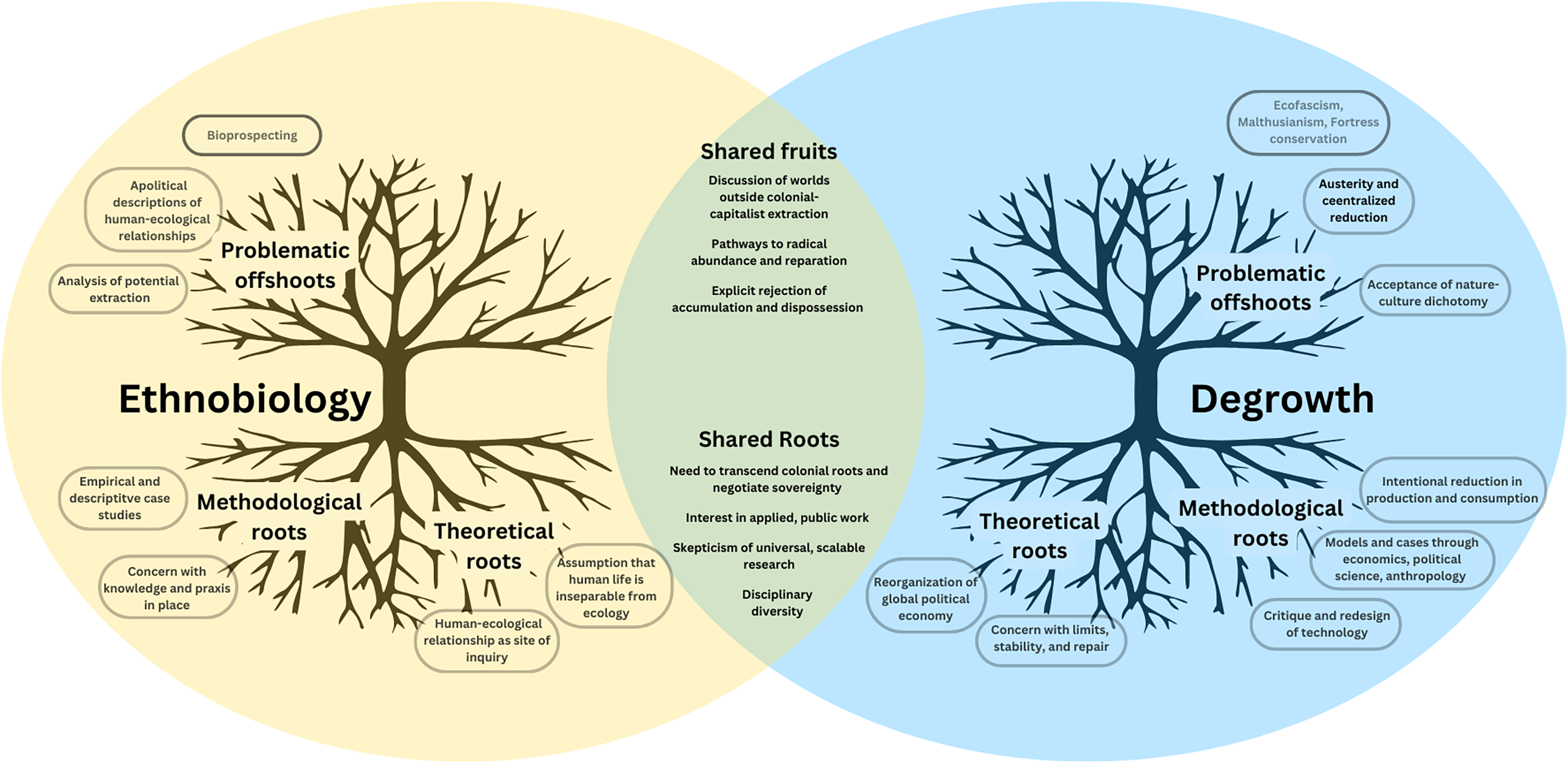
This work occurs in a larger planetary context of species extinction, climate change, and violence against people (Wolverton 2013). Through interdisciplinary research, ethnobiologists document how livelihoods and ecologies are destroyed for capital expansion. However, we also document the myriad ways in which humans enhance possibilities for other life. Small is often bountiful (VanGelder 2023). Ethnobiologists studying systems of hunting, gathering, fishing, tending, and growing provide ample evidence that humans are not necessarily destructive or simplifying. To name just a few, herring fisheries (Thornton and Moss 2021), clam gardens (Lepofsky et al. 2017), caribou hunting (Berkes 2012; Nadasdy 2007), yellow avalanche lily gathering (Turner et al. 2000), and agriculture (Anderson et al. 2021; Nabhan 2002) can all increase biodiversity compared to spaces where humans are barred entry. Ethnobiology scholarship does not embrace a theory of infinite growth for market appropriation, but it is clear that managed landscapes can be wildly productive over the long term (Anderson et al. 2021; Armstrong et al. 2021; Barthel et al. 2013; Nabhan et al. 1983).
Ethnobiologists argue that biological and cultural diversity support one another (Bridgewater and Rotherham 2019). We recognize that human beings have engaged in many different kinds of relationships with natural systems beyond capitalism, industrialism, colonialism, and growth. These data are important to support degrowth arguments and to debunk misleading Malthusian, fortress conservation, or ecofascist calls to reduce growth. As a corollary to this, we also show that reconfiguring such relationships in the name of commodification, extraction, or wresting control away from local communities leads to the destruction of that biological and cultural diversity.
For its part, ethnobiology would continue to benefit from learning about the colonial and capitalist past in relation to studies of humans and the environments where we live. This includes a more critical interaction with the pursuit of growth. Explicitly, growth narratives existed as economic botanists or colonial naturalists sought to expand plantation agriculture and profit from useful plants, animals, and microbes. But implicitly, growth has also worked through the push to take scientific findings and benefit from them as a form of exclusive knowledge, commercial foods, or medicinal commodities. Through mining, deforestation, carbon emissions, plantations, and industrial agriculture, growth-based economics have enriched a small number of people through a historical process of capital accumulation that comes at the cost of dispossessing a much larger population of their land, time, and resources. Recognizing the difference between these relationships requires a knowledge of justice and power. Ethnobiology's greatest lessons are not in the ways that we can scale up particular production or management technologies, but in how an engaged community might scale up reciprocity and care across species. This is a way of being. It is a relationship. It is not a product.
If the point of our work is not just to interpret the world in various ways but to change it, then ethnobiology and degrowth scholars are allies in action-oriented, imaginative research. Ethnobiologists offer degrowth researchers a wealth of cases illustrating communities that are already carefully building a range of diverse economic arrangements including cooperatives, stable-state local economies, and communal trusts to manage life and labor without pushing for growth. We recognize a complex series of ways that people resist colonialism and take agency over their lives. If we seek to avoid growth, for fear of falling into a trap of conventionalization and externalization, then degrowth can help us to know how to counter growth and accumulation in our own work. Together, we can work to stop looking for models to scale up and instead identify principles of collaboration for life beyond growth.
Footnotes
Acknowledgments
The author is grateful for the invitation from editors Rick Stepp, Álvaro Fernández-Llamazares, and Jeffrey Wall. This essay was improved thanks to helpful comments from Matt Abel, Myrdene Anderson, Álvaro Fernández-Llamazares, Rick Stepp, Steve Wolverton, and Eglée Zent, as well as from the anonymous reviewers. All errors are author’s own.

Funding
The author received no financial support for the research, authorship, and/or publication of this article.
Declaration of Conflicting Interests
The author declared no potential conflicts of interest with respect to the research, authorship, and/or publication of this article.