




Abstract
Shellcraft is a livelihood activity that utilizes shells and skeletal remains of marine taxa for producing ornamental and decorative items. Despite an increasing importance of shellcraft in coastal areas of the Indo-Pacific region, information necessary for stakeholders to identify and respond to change through policy and management decisions is often lacking for fisheries that support this activity. To address this knowledge gap, a quantitative approach was taken to evaluate social-ecological factors (the what, where, how much, who, when, how, how often, and how long) in a “shellcraft fishery” centered at the Nusa Islands of Papua New Guinea. More than 151,100 individuals across 69 marine taxa were fished annually for shellcraft at the Nusa Islands; fishing was infrequent and quantities fished were low for most taxa when compared with other small-scale fisheries. Fishing most taxa had no association with the main demographic divisions within households although, in terms of participation and catch richness, women were the main actors. Gleaning, combing, and free-diving were the only fishing techniques used, with taxa primarily fished by gleaning intertidal habitats during the day. To contextualize sustainability of this fishery, local ecological knowledge-based perceptions of stock status for the marine taxa fished were examined. Considerations for governance, which included synthesis of existing regulatory measures and aspirations, are also discussed. Since shellcraft occurs throughout the Indo-Pacific region and there are commonalities in taxa utilized, this study provides a basis for comparative analysis of shellcraft fisheries within the region.
Keywords
Introduction
Shellcraft is a livelihood activity that utilizes natural resources, namely shells and skeletal remains of marine taxa, for production of ornamental and decorative items (Fröcklin, Jiddawi and de la Torre-Castro 2018; Simard et al. 2019). Such items, best contextualized as “hybrid” crafts (sensu Grobar 2019), with historic roots in indigenous traditions and cultures (Tiraa-Passfield 1996; Resture and Resture 2005; Barclay et al. 2018), are today often sold to domestic and international tourists as souvenirs (Nijman 2019; Militz, Kershler and Southgate 2021; Ruenes et al. 2023). The close link between tourism and shellcraft has driven expansion of this activity throughout the Indo-Pacific region (Chand et al. 2014; Nijman 2019), and socio-economic benefit arising from this expansion has been well-documented (Barclay et al. 2018; Simard et al. 2019; Mikhailovich, Mackenzie and Smith 2022). As a result, shellcraft has increasingly become the focus of development intervention and promoted as a novel income source for households in remote coastal areas near tourist destinations worldwide (Nimoho et al. 2013; Fröcklin, Jiddawi and de la Torre-Castro 2018; Southgate et al. 2023).
In many areas where shellcraft occurs, fisheries are relied upon to supply some, or all, of the natural resources utilized (Tiraa-Passfield 1996; Floren 2003; Barclay et al. 2018). Despite their importance for shellcraft, these fisheries remain undefined and undifferentiated from the diversity and plurality of fisheries that operate in the Indo-Pacific region (Kailola 1995; Wood and Wells 1995; Dias, Leo Neto and Alves 2011). Reasons for this knowledge gap are multiple. Complex value-chains and a dispersal of fishing over large areas frustrate efforts to quantify traits of fisheries that supply shellcraft (Floren 2003; Barclay et al. 2018; Simard et al. 2022b), and these challenges are exacerbated by a chronic lack of institutional capacity to prioritize these fisheries, their specific information needs, and unique methodological challenges (Govan 2015). Moreover, prior studies have emphasized postharvest labor and transactional elements of shellcraft with limited, or no, reference to the fisheries on which these elements depend (Gössling et al. 2004; Resture and Resture 2005; Ruenes et al. 2023).
An ability to define fisheries that supply shellcraft is necessary for stakeholders to identify and respond to change through policy and management decisions (Kronen et al. 2007; Pita, Villasante and Pascual-Fernández 2019; Purcell et al. 2020). Consider, for example, the “shifting baseline syndrome” (Pauly 1995), which occurs in the absence of past information, where persons of each new generation accept the situation in which they were raised as being normal. This phenomenon implies a change in a fishery may go unnoticed if there exists no clear definition (i.e., baseline) of that fishery's past states (Pinnegar and Engelhard 2008). Although a few observable traits have been used to describe fishing for shellcraft (Tiraa-Passfield 1996; Resture and Resture 2005; Barclay et al. 2018), this information is insufficient, as a baseline, for identifying change. Viewed within a narrow qualitative scope, change becomes more challenging to identify and incongruous with the solid empirical basis required to guide policy and management decisions (Kronen et al. 2007; Pinnegar and Engelhard 2008; Kitolelei and Sato 2016). With continued expansion of shellcraft throughout the Indo-Pacific region anticipated (Southgate et al. 2023), there is urgent need to establish more purposeful baselines for the fisheries on which this activity depends.
There is also a need to contextualize sustainability as part of the baselines established. Postharvest labor and transactional elements of shellcraft have prompted concern for some of the marine taxa utilized (Dias, Leo Neto and Alves 2011; Barclay et al. 2018; Simard et al. 2019). Yet, for most taxa utilized (Wood and Wells 1995; Dias, Leo Neto, and Alves 2011; Simard et al. 2022b), past information pertaining to stock or conservation status is scant. In the absence of past information, local ecological knowledge (LEK) from fishers is a notable starting point (Alati et al. 2020; Kitolelei et al. 2022; Stiepani, Jiddawi and Mtwana Nordlund 2022). LEK is defined as the body of knowledge, practice, and beliefs held by an individual that are shaped by observations and experiences about the past state and interconnections between social and ecological systems (Bao and Drew 2017; Thaman et al. 2017; Kitolelei et al. 2022). Since LEK depends on personal observations and experiences (Bao and Drew 2017; Thaman et al. 2017), it becomes more reliable when a consensus on an ecological state, such as the stock status of a taxon, is attained for a significant number of fishers (Kitolelei and Sato 2016; Bao and Drew 2017). Analyzing LEK to identify consensus can help contextualize sustainability of fisheries by conveying how current stock status is perceived relative to recollections (Purcell et al. 2020; Simard et al. 2023).
In the present study, focus was centered at the Nusa Islands of Papua New Guinea (PNG) on households that collectively fish what is the greatest catch richness of marine taxa reportedly utilized for shellcraft in the Indo-Pacific region (Simard et al. 2022b). A quantitative approach was taken to evaluate social-ecological factors (i.e., the what, how much, who, where, how, when, how often, and how long) in the “shellcraft fishery” in order to establish a baseline that defines this fishery. To contextualize sustainability as part of this baseline, this study considered LEK-based perceptions of stock status for the marine taxa fished. Considerations for governance, which included synthesis of existing regulatory measures and aspirations, are then discussed in relation to the baseline established. Since shellcraft occurs throughout the Indo-Pacific region and there are commonalities in the taxa utilized (Floren 2003; Fröcklin, Jiddawi and de la Torre-Castro 2018; Simard et al. 2022b), this study provides basis for comparative analysis of the social-ecological factors defining shellcraft fisheries within the Indo-Pacific region.
Materials and Methods
Study Site
Papua New Guinea is composed of the eastern part of the island of New Guinea and numerous smaller islands within a global center of marine biodiversity (Hamilton, Green and Almany 2009). Many of the estimated 4,000 communities in coastal areas of PNG (Govan 2015) rely on marine resources from fisheries for subsistence, cultural activities, and income generation (Kinch 2003; Vieira et al. 2017; Simard et al. 2022a). This is particularly true for communities on smaller islands with limited arable land (Purdy et al. 2017), such as those typifying the Tigak Islands group in PNG (Figure 1). Approximately 3,000 residents live among the more than 30 islands that comprise the Tigak Islands group, which lies northwest of the New Ireland landmass in the Bismarck Archipelago (NSO 2013). Here, access to education and employment is limited, with 98% of the adult population having not completed secondary schooling and fewer than 10% of occupations generating wages (Kaly et al. 2005; Lawless and Frijlink 2015; Purdy et al. 2017). While most households can be considered food secure (Cinner and McClanahan 2006), there is growing cash dependence for educational, medical, and other services (Kaly et al. 2005). There is also a strong desire to purchase products that offer lifestyle conveniences (Kaly et al. 2005; Hair et al. 2019) requiring communities to find means of generating sufficient and reliable income. For residents of the Tigak Islands group, income opportunities are restricted and depend on nearshore areas of the marine environment (Kaly et al. 2005; Lawless and Frijlink 2015; Purdy et al. 2017).
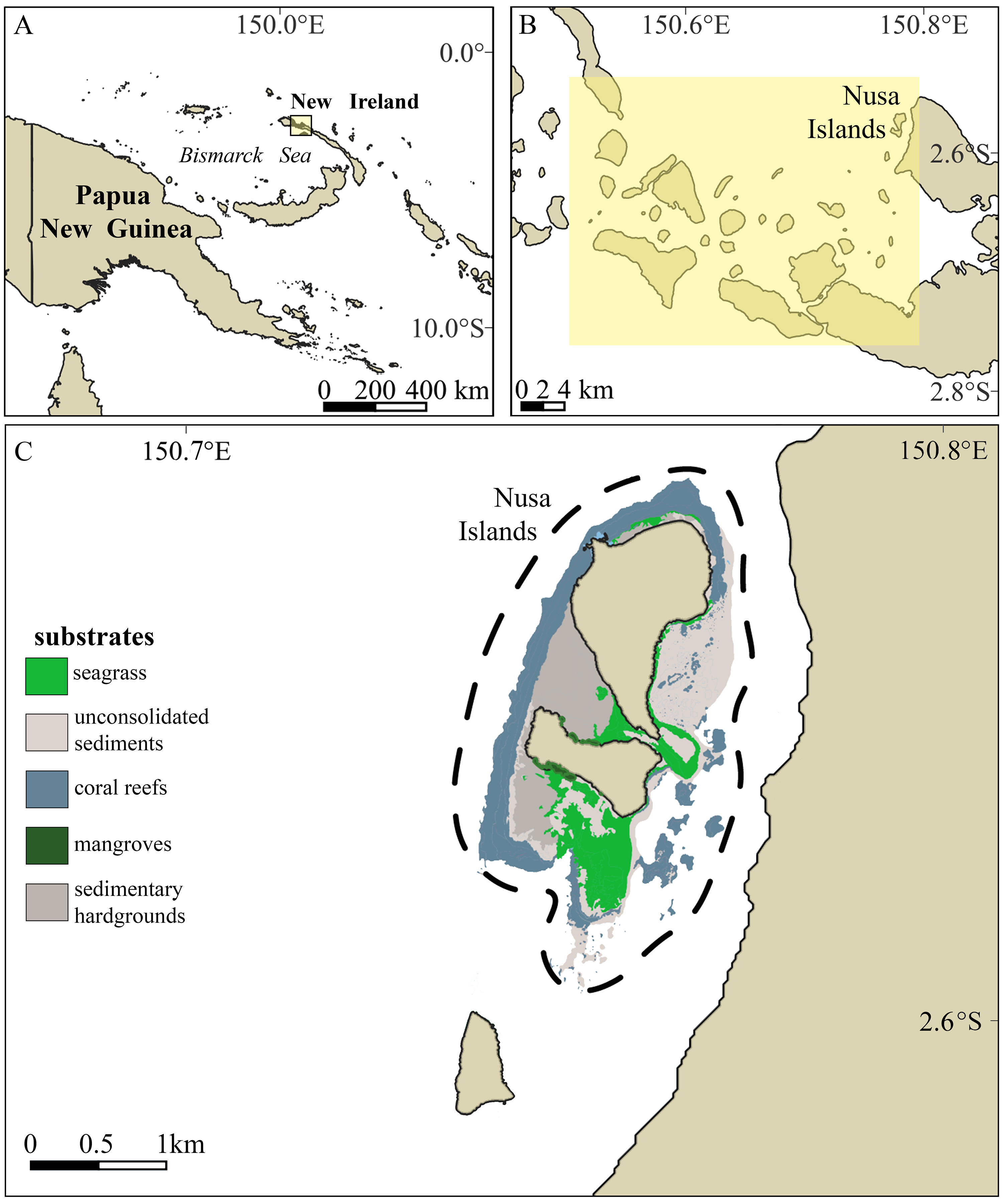
Maps of the Nusa Islands, Papua New Guinea. (A) The Tigak Islands group (yellow overlay) in geographical context of Papua New Guinea. (B) The Nusa Islands in the geographical context of the Tigak Islands group (yellow overlay). (C) Dashed line encloses the area (ca. 400 ha) at the Nusa Islands in which the studied shellcraft fishery occurs based on local marine tenure arrangements; substrate coverage within the boundary was adapted from Sambrook et al. (2020), with permission.
The Tigak Islands group, like many parts of PNG, has local marine tenure arrangements that generally define access and use rights to nearshore areas of the marine environment (Kaly et al. 2005; Foale et al. 2011). While local marine tenure arrangements aim to manage social relationships, they also provide opportunity for community-level management of fisheries (Foale et al. 2011). Communities, through elected and customary leaders, can implement informal (i.e., nonlegislated) regulatory measures (e.g., traditional and customary rules and norms) that apply to fisheries in areas where they hold access and use rights (Hair et al. 2022). In addition to any community-level management, formal (i.e., legislated) regulatory measures imposed by provincial or national governments also apply to fisheries. Formal regulatory measures of relevance to shellcraft fisheries in PNG, however, are limited to a prohibition on use of underwater lights when fishing sedentary organisms at night and to size limits for a few species with a long history of commercial exploitation (e.g., Pinctada maxima, Pinctada margaritifera, Rochia nilotica, and Turbo marmoratus) (Simard et al. 2022a). In addition, there is a formal regulatory measure prohibiting use of tank-based (e.g., SCUBA) or surface-supplied (e.g., hookah) diving systems when fishing R nilotica in PNG (Simard et al. 2022a).
Two islands within the Tigak Islands group, collectively referred to as the Nusa Islands (Figure 1), have become well-known for shellcraft (Simard et al. 2019, 2022b, 2023). Participation in shellcraft at the Nusa Islands can be traced back to 1988 with subsequent expansion attributed to tourism-related development and closure of the bêche-de-mer fishery (Simard et al. 2019). Approximately 80% of residents at the Nusa Islands (ca. 6% of the Tigak Islands group) are now involved in this activity, mostly for the purpose of generating income (Cinner 2009; Simard et al. 2019). Simard et al. (2022b) found that while residents sourced natural resources for shellcraft from as far as 417 km away from the Nusa Islands, 95% of the marine taxa utilized (n = 69) were fished at the Nusa Islands. Given that fishing is highly concentrated at the Nusa Islands, the influx of new entrants to shellcraft in recent years has prompted concern for local stocks of taxa known to be important for sustaining this livelihood activity (Simard et al. 2019). After a period of repressed demand for shellcraft across the Indo-Pacific region resulting from the coronavirus disease 2019 (COVID-19) pandemic (Mikhailovich, Mackenzie and Smith 2022), resumption of international tourism will likely exacerbate pressure on natural resources for shellcraft by reviving demand for souvenirs (Militz, Kershler and Southgate 2021). This makes establishing a baseline that defines the shellcraft fishery at the Nusa Islands both necessary and timely.
Data Collection and Standardization
The concentration of households engaged in shellcraft, their reliance on fishing for this activity, and a clear geographical boundary for the shellcraft fishery at the Nusa Islands (Figure 1) provide opportunity to evaluate social-ecological factors defining a shellcraft fishery (Simard et al. 2019, 2022b). In recognizing such opportunity, this study was conducted on those islands in July 2019 as part of interviews with households who had at least one person engaged in shellcraft during the previous year (cf. Simard et al. 2022b). As no household declined participation, data were collected for all (n = 36) households that fulfilled this criterion.
A locally based enumerator conducted interviews verbally in either English or Tok Pisin, depending on the preference of participants. Interviews were structured following the recommendations of Kronen et al. (2007). Participants were asked a series of questions for each taxon that the household fished for shellcraft at the Nusa Islands (the what), including: Quantity of that taxon fished during the previous year (the how much), who within the household fished that taxon (the who), primary source habitat of that taxon (the where), fishing techniques used for that taxon (the how), whether fishing that taxon occurred during the day and/or at night (the when), number of fishing trips conducted during the previous year for that taxon (the how often), years of experience fishing that taxon (the how long), and how stock status of that taxon was perceived to have changed since they started fishing that taxon. Participants were then asked to identify taxa that were fished collectively during a fishing trip as an extension of the how. Finally, participants were invited to share what they knew about existing regulatory measures and what kind of regulatory measures they desired for each taxon that was fished by their household.
Information provided by participants required standardization for statistical analysis and discussion. For the what, a photographic reference guide and voucher specimens were used to identify taxa to the lowest taxonomic rank based on the World Register of Marine Species (Horton et al. 2022). In some instances, taxa could not be identified to species, for reasons (e.g., a disconnect between local and scientific nomenclature) outlined by Moesinger (2018), and it proved necessary to treat groups of species as a “taxon.” This applied to black corals Antipathes spp. and Cirrhipathes spp. (hereafter Antipathidae), the cowries Monetaria annulus and Monetaria moneta (hereafter Monetaria annulus/moneta), the nautilus Allonautilus scrobiculatus and Nautilus pompilius (hereafter Nautilidae), and the sea turtles Chelonia mydas and Eretmochelys imbricata (hereafter Cheloniidae). The how much was standardized to the number of individuals fished annually. The where encompassed subtidal and intertidal habitats, which were further differentiated as subtidal pelagic, subtidal benthic, or intertidal benthic hard-substrate, and intertidal benthic soft-substrate habitats. The demographics of who fished taxa for shellcraft within households (i.e., fishers) were classified as men (i.e., ≥18 years old), women (i.e., ≥18 years old), and youth (i.e., <18 years old). The how encompassed gleaning, which involves collecting live taxa while walking or wading (Stiepani, Jiddawi and Mtwana Nordlund 2022), combing, which involves collecting empty shells or skeletal remains of taxa while walking or wading (Malm 2009), or free-diving, which involves collecting live taxa while swimming without the use of breathing apparatus.
Statistical Analysis
Statistical analysis was performed using R programing (version: 4.3.1), with the stats (R Core Team 2023), vegan (Oksanen et al. 2022), and ordinal (Christensen 2022) packages. Data pertaining to the what, how much, how often, and how long social-ecological factors are summarized using means ± standard deviations. For all taxa, Fisher's exact tests were used to evaluate whether fishing was nonrandom with respect to the who, where, how, or when factors. The same approach was taken to evaluate whether the who, where, how, or when factors varied among households.
Based on the what and how much factors, which indicated some taxa were rarely fished, perceptions of stock status were analyzed only for taxa fished by a significant (i.e., nonzero) number (n ≥ 6) of households, based on a Fisher's exact test. This approach ensured a statement of statistical significance (i.e., P < .05) could be made when consolidating perceptions of stock status, such that a consensus could be defined as a statistically significant majority (Simard et al. 2023). Consensus pertaining to a positive perception (i.e., stock is stable or increasing) or negative perception (i.e., stock is decreasing) of stock status for each taxon was then determined using a Fisher's exact test. Nonresponses (i.e., uncertain or unable to answer) were omitted from this comparison.
Further analysis aimed to determine if the perceptions of stock status were influenced by social-ecological factors, including the what, how often, and how long factors, by fitting cumulative link models (also known as ordered logit or proportion odds models) to the data for each taxon. For these models, perceptions of stock status were treated as an ordinal (i.e., ordered) response (decreasing < stable < increasing) and a null model was expanded following the suggestions of Chambers (1992); whereby, social-ecological factors were sequentially added to a null model based on a smaller Akaike Information Criterion and a significant likelihood-ratio test. Coefficients of significant social-ecological factors indicated whether perceptions of stock status were positively or negatively influenced by those factors.
To evaluate whether perceptions of stock status (as an ordered factor) for a given taxon influenced the perceived need for management of that taxon, generalized linear models with a binomial error structure were fit to the data and significance was evaluated with a likelihood-ratio test.
Results
The What
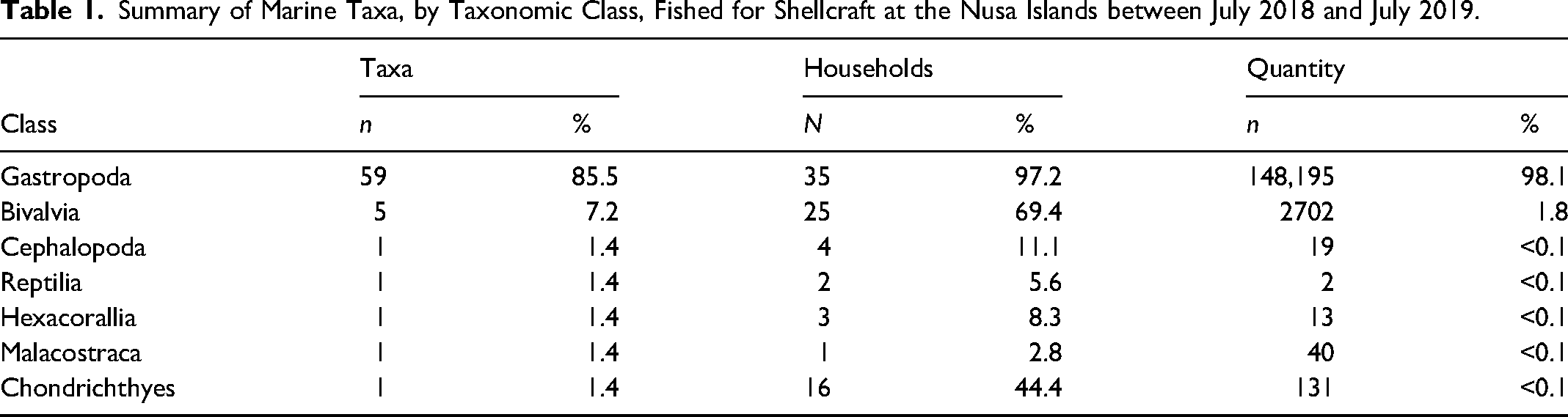
Sixty-nine marine taxa from seven classes were fished for shellcraft at the Nusa Islands (Table 1). Mollusks of class Gastropoda (86%), represented by 35 genera, and class Bivalvia (7%), represented by four genera, accounted for the majority (93%) of these taxa (Table 1). Catch richness varied among households, with 14 ± 10 (range: 0–49) taxa fished per household. No taxon, or class of taxa, was fished by all households, with 7 ± 7 (range: 1–27) households fishing a given taxon and 29 taxa being fished by a significant number (n ≥ 6) of households. Additional information on the number of households fishing each taxon is presented in Table S1, while the catch richness fished by each household is presented in Table S2.
Summary of Marine Taxa, by Taxonomic Class, Fished for Shellcraft at the Nusa Islands between July 2018 and July 2019.
The How Much
Approximately 151,100 individuals were fished for shellcraft at the Nusa Islands annually (Table 1). The most fished class was Gastropoda (98%), followed by Bivalvia (2%). Most (83%, n = 57) of the 69 taxa accounted for less than 1% of individuals fished while a single gastropod, Chrysostoma paradoxum, accounted for 39% of all individuals fished. The second (Euplica scripta), third (Strigatella paupercula), and fourth (Conomurex luhuanus) most fished taxa, all gastropods, accounted for 9%, 8%, and 6% of all individuals, respectively. By comparison, the most fished bivalve was Atrina vexillum, of which 972 individuals (0.6%) were fished. All five of these taxa were among the 29 taxa found to be fished by a significant number (n ≥ 6) of households, which collectively accounted for 84% of individuals. For each taxon, additional information on how much was fished for shellcraft at the Nusa Islands is presented in Table S1.
Quantities of taxa fished varied among households, both in absolute and relative terms. While a combined 4197 ± 4491 (range: 0–18,613) individuals were fished per household, fishing of a specific taxon ranged from 0.1 ± 0.2 (range: 0–1) individuals per household for Cheloniidae to 1633 ± 3067 (range: 0–11,760) individuals per household for Chrysostoma paradoxum. For each household, additional information on how much was fished is presented in Table S2.
The Who
Most (94%, n = 34) of the 36 households had women engaged in fishing taxa for shellcraft. By comparison, fewer households had men (64%, n = 23, P < .01) or youth (56%, n = 20, P < .01) engaged in this activity. The number of households that had only women engaged in fishing (25%, n = 9) was no different than the number of households that had women, men, and youth jointly engaged in fishing (47%, n = 17, P = .09). Additional information on who fished within each household is presented in Table S2.
For nearly half of the taxa (49%, n = 34), fishing was nonrandom in relation to who fished these taxa (Figure 2A). Fishing 32 of these taxa, all gastropods, was most often associated with women, relative to men or youth. Fishing the two other taxa (Carcharhinus melanopterus and R. nilotica) was most often associated with men, relative to women or youth. Although youth contributed to the fishing of 28 taxa, these taxa were either most often fished by women (n = 15), by men (n = 1), or randomly (n = 12) with respect to who fished these taxa. Additional information on who fished each taxon is presented in Table S1.
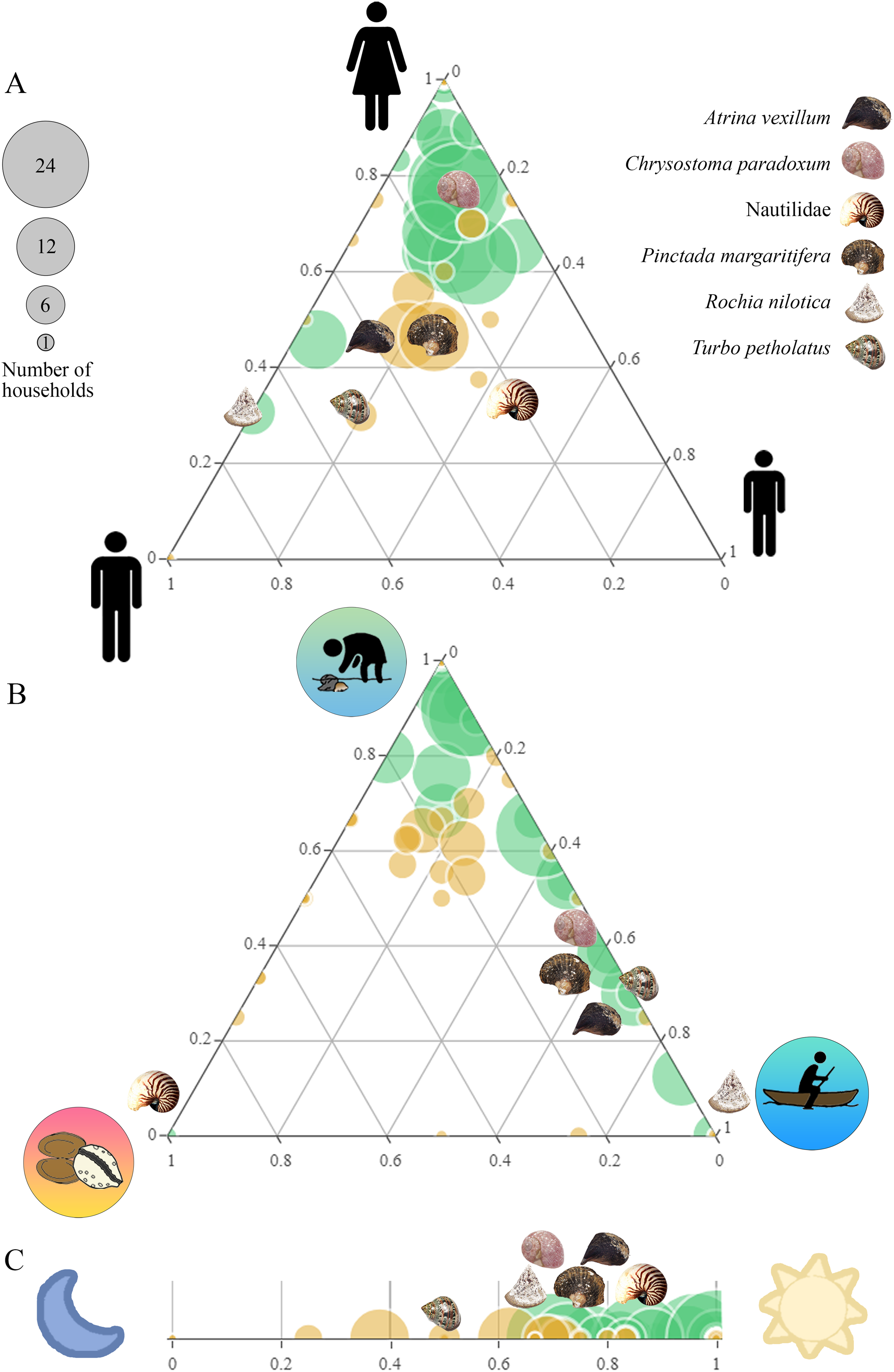
Plots of associations between marine taxa fished for shellcraft at the Nusa Islands and the who, how, and when social-ecological factors investigated in this study. Points are scaled with respect to the number of households fishing a taxon and significant associations (P < 0.05; Fisher's exact test) are shaded green. (A) Who: 34 taxa had a significant association with who (women, men, or youth) fished these taxa. (B) How: 28 taxa had a significant association with how (combing, gleaning, or free-diving) these taxa were fished. (C) When: 20 taxa had a significant association with when (night or day) these taxa were fished. Illustrations and photos: N.S.M Simard.
The Where
Of the 36 households surveyed, 97% (n = 35) fished in intertidal habitats. While all these households fished intertidal benthic soft-substrate habitats, only some of these households (75%, n = 27) also fished intertidal benthic hard-substrate habitats (P = .01). Relative to intertidal habitats, a similar number of households (92%, n = 33) fished subtidal habitats (P = .61), with subtidal benthic habitats fished by more households (89%, n = 32) than subtidal pelagic habitats (47%, n = 17; P < .01). Additional information on where each household fished is presented in Table S2.
For over half of the marine taxa (67%, n = 46), fishing was nonrandom in relation to where taxa were fished (Figure 3, Table S1). Fishing of 20 of these taxa, all gastropods, was most often associated with intertidal benthic hard-substrate habitats, relative to intertidal benthic soft-substrate and subtidal habitats. Fishing of 20 other gastropods and four bivalves (Atrina pectinata, A. vexillum, Isognomon epphiphium, and P. margaritifera) was most often associated with intertidal benthic soft-substrate habitats, relative to intertidal benthic hard-substrate and subtidal habitats. The only taxon significantly associated with fishing subtidal benthic habitats was Oliva caerulea and the only taxon significantly associated with fishing subtidal pelagic habitats was Caracharhinus melanopterus. Additional information on where each taxon was fished is presented in Table S1.
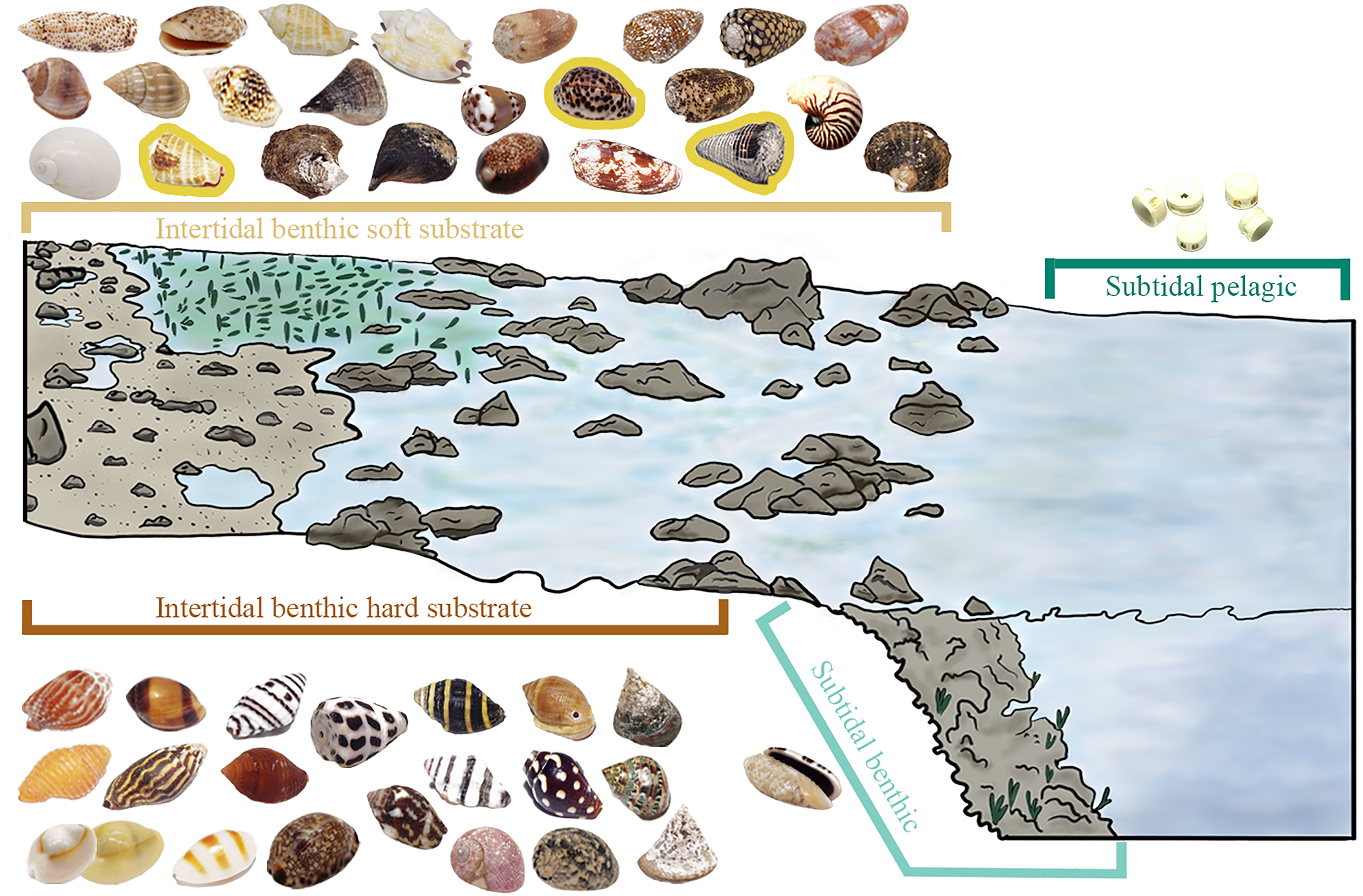
Illustration of significant associations (P < .05; Fisher's exact test) between marine taxa (n = 46) fished for shellcraft at the Nusa Islands and the where social-ecological factor investigated in this study. Taxa (Conomurex luhuanus, Conus litteratus, and Cypraea tigris) often fished together during a single fishing trip are highlighted in yellow. Illustration of source habitats adapted from Tilley et al. (2020), with permission. Photos: N.S.M Simard.
The How
Three fishing techniques, gleaning, combing, and free-diving, characterized how households fished taxa for shellcraft at the Nusa Islands. Most (97%, n = 35) of the 36 households gleaned, but only some of these households (78%, n = 28) also free-dived (P = .03). Relative to both gleaning and free-diving, fewer households (33%, n = 12) fished through combing (P < .01 and P < .01, respectively). Additional information on how each household fished is presented in Table S2.
For 28 marine taxa (41%), fishing was nonrandom in relation to how these taxa were fished (Figure 2B). Twenty-one of these taxa, comprising 20 gastropods and one bivalve (A. pectinata), were most often associated with gleaning, whereas six taxa, including Carcharhinus melanopterus and R. nilotica, were most often associated with free-diving and one taxon, Nautilidae, was most often, and only, associated with combing. Additional information on how each taxon was fished is presented in Table S1.
A significant number of households (n = 6; P = .02) identified a grouping of multiple taxa that were fished together during a fishing trip (Figure 3). This grouping consisted of the gastropods Conomurex luhuanus, Conus litteratus, and Cypraea tigris. Whilst other groupings were identified, these were often idiosyncratic practices unique to a particular household and, therefore, not typical of fishing taxa for shellcraft at the Nusa Islands.
The When
Most (97%, n = 35) of the thirty-six households fished taxa for shellcraft at the Nusa Islands during the day but only some of these households (75%, n = 27) also fished at night (P = .01). Additional information on when each household fished is presented in Table S2.
Most taxa (71%, n = 49) had no association with when fishing occurred (Figure 2C). There were, however, eighteen gastropods and two bivalves (A. vexillum and P. margaritifera) significantly associated with fishing during the day. Although thirty-four taxa were fished at night by some households, no taxon was significantly associated with fishing at night. Additional information on when each taxon was fished is presented in Table S1.
The How Often and How Long
How often a taxon was fished varied (Figure 4). For almost a third of all taxa (32%, n = 22), the mean number of fishing trips was less than once per year. Yet for taxa (42%, n = 29) fished by a significant number of households (n ≥ 6), the mean number of fishing trips per taxon ranged from 1 ± 3 (range: 0–12) trip per year for Polinices mammilla to 12 ± 14 (range: 0–48) trips per year for Strigatella paupercula. Annual fishing trips per taxon are summarized in Table S1.
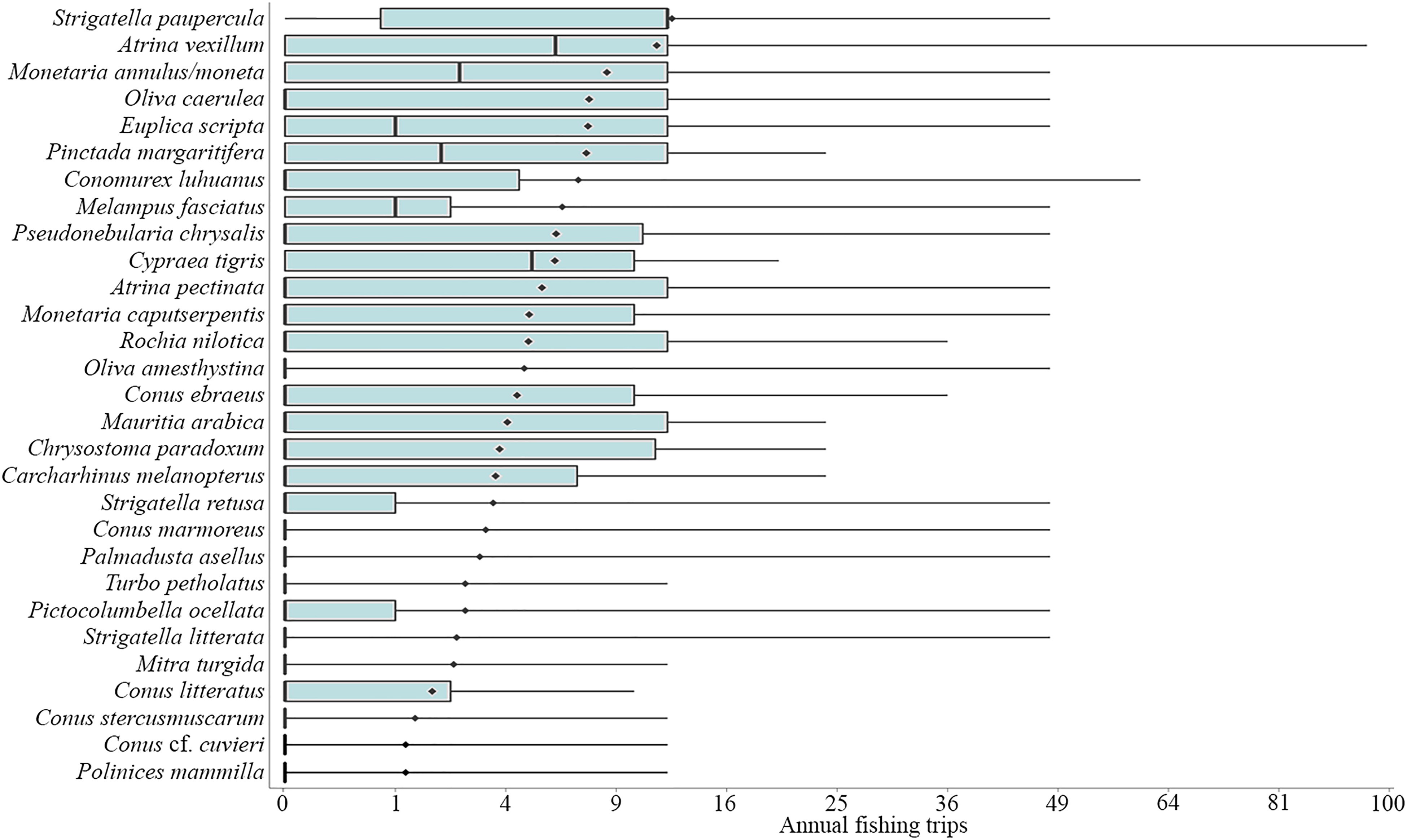
Annual fishing trips per marine taxa fished for shellcraft at the Nusa Islands. Boxplots show the mean (◆), median (central line), and interquartile range (box). Only taxa (n = 29) fished by a significant number (n ≥ 6) of households are shown.
Most (81%, n = 56) of the 69 taxa had been fished for 10 or more years by households fishing that taxon, but only four taxa (Antipathidae, Engina bonasia, Pteria penguin, and T. marmoratus) were found to have been fished for 20 or more years. For taxa (42%, n = 29) fished by a significant number (n ≥ 6) of households, the mean number of years a taxon had been fished was found to vary from 15 ± 7 years for Conus cf. cuvieri down to 9 ± 6 years for A. pectinata. Years that each taxon had been fished is summarized in Table S1.
Perceptions of Stock Status
Perceptions of stock status were evaluated for the 29 marine taxa that were fished by a significant number (n ≥ 6) of households (Figure 5). Perceptions were generally positive, with a significantly greater percentage of responses indicating stable or increasing stocks for 22 taxa. For seven taxa (A. pectinata, A. vexillum, P. margaritifera, Oliva amesthystina, P. mammilla, R. nilotica, and Turbo petholatus), the percentage of positive and negative perceptions was not significantly different (P ≥ .05).
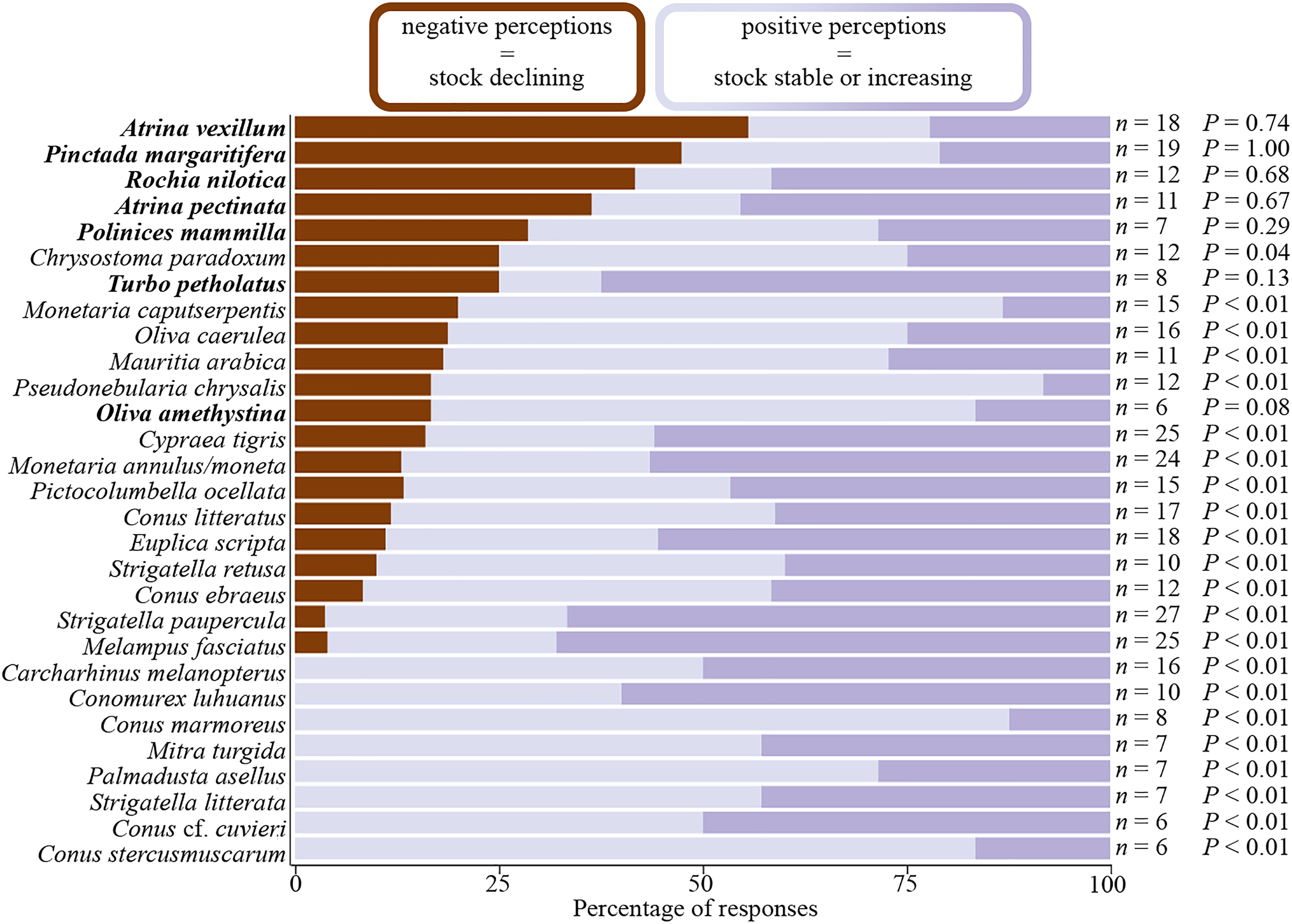
Perceptions of stock status for marine taxa that are fished for shellcraft at the Nusa Islands by a significant number (n ≥ 6) of households. For taxa in bold, perceptions were not significantly (P ≥ .05) positive (based on a Fisher's exact test).
For 18 of the 29 taxa evaluated, none of the social-ecological factors investigated (i.e., what, how often, and how long) significantly influenced perceptions of stock status. For the other 11 taxa, however, at least one social-ecological factor had a significant influence (Table 2). Catch richness (i.e., what) had a negative influence on three taxa (Mitra turgida, Monetaria caputserpentis, and T. petholatus), implying that households fishing a broader range of taxa for shellcraft were more likely to negatively perceive the stock status of these taxa. By contrast, fishing trips (i.e., how often) had a significant positive influence on three taxa (Conomurex luhuanus, Cypraea tigris, and R. nilotica), implying that households currently fishing these taxa more frequently were more likely to positively perceive the stock status of these taxa. Fishing trips also had a significant negative influence on one taxon (Conus litteratus). Fishing experience (i.e., how long) with a particular taxon had a positive influence on the perceived stock status of three taxa (Chrysostoma paradoxum, Conus marmoreus, and Conus stercusmuscarum) and a negative influence on perceived stock status of one taxon (A. vexillum).
Significant Results from Cumulative Link Models Evaluating the Influence of Social-Ecological Factors on Perceptions of Stock status for Marine Taxa Fished for Shellcraft at the Nusa Islands by a Significant Number (n ≥ 6) of Households. Symbols Indicate Whether a Social-Ecological Factor Positively (+) or Negatively (−) Influenced Perceptions of Stock status for a Given Taxon.
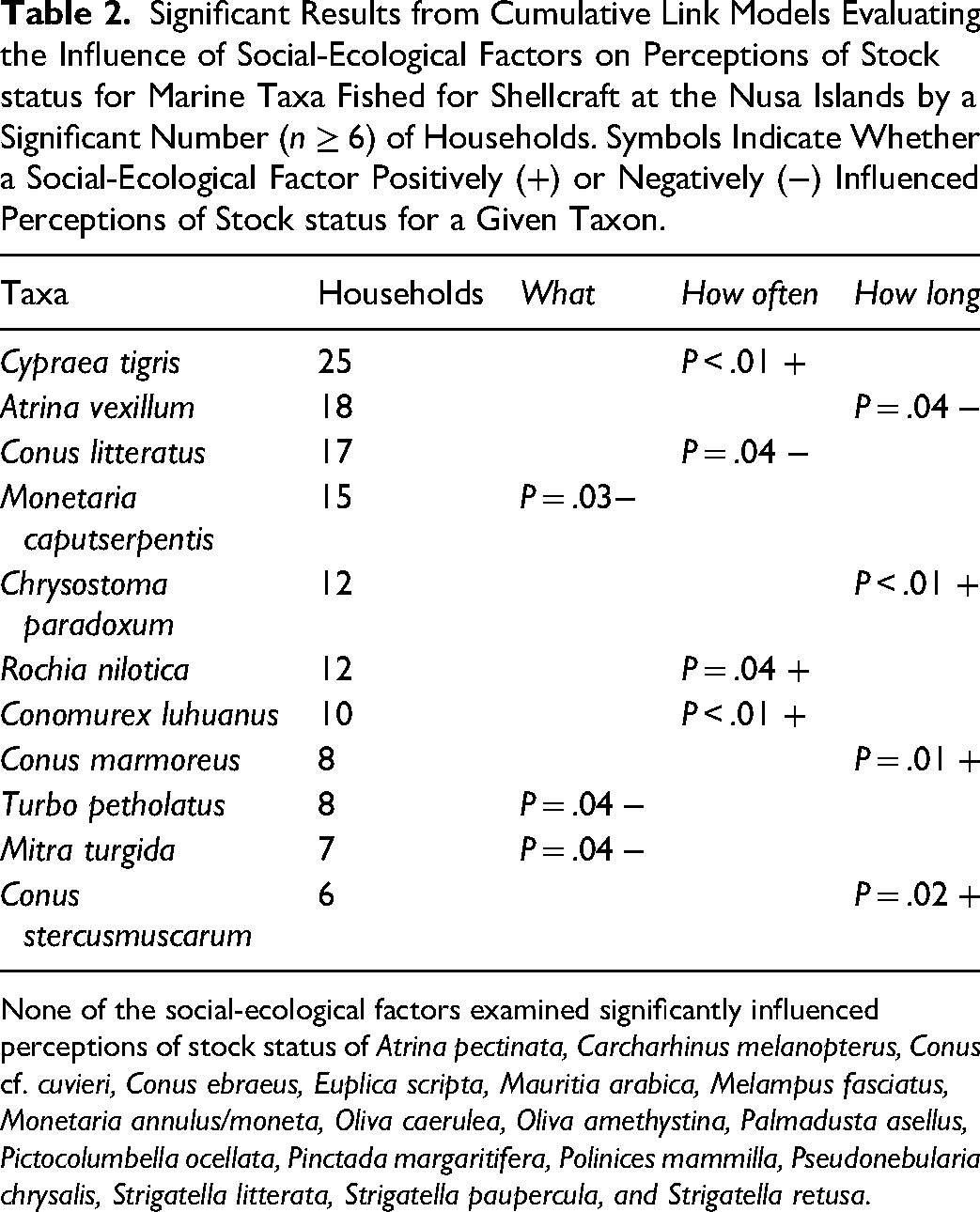
None of the social-ecological factors examined significantly influenced perceptions of stock status of Atrina pectinata, Carcharhinus melanopterus, Conus cf. cuvieri, Conus ebraeus, Euplica scripta, Mauritia arabica, Melampus fasciatus, Monetaria annulus/moneta, Oliva caerulea, Oliva amethystina, Palmadusta asellus, Pictocolumbella ocellata, Pinctada margaritifera, Polinices mammilla, Pseudonebularia chrysalis, Strigatella litterata, Strigatella paupercula, and Strigatella retusa.
Regulatory Measures
No household could recall any current regulatory measures that applied to taxa their household fished for shellcraft. Yet 53% (n = 19) of households expressed a need for regulatory measures and, collectively, proposed regulatory measures for 25 of the 69 taxa (36%) fished for shellcraft at the Nusa Islands (Table 3). All regulatory measures proposed were expressed in relation to strengthening local governance. Aspirations for governance were negatively associated with perceptions of stock status (P < .01), meaning the likelihood of proposing a regulatory measure increased the more negative perceptions of stock status were for a particular taxon.
Regulatory Measures Proposed for Taxa Fished for Shellcraft at the Nusa Islands. Number in Brackets Indicate the Number of Households Proposing the Regulatory Measure.
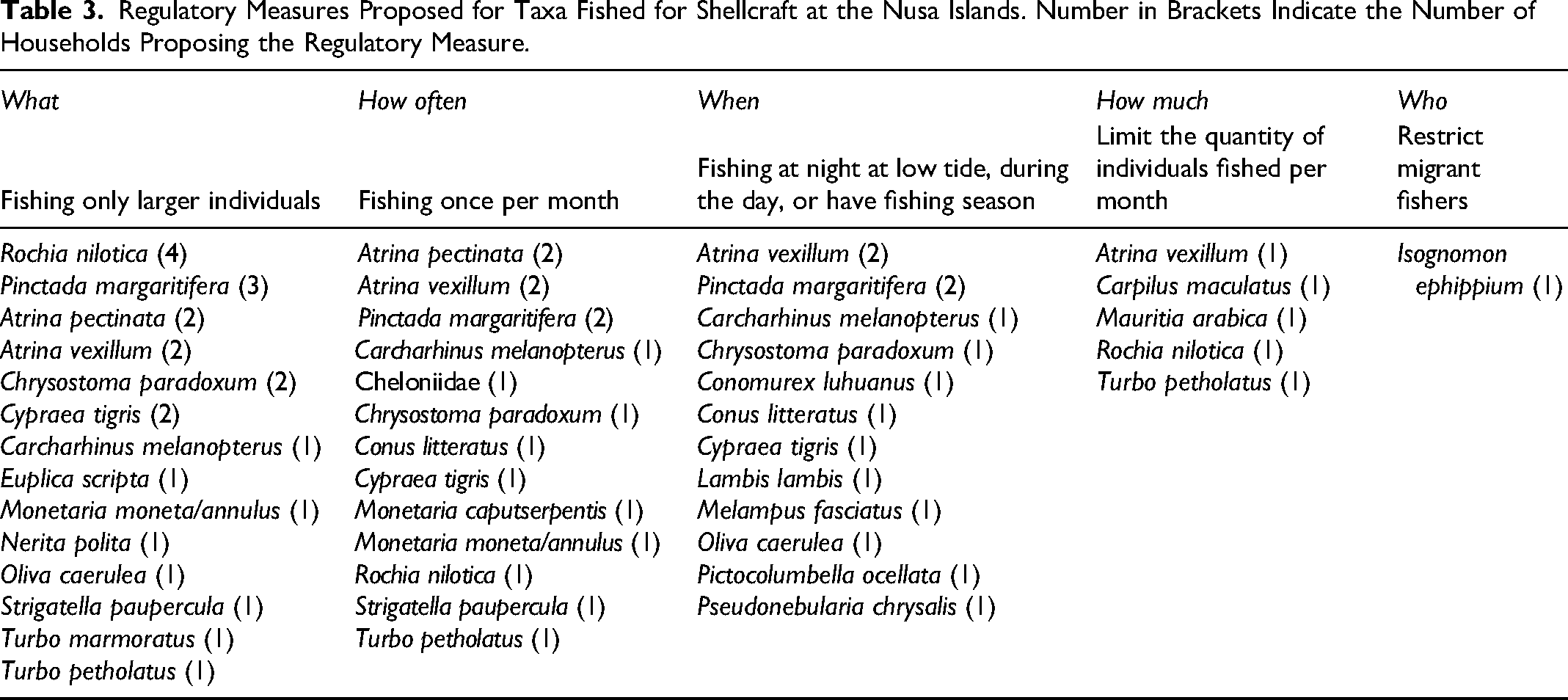
Households collectively proposed five types of regulatory measures relating to what, how often, when, and how much taxa should be fished, as well as who should fish these taxa (Table 3). An introduction of relative (i.e., adult individuals only) size limits (i.e., what) was proposed for 14 taxa, restricting the frequency of fishing trips to once per month (i.e., how often) was proposed for 13 taxa, restricting when fishing occurred to the day, the night, or a particular season was proposed for 12 taxa, an introduction of monthly fishing quotas (i.e., how much) was proposed for five taxa, and a prohibition on nonresidents fishing at the Nusa Islands was proposed (i.e., who) for one taxon (Isognomon ephippium) that is also fished locally for food (Simard et al. 2023). Given the limited number of households that expressed a need for resource management, the lack of agreement on which taxa required regulatory measures, and varied regulatory measures proposed, there was no consensus among a significant number (n ≥ 6) of households for a particular regulatory measure to be applied to any single taxon (Table 3). The nearest prospect was R. nilotica for which four households proposed relative size limits be introduced.
Discussion
Shellcraft fisheries lack sufficient information to establish purposeful baselines for identifying and responding to change through policy and management decisions (Kailola 1995; Kronen et al. 2007). To address this knowledge gap, the present study evaluated social-ecological factors in a shellcraft fishery using a quantitative approach. The baseline established for the studied fishery encompasses the taxa fished (the what and how much), persons involved in fishing (the who), habitats fished (the where), fishing techniques (the how), time of day fishing occurs (the when), fishing frequency (the how often), and fishing experience (the how long). In the following section, this baseline is discussed in relation to how it compares with what is currently known of small-scale fisheries (sensu Adams 2012) in local or regional contexts, highlighting differences and similarities. To contextualize sustainability as part of the baseline established, LEK-based perceptions of stock status are then discussed in relation to social-ecological factors theorized to signal concern. Considerations for governance, which include synthesis of existing regulatory measures and aspirations, are then discussed in relation to the baseline established.
Social-ecological Factors
At the Nusa Islands, a broad range of marine taxa were fished for shellcraft. Catch richness (n = 69) accounted for 95% of taxa utilized for shellcraft (Simard et al. 2022b) and included 15 of the 16 taxa expressly identified as being among the most important for supporting this activity (Simard et al. 2019). While small-scale fisheries in PNG are typically multispecies (Cinner and McClanahan 2006; Hair et al. 2019; Militz et al. 2018), catch richness of the studied fishery was exceptional, particularly with respect to mollusks. The catch richness of mollusks (n = 64) fished for shellcraft greatly exceeded the catch richness of mollusks (n = 31) consumed for food at the Nusa Islands (Simard et al. 2023) and, more generally, throughout PNG (Friedman et al. 2008; Kinch 2003; Koczberski et al. 2006). Some overlap was evident when comparing the composition of mollusks fished for shellcraft with those fished for food. At the Nusa Islands, specifically, 15 of the mollusks fished for shellcraft are also consumed (Simard et al. 2023). Additional overlap with more commercially focused small-scale fisheries was also noted. For instance, exports from PNG have included Pinctada spp., R. nilotica, and T. marmoratus for mother-of-pearl (Kailola 1995; Simard et al. 2022a) as well as Conomurex luhuanus and Mauritia arabica for marine aquaria (Militz, Kinch and Southgate 2018). Overall, though, the studied fishery comprised a mostly unique composition of mollusks, relative to small-scale fisheries in PNG.
Quantities of taxa fished for shellcraft at the Nusa Islands were uneven. More than a third of all individuals fished were of a single gastropod, Chrysostoma paradoxum. Bias towards this taxon has been attributed to aesthetic and cultural preferences, which are likely unique to this area of PNG (Simard et al. 2022b). For all other taxa, far fewer individuals were fished. A small portion of catch richness typically accounts for a large portion of quantities fished in most small-scale fisheries that target marine invertebrates in PNG (Hair et al. 2018; Militz, Kinch and Southgate 2018) and, in this sense, the studied fishery was no different. In relation to quantities utilized for shellcraft (Simard et al. 2022b), the studied fishery was the sole source of individuals for 40 taxa and supplied the majority of individuals for a further 18 taxa. This contextualizes the importance of the studied fishery relative to alternative avenues through which households obtained taxa, such as purchase or trade (Simard et al. 2022b). In other contexts, such as quantities of mollusks fished for food, quantities fished for shellcraft were relatively minimal. For instance, the quantity of mollusks consumed at the Nusa Islands is more than twice the quantity fished for shellcraft, despite the taxa richness of the former being less than half that of the latter (Simard et al. 2023).
Although fishing most taxa had no association with the main demographic divisions within households, fishing some taxa was nonrandom with respect to these divisions. Fishing mollusks has traditionally been gendered in the Indo-Pacific region, with divisions apparent between women and men in relation to the where, how, when, and what social-ecological factors (Malm 2015; Siar 2003; Tilley et al. 2020). While in some areas of the Indo-Pacific these divisions extend to fishing mollusks for shellcraft (e.g., Malm 2009), in other areas this is not the case. In parts of the Solomon Islands, for example, divisions that traditionally pertained to fishing mollusks began to change by the 1990s and are now commonly forgone in favor of maximizing productivity for shellcraft (Barclay et al. 2018). At the Nusa Islands, more households had women engaged in fishing taxa for shellcraft than men and a greater catch richness in this fishery was attributed to women relative to men. Both participation and catch richness were evidently gendered, with women the main actors. That said, men from most households were also active in this fishery and fished many (n = 31) of the same taxa fished by women. Likewise, most households also had youth active in this fishery, which is typical of small-scale fisheries targeting mollusks in the Indo-Pacific region (Burgos 2020; Furkon et al. 2020; Malm 2009), but no taxon was exclusively fished or most associated with youth. In some cases, though, households may rely on youth for fishing certain taxa (Siar 2003) and this was seen in five households where youth fished taxa that adults within their households did not fish. Thus, while women were the main actors in the studied fishery, both men and youth were notably engaged in this fishery.
Most households fished in both intertidal and subtidal habitats, but the majority of taxa were associated with fishing intertidal habitats. Most taxa utilized for shellcraft, both in terms of richness and quantities, are sourced from intertidal habitats (Resture and Resture 2005; Simard et al. 2022b; Marlett 2019) and fishing at the Nusa Islands reflected this. Even taxa that are abundant in subtidal habitats, such as P. margaritifera and R. nilotica (Kailola 1995; Friedman et al. 2008), had significant associations with fishing intertidal habitats. This may be explained by expansive intertidal habitats at the Nusa Islands (Figure 1) and overall health of these habitats, noting nearshore areas of the marine environment in PNG are among the least exploited in the Indo-Pacific region (Cinner and McClanahan 2006; Teh et al. 2013). When taxa are sufficiently abundant in intertidal habitats, a disinclination to fish subtidal habitats, which requires full-body immersion, commonly persists (Harding et al. 2022). Elsewhere in the Indo-Pacific region it has been shown that women, the main actors in the studied fishery, prefer fishing intertidal habitats because of the proximity to their residence (Resture and Resture 2005; Furkon et al. 2020; Tilley et al. 2020). Shellcraft in other areas, such as the Solomon Islands (Fidali-Hickie and Whippy-Morris 2005), Timor-Leste (Tilley et al. 2020), and Tuvalu (Resture and Resture 2005), relies on fishing intertidal habitats and some degree of dependence on intertidal habitats can be opined for the studied fishery.
The three fishing techniques (gleaning, combing, and free-diving), characterizing how taxa were fished, were employed to varying extents. Most taxa were fished by gleaning, a broadly accessible technique that is not dependent on additional physical capital (Kinch 2003). Gleaning is also compatible with common home duties, such as minding youth (Malm 2009), and is broadly adopted for fishing mollusks across the Indo-Pacific region (Fidali-Hickie and Whippy-Morris 2005; Resture and Resture 2005; Tilley et al. 2020). In this regard, the studied fishery was no different. Gleaning, however, is notably restricted by tidal cycles and is not always feasible when fishing a particular taxon is required (e.g., to fulfill an order) or ideal (e.g., high tide). This likely explains why a broad range of taxa fished by gleaning were also fished by free-diving, which was the only fishing technique reported that would permit access to intertidal and subtidal habitats outside of low tides (Tiraa-Passfield 1996). Combing was the least used fishing technique among households at the Nusa Islands, probably because shells and skeletal remains of taxa deposited in intertidal habitats are often found damaged and unusable for shellcraft due to abrasion in the surf zone (Mitchell-Tapping 1980; Gössling et al. 2004). Other fishing techniques that rely on traps, spades, tangle nets, bottom trawls, and dredges (Kailola 1995; Floren 2003; Dunstan, Alanis and Marshall 2010) were not used in the studied fishery. While traps have been linked to fishing Nautilidae for shellcraft in the Philippines (Dunstan, Alanis and Marshall 2010), interviews reaffirmed that Nautilidae were fished exclusively by combing drift shells from intertidal habitats at the Nusa Islands (Simard et al. 2019). The use of traps, or other specialized fishing equipment, can be labor intensive or cost-prohibitive and requires specific knowledge and skills (Floren 2003; Tiraa-Passfield 1996). Rather, the fishing techniques that characterized the studied fishery were typical of fishing mollusks locally (Friedman et al. 2008) and throughout PNG (Kinch 2003; Koczberski et al. 2006).
From interviews, it was also evident that households engaged in targeted fishing rather than the “take-everything” or “general” fishing approach commonly observed with small-scale fisheries in the Indo-Pacific region (Furkon et al. 2020; Kitolelei et al. 2021). Despite the studied fishery encompassing 64 taxa from intertidal habitats, each household generally fished a few taxa from these habitats and only three taxa were routinely fished together (Figure 3). Targeted fishing inevitably limits the postharvest sorting that would otherwise be required to organize shell material for processing. Targeted fishing is also likely consequent of household idiosyncrasies pertaining to the desire or ability to process a given taxon. Artistic inspiration and competitive market environments are presumed to motivate utilization of a unique composition of taxa for shellcraft (Simard et al. 2022b), and in the studied fishery this was reflected in targeted fishing of a unique composition of taxa by each household.
Although the majority of households reported fishing both during the day and at night, taxa were mostly fished during the day. A bias towards fishing at night, particularly with respect to moon phases, has been reported elsewhere in the Tigak Islands group (Kaly et al. 2005; Muttenthaler et al. 2012) and, more generally, in the Indo-Pacific region (Fidali-Hickie and Whippy-Morris 2005; Resture and Resture 2005; Vieira et al. 2017). In this regard, the studied fishery differed greatly; no taxon was significantly associated with fishing at night while 20 taxa, mostly gastropods, were significantly associated with fishing during the day. Even taxa regarded as nocturnal (e.g., Conus marmoreus) were fished during the day (Muttenthaler et al. 2012). This is likely because fishing mostly targeted small gastropods with vibrant shells, best identified with ample lighting. Gleaning intertidal habitats with daylight would permit scrutiny of taxa uncovered when overturning rocks or clearing soft sediment (Tiraa-Passfield 1996; Fidali-Hickie and Whippy-Morris 2005).
Fishing a specific taxon for shellcraft also occurred infrequently. Within the Tigak Islands group, households fishing bivalves and gastropods for home consumption or market sales will make several fishing trips per week (Kaly et al. 2005). Frequent fishing is necessitated due to an absence of refrigeration and a need to prevent food spoilage before consumption. Shellcraft, however, requires only inert components of taxa (i.e., shells and skeletal remains) that have a long shelf-life. Thus, taxa acquired during a single fishing trip can be stored until required, once the soft-tissue is removed (Venkatesen 2010), without compromising product quality. This is a facet shared with only a few small-scale fisheries in the Indo-Pacific, such as those supplying mother-of-pearl (Simard et al. 2021), and implies generalizations about small-scale fisheries for perishable resources may not apply to shellcraft fisheries.
Fishing for most taxa began relatively recently, considering shellcraft commenced at the Nusa Islands more than two decades ago (Simard et al. 2019). In accordance with Alati et al. (2020) and Bao and Drew (2017), most households had low fishing experience (<19 years) with taxa they fished while a few households had intermediate experience (19–30 years) with some taxa. None of the surveyed households, though, would be considered to have high experience (>30 years) for any of the taxa they fished. Thus, catch richness has expanded considerably since shellcraft first commenced at the Nusa Islands, with shellcraft prompting households to increasingly target taxa not previously fished.
Stock Status
To contextualize the sustainability of the shellcraft fishery at the Nusa Islands, a reliance on LEK-based perceptions of stock status was necessitated by an absence of past information for many of the taxa fished (Kailola 1995; Simard et al. 2021). Perceptions of stock status depend on personal observations and experiences of fishers engaged in fishing those taxa (Bao and Drew 2017; Thaman et al. 2017). At the Nusa Islands, observations and experiences likely differed among households given variation in the social-ecological factors evaluated. Yet a consensus on stock status was attained for most taxa evaluated. The enhanced environmental awareness afforded when considering LEK from all households engaged in fishing a particular taxon implies that the consensus reached for that taxon is likely to be robust and representative of actual stock status (Moller et al. 2004; Kitolelei and Sato 2016; Bao and Drew 2017).
For most (76%, n = 22) of the taxa evaluated, there was consensus that stocks had not declined. Stock status of even C. paradoxum, the taxon for which quantities fished were highest, was perceived positively with a stable or increasing stock. Further, for no taxon was a consensus reached that its stock had declined. This would imply the shellcraft fishery at the Nusa Islands, as described through the baseline established in this study, is perceived to be sustainable for most taxa, but also that further interrogation of the LEK-based perceptions of stock status is warranted for those taxa (n = 7) lacking consensus as to their stock status.
Social-ecological factors are known to influence LEK-based perceptions of stock status (Alati et al. 2020; Bao and Drew 2017; Purcell et al. 2020). Several studies, for example, have shown that more experienced fishers (the how long) have a deeper understanding of temporal trends within their fishing environments compared to less experienced counterparts (Ainsworth, Pitcher and Rotinsulu 2008; Alati et al. 2020). For this reason, when relying on LEK to appraise longer term changes to stock status, perceptions held by more experienced fishers may signal concern if they differ significantly from less experienced fishers (Bao and Drew 2017; Purcell et al. 2020). The same rationale for perceiving recent or relative changes applies to fishers that respectively fished a taxon more frequently (the how often) or fished a greater catch richness (the what) during the previous year. All three of these social-ecological factors were found to significantly influence LEK-based perceptions of stock status, but for only a few taxa. More often, perceptions were indifferent with respect to variation in the how long, how often, and what social-ecological factors.
Among the seven taxa that lacked a consensus as to their stock status, the evaluated social-ecological factors significantly influenced perceptions for three of these taxa: R. nilotica, T. petholatus, and A. vexillum. Fishers who fished R. nilotica more frequently during the previous year tended to view the stock status of this taxon more positively. This taxon is also fished for food and mother-of-pearl, but declining prices have reduced fishing for mother-of-pearl in recent years (NFA 2007; Simard et al. 2022a). It seems plausible that the stock is recovering from past fishing for mother-of-pearl and that those fishers most frequently interacting with this taxon have noticed. This would signal no concern for how shellcraft is impacting the stock of R. nilotica. In the case of T. petholatus, fishers that fished a greater catch richness during the previous year tended to view the stock status of this taxon more negatively. T. petholatus generally occurs at low density in PNG, relative to related species (Friedman et al. 2008), and it seems plausible that fishers interacting with a broad range of taxa have construed differences in density as indicative of relative stock status. This taxon is also consumed at the Nusa Islands (Simard et al. 2023) and, in comparison, the quantities fished for shellcraft are minimal (n = 145). Such evidence would signal no concern for how shellcraft is impacting the stock of T. petholatus. In the case of A. vexillum, fishers with more experience tended to view the stock status of this taxon more negatively. A. vexillum is notably important for shellcraft at the Nusa Islands (Simard et al. 2019) and, while also fished for food (Simard et al. 2023), quantities (n = 972) fished for shellcraft were much higher than quantities (n = 48) consumed. The negative change perceived by more experienced fishers is, therefore, concerning since it potentially signals longer-term declines that have gone unnoticed by recent entrants to shellcraft who perceive the current stock status of A. vexillum as being normal. Given that shellcraft is likely responsible for such declines, some consideration for governance of the shellcraft fishery at the Nusa Islands is merited.
Governance
Several households (n = 19) in this study expressed desire for strengthened governance of the shellcraft fishery at the Nusa Islands through the establishment of informal regulatory measures. Yet none of the formal regulatory measures that currently applied to taxa fished for shellcraft were acknowledged. This affirms conjecture that governance at national or provincial levels alone is insufficient to manage shellcraft fisheries in PNG (Simard et al. 2019, 2022b). The irrelevance of governance at these levels was best exemplified by several households (n = 6) proposing the establishment of relative size limits for P. margaritifera, R. nilotica, or T. marmoratus when absolute size limits for these taxa in PNG have existed as formal regulatory measures since 1992 (Simard et al. 2022a). National and provincial governments in PNG lack adequate human and financial capacity to routinely communicate and enforce formal regulatory measures (Govan 2015), particularly at a community level (Kailola 1995). In recognizing these challenges, there is advocacy for national and provincial governments to support community-level (i.e., local) governance of small-scale fisheries (Govan 2015; Kailola 1995; Kaly et al. 2005). Such an approach would align with aspirations for strengthened governance at the Nusa Islands through informal, as opposed to formal, regulatory measures.
Informal regulatory measures proposed were related to the what, how often, when, how much, and who social-ecological factors and typify those advocated for management of small-scale fisheries in the Tigak Islands group (Kaly et al. 2005). Disunity concerning what regulatory measures should be established, however, foreshadows challenges for effective local governance (Hair et al. 2020; Kaly et al. 2005). To improve the effectiveness of local governance it is recommended that communities take initiative and act before resource depletion is perceived (Bao and Drew 2017; Hair et al. 2020). Since most taxa fished for shellcraft at the Nusa Islands do not currently show signs of resource depletion, there remains scope to develop a management approach that is socially appropriate and beneficial for local livelihoods. For some taxa, this might entail adapting formal regulatory measures to become informal regulatory measures through a co-management process (Kailola 1995; Kaly et al. 2005). As part of a co-management process, the development of a monitoring program at the Nusa Islands, such as periodic landing surveys (e.g., Hair et al. 2018), could help generate the necessary data to ensure that any regulatory measures adopted are having the desired effect of preventing resource depletion (Burgos 2020).
Among the regulatory measures suggested, the establishment of relative size limits for taxa was most frequently proposed. This is based on a perception shared by fishers in the Tigak Islands group that size relates to sexual maturity of mollusks, with smaller individuals considered immature (Kaly et al. 2005; Lawless and Frijlink 2015). When considering relative size limits were proposed for P. margaritifera, R. nilotica, and T. marmoratus, which are also fished for food and mother-of-pearl (NFA 2007; Simard et al. 2022a), a co-management process that involves adapting formal regulatory measures to become informal regulatory measures, as suggested by Kailola (1995) and Berkes et al. (2001), is a strategy worth pursuing. Local governance through informal regulatory measures has aided recovery of overfished R. nilotica stocks in parts of the Indo-Pacific region (Berkes et al. 2001) and is anticipated to be similarly effective in PNG (Kailola 1995).
In addition to relative size limits, other regulatory measures that would encompass a broad range of taxa fished for shellcraft are those that are spatially based. Local governance through spatially defined no-take zones has been successful in managing small-scale fisheries in the Indo-Pacific region, especially for benthic invertebrates (Bao and Drew 2017; Thaman et al. 2017; Smallhorn-West et al. 2019). While the suggestion of a no-take zone was not put forward by any household, if fishing was prohibited in a discrete portion of the intertidal area comprising soft- and hard- substrate habitats, many of the taxa perceived to require management would presumably receive protection. While poaching aggression and lack of compliance have limited the effectiveness of no-take zones for high-value taxa locally (Hair et al. 2020), most of the taxa utilized for shellcraft have negligible value as an unworked resource (Kailola 1995). Future research should explore whether establishment of a no-take zone at the Nusa Islands through a co-management process is feasible and identify external stakeholders to help referee socio-political dynamics that will inexorably complicate governance (Aswani, Albert and Love 2017; Hair et al. 2020).
Conclusions
This study established a baseline for the shellcraft fishery at the Nusa Islands based on social-ecological factors and LEK-based perceptions of stock status. The studied fishery had a high catch richness comprised of mostly mollusks. Fishing was infrequent and quantities fished were low for most taxa when compared with other small-scale fisheries. Fishing most taxa had no association with the main demographic divisions within households although, in terms of participation and catch richness, women were the main actors. Gleaning, combing, and free-diving were the only fishing techniques used, with taxa primarily fished by gleaning intertidal habitats during the day. These characteristics lead to the conclusion that the studied fishery, whilst unique in regards the what and how much social-ecological factors, is best categorized within the “reef gleaning and other nonboat-based reef and lagoon fishery” typology of small-scale fisheries in the Indo-Pacific region (Adams 2012).
Contextualizing sustainability using LEK-based perceptions of stock status found most taxa fished for shellcraft had stable or increasing stocks while a few taxa lacked consensus as to their stock status. These taxa included A. pectinata, A. vexillum, Oliva amethystina, P. margaritifera, P. mammilla, R. nilotica, and T. petholatus, with social-ecological factors relating to long-term, recent, and relative change signaling a possible long-term decline in the stock of A. vexillum.
Aspirations for governance affirmed marginal relevance of formal regulatory measures and based on a desire to manage the shellcraft fishery at a community level, potential governance options based on informal regulatory measures were considered. While there are challenges for ensuring long-term sustainability of shellcraft at the Nusa Islands, the insights gained from this study, permitted by LEK, are likely to be of value for formulating more appropriate regulatory measures and anticipating impacts of shellcraft as this activity expands to other areas of PNG (Militz, Kershler and Southgate 2021) and more broadly throughout the Indo-Pacific region (Southgate et al. 2023).
Supplemental Material
sj-docx-1-ebi-10.1177_02780771241261223 - Supplemental material for Social-ecological Factors, Stock Status, and Governance Relating to a Shellcraft Fishery in the Indo-Pacific Region
Supplemental material, sj-docx-1-ebi-10.1177_02780771241261223 for Social-ecological Factors, Stock Status, and Governance Relating to a Shellcraft Fishery in the Indo-Pacific Region by Nittya S. M. Simard, Thane A. Militz, Jeff Kinch, Patrick D. Nunn and Paul C. Southgate in Journal of Ethnobiology
Footnotes
Acknowledgments
The authors are grateful to Michael Mangun, in his capacity as community chairman of the Nusa islands, for facilitating interactions with artisan households, and to the staff from the National Fisheries College of the Papua New Guinea National Fisheries Authority for facilitating access to the study site. Appreciation is also extended to the artisan households who volunteered their time to participate in this research. The contribution of three anonymous reviewers, who provided feedback on an earlier draft, is graciously acknowledged.
Declaration of Conflicting Interests
The authors declared no potential conflicts of interest with respect to the research, authorship, and/or publication of this article.
Funding
The authors disclosed receipt of the following financial support for the research, authorship, and/or publication of this article: This work was completed as part of a PhD thesis submitted to University of the Sunshine Coast (UniSC) by Nittya S. M. Simard while supported by an Australian Centre for International Agricultural Research (ACIAR) Project Support (CAR11907) scholarship and an Australian Government Research Training Program (RTP) scholarship. Additional support was obtained from ACIAR and Papua New Guinea National Fisheries Authority as part of ACIAR Projects, FIS/2014/060 and FIS/2022/128, administered through UniSC.
Ethical Statement
Research activities associated with this study were reviewed and approved by University of the Sunshine Coast’s Human Research Ethics Committee (S191337). Authorization to conduct research activities in Papua New Guinea (PNG) was obtained through a Memorandum of Subsidiary Agreement (FIS/2014/060 and FIS/2022/128) between the Australian Centre for International Agricultural Research and the National Fisheries College of the Papua New Guinea National Fisheries Authority. Permissions to engage with residents of the Tigak Islands group were obtained from elected and traditional community leaders prior to obtaining informed consent from households for their participation in this study.

Supplemental Material
Supplemental material for this article is available online.
References
Supplementary Material
Please find the following supplemental material available below.
For Open Access articles published under a Creative Commons License, all supplemental material carries the same license as the article it is associated with.
For non-Open Access articles published, all supplemental material carries a non-exclusive license, and permission requests for re-use of supplemental material or any part of supplemental material shall be sent directly to the copyright owner as specified in the copyright notice associated with the article.
