




Abstract
In cities nature is taking on a new role as infrastructure, providing essential services in terms of temperature regulation and water management, as well as the provision of habitat for biodiversity conservation. With this turn to green infrastructure have come new challenges to maintenance. Plants are lively things and if they are to perform their infrastructural roles they must be routinely tended to in particular ways. In the context of neoliberal governance, much of this labor falls to volunteer humans. Framed as stewardship, this volunteerism for plant-city thriving is posited as a way to meet maintenance needs while promoting human health and well-being and creating support for nature-based solutions through a sense of ownership and responsibility. While it is thus possible to read stewardship as an enrollment of people and plants into the reproduction of neoliberal urban political ecologies, in this paper I argue that such an analysis overlooks the involution of plants and people that occurs during acts of stewardship. Drawing on ethnographic research with street tree stewards in New York City I explore how vegetal agency draws people into affective, embodied relations. During acts of stewardship, trees act on people and reconfigure their relations in ways that potentially exceed the strictures of stewardship. Rather than allowing stewardship discourses and critiques thereof to be our sole frame for understanding these people-plant relations, we should also consider them from the perspective of vegetal agency and what human-tree involutions do within, around, and to human practices of stewardship.
Keywords
People have long engaged with the arboreal inhabitants of what is now New York City, from the Algonquian peoples who originally inhabited the islands, to the Dutch and English colonists who began large-scale deforestation in the 16th century, to the urban forestry movement that emerged 300 years later. Motivated by concerns for human health, civic life, and economic boosterism, the urban forestry movement in New York promoted the role of trees as a vital urban amenity. (Dümpelmann 2019). This amenity framing presents trees as something that, while ultimately unnecessary, provides highly desirable conveniences and contributions to the quality of life, for example improving environmental quality and increasing property values. This framing still exists in New York City today. Increasingly, however, those involved in promoting and supporting urban forestry in New York City understand trees as something more: infrastructure. This infrastructural framing stresses how the ecosystem services of trees, particularly their ability to regulate temperature, air quality, and stormwater, provide contributions to the flows of air and water essential to life in the city. Like all infrastructure, trees require maintenance to stabilize these contributions over time. In New York City much of this maintenance is performed by volunteers working independently or supported through environmental stewardship initiatives. Indeed, stewardship is one of the keywords that emerges in recent scholarship and practice of urban forestry in New York City (Campbell et al. 2022; Fisher, Svendsen, and Connolly 2015).
Stewardship is a widely used term with much conceptual flexibility, but can be understood broadly as the direction of care, knowledge, and agency toward actions sustaining resources necessary for human flourishing (Enqvist et al. 2018). The appeal of stewardship rests with the ways this practice empowers intrinsic motivations and relational values of people with regard to nature, including indigenous ecological knowledge (McMillen et al. 2020), in a context of environmental management (Enqvist et al. 2018). Others have pointed to various shortcomings, from reproducing discursive separateness and hierarchy between humans and nature counter to indigenous modes of understanding (Østmo and Law 2018) to depoliticizing environmental crisis and response (Swyngedouw and Ernstson 2018). These critiques draw into question what is being made resilient in the stewardship of New York City's green infrastructure (Westman and Castán Broto 2022) and connect to ongoing lines of inquiry within critical infrastructure studies regarding how social and political relations shape infrastructural form and functioning across space and time (Appel, Anand, and Gupta 2018). While such questions are significant, conversations have heretofore largely overlooked an important participant in green infrastructure and stewardship practices: plants. Frequently relegated to the background, recent scholarship reminds us that plants have agency in their own right (Lawrence 2021; Lewis-Jones 2016) and that cities are important sites of human-plant interaction and ethnobiological inquiry (Emery and Hurley 2016). Thus, I ask how a focus on the trees, and their effects on the humans charged with stewarding them, shift our interpretations of what is happening when people engage in the stewardship of trees as infrastructure. What are trees doing to people, to their sense of place, modes of governance, understandings of infrastructure and stewardship, and experiences of socio-ecologically precarious urban life, in these encounters?
To answer these questions I explore research on urban green infrastructure and environmental stewardship, as well as scholarship on vegetal agency. I draw from ethnographic research with street trees and street tree stewards in New York City to illustrate how a focus on the agency of plants complicates both straightforward valorizations and critiques of stewardship and conclude with a discussion of the possibilities for entanglement and transformation offered by these tree-human encounters. First, however, I briefly review how trees became infrastructure in New York City and what they are now expected to do.
Street Trees in New York City
New York City is situated across an estuary, where the East and Hudson Rivers empty into the New York Bay, and ultimately, the Atlantic Ocean. In 2005 the United States Environmental Protection Agency (EPA) placed the City of New York under an Order of Consent to reduce the flow of sewage into surrounding waterways. New York City uses a combined sewer system, wherein one set of pipes carries both storm and wastewater to treatment facilities. Surges of stormwater from intense rainfall events (which are increasingly common due to global climate change) overwhelm the system, causing raw sewage to overflow into surrounding waterways—a phenomenon known as combined sewer overflow. The NYC Green Infrastructure Plan (PlaNYC 2010) was among the measures introduced to comply with EPA standards. This plan proposes using living systems, like street trees, rain gardens, and green roofs to retain or slow the flow of stormwater into the sewer system.
Green infrastructure is increasing across cities in the US and around the world. As a nature-based solution, these infrastructures utilize nature or natural processes to regulate, stabilize, and adapt human environments to routine and extraordinary disturbances (Frantzeskaki et al. 2019). In addition to stormwater management, New York City is employing green infrastructure to reduce heat islands, increase biodiversity, support human wellbeing, and improve air quality (McPhearson, Hamstead, and Kremer 2014). Many of New York City's poorest and/or Black, Indigenous, and People of Color (BIPOC) residents live with lower access to greenspace and increased risk of flooding, heat stress, and asthma (Checker 2021). Plans and programs promoting green infrastructure also position these interventions as tools for social and environmental justice by targeting underserved neighborhoods where flooding and/or heat wave casualties are highest (Meerow 2020). Trees have been an important part of this vision, particularly street trees—those planted in sidewalks and along roadways (Campbell 2017; Nyelele and Kroll 2020).
Researchers frequently bring these multiple different contributions of trees to urban life together under the umbrella of ‘ecosystem services’. These services include the provision of habitat to other species (supporting ecosystem services, Mullaney, Lucke, and Trueman 2015); fruits, leaves, and wood that can be used by residents (provisioning services, Hurley and Emery 2018; Russo et al. 2017); contributions to human health, sociality, and spirituality (cultural services, Andersson et al. 2015); and significantly for conversations regarding trees as green infrastructure, regulating services through cooling and stormwater absorption (Meerow 2020; Mullaney, Lucke, and Trueman 2015). New York City's plans for addressing urban heat and stormwater run-off encourage environmental managers and urban forestry professionals to maximize these regulating services by engaging trees as a type of green infrastructure (OneNYC 2017; PlaNYC 2010). Together the logics of ecosystem services provision and these plans translate the ability of trees to provide shade and retain water into infrastructural functions that can be administered through techno-managerial approaches to environmental sustainability (Nelson and Bigger 2021).
New York City is a global leader in such approaches (Campbell 2017; Gandy 2002), which align neatly with the market logics of neoliberal governance that also dominate the city (Battistoni 2017). Even as crises like climate change force a reckoning with the externalization of nature from calculations of value, nature is being re-valued in ways that support—and naturalize—capitalist market-based approaches to the management and distribution of resources. The categorization of nature, including street trees, into suites of services instrumentalizes natural processes and presents them as functions that can be valued and managed effectively via markets. This is evidenced from the emergence of carbon markets (Nelson and Bigger 2021) to ongoing green gentrification (Checker 2021). The latter is of particular significance to conversations regarding street trees and green infrastructure in New York City, as tree planting and urban greening have been creating value in property markets from the days of downtown economic boosterism (Dümpelmann 2019) to contemporary efforts at environmental remediation (Gould and Lewis 2017). While dispossession is not always the goal of such efforts, in a city where housing is an important mode of capital accumulation improvements in environmental quality cannot be disentangled from their effects on socio-spatial inequalities based on differences of class and race (Checker 2021).
Absent from this narrative of street trees and their place in green infrastructure planning, ecosystem service provision, and property markets is the agency of the nonhuman world (Haraway 2008) and the relational and intrinsic values that inhere therein (West et al. 2018). Trees have always been a part of urban life in New York City, and the city's many diverse populations continue to have deep psycho-social-spiritual bonds with nature (Svendsen, Campbell, and McMillen 2016). As an employee of the New York Botanical Gardens puts it, “everyone has a tree story,” and these stories, as I will discuss further below, are often in excess of the aligned logics of green infrastructure, ecosystem service provision, and techno-managerial environmental governance. Moreover, while these logics promulgate ideas of trees as infrastructure among urban forestry professionals, urban planners, and civil/environmental engineers via official planning and management discourse, these “tree experts” embrace multiple narratives of valuation in practice.
Regardless of narrative frame, city streets are not easy places for trees to live. There is little soil, most of it low quality, and so compacted and impermeably covered that little water can be absorbed; many trees suffer draught-like conditions even in times of normal rainfall (Mullaney, Lucke, and Trueman 2015). Young trees must therefore be watered regularly if they are to survive to maturity, and mature trees often benefit from additional water, particularly during hot summer months. The little plot of earth in which a street tree lives, called a tree bed or pit, attracts weeds, litter, and dog waste, all of which are considered unsightly and some—particularly dog urine due to its high nitrogen content—harmful to the tree. A low (6–12″) fence-like structure called a guard, as well as ornamental plants and mulch, can act as deterrents and promote watering and water retention and reduce compaction (Lu et al. 2011). Street trees must also contend with air pollution, broken branches and damaged bark from inconsiderate humans and their motor vehicles, and lack of sunlight due to shading from tall buildings. Finally, there is the issue of human preferences and the ways it conflicts with trees’ own inherent liveliness. Trees grow, changing themselves and their surroundings in the process, in ways not always beneficial to people (von Döhren and Haase 2019). Pedestrians desire leaves and fruits to be cleared from the sidewalk and sidewalks cracked or lifted from tree roots be mended. Low-hanging or likely-to-fall branches require pruning to avoid accidental harm to cars, people, and pets. These challenges underscore the fact trees do not simply perform as infrastructure any more than pipes or wires do. Keeping street trees alive and within the aesthetic, social, and spatial norms of the city requires maintenance and someone to perform that labor. In New York City this labor is provided by informal and formal volunteers and is frequently framed as stewardship.
Green Infrastructure, Stewardship, and Vegetal Agency
Infrastructures are understood here as processes, and associated sets of relations, ordering the flows that link humans to their environments (Hetherington 2019). Infrastructures work both to arrange connections between humans and their environments and to fix these arrangements in space and time (Appel, Anand and Gupta 2018). Such efforts in turn enroll a host of material, social, and political relations that simultaneously activate infrastructure as a site for reproducing state power and social inequality and introduce possibilities for appropriation and contestation (Anand 2017). In linking humans and their environments, infrastructures frequently engage the material world, and with it, nonhuman life. This can be through the ways infrastructures direct natural flows, like water (Gandy 2002) or animal behavior (Wakefield 2020), or the ways nonhuman activities disrupt, thwart, or repurpose infrastructure (Barua 2021). These engagements can also entail utilizing nature or natural processes as infrastructures themselves (Carse 2012), a practice growing increasingly popular through the propagation of frameworks like nature-based solutions (Frantzeskaki et al. 2019).
Both this processual, relational account of infrastructure and the increasing enrollment of nature as infrastructure sit awkwardly alongside more popular discourses, like those found in New York City policy and practice, where the term ‘infrastructure’ carries objectifying implications. In the case of green infrastructure, these implications help to obscure the liveliness of plants and animals and render them inert tools for environmental management (Wakefield 2020). This reflects ontological and discursive frames that posit matter as a dead object to be used and position humans as separate and dominant over nature in ways that support its infrastructuralization (Battistoni 2017). The work of scholars engaging infrastructure in a critical and relational mode provide one entry point for challenging this framing of green infrastructure, by disrupting notions of infrastructure as a stable object. The liveliness of trees and other green infrastructures provides another.
Recent scholarship challenges the idea that infrastructure, regardless of what comprises it, is inert in any way (Denis and Pontille 2015), arguing that all matter, biotic or abiotic, is alive in some fashion (Bennett 2010). The liveliness of matter figures prominently in scholarship on infrastructure, not least in conversations about the importance of maintenance. Infrastructures order the relationship of people to their environments, often appearing to fix particular relationships between humans and nature or material objects (Gandy 2002; Hetherington 2019). That fixity is fragile, however, as pipes leak, paint fades, weeds sprout; labor—maintenance—is required to hold these infrastructures and their relational orderings in place, in a “ceaseless performance of a stabilized world” (Denis and Pontille 2015: 353). This work is often routine and if done well, unnoticed. But it is also work that upholds everything from state authority (Carse 2012) to everyday urban life (Hall and Smith 2015). This labor is not simply material, but social, and relations are sustained not just with infrastructure-making matter, but with humans and human institutions (Hall and Smith 2015). While careful investigation reveals these lively, processual, and relational aspects, infrastructures are frequently intended and perceived to be background, unnoticed by everyday residents if working properly (Appel, Anand, and Gupta 2018). Green infrastructures necessarily subvert this expectation (Morita 2017), as plants are widely recognized to be alive and affecting, particularly trees (Jones 2021; Phillips, Atchison, and Straughan 2023). Thus, street trees provide a useful entry point for thinking with urban residents the ways plants and infrastructures come together to enroll and entangle them in world-making projects.
These entanglements are particularly noticeable, to scholars and urban residents alike, in the work required to render nature into infrastructure. For example, proponents of regenerating oyster reefs in the New York Harbor must labor discursively and materially to make oysters infrastructures of climate adaptation and resilience (Wakefield 2020). Re-arranging the ways nature is valued, in order to preserve ecological function while extracting desired qualities like cooling or resilience, also requires work (Nelson and Bigger 2021). In the context of green infrastructure, work often takes the form of maintenance, focused on keeping plants alive and optimized for infrastructural functions, but also addressing social acceptability. For example, street trees must grow big and leafy so as to provide shade and cooling, which in turn requires routine tasks like watering and mulching, but also repairing sidewalks cracked by spreading roots and cleaning up leaf litter so as not to endanger pedestrian safety.
In New York City, street trees are the property of the Department of Parks and Recreation (hereafter, the “Parks Department”), but this department has neither the budget nor the capacity to maintain the City's 600,000 street trees. Consequently, routine maintenance falls to the general public and is typically performed by contracted landscapers, doormen or building superintendents, residents, or civic organizations. This maintenance, if it is performed at all, can be idiosyncratic, based on personal desires or folk wisdom. To provide guidance in line with the City's environmental management goals, the Parks Department and partnering non-profit organizations run civic stewardship programs. These programs train volunteers in how to best tend a street tree and rely on motivating volunteers through nonmarket modes of valuation, such as personal values and desires to contribute, learn, and explore the city (Johnson et al. 2018; West et al. 2018). At the same time, these stewardship initiatives bridge gaps in institutional capacity and meet demands for responsible, efficient public-private service provision from the city's governing regime (Fisher, Svendsen, and Connolly 2015). As such, street tree stewardship programs in New York City reflect the conceptual and practical capaciousness of stewardship (Enqvist et al. 2018). Indeed, the emergence of the concept of stewardship as a frame with purchase in urban governance and sustainability science comes from its ability to tie ethics and efficiency together. As a “boundary object” environmental stewardship can bring together constituencies from different disciplines and realms of practice to work toward ecological resilience and human wellbeing in a way that is intended to be ethical, practical, and scientifically- informed (Enqvist et al. 2018).
The situatedness of stewardship between devolved, techno-managerial approaches to environmental governance and ethical engagements with nature complicates our understandings of this practice. Infrastructural approaches to nature instrumentalize biotic life and ecosystems, and the most prominent critiques of nature-as-infrastructure rely on fundamentally similar human-nature dichotomies by arguing that nature should be allowed to exist, separate from humans, for its own sake (Battistoni 2017). Stewardship posits nature as something with intrinsic value best appreciated by working in relation with it, a position in alignment with those seeking to trouble human-nature dichotomies (Haraway 2008), promote relational values (West et al. 2018), and engage indigenous knowledges and practices (McMillen et al. 2020). At the same time, stewardship also enables these relationships to be presented as instrumental labor within frameworks of green infrastructure or nature-based solutions. This complexity within the conceptualization and discourse of stewardship bears out in its practice as well. The rich array of social relationships, cultural meanings, and political aims people bring to their everyday practices of sustainability challenge any straightforward reduction to ecological modernism (Isenhour 2011) or neoliberal state formation (Premat 2009). Likewise, the ethnographic vignettes presented below draw our attention to the ways street tree stewardship in New York City at once supports techno-managerial approaches to environmental governance and nurtures lived experiences in excess of them.
For acts of maintenance are collective, enrolling whole ecologies of social and material relations that profoundly affect the ways this labor is talked about and performed (Mattern 2018). Green infrastructures entail further sets of natural ecologies that shape maintenance needs and practices (Morita 2017). Recent developments in critical plant studies and vegetal geographies help bring into increasing focus this agentic power of plants (Lawrence 2021). This scholarship focuses on the ways plants communicate (Gagliano, Ryan, and Vieria 2017) and care for one another (Simard 2021), as well as their creation of, interference in, or indifference to the conditions of animal life (Ergas and York 2021). Plants also exert influence over social dimensions of human life, creating place and shaping relations (Lewis-Jones 2016). For example, the growth patterns of trees—columnar and arching—co-create urban atmospheres alongside human residents (Jones 2021), while plants whose growth is rapid and lateral and who thrive in disturbed conditions can intersect with human concerns about where particular species grow to create the “weed” (Doody et al. 2014). These examples show how vegetal agency, like all agency, is produced and constrained through the ways individual actions are interpolated within broader social, political, and technological relations (Carse 2019; Maurer 2020).
Plant agency is often overlooked because of the inherent other-ness of plants (Ergas and York 2021). Their experiential and cognitive worlds are deeply different from our animal ones, and building a sense of relationship with plants requires imagination, creativity, and openness to affective pull (Hall 2022). Hustak and Myers (2012) explore this latter point through their idea of human-plant involution, tracing the ways humans have found themselves involved with plants by following through their momentum toward one another. The sensory and affective entanglements of this involutionary momentum form the basis for Myers’ subsequent framing of gardens as places where people stage relationships with plants (Myers 2017).
This proposition, though grounded in a concern for affective ecologies rather than labor, is not inconsistent with Battistoni's (2017) concept of hybrid labor, wherein green infrastructures are understood as sites where people and nature work in common to reproduce the conditions of life on earth. Myers’ (2017) emphasis on affect, however, and the notion that humans and plants might conspire together, also invites us to consider the limits of available concepts such as stewardship or labor (Besky and Blanchette 2019). Taking everyday practice as a site of affective and ethical experimentation (Anjaria 2020; Lewis 2015; Vine 2018), I wish to consider what else might be emerging from the entanglement of humans and trees amidst New York City's “ruderal ecology” (Stoetzer 2018) of diverse people and plants, climate change and adaptation, neoliberal governance, and environmental stewardship. In so doing I seek to advance ethnobiological inquiry regarding the role of cities in human-plant relations (Emery and Hurley 2016). Thus, I ask what kinds of human-plant relations are being produced as people and trees labor together to make New York a climate adapted and resilient city? In what ways do trees shape human practice and experience of this labor? And what can this relational perspective, which takes seriously the agency of trees in urban green infrastructures, offer our understandings and practices of environmental management and civic stewardship?
The Practice of Street Tree Stewardship in New York City
To investigate these questions I present three vignettes chosen to illustrate formal and informal practices of street tree stewardship in New York City and the kinds of human-tree relations generated therein. These vignettes are drawn from 18 months of ethnographic research (September 2018–February 2020) with street trees and the people who tend to them in New York City, conducted with approval from Columbia University IRB ethical review. Research activities occurred in four of the five boroughs (the Bronx, Manhattan, Queens, and Brooklyn) as I engaged in activities with various public and non-profit organizations, but focused on two neighborhoods within the City, selected to represent key differences in the contexts in which stewardship is performed: the Upper West Side (Manhattan) and Gowanus (Brooklyn). The Upper West Side is a wealthy, majority White, established neighborhood with many old street trees and civic organizations. Gowanus is a formerly industrial, low-income and mixed-race neighborhood undergoing extensive environmental remediation with several prominent environmental and social justice-focused organizations. The work of these organizations with respect to green infrastructure and environmental remediation is significant. Gowanus has been and continues to be a flashpoint of gentrification in the city, and efforts like the Gowanus Neighborhood Coalition for Justice have been very deliberate in demanding both improved environmental conditions via green infrastructure and protection from economically driven displacement. As such, I do not presume participation in street tree stewardship to be an act of environmental gentrification, but do reflect on questions raised by the ways stewards’ identities intersect with broader political economic and ecological relations in the city.
Research activities included close observation of street trees in each focus neighborhood, attendance at organization meetings, participation in street tree stewardship events, and interviews with tree stewards. To understand the full context of street tree stewardship in New York City I also attended trainings through the Trees New York Citizen Pruner program and the Parks Department Super Stewards program, and spoke with those involved in tree stewardship throughout the City, including employees of Trees New York, the Parks Department, and the USDA-Forest Service Urban Field Station. This combination of observation, participation, and conversation provided an overview of stewardship within City policy and discourse and an in-depth perspective on how stewardship was practiced among particular people and trees.
Best Practices in Green Infrastructure Stewardship
On a warm and rainy weekday morning in the summer of 2019, I attended a training session on street tree stewardship in Queens offered directly by the Parks Department. After I and about a dozen other volunteers signed in and grabbed a poncho, pair of gloves, and trowel, we gathered around a tree. There we received a mini-lecture about the benefits of street trees, which emphasized stormwater management and heat island reduction, as well as biodiversity and other ecosystem services. We were working on a block planted exclusively with London Planes (Platanus x acerfolia), and the instructor used this as an opportunity to discuss the problems associated with monoculture—for example, London Planes across the city were infected with the fungus anthracnose—while presenting the benefits of biodiverse, native species. Like other stewardship courses I had taken, the presented list of benefits made no mention of the ways trees made people healthy and happy. During the following discussion between parks employees and volunteers, however, trees’ many benefits to people, including ideas about how trees relieved stress or beautified neighborhoods, were brought up by participants and instructors alike.
Next, the instructor, a Parks Department employee, explained the best practices for street tree maintenance. Remove weeds and trash, she told us, as an unkempt bed would attract further litter and dog waste, and make people dislike street trees. Aerate the soil to a depth of 2–3″, and cover with 1–2″ of mulch. “But avoid the mulch volcano,” she cautioned, and then proceeded to explain how mounding the mulch up against the trunk of the tree would invite fungal infection. “Make a mulch donut instead,” she said while demonstrating how to form a ring 2–3″ away from the trunk. “Donuts are much better than volcanoes.” None of the trees on this block had tree guards, but the instructor explained the benefits of having one (although not the estimated $2000 price tag). Tree guards prevent soil compaction by making it harder for people to walk through tree beds. “But make sure they’re open around the bottom, so water can flow from the sidewalk into the pit, to get absorbed.” And then we were sent forth to tend the trees.
The days’ activities included picking up trash, aerating the soil, and mulching, and we worked diligently as the rain faded and the sky cleared. As mid-day approached we finished our allotted tasks and rested in the shade of those elegant London Planes to escape the increasingly brutal heat. We were awarded Parks Department water bottles, told we now qualified for the Super Stewards program, and sent home. The structure and tenor of this session were not unique, but more or less the norm over the five Parks sponsored or affiliated stewardship events or trainings I attended, and it exemplifies the stewardship model of street tree maintenance in New York. Trees are presented as tools for reducing heat islands and stormwater run-off. In order to keep them functioning as green infrastructure, best practices for maintenance—as determined by urban forestry professionals—are disseminated through a series of public-private partnerships. In these partnerships residents are charged as stewards of the urban environment, using best practices to ensure street trees perform their proscribed roles.
The fact that labor must be expended to keep trees in good graces with their human neighbors, safe from abuse, and performing as infrastructure for heat and water management, reminds us of the liveliness of both trees and the urban socio-ecologies they are a part of. Trees, people, sidewalks, rain, dogs—all are acting on one another, creating opportunities for response (Haraway 2008). These opportunities represent possibilities for humans and trees to create together different sorts of relationships, ones that expand, complicate, or exceed how infrastructure and stewardship are presented in official city policy and discourse.
And emerge they did. One cold and dreary day in January 2020 I found myself again in Queens clearing trash, aerating soil, and applying mulch. In a donut, naturally. Our group was all in good spirits as together volunteers and Parks employees talked about edible landscapes, shifting climate zones, and opportunities for changing New Yorkers’ relationships with plants. Soon I and my fellow volunteers were exemplifying one possible change. We found several trees with adhesive tape wound around them and old plastic watering bags clinging disused to their trunks. As we removed tape and bags the sight of damaged, rotted bark inspired expressions of sorrow and compassion. We exclaimed, we sighed, and we felt our skin crawl with a sense of identification and tenderness toward the trees. As our bodies imagined what their bark might feel, an affective bond formed and a shift occurred. We were no longer simply stewards ensuring a healthy, sustainable urban environment; we were people caring for another injured living thing. This was not a shift that occurred in our actions, nor in the ways we named what we were doing; it occurred in our bodies, in the ways we moved and felt in the presence of these trees.
And we were not alone. In my conversations with Parks-trained tree stewards I heard many explanations of the how and why of best practices for street tree stewardship and conceptualizations of stewardship and infrastructure that mirrored those presented in official New York City policy and discourse. But I also heard many stories of deep, embodied, affective relationships with the trees these stewards looked after. Trees, it would seem, were doing something to people.
Affective Embodiments of Street Tree Care
My conversations with participants of civic stewardship programs typically began with the specificities of street tree maintenance routines and methods. These clearly reflected the education they had received and reflected understandings of green infrastructure and environmental stewardship embedded within Parks stipulated best practices. When I asked these stewards to tell me why they did what they did—getting up early on weekend mornings to prune, wrangling neighbors to help with watering and litter pick-up—the tenor of the conversations shifted. Creeping in and around very sincere and erudite explanations of how well-maintained trees are better able to cool streets and absorb stormwater came stories of deeply personal relationships with trees. My conversation with Matt and Paul, 1 trained street tree stewards in Brooklyn, exemplifies this pattern.
This 30-something white couple had recently become tree ambassadors for their residential block. Tree ambassadors are volunteers in a local nonprofit's street tree stewardship program, and receive formal, Parks-certified training and support from the organization to coordinate the maintenance of trees, including watering, mulching, trash removal, and planting. Matt and Paul became tree ambassadors when Paul, searching for a way to “give back to the community,” spied a sign, stapled to a utility pole (mercifully not taped to a tree), to join the program. It appealed to him, he explained, because he wanted something that didn’t involve humans too much. The training required a partner, so he recruited Matt and together they learned how to properly tend a street tree.
The training was for both an unanticipated source of transformation; they went from being only vaguely aware of street trees to developing a deep sense of empathy for them. “They’re so fragile,” Matt remarked as he explained how little water a street tree receives and how little soil it has access to. He continued: “They’re just hemmed into this tight little space and the city is so unkind to them, and you know, I really identify with that” (Figure 1). Here Matt embodied this feeling through a gesture familiar to many New York City residents—arms pulled in straight to the sides, shoulders and torso squeezed in, bobbing slightly from side to side—mimicking the motion residents of crowded apartments, subways, and sidewalks make as they try to navigate “tight little space[s].” Paul concurred with this emotional assessment, and both agreed that taking care of street trees, because they were so fragile, was something they felt to be important and worth doing. Here it is important to note that the stewardship training program Matt and Paul attended is responsible for their recognition of street trees’ fragility; the water and soil needs of trees were not something either had considered before. But it was being with trees, engaging in actual day-to-day maintenance, that provided the space for feeling this fragility, for allowing it to act upon them and to bring forth their own bodily experiences of precarity as a means to recognize trees as beings with experience too.
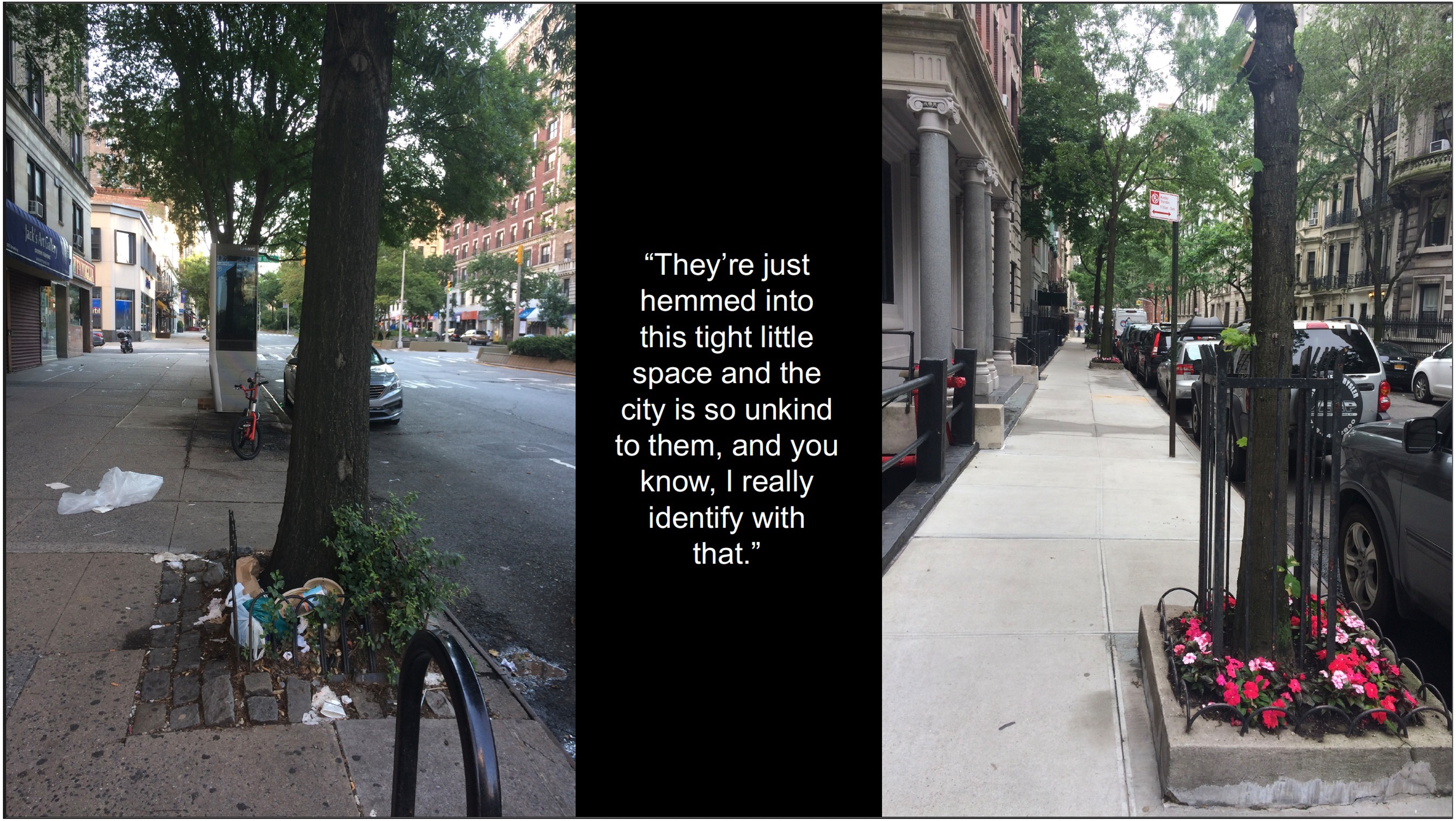
The life of a street tree, Manhattan, NYC. Photo credit the author.
Matt and Paul both found satisfaction in their experiences as tree stewards in ways echoed by others I talked to throughout New York City. Maintaining street trees was a way for these individuals to contribute to their city by improving the urban environment. This desire to contribute was rooted in a sense of disconnection and powerlessness. Roughly half of the tree stewards I spoke with referenced the isolation and anomie of modern metropolitan life, and nearly as many referred to a feeling of paralysis and powerlessness in the face of climate change. Maintaining street trees, though acknowledged to be a seemingly small gesture, is for these individuals a meaningful way of addressing these feelings (see also Campbell et al. 2022; Johnson et al. 2018).
Satisfaction was also evident in narratives about how maintaining street trees provided a way to enter relationships with the natural world that offered a sense of connection, delight, and growth (see also Svendsen, Campbell and McMillen 2016). Here, acts of mulching, watering, trash removal, and planting are more than managerial tasks to ensure optimal urban environments. They are ways that one finds oneself involved in ecological interconnectedness, giving to trees so that they might give to us. They are also, significantly, ways stewards find themselves being pulled by trees into affective and embodied relationships (cf. Hustak and Myers 2012).
Stewards like Matt and Paul accounted for the infrastructural roles of street trees in their maintenance practices and spoke glowingly about their participation in stewardship programs. Viewed in one way, their practices reflected an instrumentalized understanding of trees as infrastructures and a managerial notion of themselves as stewards. Their everyday relationships with trees, however, included more relational, emotional dimensions, with human and tree acting on one another. The affective pull of mutualistic human-tree relationships found a place within the stewardship of green infrastructure. Here human-tree involutions seem to knit together the space between best practices of green infrastructure stewardship and lively urban socio-ecologies. This, however, is not consistently the case; sometimes trees interacted with social relations to pull this space farther apart.
To Make Someone's Day
I met Susan, a white woman, while walking down a street on Manhattan's Upper West Side in June 2019. Susan was measuring the dimensions of a tree bed, and I stopped to ask her why. She explained that she and the other residents in her co-operatively owned building were going to plant flowers in the beds. Most of the trees in question were honey locust (Gleditsia triacanthos), which made doing so difficult. Honey locust are popular in New York City for being a naturalized and salt-tolerant tree. These trees, however, inhabit their surroundings differently from many other species found in the City. Their roots grow along the surface, forming impressive masses that inspire complaint from many stewards. Lucas, who looked after the street trees in the business improvement district neighboring Susan's building confessed one day that “I hate honey locust. I know they are salt tolerant and everything, but their roots grow at the surface and it's so hard to plant in their beds.” In my experience working alongside Lucas, it is indeed very difficult to carve out space among honey locust roots to plant anything.
Many New Yorkers solved this problem by dumping planting mix on top of the bed, effectively adding a layer of top soil to garden in, but also inviting fungal infection to the trunk in the same way a “mulch volcano” does. During our conversation Susan explained that she had “heard somewhere” you weren’t supposed to put soil or mulch up next to the tree trunk because it harmed the tree so she had devised a design wherein a layer of planting soil would be deposited in a U-shape along the outer edge of the bed, held in place by a panel in the tree guard (Figure 2). “It seems like a lot of trouble,” I commented. “Why plant in the tree beds at all?” Susan responded: “To give it a bit of pop.” She elaborated on how nice it was to turn the corner down a street and see colorful flowers, how it cheered her up and she hoped by planting in their building's tree beds, she and her fellow residents could help make someone's day too. I followed up with Susan later in the month, to see how the beds turned out. I admired the ring of ornamental plants and commented on the cleverness of the U-shaped design. Susan responded at length about how much creative satisfaction she had derived from the enterprise, and how she enjoyed working together with people to learn about plants and to put that knowledge into practice. She felt they were really making a difference on the block.
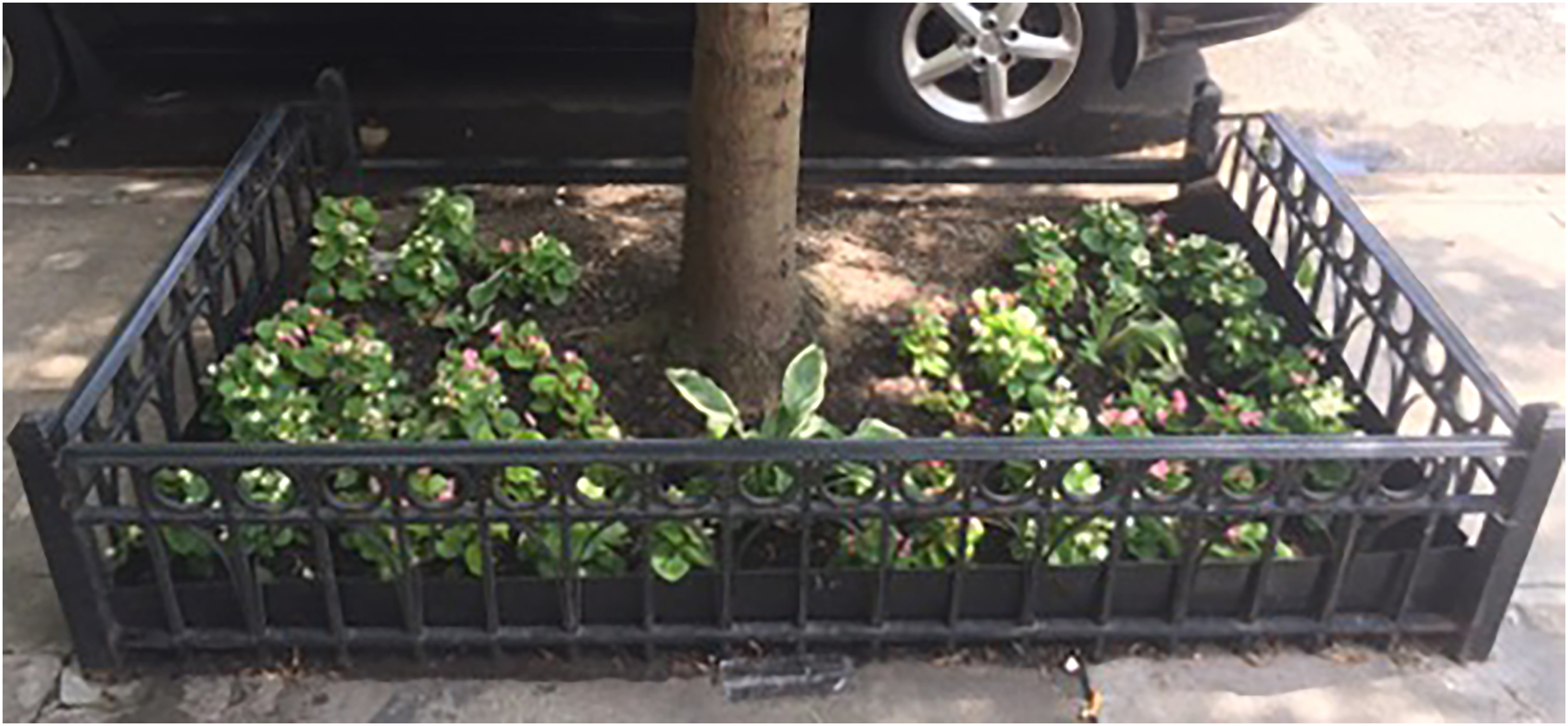
Susan's tree bed. Photo credit the author.
It is important to note that Susan had received no formal stewardship training and did not use concepts like ‘infrastructure’ or ‘stewardship’ to describe or frame her actions. Nevertheless, she had clearly heard about some of the best practices of green infrastructure stewardship, like avoiding mounding soil or mulch against tree trunks. It is also clear that the infrastructural functions of the tree and tree bed were not Susan's or her neighbors’ top priority. The panelling they installed greatly reduced stormwater absorption by blocking flow directly from the sidewalk into the bed. The arching branches and delicate compound foliage of the honey locust trees made them welcome residents of the block, however, and while Susan knew little about tree biology or best practices of maintenance, she took their welfare seriously. In comparison to the sufferings of untended trees in the City—soil compaction from foot traffic, scars from car doors, nitrogen burn from urinating dogs—and the toll that weedy, trash-filled beds take on streetscape aesthetics, Susan's efforts can hardly be condemned. Moreover, a “pop” of color as you turn the corner really does brighten your day, and in all my conversations with New Yorkers about how street trees and tree beds could be improved, less trash and more flowers was a nearly universal sentiment.
In infrastructural terms, however, Susan is not a particularly good steward of the City's green infrastructure. While the trees are likely to stay healthy through Susan's attentive care and they will continue to shade and cool the street, their ability to absorb stormwater, a crucial function of New York City's green infrastructure, was severely compromised by Susan's efforts to improve the streetscape and the spirits of her neighbors. Moreover, in my conversations with Susan she never discussed having a particularly emotional attachment to the trees. This absence did not, however, mean that Susan was not being affected by her street's honey locusts. Their appearance pleased her and her community and pulled Susan toward caring for them. This momentum, however, intersected with Susan's desires and the trees growth patterns in a way that propelled her away from good stormwater management practices.
Stewardship and Human-Tree Involution
Stewardship—as a discourse and practice—is a key part of making trees infrastructure in New York City. It draws in residents motivated to connect with the community and nature and contribute to environmental sustainability and civic life in their city. Programs based on teaching and supporting stewardship instruct volunteers in expert-determined best practices for street tree maintenance to realize street trees as functional green infrastructure. This, in turn, aligns the stewardship of New York City's environmental and infrastructural resources with neoliberal modes of governance by devolving maintenance to private individuals and organizations. This is only one facet of the human-tree encounter, however, because more than maintenance is happening in the stewardship of green infrastructure. Stewards experience social and ecological connections as well as feelings of health and community as they make sense of the ways their motivations, knowledge, and ethics meet other people and trees in practice. These experiences of tree stewardship are situated in the space between best practices of green infrastructure maintenance and the lively socio-ecologies in which tree and steward are embedded. Here what is understood as optimal conditions for tree-based stormwater management must contend with human neglect, the vagaries of the urban environment, and competing interests from, for example, streetscape aesthetics. In an idealized form, it is the role of the steward to meet the tree amidst this lively street socio-ecology and pull it into alignment with green infrastructure best practices. As the stories recounted here suggest, however, the tree is an active participant in these meetings, pulling upon people even as stewards’ own identities and experiences shape the everyday practice of stewardship. The two end up entangled in material relations and affectively charged ecologies, following through in a movement toward one another that Hustak and Myers (2012) term involution.
This involutionary momentum can propel human and tree along a trajectory that supports stewardship narratives and best practices of green infrastructure maintenance, as happened for Matt and Paul or during our work in Queens. Sometimes, as in the case of Susan, it does not, for the trajectories of human-tree entanglement are shaped by what is brought to the encounter. Trees bring their needs for soil and water, along with their own particularities like the London plane's susceptibility to anthracnose fungus or the honey locust's surface spreading roots. Likewise, humans bring a host of factors, from collective concerns about streetscape navigability and aesthetics to individual desires for connection and efficacy. In the case of street tree stewardship in New York City, people may also bring knowledge, gained through civic stewardship programs, about combined sewer overflow, nature-based solutions for climate adaptation, and best practices for green infrastructure maintenance. Each human-tree encounter is laden with a different assortment of factors, which in turn generate different involutionary trajectories. Matt and Paul's desires to connect and formal training combined with their and the street trees’ shared experience of harsh, cramped living conditions impel them toward best practices of street tree stewardship. Meanwhile, Susan's desires to beautify her neighborhood and lack of training met the particularities of honey locust root growth to produce a trajectory away from good stormwater management. Centering plant agency, asking what trees are doing to people, helps us sense the complexity of human-tree encounters (Ergas and York 2021; Lawrence 2021). For as the examples presented here demonstrate, stewardship does not foreclose the possibility of involution. Indeed, by facilitating human-tree entanglement, stewardship-driven programs become part of a “ruderal” re-making of urban life and landscape, producing unintended effects amidst climate change, neoliberal governance, and techno-managerial approaches to environmental sustainability (Stoetzer 2018). When named or identified in official discourse or programing these entanglements are routinely reduced to co-benefits, but they are recognized and valued as ends unto themselves by those who in engage in them, from Parks employees to trained street tree stewards to wayward ethnographers.
More instrumental framings of stewardship persist alongside the more relational, entangled practices of humans and trees, and continue to influence how human-tree encounters occur. This supports arguments that concepts like stewardship and green infrastructure are ways our relationships to nature are ordered and re-ordered, and reminds us of the importance of continuing to examine how histories and political economies shape human-plant relations (Klepacki and Kujawska 2018). In New York City trees are instrumentalized as stewards recount the benefits proper maintenance of street trees is meant to insure (Battistoni 2017), and the role of humans valorized as that which keeps nature thriving (Myers 2019) and ensures service provision (Nelson and Bigger 2021). Moreover, stewards’ enthusiastic embrace of this labor supports and legitimizes neoliberal modes of environmental governance that leverage New Yorkers’ desires to connect and contribute in order to address climate change adaptation and resilience without requiring changes in institutional arrangements of finance and management, all while reinforcing individual action as the appropriate site of behavior change. Within the conceptual and practical capaciousness of stewardship, human-tree entanglement sits alongside the re-production of these discourses and relations that would undermine both human and tree flourishing.
Broader concerns about the equity of green infrastructure interventions are also relevant to conversations about stewardship (Andersson et al. 2019; Nyelele and Kroll 2020). In New York City, the socio-demographic profile of informal tree stewards is unknown, though observation and anecdote suggest a wide diversity of residents participate. Formally trained stewards, on the other hand, tend to be white, middle class, and highly educated (Johnson et al. 2018), and by focusing on formally trained stewards my research also focused on the experiences of primarily white, highly educated, middle-class New Yorkers. While the significance of vegetal agency in shaping human-tree encounters is not undone by this focus, it leaves open questions about how the trajectories of these encounters change when differences in class-based aesthetics (Maurer 2020), enactments of environmental injustice (Checker 2021), and experiences of race and class-based inequalities and violence (Carmichael and McDonough 2019; Finney 2014) are brought to bear. Going forward, particular attention and analysis need to be given to both who participates in human-tree involutions via stewardship (McLain et al. 2017) and why those individuals and not others, as well as other sites where human-plant involutions may be occurring (e.g., foraging, Marquina et al. 2022). Further consideration of the ways these involutions are enrolled in or resist environmental gentrification is also warranted. The relatively intimate scale of involutionary encounters opens questions about whether the trajectories of human-tree entanglement can be scaled into political projects that can, for example, resist the linkages between improved environmental quality and dispossession.
Such questions are important because stewardship is a practice often in abundance of the instrumental framing and managerial best practices presented in policy discourse and official programming. While this aspect of street tree stewardship does not discredit critiques regarding social and environmental injustice, instrumental human-nature relations, and neoliberal modes of governance, it does invite further exploration. For affective, embodied human-plant relationships are also occurring, like the moment a group of street tree stewards in Queens felt in our bodies the damage done to the bark of a neglected tree. These moments are like root tendrils seeking water through cracks in pipes and walls; they wend through instrumentalist and managerial discourses and ask us to follow involutionary trajectories in other directions. They invite us to consider the ways engagements with street trees can provide a basis for imagining post-Anthropocene—planthroposcene (Myers 2017)—subjectivities. Or put another way, allowing oneself to feel the affective pull of a tree in one's body may help realize ways of being human that seek to “conspire with plants to imagine livable futures for us all” (Myers 2019: 147). Stewardship does not ask a person to be transformed by their encounter with a tree, but it does provide an encounter that may enable trees to act on people such that our ways of relating to nature are transformed, however fleetingly, into something less anthropocentric, instrumental, and exploitative. Like a tree whose branches spread out and over, protecting what lies beneath from rain and sun, giving young seedlings protection to root and grow, the frame of stewardship acts as a “discursive canopy” in the realm of urban forestry in New York City. Here, stewardship is less a boundary object, bringing together instrumental, managerial approaches with ethically motivated human-nature relationships (Enqvist et al. 2018), and more a key part of a “ruderal ecology” making possible affective, embodied relationships otherwise un-named and un-nurtured to emerge amidst the ruins of climate change and neoliberal governance (Stoetzer 2018). Stewardship protects and holds space for the creative moments when ethics and affect can meet and experiments with other possible human-nature relationships emerge (Lewis 2015; Vine 2018). Relationships predicated on mutuality and recognizing vegetal agency, where the tree is an acknowledged participant able to act on humans as much as humans act upon it.
It is this ability of trees to affectively charge encounters with humans that makes the maintenance of green infrastructure such a fertile place of plant-anthropo-genesis. Multispecies infrastructure is uniquely situated in this regard, as it renders explicit interdependency and maintenance requires some degree of seeing the world the way a plant does (Hall and Smith 2015), conditions of possibility Morita (2017) terms “infrastructural involution.” Street trees are sites, like gardens, for staging relationships between humans and plants (Myers 2019). While civic stewardship programs attempt to stage one kind of relationality, predicated on techno-managerial approaches to environmental governance, by providing a discursive canopy for lively and potentially unruly humans and trees, they make possible affective embodied encounters, human-plant involutions, moments to imagine and experience a world otherwise.
Footnotes
Declaration of Conflicting Interests
The author declared no potential conflicts of interest with respect to the research, authorship, and/or publication of this article.
Funding
The author disclosed receipt of the following financial support for the research, authorship, and/or publication of this article: This work was supported by the National Science Foundation, Sustainability Research Network Grant (#1444745): “Integrated Urban Infrastructure Solutions for Environmentally Sustainable, Healthy, and Livable Cities.”.
