




Abstract
We offer first, exploratory evidence into a design element employed by many artists and curators to maximize impacts of art interventions towards attitude change—the anticipation and design for specific emotional experiences. In two exhibitions involving refugee acceptance (Study 1, N = 41) and climate awareness (Study 2, N = 49), we collected curator/artist-provided sets of specific intended emotions, matched to viewer reports and to changes in attitude measures via a pre-post design. In both studies, viewers felt more intended emotions and were proficient at identifying how they were intended to feel with, in Study 1, significant relation between the former and agreement that the exhibition had caused one to reflect. In Study 2, feeling more intended emotions, as set by the curator but not the artist, correlated to changes in nature connectedness. However, feeling more emotions in general, regardless of intentions, was consistently the strongest driver of effects, raising new implications for emotion-, arts-based-, and intervention-research.
“What a pity I preached to them. A sermon is so much more likely to cake into mud, and close the fountains, than a psalm or song” (D. H. Lawrence, The Man Who Died, 1929, p. 35)
Art––as a central component of human communication and human culture––has also long been seen as an agent for effecting individual and societal development. Art fulfills a niche across our societies, providing a range of avenues to represent, to explore, share, and to critically discuss our perceptions, our worldviews, and our individual experiences (Pelowski et al., 2017). This continues to the present day, with artists, institutions, and other public and private stakeholders especially recognizing this potential and seeking to apply the arts to modify our feelings, to change or beautify our spaces (Belfiore, 2002; Mathews, 2010), and to ameliorate our wellbeing or health (Chatterjee & Noble, 2017; Thomson et al., 2018; Todd et al., 2017; Tymoszuk et al., 2020; see also Cotter & Pawelski, 2022; Fancourt & Finn, 2019; or Trupp et al., 2025).
Equally intriguing, although less empirically explored, art is argued to provide a means of directly transforming our behaviors and thoughts. Long suggested as a means of communicating ideas and values (Deaton, 2015) or of educating viewers (Belfiore & Bennett, 2007; Lawson, 2014), recent initiatives aim to build on this power of art. Often in the form of focused exhibitions, installations, or collaborative projects, the arts are increasingly applied to target a range of contemporary topics. From shaping awareness and attitudes regarding immigration and refugees (Briciu, 2020; Mendelssohn, 2018; Papouli, 2017; Tate, 2019), to mediating responses to homelessness (Peters, 2019), or to tackling the climate crisis (Galafassi et al., 2018; Lee, 2021; Marković & Petrović, 2021; Pinsky & Sommer, 2020; Roosen et al., 2018; Sommer et al., 2019; Sommer & Klöckner, 2021), these applications (see also examples in Figure 1) have increasingly been featured by major international cultural organizations and arts festivals (Venice Biennale, Alemani, 2022; Venice Biennale, Pedrosa, 2023; Documenta fifteen, 2022). They are the target of policy and funding (European Commission, 2023), and drive the practice of many curators and working artists (Kidd & Jackson, 2010; see Pelowski et al., 2024 for review; Roberts et al., 2011). Because of its diversity, its omni-presence, and its ability to effectively deliver its message––perhaps with more nuance and resonance than other means––art is seen as a particularly powerful vehicle for such ends (Hall & Robertson, 2010; Klöckner & Sommer, 2021; Marks et al., 2016; O’Neill & Nicholson-Cole, 2009; Pelowski et al., 2024; Roosen et al., 2018; Trumbo & Shanahan, 2000; Weber, 2006).
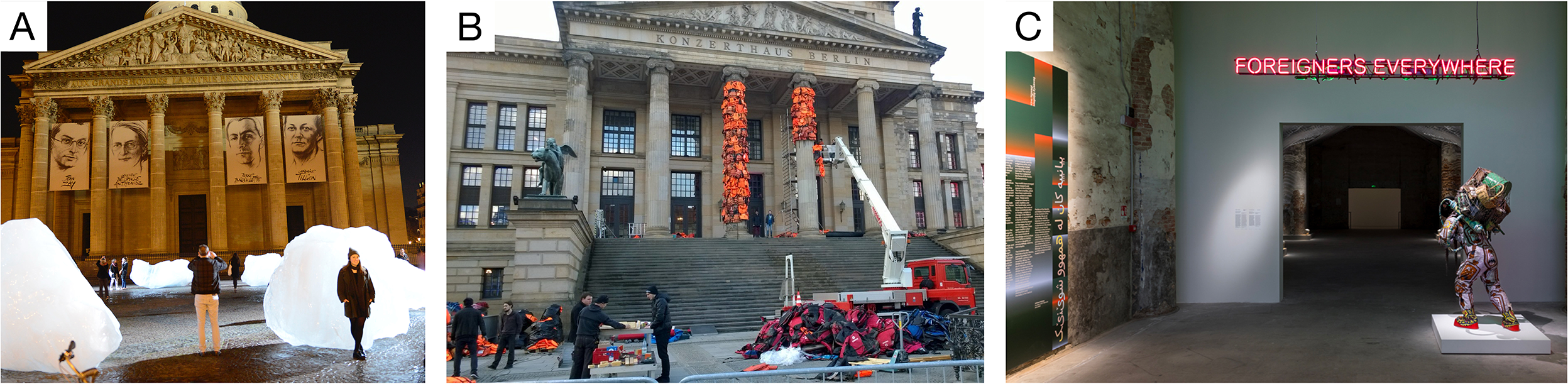
Examples of Socially-Focused Art Interventions and Artist/Curator-Stated Emotional Aims. (
At the same time––and despite this widespread interest and growing application––there are key outstanding questions, especially regarding art's ability to prompt social and individual change. There is, on the one hand, still a need for more data. While there is increasing advocacy, this often remains at the anecdotal level. Very few studies have empirically looked into the ability to detect attitude or behavioral changes in individuals (e.g., see Pelowski et al., 2024 for recent review). Of the extant studies, most tend to be generally anecdotal or pilot-level observations (Atlas, 2009; Hahn & Berkers, 2021; Keller et al., 2020; Klöckner & Sommer, 2021; Szubielska et al., 2022), administered only post-intervention, without matched baselines, and, thus, lacking the ability to actually detect specific statistical changes that can be attributed to the intervention itself (Aricat et al., 2014; Cavnar-Lewandowski & Gavin, 2017; Papouli, 2017; Pitt, 2019; Sommer et al., 2019; see Pelowski et al., 2024). Providing this evidence is, in fact, argued to be one of the most needed targets for the emerging field of art-based interventions (Belfiore & Bennett, 2007; Pelowski et al., 2024) as well as, more broadly, for any effort that seeks to effect meaningful and widely applicable benefits via the arts (Clift et al., 2021; Trupp et al., 2022).
On the other hand, in the handful of studies that have employed pre-/post-designs or other controlled measures, results have been mixed, suggesting small effect sizes (Aricat et al., 2014; Sommer et al., 2019; Zazulak et al., 2015), large inter-individual variance, or showing no significant differences between arts-based and other ‘non-art,’ or even non-topic-related, conditions (see footnote as well as Pelowski et al., 2024, for review). 1 These limitations, while not unique only to discussions relating to the arts (see Abrahamse et al., 2005; Möser & Bamberg, 2008; Rees et al., 2015 for similar discussion of environment-focused marketing campaigns), have coincided with a growing questioning, from both scholarly and popular/policy perspectives, of art's efficacy to really act as an efficient or effective solution for targeting attitude change (Belfiore & Bennett, 2007; Belfiore & Bennett, 2010; Gaztambide-Fernández, 2013; Mendelssohn, 2018; Trupp et al., 2025 for review).
At the very least, authors argue for the need of a better, more nuanced understanding of arts engagements, the key contributing mechanisms or factors, and especially how interventions might be better designed to maximize outcomes (Belfiore & Bennett, 2010; Cotter et al., 2024; Fancourt et al., 2021; Gaztambide-Fernandez, 2013; Trupp et al., 2023). For example, even when attempting to mediate engagement via additional approaches––such as by providing contextual information or explanations on an artwork's aim (see e.g., Pitt, 2019 above; but also Keller et al., 2020)––results have still been limited, leading to further demands for other, less ‘didactic,’ more effective means (Keller et al., 2020; Sommer et al., 2019).
The present paper explores one particularly intriguing answer––emotion. Specifically, we consider the ability of curators or of artists to target a viewer's complex emotional responses, as a design element, to prompt socially-focused attitude change via art.
Emotion––A Key Mediator for Attitude Change within Intervention Design?
The relation of emotion to attitudes and behaviors is well established in psychology and communication sciences. On a very basic level, it is argued that emotions play a primary means of feedback on, and our resulting interpretations of, our actions and the surrounding environment. As put by Schwarz (2011, p. 9; see also Keltner & Oatley, 2022; Schwarz & Clore, 2003), feelings or affect may provide some of the earliest and most salient “information about [a] person's own response to [a] target,” and thus are a primary means of guiding interpretations as well as of directing responses. Research (e.g., Moser, 2016; Thompson, 2006) has, in turn, shown that, especially if individuals must make immediate decisions or have little other information to work with, they may often resort to their feelings when assessing or interpreting people, situations, and even values.
Emotion may also be key in directing attention, alerting us to what is important or to things which we should give more careful assessments (Curtis, 2010; Leder et al., 2004). It is also linked to aspects such as self-relevance or a feeling of importance for one's own ideals and existence (Hoijer, 2010; Keltner & Oatley, 2022; Swim & Bloodhart, 2015; Weber, 2006), and, thus, via these aspects as well, is connected to directed behaviors (i.e., helping of others, self-protection, reparation; Devoldre et al., 2010; Wilson & Arvai, 2006; see Swim & Bloodhart, 2015 for review) or otherwise to providing meaning for information and context. Emotion is also argued to be particularly important in navigating social situations, providing, as put by Keltner and Oatley (2022, see also Stamkou, 2022; see also Oatley et al., 2018) “a grammar of social life” that “help[s] us understand the moral framework of situations,” and is, in turn, suggested to touch even more basic discussions of empathy and understanding of others (Gerger et al., 2018; Singer & Lamm, 2009).
Emotion is, in turn, highlighted as an avenue for impacting individuals and for creating persuasive arguments. In communication studies (see, e.g., the Elaboration Likelihood Model, Petty & Cacioppo, 1986), emotion is suggested as a main component of a “peripheral” versus a “central” route. Whereas central processing is tied to more conceptual consideration of a message, involving weighing of meaning and consequences, peripheral processing involves often more acute reactions to affective cues, which researchers suggest may in fact influence attitudes or decisions more directly and independently of cognitive structure (Bodur et al., 2000; see also Kahneman, 2011). See also Stanojlović et al. (2021) for discussions of pathways linking emotions and actions at the level of the brain. This use of emotion is also a key component of marketing and advertising, where researchers suggest that, beyond simply showcasing products or giving information, effective ads must develop a certain “feel” which may resonate with consumers, and even generate similar understanding across groups (see He et al., 2021 for recent review). This is also supported by studies, which suggest that creating emotional connections with products, or even consumer designs, may lead to greater success (e.g., Escalas & Stern, 2003; Norman, 2004; see for review, Vaidya & Kalita, 2021). Similarly, decision making literature (Pfister & Böhm, 2008) highlights emotions as fulfilling a “relevance-” or “commitment-function,” motivating people to act.
Following these same arguments, emotion has been emphasized as an effective means for targeting societal challenges. For example, in discussion of approaches to climate change (Brosch, 2021; Brosch & Steg, 2021; Moser, 2016; Roeser, 2012; Stoll-Kleemann et al., 2022), emotion is suggested as a perhaps more effective candidate than didactic information. In discussions of communications or interventions, researchers similarly argue that strategies limited to only illustrating a problem or to transmitting knowledge, through, say, scientific papers or newspaper articles, are not sufficient to trigger changes or will soon be forgotten (Marković & Petrović, 2021; Pinsky & Sommer, 2020). Whereas designing interventions that target emotion may be key for creating stronger eventual understanding regarding implications of individuals’ decisions (Allpress et al., 2010; Brosch, 2021; Rees et al., 2015; Sommer et al., 2019; Sommer & Klöckner, 2021). Emotion––especially basic varieties––is also suggested to provide a relatively more culturally- or situationally-universal basis for communication and sharing experience (Sauter et al., 2010; but see also Elfenbein & Ambady, 2002), to the extent that affective responses have been suggested as the potential “missing link” (Roeser, 2012) in targeting especially complex, multifaceted societal topics (see also Curtis et al., 2014; Galafassi et al., 2018; Marks et al., 2016; Sommer & Klöckner, 2021).
Emotion, Emotional Journeys, and (Socially-Focused) Art
Emotion is also deeply connected to art. Since the Greek and Latin treatises on poetics, art has always been regarded as inextricably linked to emotions (Menninghaus et al., 2019; Swanger, 1993; Zangwill, 1999; see also Fingerhut & Prinz, 2018, 2020 or Pelowski et al., 2022 for reviews). Most models of art processing (see Pelowski et al., 2016, 2017 for reviews) foreground emotional reactions––positive/negative as well as more profound or esoteric states––as key outputs and also contributing factors throughout the art perception process. Similarly, for artists, imparting emotional reactions has been argued to be a guiding point for artworks that find resonance with an audience (Kozbelt, 2006; Tinio, 2013; Yegorova, 2018). Multiple studies do suggest that the more emotions are imparted, the deeper, the more sincere, and the more pleasurable the experience (Eerola et al., 2016; Gerger et al., 2018; Miu & Baltes, 2012; Zickfeld et al., 2017; although see also Rodriguez et al., 2024 suggesting that more complex emotional experiences are not necessarily more satisfactory or the result of more time spent viewing).
These different aspects of emotions are often linked to the intentions and to the designs of curators and artists. By both reflecting on their own feelings and by intuiting a future perceiver's response, artists may seek to better create their own work and target specific reactions in the perceiver's experience (Pelowski et al., 2020b). This may translate in viewer response (see Barwell, 1986; Pelowski et al., 2020b) to a combination of both intellectually recognizing how an artist may have wanted one to feel, or decoding emotional content, as well as to one's actual feeling states, both of which have been tied to more positive, self-related outputs (Pelowski et al., 2022). These emotional targets are also connected, potentially, to attitude change. Stamkou (2022), for example (see also Belfiore & Bennett, 2007; Keltner & Oatley, 2022), suggests that “when engaging with a work of art, people [may] experience and develop a shared understanding of the emotions communicated through the artwork” and that “the arts …enable individuals to understand a culture's [or a topic's] emotional patterns,” that may “have downstream consequences” on behavior.
The patterns or processes related to designed emotion may also be quite complex. Artists may often anticipate multiple reactions from an audience, thinking of an engagement as a nuanced mixture or journey that one might go through to a desired end. Such patterns, which could of course occur in many ways, are in fact one of the main design elements suggested for many socially-focused installations with art (see e.g., for empirical/theoretical studies, Curtis et al., 2014; Klöckner & Sommer, 2021; Marks et al., 2016; Roeser, 2012; Sommer & Klöckner, 2021; for examples of actual artist/curator statements, see again Figure 1).
Scholars suggest that one of the arts’ most powerful potentialities is such a degree of nuance or “openness” (Hegenbart, 2021, p. 126), allowing them to achieve what traditional “propaganda” or “political activism does not” (see also Groys, 2014; Gabriela Léon, as quoted in Hegenbart, 2021; Weibel, 2015). 2 Emotional progressions are also increasingly considered by curators, who similarly employ emotion as a “tool” (Norris & Tisdale, 2017) for exhibition design, using these to engage viewers and to drive awareness and impact of content (see also Falk, 2021; or Varutti, 2023 for discussion of an “affective turn” in curation; as well as Munro, 2014 who explicitly connect this design approach to curatorial focus on societal challenges). These mechanistic aspects, once again, operate in tandem with the other arguments highlighting the arts: enhancing memorability, meaningfulness (Pinsky & Sommer, 2020; Sommer et al., 2019); providing a necessary “aesthetic dimension” (Curtis, 2010, p. 78), where more didactic arguments “can turn people off”.
Empirical Evidence for Emotion as Mediator for Attitude Change in Art
Studies have begun to investigate emotion-related aspects, often at least suggesting complex patterns and their potential as a mediator of impact. In general, recent reviews of socially-focused behaviors (Brosch, 2021; see also Myers et al., 2023; Rees & Bamberg, 2014; Stoll-Kleemann et al., 2022) have shown connections to reported emotions in regards to these topics. Studies have also shown evidence from more experimental designs that explicitly test the role of emotions in ‘art-like’ media contexts. Rees et al. (2015) report an intervention in which individuals were presented with a short text noting that either directly human-caused (e.g., air pollution) or indirectly human-/nature-caused issues (e.g., earthquakes, volcanos) were threats to the environment (compared between groups), and with the former expected to elicit more “moral emotions” (guilt and shame). Reported feelings of these emotions, but also anger and sadness, significantly, and each independently, mediated intentions to act (assessed post-intervention). “Emotional coldness” showed opposite effects. Swim and Bloodhart (2015) report an online study in which adults were presented with pictures of polar bears with a caption describing the threat of climate change to these animals. This was accompanied by a written prompt to either encourage an “emotional” perspective, where participants were asked to imagine how the animals felt, or a more “detached” prime, with participants asked to focus on the image quality, as well as by both no-prompt or no-intervention conditions (all contrasted between participants). Although they reported no main effect of the interventions, participants in the emotional perspective were more likely to donate a portion of their payment ($1.00 USD) to environmental causes. Participants who reported feeling greater magnitudes of emotions (again a blend of, for example, empathy, distress, worry, hope, guilt, shame), as well as less boredom, were more likely to donate and to support environmental groups. Lai et al. (2016) reported a comparative investigation of 18 interventions meant to reduce implicit biases, several of which were formally similar to art (i.e., stories; positively or negative-associated pictures). They suggested that, while varying widely in design, the most effective interventions were emotionally evocative and allowed individuals to personally share the “vivid” experiences of others (see also Appel & Richter, 2010; Richeson & Nussbaum, 2004 for similar results).
A handful of studies have also recently begun assessing art contexts. Sommer et al. (2019) in their questionnaire-based study of visitors’ reactions to an art installation, “Pollution Pods,” designed to allow individuals to experience different degrees of air pollution in cities (see Footnote 1 above), showed that, beyond a small general effect on increased agreement with the intention to “do something to actively prevent climate change/environmental problems in the future,” those who reported experiencing more emotions (sadness, helplessness, anger, awe, inspiration, surprise, guilt, shame, happiness, pride, etc., each considered independently) were significantly more likely to report attitude change. Klöckner and Sommer (2021) reported survey evidence of audience responses from 37 visual arts events collected at ArtCOP21in conjunction with the 21st UN Climate Summit. Participants were asked to report on different emotions felt in their engagements. Multilevel-structural equation modeling suggested that both positive and negative responses significantly related to perceived artwork quality, heightened reflection, and policy support. Similarly, Kühnapfel et al. (2025) report on the impact of an exhibition visit on neighborhood connectedness, which suggested that most participants reported a blend of positive but also mixed emotions.
See also Marks et al. (2016) for qualitative evidence from an environmentally-focused land art festival, which suggested, again, moderate general impact (of N = 120 respondents, 41% indicated that they “intend[ed] to change their behaviour”). At the same time––and unlike other factors such as length of time, number of visits, or demographics––emotion showed relation to professed change in behavior (see Curtis, 2010 for a similar case report). 3
Complex Emotion Characterizations; Connecting Viewers to Curators and Artists––Promise but also Limitations in Art Emotion Research
At the same time, research is still not without outstanding questions. First and foremost, much as with the general topic of interventions discussed above, most studies still only involve correlations between reported feelings and intentions as stated by an audience (e.g., Rees & Bamberg, 2014) or are only anecdotal and assessed post-intervention (Curtis, 2010; Klöckner & Sommer, 2021; Marks et al., 2016; Rees et al., 2015; Swim & Bloodhart, 2015). Results have also not revealed clear, systematic evidence for the specific contributions from emotion factors. In the “Pollution Pods” art installation above, Sommer et al. (2019) report that, although a significant contribution to attitude data, emotional effects only increase the adjusted R2 over a model with a number of basic demographic and pollution-focused factors by 3%. See also Pitt (2019), who reported a pre/post study on music meant to “emotionally” connect viewers with the impact of climate change, contrasted against a scientific article, a presentation of both article and music, and an unrelated musical piece. Contrary to expectations, they found no between-conditions difference.
Potentially related, studies tend to consider rather limited sets of emotions. Most studies have considered only one or a handful of specific (i.e., social) responses, or may otherwise have a rather limited approach for how emotions are selected, combined, or considered. For example, Rees et al. (2015) reported impacts from their target emotion of guilt but also noted relations to sadness and anger, but not pride, which, surprisingly, showed opposite effects. Sommer et al. (2019) reported sadness, helplessness, anger, but also inspiration, surprise, guilt, happiness––all of which were considered individually and with most showing some relations to attitude change. The study by Klöckner and Sommer (2021), while asking participants to report on a number of specific emotions, ultimately only looked at their combinations into basic positive or negative valence, both of which again showed effects (see also Myers et al., 2023). Thus, it may be that such studies have missed or obscured impacts from more complex emotional experiences.
More theoretically, these results, and even the accompanying interventions, could feed into counter-arguments against emotion as a means for attitude change in the first place. Much as artworks or other communications that are too direct or ‘on the nose’ regarding how individuals should think or act could lead to underwhelming or even opposite results, similar effects might be found from art that too overtly seeks to determine what should be felt or that does evoke certain specific feelings (see e.g., Groys, 2014; Hegenbart, 2021). For example, interventions that confront individuals with specific unwanted felt emotions could push them away or terminate further thoughts on a topic due to a desire to avoid the associated distress (Moser & Dilling, 2007; Slovic et al., 2007; Swim & Bloodhart, 2015). Notably, such effects may have been found in the Sommer et al. (2019) study where, while certain emotions (sadness, helplessness, anger) did show a positive relation to attitude change, so-called “moral emotions” of guilt and shame showed negative trends. Hegenbart (2021) makes a similar argument, taking as an example the Holocaust memorial in Berlin, which, she argues, may be too easily framed as only a “monument of shame” and dismissed. See also literature on the topic of “reactance” or tendency to push back against didactice or manipulative messaging (Brehm & Brehm, 2013; see Ratcliff, 2021 for recent review). See Swim and Bloodhart (2015) for an art-based, as well as Allpress et al. (2010; also Nurmis, 2016; Rees & Bamberg, 2014; Reser & Bradley, 2017; Täuber & Van Zomeren, 2013) for similar ambiguous findings across non-arts interventions.
Also related to the above argument, suggestions have been made regarding potential key differences in emotions that are felt versus simply recognized, especially again in the context of overly narrow, emotion-eliciting art. A longstanding discussion in art theory (often under the umbrella-term of ‘Kitsch,’ see Pelowski et al., 2020a for review), suggests that artworks that are too obvious or clearly about specific feeling may have limited impact. As put by Gombrich (1985, p. 62), this is “not because [one] has failed ‘to pick up the message’ but because [they] understand it all too well” (see also Adorno, 1997). Past studies with climate change-related art (Hastings et al., 2004; see O’Neill & Nicholson-Cole, 2009 for review) suggest, for example, that especially laboratory-based intervention often lead to individuals being able to state or ‘understand’ particular emotion-centric approaches but without personally being moved by such messages (see Moser & Dilling, 2007; O’Keefe, 2002 for similar arguments in general climate change research). Thus, once again, these approaches may be overlooking one of the key features, especially of art, involving a mixed ‘profile’ of affective experience. It may be the nuanced emotional mixtures––as suggested in the work of curators or artists––that might better lead to meaningful results. At the same time, current studies have completely omitted the actual intentions of the artist or other designers or curators. We do not in fact know what were such emotion-related aims or what specific form these may have taken.
On the other hand, arguments can also be made against artist or curator guidance. Especially in their discussions of the openness to engagement that might be important with art, scholars also argue that this may require that an audience actively guide their own affective or meaning-making process. As argued recently by Hegenbart (2021; see also Bourriaud, 2020; Groys, 2014; Marini et al., 2012; Nakajima, 2012), successful attitude-changing art “need not be driven by a goal-oriented artistic intention,” or aimed at “a direct …effect on the audience”. A similar argument has also been made specifically for the working artist. The nineteenth century idea of “Art for art's sake” (Pelowski et al., 2022; Zangwill, 1999 for reviews), suggests that a “true” (or maximally successful) artist should not care what the audience feels, or try to lead their experience along a designed emotional path. Worrying too much about this could lead to sub-standard, minimally impactful, art.
It could also be that emotions, in general, whether intended/designed or not, could get in the way of art's or other interventions’ intellectual impact. A longstanding counterargument to emotion-centered discourse, again related to art's ability to deliver knowledge or “truth,” is that individuals must find themselves in a more analytic, evaluative frame (Greppi, 2021). This so-called “aesthetic” mode (see e.g., Pelowski et al., 2017) is often connected to disinterested, intellectual engagement, free of visceral or individual-centered affect––a position often connected to art with more “conceptual” approaches or aims.
Present Study
This paper offers exploratory evidence on whether the emotions intended by artists or curators, and the degree to which they are felt or identified by viewers, might influence attitude change after an exhibition visit. This was achieved through the investigation of two exhibitions on socially relevant topics, involving refugee acceptance, empathy, prosocial behavior (Study 1), as well as the climate crisis (Study 2). Visitor engagement with both exhibitions was evaluated using a pre-/post-design, assessing the impact on standardized attitude measures.
These studies were further coupled with a unique opportunity to work directly with the curator (Study 1) or with both the curator and the artist (Study 2) to assess the emotions intended to be felt in the viewing experience. This approach followed an empirical paradigm introduced by our team (see Pelowski et al., 2020; Pelowski et al., 2022; also Demmer et al., 2023) in which we presented designers of exhibitions or individual art installations with a list of emotions or phenomenal states and asked them to select those that they specifically wished viewers to feel during their experiences. These unique ‘emotional profiles’ then allowed us to match, at the individual viewer level, the degree to which they had been felt by a visitor as compared to the reported experience of the non-intended emotions. We also considered viewers’ ability to detect emotion intentions regardless of their actual feelings, using approaches from signal detection theory, and with the degree to which participants reported having stronger emotional experiences and reported feeling more the intended emotions coinciding with generally higher liking and understanding as well as to a higher sense of meaningfulness and perceived intentionality (see especially Pelowski et al., 2020b).
By using this same method as a frame, this provided a means of exploring whether the designated emotions might correlate to changes in attitude scales––as both were specified by a curator and/or artist. The present study also allowed for new evidence assessing the curator's perspective and role as exhibition designer as well as (in Study 2) possible differences between curator and artist, which, to our knowledge, has not been considered in terms of a match to specific intentions (see e.g., Pelowski et al., 2024). This study also presented one more opportunity to systematically assess and to provide needed evidence for the potential attitude change impact of receptive arts.
Method—Study 1
Stimuli/Setting—“Show Me Your Wound,” Dom Museum, Vienna
For Study 1, we employed an art exhibition, “Show Me Your Wound” (“Zeig mir deine Wunde” in German), at the Dom Museum in Vienna (20 September 2018–25 August 2019). This addressed the topic of the vulnerability of humans, both at the level of the psyche and the body, as well as the implications for politics and society. As put by the curators in a book accompanying the show (Schwanberg, 2018, pp. 36–40), “everybody sustains injuries or feels threatened by the prospect of harm in the course of her or his own life.” In “recent years,” they continued, “tides of refugees and terrorist attacks in the public realm have increasingly pushed this dimension to the fore” (p. 32). “Through the exposure of [such] vulnerability,” they thus hoped, the exhibition might “bring about positive change” on this topic (pp. 37–38).
The exhibition (Figures 2, 3) included 40 + artworks in a range of visual and multisensory media, displaying examples of physical/mental wounding and with the aim of articulating the interconnectedness between physical and mental pain, as well as artworks constituting a main message of the show suggesting “that wounds are frequently caused by struggles for power and violent conflicts originating in political, religious, or gender-based oppression” (p. 43). This included examples (Figure 2, B) such as a bomb disposal suit from the wars in Afghanistan, or a video piece in which a young, deaf Syrian child conveyed through body gestures and movements his experience of the occupation of his village and his flight from ISIL (Figure 3). The last section showed other examples of wounding as well as showing more hopeful works with the aim of conveying the message that “wounds will only heal if the individual …gets actively involved” (p. 44).
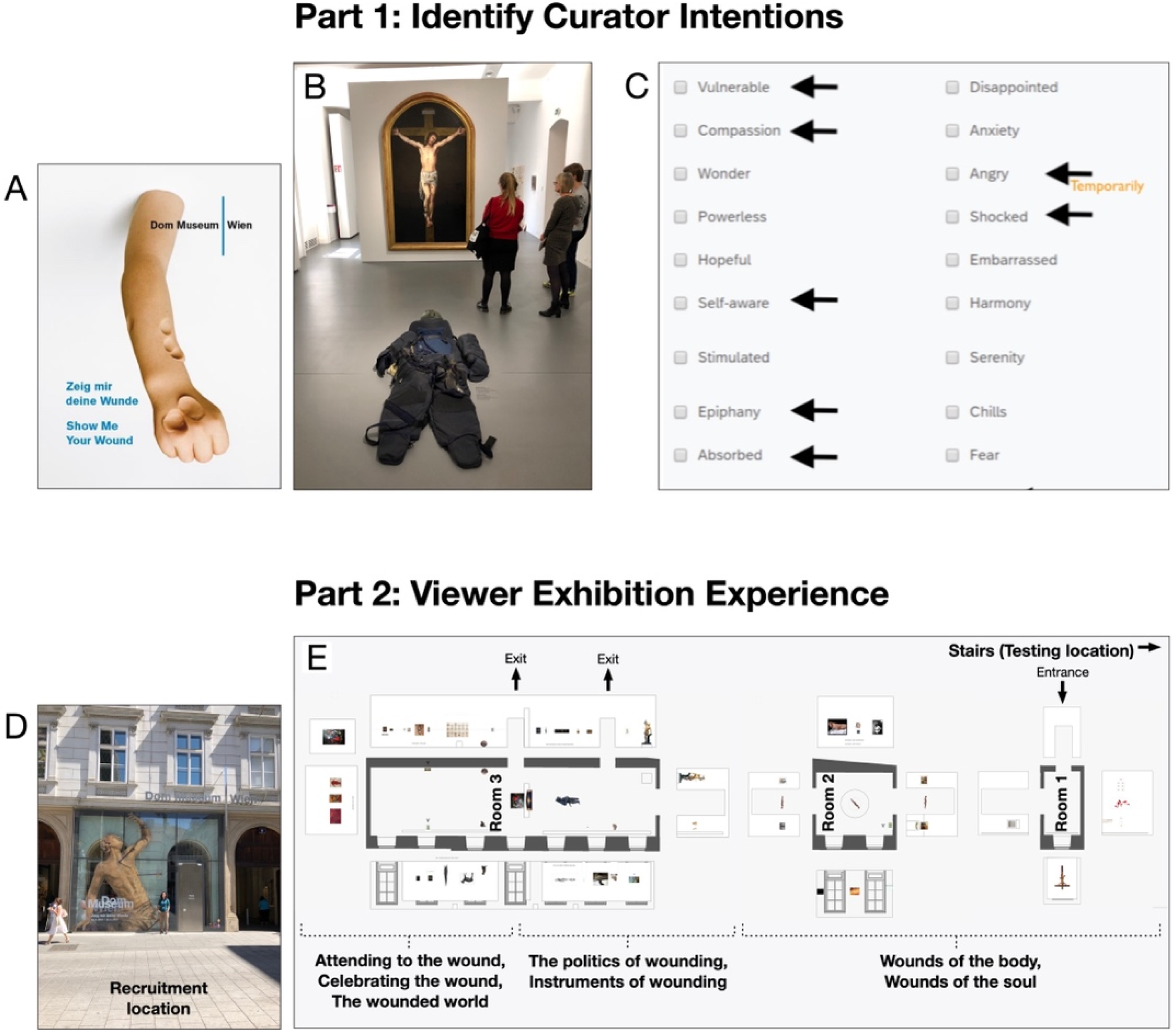
Overview of Study Components and Exhibition Design, “Show Me Your Wound” (“Zeig Mir Deine Wunde”), Dom Museum Vienna. (
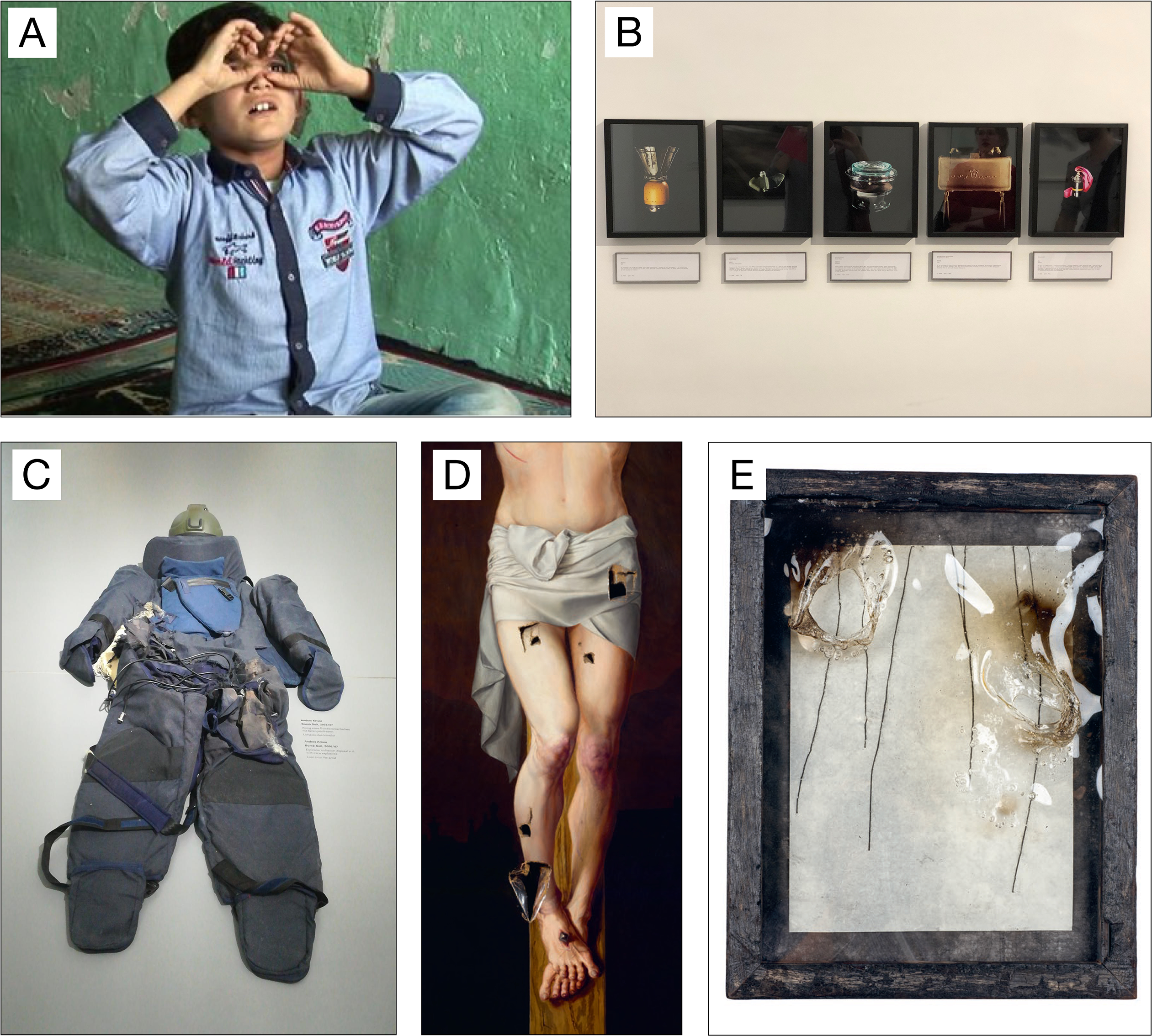
Artworks from “Show Me Your Wound” (“Zeig Mir Deine Wunde”), Dom Museum Vienna. (
Part 1: Curator Intentions Regarding Attitude Change and Emotional Experience
To identify target attitudes or behaviors that the curators wished to address through their exhibition design, we conducted an interview (K. Speidel), with the main question: “Imagine an ideal visit to the exhibition. What attitudes, behaviors, or other types of reflection would you like a viewer to report doing or changing as a result of their visit?” Answers, which echoed those also noted in the printed book discussed above (Schwanberg, 2018), included keywords such as “acceptance of others” (especially of refugees), “compassion,” “xenophobia,” “empathic concern,” and “prosocialness.”
To identify the emotions that the curator had specifically targeted for viewers in the exhibition design, we then provided a list of 36 items, with the instructions that the curator should again imagine an ideal visit to the exhibition and identify (by ticking a box, see Figure 2, C) those responses, if any, they would like a visitor to report feeling. The procedure was based on the previous studies of Pelowski et al. (2020, 2022) and included an emotion list (see Figure 4, below) designed to give a broad range of possible feelings, including classic ‘basic’ emotions, from positive to generally negative valence, as well as epistemic and also social or more ‘moral’ emotions as used in many past intervention studies. In addition, the curator had the option of suggesting additional items––in this case, two (“vulnerable,” “compassion”)––which were added, leading to a final total of 38 emotions.
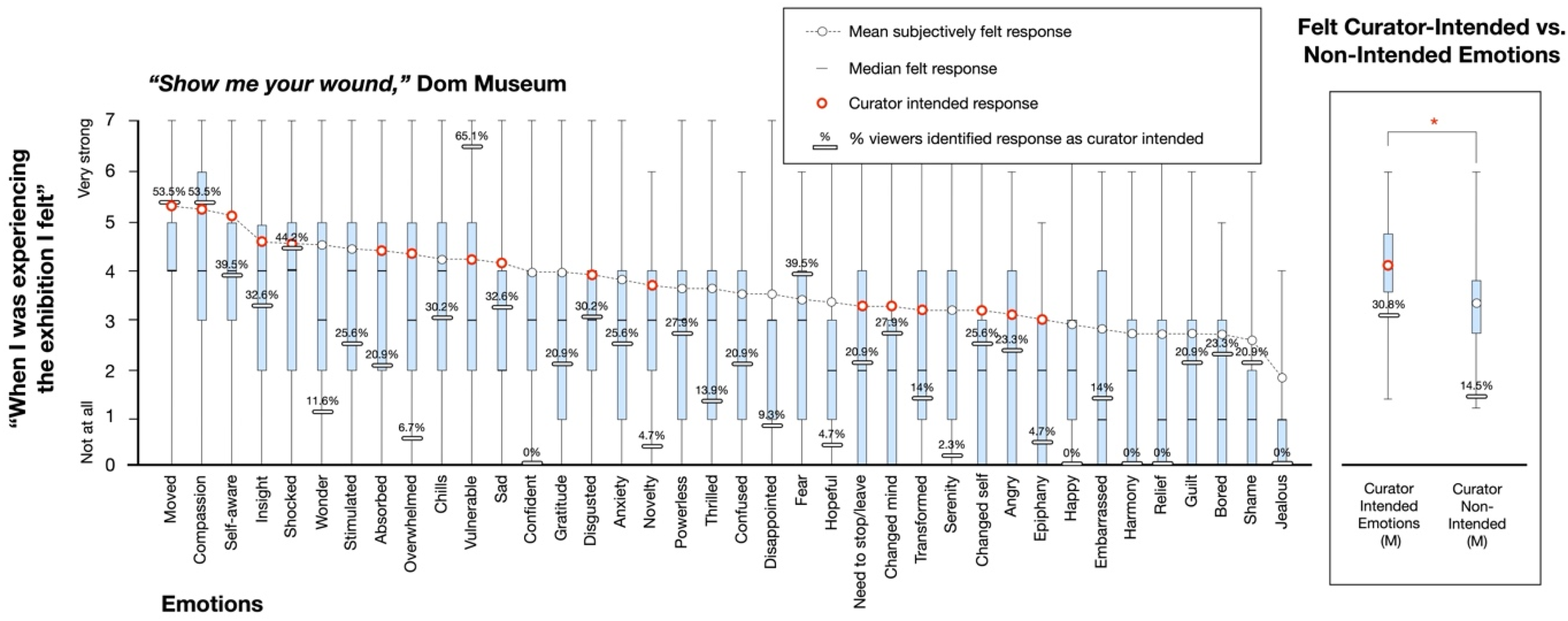
Emotions Personally Felt When Viewing Artworks and also Emotions Perceived to Be Intended by the Curator (“Show Me Your Wound,” Dom Museum Vienna). (Results from N = 41 Exhibition Visitors. Dotted Line Represents Group Mean of Reported Subjectively Felt Emotions; Flattened Ovals Represents % of Viewers Who Selected Each Emotion as ‘Intended by the Curator to be Evoked in a Viewer’, Regardless of Whether Viewer had Actually Felt this Way in their Experience; Red Circles Represent Emotions Actually Intended by the Curator. *Difference Between Mean Reported Felt Emotions Significant At p < .001, Based on Paired T Test).
From the final list, the curator selected 17 items (45%) as intended (e.g., see Figure 2). This included a mix of rather intense and/or social responses (“vulnerable,” “compassion,” “moved,” “shocked,” “sad,” “overwhelmed”), items related to meaning or reflection (“self-aware,” “epiphany,” “changed mind about meaning,” “changed something about myself,” “transformed,” “novelty,” “insight”), as well as “absorbed” and three other negative emotions (“angry,” “need to leave/stop looking”, “disgusted”), which were noted as not being aimed at per se, but which might occur temporarily as a consequence of visitors’ engagement with the topics addressed.
Note also, this exhibition—considering general artwork appraisals and population-wide pre-post attitude change—was previously reported in Pelowski et al. (2024), which used this data as a comparison for an additional ecological momentary assessment study of a different cohort of visitors. However, the assessment of the main questions here, regarding curator's intentions and visitor emotional experience, was not previously considered.
Part 2: Exhibition Visitor Assessment
Participants
To assess the experience had by exhibition visitors, we included a final sample of 41 participants (17 males, 24 females, Mage = 32.02, SD = 12.44, range = 18–65 years) recruited from among the foot traffic in the area in front of the museum (see Figure 2, D) and from individuals who had already decided to visit. The number of participants constituted a convenience sample, representing the maximum number of people who could be recruited each weekday for one week. Participation was voluntary and rewarded by a free ticket to see the exhibition (8 Euros) and, upon completion, a tote bag, both supplied by the museum. All participants were comfortable speaking English, which was the language used in all assessment materials. The final sample was derived from an initial sample of 53 participants, with individuals omitted due to failure to complete the study. Although smallish, the final sample exceeded minimum size suggestions for exploratory assessments such as the present study (VanVoorhis & Morgan, 2007). The procedure followed the protocols of the University of Vienna Ethics Committee. Signed informed consent was completed before participation.
Procedure
The study employed a matched pre-/post-viewing design (see, e.g., Pelowski, 2015; Pelowski et al., 2020). Participants were first stopped outside the museum by a researcher and asked to participate. If they agreed, they were then led into the lobby of the museum and brought to a small lounge area in the back of this space. They were given a basic explanation of the research aim, informing them that we were interested in art appreciation in real-life exhibition settings and that they would be asked to look at the exhibition and to report on their experience. Notably, no mention was given to any specific emotions, appraisals, exhibition aims, or possible behavioral/attitude changes related to the art visit (see footnote for full instruction text). 4
Participants filled out a pre-test (see below) via Qualtrics (Qualtrics Int., Seattle WA, USA), which could be accessed on participants’ own smartphones, via QR code, or via a tablet computer provided by our research team. Upon completion of the survey, which took about 15 min, they were asked to then visit the exhibition. Participants were told that they could freely move through the exhibition space and engage the artworks in any order, manner, and time duration that they wished. However, they were instructed to proceed directly to the exhibition and to not visit other parts of the gallery. Upon completion of their exhibition visit, they were asked to immediately return to the testing area to fill out a post-test (taking roughly 20 min). Once finished, participants were free to visit or revisit any parts of the gallery that they wished. Participants were not observed while inside the gallery.
Pre-survey—Target Attitudes
The pre-test employed a selection of standardized batteries targeting the range of attitudes or behaviors that had been identified by the curators as aims for the exhibition visit. This included: (1) Xenophobia, assessed via a 5-item battery (Van der Veer, et al., 2011) argued to be a cross-culturally applicable measurement of attitudes regarding immigration or acceptance of others (e.g., “Immigration in this country is out of control,” 1 = strongly disagree, 7 = strongly agree). Additionally, (2) we used the Empathic Concern subscale of the “Interpersonal Reactivity Index” (Davis, 1983), which presents seven statements relating to concern for others and especially the less fortunate (e.g., “Other people's misfortunes do not usually disturb me,” 1 = does not describe me well, 5 = describes me very well). (3) We assessed more general Prosocialness via the “Prosocialness Scale for Adults” (Caprara, 2005), which asks for agreement to 16 statements relating to having helpful behaviors (“I try to help others”) and understanding others’ situations (“I intensely feel what others feel,” 1 = not true, 5 = completely true). (4) We also included the Social Value Orientation (SVO) task (Murphy et al., 2011), which asks individuals to hypothetically divide up money between themselves and a “randomly paired,” previously unknown, “other” person. This task is argued to measure the propensity to maximize one's own gain at the expense of others.
Additionally, (5) Mood was assessed by three items (“How do you feel right now?”, 1 = not at all, 7 = very much) assessing “positive mood,” “negative mood,” and “emotionally aroused,” following a circumplex model of mood/emotion (Russell, 1980). Order of batteries was fixed as above. However the order of individual items within batteries was randomized.
Post-survey
The post-viewing survey, completed immediately after the visit to the exhibition, included a matched set of mood questions (answered first), followed by several additional assessments about the artworks/exhibition and the emotional experience.
Exhibition Appraisal: Participants were asked to evaluate the exhibition using seven bipolar scales (“Overall the exhibition was____”, e.g., 1 = “good,” 7 = “bad;” see full list in Figure 5). These scales (see Pelowski, 2015 for previous use with art) were selected to cover main evaluative/hedonic ratings of quality and enjoyment (bad-good, ugly-beautiful, meaningless-meaningful, boring-interesting) as well as terms connected to activity and potency of the stimuli/experience (potent-impotent, active-passive, strong-weak). Participants were also asked “Would you pay to see the exhibition again?” (1 = not at all, 7 = strongly agree).
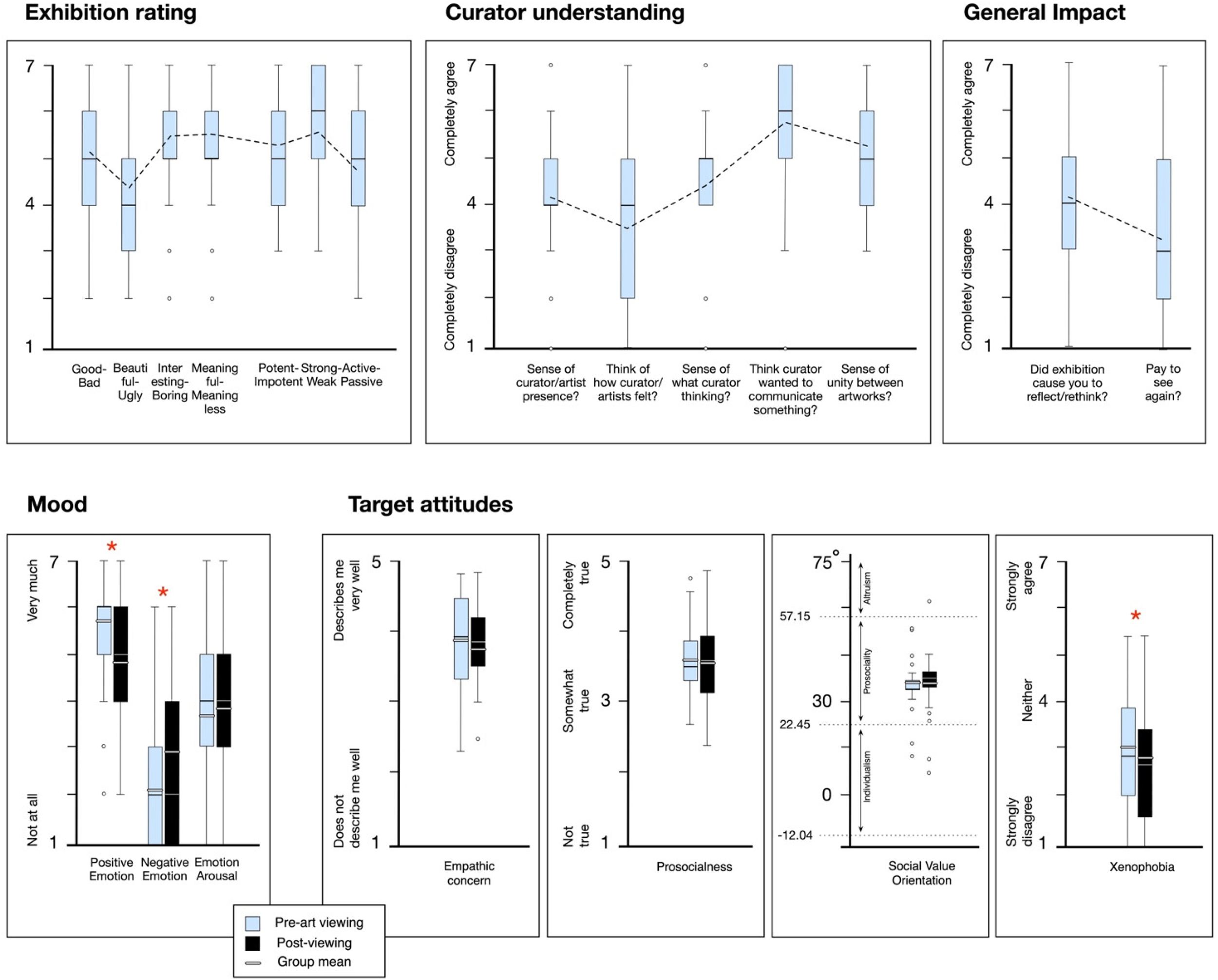
Participant-Wide Artwork Ratings, Understanding of the Curator, Mood, and Empathic, Prosocial, and Xenophobic Attitudes, Pre- and Post-Visit (“Show Me Your Wound,” Dom Museum Vienna). (Results Based Reports from N = 41 Participants. * Denotes Significant Difference (p < .05), Pre-/Post-Visit, from Repeat Measures T-Tests with Time as Within-Participant Factor (See Familywise Bonferroni Correction Information in Table A1).
Felt Emotional Experience: Participants were then asked to report on their emotional experiences. Participants were presented with the same list of 38 terms as used with the curator in Part 1 and asked to report the incidence and the magnitude of their feelings (“When I was experiencing the exhibition, I felt [x],” 0 = not at all, 7 = very strong; see Pelowski et al., 2020, 2022 for similar usage). Importantly, this section explicitly asked participants to consider and report on their actual feelings rather than any attributions that might tie to the art (e.g., a ‘sad’ painting).
Perceived Curators’ Emotion Intentions: Following the above assessment, participants were then presented with the same emotion list and asked to report (via ‘yes’/'no’ tick box) which of the feelings they thought had specifically been intended for them to feel, regardless of whether the participant had personally felt in that way (following again Pelowski et al., 2020, 2022). Participants were free to decide how many emotions to select. No selections was also possible.
Awareness or Thoughts Regarding the Curator: Viewers were also asked to report on five questions regarding their awareness of the curator's and/or artists’ choices (following Pelowski et al., 2020): (1) “Did you have a sense of the curators’/artists’ presence?” (2) “Did you think about the way that the artists/curators must have felt when making/selecting the art?” (3) “Did you have a sense of what the curator was thinking when making the exhibition?” (4) “Do you think the curator wanted to communicate something to the viewer?” (5) “Was there a sense of unity between the artworks?” (all, 1 = not at all; 7 = very much). This last question was included to assess the perceived level of coherence between the art pieces and the presence of a unified message.
Matched Attitude Measures: Participants then answered the same prosocial/empathy batteries, as well as one additional question (assessed post-intervention only) about the general impact from the exhibition in terms of its ability to incite reflection (“Did the exhibition cause you to reflect on or rethink anything about yourself, your expectations, or the world?” see e.g., Pelowski, 2015; Klöckner & Sommer, 2021).
Other Background/Control Questions: Participants then answered several background questions that could potentially impact their engagement, including: (1) political orientation (1 = left wing; 7 = right wing); (2) how important religion was to them (1 = not at all; 7 = very much) and their specific religion (free answer), included due to the religious themes of some of the art (see Dunham et al., 2014); (3–4) general art interest and objective art knowledge, via the Vienna Art Interest and Art Knowledge questionnaire (Specker et al., 2020); (5) whether participants had previously studied or were currently studying art/art history; (6) frequency of visits to museums/galleries (following Leder et al., 2014); (7) basic demographic information; (8) whether individuals had read the wall texts (‘Yes/No’). In addition, (9) we assessed trait empathy via the Questionnaire of Cognitive and Affective Empathy (QCAE, Reniers et al., 2011), following the Pelowski et al. (2020, 2022) studies of viewers-artist emotion matching, which had, however not found strong relations to emotion sharing, identification, or art experience. 5
Results—Study 1
Participant information is summarized in Table S1 (Supplementary Materials; see again Pelowski et al., 2024 for further discussion). The sample had a moderate-leftish political orientation (M = 2.98, where 1 = left, 7 = right); only five individuals (12.2%) answered on the right-wing side of the scale. Under half (41.5%) considered themselves to be religious, all of Christian faiths. When asked about importance of religion, these participants reported a mean score of M = 5.24 (moderately “important” on the 7-point scale). The overall sample mean was 3.56 (moderately “not important”). Participants were quite ‘lay’ art viewers, with a mean art interest scale of M = 47.59 (SD = 14.0, Range = 14–54) of 77 possible points, and art knowledge scores of M = 4.95 (on 26 point scale, SD = 4.4, Range = 0–17; See Specker et al., 2020 for interpretation). Most (75.61%) had never studied art history or art making; 82.9% had read the wall texts.
Exhibition Appraisal and Prior Mood
Participants’ appraisals of the exhibition (Figure 5) suggested that the art was generally evaluated positively, however with widish distributions across the entire sample. Answers to the question of whether the exhibition had caused individuals to re-think about themselves also showed a wide distribution. Participants strongly agreed that the exhibition had a communicative intent (M = 5.76) and a perceived sense of unity between artworks (M = 5.17). Participants entered the exhibition in a rather positive (M = 5.71, see Figure 5) and low negative mood (M = 2.05). Paired t-tests comparing pre-/post-viewing reports suggested that participants showed significantly decreased positive mood (M = 4.85, t(40) = 3.622, p = .001, d = .566) and increased negative mood after the visit (M = 2.90, t(40) = -3.404, p = .002, d = .532). No significant change was found for emotional arousal (t(40) = 0.675, p = .504, d = .105).
Pre-Post Attitude Change
To assess the attitude measures, we calculated composite scores for all scales or sub-scales following their original papers’ methodologies. To ensure comparability across measures, we used average scores instead of sum scores. For Social Value Orientation (SVO) scoring, three participants appeared to misunderstand the task (i.e., selecting no or more than one possible money divisions), and were excluded from analyses. No other scales had missing data.
The results are shown as box plots/averages in Figure 5 (see also Table A1, Appendix and Pelowski et al., 2024 for statistical information). In pre-viewing baselines, most participants reported positive scores across all scales (e.g., relatively higher self-assessed agreement of Empathic Concern, Prosocialness; lowish Xenophobia), notably with no suggested ceiling or floor effects. Post-exhibition, most factors tended to show small general decreases—suggesting lower agreement that one was as empathically concerned or prosocial as they had previously professed before the exhibition, but also lower xenophobia. Repeated measures t-tests conducted across the sample, however, revealed only one significant decrease for Xenophobia with a smallish effect (d = 0.425; see Cohen, 1988; see Table A1 for Bonferroni correction information).
Correlations Between Attitude Change, Baselines, Participant Background, Exhibition Ratings
Correlations between the attitude changes (converted to post- minus pre-intervention difference scores) and the baseline attitude measures, as well as exhibition appraisals and demographic factors, are provided for descriptive purposes in Tables S2–4 of Supplementary Materials (see Pelowski et al., 2024 for discussion). These tended to show low, non-significant relations between the baseline and the change scores as well as between the different batteries at both the pre- and the post-visit assessments. Exhibition ratings, individuals’ art interest/knowledge, importance of religion, and political orientation also showed no significant correlations to attitude changes, with the exception of increased SVO and higher art interest. Comparisons between reading labels (‘yes’/'no’) and change scores showed no differences.
Emotion
Figure 4 displays means and boxplots of reported felt emotions for all 38 items. The figure also denotes those emotions specifically identified by the curator as intended (denoted by a red circle). Participants tended, in general, to report a rather moving, reflective, epistemic emotional experience, with the highest average magnitude emotions—across the participant sample—being “moved,” “self aware,” “insight,” “shock,” etcetera. Notably, as can be seen from the leftward clustering of red circles in Figure 4, the emotions identified by the curator tended to be among those with the highest magnitudes. This trend was particularly evident for the emotions added by the curator (“vulnerable,” “compassion”). At the same time, and similar to the exhibition ratings, when looking across the entire sample of viewers, the emotional reports also showed a rather large spread, with individuals reporting answers across most scale points.
Felt Curator-Intended Versus Non-Intended Emotions
To assess whether participants generally felt more those emotions that had been intended by the curator, we calculated the average reported magnitude of all intended emotions (n = 17) versus those that had not, for each participant (following procedure of Pelowski et al., 2020, 2022). A within-participant t-test (see also right side, Figure 4) comparing the two means reached statistical significance (t (40) = 5.540, p < .001, Mdifference = 0.69, d = .86), suggesting that participants had felt more the targeted emotions, and with 85.37% reporting higher relative scores for the intended versus the non-intended emotions. These percentages and effect sizes were in line with past studies’ that had employed the same procedure (Pelowski et al., 2020, 2022). 6
Identification of Intended Emotions
Participants’ identification of emotions that they thought the curator had intended are also displayed in Figure 4 (see flattened ovals with the corresponding percentage of ‘yes’ answers across all viewers). In general, most participants selected only a few emotions as curator-intended (M = 8.29, SD = 4.05). The maximum number of emotions selected by any individual was 17 (of the 38 possible), occurring in only one case. The minimum number of selections was two.
Overall, the most selected emotions were “vulnerable” (identified by 65.1% of participants), followed by “moved,” “compassion” (both 53.1%), and “shocked” (44.2%). Interestingly, these four most-selected emotions were also identified by the curator. This was followed by “fear,” selected by 39.5% of participants but not in fact intended. Five emotions were selected by 0% of participants (“confident,” “happy,” “harmony,” “relief,” “jealous”). All of the 17 curator-selected emotions had at least one participant who selected them. Across all emotions, the correlation between the viewer-wide selection rates and the average magnitude of reported feelings was r = .64 (p < .001).
To assess the relation between the identification of emotion intentions and attitude change, we followed Pelowski et al. (2020b, 2022; see also Dubal et al., 2014). Each individual emotion was treated as a binary ‘yes/no’ question, with participant answers on the post-test coded as “hits” (cases where they had correctly selected an emotion as intended), “false alarms” (cases where they had indicated an emotion but this had not actually been specified by the curator), “misses,” and “correct rejections”. These results were then used to calculate a sensitivity index (d’) for each viewer, with a resulting score of ‘0’ signifying random chance in answering; positive scores indicated some ability to correctly detect yes/no answers. Cases where the ratio of false alarms to correct hits was ‘0’ were adjusted using a loglinear approach (Hautus, 1995).
Results are reported in Table A2, Appendix. All but five participants (87.8%) showed positive d’ scores. A t-test against chance (‘0’) was significant (t(40) = 7.611, p < .001). The total rate of correct (yes + no) answering was 61.05%. 7 The hit rate when making a ‘yes’ guess was 65.8%, compared against a chance level for being correct of 44.7% (17/38), thus 1.47 times better. Participants, on average, correctly selected 5.24 emotions out of the 17 that had been intended by the curator. The maximum number of correct ‘hits’ was 10. Every participant identified at least one emotion correctly. No participant reported that they thought that no emotions had been intended.
Relation of Felt/Identified Curator-Intended Emotions to Background, Art Experience
Correlations between the felt curator-intended versus non-intended emotions (differences scores of both emotion group averages) as well as sensitivity (d’) and viewer background or exhibition appraisal results (Table A3) suggested, similar to past findings (Pelowski et al., 2020, 2022), that those individuals who felt more curator-intended emotions did tend to rate the exhibition as more interesting, meaningful, potent, and were more likely to wish to pay to see the exhibition again. At the same time, ability to guess intentions (d’) did not show significant correlations with the assessments. Following Pelowski et al. (2020, 2022), we also considered total felt emotion (average across all emotion items), which showed similar results as found with feeling curator intentions above, albeit not with a significant relation to meaningfulness.
Participants with a higher art interest also reported significantly stronger feelings of the intended emotions compared to unintended. No notable relationships were found with art knowledge. No relation was found between those who had or had not read the exhibition labels and feeling relatively more intended emotions, d’ scores, or generally feeling emotions (see Pelowski et al., 2022 for similar results).
Felt/Identified Intended Emotions and Attitude Change
Finally, to test whether the degree to which viewers felt or identified the emotions intended by the curator coincided with greater changes in attitudes, we again looked to correlations between the felt intended- versus non-intended-emotion scores, the d’, and the change scores for the attitude measures. As above, we also considered total felt emotion, and, as a potential additional indicator of impact, answers to the post-test question regarding whether the visit had made individuals reflect or think about the world and themselves.
Results (see Table 1) suggested, among the target emotion factors, only a significant relation between feeling more the intended curator emotions and agreement that the exhibition had caused one to rethink or reflect on oneself or one's expectations (note again, that this was only assessed post-intervention). A positive, albeit non-significant, trend was also found between feeling more intended emotions and increased (pre- vs. post-) Social Value Orientation scores. Significant relations were also found between feeling more emotions in general (regardless of whether these were intended) and increased Prosocialness as well as for agreement with the post-intervention self reflection question. Only the first finding for the intended feelings above survived a Bonferroni correction (see Table 1 footnote). No relations were found regarding ability to identify curator emotion intentions (d’).
Study 1: Correlations Between Viewers’ Felt Curator-Intended Emotion, Ability to Pick out Curator Emotion Intentions, Magnitude of Emotion Felt, and Post-Exhibition Attitude Change.
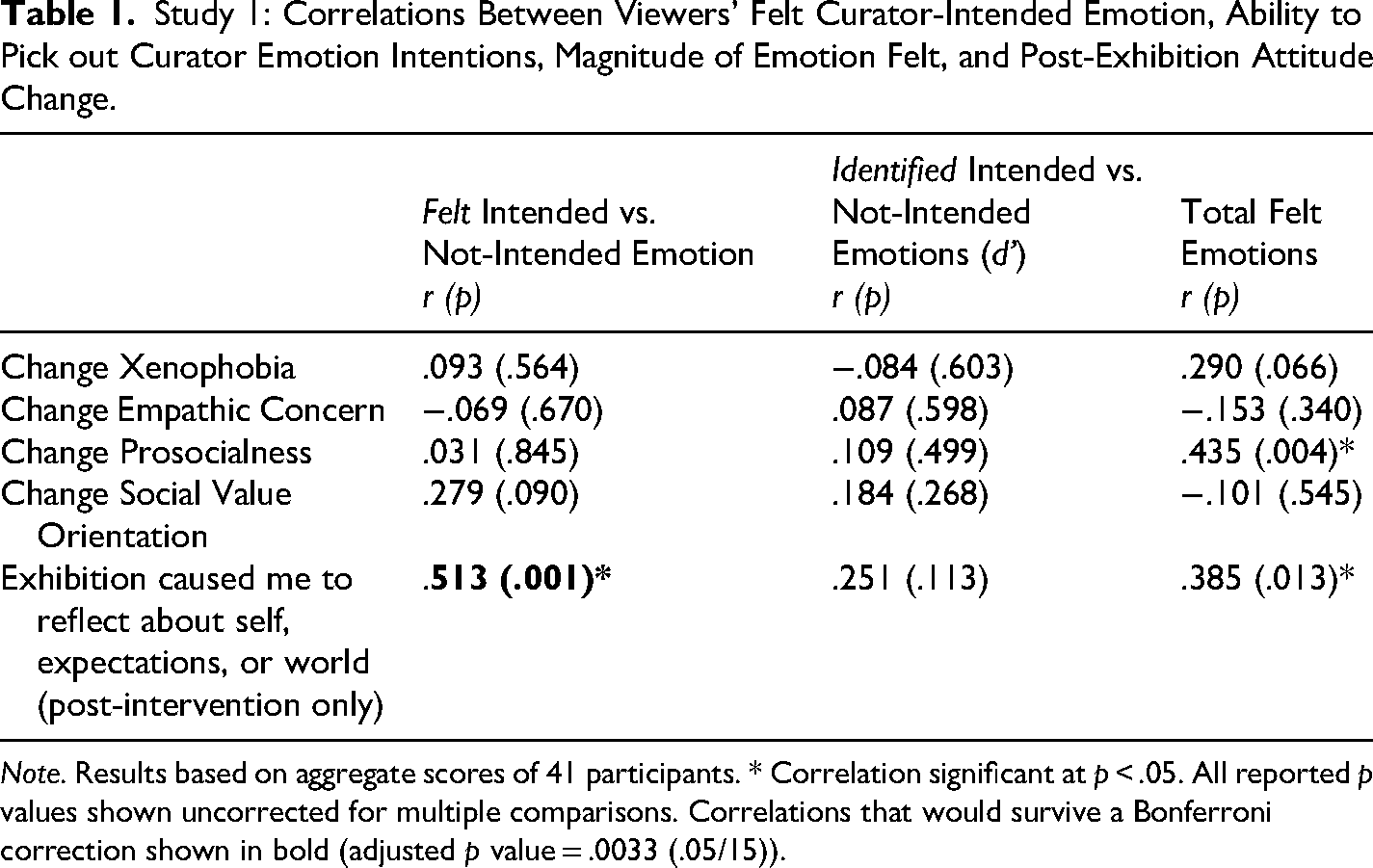
Note. Results based on aggregate scores of 41 participants. * Correlation significant at p < .05. All reported p values shown uncorrected for multiple comparisons. Correlations that would survive a Bonferroni correction shown in bold (adjusted p value = .0033 (.05/15)).
Curator-Intended Profiles Versus Specific Emotion Targets, Which Correlate with Change?
As one last exploratory point of comparison, especially as this regards the question of an emotional mixture as opposed to individual emotion targets as the focus of curatorial or artistic design, we conducted similar correlations between change scores and individual emotions that had been the previous main targets of socially-focused intervention research (see Table A4) These included guilt (see e.g., Curtis, 2010; Rees et al., 2015; Sommer et al., 2019), shame (Allpress et al., 2010), anger (Rees et al., 2015; Sommer et al., 2019), fear (Hastings et al., 2004; O’Neill & Nicholson-Cole, 2009; Reser & Bradley, 2017), sadness (Rees et al., 2015; Sommer et al., 2019); hope (Swim & Bloodhart, 2015). Additionally, we considered wonder, which, along with or as a synonym to awe, had also been connected in interventions to especially prosocial changes (Piff et al., 2015; Sommer et al., 2019; Stellar et al., 2018) and is also argued in arts literature to potentially represent a classic ‘aesthetic’ or epistemic often tied to arts (Fingerhut & Prinz, 2018, 2020), and compassion, which, to our knowledge, had not been previously considered but was highlighted by the curator, as well as by the designers of the intervention in Study 2 (below). Note also, with the exception of sadness, none of these had been singled out by the curator. The results did suggest that ‘guilt,’ ‘shame,’ ‘fear,’ and ‘wonder’ significantly correlated with changes in Prosocialness. “Compassion” correlated with change in SVO. All with effect sizes greater than those found for feeling more the intended emotions above. However, all effect sizes were also generally lower than that for the total felt emotion, averaged across all items, above. No finding survived Bonferroni correction (see Table A3).
Study 2
Study 1 did find some, albeit rather tentative, evidence for a relation between some attitude changes following a visit to an art exhibition—focused on awareness and acceptance of others and especially refugees or marginalized members of society—and the viewer's curator-designed, and especially felt, emotional experience. In Study 2, we had one more opportunity to employ a similar empirical design and assessment of our research questions, in this case considering an art exhibition targeting a different theme and attitudes, involving viewers’ environmental awareness or perceived connection between their lives and environmental impacts. This also provided a unique opportunity to work with both curator and the artist, who also provided a report of emotional intentions.
Stimuli/Setting—“The Mine Gives, the Mine Takes,” Galerie Wedding, Berlin
The setting of the second study was the exhibition The Mine Gives, the Mine Takes (“Die Mine gibt, die Mine nimmt” in German), curated by S. H. Ovesen and by the artist Ana Alenso, held at Galerie Wedding in Berlin (4 December 2020–27 February 2021; Figure 6). The exhibition had the overall aim of addressing the ecological and socio-economic crisis affecting the Amazonian area of Venezuela, stemming from widespread, mostly-uncontrolled, gold or other metal mining. As communicated in the accompanying brochure prepared by the artist and curator (Alenso, 2020), “the mines in South America are not just a well of resources—they are permanently robbing the surrounding environment and the local population of their livelihood,” imperiling workers through hazardous use of mercury, breaking down the surrounding society, and leaving the land stripped and polluted. In collaboration with the environmental organization SOS Orinoco (https://sosorinoco.org), the artist aimed to share first-hand accounts of this reality and to raise the public's awareness, even among individuals (e.g., Berlin residents) who might never visit Venezuela, on their co-responsibility derived from inaction or purchase of precious metals.
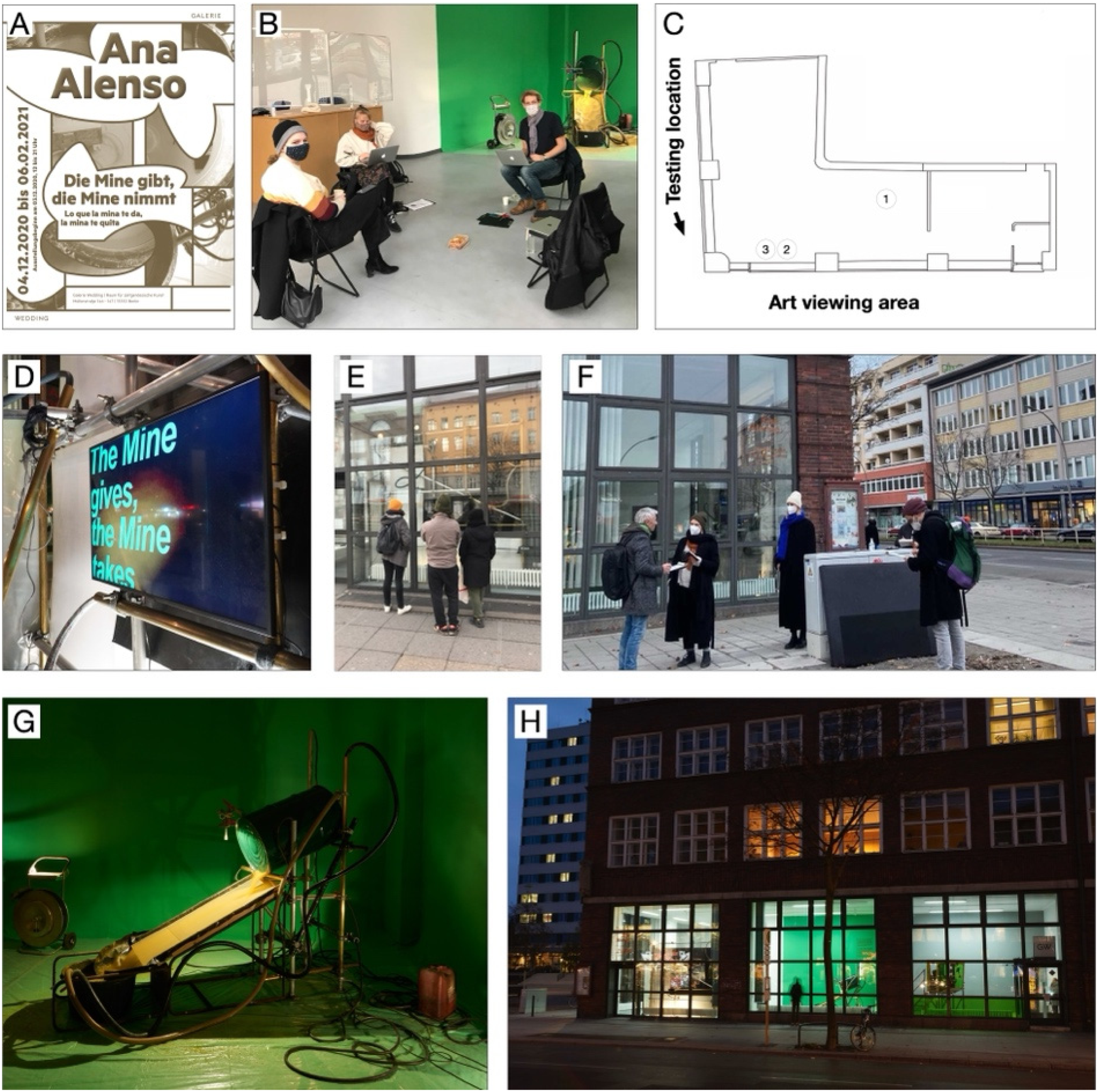
Overview of Exhibition and Testing Locations, “The Mine Gives, The Mine Takes,” 2020, Galerie Wedding, Berlin. (
The exhibition was situated in the main two rooms of the gallery (Figure 6, C) and included three components: Lo que la mina te da, la mina te quita (“The Mine Gives, the Mine Takes,” 2020, Figure 6, G) an installation of a makeshift gold mining apparatus used in the region and showing, especially through the flowing of muddy wastewater, the unstable and dangerous impact on the environment; We are Satellites, 2020 (Figure 6, D), a video installation showing intertwined images and videos shot from satellites with documentary films about mines in the Orinoco region; and Gold Exploration, 2020, another video connected explicitly to the commercial gold business. Due to the Covid-19 pandemic, which forced the closures of most galleries and museums, the exhibition was designed so that it could be viewed entirely from the outside at street level and with viewers able to engage from the pedestrian square and sidewalk looking through the large windows of the gallery. This also allowed us to conduct testing, operating in the same public outside space, while following all regulations.
Part 1: Curator/Artist Intentions for Attitude Change and Emotional Experience
The procedure for assessing target attitudes as well as targeted emotions was the same as in Study 1. However, we had the opportunity to interview both curator and artist, who had worked together on the exhibition, thus allowing us to use both of their reports as a basis for the forthcoming assessment. The interviews were conducted on Zoom (Zoom Video Communications, Inc., San Jose, California). Both the artist and curator gave informed consent and participated in a brief introduction and then moved to two, separate breakout rooms so that we could collect answers simulteneously.
Both artist and curator showed high agreement regarding targets for specific attitude changes. Thus, both were combined for Part 2. These involved increasing awareness of environmental issues in Venezuela but also globally, as well as increasing awareness of each individuals’ connection to environmental and planetary health through their daily actions (such as gold purchasing or other consumption). Both also noted that they would like to see a shifting of individuals’ priorities or values, away from material possessions to appreciation of the environment.
To assess target emotions, we employed an expanded 46-item list (see Figure 7). This included the items from Study 1, with the addition of eight new items (see grey text in figure) covering especially some more generally positive states often connected to art engagements and which had been omitted in the prior study. The artist identified 11 emotions, including largely positive or reflective responses (“absorbed,” “compassion,” “gratitude,” “moved,” “profundity,” “self-aware,” “stimulated,” “surprise,” “transformed,” “awe,” “overwhelmed”). These showed overlap with the curator, with all but the last two items also included in her own list. At the same time, the curator also indicated a more expansive 30-item list, including also more negative states (“angry,” “anxiety,” “confused,” “disgusted,” “vulnerable,” “powerless,” “sad”), social emotions (“guilt,” “shame”), epistemic reactions (“changed mind about art meaning,” “changed something about myself,” “epiphany,” “insight,” “novelty”), as well as additional positive outcomes (“happy,” “hopeful,” “playfulness,” “sublime,” “thrilled,” “wonder”). One additional emotion (“disappointed”) was suggested as not aimed at, per se, but expected, and thus included. No additional items were added, in the present study, by curator or artist.
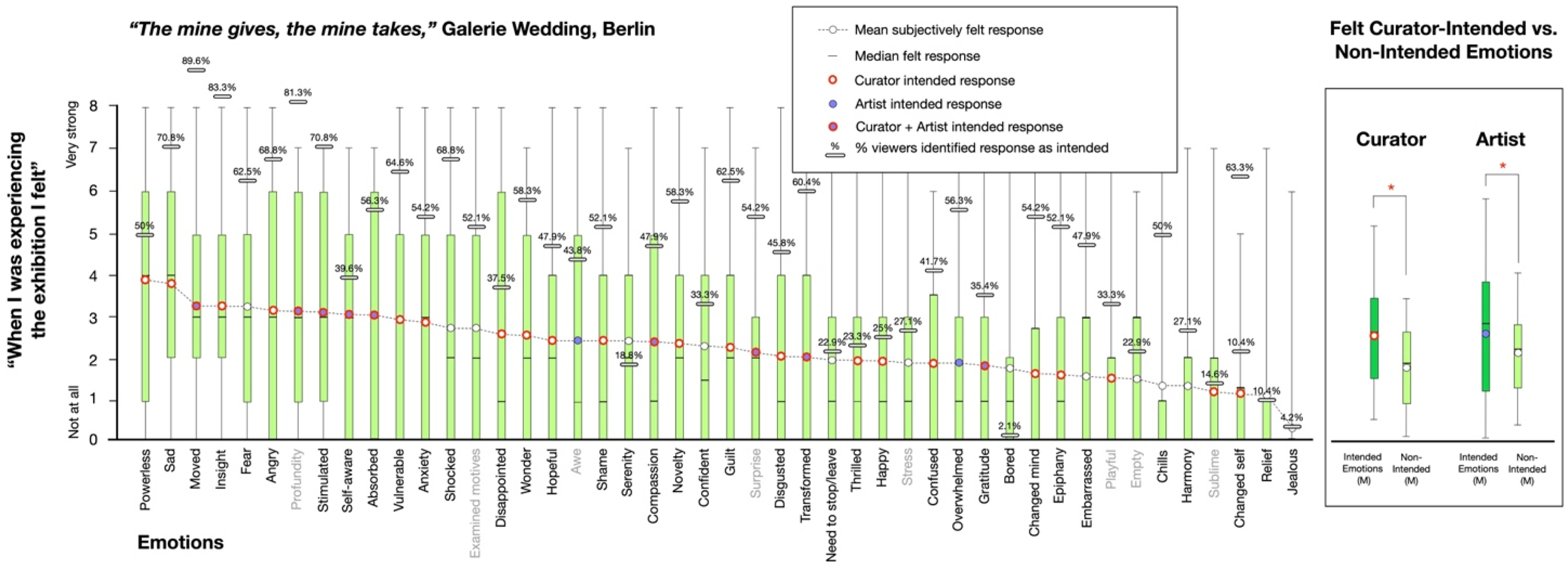
Emotions Personally Felt When Viewing Artworks and also Emotions Perceived to be Intended by the Curator/Artist (“The Mine Gives, the Mine Takes,” Galerie Wedding, Berlin). (Results Based Reports from N = 49 Participants. Dotted Line Represents Group Mean of Reported Subjectively Felt Emotions; Ovals Represent % of Viewers who Selected each Emotion as Probably Intended by the Curator/Artist to be Evoked in Viewers, Regardless of Whether they Actually Felt this Way; Red Circles Represent Emotions Intended by Curator; Blue Solid Circles Represent Emotions Intended by Artist. * Difference Between Mean Reported Felt Emotions (Average of all Intended and Non-Intended as Specified by Curator or Artist) Significant at p < .001 (Paired T-Test)).
Part 2: Visitor Assessment
Participants
The viewer assessment then involved a final sample of 49 participants (23 males, 24 females, 1 “other,” 1 “preferred not to say,” Mage = 40.39, range = 22–70 years) recruited from among the foot traffic outside the gallery. Participation was voluntary and respondents were offered a voucher for a drink at a nearby café upon completion. Individuals could choose to answer in English or German. Those not comfortable with either language were excluded from participation. The final sample was derived from an initial sample of 52, with individuals omitted due to failure to complete all portions or due to being less than 18 years of age.
Procedure
The procedure employed the same instructions and pre-post design as in Study 1, with, in this case, the public square around the corner of the gallery serving as the testing area. The survey materials, unlike Study 1, were administered exclusively in paper versions and made use of generally shortened or paired down versions of the supporting assessments, beyond the main target batteries, for the sake of minimizing overall testing time.
Pre-survey
The pre-survey (requiring roughly 10 min) once again assessed the main attitudes targeted by the exhibition. This included, in the following set order: (1) Nature Connectedness, assessed via one item from the Extended Inclusion of Nature in Self scale (Martin & Czellar, 2016). This presents seven examples of two equally sized circles representing the “self” and “nature” overlapping to varying degrees with participants asked to select which described their level of interconnectedness (1 = not at all connected, 7 = completely overlapping). (2) Nature Awareness was measured through the Brief Ecological Paradigm (BEP, López-Bonilla & López-Bonilla, 2016), a five-item battery developed to measure general attitudes about one's relationship with the environment and awareness of a possible eco crisis (e.g., “Humans are severely abusing the environment,” 1 = strongly disagree, 4 = neither agree/disagree, 7 = strongly agree, modified for cross-battery consistency in scale points). (3) We also assessed relative importance of various personal Values, based on a 16-item scale by Steg et al. (2014) divided into four main aspects—Egoistic (e.g., “social power,” “wealth”), Altruistic (“equality,” “social justice”), and, relating to the main curator arguments, both Hedonic (“pleasure,” “enjoying life”) and Biospheric (“unity with nature,” “protecting the environment”) aims (0 = not at all important, 7 = of supreme importance; see Keller et al., 2020 for art intervention use). As in Study 1, we also employed the same (4) Empathic Concern scale (Davis, 1983) and (5) assessed Mood, in this case, along two continuous scales (0 = none, 100 = a great deal) measuring positive and negative valence.
Post-survey
The post survey included, first, a matched set of the above mood questions, followed by three questions eliciting appraisals of the exhibition (“I liked the art,” “The art was beautiful,” “I would pay to see this again,” 1 = not at all, 7 = very much), and then by a section in which viewers were asked to rate their level of intended actions as a result of having engaged with the show (“I plan to continue to deliberately act pro-environmentally in my everyday life,” “I intend to see more works by the same artist,” “I intend to engage more with environmental art,” 1 = fully disagree, 7 = fully agree). The latter questions were included based on the interviews with the curator/artist regarding follow-up behaviors they might like to see in a visitor.
Participants were then presented with the emotion list and asked to indicate which they had experienced while looking at the exhibition (“While looking at the artwork, I felt [emotion]”, 0 = not at all, 8 = extremely). 8 This was followed by the presentation of the same list with the instructions to select those that they thought they “were intended to feel while looking at the art,” regardless of whether they felt in that way or not. Notably, we did not include the mention of either artist or curator so as to allow for a general sense of intention that could be used for both.
Participants then completed the same Nature Connectedess, Values, and Empathic Concern questions as in the pre-survey, followed by basic demographics on gender, level of education, country of origin. Participants also specified the primary reason for their visit to the area (including “to visit the gallery or see the art”), their prior familiarity with the exhibition, whether they had ever previously visited, and whether they had read the informative material (the brochure referenced above), which, in this case did contain a more explicit description of the curator/artist aims. Finally, art interest was rated, in this case, on a single 7-point scale (“I am interested in art”, 1 = not at all, 7 = very much), as was the frequency of their visits to art museums/galleries before the Covid-19 crisis (1 = less than once per year, 7 = once every week or more often).
Results—Study 2
Participants (Table S5, Supp. Mat.) were majority (81.63%) German from the surrounding area. They had relatively high art interest (M = 5.82 on 7-point scale); however only 8.16% had taken classes in art history or production past the secondary level. Only 8.51% had planned to visit the gallery specifically. Whereas most (59.57%) happened to be passing by. About half (51%) had never before noticed the exhibition. Only 18.36% (n = 9) had read about or previously visited. While viewing the exhibition, 18.36% read the accompanying text. Due to the use of paper-based assessments, Study 2 had some incidence of missing data (<5% per individual). This is reflected in the degrees of freedom for assessments below.
As in Study 1, the exhibition was rated, on average (see Figure 8), as generally ‘good,’ ‘interesting,’ and ‘liked,’ with moderate agreement regarding willingness to pay; however again with wide spreads across scales. Participants entered the exhibition in rather positive (M = 57.40) and low negative moods (M = 23.85), with negative mood significantly increasing post visit (t(47) = -4.581, p < .001, d = .661; positive mood t(47) = -0.895, p = .375, d = .129).
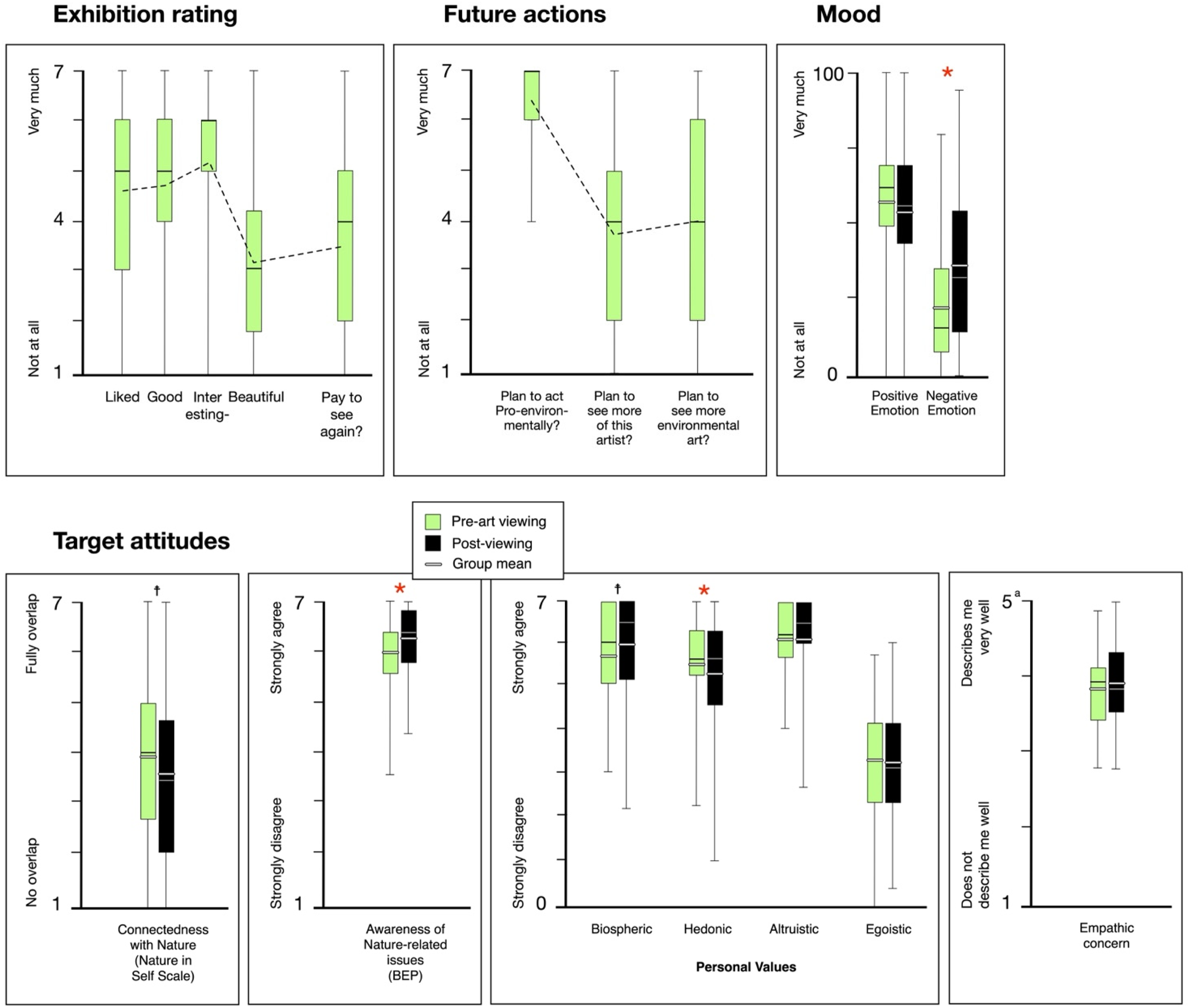
Artwork Ratings, Mood, Nature Connectedness, Nature Awareness, Values and Empathic Concern, Pre- and Post-Visit to Art Exhibition (“The Mine Gives, The Mine Takes,” Galerie Wedding, Berlin). (Results Based Reports from N = 49 Participants. * Denotes Significant Difference, p < .05, Pre-/Post-Visit, from Repeat Measures T-Tests with Time as Within-Participant Factor. †p < .10. (See Table A5 for Information on Bonferroni Corrections). a7-Point Scale, Employed in Study 2, Adjusted to 5-Point for Better Comparison to Study 1 Results).
Pre-Post Attitude Change
The pre-visit target attitudes (Figure 8, bottom) indicated that participants rated their sense of Nature Connectedness in the middle of the scale. They showed comparatively higher agreement with Nature Awareness, as well as Empathic Concern (reflecting similar levels to Study 1). Participants also reported relatively high Biospheric values as defining their selves. Hedonic values, similarly, showed high agreement. Whereas, Egoistic values were comparatively lower.
Paired t-tests, across the entire sample (Table A5), suggested significant increases, following the exhibition, in Nature Awareness (t(48) = -3.851, p < .001, d = .550) and a significant decrease in Hedonic values (t(48) = 2.356, p = .023, d = .337). Biospheric values showed an increase, although not reaching significance (p = .096). Only increased Nature Awareness survived a Bonferroni correction. Correlations between attitude changes, baseline attitude scores, and demographic factors (Table S6–8, Supp. Mat.) were largely in line with Study 1, with low-to-moderate correlations between the change scores of the various attitudes, and low relations between baselines and changes for specific scales. As in Study 1, art interest, as well as the exhibition's ratings, showed no significant correlation to attitude change. Comparison between individuals who had or had not read the accompanying informational brochure showed, unlike Study 1, a significantly greater decrease in Egoistic values and increase in Nature Awareness, post visit, among those who had read.
Emotion
Emotions reported by participants (group-wide boxplots and means) are shown in Figure 7, which also denotes those that had been singled out by the curator (red circles) and by the artist (blue solid circles). In general, the exhibition tended to lead to a mix of reported epistemic and also reflective emotions, with––much as in Study 1––some of the highest magnitudes reported for being “moved,” “insight,” “self-aware,” “stimulated”; “absorbed”. At the same time, the exhibition also led to other emotions that had not shown such high magnitudes in Study 1, including “sad,” “fear,” “angry,” and “powerless”. As in Study 1, most emotions also showed a wide spread across the sample of participants.
Felt Curator/Artist-Intended Versus Non-Intended Emotions
Paired t-tests comparing reported magnitude of subjectively felt emotions between those intended versus not-intended, conducted separately using both the curator's and the artist's profiles (see also Figure 7, right), showed significantly higher means for curator-intended emotions (t(48) = 6.180, p < .001, Mdifference = 0.65, d = .883). A similar, significant result was also found using the intentions of the artist (t(48) = 3.872, p < .001, Mdifference = 0.49, d = .553); 87.76% of participants reported higher scores for curator-intended emotions. For the artist, this total was 71.43%.
Identification of Curator/Artist-Intended Emotions
Viewers’ selection of emotions that they thought the exhibition designers had intended are shown as % in Figure 7. The most selected emotions were “moved” (selected by 91.3% of participants), “insight,” and “profundity” (both 82.61%), “stimulated” (73.91%), and “sad” (71.74%)—all of which had been actually selected by the curator and, in most cases, by the artist. The least selected emotions were “bored” (2.17%) and “jealous” (4.35%). All emotions were selected by at least one participant. Mean number of selections was 21.9 (47.6%), albeit with a wide spread between participants (maximum number of selections, 44/95.7%; three individuals selected zero emotions). The correlation between the viewer-wide selection rates and the average magnitude of reported felt emotion, was r = .674 (p < .001), again similar to Study 1.
Results for intention guesses (hits, misses, d’) are shown in Table A6. A t-test against chance (‘0’) was significant for both the curator (t(45) = 7.516, p < .001; participants with positive d’ scores = 83.7%/n = 8) and for the artist (t(45) = 3.959, p < .001; positive d’ scores = 83.7%/n = 8).
Correlations of Feeling/Identification Scores; Exhibition Ratings
As in Study 1, correlation analyses (Table A7) suggested that feeling more emotions in general and feeling more those intended by both curator and artist, positively related with ratings of the art (liking, interest, beauty, willingness to pay). Intention identification (d’), once again, did not show significant relations to ratings. No difference was found regarding felt intended emotions, d’, or general amount of felt emotions, and reading the exhibition information or, in the present case, art interest. As in Study 1, correlations between feeling intended emotions and the ability to detect intentions were also low-moderate (r = .134 for curator list; .350 for artist list).
Felt/Identified Curator-Intended Emotions and Attitude Change
Correlations between the relative amount of felt or identified intended emotions, as selected by both curator or artist, and changes in attitudes are shown in Table 2. These detected a significant correlation between feeling relatively more intended emotions, as selected by the curator, and decreased Nature Connectedness, post visit, as well as reduction in Hedonic values. As in Study 1, similar correlations were also found for the same above attitude changes and feeling more emotions in general, which also correlated to increased Nature Awareness. Ability to detect curator intentions (d’), as in Study 1, showed few notable results, with only higher sensitivity coinciding with a reduction in Empathic Concern, but also with less professed agreement to act pro-environmentally in the future (assessed post-visit only). Using the artist's profile revealed no significant relations with any attitude change, both for feeling or identifying emotion intentions.
Study 2: Correlations Between Viewers’ Felt Curator-/Artist-Intended Emotion, Ability to Pick out Emotion Intentions, and Magnitude of Total Emotion Felt, and Attitude Change (“The Mine Gives, the Mine Takes,” Galerie Wedding, Berlin).
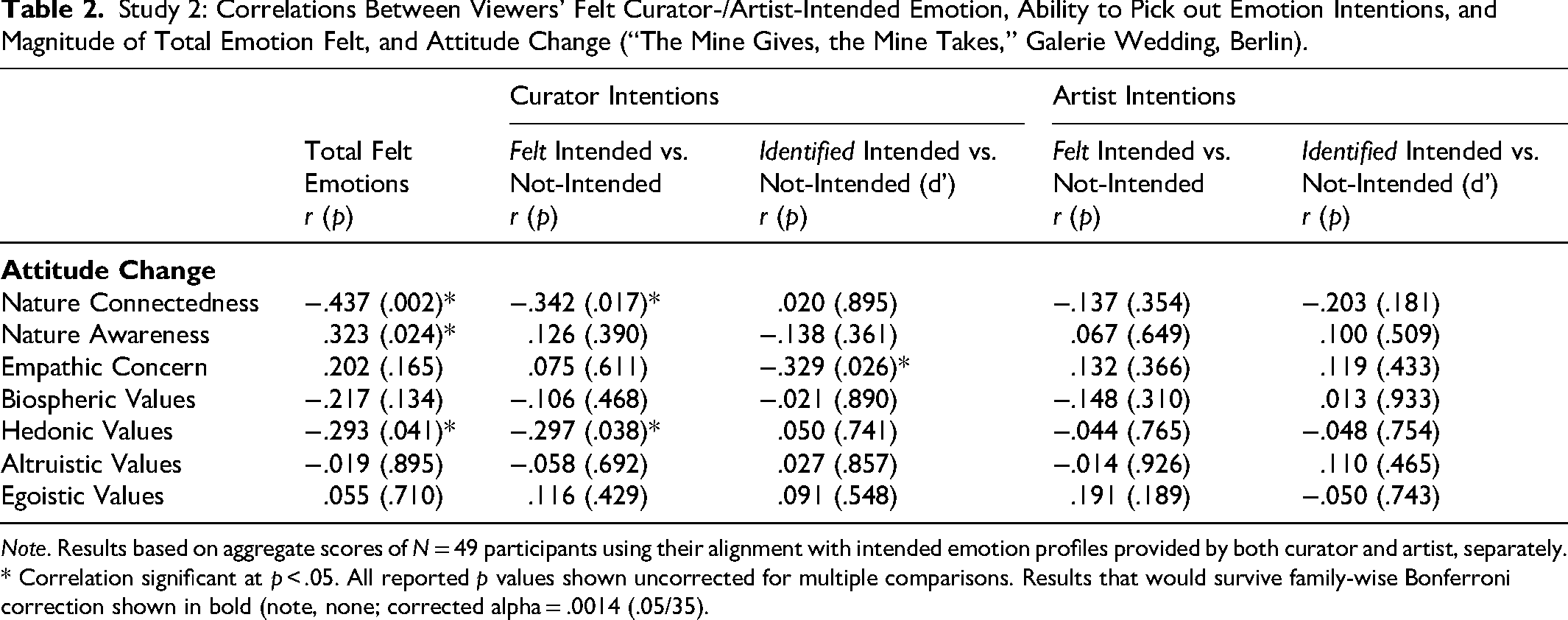
Note. Results based on aggregate scores of N = 49 participants using their alignment with intended emotion profiles provided by both curator and artist, separately. * Correlation significant at p < .05. All reported p values shown uncorrected for multiple comparisons. Results that would survive family-wise Bonferroni correction shown in bold (note, none; corrected alpha = .0014 (.05/35).
A final similar consideration of the same attitude changes and the individual emotions considered in Study 1 showed (see Table A8) significant negative relations between Nature Connectedness and feeling “shame,” “anger,” “fear,” “sadness,” as well as “compassion.” “Compassion” and “wonder” showed correlation to increased Nature Awareness, and “compassion” correlated also to Empathic Concern, with effect sizes for all findings comparable to those for Study 1, but again generally lower than those for total feeling as averaged across all possible emotion items.
General Discussion and Conclusion
This paper offered first, exploratory evidence on the relation between emotion combinations, as intended by artists or curators, and attitude change as an outcome of a visit to an art exhibition. We addressed this via two studies, built around the unique opportunities to work with curators and artists to investigate their design choices with regards to two exhibitions on contemporary topics (refugee acceptance, Study 1, and the climate, Study 2). Employing a new research paradigm (Pelowski et al., 2020, 2022), we first asked the designers to identify their attitude change targets as well as the specific feelings that they might wish viewers to experience as part of their engagement. By then matching these emotion ‘profiles’ to pre-/post-evidence from visitors, we had the opportunity to analyze the possible relations between viewer feelings, understanding, and attitude changes. More broadly, this provided insights into the––still currently empirically unconsidered––potential importance or mediating role of such complex, multi-valenced emotions, and designers’ guiding intentions, in intervention design. In turn, the results from both studies provided several intriguing findings, and new questions, which we walk through below.
Artist/Curator Reports: Evidence for Clear Attitude Targets and Intended Emotional Response
First, beginning with the basic reports from the exhibitions’ designers, it is notable that, in both studies, both artist and curators did have clear targets for specific changes that they wished to achieve via their art or exhibitions. These impacts––increased refugee acceptance, compassion, prosocialness, and lower xenophobia in Study 1; increased awareness of our connection to and our impacts on the environment, as well as a rethinking of values, especially in regards to gold mining, in Study 2––were very much in line with areas of emerging discourse on arts-based interventions. These reports provided supporting examples that such specific attitudes or value changes can be salient features in designers’ intentions. These could be clearly articulated, and, at least here, do appear to play a key aspect of the design process. Even more, we also found clear evidence that the designers did look to emotion as a means of mediating effects. In both studies, both curators and the artist reported specific sets of emotions or other phenomenal states that they wished, or at least envisioned, a visitor would experience, suggesting that designers did see these as a key element for achieving their chosen didactic, value-related, and/or attitude/behavioral-related outcomes in the art experience.
The identified emotion terms, especially regarding the number and variety of items, also raise implications. In Study 1, the curator noted 17 specific items––roughly half of the 36 possible provided. These included a mix of social (e.g., “vulnerable,” “compassion”), generally negative (“shocked,” “sad,” “overwhelmed,” “disgusted,” “angry”), self-reflective/epistemic (“self-aware,” “epiphany,” “changed something about myself,” “transformed,” “novelty,” “insight”) as well as more positive or even classic ‘aesthetic’ (“absorbed,” “moved”) states. In Study 2, from an expanded list of 46, we found a similarly nuanced list from both the artist, who identified 11 feelings, many of which overlapped with Study 1 (“absorbed,” “compassion,” “gratitude,” “moved,” “profundity,” “self-aware,” “stimulated,” “surprise,” “transformed,” “awe,” “overwhelmed”), and from the curator, who––in addition to showing very high overlap with the list of the artist (9 of the 11 items)––provided a 30 positive, negative (additionally, e.g.,: “angry,” “anxiety,” “confused,” “disgusted,” “vulnerable,” “powerless,” “sad,” “disappointed”), social (“guilt,” “shame”), and epistemic reactions (“epiphany,” “insight,” “novelty,” “changed mind about myself”).
The emotion profiles go beyond the single or small handful of items currently considered in most empirical research (though see Rodriguez et al., 2024 and Cotter et al., 2024 for other analytic methods considering emotional complexity in arts experiences). While sets may include a mix feelings that could align with previous studies––in the present case, notably negative feelings such as, for example, ‘anger’ (Rees et al., 2015; Sommer et al., 2019), ‘sadness’ (Rees et al., 2015; Sommer et al., 2019), or social feelings such as ‘guilt’ (Curtis, 2010; Rees et al., 2015; Sommer et al., 2019)––the reports also tended to include a rich combination of positive, self-reflective, as well as even more profound responses that might best work in concert or even be particularly salient with art. Although the present study was not designed to dig into the specific combinations themselves (however, we do note that these combinations do tend to coincide generally with previous arguments for reflective, transformative experiences; see Pelowski & Akiba, 2011; Miller et al., 2025), this finding provides new empirical verification of what to date had been a well-acknowledged but not actually empirically considered topic of the curatorial/artistic or even more general intervention design (Curtis et al., 2014; Falk, 2021; Klöckner & Sommer, 2021; Munroe, 2014; Norris & Tisdale, 2017; Varutti, 2023; Weibel, 2015). It is also of note that the present finding is, to our knowledge, the first to actually elicit the actual intentions, at the emotion level, from curators or artists in the designs of their interventions.
Exhibitions’ Impact: Evidence for General, but Limited Attitude Change in Socially-Focused Art
Turning to the resulting visitors’ experience, we uncovered a number of findings that support many of this paper's arguments. First, before considering emotions, in the basic question of whether and to what degree individuals tended to be affected, in general, by their engagement with the art, we did find some evidence for change. In Study 1 (see again Pelowski et al., 2024 for further discussion), when considered across the entire participant cohorts, a significant decrease was found in Xenophobia. This was concomitant also with a decrease in mood and increased reports of self-reflection as a result of the visit. In Study 2, we found similar significant cohort-wide impacts on mood and increases in Nature Awareness as well as a shift in values, with a significant decrease in Hedonic values, or professed importance and pursuit of material possessions or basic pleasure and, albeit not significant, a notable increase in Biospheric values or importance of nature, with both Study 1 and 2 findings also in line with the main targets as identified by the curators/artists. From two different interventions, with different main targets and design features, we find that the art could create a general impact on visitors, supporting such applications or the general efficacy of interventions showcasing the arts.
At the same time, the detected effects also suggested similar issues as had been noted in previous research (Pelowski et al., 2024; Trupp et al., in press). Although cases of notable effects could be found, in our general assessments, the actual effect sizes in both studies tended to be small (see Tables A1 and A4), with inconconsistent impacts on some but not all expected scales, and with large inter-individual variance. Notably in the present data, only two results––decreased Xenophobia in Study 1 (Cohen's d = 0.425) and increased Nature Awareness in Study 2 (d = 0.550)––would have survived correction for multiple comparisons and only when using rather liberal family-wise approaches (see also Pelowski et al., 2024 for discussion on Study 1 involving this topic). These findings, in conjunction with a generally low relation between the attitude changes and other factors such as overall exhibition appraisals (Study 1–2), levels of art interest (Study 1–2), art knowledge (Study 1), political orientation (Study 1), or even reading of the accompanying information (Study 1 but, in this case, not 2; see Tables S2–4, S6–8 Supp. Mat.), suggested again the difficulty with creating and detecting truly robust, consistent attitude change and also highlighted the need to consider other potentially mediating factors.
Felt/Intuited Emotions––Was There Evidence for Relations to Art Visits and Attitude Change?
Turning, then, to our target research questions, we did find some support for the role of emotion, and especially the intended combinations in visitors’ experience. There was consistent evidence that participants generally reported feeling more the emotions that had been intended by curators and artist. When averaging all intended emotions (e.g., the above emotion ‘profiles’) and comparing to the non-selected emotion terms, the former was higher for 85.37% of Study 1 participants (curator profile) and for 87.76% when using the curator's and for 71.43% when using the artist's, intended profile in Study 2. Participants were also adept at identifying those emotions that they thought might be intended. In Study 1, all participants selected at least one correct emotion and 87.8% showed positive d’ scores, indicating detection ability in their yes/no answers (see Dubal et al., 2014; Pelowski et al., 2020, 2022). Similar results were found in Study 2, with positive d’ scores in both artist and curator cases found for 83.7% of participants.
These findings are in line with, and even at the higher end of, previous reports by Pelowski et al. (2020, 2022), adding further evidence for a connection between the intentions of a designer and the experience of a viewer. Also of note, in both present studies very few participants (0% in Study 1; 6.1% in Study 2) reported that they thought that no emotions had been intended, suggesting this to be a quite intuitive feature in many viewers’ expectations or reactions to their visits. Also in keeping with past studies (Pelowski et al., 2020, 2022), individuals who felt more the intended emotions rated the exhibitions more positively, with significant correlations to interestingness, meaningfulness, potency, and willingness to pay in Study 1. Correlation were found between liking, interest, beauty, willingness to pay and feeling both the curator's and the artist's profiles in Study 2. Whereas, in both studies, and also in line with the previous papers, ability to guess intentions (d’) did not show significant correlations with ratings (see Pelowski et al., 2020, 2022 for similar museum results).
At the same time, when then considering whether the degree to which individuals felt relatively more, or could better identify, the intended emotion profiles related to actual higher attitude changes, we found some, but rather mixed, evidence. In Study 1, a signficant correlation was found between feeling more the curator-intended emotions and higher agreement that the exhibition had caused one to rethink or reflect on themselves (assessed post-visit only), as well as a non-significant trend with increased (pre- vs- post-visit) Social Value Orientation, or willingness to allocate more money from oneself to an unknown other (Murphy et al., 2011). At the same time, relations with the other target aspects (Xenophobia, Prosocialness, Empathic Concern) were not found. In Study 2, significant correlations were similarly found between feeling more intended emotions, using the curator's (but not the artist's) profile, and decreased post-visit Nature Connectedness (a greater reported sense of actual separation between nature and the viewer) but also in Hedonic values. 9
These findings do provide some support for this paper's main target, regarding the relation between such guided profiles and target change. These relations could be tracked across two studies and did suggest that, when such feelings as intended and designed for by artist or curator are more present for viewers, this may coincide with some higher likelihood of intended effects at the level of attitudes or future behaviors. This does give some credence to the general suggestions, in both belletristic discussions and in current artistic or curatorial practice for this role of emotional guidance (e.g., Belfiore & Bennett, 2007; Keltner & Oatley, 2022; Stamkou, 2022; see also Curtis et al., 2014; Klöckner & Sommer, 2021; Marks et al., 2016; Sommer & Klöckner, 2021).
On the other hand, as with the general exhibition ratings above, less evidence was found for ability to guess intentions (d’), with no significant relations in Study 1 and higher sensitivity in Study 2 only coinciding with a reduction in self-assessed Empathic Concern and, interestingly, with less professed agreement to act pro-environmentally in the future (albeit assessed post-visit only). This lack of, or even negative, relations with identifying emotions also fits past findings, suggesting that, while such a basic ability may be present for most participants (see Pelowski et al., 2020), this does not coincide with positive changes or ratings of art, institution, or experience. Rather, it appears that actually feeling such emotion and viscerally responding to art or perhaps to other types of interventions is actually most important. This is again reflected in literature and lab-based studies on attitude change, contrasting against intellectual ‘understanding,’ with emotion perhaps a better driver of impact (O’Keefe, 2002; Moser & Dilling, 2007; for review O’Neill & Nicholson-Cole, 2009). Note as well that, for example, the aspect of reading extra information also showed non significant relations to attitude changes, suggesting against an alternative informational or didactic approach (see also, e.g., Curtis, 2010).
The findings also support arguments that mixed sets of emotions or quite diverse and nuanced responses may be quite common in individuals’ reactions (Myers et al., 2023; Rees et al., 2015) and should be accounted for in research. More broadly, by considering the full designer-viewer pipeline, this aspect of the guided emotional experience may provide an intriguing example of a specific mechanism (Belfiore & Bennett, 2007; Fancourt et al., 2021; Trupp et al., 2023) mediating desired outputs via interventions, and suggesting the potential at least for this line of research.
‘Profiles,’ Specific Emotions, or General Feeling––What is a Best Mediator for Changes from Art?
The above findings also leave open questions. Although we did find some evidence for significant relations between feeling intended emotion and attitude change, this was still low in effect size and the consistency with which they led to desired impacts. As a point of comparison, we considered several individual emotions that had been oft-targeted in intervention research with similar (climate-related, refugee acceptance) topics: “guilt,” “shame,” “anger,” “fear,” “sadness,” “hope” (see Curtis, 2010; Hastings et al., 2004; O’Neill & Nicholson-Cole, 2009; Rees et al., 2015; Reser & Bradley, 2017; Sommer et al., 2019; Swim & Bloodhart, 2015), as well as “wonder” and “compassion,”’ with the latter noted by both studies’ curators and the Study 2 artist. These did also reveal several significant correlations, between “guilt,” “shame,” “fear,” “wonder” and Prosocialness in Study 1, as well as between “compassion” and Social Value Orientation. In Study 2, significant correlations were found between “shame,” “fear,” and “compassion,” as well as “anger” and “sadness,” and (reduced) Nature Connectedness. “Compassion” and “wonder” also showed correlation to increased Nature Awareness and “compassion” to Empathic Concern. For these significant outcomes, the effect sizes did also tend to be slightly higher than for feeling more the full intended profiles considered above (e.g., with rs in Study 1 of .32 to .40 for individual emotions as compared to a max of r = .28 for relations to feeling the intended profile; in Study 2, r = .3–.43 compared to .29–.34; see again Tables A3/A6).
These results provide somewhat of a counter-example to the main target above, suggesting that, instead of large combinations of emotions as a predictor of attitude change, it may be that certain specific responses could be important to consider in interventions. It is of note also that our designers did include several of these terms––including “sad” (Study 1 but not 2), “guilt,” “shame,” “anger,” “hope” (Study 2 curator, but not Study 1). The artist in Study 2 did not identify any of these, and also, notably, did not show any significant effects with attitude change.
The individual emotion findings themselves can connect to past research and suggestions for intervention design. Especially for example, “shame” and “fear,” which were found to be significantly related in both studies, might provide a key candidate and validating past findings with these terms (Allpress et al., 2010; Hastings et al., 2004; O’Neill & Nicholson-Cole, 2009; Reser & Bradley, 2017). Climate change researchers have suggested that fear-based interventions may not be effective as tools for inspiring action (Reser & Bradley, 2017), whereas, hope (Swim & Bloodhart, 2015) has been argued to be better, as the former may block constructive engagement (O'Neill & Nicholson-Cole, 2009; but see also Ojala, 2023 for potential differences with this response regarding cognitive/emotional framing or relative amount of constructiveness in relation to target attitude or behavioral changes). See also Rees and Bamberg (2014) for arguments against anger.
Similarly, shame, and contrary to the present findings, has been suggested as potentially shutting off potential for personal change due to a relation to feeling oneself to simply be a ‘bad person’ rather than opening the desire to repair any damage done (Allpress et al., 2010). Guilt, as well, which has been both questioned but also argued to be a “mechansim of persuation,” (O’Keefe, 2002; see also Rees et al., 2015) finds support in our Study 2 (see also Harth et al., 2013; or Rees et al., 2015; Sommer et al., 2019 for previous findings with anger). The present results do suggest many of these to be viable targets.
“Compassion” also would appear to be a key candidate. Although to our knowledge this has not been previously considered, this feeling was both identified by all designers and also showed a range of significant relations in both exhibitions. At the same time, these findings suggest against arguments that social/negative, or generally ‘unwanted’ emotions (Moser & Dilling, 2007; Slovic et al., 2007; Swim & Bloodhart, 2015) are generally not suited to attitude changes (note, our findings are contrary to, e.g., Sommer et al.'s, 2019 reports from their own art-based study).
Although slightly higher than the profiles, the individual emotions still showed rather smallish effects, with no finding surviving Bonferroni correction. The different specific emotions from the above list also still tended to show rather differential results across the studies, leading to the suggestion, once again, that these factors are not so systematic or, perhaps more likely, that different emotions may work better in different contexts (see similar arguments from Myers et al., 2023 reporting differential effects from many of the same emotions across non-arts-based climate change interventions). When looking to the visitor reports, especially in our present studies, it should also be remembered that these emotions clearly did not occur in isolation, but were rather blended into a multivariate experience. This could partially explain why these emotions tended to show similar consistency of effects or even some of the negative responses still showed significant relations to changes where previously more focused lab studies may have not.
On the other hand, the different emotions and the intended profiles may, in concert, have partially revealed what did appear to be the strongest predictor of consistent attitude changes––total magnitude of emotion felt. In Study 1, the total felt emotion, averaged across all individual items, and irrespective of their intendedness, showed significant correlations to the widest range of factors––increased Prosocialness (pre-versus-post visit) and to reporting the exhibition had caused viewers to rethink (post-visit), and also showed a non-significant trend with Xenophobia. In Study 2, similarly, feeling more emotion in general correlated to significantly decreased Hedonic values, decreased sense that individuals were connected to nature (Nature Connectedness), as well as general increased sense of Nature Awareness. In both studies, these findings also tended to show the highest relative effect sizes (e.g., r = .43).
This result, in conjunction especially also with the similarly significant correlations with the positive ratings of the exhhibitions (see e.g., Pelowski et al., 2020, 2022), is in fact in keeping with our past findings from general museum studies. These papers had also noted that general magnitude of reported emotions, even above specific intentions, showed the highest relation to evaluations, sense of meaning, or willingness to revisit. In Pelowski et al. (2022), we had suggested that this may specifically speak to the basic importance of evoking emotion with art, as well as for considering this as an individual-centered, unique experience. While feelings might be anticipated and even shared by many visitors, perhaps as a factor of specific artworks or design decisions, it may be most important that individuals have some feelings, in general, in their engagement. This suggestion would provide some contextualization for the above emotion findings, which did overlap as part of this global emotion experience, suggesting why many emotions or profiles did show some general relations to change.
Thus, in sum, these studies may provide a final suggestion for intervention research, suggesting again for the basic importance of emotion and that these should be evoked or actually felt in participants. Such emotions may well occur in concert across many different, interrelated specific feeling states. They may also be guided or anticipated as part of the design process. However, it may be most important that the aim of an artist, curator, or other designer is to create the grounds for the basic feelings of emotions in the first place. One could further interpret the results to connect to ongoing discussions for providing a necessary “open-endedness” (Bourriaud, 2020; Hegenbart, 2021; Marini et al., 2012; Nakajima, 2012), with individuals left open to find their own experiences, and which could, once again, be particularly resonant in cases such as with art. But, see again also Rodriguez et al. (2024) suggesting that merely a complex mix of emotions by itself may also not lead to positive impacts, but rather these may still need to be in some way cohesive and targeted.
Caveats and Future Targets
This paper is of course not without caveats and targets for future study. This was an exploratory, first analysis, with a wide, and rather speculative, range of considered factors. Future studies should, following from these findings, employ more controlled, directed means of follow-up testings. The two empirical studies further employed a sample of participants from a homogeneous cultural background, and the two exhibitions chosen were highly thematized and addressed very specific behavioral traits. In addition, due to the methods adopted (Pearson's and Kendall's correlations), no claim on causality could be made. Future studies are needed to examine the effects of emotional sharing and understanding on a bigger and more culturally varied sample, employing a broad range of art media and contents, and adopting a hypothesis-testing approach to allow for assessing of consistency or discrepancy with the present results.
Research could also benefit from a much more detailed and systematic assessment of specific design features and how these relate to individual emotions, as well as whether certain profiles or combinations might be ideal candidates for change or reveal or map to certain cognitive or behavioral states. This paper did not explore whether specific patterns are ‘best,’ beyond simply comparing between that of the curator and artist in Study 2. Such a nuanced mapping of feelings or other factors and consideration of their interaction with formal or contextual factors, while beyond the aim of the present paper, is only now emerging (e.g., see Miller et al., 2025), but would be an important target.
Questions can also be built around potential differences between artists, curators, or other stakeholders in their designs and intentions. One of the notable aspects of especially Study 2 was that the profile of the artist, in regards to intended feelings, did not show any specific relationships when considering the degree to which this was felt by participants. Whereas, that of the curator (and similarly for Study 1) did show effects. This was also despite the fact that both curator and artist showed high agreement in their attitude change targets. Most probably, this difference was due to some combination of a more limited set of chosen responses, which did not include any of the specific emotions considered independently above. One speculation may also be that curators, whose job precisely consists in mediating artworks’ message to the public, may generally be accomplished at eliciting or anticipating those reactions in an exhibition framework. The present paper was again one of the first, to our knowledge, to even look into such a double perspective of curators and artists along with the emotion-related results. Future study could explore even more fully the specific design decisions and making process as a component of the overall intervention impact.
Finally, it is also important to note that the present study, in considering its target prosocial aspects, focused on often standard batteries for largely hypothetical attitudes or constructs. While it is informative that we did fid pre-post changes here, the actual relation between hypothetical changes in self-reports and in either intentions to act or, even better, actual changes in concrete actions, is not often so clear (see e.g., Pelowski et al., 2024). Especially impacting the latter is an outstanding challenge in intervention research and might also be targeted via the approaches of the present paper.
Supplemental Material
sj-docx-1-art-10.1177_02762374251349376 - Supplemental material for Designing Emotions as Mediators of Attitude Change from Socially-Focused Art Exhibitions: Two Studies of Matched Artist/Curator Intentions and Viewer Response on the Refugee Crisis and Climate Awareness
Supplemental material, sj-docx-1-art-10.1177_02762374251349376 for Designing Emotions as Mediators of Attitude Change from Socially-Focused Art Exhibitions: Two Studies of Matched Artist/Curator Intentions and Viewer Response on the Refugee Crisis and Climate Awareness by Matthew Pelowski, Eleonora Marengo, Katherine N. Cotter, Corinna Kühnapfel, Klaus Speidel and Joerg Fingerhut in Empirical Studies of the Arts
Footnotes
Author Note
Matthew Pelowski, Department of Cognition, Emotion, and Methods in Psychology, Faculty of Psychology, and Vienna Cognitive Science Hub, University of Vienna, AT; Eleonora Marengo, Director’s Office and Development, Castello di Rivoli Museo d’Arte Contemporanea, Rivoli-Torino, IT, and Faculty of Humanities, Philosophy, and Economics, Università Cattolica del Sacro Cuore, Milan, IT; Katherine N. Cotter, Humanities and Human Flourishing Project, Positive Psychology Center, University of Pennsylvania, USA; Corinna Kühnapfel, Berlin School of Mind and Brain, Department of Philosophy, Humboldt-Universität zu Berlin, DE, and Department of Cognition, Emotion, and Methods in Psychology, Faculty of Psychology, University of Vienna, AT; Klaus Speidel, University of Applied Arts Vienna, AT; Joerg Fingerhut, Berlin School of Mind and Brain, Department of Philosophy, Humboldt-Universität zu Berlin, DE.
Author Contributions
Matthew Pelowski and Katherine N. Cotter conceived and designed Study 1; Matthew Pelowski, Joerg Fingerhut, and Corinna Kühnapfel conceived and designed Study 2. Matthew Pelowski and Katherine N. Cotter collected the data for Study 1, assisted by Klaus Speidel in regards to access and curatorial intent; Corinna Kühnapfel collected the data for Study 2. Matthew Pelowski and Eleonora Marengo conducted the analysis and wrote the manuscript. All authors provided comments on the finalized manuscript.
We would like to thank the Dom Museum and specifically its director, Johanna Schwanberg, as well as Katja Brandes, the head of educational programs until 2024, for their trust and collaboration. Similarly, we thank Solvej H. Ovesen and her team at Galerie Wedding, as well as the exhibition's featured artist, Ana Alenso, for their time for interviews and access to the gallery and artworks. We thank Eva Specker with her help with data collection for Study 1 and Lisa Ness and Alina Podschun for their help with the data collection in Study 2, as well as Philip Zelenka and Lara Ehrlich for their help with coding and preprocessing of the data.
Funding
The writing of this paper was supported by a grant to MP and JF from the EU Horizon 2020 TRANSFORMATIONS-17-2019, Societal Challenges and the Arts (870827); and by a grant to EM from the Erasmus + Thesis Abroad program (Università Cattolica del Sacro Cuore, Milan, IT).
Declaration of Conflicting Interests
The authors declared no potential conflicts of interest with respect to the research, authorship, and/or publication of this article.
Supplemental Material
Supplemental material for this article is available online.
Notes
Author Biographies
 ). His research focuses on the impact of art reception, production, and creativity on our emotion, cognition, bodies, and brains.
Appendix
Study 1: Population-Wide Changes in Target Attitudes, Pre- and Post-Visit to Art Exhibition (“Show Me Your Wound,” Dom Museum Vienna). Note. Results based on repeat measures t-test, N = 41 participants, with time as within-participant factor (immediately pre-exhibition visit, immediately post-visit). * Denotes significance at p < .05, uncorrected for multiple comparisons. Results that would retain significance following Bonferroni correction for multiple comparisons shown in bold (familywise Bonferroni, adjusted α = .01, p = .05/5). Note, original Pelowski et al. (2024) paper had reported a suggested adjusted alpha of α = .00417 (p = .05/12) due to inclusion also of Cognitive/Affective Empathy and sub-aspects. For further discussion of correlations between baseline and change scores and relations to other aspects of art/exhibition rating, see Pelowski et al. (2024) and Tables S2–4, Supplementary Materials. Study 1: Viewer Identification of Curator-Intended Emotions and Signal Detection Statistics (“Show Me Your Wound,” Dom Museum Vienna). Note. Results based on aggregate score of N = 41 participants. a ‘Correct guess rate (yes + no)’ refers to the percentage of correct (i.e., hits and correct rejections) from the total amount of guesses. b ‘Correct guess rate when yes’ refers to the percentage of correct guesses from the total amount of guesses where the viewer indicated yes—i.e., the number of hits from the combined number of hits and false alarms.
c
Sensitivity index (d’) provides a measure of viewer ability to correctly identify both curator-intended (hits) and non-intended (correct rejections) emotions, treating each of the 38 emotion terms as an individual Y/N question. A resulting d’ of 0 would signify no sensitivity or random chance in yes/no answering; a positive score indicates some ability to correctly detect yes/no answers (Dubal et al., 2014). Cases where the ratio of false alarms or correct hits was “0” adjusted using loglinear approach (Hautus, 1995).
d
The decision criterion statistic (C) measures an individual's likelihood of using more “yes” (chosen emotion) versus ‘no’ answers, signified by a more positive nonzero score. Study 1: Correlations Between Viewers‘ Felt Curator-Intended Emotion, Ability to Pick out Curator Emotion Intentions, Magnitude of Emotion Felt, and Participant Background and Exhibition Evaluation. Note. Results based on aggregate scores of N = 41 participants. * Correlation significant at p < .05. All reported p values shown uncorrected for multiple comparisons. a Lower scores align with relatively more left-wing political views; higher scores align to more rightward views. b All scales rotated so that a higher score signifies the more positive term and/or general agreement. Study 1: Correlations Between Reported Specific Emotions and Attitude Change (“Show Me Your Wound,” Dom Museum Vienna). Note. Results based on aggregate scores of N = 41 participants. * Correlation significant at p < .05. All reported p values shown uncorrected for multiple comparisons. Correlations that would survive a Bonferroni correction shown in bold (adjusted p value = .00013 (.05/40)). Study 2: Population-Wide Changes in Target Attitudes, Pre- and Post-Visit to Art Exhibition (“The Mine Gives, the Mine Takes,” Galerie Wedding, Berlin). Note. Results based on repeat measures t-test, N = 49 participants, with time as within-participant factor (immediately pre-exhibition visit, immediately post-visit). * Denotes significance at p < .05, uncorrected for multiple comparisons. Results that would retain significance following Bonferroni correction for multiple comparisons shown in bold (familywise Bonferroni, adjusted alpha = .0072, .05/7). For further discussion of correlations between baseline and change scores and relations to other aspects of art/exhibition rating, see Tables S6–8, Supplementary Materials. Study 2: Viewer Identification of Curator-Intended Emotions and Signal Detection Statistics (“The Mine Gives, the Mine Takes,” Galerie Wedding, Berlin). Note. Results based on aggregate score of N = 49 participants’ assessments of 46 emotion questions. a ‘Correct guess rate (yes + no)’ refers to the percentage of correct (i.e., hits and correct rejections) from the total amount of guesses. b ‘Correct guess rate when yes’ refers to the percentage of correct guesses from the total amount of guesses where the viewer indicated yes—i.e., the number of hits from the combined number of hits and false alarms.
c
Sensitivity index (d’) provides a measure of viewer ability to correctly identify both intended (hits) and non-intended (correct rejections) emotions, treating each of the 46 emotion terms as an individual Y/N question. A resulting d’ of 0 would signify no sensitivity or random chance in yes/no answering; a positive score indicates some ability to correctly detect yes/no answers (see also Dubal et al., 2014). Cases where the ratio of false alarms or correct hits was “0” adjusted using loglinear approach (Hautus, 1995).
d
The decision criterion statistic (C) measures an individual's likelihood of using more “yes” (chosen emotion) versus ‘no’ answers, signified by a more positive nonzero score. Study 2: Correlations Between Viewers’ Felt Curator-/Artist-Intended Emotion, Ability to Pick out Emotion Intentions, Magnitude of Total Emotion Felt, and Participant Background, Exhibition Evaluation, and Attitude Change (“The Mine Gives, the Mine Takes,” Galerie Wedding, Berlin). Note. Results based on aggregate scores of N = 49 participants using their alignment with intended emotion profiles provided by both curator and artist, separately. * Correlation significant at p < .05. All reported p values shown uncorrected for multiple comparisons. Study 2: Correlations Between Reported Specific Emotions and Attitude Change (“The Mine Gives, the Mine Takes,” Galerie Wedding, Berlin). Note. Results based on aggregate scores of N = 49 participants. * Correlation significant at p < .05. All reported p values shown uncorrected for multiple comparisons. No correlations would survive a Bonferroni correction (adjusted p value = .00016 (.05/32)).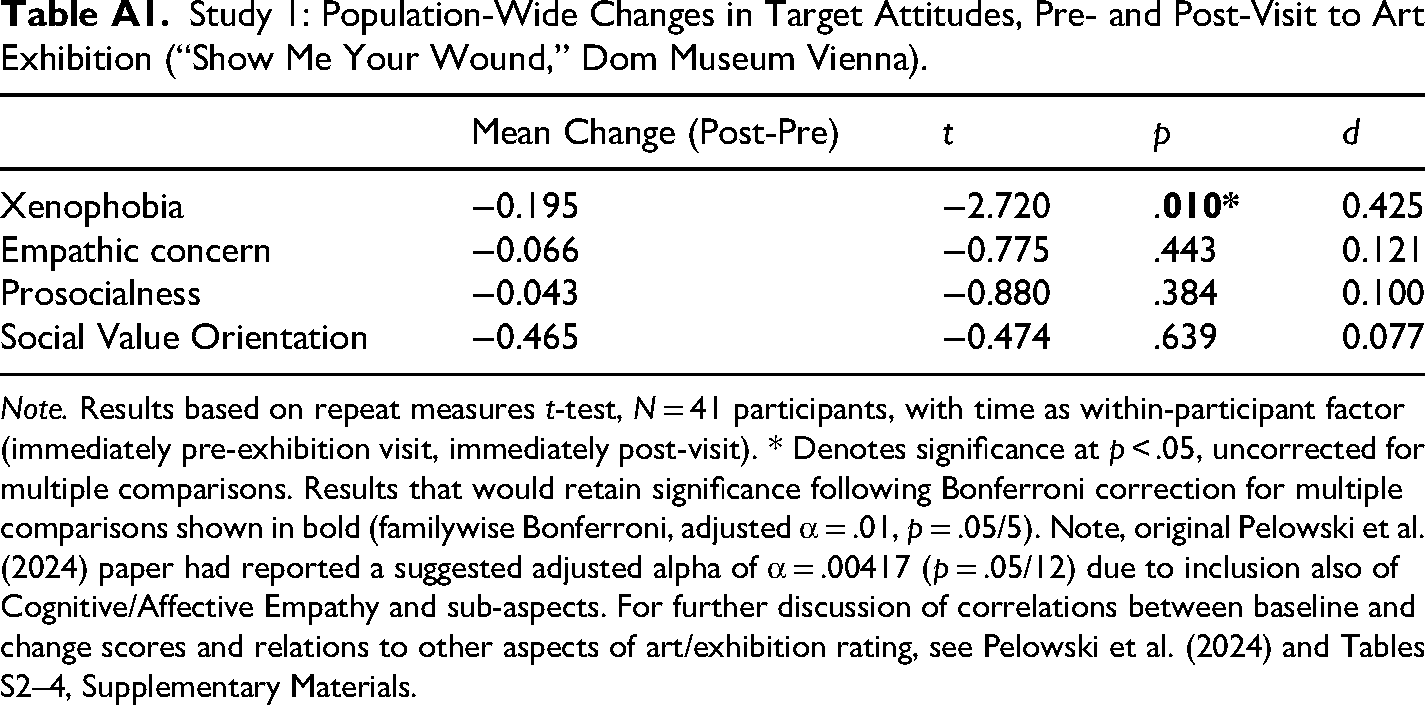
Mean Change (Post-Pre)
t
p
d
Xenophobia
−0.195
−2.720
.
0.425
Empathic concern
−0.066
−0.775
.443
0.121
Prosocialness
−0.043
−0.880
.384
0.100
Social Value Orientation
−0.465
−0.474
.639
0.077
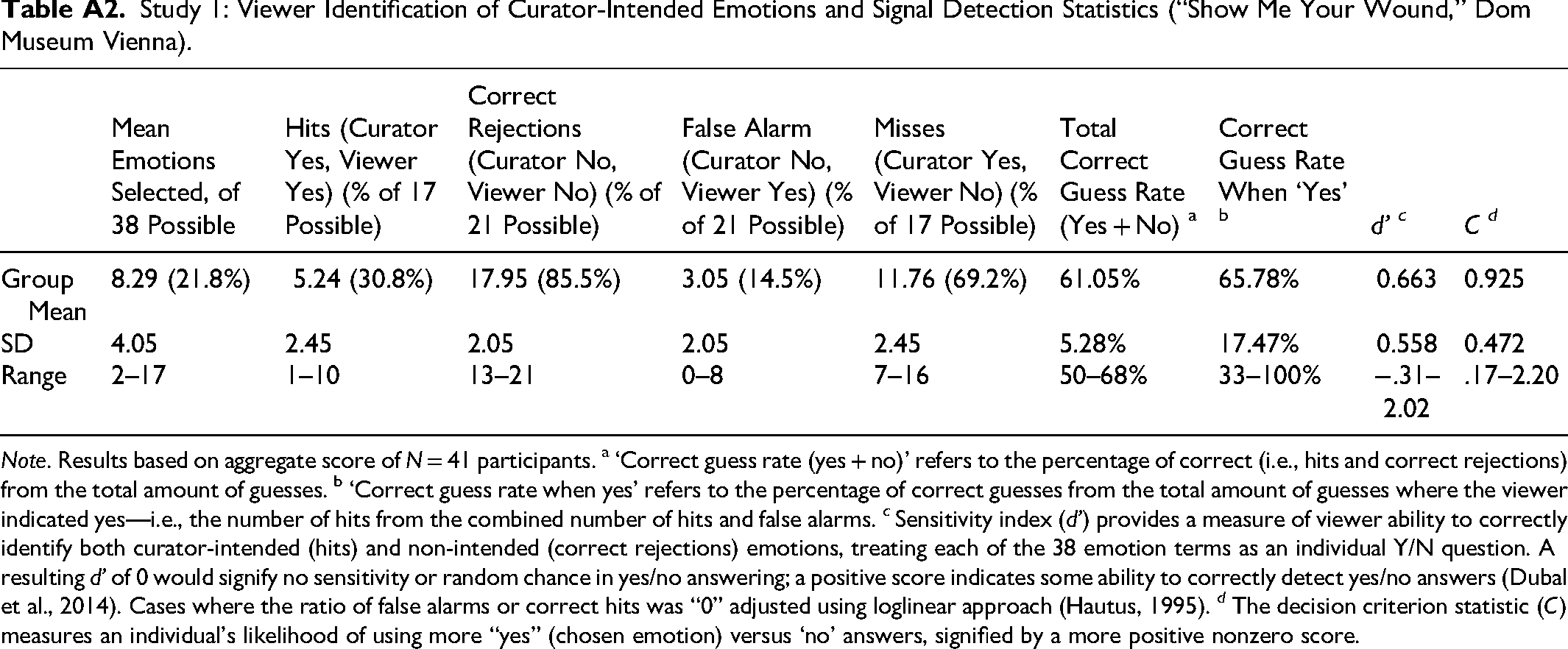
Mean Emotions Selected, of 38 Possible
Hits (Curator Yes, Viewer Yes) (% of 17 Possible)
Correct Rejections (Curator No, Viewer No) (% of 21 Possible)
False Alarm (Curator No, Viewer Yes) (% of 21 Possible)
Misses (Curator Yes, Viewer No) (% of 17 Possible)
Total Correct Guess Rate (Yes + No) a
Correct Guess Rate When ‘Yes’ b
d’ c
C d
Group Mean
8.29 (21.8%)
5.24 (30.8%)
17.95 (85.5%)
3.05 (14.5%)
11.76 (69.2%)
61.05%
65.78%
0.663
0.925
SD
4.05
2.45
2.05
2.05
2.45
5.28%
17.47%
0.558
0.472
Range
2–17
1–10
13–21
0–8
7–16
50–68%
33–100%
−.31–2.02
.17–2.20
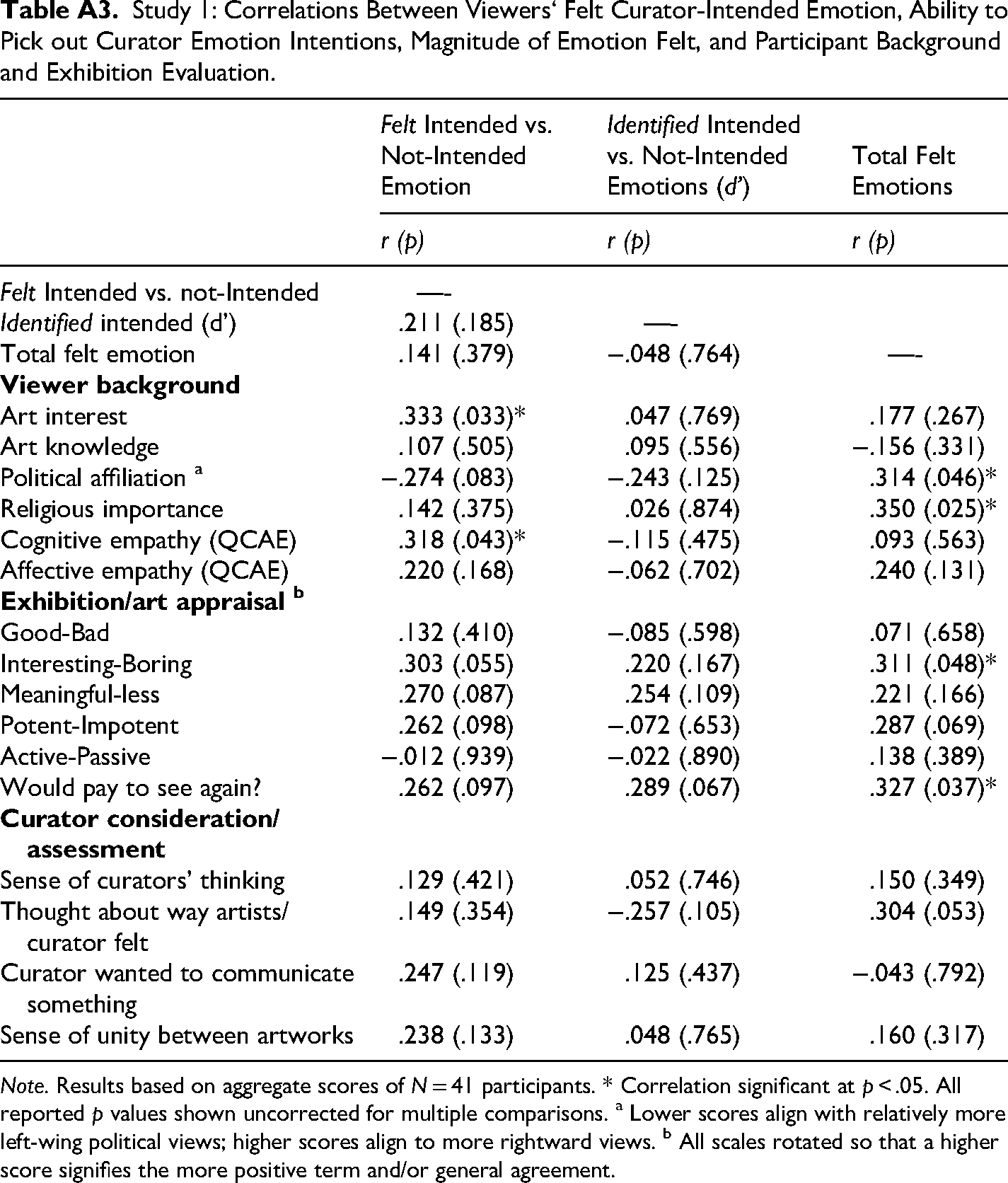
Felt Intended vs. Not-Intended Emotion
Identified Intended vs. Not-Intended Emotions (d’)
Total Felt Emotions
r (p)
r (p)
r (p)
Felt Intended vs. not-Intended
—-
Identified intended (d’)
.211 (.185)
—-
Total felt emotion
.141 (.379)
−.048 (.764)
—-
Art interest
.333 (.033)*
.047 (.769)
.177 (.267)
Art knowledge
.107 (.505)
.095 (.556)
−.156 (.331)
Political affiliation a
−.274 (.083)
−.243 (.125)
.314 (.046)*
Religious importance
.142 (.375)
.026 (.874)
.350 (.025)*
Cognitive empathy (QCAE)
.318 (.043)*
−.115 (.475)
.093 (.563)
Affective empathy (QCAE)
.220 (.168)
−.062 (.702)
.240 (.131)
Good-Bad
.132 (.410)
−.085 (.598)
.071 (.658)
Interesting-Boring
.303 (.055)
.220 (.167)
.311 (.048)*
Meaningful-less
.270 (.087)
.254 (.109)
.221 (.166)
Potent-Impotent
.262 (.098)
−.072 (.653)
.287 (.069)
Active-Passive
−.012 (.939)
−.022 (.890)
.138 (.389)
Would pay to see again?
.262 (.097)
.289 (.067)
.327 (.037)*
Sense of curators’ thinking
.129 (.421)
.052 (.746)
.150 (.349)
Thought about way artists/curator felt
.149 (.354)
−.257 (.105)
.304 (.053)
Curator wanted to communicate something
.247 (.119)
.125 (.437)
−.043 (.792)
Sense of unity between artworks
.238 (.133)
.048 (.765)
.160 (.317)
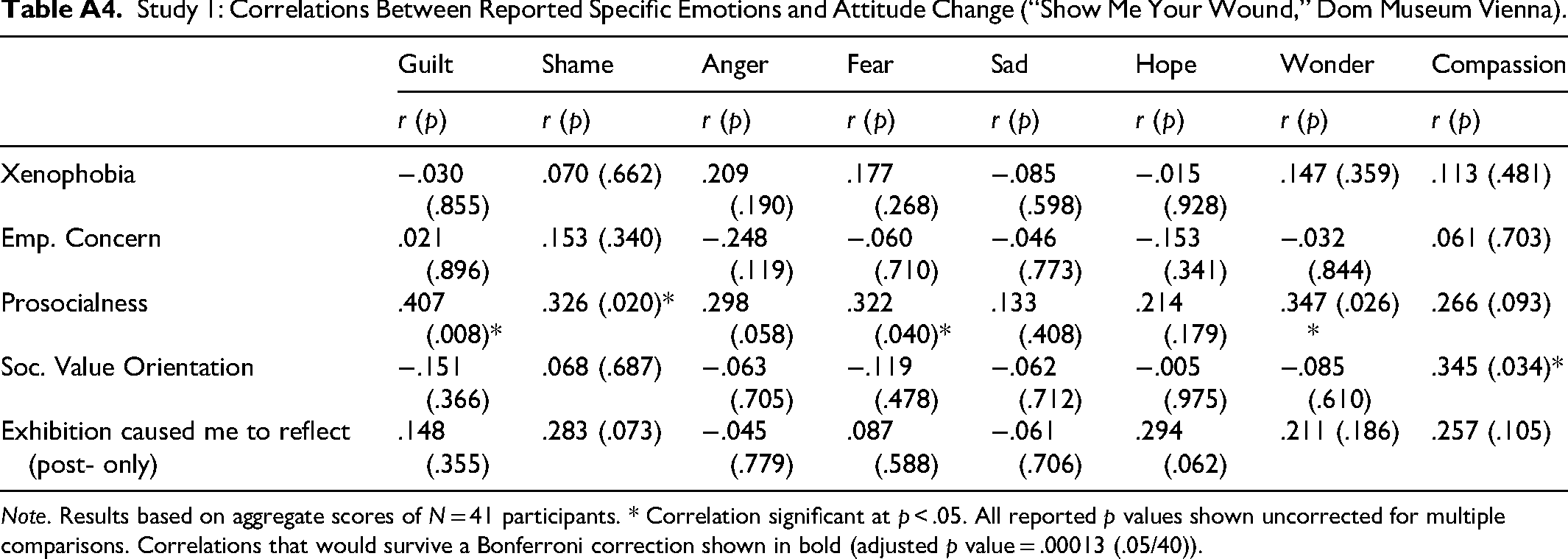
Guilt
Shame
Anger
Fear
Sad
Hope
Wonder
Compassion
r (p)
r (p)
r (p)
r (p)
r (p)
r (p)
r (p)
r (p)
Xenophobia
−.030 (.855)
.070 (.662)
.209 (.190)
.177 (.268)
−.085 (.598)
−.015 (.928)
.147 (.359)
.113 (.481)
Emp. Concern
.021 (.896)
.153 (.340)
−.248 (.119)
−.060 (.710)
−.046 (.773)
−.153 (.341)
−.032 (.844)
.061 (.703)
Prosocialness
.407 (.008)*
.326 (.020)*
.298 (.058)
.322 (.040)*
.133 (.408)
.214 (.179)
.347 (.026)*
.266 (.093)
Soc. Value Orientation
−.151 (.366)
.068 (.687)
−.063 (.705)
−.119 (.478)
−.062 (.712)
−.005 (.975)
−.085 (.610)
.345 (.034)*
Exhibition caused me to reflect (post- only)
.148 (.355)
.283 (.073)
−.045 (.779)
.087 (.588)
−.061 (.706)
.294 (.062)
.211 (.186)
.257 (.105)
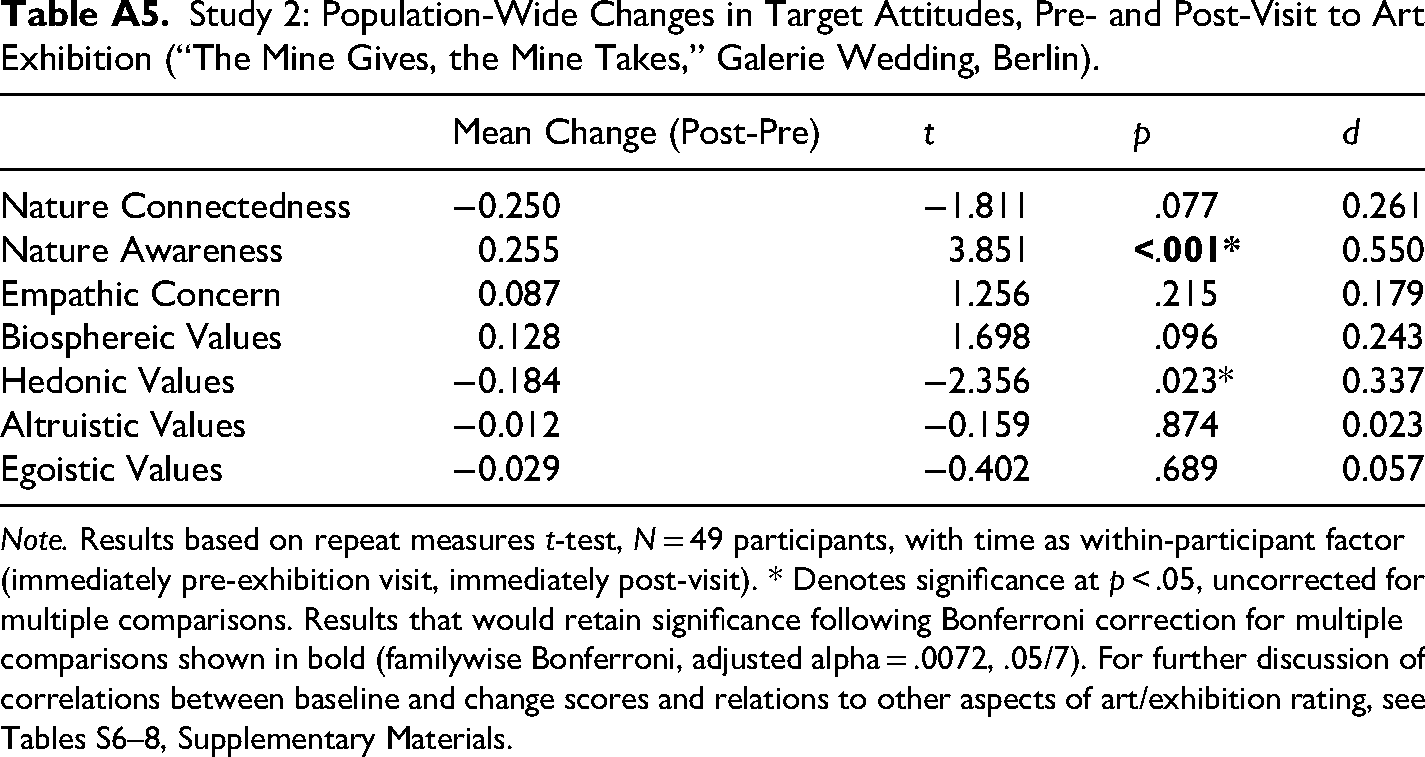
Mean Change (Post-Pre)
t
p
d
Nature Connectedness
−0.250
−1.811
.077
0.261
Nature Awareness
0.255
3.851
0.550
Empathic Concern
0.087
1.256
.215
0.179
Biosphereic Values
0.128
1.698
.096
0.243
Hedonic Values
−0.184
−2.356
.023*
0.337
Altruistic Values
−0.012
−0.159
.874
0.023
Egoistic Values
−0.029
−0.402
.689
0.057
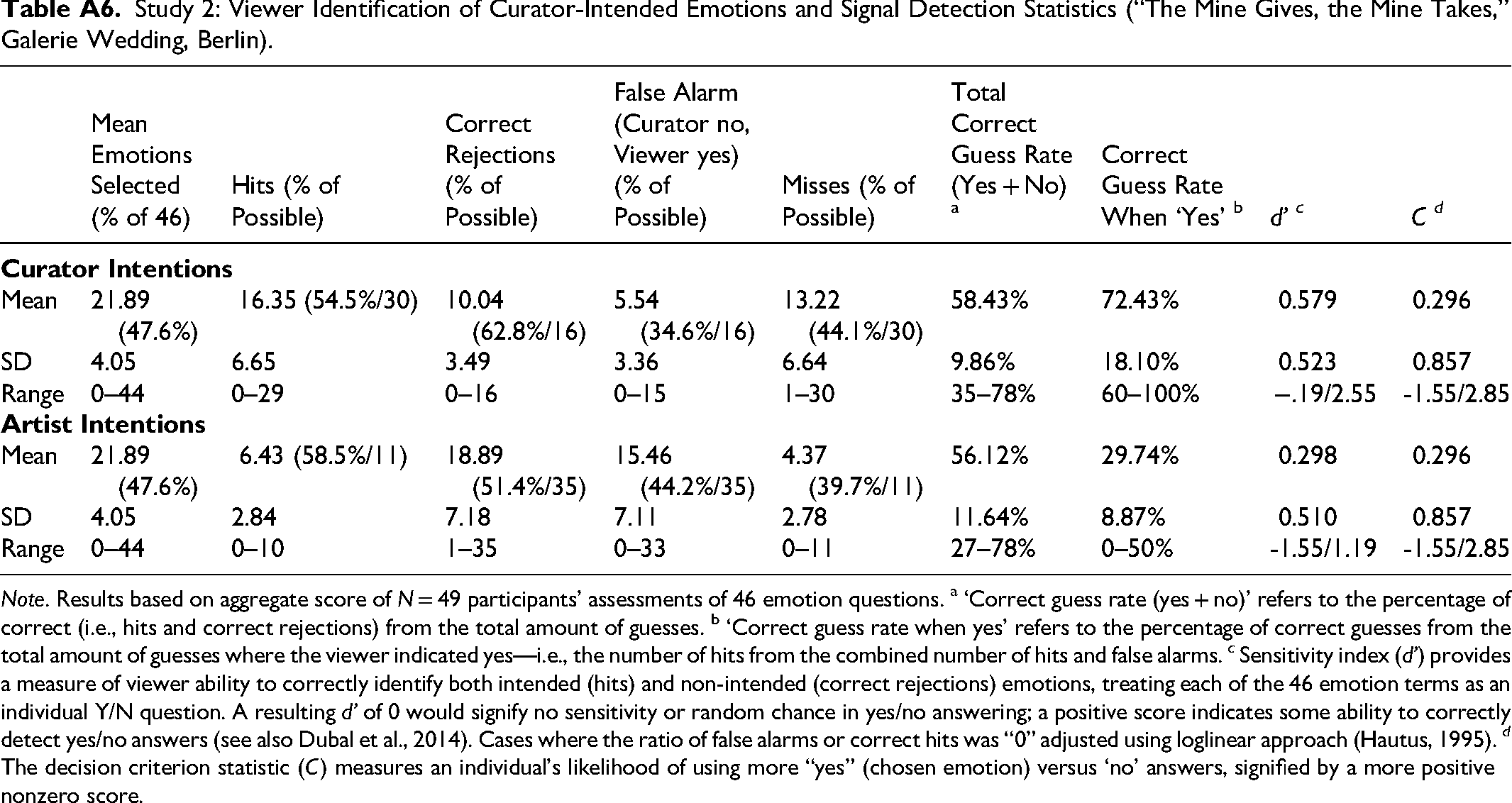
Mean Emotions Selected (% of 46)
Hits (% of Possible)
Correct Rejections (% of Possible)
False Alarm (Curator no, Viewer yes) (% of Possible)
Misses (% of Possible)
Total Correct Guess Rate (Yes + No) a
Correct Guess Rate When ‘Yes’ b
d’ c
C d
Mean
21.89
(47.6%)
16.35 (54.5%/30)
10.04 (62.8%/16)
5.54
(34.6%/16)
13.22 (44.1%/30)
58.43%
72.43%
0.579
0.296
SD
4.05
6.65
3.49
3.36
6.64
9.86%
18.10%
0.523
0.857
Range
0–44
0–29
0–16
0–15
1–30
35–78%
60–100%
−.19/2.55
-1.55/2.85
Mean
21.89
(47.6%)
6.43 (58.5%/11)
18.89 (51.4%/35)
15.46
(44.2%/35)
4.37
(39.7%/11)
56.12%
29.74%
0.298
0.296
SD
4.05
2.84
7.18
7.11
2.78
11.64%
8.87%
0.510
0.857
Range
0–44
0–10
1–35
0–33
0–11
27–78%
0–50%
-1.55/1.19
-1.55/2.85
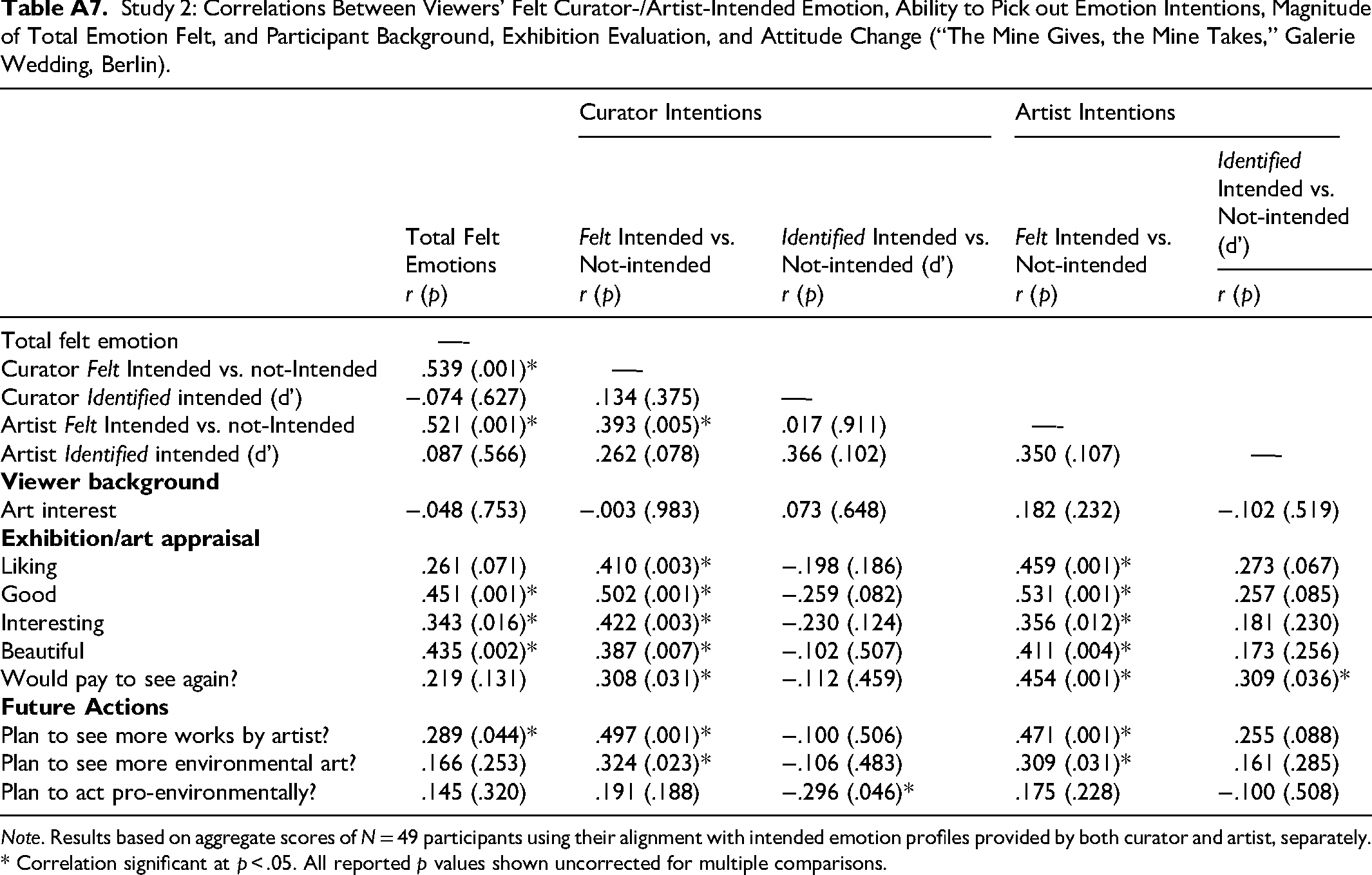
Curator Intentions
Artist Intentions
Total Felt Emotions
Felt Intended vs. Not-intended
Identified Intended vs. Not-intended (d’)
Felt Intended vs. Not-intended
Identified Intended vs. Not-intended (d’)
r (p)
r (p)
r (p)
r (p)
r (p)
Total felt emotion
—-
Curator Felt Intended vs. not-Intended
.539 (.001)*
—-
Curator Identified intended (d’)
−.074 (.627)
.134 (.375)
—-
Artist Felt Intended vs. not-Intended
.521 (.001)*
.393 (.005)*
.017 (.911)
—-
Artist Identified intended (d’)
.087 (.566)
.262 (.078)
.366 (.102)
.350 (.107)
—-
Art interest
−.048 (.753)
−.003 (.983)
.073 (.648)
.182 (.232)
−.102 (.519)
Liking
.261 (.071)
.410 (.003)*
−.198 (.186)
.459 (.001)*
.273 (.067)
Good
.451 (.001)*
.502 (.001)*
−.259 (.082)
.531 (.001)*
.257 (.085)
Interesting
.343 (.016)*
.422 (.003)*
−.230 (.124)
.356 (.012)*
.181 (.230)
Beautiful
.435 (.002)*
.387 (.007)*
−.102 (.507)
.411 (.004)*
.173 (.256)
Would pay to see again?
.219 (.131)
.308 (.031)*
−.112 (.459)
.454 (.001)*
.309 (.036)*
Plan to see more works by artist?
.289 (.044)*
.497 (.001)*
−.100 (.506)
.471 (.001)*
.255 (.088)
Plan to see more environmental art?
.166 (.253)
.324 (.023)*
−.106 (.483)
.309 (.031)*
.161 (.285)
Plan to act pro-environmentally?
.145 (.320)
.191 (.188)
−.296 (.046)*
.175 (.228)
−.100 (.508)
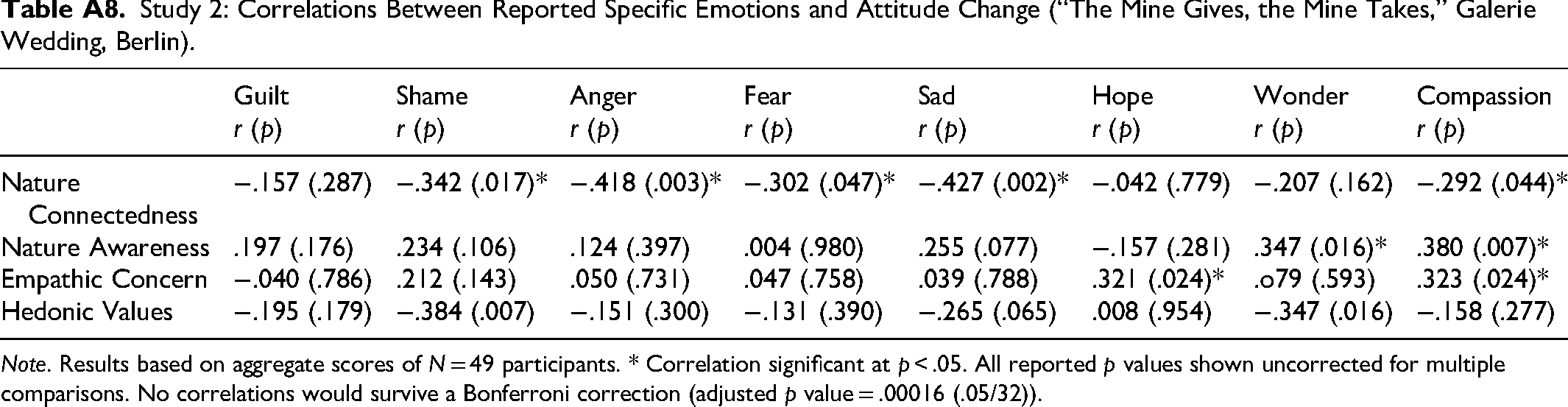
Guilt
Shame
Anger
Fear
Sad
Hope
Wonder
Compassion
r (p)
r (p)
r (p)
r (p)
r (p)
r (p)
r (p)
r (p)
Nature Connectedness
−.157 (.287)
−.342 (.017)*
−.418 (.003)*
−.302 (.047)*
−.427 (.002)*
−.042 (.779)
−.207 (.162)
−.292 (.044)*
Nature Awareness
.197 (.176)
.234 (.106)
.124 (.397)
.004 (.980)
.255 (.077)
−.157 (.281)
.347 (.016)*
.380 (.007)*
Empathic Concern
−.040 (.786)
.212 (.143)
.050 (.731)
.047 (.758)
.039 (.788)
.321 (.024)*
.o79 (.593)
.323 (.024)*
Hedonic Values
−.195 (.179)
−.384 (.007)
−.151 (.300)
−.131 (.390)
−.265 (.065)
.008 (.954)
−.347 (.016)
−.158 (.277)
References
Supplementary Material
Please find the following supplemental material available below.
For Open Access articles published under a Creative Commons License, all supplemental material carries the same license as the article it is associated with.
For non-Open Access articles published, all supplemental material carries a non-exclusive license, and permission requests for re-use of supplemental material or any part of supplemental material shall be sent directly to the copyright owner as specified in the copyright notice associated with the article.
